Performing the Urinalysis
Laboratory Procedures
Analyzing the Urine Sample
 A complete urinalysis usually involves
3 steps.
 1. Checking and recording the physical
characteristics of the urine
 2. Performing a chemical analysis using a
multi-test dipstick
 3. Centrifuging a small portion of the
sample and examining the sediment
under a microscope
1. Checking and recording the
physical properties of the urine
 Physical properties include:
 Color
 Transparency
 Odor
 Specific gravity
 Volume
2. Chemical Analysis
 Many chemical tests can be performed on a small
quantity of urine by using a dipstick
 Each pad on dipstick is designed to test for a
particular substance in the urine.
 When the urine comes in contacts with the reagents,
a chemical reaction will cause a color change based
on the amount of the substance in the urine.
 Color is compared to chart, and approximate amount
of substance in urine can be determined
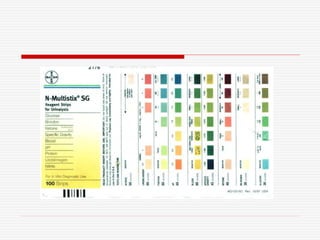
 Several brands of dipstick exist.
Chemical analysis
 Certain drugs and medications may
interfere with chemical tests.
 Be sure to know any medications
animal is currently receiving when
performing a urinalysis.
Components on the Dipstick
 Urine pH
 Protein
 Glucose
 Ketones
 Bilirubin
 Urobilinogen
 Blood
 Nitrites
Urine pH
 Number of how acidic or alkaline the urine is
 pH is affected by diet.
 Plant diets can cause alkaline urine
 High protein diets can cause acidic urine
 Small animal pH is usually acidic
 In general dog and cat urine pH is 6-7
 Large animal urine is usually alkaline
 Other factors may affect urine pH
 Fever
 Starvation
 Certain drugs
Protein
 Healthy animals will usually not have any
protein in their urine although in some
cases trace amounts can be found in
concentrated dog and cat urine.
 The urine protein level must be interpreted
along with the Urine specific gravity.
 Small amounts of protein are more
significant in dilute or unconcentrated
urine.
 Protein may be lost in the urine due to
glomerulopathies, inflammation, or
hemorrhage.
Glucose
 If the sugar in the blood is
significantly higher than normal,
some excess may be found in the
urine.
 Normal dog and cat urine should be
negative for glucose.
 In some cases if the urine is not run
immediately, false glucose readings
may occur.
Ketones
 Ketones are the substances formed in the
body during the breakdown of lipids.
 Normal pet urine should be negative for
ketones
 When excess amounts of ketones are
formed, their levels rise in the blood and
then are released in the urine.
 Can cause CNS depression and acidosis
 May result in ketonuria caused by:
 Starvation
 Diabetes
Bilirubin
 Pigment made by the liver from dead or
dying red blood cells.
 Small amounts may sometimes be found in
healthy dogs.
 Dogs can conjugate bilirubin in their kidneys, so
small amount may be insignificant.
 Bilirubin found in cat urine is a concern and
can be a sign of liver disease, bile duct
obstruction, or hemolysis.
Urobilinogen
 Compound formed from bilirubin by
intestinal tract.
 Normal dogs and cats have small amounts
of urobilinogen in their urine.
 Results from dipstick are not considered
very accurate and may be difficult to
interpret.
 Usually recorded as “normal” or
“abnormal”.
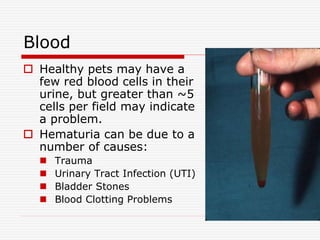
Blood
 Healthy pets may have a
few red blood cells in their
urine, but greater than ~5
cells per field may indicate
a problem.
 Hematuria can be due to a
number of causes:
 Trauma
 Urinary Tract Infection (UTI)
 Bladder Stones
 Blood Clotting Problems
Blood cells in the Urine
Nitrites
 May be produced by the bacteria
present in some infections
 Test often shows a “false negative”
and is considered inaccurate in pets.
 However, if positive, should examine
sediment closely for bacteria.
Examining Urine Sediment
 After urine sediment is centrifuged
(generally about 5 minutes), the top
portion of the liquid is poured off and the
sediment is resuspended and examined
microsopically.
 Indications for sediment exam include:
 Provides additional information
 A form of cytology
 Must be interpreted with other clinical data,
including physical and chemical composition of
the urine.
Urine Sediment Exam Procedure
 1. Collect urine in a clean container
 2. Throughly mix specimen and transfer 3-
5 ml volume to a centrifuge tube
 3. Centrifuge for 3-5 mins
 4. Pour off supernatant
 5. Leave approximately 0.5 ml of
supernatant
 6. Resuspend urine sediment by tapping
tube or flicking it w/ your finger.
 7. Examine a stained or unstained
sediment. (Or both!)
Potential Sediment Elements
 White blood cells
 Red blood cells
 Lipid droplets
 Bacteria
 Crystal
 Casts
White blood cells
 Larger than normal numbers of white
blood cells may indicate inflammation
from a bladder or kidney infection.
Lipid Droplets
 Are common in the sediment of urine,
especially in cats.
 Number and size may vary
 Should not be confused w/ air
bubbles or RBC’s. They will be in
focus when other structures are
not.
Bacteria
 Sediment is examined for presence of
bacteria
 Small amounts may be due to
contamination, large amounts may
indicate bladder infection (especially
if sample is obtained via
cystocentesis).
 A urine culture and sensitivity may
indicated with large amounts of
bacteria.
Crystals
 Made up of minerals and can
sometimes be found in the urine.
 Under certain conditions, crystals can
clump together to form bladder
stones (uroliths).
 The pH of the urine may influence the
type of crystal development
 Some animals and species are more
predisposed to crystal and stone
formation.
Common Crystal
Types
 Struvite
 Calcium Oxalate
 Ammonium Urate
Casts
(These will be covered in depth in Clin-Path!)
 Urine Casts are small cylinder-shaped formations of
cells and debris from inside the tubules of the kidneys
 Presence and composition of casts can indicate kidney
function
 Types of casts:
 Hyaline
 Granular
 Waxy
 Fatty
 Cellular
 Mixed
 Bile stained
Specific Gravity
 Measures the concentrating ability of the
kidney.
 Done with a refractometer
 There may be a spot on the dip-stick
for SG, however in animals, these are
not valid results.
Specific Gravity “normals” p. 158 Lab bk
 “Normal” values in dogs is between 1.001-1.060
 “Normal” values in cats can range from 1.001 – 1.080
 There is no set “normal” value in animals, however the
following guidelines should be used:
 SG: below 1.008 is said to indicate dilution (hyposthenuric)
 SG: 1.008-1.012 is said to be fixed or isosthenuric (same SG as
plasma)
 SG: 1.013 – 1.030 is considered normal if no dehydration
suspected.
 SG: above 1.025 implies renal tubule concentration ( in cats, this
can indicate renal disease)

Performing-the-Urinalysis.ppt

  • 1.
  • 2.
    Analyzing the UrineSample  A complete urinalysis usually involves 3 steps.  1. Checking and recording the physical characteristics of the urine  2. Performing a chemical analysis using a multi-test dipstick  3. Centrifuging a small portion of the sample and examining the sediment under a microscope
  • 3.
    1. Checking andrecording the physical properties of the urine  Physical properties include:  Color  Transparency  Odor  Specific gravity  Volume
  • 4.
    2. Chemical Analysis Many chemical tests can be performed on a small quantity of urine by using a dipstick  Each pad on dipstick is designed to test for a particular substance in the urine.  When the urine comes in contacts with the reagents, a chemical reaction will cause a color change based on the amount of the substance in the urine.  Color is compared to chart, and approximate amount of substance in urine can be determined
  • 5.
     Several brandsof dipstick exist.
  • 7.
    Chemical analysis  Certaindrugs and medications may interfere with chemical tests.  Be sure to know any medications animal is currently receiving when performing a urinalysis.
  • 8.
    Components on theDipstick  Urine pH  Protein  Glucose  Ketones  Bilirubin  Urobilinogen  Blood  Nitrites
  • 9.
    Urine pH  Numberof how acidic or alkaline the urine is  pH is affected by diet.  Plant diets can cause alkaline urine  High protein diets can cause acidic urine  Small animal pH is usually acidic  In general dog and cat urine pH is 6-7  Large animal urine is usually alkaline  Other factors may affect urine pH  Fever  Starvation  Certain drugs
  • 10.
    Protein  Healthy animalswill usually not have any protein in their urine although in some cases trace amounts can be found in concentrated dog and cat urine.  The urine protein level must be interpreted along with the Urine specific gravity.  Small amounts of protein are more significant in dilute or unconcentrated urine.  Protein may be lost in the urine due to glomerulopathies, inflammation, or hemorrhage.
  • 12.
    Glucose  If thesugar in the blood is significantly higher than normal, some excess may be found in the urine.  Normal dog and cat urine should be negative for glucose.  In some cases if the urine is not run immediately, false glucose readings may occur.
  • 13.
    Ketones  Ketones arethe substances formed in the body during the breakdown of lipids.  Normal pet urine should be negative for ketones  When excess amounts of ketones are formed, their levels rise in the blood and then are released in the urine.  Can cause CNS depression and acidosis  May result in ketonuria caused by:  Starvation  Diabetes
  • 14.
    Bilirubin  Pigment madeby the liver from dead or dying red blood cells.  Small amounts may sometimes be found in healthy dogs.  Dogs can conjugate bilirubin in their kidneys, so small amount may be insignificant.  Bilirubin found in cat urine is a concern and can be a sign of liver disease, bile duct obstruction, or hemolysis.
  • 15.
    Urobilinogen  Compound formedfrom bilirubin by intestinal tract.  Normal dogs and cats have small amounts of urobilinogen in their urine.  Results from dipstick are not considered very accurate and may be difficult to interpret.  Usually recorded as “normal” or “abnormal”.
  • 16.
    Blood  Healthy petsmay have a few red blood cells in their urine, but greater than ~5 cells per field may indicate a problem.  Hematuria can be due to a number of causes:  Trauma  Urinary Tract Infection (UTI)  Bladder Stones  Blood Clotting Problems
  • 17.
    Blood cells inthe Urine
  • 18.
    Nitrites  May beproduced by the bacteria present in some infections  Test often shows a “false negative” and is considered inaccurate in pets.  However, if positive, should examine sediment closely for bacteria.
  • 19.
    Examining Urine Sediment After urine sediment is centrifuged (generally about 5 minutes), the top portion of the liquid is poured off and the sediment is resuspended and examined microsopically.  Indications for sediment exam include:  Provides additional information  A form of cytology  Must be interpreted with other clinical data, including physical and chemical composition of the urine.
  • 20.
    Urine Sediment ExamProcedure  1. Collect urine in a clean container  2. Throughly mix specimen and transfer 3- 5 ml volume to a centrifuge tube  3. Centrifuge for 3-5 mins  4. Pour off supernatant  5. Leave approximately 0.5 ml of supernatant  6. Resuspend urine sediment by tapping tube or flicking it w/ your finger.  7. Examine a stained or unstained sediment. (Or both!)
  • 21.
    Potential Sediment Elements White blood cells  Red blood cells  Lipid droplets  Bacteria  Crystal  Casts
  • 22.
    White blood cells Larger than normal numbers of white blood cells may indicate inflammation from a bladder or kidney infection.
  • 23.
    Lipid Droplets  Arecommon in the sediment of urine, especially in cats.  Number and size may vary  Should not be confused w/ air bubbles or RBC’s. They will be in focus when other structures are not.
  • 24.
    Bacteria  Sediment isexamined for presence of bacteria  Small amounts may be due to contamination, large amounts may indicate bladder infection (especially if sample is obtained via cystocentesis).  A urine culture and sensitivity may indicated with large amounts of bacteria.
  • 26.
    Crystals  Made upof minerals and can sometimes be found in the urine.  Under certain conditions, crystals can clump together to form bladder stones (uroliths).  The pH of the urine may influence the type of crystal development  Some animals and species are more predisposed to crystal and stone formation.
  • 27.
    Common Crystal Types  Struvite Calcium Oxalate  Ammonium Urate
  • 28.
    Casts (These will becovered in depth in Clin-Path!)  Urine Casts are small cylinder-shaped formations of cells and debris from inside the tubules of the kidneys  Presence and composition of casts can indicate kidney function  Types of casts:  Hyaline  Granular  Waxy  Fatty  Cellular  Mixed  Bile stained
  • 29.
    Specific Gravity  Measuresthe concentrating ability of the kidney.  Done with a refractometer  There may be a spot on the dip-stick for SG, however in animals, these are not valid results.
  • 30.
    Specific Gravity “normals”p. 158 Lab bk  “Normal” values in dogs is between 1.001-1.060  “Normal” values in cats can range from 1.001 – 1.080  There is no set “normal” value in animals, however the following guidelines should be used:  SG: below 1.008 is said to indicate dilution (hyposthenuric)  SG: 1.008-1.012 is said to be fixed or isosthenuric (same SG as plasma)  SG: 1.013 – 1.030 is considered normal if no dehydration suspected.  SG: above 1.025 implies renal tubule concentration ( in cats, this can indicate renal disease)

Editor's Notes

  • #26 Bacteria in the form of rods and cocci