USM - ISPEAR
By the end of this lesson, you should learn:
The
Definition &
Elements of
Rhythm
Rhythmic
Activities
Rhythmic
Fundamental
s
• A term which denotes an aspect of a quality
of movement.
• It is a measured motion or flow characterized
by regular recurrence of elements such as
beats, sounds, accents and others.
• Every individual has rhythm. It is found
in all of nature and is natural to every
individual. When an individual moves in
response to a particular rhythm or
music we call the movements as
rhythmic movements or rhythms.
• Rhythm is most clearly seen through
dance- the art of movement.
Regular pattern of
sound and or movement
RHYTH
M
Structured forms which
start creative rhythmic
movements.
RHYTHMS
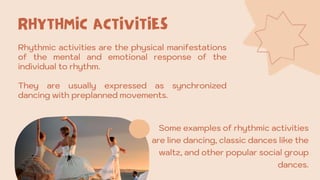
Some examples of rhythmic activities
are line dancing, classic dances like the
waltz, and other popular social group
dances.
Rhythmic activities are the physical manifestations
of the mental and emotional response of the
individual to rhythm.
They are usually expressed as synchronized
dancing with preplanned movements.
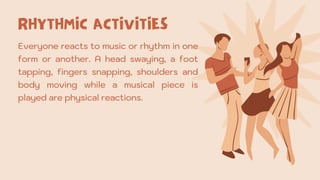
Everyone reacts to music or rhythm in one
form or another. A head swaying, a foot
tapping, fingers snapping, shoulders and
body moving while a musical piece is
played are physical reactions.
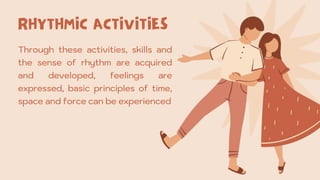
Through these activities, skills and
the sense of rhythm are acquired
and developed, feelings are
expressed, basic principles of time,
space and force can be experienced
In the field of dance, there are certain fundamental
knowledge and rhythmic skills considered
important for proficiency and efficiency in bodily
movements.
• BEAT - the underlying pulse of a rhythm.
The underlying pulse is the steady sound
which serves as the constant measure upon
which all rhythmic structure or relationship
depends. This beat determines the time
signature of a piece of music or movements.
2. TEMPO - The rate of speed of the
movements
3. INTENSITY - variation of stress of
movement. It refers to dynamics or force
such asheavy or light.
4. PITCH - lowness or highness of a tone.
5. ACCENT - emphasis on certain beats.
6. METER - the regular recurrence of
beats which divides a musical design into
measure.
7. PHRASE - measures grouped together.
This gives the feeling of unity. The end of
a phrase may suggest a change in
direction of movement.
8. BAR - in music a vertical line across a
staff dividing it into equal measures of
time.
9. COUNT - a pulse beat, a time limit.
10. NOTE - a printed symbol of a musical
tone.
11. MEASURE - a group of pulse beats.
12. NOTE PATTERN - refers to a note or
set of notes with or without rest used for
a certain dance step.
13. STEP PATTERN - refers to the
movement or movements done for each
of the dance steps.

Rhythmic Activities (Definition, Elements, Fundamentals).pptx

  • 1.
  • 2.
    By the endof this lesson, you should learn: The Definition & Elements of Rhythm Rhythmic Activities Rhythmic Fundamental s
  • 3.
    • A termwhich denotes an aspect of a quality of movement. • It is a measured motion or flow characterized by regular recurrence of elements such as beats, sounds, accents and others.
  • 4.
    • Every individualhas rhythm. It is found in all of nature and is natural to every individual. When an individual moves in response to a particular rhythm or music we call the movements as rhythmic movements or rhythms. • Rhythm is most clearly seen through dance- the art of movement.
  • 5.
    Regular pattern of soundand or movement RHYTH M Structured forms which start creative rhythmic movements. RHYTHMS
  • 6.
    Some examples ofrhythmic activities are line dancing, classic dances like the waltz, and other popular social group dances. Rhythmic activities are the physical manifestations of the mental and emotional response of the individual to rhythm. They are usually expressed as synchronized dancing with preplanned movements.
  • 7.
    Everyone reacts tomusic or rhythm in one form or another. A head swaying, a foot tapping, fingers snapping, shoulders and body moving while a musical piece is played are physical reactions.
  • 8.
    Through these activities,skills and the sense of rhythm are acquired and developed, feelings are expressed, basic principles of time, space and force can be experienced
  • 9.
    In the fieldof dance, there are certain fundamental knowledge and rhythmic skills considered important for proficiency and efficiency in bodily movements.
  • 10.
    • BEAT -the underlying pulse of a rhythm. The underlying pulse is the steady sound which serves as the constant measure upon which all rhythmic structure or relationship depends. This beat determines the time signature of a piece of music or movements.
  • 11.
    2. TEMPO -The rate of speed of the movements 3. INTENSITY - variation of stress of movement. It refers to dynamics or force such asheavy or light. 4. PITCH - lowness or highness of a tone.
  • 12.
    5. ACCENT -emphasis on certain beats. 6. METER - the regular recurrence of beats which divides a musical design into measure. 7. PHRASE - measures grouped together. This gives the feeling of unity. The end of a phrase may suggest a change in direction of movement.
  • 13.
    8. BAR -in music a vertical line across a staff dividing it into equal measures of time. 9. COUNT - a pulse beat, a time limit. 10. NOTE - a printed symbol of a musical tone. 11. MEASURE - a group of pulse beats.
  • 14.
    12. NOTE PATTERN- refers to a note or set of notes with or without rest used for a certain dance step. 13. STEP PATTERN - refers to the movement or movements done for each of the dance steps.