Business, Management and Economics Research
ISSN(e): 2412-1770, ISSN(p): 2413-855X
Vol. 4, Issue. 12, pp: 171-177, 2018
URL: https://arpgweb.com/journal/journal/8
DOI: https://doi.org/10.32861/bmer.412.171.177
Academic Research Publishing
Group
171
Original Research Open Access
Performance Ratio Analysis and Management Effectiveness
John Nkeobuna Nnah Ugoani
College of Management and Social Sciences, Rhema University, Aba, Nigeria
Abstract
Key performance ratios indicate the underlying level of performance and health of the enterprise. Therefore,
understanding the components of the final accounts and their performance ratios is important because of the crucial
nature of ROE. Even though PRA represents one of the best ways to compare the performance of a business and its
peers in the same industry it could be highly distorted due to taxation challenges, hidden gains or losses as well as
the issues of window-dressing. Generally, ratios look at the path an enterprise appears to be moving towards as well
as its recent performance and current financial situation so as to guide management actions with the aim of
enhancing ME. The exploratory research design was used for the study. There were 66 participants in the study and
data were collected from both primary and secondary sources. The multiple method of data generation made it
possible for data of the study to be compared and contrasted with each other. Data were analyzed through descriptive
and regression statistical methods. The result showed a strong positive correlation between PRA and ME. The study
was not exhaustive; therefore, further study could examine the relationship between PRA and Trade Debt in Nigeria
as a way of helping firms chart a way of meeting their debt obligations. On the basis of the result of this study it was
suggested that management of companies should institutionalize effective PRA mechanism adequate enough to track
performance at regular intervals.
Keywords: Window-dressing; Weak corporate governance; Comparative performance; Important business decisions;
Profitability.
CC BY: Creative Commons Attribution License 4.0
1. Introduction
A ratio is used to express the relationship between two quantities which is usually expressed by dividing the
magnitude of one quantity by that of the other. Management effectiveness reflects that management is working
toward the achievement of organizational goals, as may be shown by the levels of performance or profitability as
well as the satisfaction of stakeholders. Lucey (2001) opines that ratio analysis is the systematic production of ratios
from both internal and external financial reports so as to summarize key performance relationships and results in
order to appraise business performance. He postulates that ratio analysis as a practical means of monitoring and
improving business performance is greatly enhanced when they are prepared regularly and on a consistent basis so
that trends can be highlighted and any changes investigated. Ratios are prepared showing the inter-locking and the
inter-dependent nature of the factors which contribute to financial and business success. According to Lucey (2001)
typically, this is done using the traditional pyramid of ratios that direct attention to areas where there are
inefficiencies because management effectiveness requires a high dose of active management. Even though this
provides a valuable service, but it does not show how the deficiencies will be reversed, and the major import means
that managerial action is invited to such areas of inefficiency. Performance Ratio Analysis (PRA) is increasingly
employed by management to compare and contrast the basis, levels, and reasons of management effectiveness (ME)
or otherwise. PRA is used frequently in balance sheet analysis of a company because reading a company’s financial
statements give stakeholders and the public some understanding of what the business does, what the numbers in the
financial statements indicate, and to some degree, how they have been manipulated. According to Barltrop and
McNaughton (1997) the absolute numbers are most likely to yield immediate insight only in extreme cases, for
example, if the company is showing negative equity ratio, it becomes pretty clear that the enterprise is insolvent, and
thus is in a deep financial difficulty. Investors rely in most cases on PRA through a look at the composition of the
balance sheet or the profit and loss statement and the related composition and performance ratios to make investment
decisions. The numbers will determine whether there are no obvious disparities or that the relationship between
some numbers looks suspicious and requires closer, further analysis and discussion with top management. Among
the most important data to look at are the company’s comparative performance against peers or competitors in its
own data over a certain period of time. Almost as a universal standard, PRA focuses on capital adequacy (CA), asset
and liability ratio (ALR), return on assets (ROA), return on equity (ROE) Return on Investment (ROI) as well as
other measures like measures of operating efficiency, and staffing efficiency of the enterprise. Barltrop and
McNaughton (1997) emphasize that the best way to bring out the comparative performance of the enterprise is to
reduce the numbers down to ratios that allow direct comparison between competitions in the same market space to
explore the key ratios that indicate the underlying level of performance and health of the enterprise. To maximize the
inherent benefits of PRA to management, the exercise would require a good understanding of the balance sheet
figures and the components of the statement of profit and loss of the company. Understanding the components of the
final accounts and their performance ratios is necessary because of the crucial nature of ROE. Shareholders equity is
the owners claim on the assets of a company, which is generally composed of contributed capital and retained
Business, Management and Economics Research
172
earnings. The relationship of these components to some extent reveals the quality of management (Ekwerike, 1998);
(Monwuba, 1995). PRA provides management with critical information necessary to drive market leadership and
also assists management in understanding any differences in operations and be able better to define the most
effective combination of resources as a business strategy to enhance ME. Regardless of the area of focus and with
regard to the growing wave of market globalization, it is safe to guess that PRA is an effective business operational
tool that results in an alignment between strategy and major process dimensions that enhances business performance
(Bodie et al., 1996; Chase, 2001; Helfert, 1997; Johnson and Kaplan, 1987). Businesses rely on performance
evaluation and PRA to track ME. Lucey (2001) argues that ratios help management to plan, control or make
important business decisions. Ratio analysis can be directed towards various aspects of business performance such as
financial performance, in terms of profitability, return on capital employed, current assets and current liabilities as
well as ROE and ROI. It can be emphasized that lists of assets each of them contributes to performance without
PRA. Also, PRA is an essential ingredient in management finance or financial management which enhances ME
Brisham and Ehrhardt (2014).
1.2. Statement of the Problem
Even though PRA represents one of the best ways to compare the performance of a business and other
institutions, it could be highly distorted due to taxation challenges, hidden gains or losses, fraudulent accounting and
auditing processes, among other nondisclosure problems. Hidden taxation can take many forms including
understatement and total avoidance that frustrate the actual picture of profits or losses. Sometimes balance sheet
figures are manipulated with active collaboration of external auditors to the extent that the actual performance result
is not presented to stakeholders and the public. Lack of good understanding of the components of the final accounts
as well as managerial incompetence pose serious challenges to the efficacy of PRA. Audit failures are costly to
investors as they impair the quality of PRA, and even the auditors themselves and the society as a whole. For
examples, the Cadbury accounting and auditing scandal in Nigeria and the collapse of Enron, in the USA where not
foreseen by the respective PRA of the period before the bubble has burst. Also fraud related transactions, among
others impair PRA and ME. Issues of window-dressing, weak corporate governance, and unethical managerial
practices dilute the power of PRA in enhancing ME in Nigeria (Adeyemi and Akinmiyi, 2011; Babalola, 2013;
Muriana and Ahunanya, 2010; Okaro and Okafor, 2013; Skinner and Srinivasan, 2010).
1.3. Objective of the Study
The study was designed to examine the impact of PRA on ME.
1.4. Significance of the Study
The study will enable managers, students and the public renew interest in the imperatives of PRA and ME in
Nigeria.
1.5. Research Questions
i. Is ROE ratio necessary in checking ME?
ii. Do you think ROA ratio is needed to evaluate business performance?
iii. What is the relevance of the measures of operating efficiency?
iv. Can capital inadequacy affect enterprise performance?
v. Is it connect to state that staff efficiency contributes to ME?
1.6. Hypothesis
Ho: There is no relationship between PRA and ME
Hi: There is a relationship between PRA and ME.
2. Literature Review
PRA analysis requires consistency in balance sheet and profit and loss statements. Comparisons will not be
comprehensive and objective if distortions exist in the final accounts of the company. Off balance sheet activities
like provisions and revelation of assets, fraudulent accounting and auditing practices distort PRA and weakens ME
in many respects (Johnson and Kaplan, 1987; Solanke, 2007), Barltrop and McNaughton (1997) suggest that ratios
that indicate a significant divergence from the peer comparison base and trend lines that point away from the peer
average should be a cause for concern and the basis for discussion with top management of the company. Effective
PRA should be based on accurate data and consistent format to calculate key ratios. The ideal or traditional approach
will be to compare these ratios with those of similar institutions to establish the relative condition and performance
of the company compared to its peers and to see whether it is improving or deteriorating. The focus will then be to
pick the factors that are material and to use them to gain an understanding of how management is performing. PRA
is useful in management control, which is the process by which management ensures that resources are used
efficiently and effectively in the accomplishment of organizational objectives (Omolehinwa, 2002).
2.1. Key Performance Ratios
Barltrop and McNaughton postulate that business performance ratios are affected by the market conditions in
which the enterprise operates, including macrofinancial policies, government regulations regarding the process of
Business, Management and Economics Research
173
doing business, accounting and auditing standards, competition as well as prevailing business practices. Even though
there are no universally acceptable standard ratios to monitor ME, the measures of profitability, operating efficiency
and staffing efficiency are recognized to be among the important measures of ME. The two most important measures
of enterprise profitability are: ROA and ROE. ROA relates operating profits to total resources under management
control. This ratio is seen by many to be the best single ratio for evaluating the performance of management. This
ratio is expressed as net income after tax x 100 over average total assets. ROE measures the return on shareholders
equity. This ratio is significant to assure significant shareholders of the status of their equity in the business. This
important ratio is expressed as net income after tax x 100 over average equity capital. Barltrop and McNaughton
(1997) state that staffing efficiency is a major component of operating efficiency, and that staff productivity is
crucial to ME. They believe that excessive restrictions on salary levels can lead to a decline in the quality and
motivation of the staff thus actually reducing the efficiency of the enterprise over the longer term. Net income per
staff is expressed as net income after tax over total staff count. The Net Income per staff ratio measures the average
income generated by each staff member. For ME, the net income to staff expenses is also calculated and this is
expressed as net income after tax over staff express. This ratio is significant as it measures ROI in staffing costs.
Barltrop and McNaughton (1997) opine that this ratio is probably a better measure than net income per staff ratio
since it enables institutions of a different type to be compared to some degrees. It takes a closer look at the net effect
of staffing decisions, regardless of whether these emphasize low cost, low expertise, junior staff or high cost, high
managers and professionals. Even though there is no minimum capital adequacy ratio set for industrial operations by
the regulators like in the banking industry, sound management and operating efficiency in a competitive market
require that companies should maintain an acceptable capital to asset ratio so as to continue to be viable in a
changing regulatory, economic, global or competitive business environment. In addition to understanding and
improving on the efficacy of key performance ratios (KPRs). Success in the global market of the 21st
century and
beyond hinges to a high degree of human motivation since the human being controls all the other critical factors of
production (Mohammed et al., 2013).
2.2. Empirical Review
Key financial ratios are used to determine the strengths and weaknesses of management activity by the method
of PRA. PRA is a quantitative technique used to enhance management decisions (Ayandele, 2005; Ikon, 2004).
According to Nzotta (2002) ratio analysis constitutes a major tool in the enterprise. It essentially involves reducing
the magnitude of information on the statement of accounts of an enterprise by either eliminating, reclassifying
combining or rearranging them in a better format. They are a shortcut method of conveying crucial facts about an
entity’s operations and financial situation to any interested party. He insists that ratios could also be described as the
relationship between two accounting figures expressed mathematically. Ratios point out relationships, which may
not be obvious from available raw data and could equally show elements associated with successful and unsuccessful
enterprise performance. Ratios essentially look at the path an enterprise appears to be moving towards as well as its
recent performance and current financial situation (Hoel, 1984). According to Adedeji (2014) PRA is useful to
assess past performance of the enterprise, the current position and the future potential and related risks of the
business. They state that critical data for PRA usually come from published Annual Reports of the business,
management reports and government reports such as the report for the regulatory agencies. Dansby and Lawrence
(2000) define a ratio as a fractional relationship of one number to another. Lucey (2001) defines ratio analysis as a
technique of financial analysis in which meaningful relationship is shown between the components of financial
statements. He emphasizes that a ratio is often expressed proportionately to show the relationship between figures in
the financial statements. Ratios are useful guides for evaluating management activity. Lasher (1997) opines that
ratios are most meaningful when used in comparison, because one measure alone does not tell the whole truth about
a company and one measure should never be the sole basis for a financial or management decision. Therefore, for
effective management decision-making KPRs such as ROA, ROE, ROI, return on sales (ROS) among others are
used (Dansby and Lawrence, 2000). Hossan and Habib (2010) state that various performance ratios are employed by
management to enhance its efficacy. Among them are liquidity ratios, assets management ratios, and market value
ratios that are often used to compare the performance between two periods or two companies in the same industry.
Liquidity ratio conveys the ability of the company to repay debts and the level of total cash. Asset management ratio
reveals how effectively management is putting its assets into use. The current ratio deals with the relationship
between the current assets and current liabilities of the entity. They explain that the profitability ratio is used to
assess how well an enterprise is performing by analyzing how profit was earned in relation to sales, total assets
employed vis-à-vis the networth of the company (Lucey, 2001). Adedeji (2014) opines that ratio analysis is a method
used by financial managers and investors alike to compare a company financial structure conditions and
performances with standards prevailing in such industry for the purpose of high lighting improvement or
deterioration in the trend of the business performance.
3. Methodology
3.1. Research Design
The exploratory research design was employed for the study. This type of design can involve either the
quantitative or qualitative techniques, or both. This approach was most appropriate for this study as it gave the
investigator the opportunity to explore issues of the study from multiple sources of data, including personal
Business, Management and Economics Research
174
experience, case analysis, observations, interviews, and public documents. This design is historical in nature and
does not usually require a large sample or a structured questionnaire (Brannen, 2005).
3.2. Sources of Data
Data for the study were collected through secondary and primary sources. Secondary data are information that
has been previously obtained for some other purposes other than the research project at hand, while primary data are
information gathered and assembled specifically for the research objectives at hand (Aaker et al., 2004).
3.3. Population, Sample and Size of the Study
The population of the study comprised of the people in Nigeria. The sample was selected by the purposive
method while the sample size was determined by the sample ratio concept (Obodoeze, 1996).
3.4. Area of the Study
The study was carried out in South-East Nigeria comprising of 5 states out of the 36 states and the Federal
Capital Territory (FCT) in Nigeria. It is believed that the opinion of the people in the South-East Zone will
adequately represent the opinion of the people in Nigeria (Ezejelue and Nkemnebe, 2018).
3.5. Decision Rule
The mean out-off point for the analysis of responses to the research questions of this study was at 3 points. This
method is appropriate to answer research questions (Nwankwo, 2011).
3.6. Data Analysis
Data were analyzed through descriptive and regression statistical techniques, and result presented in tables
(Nworuh, 2004).
4. Presentation of Result
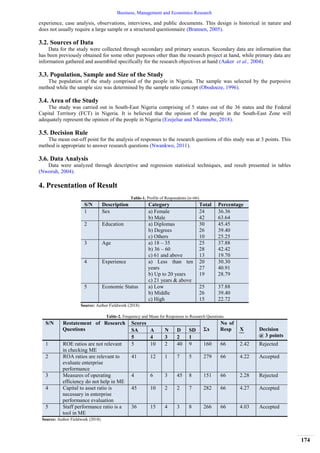
Table-1. Profile of Respondents (n=66)
S/N Description Category Total Percentage
1 Sex a) Female
b) Male
24
42
36.36
63.64
2 Education a) Diplomas
b) Degrees
c) Others
30
26
10
45.45
39.40
25.25
3 Age a) 18 – 35
b) 36 – 60
c) 61 and above
25
28
13
37.88
42.42
19.70
4 Experience a) Less than ten
years
b) Up to 20 years
c) 21 years & above
20
27
19
30.30
40.91
28.79
5 Economic Status a) Low
b) Middle
c) High
25
26
15
37.88
39.40
22.72
Source: Author Fieldwork (2018)
Table-2. Frequency and Mean for Responses to Research Questions
S/N Restatement of Research
Questions
Scores
Ʃx
No of
Resp X Decision
@ 3 points
SA A N D SD
5 4 3 2 1
1 ROE ratios are not relevant
in checking ME
5 10 2 40 9 160 66 2.42 Rejected
2 ROA ratios are relevant to
evaluate enterprise
performance
41 12 1 7 5 279 66 4.22 Accepted
3 Measures of operating
efficiency do not help in ME
4 6 3 45 8 151 66 2.28 Rejected
4 Capital to asset ratio is
necessary in enterprise
performance evaluation
45 10 2 2 7 282 66 4.27 Accepted
5 Staff performance ratio is a
tool in ME
36 15 4 3 8 266 66 4.03 Accepted
Source: Author Fieldwork (2018)
Business, Management and Economics Research
175
4.1. Model Specification
To achieve the objectives of this study and test the hypothesis the following regression model was developed to
capture the causality relationship between PRA and ME.
ME = F (PPT) ………………………………………….. Functional form
ME = b0 + b1 PRA + U ………………………………… Mathematical form
Where
ME = Management Effectiveness
PRA = Performance Ratio Analysis
b0 = Constant term
b1 = Coefficient attached to explanatory variable
U = disturbance term.
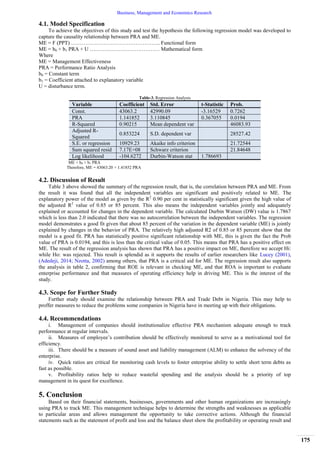
Table-3. Regression Analysis
Variable Coefficient Std. Error t-Statistic Prob.
Const. 43063.2 42990.09 -3.16529 0.7262
PRA 1.141852 3.110845 0.367055 0.0194
R-Squared 0.90215 Mean dependent var 46083.93
Adjusted R-
Squared
0.853224 S.D. dependent var 28527.42
S.E. or regression 10929.23 Akaike info criterion 21.72544
Sum squared resid 7.17E+08 Schwarz criterion 21.84648
Log likelihood -104.6272 Durbin-Watson stat 1.786693
ME = b0 + b1 PRA
Therefore, ME = 43063.20 + 1.41852 PRA
4.2. Discussion of Result
Table 3 above showed the summary of the regression result, that is, the correlation between PRA and ME. From
the result it was found that all the independent variables are significant and positively related to ME. The
explanatory power of the model as given by the R2
0.90 per cent in statistically significant given the high value of
the adjusted R2
value of 0.85 or 85 percent. This also means the independent variables jointly and adequately
explained or accounted for changes in the dependent variable. The calculated Durbin Watson (DW) value is 1.7867
which is less than 2.0 indicated that there was no autocorrelation between the independent variables. The regression
model demonstrates a good fit given that about 85 percent of the variation in the dependent variable (ME) is jointly
explained by changes in the behavior of PRA. The relatively high adjusted R2 of 0.85 or 85 percent show that the
model is a good fit. PRA has statistically positive significant relationship with ME, this is given the fact the Prob
value of PRA is 0.0194, and this is less than the critical value of 0.05. This means that PRA has a positive effect on
ME. The result of the regression analysis has shown that PRA has a positive impact on ME, therefore we accept Hi:
while Ho: was rejected. This result is splendid as it supports the results of earlier researchers like Lucey (2001),
(Adedeji, 2014; Nzotta, 2002) among others, that PRA is a critical aid for ME. The regression result also supports
the analysis in table 2, confirming that ROE is relevant in checking ME, and that ROA is important to evaluate
enterprise performance and that measures of operating efficiency help in driving ME. This is the interest of the
study.
4.3. Scope for Further Study
Further study should examine the relationship between PRA and Trade Debt in Nigeria. This may help to
proffer measures to reduce the problems some companies in Nigeria have in meeting up with their obligations.
4.4. Recommendations
i. Management of companies should institutionalize effective PRA mechanism adequate enough to track
performance at regular intervals.
ii. Measures of employee’s contribution should be effectively monitored to serve as a motivational tool for
efficiency.
iii. There should be a measure of sound asset and liability management (ALM) to enhance the solvency of the
enterprise.
iv. Quick ratios are critical for monitoring cash levels to foster enterprise ability to settle short term debts as
fast as possible.
v. Profitability ratios help to reduce wasteful spending and the analysis should be a priority of top
management in its quest for excellence.
5. Conclusion
Based on their financial statements, businesses, governments and other human organizations are increasingly
using PRA to track ME. This management technique helps to determine the strengths and weaknesses as applicable
to particular areas and allows management the opportunity to take corrective actions. Although the financial
statements such as the statement of profit and loss and the balance sheet show the profitability or operating result and
Business, Management and Economics Research
176
solvency or general financial position of the business the available information must be related to the various items
of the financial statements in order to be meaningful and used for management decision-making. Because of the
summarized nature of financial statements, some basic truths are hidden in them. Therefore, using KPRs helps to
determine the actual ROA, ROE, ROI, ROS, among others, and to be compared with other relevant figures to
strengthen management decision-making and ME. PRA is about the most powerful tool used in analyzing and
interpreting financial and management reports to enhance informed judgment. The qualitative and quantitative
techniques of the exploratory research design were employed for the study to determine the relationship between
PRA and ME in Nigeria. Based on relevant literature review, and critical statistical analysis, the study found a
positive relationship between PRA and ME in Nigeria. The result supports the findings of earlier scholars like Lucey
(2001) that ratio analysis can be directed towards various aspects of enterprise performance with the aim of
enhancing ME. The result also supports the evidence by Nzotta (2002) that ratio analysis enables management and
stakeholders to get a clearer picture of enterprise performance based on informed judgment, and decisions about the
past performance, present condition and the potentials of the business.
References
Aaker, D. A., Day, G. S. and Kumar, V. (2004). Marketing Research. 8th edn: N.J. John Wiley and Sons: Hobokey.
Adedeji, E. A. (2014). A Tool for measuring Organizational Performance using Ratio Analysis Research. Journal of
Finance and Accounting, 5(19): 48-22.
Adeyemi, S. B. and Akinmiyi, K. O. (2011). Stakeholders Perception of the Independence of Statutory auditors in
Nigeria. Serbian, Journal of Management, 6(2): 247 – 67.
Ayandele, I. A. (2005). Quantitative techniques for managerial decisions. Ugo, Cle-Print Publishers: Lagos.
Babalola, Y. A. (2013). Corporate audit committees and risk controlling in Nigeria. European Journal of Business
and Management, 5(12): 111-20.
Barltrop, C. J. and McNaughton, D. (1997). Financial analysis. In C. J. Barltrop and D. Mcnaughton, (EDS)
banking institutions in developing markets. Interpreting Financial Statements: The World Bank,
Washington, D. C.: 4-20.
Bodie, Z., Kane, A. and Marcus, A. (1996). Investments. 3rd edn: Richard D Irwin: Burv Ridge, IL.
Brannen, J. (2005). Mixing method, The entry of qualitative and quantitative approaches into the research process.
International Journal of Social Research Methodology, 8(3): 173-84.
Brisham, E. F. and Ehrhardt, M. C. (2014). Financial Management. Theory and Practice. 14th edition USA, South-
Western Cengage Learning.
Chase, R. B. (2001). Financial analysis: In R. B. Chase, N. J. Aquilano and F. R jacobs (EDS). For comparative
advantage. McGraw-Hill, Irwin: New York.
Dansby, R. I. K. B. S. and Lawrence, M. D. (2000). Paradigm College Accounting. 4th edn: M. N. Paradigm
Publishing In:
Ekwerike, M. F. (1998). Accounting theory & consolidated balance sheets, An instructional manual for professional,
Post-graduate and undergraduate students. Maxey Consultants, Ltd: Owerri.
Ezejelue, A. O. E. O. and Nkemnebe, A. (2018). Basic principles in managing research projects. 2nd edn:
Education Books Ltd: Port Harcourt.
Helfert, E. (1997). Techniques of financial analysis. A modern approach. 9th edn: Burv Ridge IL: Irwin.
Hoel, P. G. (1984). Introduction to mathematical statistics. 4th edn: John Wiley and Sons: New York.
Hossan, F. and Habib, M. A. (2010). Performance evaluation and ratio analysis of pharmaceutical company in
Bangladesh. Master’s thesis in international business 15 ects. Department of economic and informatics.
University west, Spring term.
Ikon, M. A. (2004). An introduction to business in the Nigerian environment. Onitsha Nigeria Publishers.
Johnson, T. and Kaplan, R. (1987). Relevance lost, The rise and fall of management accounting. Harvard Business
School Press: Boston.
Lasher, W. R. (1997). Advanced Financial Accounting. 5th edn, `: Pitman Publishing Co: London.
Lucey, T. (2001). Ratio analysis. In T. Lucey, management accounting. ELST: London.
Mohammed, S. H., Mohammed, A., Saiful, I. T. and Ubeda, S. S. (2013). Employee motivation in the non-
governmental financing companies of Bangladesh. European Journal of Business and Management, 5(12):
121-30.
Monwuba, A. O. (1995). Management Accounting. IBS Press Nigeria: Enugu.
Muriana, A. O. E. and Ahunanya, S. (2010). Transparency in corporate governance, A comparative study of enron,
USA, And cadbury plc, Nigeria. Medwell Journals, 5(6): 471-76.
Nwankwo, O. C. (2011). A Practical Guide To Research Writing for Students of Research Enterprise. Port-Harcourt
Pam Unique Publishers: Nwankwo.
Nworuh, G. E. (2004). Basic research methodology for researchers, Trainees and trainers in management sciences.
2nd edn: Ambix Printers Nigeria: Owerri.
Nzotta, S. M. (2002). Corporate financial decisions. Olliverson Industrial Publishers: Owerri.
Obodoeze, F. O. (1996). Modern textbook of research methodology. Enugu Academic Publishing Company.
Okaro, S. C. and Okafor, G. O. (2013). Drivers of audit failure in nigeria – evidence from cadbury (Nigeria) plc.
Research Journal of Finance and Accounting, 4(6): 14-17.
Omolehinwa, A. (2002). Work out management accounting notes and worked examples. 2nd edn: Pan of Publishing,
Inc: Lagos.
Business, Management and Economics Research
177
Skinner, D. and Srinivasan, S. (2010). Audit questions and audit reputation, Evidence from Japan and USA, SSRN.
Solanke, O. O., 2007. "Corporate governance issues in financial reporting." In The Cadbury Challenge. 2nd Business
Law Conference of Nigerian Bar Association. 11th – 13th March.
Biography
John Nkeobuna Nnah Ugoani is an Associate Professor of Management at
Rhema University, Nigeria. His research interest focuses on business,
management, bank management, organizational behavior, public sector
management, diversity and conflict management, strategic management, emotional
intelligence, entrepreneurship, governance, leadership, corruption management,
and family business among others. John is recognized for presenting the first
best PhD Dissertation in Management at the Faculty of Business
Administration, Imo State University, Owerri, Nigeria. He has over 70 scholarly
publications with full paper readership downloads and abstract views of over
5000 and 15000 respectively and ranked among Top Ten Authors by SSRN.
Before entering academia, he was a senior manager at First Bank of Nigeria Plc.

Performance Ratio Analysis and Management Effectiveness

  • 1.
    Business, Management andEconomics Research ISSN(e): 2412-1770, ISSN(p): 2413-855X Vol. 4, Issue. 12, pp: 171-177, 2018 URL: https://arpgweb.com/journal/journal/8 DOI: https://doi.org/10.32861/bmer.412.171.177 Academic Research Publishing Group 171 Original Research Open Access Performance Ratio Analysis and Management Effectiveness John Nkeobuna Nnah Ugoani College of Management and Social Sciences, Rhema University, Aba, Nigeria Abstract Key performance ratios indicate the underlying level of performance and health of the enterprise. Therefore, understanding the components of the final accounts and their performance ratios is important because of the crucial nature of ROE. Even though PRA represents one of the best ways to compare the performance of a business and its peers in the same industry it could be highly distorted due to taxation challenges, hidden gains or losses as well as the issues of window-dressing. Generally, ratios look at the path an enterprise appears to be moving towards as well as its recent performance and current financial situation so as to guide management actions with the aim of enhancing ME. The exploratory research design was used for the study. There were 66 participants in the study and data were collected from both primary and secondary sources. The multiple method of data generation made it possible for data of the study to be compared and contrasted with each other. Data were analyzed through descriptive and regression statistical methods. The result showed a strong positive correlation between PRA and ME. The study was not exhaustive; therefore, further study could examine the relationship between PRA and Trade Debt in Nigeria as a way of helping firms chart a way of meeting their debt obligations. On the basis of the result of this study it was suggested that management of companies should institutionalize effective PRA mechanism adequate enough to track performance at regular intervals. Keywords: Window-dressing; Weak corporate governance; Comparative performance; Important business decisions; Profitability. CC BY: Creative Commons Attribution License 4.0 1. Introduction A ratio is used to express the relationship between two quantities which is usually expressed by dividing the magnitude of one quantity by that of the other. Management effectiveness reflects that management is working toward the achievement of organizational goals, as may be shown by the levels of performance or profitability as well as the satisfaction of stakeholders. Lucey (2001) opines that ratio analysis is the systematic production of ratios from both internal and external financial reports so as to summarize key performance relationships and results in order to appraise business performance. He postulates that ratio analysis as a practical means of monitoring and improving business performance is greatly enhanced when they are prepared regularly and on a consistent basis so that trends can be highlighted and any changes investigated. Ratios are prepared showing the inter-locking and the inter-dependent nature of the factors which contribute to financial and business success. According to Lucey (2001) typically, this is done using the traditional pyramid of ratios that direct attention to areas where there are inefficiencies because management effectiveness requires a high dose of active management. Even though this provides a valuable service, but it does not show how the deficiencies will be reversed, and the major import means that managerial action is invited to such areas of inefficiency. Performance Ratio Analysis (PRA) is increasingly employed by management to compare and contrast the basis, levels, and reasons of management effectiveness (ME) or otherwise. PRA is used frequently in balance sheet analysis of a company because reading a company’s financial statements give stakeholders and the public some understanding of what the business does, what the numbers in the financial statements indicate, and to some degree, how they have been manipulated. According to Barltrop and McNaughton (1997) the absolute numbers are most likely to yield immediate insight only in extreme cases, for example, if the company is showing negative equity ratio, it becomes pretty clear that the enterprise is insolvent, and thus is in a deep financial difficulty. Investors rely in most cases on PRA through a look at the composition of the balance sheet or the profit and loss statement and the related composition and performance ratios to make investment decisions. The numbers will determine whether there are no obvious disparities or that the relationship between some numbers looks suspicious and requires closer, further analysis and discussion with top management. Among the most important data to look at are the company’s comparative performance against peers or competitors in its own data over a certain period of time. Almost as a universal standard, PRA focuses on capital adequacy (CA), asset and liability ratio (ALR), return on assets (ROA), return on equity (ROE) Return on Investment (ROI) as well as other measures like measures of operating efficiency, and staffing efficiency of the enterprise. Barltrop and McNaughton (1997) emphasize that the best way to bring out the comparative performance of the enterprise is to reduce the numbers down to ratios that allow direct comparison between competitions in the same market space to explore the key ratios that indicate the underlying level of performance and health of the enterprise. To maximize the inherent benefits of PRA to management, the exercise would require a good understanding of the balance sheet figures and the components of the statement of profit and loss of the company. Understanding the components of the final accounts and their performance ratios is necessary because of the crucial nature of ROE. Shareholders equity is the owners claim on the assets of a company, which is generally composed of contributed capital and retained
  • 2.
    Business, Management andEconomics Research 172 earnings. The relationship of these components to some extent reveals the quality of management (Ekwerike, 1998); (Monwuba, 1995). PRA provides management with critical information necessary to drive market leadership and also assists management in understanding any differences in operations and be able better to define the most effective combination of resources as a business strategy to enhance ME. Regardless of the area of focus and with regard to the growing wave of market globalization, it is safe to guess that PRA is an effective business operational tool that results in an alignment between strategy and major process dimensions that enhances business performance (Bodie et al., 1996; Chase, 2001; Helfert, 1997; Johnson and Kaplan, 1987). Businesses rely on performance evaluation and PRA to track ME. Lucey (2001) argues that ratios help management to plan, control or make important business decisions. Ratio analysis can be directed towards various aspects of business performance such as financial performance, in terms of profitability, return on capital employed, current assets and current liabilities as well as ROE and ROI. It can be emphasized that lists of assets each of them contributes to performance without PRA. Also, PRA is an essential ingredient in management finance or financial management which enhances ME Brisham and Ehrhardt (2014). 1.2. Statement of the Problem Even though PRA represents one of the best ways to compare the performance of a business and other institutions, it could be highly distorted due to taxation challenges, hidden gains or losses, fraudulent accounting and auditing processes, among other nondisclosure problems. Hidden taxation can take many forms including understatement and total avoidance that frustrate the actual picture of profits or losses. Sometimes balance sheet figures are manipulated with active collaboration of external auditors to the extent that the actual performance result is not presented to stakeholders and the public. Lack of good understanding of the components of the final accounts as well as managerial incompetence pose serious challenges to the efficacy of PRA. Audit failures are costly to investors as they impair the quality of PRA, and even the auditors themselves and the society as a whole. For examples, the Cadbury accounting and auditing scandal in Nigeria and the collapse of Enron, in the USA where not foreseen by the respective PRA of the period before the bubble has burst. Also fraud related transactions, among others impair PRA and ME. Issues of window-dressing, weak corporate governance, and unethical managerial practices dilute the power of PRA in enhancing ME in Nigeria (Adeyemi and Akinmiyi, 2011; Babalola, 2013; Muriana and Ahunanya, 2010; Okaro and Okafor, 2013; Skinner and Srinivasan, 2010). 1.3. Objective of the Study The study was designed to examine the impact of PRA on ME. 1.4. Significance of the Study The study will enable managers, students and the public renew interest in the imperatives of PRA and ME in Nigeria. 1.5. Research Questions i. Is ROE ratio necessary in checking ME? ii. Do you think ROA ratio is needed to evaluate business performance? iii. What is the relevance of the measures of operating efficiency? iv. Can capital inadequacy affect enterprise performance? v. Is it connect to state that staff efficiency contributes to ME? 1.6. Hypothesis Ho: There is no relationship between PRA and ME Hi: There is a relationship between PRA and ME. 2. Literature Review PRA analysis requires consistency in balance sheet and profit and loss statements. Comparisons will not be comprehensive and objective if distortions exist in the final accounts of the company. Off balance sheet activities like provisions and revelation of assets, fraudulent accounting and auditing practices distort PRA and weakens ME in many respects (Johnson and Kaplan, 1987; Solanke, 2007), Barltrop and McNaughton (1997) suggest that ratios that indicate a significant divergence from the peer comparison base and trend lines that point away from the peer average should be a cause for concern and the basis for discussion with top management of the company. Effective PRA should be based on accurate data and consistent format to calculate key ratios. The ideal or traditional approach will be to compare these ratios with those of similar institutions to establish the relative condition and performance of the company compared to its peers and to see whether it is improving or deteriorating. The focus will then be to pick the factors that are material and to use them to gain an understanding of how management is performing. PRA is useful in management control, which is the process by which management ensures that resources are used efficiently and effectively in the accomplishment of organizational objectives (Omolehinwa, 2002). 2.1. Key Performance Ratios Barltrop and McNaughton postulate that business performance ratios are affected by the market conditions in which the enterprise operates, including macrofinancial policies, government regulations regarding the process of
  • 3.
    Business, Management andEconomics Research 173 doing business, accounting and auditing standards, competition as well as prevailing business practices. Even though there are no universally acceptable standard ratios to monitor ME, the measures of profitability, operating efficiency and staffing efficiency are recognized to be among the important measures of ME. The two most important measures of enterprise profitability are: ROA and ROE. ROA relates operating profits to total resources under management control. This ratio is seen by many to be the best single ratio for evaluating the performance of management. This ratio is expressed as net income after tax x 100 over average total assets. ROE measures the return on shareholders equity. This ratio is significant to assure significant shareholders of the status of their equity in the business. This important ratio is expressed as net income after tax x 100 over average equity capital. Barltrop and McNaughton (1997) state that staffing efficiency is a major component of operating efficiency, and that staff productivity is crucial to ME. They believe that excessive restrictions on salary levels can lead to a decline in the quality and motivation of the staff thus actually reducing the efficiency of the enterprise over the longer term. Net income per staff is expressed as net income after tax over total staff count. The Net Income per staff ratio measures the average income generated by each staff member. For ME, the net income to staff expenses is also calculated and this is expressed as net income after tax over staff express. This ratio is significant as it measures ROI in staffing costs. Barltrop and McNaughton (1997) opine that this ratio is probably a better measure than net income per staff ratio since it enables institutions of a different type to be compared to some degrees. It takes a closer look at the net effect of staffing decisions, regardless of whether these emphasize low cost, low expertise, junior staff or high cost, high managers and professionals. Even though there is no minimum capital adequacy ratio set for industrial operations by the regulators like in the banking industry, sound management and operating efficiency in a competitive market require that companies should maintain an acceptable capital to asset ratio so as to continue to be viable in a changing regulatory, economic, global or competitive business environment. In addition to understanding and improving on the efficacy of key performance ratios (KPRs). Success in the global market of the 21st century and beyond hinges to a high degree of human motivation since the human being controls all the other critical factors of production (Mohammed et al., 2013). 2.2. Empirical Review Key financial ratios are used to determine the strengths and weaknesses of management activity by the method of PRA. PRA is a quantitative technique used to enhance management decisions (Ayandele, 2005; Ikon, 2004). According to Nzotta (2002) ratio analysis constitutes a major tool in the enterprise. It essentially involves reducing the magnitude of information on the statement of accounts of an enterprise by either eliminating, reclassifying combining or rearranging them in a better format. They are a shortcut method of conveying crucial facts about an entity’s operations and financial situation to any interested party. He insists that ratios could also be described as the relationship between two accounting figures expressed mathematically. Ratios point out relationships, which may not be obvious from available raw data and could equally show elements associated with successful and unsuccessful enterprise performance. Ratios essentially look at the path an enterprise appears to be moving towards as well as its recent performance and current financial situation (Hoel, 1984). According to Adedeji (2014) PRA is useful to assess past performance of the enterprise, the current position and the future potential and related risks of the business. They state that critical data for PRA usually come from published Annual Reports of the business, management reports and government reports such as the report for the regulatory agencies. Dansby and Lawrence (2000) define a ratio as a fractional relationship of one number to another. Lucey (2001) defines ratio analysis as a technique of financial analysis in which meaningful relationship is shown between the components of financial statements. He emphasizes that a ratio is often expressed proportionately to show the relationship between figures in the financial statements. Ratios are useful guides for evaluating management activity. Lasher (1997) opines that ratios are most meaningful when used in comparison, because one measure alone does not tell the whole truth about a company and one measure should never be the sole basis for a financial or management decision. Therefore, for effective management decision-making KPRs such as ROA, ROE, ROI, return on sales (ROS) among others are used (Dansby and Lawrence, 2000). Hossan and Habib (2010) state that various performance ratios are employed by management to enhance its efficacy. Among them are liquidity ratios, assets management ratios, and market value ratios that are often used to compare the performance between two periods or two companies in the same industry. Liquidity ratio conveys the ability of the company to repay debts and the level of total cash. Asset management ratio reveals how effectively management is putting its assets into use. The current ratio deals with the relationship between the current assets and current liabilities of the entity. They explain that the profitability ratio is used to assess how well an enterprise is performing by analyzing how profit was earned in relation to sales, total assets employed vis-à-vis the networth of the company (Lucey, 2001). Adedeji (2014) opines that ratio analysis is a method used by financial managers and investors alike to compare a company financial structure conditions and performances with standards prevailing in such industry for the purpose of high lighting improvement or deterioration in the trend of the business performance. 3. Methodology 3.1. Research Design The exploratory research design was employed for the study. This type of design can involve either the quantitative or qualitative techniques, or both. This approach was most appropriate for this study as it gave the investigator the opportunity to explore issues of the study from multiple sources of data, including personal
  • 4.
    Business, Management andEconomics Research 174 experience, case analysis, observations, interviews, and public documents. This design is historical in nature and does not usually require a large sample or a structured questionnaire (Brannen, 2005). 3.2. Sources of Data Data for the study were collected through secondary and primary sources. Secondary data are information that has been previously obtained for some other purposes other than the research project at hand, while primary data are information gathered and assembled specifically for the research objectives at hand (Aaker et al., 2004). 3.3. Population, Sample and Size of the Study The population of the study comprised of the people in Nigeria. The sample was selected by the purposive method while the sample size was determined by the sample ratio concept (Obodoeze, 1996). 3.4. Area of the Study The study was carried out in South-East Nigeria comprising of 5 states out of the 36 states and the Federal Capital Territory (FCT) in Nigeria. It is believed that the opinion of the people in the South-East Zone will adequately represent the opinion of the people in Nigeria (Ezejelue and Nkemnebe, 2018). 3.5. Decision Rule The mean out-off point for the analysis of responses to the research questions of this study was at 3 points. This method is appropriate to answer research questions (Nwankwo, 2011). 3.6. Data Analysis Data were analyzed through descriptive and regression statistical techniques, and result presented in tables (Nworuh, 2004). 4. Presentation of Result Table-1. Profile of Respondents (n=66) S/N Description Category Total Percentage 1 Sex a) Female b) Male 24 42 36.36 63.64 2 Education a) Diplomas b) Degrees c) Others 30 26 10 45.45 39.40 25.25 3 Age a) 18 – 35 b) 36 – 60 c) 61 and above 25 28 13 37.88 42.42 19.70 4 Experience a) Less than ten years b) Up to 20 years c) 21 years & above 20 27 19 30.30 40.91 28.79 5 Economic Status a) Low b) Middle c) High 25 26 15 37.88 39.40 22.72 Source: Author Fieldwork (2018) Table-2. Frequency and Mean for Responses to Research Questions S/N Restatement of Research Questions Scores Ʃx No of Resp X Decision @ 3 points SA A N D SD 5 4 3 2 1 1 ROE ratios are not relevant in checking ME 5 10 2 40 9 160 66 2.42 Rejected 2 ROA ratios are relevant to evaluate enterprise performance 41 12 1 7 5 279 66 4.22 Accepted 3 Measures of operating efficiency do not help in ME 4 6 3 45 8 151 66 2.28 Rejected 4 Capital to asset ratio is necessary in enterprise performance evaluation 45 10 2 2 7 282 66 4.27 Accepted 5 Staff performance ratio is a tool in ME 36 15 4 3 8 266 66 4.03 Accepted Source: Author Fieldwork (2018)
  • 5.
    Business, Management andEconomics Research 175 4.1. Model Specification To achieve the objectives of this study and test the hypothesis the following regression model was developed to capture the causality relationship between PRA and ME. ME = F (PPT) ………………………………………….. Functional form ME = b0 + b1 PRA + U ………………………………… Mathematical form Where ME = Management Effectiveness PRA = Performance Ratio Analysis b0 = Constant term b1 = Coefficient attached to explanatory variable U = disturbance term. Table-3. Regression Analysis Variable Coefficient Std. Error t-Statistic Prob. Const. 43063.2 42990.09 -3.16529 0.7262 PRA 1.141852 3.110845 0.367055 0.0194 R-Squared 0.90215 Mean dependent var 46083.93 Adjusted R- Squared 0.853224 S.D. dependent var 28527.42 S.E. or regression 10929.23 Akaike info criterion 21.72544 Sum squared resid 7.17E+08 Schwarz criterion 21.84648 Log likelihood -104.6272 Durbin-Watson stat 1.786693 ME = b0 + b1 PRA Therefore, ME = 43063.20 + 1.41852 PRA 4.2. Discussion of Result Table 3 above showed the summary of the regression result, that is, the correlation between PRA and ME. From the result it was found that all the independent variables are significant and positively related to ME. The explanatory power of the model as given by the R2 0.90 per cent in statistically significant given the high value of the adjusted R2 value of 0.85 or 85 percent. This also means the independent variables jointly and adequately explained or accounted for changes in the dependent variable. The calculated Durbin Watson (DW) value is 1.7867 which is less than 2.0 indicated that there was no autocorrelation between the independent variables. The regression model demonstrates a good fit given that about 85 percent of the variation in the dependent variable (ME) is jointly explained by changes in the behavior of PRA. The relatively high adjusted R2 of 0.85 or 85 percent show that the model is a good fit. PRA has statistically positive significant relationship with ME, this is given the fact the Prob value of PRA is 0.0194, and this is less than the critical value of 0.05. This means that PRA has a positive effect on ME. The result of the regression analysis has shown that PRA has a positive impact on ME, therefore we accept Hi: while Ho: was rejected. This result is splendid as it supports the results of earlier researchers like Lucey (2001), (Adedeji, 2014; Nzotta, 2002) among others, that PRA is a critical aid for ME. The regression result also supports the analysis in table 2, confirming that ROE is relevant in checking ME, and that ROA is important to evaluate enterprise performance and that measures of operating efficiency help in driving ME. This is the interest of the study. 4.3. Scope for Further Study Further study should examine the relationship between PRA and Trade Debt in Nigeria. This may help to proffer measures to reduce the problems some companies in Nigeria have in meeting up with their obligations. 4.4. Recommendations i. Management of companies should institutionalize effective PRA mechanism adequate enough to track performance at regular intervals. ii. Measures of employee’s contribution should be effectively monitored to serve as a motivational tool for efficiency. iii. There should be a measure of sound asset and liability management (ALM) to enhance the solvency of the enterprise. iv. Quick ratios are critical for monitoring cash levels to foster enterprise ability to settle short term debts as fast as possible. v. Profitability ratios help to reduce wasteful spending and the analysis should be a priority of top management in its quest for excellence. 5. Conclusion Based on their financial statements, businesses, governments and other human organizations are increasingly using PRA to track ME. This management technique helps to determine the strengths and weaknesses as applicable to particular areas and allows management the opportunity to take corrective actions. Although the financial statements such as the statement of profit and loss and the balance sheet show the profitability or operating result and
  • 6.
    Business, Management andEconomics Research 176 solvency or general financial position of the business the available information must be related to the various items of the financial statements in order to be meaningful and used for management decision-making. Because of the summarized nature of financial statements, some basic truths are hidden in them. Therefore, using KPRs helps to determine the actual ROA, ROE, ROI, ROS, among others, and to be compared with other relevant figures to strengthen management decision-making and ME. PRA is about the most powerful tool used in analyzing and interpreting financial and management reports to enhance informed judgment. The qualitative and quantitative techniques of the exploratory research design were employed for the study to determine the relationship between PRA and ME in Nigeria. Based on relevant literature review, and critical statistical analysis, the study found a positive relationship between PRA and ME in Nigeria. The result supports the findings of earlier scholars like Lucey (2001) that ratio analysis can be directed towards various aspects of enterprise performance with the aim of enhancing ME. The result also supports the evidence by Nzotta (2002) that ratio analysis enables management and stakeholders to get a clearer picture of enterprise performance based on informed judgment, and decisions about the past performance, present condition and the potentials of the business. References Aaker, D. A., Day, G. S. and Kumar, V. (2004). Marketing Research. 8th edn: N.J. John Wiley and Sons: Hobokey. Adedeji, E. A. (2014). A Tool for measuring Organizational Performance using Ratio Analysis Research. Journal of Finance and Accounting, 5(19): 48-22. Adeyemi, S. B. and Akinmiyi, K. O. (2011). Stakeholders Perception of the Independence of Statutory auditors in Nigeria. Serbian, Journal of Management, 6(2): 247 – 67. Ayandele, I. A. (2005). Quantitative techniques for managerial decisions. Ugo, Cle-Print Publishers: Lagos. Babalola, Y. A. (2013). Corporate audit committees and risk controlling in Nigeria. European Journal of Business and Management, 5(12): 111-20. Barltrop, C. J. and McNaughton, D. (1997). Financial analysis. In C. J. Barltrop and D. Mcnaughton, (EDS) banking institutions in developing markets. Interpreting Financial Statements: The World Bank, Washington, D. C.: 4-20. Bodie, Z., Kane, A. and Marcus, A. (1996). Investments. 3rd edn: Richard D Irwin: Burv Ridge, IL. Brannen, J. (2005). Mixing method, The entry of qualitative and quantitative approaches into the research process. International Journal of Social Research Methodology, 8(3): 173-84. Brisham, E. F. and Ehrhardt, M. C. (2014). Financial Management. Theory and Practice. 14th edition USA, South- Western Cengage Learning. Chase, R. B. (2001). Financial analysis: In R. B. Chase, N. J. Aquilano and F. R jacobs (EDS). For comparative advantage. McGraw-Hill, Irwin: New York. Dansby, R. I. K. B. S. and Lawrence, M. D. (2000). Paradigm College Accounting. 4th edn: M. N. Paradigm Publishing In: Ekwerike, M. F. (1998). Accounting theory & consolidated balance sheets, An instructional manual for professional, Post-graduate and undergraduate students. Maxey Consultants, Ltd: Owerri. Ezejelue, A. O. E. O. and Nkemnebe, A. (2018). Basic principles in managing research projects. 2nd edn: Education Books Ltd: Port Harcourt. Helfert, E. (1997). Techniques of financial analysis. A modern approach. 9th edn: Burv Ridge IL: Irwin. Hoel, P. G. (1984). Introduction to mathematical statistics. 4th edn: John Wiley and Sons: New York. Hossan, F. and Habib, M. A. (2010). Performance evaluation and ratio analysis of pharmaceutical company in Bangladesh. Master’s thesis in international business 15 ects. Department of economic and informatics. University west, Spring term. Ikon, M. A. (2004). An introduction to business in the Nigerian environment. Onitsha Nigeria Publishers. Johnson, T. and Kaplan, R. (1987). Relevance lost, The rise and fall of management accounting. Harvard Business School Press: Boston. Lasher, W. R. (1997). Advanced Financial Accounting. 5th edn, `: Pitman Publishing Co: London. Lucey, T. (2001). Ratio analysis. In T. Lucey, management accounting. ELST: London. Mohammed, S. H., Mohammed, A., Saiful, I. T. and Ubeda, S. S. (2013). Employee motivation in the non- governmental financing companies of Bangladesh. European Journal of Business and Management, 5(12): 121-30. Monwuba, A. O. (1995). Management Accounting. IBS Press Nigeria: Enugu. Muriana, A. O. E. and Ahunanya, S. (2010). Transparency in corporate governance, A comparative study of enron, USA, And cadbury plc, Nigeria. Medwell Journals, 5(6): 471-76. Nwankwo, O. C. (2011). A Practical Guide To Research Writing for Students of Research Enterprise. Port-Harcourt Pam Unique Publishers: Nwankwo. Nworuh, G. E. (2004). Basic research methodology for researchers, Trainees and trainers in management sciences. 2nd edn: Ambix Printers Nigeria: Owerri. Nzotta, S. M. (2002). Corporate financial decisions. Olliverson Industrial Publishers: Owerri. Obodoeze, F. O. (1996). Modern textbook of research methodology. Enugu Academic Publishing Company. Okaro, S. C. and Okafor, G. O. (2013). Drivers of audit failure in nigeria – evidence from cadbury (Nigeria) plc. Research Journal of Finance and Accounting, 4(6): 14-17. Omolehinwa, A. (2002). Work out management accounting notes and worked examples. 2nd edn: Pan of Publishing, Inc: Lagos.
  • 7.
    Business, Management andEconomics Research 177 Skinner, D. and Srinivasan, S. (2010). Audit questions and audit reputation, Evidence from Japan and USA, SSRN. Solanke, O. O., 2007. "Corporate governance issues in financial reporting." In The Cadbury Challenge. 2nd Business Law Conference of Nigerian Bar Association. 11th – 13th March. Biography John Nkeobuna Nnah Ugoani is an Associate Professor of Management at Rhema University, Nigeria. His research interest focuses on business, management, bank management, organizational behavior, public sector management, diversity and conflict management, strategic management, emotional intelligence, entrepreneurship, governance, leadership, corruption management, and family business among others. John is recognized for presenting the first best PhD Dissertation in Management at the Faculty of Business Administration, Imo State University, Owerri, Nigeria. He has over 70 scholarly publications with full paper readership downloads and abstract views of over 5000 and 15000 respectively and ranked among Top Ten Authors by SSRN. Before entering academia, he was a senior manager at First Bank of Nigeria Plc.