Download the full version and explore a variety of test banks
or solution manuals at https://testbankfan.com
Framework for Human Resource Management 7th
Edition Gary Dessler Solutions Manual
_____ Tap the link below to start your download _____
https://testbankfan.com/product/framework-for-human-
resource-management-7th-edition-gary-dessler-solutions-
manual/
Find test banks or solution manuals at testbankfan.com today!
We believe these products will be a great fit for you. Click
the link to download now, or visit testbankfan.com
to discover even more!
Framework for Human Resource Management 7th Edition Gary
Dessler Test Bank
https://testbankfan.com/product/framework-for-human-resource-
management-7th-edition-gary-dessler-test-bank/
Human Resource Management 14th Edition Gary Dessler
Solutions Manual
https://testbankfan.com/product/human-resource-management-14th-
edition-gary-dessler-solutions-manual/
Human Resource Management 13th Edition Gary Dessler
Solutions Manual
https://testbankfan.com/product/human-resource-management-13th-
edition-gary-dessler-solutions-manual/
Elementary Statistics Using Excel 5th Edition Triola
Solutions Manual
https://testbankfan.com/product/elementary-statistics-using-excel-5th-
edition-triola-solutions-manual/
Technical Communication with 2016 MLA Update 11th Edition
Markel Solutions Manual
https://testbankfan.com/product/technical-communication-with-2016-mla-
update-11th-edition-markel-solutions-manual/
Database Processing Fundamentals Design and Implementation
15th Edition Kroenke Test Bank
https://testbankfan.com/product/database-processing-fundamentals-
design-and-implementation-15th-edition-kroenke-test-bank/
Essentials of Geology 12th Edition Lutgens Test Bank
https://testbankfan.com/product/essentials-of-geology-12th-edition-
lutgens-test-bank/
Sustainable Energy 1st Edition Richard Dunlap Solutions
Manual
https://testbankfan.com/product/sustainable-energy-1st-edition-
richard-dunlap-solutions-manual/
Using MIS 7th Edition Kroenke Solutions Manual
https://testbankfan.com/product/using-mis-7th-edition-kroenke-
solutions-manual/
Labor Relations and Collective Bargaining 9th Edition
Carrell Test Bank
https://testbankfan.com/product/labor-relations-and-collective-
bargaining-9th-edition-carrell-test-bank/
Copyright © 2013 Pearson Education, Inc. publishing as Prentice Hall 95
PART THREE APPRAISING AND COMPENSATING EMPLOYEES
C H A P T E R T S i x
Performance Management
and Appraisal
6
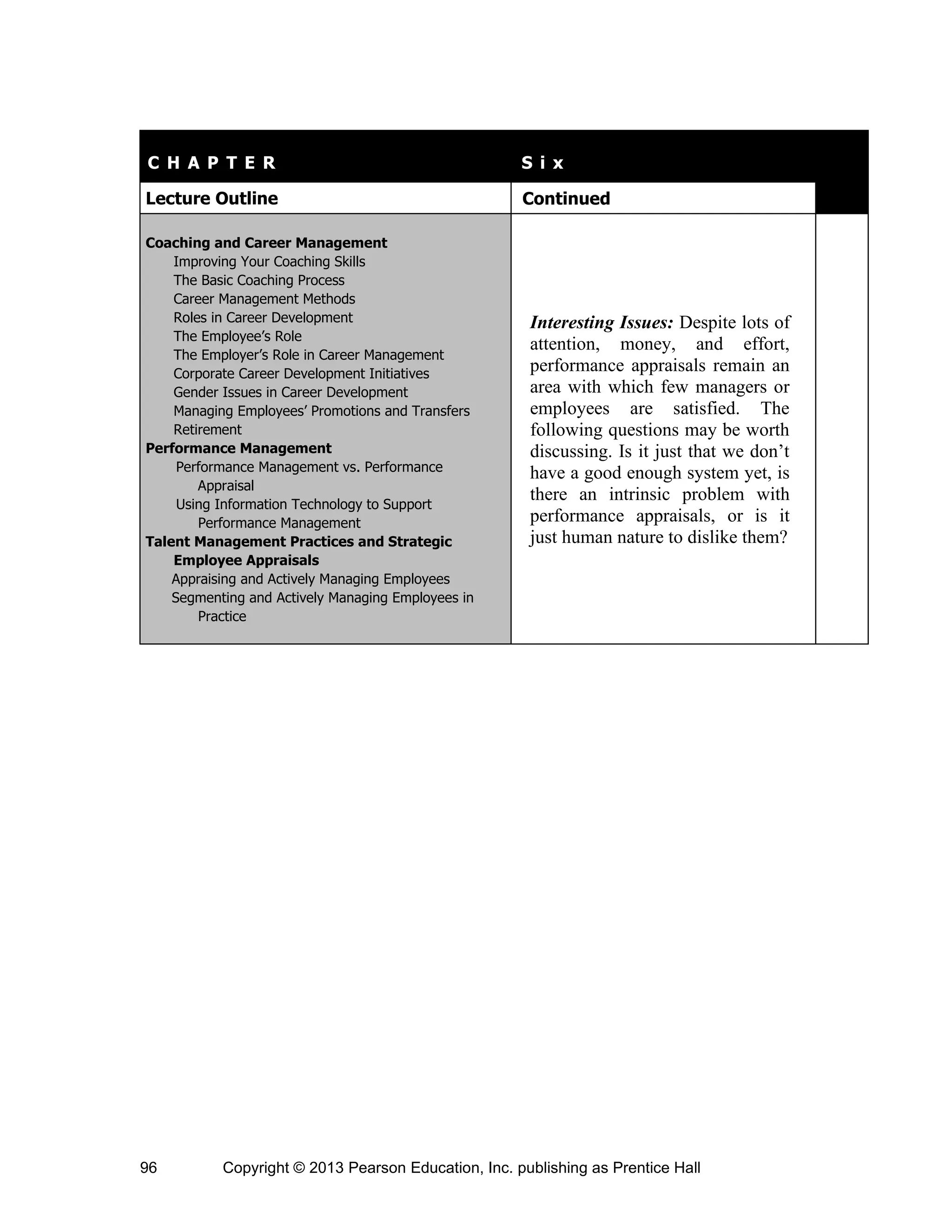
Lecture Outline
Overview
Basic Concepts in Performance Management
Why Appraise Performance?
- The Importance of Continuous Feedback
- Performance Management
- Performance Management Defined
- The Appraisal Cycle
Setting Effective Goals and Work Standards
Who Should Do the Appraising?
Basic Appraisal Methods
Graphic Rating Scale Method
Alternation Ranking Method
Paired Comparison Method
Forced Distribution Method
Critical Incident Method
Behaviorally Anchored Rating Scales
Appraisal Forms in Practice
The Management by Objectives Method
Computerized and Web-Based Performance
Appraisals
Electronic Performance Monitoring
Practical Suggestions for More Effective
Appraisals
Ensure Fairness
Deal with Common Appraisal Problems
Understand the Legal Aspects of Performance
Appraisal
Conduct First-Rate Appraisal Feedback Interviews
In Brief: This chapter gives an
overview of the performance
appraisal process and the different
tools and methods available. The
main topics covered include the
performance management process,
appraisal methods, appraisal
performance problems and
solutions, and the appraisal
interview.
Copyright © 2013 Pearson Education, Inc. publishing as Prentice Hall
96
C H A P T E R T S i x
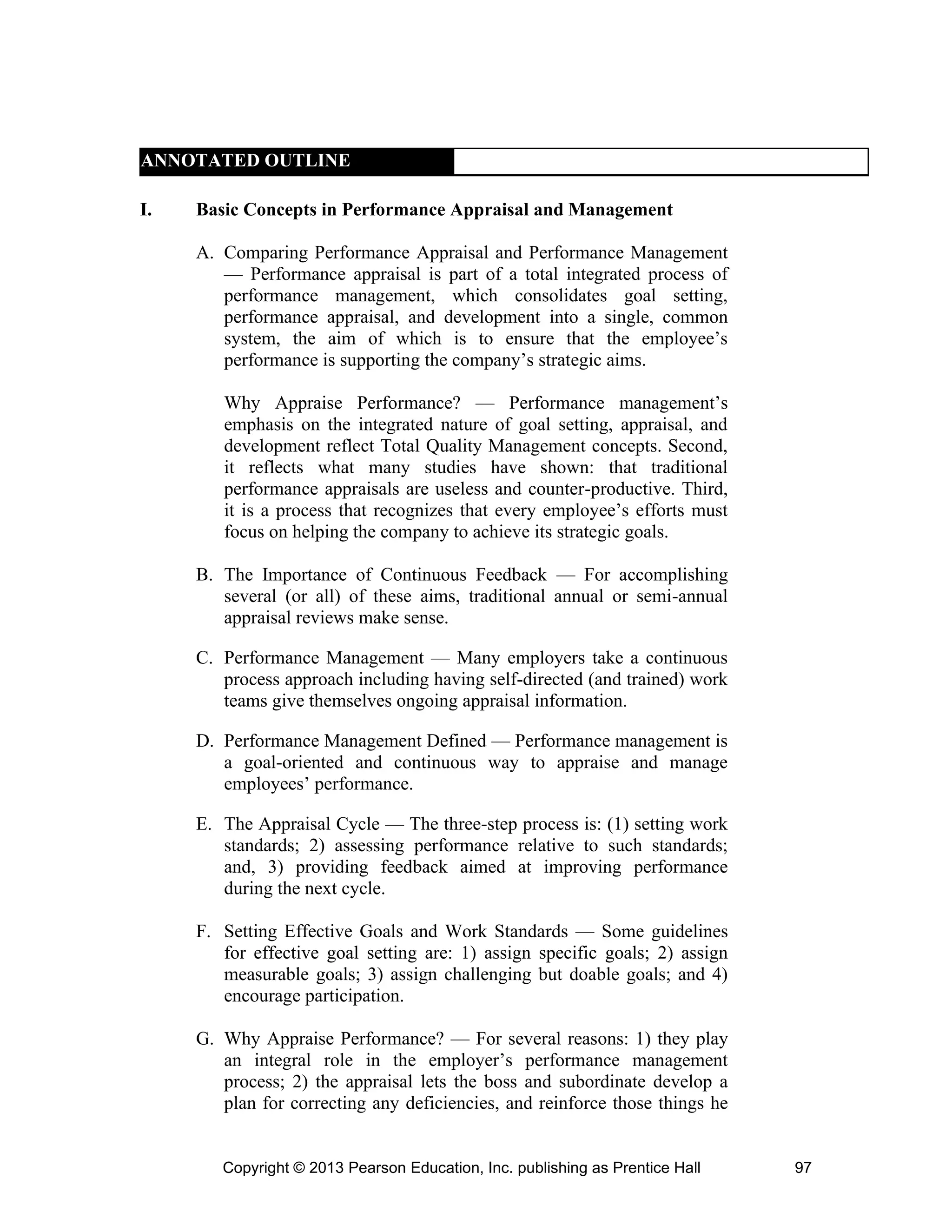
Lecture Outline Continued
Coaching and Career Management
Improving Your Coaching Skills
The Basic Coaching Process
Career Management Methods
Roles in Career Development
The Employee’s Role
The Employer’s Role in Career Management
Corporate Career Development Initiatives
Gender Issues in Career Development
Managing Employees’ Promotions and Transfers
Retirement
Performance Management
Performance Management vs. Performance
Appraisal
Using Information Technology to Support
Performance Management
Talent Management Practices and Strategic
Employee Appraisals
Appraising and Actively Managing Employees
Segmenting and Actively Managing Employees in
Practice
Interesting Issues: Despite lots of
attention, money, and effort,
performance appraisals remain an
area with which few managers or
employees are satisfied. The
following questions may be worth
discussing. Is it just that we don’t
have a good enough system yet, is
there an intrinsic problem with
performance appraisals, or is it
just human nature to dislike them?
Copyright © 2013 Pearson Education, Inc. publishing as Prentice Hall 97
ANNOTATED OUTLINE
I. Basic Concepts in Performance Appraisal and Management
A. Comparing Performance Appraisal and Performance Management
— Performance appraisal is part of a total integrated process of
performance management, which consolidates goal setting,
performance appraisal, and development into a single, common
system, the aim of which is to ensure that the employee’s
performance is supporting the company’s strategic aims.
Why Appraise Performance? — Performance management’s
emphasis on the integrated nature of goal setting, appraisal, and
development reflect Total Quality Management concepts. Second,
it reflects what many studies have shown: that traditional
performance appraisals are useless and counter-productive. Third,
it is a process that recognizes that every employee’s efforts must
focus on helping the company to achieve its strategic goals.
B. The Importance of Continuous Feedback — For accomplishing
several (or all) of these aims, traditional annual or semi-annual
appraisal reviews make sense.
C. Performance Management — Many employers take a continuous
process approach including having self-directed (and trained) work
teams give themselves ongoing appraisal information.
D. Performance Management Defined — Performance management is
a goal-oriented and continuous way to appraise and manage
employees’ performance.
E. The Appraisal Cycle — The three-step process is: (1) setting work
standards; 2) assessing performance relative to such standards;
and, 3) providing feedback aimed at improving performance
during the next cycle.
F. Setting Effective Goals and Work Standards — Some guidelines
for effective goal setting are: 1) assign specific goals; 2) assign
measurable goals; 3) assign challenging but doable goals; and 4)
encourage participation.
G. Why Appraise Performance? — For several reasons: 1) they play
an integral role in the employer’s performance management
process; 2) the appraisal lets the boss and subordinate develop a
plan for correcting any deficiencies, and reinforce those things he
Copyright © 2013 Pearson Education, Inc. publishing as Prentice Hall
98
does correctly; 3) they serve a useful career planning purpose; and
4) it plays a part in salary decisions.
H. Who Should Do the Appraising?
1. The Immediate Supervisor — is usually in the best position to
observe and evaluate the subordinate’s performance, and is
responsible for that person’s performance.
2. Peer Appraisals — becoming more popular with firms using
self-managing teams.
3. Rating Committees — consist of multiple raters, typically the
employee’s immediate supervisor and three or four other
supervisors.
4. Self-Ratings — tend to be higher than supervisor or peer
ratings.
5. Appraisal by Subordinates — or upward feedback, is where
subordinates anonymously rate their supervisor’s performance.
Research Insight—One study shows that upward feedback is very effective
in improving supervisors’ behaviors.
6. 360-Degree Feedback — where ratings are collected from the
employee, the employee’s supervisors, subordinates, peers, and
internal or external customers. This method is the subject of
considerable debate. One study found significant correlation
between 360-degree ratings and conventional ratings. Firms
should carefully assess potential costs, carefully train those
giving feedback, and not rely solely on 360-degree feedback.
II. Basic Appraisal Methods
A. Graphic Rating Scale Method — is the simplest and most popular
performance appraisal technique. A scale is used to list a number
of traits and a range of performance for each, and then the
employee is rated by identifying the score that best describes
his/her performance level for each trait. Managers must decide
which job performance aspects to measure. Some options include
generic dimensions, actual job duties, or behaviorally recognizable
competencies.
Copyright © 2013 Pearson Education, Inc. publishing as Prentice Hall 99
B. Alternation Ranking Method — involves employees being ranked
from best to worst on a particular trait, choosing highest, then
lowest, next highest, next lowest, and so forth until all are ranked.
C. Paired Comparison Method — involves ranking employees by
making a chart of all possible pairs of employees for each trait and
indicating which is the better employee of the pair.
D. Forced Distribution Method — Predetermined percentages of rates
are placed in various performance categories; similar to grading on
a curve.
Teaching Tip: Discuss what the ramifications of using the forced distribution
method for class grades would be. Students will have strong opinions.
E. Critical Incident Method — a supervisor keeps a detailed record of
uncommonly good or undesirable examples of an employee’s
work-related behavior, and reviews it with the employee at
predetermined times.
F. Behaviorally Anchored Rating Scales (BARS) — combine the
benefits of narratives, critical incidents, and quantified scales, by
anchoring a scale with specific behavioral examples of good or
poor performance. The five steps in developing a BARS are: 1)
generate critical incidents; 2) develop performance dimensions; 3)
reallocate incidents; 4) scale the incidents; and 5) develop final
instrument. The advantages of BARS include a more accurate
gauge, clearer standards, feedback, independent dimensions, and
consistency.
G. Appraisal Forms in Practice — involve rating the employee’s
performance for each performance factor, writing down examples
and an improvement plan, aiding the employee in understanding
where his/her performance was good or bad, and summarizing by
focusing on problem solving.
H. Management by Objectives (MBO) — requires the manager to set
specific measurable goals with each employee and then
periodically discuss his/her progress toward these goals. The
process consists of six steps: 1) set the organization’s goals; 2) set
departmental goals; 3) discuss departmental goals; 4) mutually
define expected results; 5) conduct performance reviews; and 6)
provide feedback.
I. Computerized and Web-Based Performance Appraisal — generally
enables managers to keep notes on subordinates during the year,
Copyright © 2013 Pearson Education, Inc. publishing as Prentice Hall
100
rate employees on a series of performance traits, and then generate
written text to support each part of the appraisal. About one-third
of employers use online performance management tools for at least
some employees.
J. Electronic Performance Monitoring — systems used to allow
managers access to their employees’ computers and telephones.
III. Practical Suggestions for More Effective Appraisals Few
supervisory tasks are as complex and poorly administered than
appraisals.
A. Ensure Fairness — The first challenge is to make sure the
subordinate views the appraisal as fair. Many managers don’t focus
on the developmental aspect of the appraisal, but instead use it for
political purposes.
B. Deal with Common Appraisal Problems — It can be difficult to
rate performance for several reasons. Much depends on a good
rating, including career progress, or being able to obtain a raise.
There are also technical problems that can affect the fairness of the
process.
1. Unclear Standards — Ambiguous traits and degrees of merit
can result in an unfair appraisal.
2. Halo Effect — the influence of a rater’s general impression on
ratings of specific qualities, can be a problem.
3. Central Tendency — involves supervisors sticking to the
middle of the rating scales, thus rating everyone approximately
average.
4. Leniency or Strictness — Supervisors have the tendency to rate
everyone either high or low.
5. Bias — the tendency to allow individual differences such as
age, race, and sex to affect the appraisal ratings employees
receive is a problem.
Research Insight — Bias can influence the way a person appraises another
person. In one study, for example, the identical employee was rated differently
if pregnant.
Copyright © 2013 Pearson Education, Inc. publishing as Prentice Hall 101
C. Understand the Legal Aspect of Performance Appraisal —
Performance appraisals have legal implications, because they often
affect raises, promotions, training, and other HR actions.
D. Conduct First-Rate Appraisal Feedback Interviews — an interview
in which the supervisor and subordinate review the appraisal and
make plans to remedy deficiencies and reinforce strengths.
E. Preparing for the Appraisal Interview
Step 1 — give the subordinate enough notice to review his/her
work. Step 2 — Study his/her job description.
Step 3 — Choose the right place for the interview and schedule
enough time for it.
F. Conducting the Interview — Prepare for the interview by
conducting the interview in a private area without interruptions.
Talk in terms of objective, observable work data using examples.
Get agreement with the employee of how you will know
improvement has occurred. Ensure the process is fair and learn
how to deal with defensiveness.
IV. Coaching and Career Management
A. Improving Your Coaching Skills — Coaching means educating,
instructing, and training subordinates. Mentoring means advising,
counseling, and guiding. Coaching focuses on teaching shorter-
term job related skills, mentoring on helping employees navigate
longer-term career hazards.
B. The Basic Coaching Process — Preparing to coach involves
understanding the problem, the employee, and his or her skills.
Planning requires reaching consensus on the problem and on what
to change. Finally, once agreement is reached, educating,
instructing, training and ongoing encouragement are the important
steps in the change process.
V. Career Management Methods
A. Mentoring — Having a mentor — a senior person in the firm who
can be a sounding board for your career questions and concerns —
can enhance career satisfaction and success.
B. The Employee’s Role — An individual must accept responsibility
for his/her own career; assess his/her own interests, skills, and
values; and take the steps required to ensure a happy and fulfilling
Copyright © 2013 Pearson Education, Inc. publishing as Prentice Hall
102
career. Finding a mentor who can be a sounding board is often
helpful. Mentoring programs can be informal or formal.
Copyright © 2013 Pearson Education, Inc. publishing as Prentice Hall 103
B. The Employer’s Role — Employers can support career
development efforts in many ways. There are several
organizational career-planning practices. The means for helping to
further an employee’s career depends on the length of time the
employee has been with the firm.
C. Gender Issues in Career Development—Women and men face
different challenges as they advance through their careers. Women
face the glass ceiling. Minority women may be particularly at risk.
D. Managing Employees’ Promotions and Transfers
1. Making Promotion Decisions — Promotions usually provide
opportunities to reward the exceptional performance of tested
and loyal employees. However, unfairness, arbitrariness, or
secrecy can diminish the effectiveness of the promotion
process for all concerned.
2. Handling Transfers — Transfers are moves from one job to
another, usually with no change in salary or grade. The
frequent relocating of transfer employees has been assumed to
have a damaging effect on transferees’ family life. Transfers
are also costly financially.
E. Retirement—Some employers are instituting formal preretirement
counseling aimed at easing the passage of their employees into
retirement. A large majority of employees have said they expect to
continue to work beyond the normal retirement age. Part-time
employment is an alternative to outright retirement. Employers can
benefit from retirement planning by becoming able to anticipate
labor shortages.
1. Create a Culture that Honors Experience — Changing cultures
that are explicitly or implicitly biased against older workers
can help make a company more attractive to retirees.
2. Modify Selection Procedures
3. Offer Flexible Work — Redesigning jobs to include
telecommuting and other options will attract and retain
workers.
4. Phased retirement — Phased retirement programs combine
reduced work hours, job change, and reduced responsibilities.
VI. Performance Management
Copyright © 2013 Pearson Education, Inc. publishing as Prentice Hall
104
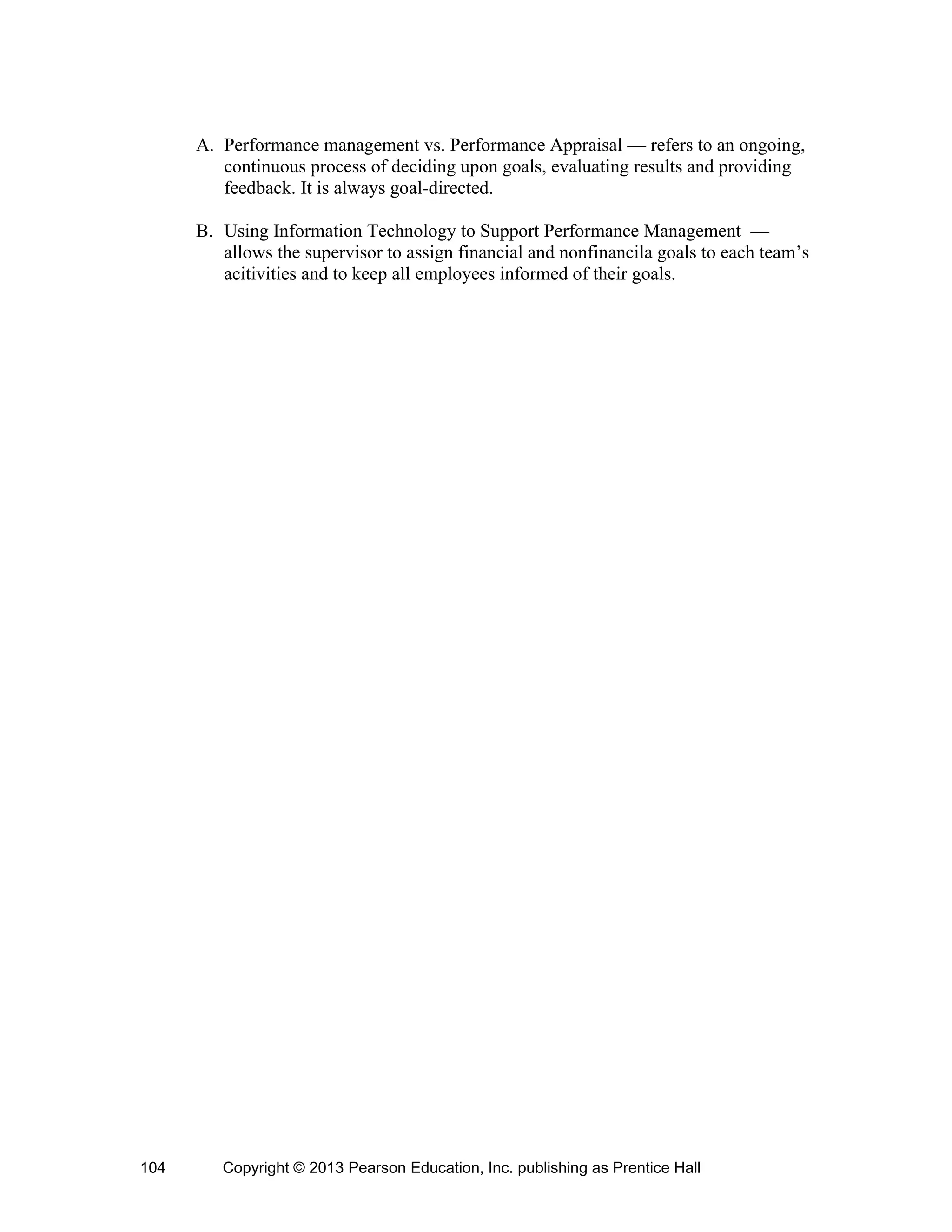
A. Performance management vs. Performance Appraisal — refers to an ongoing,
continuous process of deciding upon goals, evaluating results and providing
feedback. It is always goal-directed.
B. Using Information Technology to Support Performance Management —
allows the supervisor to assign financial and nonfinancila goals to each team’s
acitivities and to keep all employees informed of their goals.
Copyright © 2013 Pearson Education, Inc. publishing as Prentice Hall 105
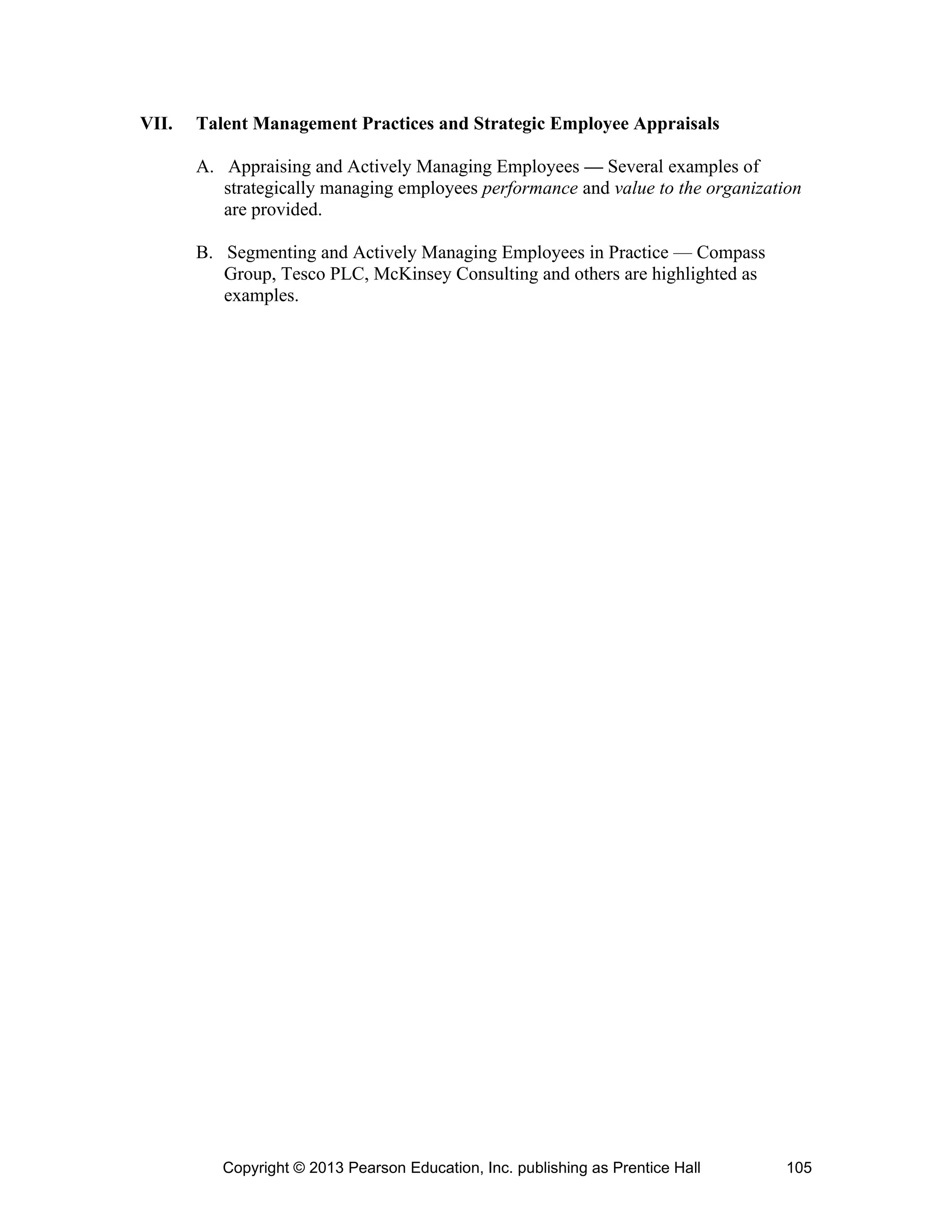
VII. Talent Management Practices and Strategic Employee Appraisals
A. Appraising and Actively Managing Employees — Several examples of
strategically managing employees performance and value to the organization
are provided.
B. Segmenting and Actively Managing Employees in Practice — Compass
Group, Tesco PLC, McKinsey Consulting and others are highlighted as
examples.
Copyright © 2013 Pearson Education, Inc. publishing as Prentice Hall
106
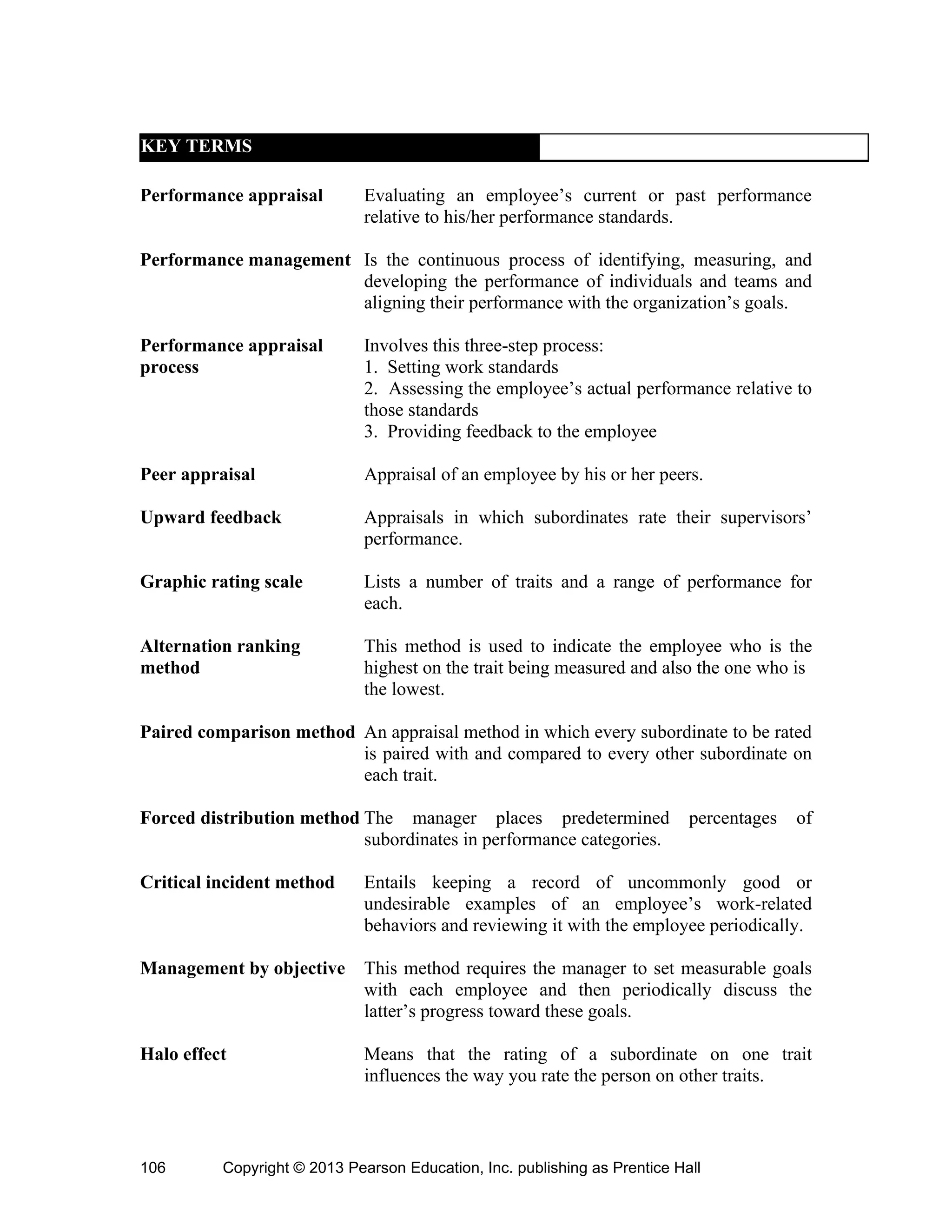
KEY TERMS
Performance appraisal Evaluating an employee’s current or past performance
relative to his/her performance standards.
Performance management Is the continuous process of identifying, measuring, and
developing the performance of individuals and teams and
aligning their performance with the organization’s goals.
Performance appraisal Involves this three-step process:
process 1. Setting work standards
2. Assessing the employee’s actual performance relative to
those standards
3. Providing feedback to the employee
Peer appraisal Appraisal of an employee by his or her peers.
Upward feedback Appraisals in which subordinates rate their supervisors’
performance.
Graphic rating scale Lists a number of traits and a range of performance for
each.
Alternation ranking This method is used to indicate the employee who is the
method highest on the trait being measured and also the one who is
the lowest.
Paired comparison method An appraisal method in which every subordinate to be rated
is paired with and compared to every other subordinate on
each trait.
Forced distribution method The manager places predetermined percentages of
subordinates in performance categories.
Critical incident method Entails keeping a record of uncommonly good or
undesirable examples of an employee’s work-related
behaviors and reviewing it with the employee periodically.
Management by objective This method requires the manager to set measurable goals
with each employee and then periodically discuss the
latter’s progress toward these goals.
Halo effect Means that the rating of a subordinate on one trait
influences the way you rate the person on other traits.
Copyright © 2013 Pearson Education, Inc. publishing as Prentice Hall 107
Central tendency Refers to a tendency to rate all employees about average.
Appraisal interview An interview in which the supervisor and subordinate
review the appraisal and make plans to remedy deficiencies
and reinforce strengths.
Coaching Means educating, instructing, and training subordinates.
Copyright © 2013 Pearson Education, Inc. publishing as Prentice Hall
108
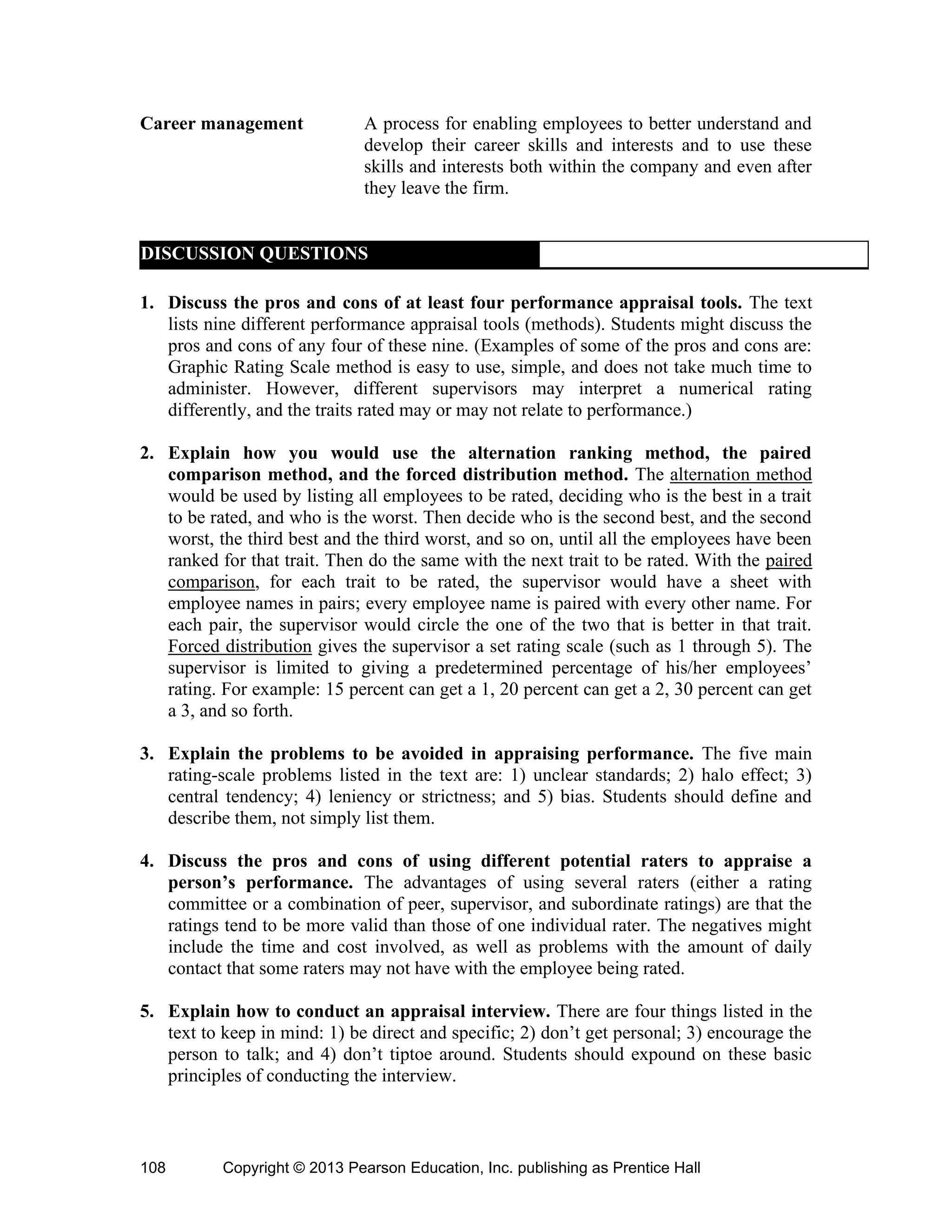
Career management A process for enabling employees to better understand and
develop their career skills and interests and to use these
skills and interests both within the company and even after
they leave the firm.
DISCUSSION QUESTIONS
1. Discuss the pros and cons of at least four performance appraisal tools. The text
lists nine different performance appraisal tools (methods). Students might discuss the
pros and cons of any four of these nine. (Examples of some of the pros and cons are:
Graphic Rating Scale method is easy to use, simple, and does not take much time to
administer. However, different supervisors may interpret a numerical rating
differently, and the traits rated may or may not relate to performance.)
2. Explain how you would use the alternation ranking method, the paired
comparison method, and the forced distribution method. The alternation method
would be used by listing all employees to be rated, deciding who is the best in a trait
to be rated, and who is the worst. Then decide who is the second best, and the second
worst, the third best and the third worst, and so on, until all the employees have been
ranked for that trait. Then do the same with the next trait to be rated. With the paired
comparison, for each trait to be rated, the supervisor would have a sheet with
employee names in pairs; every employee name is paired with every other name. For
each pair, the supervisor would circle the one of the two that is better in that trait.
Forced distribution gives the supervisor a set rating scale (such as 1 through 5). The
supervisor is limited to giving a predetermined percentage of his/her employees’
rating. For example: 15 percent can get a 1, 20 percent can get a 2, 30 percent can get
a 3, and so forth.
3. Explain the problems to be avoided in appraising performance. The five main
rating-scale problems listed in the text are: 1) unclear standards; 2) halo effect; 3)
central tendency; 4) leniency or strictness; and 5) bias. Students should define and
describe them, not simply list them.
4. Discuss the pros and cons of using different potential raters to appraise a
person’s performance. The advantages of using several raters (either a rating
committee or a combination of peer, supervisor, and subordinate ratings) are that the
ratings tend to be more valid than those of one individual rater. The negatives might
include the time and cost involved, as well as problems with the amount of daily
contact that some raters may not have with the employee being rated.
5. Explain how to conduct an appraisal interview. There are four things listed in the
text to keep in mind: 1) be direct and specific; 2) don’t get personal; 3) encourage the
person to talk; and 4) don’t tiptoe around. Students should expound on these basic
principles of conducting the interview.
Copyright © 2013 Pearson Education, Inc. publishing as Prentice Hall 109
INDIVIDUAL AND GROUP ACTIVITIES
1. Working individually or in groups, develop a graphic rating scale for the
following jobs: secretary, engineer, and directory assistance operator. Job
characteristics may include but not be limited to: Secretary—quantity of work,
frequency of errors, attendance, and initiative; Engineer—initiative, significance of
contribution to the organization, problem-solving skills, frequency of errors, and
communication skills; Directory Assistance Operator—speed, attendance, accuracy,
and friendliness.
2. Working individually or in groups, describe the advantages and disadvantages
of using the forced distribution appraisal method for college professors. The
disadvantages include decreased morale, interdepartmental inequities, and unfair
rankings. The advantages would include steering clear of many of the biases listed, as
well as overcoming the central tendency problem.
3. Working individually or in groups, develop, over the period of a week, a set of
critical incidents covering the classroom performance of one of your instructors.
If you had the class conduct a job analysis and create a job description for an
instructor in Chapter 3, it would be helpful to refer to that to help identify what kinds
of behavior and tasks the instructor should be doing. This will give a good basis for
students to observe and watch for critical incidents. If they find critical incidents that
are not based in these other documents, it will be a good opportunity to go back and
review how all this ties together and that we haven’t communicated to the instructor
in the job description these behaviors or tasks for which they are now wanting to rate
them.
4. Working individually or in groups, evaluate the rating scale in Figure 6.1.
Discuss ways to improve it. There are many things that might be suggested for
improvements. These suggestions might include but not be limited to: clearer
explanation of the rating scale (what does “very descriptive” mean?), consider
reducing the rating scale from seven points to four or five, provide behavioral anchors
for the scale points, and rework the items so that each one is only rating one trait or
behavior (some have several).
HR in Action Case Incident 1: Appraising the Secretaries at Sweetwater U
1. Do you think that the experts’ recommendations will be sufficient to get most of
the administrators to fill out the rating forms properly? Why? Why not? What
additional actions (if any) do you think will be necessary? Although controversial,
APPLICATION EXERCISES
Copyright © 2013 Pearson Education, Inc. publishing as Prentice Hall
110
the recommendations would, in fact, encourage administrators to fill the forms out
correctly. Using the more detailed form and not tying the performance ratings to
salary increases would allow the managers to feel more free about rating the
secretaries accurately. There would, however, need to be some strong training
sessions (both for administrators and secretaries) to help them understand the new
system. Because all secretaries have traditionally received the same salary increases,
and have been pleased with that, it would be advisable to consider lowering the
maximum increase to an amount that could be given to all secretaries while staying
within budget. Then all secretaries with a satisfactory rating or better would receive
that increase.
2. Do you think that Vice President Winchester would be better off dropping
graphic rating forms, substituting instead one of the other techniques we
discussed in this chapter such as a ranking method? Why? Certainly other
methods could be used. He has already had a taste of what would result if he went to
a forced distribution or other ranking method. A BARS system might be best, but it
could be costly to develop if the clerical staff has positions that are significantly
different.
3. What performance appraisal system would you develop for the secretaries if you
were Rob Winchester? Defend your answer. If the development costs are not too
great, the BARS system would give the strongest solution to the current situation. The
behavioral anchors would make it more difficult to just rate everyone at the top. It
would also help to eliminate the different interpretations of what the rating scales
mean.
Continuing Case: Carter Cleaning Company
1. Is Jennifer right about the need to evaluate the workers formally? The
managers? Why or why not? Based on the information presented in the chapter, the
students need to determine if the workers and managers should be evaluated formally
or informally, and they need to provide reasons for their decision. Of course she is
right! Jennifer already outlined some of the reasons for the need for appraisals:
probationary period, motivation, feedback, and so on. It is not clear that objectives
and goals have been clearly established and communicated. Also, it is important to tie
salary, promotion, and disciplinary decisions to these goals. Without it, employees
will do what they prefer or enjoy doing. With it, they should understand what the
priorities are and what they need to be doing.
2. Develop a performance appraisal method for the workers and managers in each
store. The students need to be familiar with different appraisal methods discussed in
the chapter. They should use the sample appraisal forms given in the chapter as
guides.
Copyright © 2013 Pearson Education, Inc. publishing as Prentice Hall 111
Experiential Exercise: Setting Goals and Appraising an Instructor
Purpose: The purpose of this exercise is to give you practice in developing and using a
performance appraisal system.
Required Understanding: You are going to develop a performance appraisal form for
an instructor and should therefore be thoroughly familiar with the discussion of
performance appraisals in this chapter.
How to Set up the Exercise: Divide the class into groups of four or five students. 1)
First, based on what you now know about performance appraisals, do you think Figure
6.1 is an effective scale for appraising instructors? Why? 2) Next, the group should
develop its own tool for appraising the instructor. 3) Last, have a spokesperson from each
group put his/her group’s appraisal tool on the board.
Another Random Scribd Document
with Unrelated Content
The Project Gutenberg eBook of Protection
and Communism
This ebook is for the use of anyone anywhere in the United States
and most other parts of the world at no cost and with almost no
restrictions whatsoever. You may copy it, give it away or re-use it
under the terms of the Project Gutenberg License included with this
ebook or online at www.gutenberg.org. If you are not located in the
United States, you will have to check the laws of the country where
you are located before using this eBook.
Title: Protection and Communism
Author: Frédéric Bastiat
Release date: November 10, 2013 [eBook #44144]
Most recently updated: October 23, 2024
Language: English
Credits: Produced by David Widger
*** START OF THE PROJECT GUTENBERG EBOOK PROTECTION
AND COMMUNISM ***
PROTECTION and
COMMUNISM
From The French
By Frederic Bastiat.
With a Preface, by The Translator
London:
John W. Parker And Son, West Strand
MDCCCLII.
CONTENTS
TRANSLATOR'S PREFACE.
PROTECTION AND COMMUNISM.
TRANSLATOR'S PREFACE.
This translation will not, it is hoped, be unacceptable to the
English reader, particularly at the present moment, when it is not
improbable that, under certain circumstances, a great effort may be
made in this country to restore Protection—or, should that wild
attempt be considered impossible, to shift the public burdens in such
a manner as to effect, as far as possible, the same purpose in favour
of what is called the 'agricultural interest.' M. Bastiat's spirited little
work is in the form of a letter, addressed to M. Thiers—the
archenemy of free-trade, as he was of most propositions which had
for their object the true happiness of France. The present was only
one of a series of efforts made by M. Bastiat in favour of the cause
of freedom of commerce; and the English reader has already had an
opportunity of admiring the force of his arguments and the clearness
of his style, in Mr. Porter's* admirable translation of Popular
Fallacies, which is, indeed, a perfect armory of arguments for those
'who, although they may have a general impression favourable to
Free-trade, have yet some fears as to the consequences that may
follow its adoption.' What impression M. Bastiat may have produced
on the public mind of France it is not easy to conjecture, or how far
the recent violent changes in that country, presuming them to be at
all permanent, may prove favourable to Free-trade or otherwise. But
it is to be feared that there is an amount of prejudice and ignorance
in France, among the mass of her people, more inveterate and more
difficult to remove and enlighten than was the case in this country.
However, seed thus sown cannot remain altogether without fruit,
and the rapidity with which correct principles spread through a great
community, under apparently most unfavourable circumstances, is
such as frequently to astonish even those most convinced of the vast
power of truth.
* Secretary of the Board of Trade, and author of the
Progress of the Nation.
The real object of M. Bastiat is to expose the unsoundness and
injustice of the system of Protection. He does this partly by a
dexterous reference to the theory of Communism, and shows, with
logical force and neat application, that the principles of the two are
in truth the same. The parallel thus drawn, so far from being fanciful
or strained, is capable of easy demonstration. But, in drawing it, M.
Bastiat rather assumes than proves that Communism is itself wholly
indefensible—that its establishment would be destructive of security
and property, and, consequently, of society—in a word, that it is
another term for robbery.
This is true, and obviously so, of Communism, in its more
extravagant form; and it is to this, of course, that M. Bastiat refers.
But it cannot be denied that there are many modifications of the
principle which embrace more or less truth, and which appear to
offer a corrective to that excessive competition or pressure of
numbers, the evils of which are patent, admitted, and deplored. That
the specific remedy proposed is vicious, that it would quickly make
matters much worse than they are, that it is, in fact, a fraud and a
mockery, does not prevent it from being, and naturally, captivating
to many who at present see no other way out of the difficulties and
the struggles by which they are surrounded: and who are tempted
to embrace it, not only as a relief to their present wants and
anxieties, but because it would, in their opinion, entail other
consequences, as connected with their social condition, particularly
grateful to their feelings. We further admit that such sentiments—
not in themselves irrational—founded on a legitimate desire for
improvement, and entertained by large and important classes—are
entitled to the most respectful consideration.
Whether some considerable melioration in the condition of our
labourers and artisans may not by degrees be effected by means of
combined labour, or co-operation, and the principle of partnership, is
no doubt one of the great questions to be solved by modern society,
but it is much too wide a one to be entered upon, however cursorily,
in this place. It is understood, however, that one of the most original
and powerful thinkers within the domain of statistics is at the
present moment engaged on this subject; and, if this be so, we shall
no doubt, before long, be in the possession of views of extreme
importance and interest.
We have, with deep regret, to add that M. Bastiat died during the
autumn of last year, after a long illness, in the south of Italy. By his
death, not only France, but the world also, has sustained a loss.
PROTECTION AND COMMUNISM.
TO M. THIERS.
Sir,
Do not be ungrateful to the revolution of February. It may have
surprised, perhaps disturbed you, but it has also afforded you,
whether as an author, an orator, or a practised statesman, some
unexpected triumphs. Amidst these successes, there is one certainly
of no usual character. We not long ago read in La Presse, 'The
Association for the Protection of National Labour (the ancient
Mimerel Club)* is about to address a circular to all its
correspondents, to announce that a subscription is opened for the
purpose of promoting in manufactories the circulation of M. Thiers's
book upon Property. The association itself subscribes for 5000
copies.' Would that I had been present when this flattering
announcement met your eyes. It should have made them sparkle
with joy. We have good reason to say that the ways of Providence
are as infallible as they are impenetrable. For if you will bear with
me for a moment I will endeavour to prove that Protection, when
fully developed, and pushed to its legitimate consequences, becomes
Communism. It is sufficiently singular that a champion of Protection
should discover that he is a promoter of Communism; but what is
more extraordinary and more consoling still, is the fact that we find
a powerful association, that was formed for the purpose of
propagating theoretically and practically the principles of
Communism (in the manner deemed most profitable to its members)
now devoting the half of its resources to destroy the evil which it has
done with the other half.
* An association, Mr. Porter informs us, composed like that
assembling (or that did assemble, for we are not quite sure
whether it still exists,) at No. 17, New Bond Street,
exclusively of producers, at least of the article sought to
be protected, and therefore of persons who believe
themselves to be interested in excluding from the home
market the productions of others.
I repeat it,—this is consoling. It assures us of the inevitable
triumph of truth, since it shows us the real and first propagators of
subversive doctrines, startled at their success, industriously
correcting with the proper antidote the poison they had spread.
This supposes, it is true, the identity of the principles of
Communism and of Protection, and perhaps you do not admit this
identity, though, to speak the truth, it seems to me impossible that
you could have written four hundred pages upon Property without
being struck by it. Perhaps you imagine that some efforts made in
favour of commercial freedom, or rather of free trade, the
impatience of a discussion without results, the ardour of the contest,
and the keenness of the struggle, have made me view (what
happens too often to all of us) the errors of my adversaries in
exaggerated colours. But, beyond question, according to my idea, it
requires but little effort to develop the principles you have been
advocating into those of Communism. How can it be that our great
manufacturers, landed proprietors, rich bankers, able statesmen,
have become, without knowing or wishing it, the introducers, the
very apostles of Communism in France? And why not, I would ask?
There are numerous workmen fully convinced of the right of labour,
and consequently Communists also without knowing or wishing it,
and who would not acknowledge the title. The reason of this is, that
amongst all classes interest biases the will, and the will, as Pascal
says, is the chief element of our faith. Under another name, many of
our working classes, very honest people be it observed, use
Communism as they have always used it, namely, on the condition
that the wealth of others should alone be liable to the law. But as
soon as the principle, extending itself, would apply the same rule to
their own property—oh! then Communism is held in detestation, and
their former principles are rejected with loathing. To express surprise
at this, is simply to confess ignorance of the human heart, its secret
workings, and how strong its inclination is to practise self-
deception.*
* The truth of this is found on all occasions where the
interests or the passions of men are concerned, and was
rather amusingly shown in many ways when the free-trade
measures of Sir R. Peel were being carried through. Then
every interest desired free-trade, except with reference to
the articles produced by itself.
No, Sir; it is not the heat of controversy, which has betrayed me in
seeing the doctrine of Protection in this light, for, on the contrary, it
was because I saw it in this point of view before the struggle
commenced that I am thus engaged. Believe me that to extend
somewhat our foreign commerce—a consequential result which,
however, is far from despicable—was never my governing motive; I
believed, and I still believe, that property itself was concerned in the
question; I believed, and I still believe, that our tariff of customs,
owing to the principle which has given it birth, and the arguments by
which it is defended, has made a breach in the very principle of
property itself, through which all the rest of our legislation threatens
to force itself. In considering this state of things, it seems to me that
a Communism, the true effect and range of which, (I must say this
to be just,) was not contemplated by its supporters, was on the
point of overwhelming us. It seems to me that this particular species
of Communism (for there are several kinds of it) flows logically from
the arguments of the protectionists, and is involved when those
arguments are pressed to their legitimate conclusion. It is upon this
ground, therefore, that it seems to me of the utmost importance to
meet the evil, for, fortified as it is by sophistical statements, and
sanctioned by high authority, there is no hope of eradicating the
error while such statements are permitted to take possession of and
to distract the mind of the public. It is thus that we view the matter
at Bordeaux, Paris, Marseilles, Lyons, and elsewhere, where we have
organized the free-trade association. Commercial freedom,
considered by itself, is without doubt a great blessing to the people;
but if we had only this object in view, our body should have been
named the Association for Commercial Freedom, or, more accurately,
for the Gradual Reform of the Tariffs. But the word 'free-trade'
implies the free disposal of the produce of labour, in other terms
'property' and it is for this reason that we have preferred it. We
knew, indeed, that the term would give rise to many difficulties. It
affirmed a principle, and from that moment all the supporters of the
opposite one ranged themselves against us. More than this, it was
extremely objectionable, even to some of those who were the most
disposed to second us, that is to say, to merchants and traders more
engaged in reforming the Customs than in overthrowing
Communism. Havre, while sympathizing with our views, refused to
enlist under our banner. On all sides I was told, 'Let us obtain
without loss of time some modification of our tariff, without
publishing to the world our extreme pretensions.' I replied, 'If you
have only that in view, exert your influence through your chambers
of commerce.' To this they answered, 'The word free-trade frightens
people, and retards our success.' Nothing is more true; but I would
derive even from the terror inspired by this word my strongest
arguments for its adoption. The more disliked it is, say I, the more it
proves that the true notion of property is obscured. The doctrine of
Protection has clouded ideas, and confused and false ideas have in
their turn supported Protection. To obtain by surprise, or with the
consent of the Government, an accidental amelioration of the tariff
may modify an effect, but cannot destroy a cause. I retain, then, the
word Free-trade, not in the mere spirit of opposition, but still, I
admit, because of the obstacles it creates or encounters—obstacles
which, while they betray the mischief at work, bear along with them
the certain proof, that the very foundation of social order was
threatened.
It is not sufficient to indicate our views by a word; they should be
defined. This has been done, and I here transcribe, as a programme,
the first announcement or manifesto of this association.
'When uniting for the defence of a great cause, the undersigned
feel the necessity of declaring their creed: of proclaiming the design,
the province, the means and the principles of their association.
'Exchange is a natural right, like property. Every one who has
made or acquired any article should have the option either to apply
it immediately to his own use, or to transfer it to any one,
whomsoever he may be, who may consent to give him something he
may prefer to it in exchange. To deprive him of this power when he
makes no use of it contrary to public order or morality, and solely to
gratify the convenience of another, is to legalise a robbery—to
violate the principle of justice.
'Again, it is to violate the conditions of social order—for what true
social order can exist in the midst of a community, in which each
individual interest, aided in this by law and public opinion, aims at
success by the depression of all the others?
'It is to disown that providential superintendence which presides
over human affairs, and made manifest by the infinite variety of
climates, seasons, natural advantages and resources, benefits which
God has so unequally distributed among men to unite them by
commercial intercourse in the ties of a common brotherhood.
'It is to retard or counteract the development of public prosperity,
since he who is not free to barter as he pleases, is not free to select
his occupation, and is compelled to give an unnatural direction to his
efforts, to his faculties, to his capital, and to those agents which
nature has placed at his disposal.
'In short, it is to imperil the peace of nations, for it disturbs the
relations which unite them, and which render wars improbable in
proportion as they would be burdensome.
'The association has, then, for its object Free-trade.
'The undersigned do not contest that society has the right to
impose on merchandise, which crosses the frontier, custom dues to
meet national expenses, provided they are determined by the
consideration of the wants of the Treasury alone.
'But as soon as a tax, losing its fiscal character, aims at the
exclusion of foreign produce, to the detriment of the Treasury itself,
in order to raise artificially the price of similar national products, and
thus to levy contributions on the community for the advantage of a
class, from that instant Protection, or rather robbery, displays itself,
and this is the principle which the association proposes to eradicate
from the public mind, and to expunge from our laws, independently
of all reciprocity, and of the systems which prevail elsewhere.
'Though this association has for its object the complete
destruction of the system of protection, it does not follow that it
requires or expects such a reformation to be accomplished in a day,
as by the stroke of a wand. To return even from evil to good, from
an artificial state of things to one more natural, calls for the exercise
of much prudence and precaution. To carry out the details belongs
to the supreme power—the province of the association is to
propagate the principle, and to make it popular.
'As to the means which the association may employ to accomplish
its ends, it will never seek for any but what are legal and
constitutional.
'Finally, the association has nothing to do with party politics. It
does not advocate any particular interest, class or section of the
country. It embraces the cause of eternal justice, of peace, of union,
of free intercourse, of brotherhood among all men—the cause of
public weal, which is identical in every respect with that of the public
consumer.'
Is there a word in this programme which does not show an ardent
wish to confirm and strengthen, or rather perhaps to re-establish, in
the minds of men the idea of property, perverted, as it is, by the
system of Protection? Is it not evident that the interest of commerce
is made secondary to the interest of society generally? Remark that
the tariff, in itself good or evil in the financial point of view, engages
little of our attention. But, as soon as it acts intentionally with a view
to Protection, that is to say, as soon as it develops the principle of
spoliation, and ignores, in fact, the right of property, we combat it,
not as a tariff, but as a system. It is there, we say, that we must
eradicate the principle from the public mind, in order to blot it from
our laws.*
* As Mr. Porter says, in one of his excellent notes on M.
Bastiat's work on Popular Fallacies, 'The true history of
all progress in regard to great questions, involving change
in social policy, is here indicated by M. Bastiat. It is in
vain that we look for such change through the enlightenment
of what should be the governing bodies. In this respect, all
legislative assemblies, whether called a Chamber of Deputies
or a House of Commons, are truly representatives of the
public mind, never placing themselves in advance, nor
lagging much behind the general conviction. This is not,
indeed, a new discovery, but we are much indebted to Mr.
Cobden and the leading members of the Anti-Corn-Law League
for having placed it in a point of view so prominent that it
can no longer be mistaken. Hereafter, the course of action
is perfectly clear upon all questions that require
legislative sanction. This can only be obtained through the
enlightenment of the constituency; but when such
enlightenment has been accomplished—when those mainly
interested in bringing about the change have once formed
their opinion in its favour, the task is achieved.'
It will be asked, no doubt, why, having in view a general principle
of this importance, we have confined the struggle to the merits of a
particular question.
The reason of this, is simple. It is necessary to oppose association
to association, to engage the interests of men, and thus draw
volunteers into our ranks. We know well that the contest between
the Protectionists and Free-traders cannot be prolonged without
raising and finally settling all questions, moral, political,
philosophical, and economical, connected with property. And since
the Mimerel Club, in directing its efforts to one end, had weakened
the principle of property, so we aimed at inspiring it with renewed
vigour, in pursuing a course diametrically opposite.
But what matters it what I may have said or thought at other
times? What matters it that I have perceived, or thought that I have
perceived, a certain connexion between Protection and Communism?
The essential thing is to prove that this connexion exists, and I
proceed to ascertain whether this be so.
You no doubt remember the time when, with your usual ability,
you drew from the lips of Monsieur Proudhon this celebrated
declaration, 'Give me the right of labour, and I will abandon the right
of property.' M. Proudhon does not conceal that, in his eyes, these
two rights are incompatible.
If property is incompatible with the right of labour, and if the right
of labour is founded upon the same principle as Protection, what
conclusion can we draw, but that Protection is itself incompatible
with property? In geometry, we regard as an incontestable truth,
that two things equal to a third are equal to each other.
Now it happens that an eminent orator, M. Billault, has thought it
right to support at the tribune the right of labour. This was not easy,
in the face of the declaration which escaped from M. Proudhon. M.
Billault understood very well, that to make the state interfere to
weigh in the balance the fortunes, and equalize the conditions, of
men, tends towards Communism; and what did he say to induce the
National Assembly to violate property and the principles thereof? He
told you with all simplicity that he asked you to do what, in effect,
you already do by your tariff. His aim does not go beyond a
somewhat more extended application of the doctrines now admitted
by you, and applied in practice. Here are his words:—
'Look at our custom-house tariff? By their prohibitions, their
differential taxes, their premiums, their combinations of all kinds, it
is society which aids, which supports, which retards or advances all
the combinations of national labour; it not only holds the balance
between French labour, which it protects, and foreign labour, but on
the soil of France itself it is perpetually interfering between the
different interests of the country. Listen to the perpetual complaints
made by one class against another: see, for example, those who
employ iron in their processes, complaining of the protection given
to French iron over foreign iron; those who employ flax or cotton
thread, protesting against the protection granted to French thread,
in opposition to the introduction of foreign thread; and it is thus with
all the others. Society (it ought to be said, the government) finds
itself then forcibly mixed up with all these struggles, with all the
perplexities connected with the regulation of labour; it is always
actively interfering between them, directly and indirectly, and from
the moment that the question of custom duties is broached, you will
see that you will be, in spite of yourselves, forced to acknowledge
the fact and its cause, and to take on yourself the protection of
every interest.
'The necessity which is thus imposed on the government to
interfere in the question of labour, should not, then, be considered
an objection to the debt which society owes to the poor workmen.'
And you will remark well that in his arguments, M. Billault has not
the least intention of being sarcastic. He is no Free-trader,
intentionally disguised for the purpose of exposing the inconsistency
of the Protectionists. No; M. Billault is himself a Protectionist, bonâ
fide. He aims at equalizing our fortunes by law. With this view, he
considers the action of the tariffs useful; and being met by an
obstacle—the right of property—he leaps over it, as you do. The
right of labour is then pointed out to him, which is a second step in
the same direction. He again encounters the right of property, and
again he leaps over it; but turning round, he is surprised to see you
do not follow him. He asks the reason. If you reply—I admit in
principle that the law may violate property, but I find it inopportune
that this should be done under the particular form of the right of
labour, M. Billault would understand you, and discuss with you the
secondary question of expediency. But you raise up, in opposition to
his views, the principle of property itself. This astonishes him; and
he conceives that he is entitled to say to you—Do not act with
inconsistency, and deny the right of labour on the ground of its
infringement of the right of property, since you violate this latter
right by your tariffs, whenever you find it convenient to do so. He
might add, with some reason, by the protective tariffs you often
violate the property of the poor for the advantage of the rich. By the
right of labour, you would violate the property of the rich to the
advantage of the poor. By what chance does it happen that your
scruples stop short at the point they do?
Between you and M. Billault there is only one point of difference.
Both of you proceed in the same direction—that of Communism:
only you have taken but one step, and he has taken two. On this
account the advantage, in my eyes at least, is on your side; but you
lose it on the ground of logic.
For since you go along with him, though more slowly than he
does, he is sufficiently well pleased to have you as his follower. This
is an inconsistency which M. Bitlault has managed to avoid, but,
alas! to fall himself also into a sad dilemma! M. Billault is too
enlightened not to feel, indistinctly perhaps, the danger of each step
that he takes in the path which ends in Communism. He does not
assume the ridiculous position of the champion of property, at the
very moment of violating it; but how does he justify himself? He
calls to his aid the favourite axiom of all who can reconcile two
irreconcilable things—There are no fixed principles. Property,
Communism—let us take a little from both, according to
circumstances.
'To my mind, the pendulum of civilization which oscillates from the
one principle to the other, according to the wants of the moment,
but which always makes the greater progress if, after strongly
inclining towards the absolute freedom of individual action, it fells
back on the necessity of government interference.'
There is, then, no such thing as truth in the world. No principles
exist, since the pendulum ought to oscillate from one principle to the
other, according to the wants of the moment. Oh! metaphor, to what
a point thou wouldst bring us, if allowed!
But as you have well said, in your place in the Assembly, one
cannot discuss all parts of this subject at once, I will not at the
present moment examine the system of Protection in the purely
economic point of view. I do not inquire then whether, with regard to
national wealth, it does more good than harm, or the reverse. The
only point that I wish to prove is, that it is nothing else than a
species of Communism. MM. Billault and Proudhon have commenced
the proof, and I will try and complete it.
And first, What is to be understood by Communism? There are
several modes, if not of realizing community of goods, at least of
trying to do so. M. de Lamartine has reckoned four. You think that
there are a thousand, and I am of your opinion. However, I believe
that all these could be reduced under three general heads, of which
one only, according to me, is truly dangerous.
First, it might occur to two or more men to combine their labour
and their time. While they do not threaten the security, infringe the
liberty, or usurp the property of others, neither directly nor indirectly,
if they do any mischief, they do it to themselves. The tendency of
such men will be always to attempt in remote places the realization
of their dream. Whoever has reflected upon these matters knows
these enthusiasts will probably perish from want, victims to their
illusions. In our times, Communists of this description have given to
their imaginary elysium the name of Icaria,* as if they had had a
melancholy presentiment of the frightful end towards which they
were hastening. We may lament over their blindness; we should try
to rescue them if they were in a state to hear us, but society has
nothing to fear from their chimeras.
* This, as most of our readers are aware, is an imaginary
country at the other side of the world, where a state of
circumstances is supposed to exist productive of general
happiness—moral and physical—to all. The chief creator of
this modern Utopia, from which indeed the idea is
confessedly taken, is M. Cabet, whose book was published
during the year of the late revolution in France. It is
meant to be a grave essay on possible things, but could only
be considered so, we venture to think, in Paris, and only
there in times of unusual excitement. The means by which M.
Cabet and his followers suppose their peculiar society could
be established and maintained, are beyond conception false,
ludicrous, and puerile.
M. Cabet was obliged to leave France for a grave offence,
but found a refuge and no inconsiderable number of followers
in America, where, by the side of much that is excellent and
hopeful, flourishes, perhaps, under present circumstances,
as a necessary parallel, many of the wild and exploded
theories of the world.
Another form of Communism, and decidedly the coarsest, is this:
throw into a mass all the existing property, and then share it equally.
It is spoliation becoming the dominant and universal law. It is the
destruction, not only of property, but also of labour and of the
springs of action which induce men to work. This same Communism
is so violent, so absurd, so monstrous, that in truth I cannot believe
it to be dangerous. I said this some time ago before a considerable
assembly of electors, the great majority of whom belonged to the
suffering classes. My words were received with loud murmurs.
I expressed my surprise at it. 'What,' said they, 'dares M. Bastiat
say that Communism is not dangerous? He is then a Communist!
Well, we suspected as much, for Communists, Socialists, Economists,
are all of the same order, as it is proved by the termination of the
words.' I had some difficulty in recovering myself; but even this
interruption proved the truth of my proposition. No, Communism is
not dangerous, when it shows itself in its most naked form, that of
pure and simple spoliation; it is not dangerous, because it excites
horror.
I hasten to say, that if Protection can be and ought to be likened
to Communism, it is not that which I am about to attack.
But Communism assumes a third form:—
To make the state interfere to, let it take upon itself to adjust
profits and to equalize men's possessions by taking from some,
without their consent, to give to others without any return, to
assume the task of putting things on an equality by robbery,
assuredly is Communism to the fullest extent. It matters not what
may be the means employed by the state with this object, no more
than the sounding names with which they dignify this thought.
Whether they pursue its realization by direct or indirect means, by
restriction or by impost, by tariffs or by the right of labour; whether
they call it by the watchword of equality, of mutual responsibility, of
fraternity, that does not change the nature of things; the violation of
property is not less robbery because it is accomplished with
regularity, order, and system, and under the forms of law.
I repeat that it is here, at this juncture, that Communism is really
dangerous. Why? Because under this form we see it incessantly
ready to taint everything. Behold the proof! One demands that the
state should supply gratuitously to artisans, to labourers, the
instruments of labour,* that is, to encourage them to take them
from other artisans and labourers. Another wishes that the state
should lend without interest; this could not be done without violating
property. A third calls for gratuitous education to all degrees;
gratuitous! that is to say, at the expense of the tax-payers.**
* By this phrase we believe is meant much more than the
English words might indicate—the supplying all the capital
necessary to start the artisan in the world.
** We think, with Adam Smith and most others, that education
and religious instruction may fairly and properly, if the
occasion requires, be excepted from this rule, on the ground
that as they are most beneficial to the whole of society—
their effects not stopping short with the persons receiving
the immediate benefits—'they may, without injustice, be
defrayed by the general contribution of the whole society.'
We by no means say, however, that this public support should
supersede voluntary contribution.
A fourth requires that the state should support the associations of
workmen, the theatres, the artists, See. But the means necessary for
such support is so much money taken from those who have
legitimately made it. A fifth is dissatisfied unless the state artificially
raises the price of a particular product for the benefit of those who
sell it; but it is to the detriment of those who buy. Yes, under this
form, there are very few people who at one time or an other would
not be Communists. You are so yourself; M. Billault is; and I fear
that in France we are all so in some degree. It seems that the
intervention of the state reconciles us to robbery, in throwing the
responsibility of it on all the world; that is to say, on no one; and it is
thus that we sport with the wealth of others in perfect tranquillity of
conscience. That honest M. Tourret, one of the most upright of men
who ever sat upon the ministerial bench, did he not thus commence
his statement in favour of the scheme for the advancement of public
money for agricultural purposes? 'It is not sufficient to give
instruction for the cultivation of the arts. We must also supply the
instruments of labour.' After this preamble, he submits to the
National Assembly a proposition, the first heading of which runs
thus:—
'First—There is opened, in the budget of 1849, in favour of the
Minister of Agriculture and Commerce, a credit of ten millions, to
meet advances to the proprietors and associations of proprietors of
rural districts.' Confess that if this legislative language was rendered
with exactness, it should have been:—
'The Minister of Agriculture and Commerce is authorized, during
the year 1849, to take the sum of ten millions from the pocket of the
labourers who are in great want of it, and to whom it belongs, to put
it in the pocket of other labourers who are equally in want of it, and
to whom it does not belong.'
Is not this an act of Communism, and if made general, would it
not constitute the system of Communism?
The manufacturer, who would die sooner than steal a farthing,
does not in the least scruple to make this request of the legislature
—'Pass me a law which raises the price of my cloth, my iron, my
coal, and enable me to overcharge my purchasers.' As the motive
upon which he founds this demand is that he is not content with the
profit, at which trade unfettered or free-trade would fix it, (which I
affirm to be the same thing, whatever they may say,) so, on the
other hand, as we are all dissatisfied with our profits, and disposed
to call in the aid of the law, it is clear, at least to me, that if the
legislature does not hasten to reply, 'That does not signify to us; we
are not charged to violate property, but to protect it,' it is clear, I say,
that we are in downright Communism. The machinery put in motion
by the state to effect the object may differ from what we have
indicated, but it has the same aim, and involves the same principle.
Suppose I present myself at the bar of the National Assembly, and
say, 'I exercise a trade, and I do not find that my profits are
sufficient: consequently I pray you to pass a law authorizing the tax-
collectors to levy, for my benefit, only one centime upon each French
family,' If the legislature grants my request, this could only be taken
as a single act of legal robbery, which does not at this point merit
the name of Communism. But if all Frenchmen, one after the other,
made the same request, and if the legislature examined them with
the avowed object of realizing the equality of goods, it is in this
principle, followed by its effects, that I see, and that you cannot help
seeing, Communism.
Whether, in order to realize its theory, the legislature employs
custom-house officers or excise collectors, imposes direct or indirect
taxes, encourages by protection or premiums, matters but little.
Does it believe itself authorized to take and to give without
compensation? Does it believe that its province is to regulate profits?
Does it act in consequence of this belief? Do the mass of the public
approve of it?—do they compel this species of action? If so, I say we
are upon the descent which leads to Communism, whether we are
conscious of it or not.
And if they say to me, the state never acts thus in favour of any
one, but only in favour of some classes, I would reply—Then it has
found the means of making Communism even worse than it naturally
is.
I know, Sir, that some doubt is thrown on these conclusions by the
aid of a ready confusion of ideas. Some administrative acts are
quoted, very legitimate cases in their way, where the intervention of
the state is as equitable as it is useful; then, establishing an
apparent analogy between these cases, and those against which I
protest, they will attempt to place me in the wrong, and will say to
me—'As you can only see Communism in Protection, so you ought to
see it in every case where government interferes.'
This is a trap into which I will not fall.
This is why I am compelled to inquire what is the precise
circumstance which impresses on state intervention the communistic
character.
What is the province of the state? What are the things which
individuals ought to entrust to the Supreme Power? Which are those
which they ought to reserve for private enterprise? To reply to these
questions would require a dissertation on political economy.
Fortunately I need not do this for the purpose of solving the problem
before us.
When men, in place of labouring for themselves individually,
combine with others, that is to say, when they club together to
execute any work, or to produce a result by an united exertion, I do
not call that Communism, because I see nothing in this of its
peculiar characteristic, equalizing conditions by violent means. The
state takes, it is true, by taxes, but it renders service for them in
return. It is a particular but legitimate form of that foundation of all
society, exchange. I go still further. In intrusting a special service to
be done by the state, it may be made beneficial, or otherwise,
according to its nature and the mode in which it is effected.
Beneficial, if by this means the service is made with superior
perfection and economy, and the reverse on the opposite
hypothesis: but in either case I do not perceive the principle of
Communism. The proceeding in the first was attended with success;
in the second, with failure, that is all; and if Communism is a
mistake, it does not follow that every mistake is Communism.
Political economists are in general very distrustful on the question
of the intervention of government. They see in it inconveniences of
all sorts, a discouragement of individual liberty, energy, foresight,
and experience, which are the surest foundations of society. It often
happens, then, that they have to resist this intervention. But it is not
at all on the same ground and from the same motive which makes
them repudiate Protection. Our opponents cannot, therefore, fairly
turn any argument against us in consequence of our predilections,
expressed, perhaps, without sufficient caution for the freedom of
private enterprise, nor say, 'It is not surprising that these people
reject the system of Protection, for they reject the intervention of
the state in everything.'
First, it is not true that we reject it in everything: we admit that it
is the province of the state to maintain order and security, to enforce
regard for person and property, to repress fraud and violence. As to
the services which partake, so to speak, of an industrial character,
we have no other rule than this: that the state may take charge of
these, if the result is a saving of labour to the mass of the people.
But pray, in the calculation, take into account all the innumerable
inconveniences of labour monopolized by the state.
Secondly, I am obliged to repeat it, it is one thing to protest
against any new interference on the part of the state on the ground
that, when the calculation was made, it was found that it would be
disadvantageous to do so, and that it would result in a national loss;
and it is another thing to resist it because it is illegitimate, violent,
unprincipled, and because it assigns to the government to do
precisely what it is its proper duty to prevent and to punish. Now
against the system called Protection these two species of objections
may be urged, but it is against the principle last mentioned, fenced
round as it is by legal forms, that incessant war should be waged.
Thus, for example, men would submit to a municipal council the
question of knowing whether it would be better that each family in a
town should go and seek the water it requires at the distance of
some quarter of a league, or whether it is more advantageous that
the local authority should levy an assessment to bring the water to
the marketplace. I should not have any objection in principle to
enter into the examination of this question. The calculation of the
advantages and inconveniences for all would be the sole element in
the decision. One might be mistaken in the calculation, but the error,
which in this instance may involve the loss of property, would not be
a systematic violation of it.
But when the mayor proposes to discourage one trade for the
advantage of another, to prohibit boots for the advantage of the
shoemaker, or something like it, then would I say to him, that in this
instance he acts no longer on a calculation of advantages and
inconveniences; he acts by means of an abuse of power, and a
violent perversion of the public authority; I would say to him, 'You
who are the depositary of power and of the public authority to
chastise robbery, dare you apply that power and authority to protect
it and render it systematic?'
Should the idea of the mayor prevail, if I see, in consequence of
this precedent all the trading classes of the village bestirring
themselves, to ask for favours at the expense of each other—if in
the midst of this tumult of unscrupulous attempts I see them
confound even the notion of property, I must be allowed to assume
that, to save it from destruction, the first thing to do is to point out
what has been iniquitous in the measure, which formed the first link
of the chain of these deplorable events.
It would not be difficult, Sir, to find in your work passages which
support my position and corroborate my views. To speak the truth, I
might consult it almost by chance for this purpose. Thus, opening
the book at hap-hazard, I would probably find a passage
condemning, either expressly or by implication, the system of
Protection—proof of the identity of this system in principle with
Communism. Let me make the trial. At page 283, I read:—
'It is, then, a grave mistake to lay the blame upon competition,
and not to have perceived that if the people are the producers, they
are also the consumers, and that receiving less on one side,' (which
I deny, and which you deny yourself some lines lower down,) 'paying
less on the other, there remains then, for the advantage of all, the
difference between a system which restrains human activity, and a
system which places it in its proper course, and inspires it with
ceaseless energy.'
I defy you to say that this argument does not apply with equal
force to foreign as to domestic competition. Let us try again. At page
325, we find:
'Men either possess certain rights, or they do not. If they do—if
these rights exist, they entail certain inevitable consequences....
But more than this, they must be the same at all times; they are
entire and absolute—past, present, and to come—in all seasons; and
not only when it may please you to declare them to be, but when it
may please the workmen to appeal to them.'
Will you maintain that an iron-master has an undefined right to
hinder me for ever from producing indirectly two hundredweight of
iron in my manufactory, for the sake of producing one hundred-
weight in a direct manner in his own? This right, also, I repeat,
either exists, or it does not. If it does exist, it must be absolute at all
times and in all seasons; not only when it may please you to declare
it to be so, but when it may please the iron-masters to claim its
protection.
Let us again try our luck. At page 63, I read,—
'Property does not exist, if I cannot give as well as consume it.'
We say so likewise. 'Property does not exist, if I cannot exchange
as well as consume it;' and permit me to add, that the right of
exchange is at least as valuable, as important in a social point of
view, as characteristic of property, as the right of gift. It is to be
regretted, that in a work written for the purpose of examining
property under all its aspects, you have thought it right to devote
two chapters to an investigation of the latter right, which is in but
little danger, and not a line to that of exchange, which is so boldly
attacked, even under the shelter of the laws.
Again, at page 47:—
'Man has an absolute property in his person and in his faculties.
He has a derivative one, less inherent in his nature, but not less
sacred, in what these faculties may produce, which embraces all that
can be called the wealth of this world, and which society is in the
highest degree interested in protecting; for without this protection
there would be no labour; without labour, no civilization, not even
the necessaries of life—nothing but misery, robbery, and
barbarism.'*
* This is a happy exposure of the inconsistency of M.
Thiers. But we have had recently, and in the sitting of the
late National Assembly, a curious example of the perversion
of his extraordinary powers, in the speeches, full of false
brilliancy, to the legislature of France, in condemnation of
the principles of Free-trade. His statements were coloured,
or altogether without foundation; the examples which he
adduced, when looked into, told against him, and his logic
was puerile. Yet he found an attentive and a willing
auditory. Indeed, the prejudices of the French on this
subject, mixed up as they are with so many influences
operating on their vanity, are still inveterate; and it was,
as it always has been, M. Thiers's object to reflect
faithfully the national mind. His aim never was the noble
one of raising and enlightening the views of his countrymen,
but simply to gain an influence over their minds, by
encouraging and echoing their prejudices and keeping alive
their passions.
Well, Sir, let us make a comment, if you do not object, on this
text.
Like you, I see property at first in the free disposal of the person;
then of the faculties; finally, of the produce of those faculties, which
proves, I may say as a passing remark, that, from a certain point of
view, Liberty and Property are identical.
I dare hardly say, like you, that property in the produce of our
faculties is less inherent in our nature than property in these
faculties themselves. Strictly speaking, that may be true; but
whether a man is debarred from exercising his faculties, or deprived
of what they may produce, the result is the same, and that result is
called Slavery. This is another proof of the identity of the nature of
liberty and property. If I force a man to labour for my profit, that
man is my slave. He is so still, if, leaving him personal liberty, I find
means, by force or by fraud, to appropriate to myself the fruits of his
labour. The first kind of oppression is the more brutal, the second
the more subtle. As it has been remarked that free labour is more
intelligent and productive, it may be surmised that the masters have
said to themselves, 'Do not let us claim directly the powers of our
slaves, but let us take possession of much richer booty—the produce
of their faculties freely exercised, and let us give to this new form of
servitude the engaging name of Protection.'
You say, again, that society is interested in rendering property
secure. We are agreed; only I go further than you; and if by society
you mean government, I say that its only province as regards
property is to guarantee it in the most ample manner; that if it tries
to measure and distribute it by that very act, government, instead of
guaranteeing, infringes it. This deserves examination.
When a certain number of men, who cannot live without labour
and without property, unite to support a common authority, they
evidently desire to be able to labour, and to enjoy the fruits of their
labour in all security, and not to place their faculties and their
properties at the mercy of that authority. Even antecedent to all form
of regular government, I do not believe that individuals could be
properly deprived of the right of defence—the right of defending
their persons, their faculties, and their possessions.
Without pretending, in this place, to philosophise upon the origin
and the extent of the rights of governments—a vast subject, well
calculated to deter me—permit me to submit the following idea to
you. It seems to me that the rights of the state can only be the
reduction into method of personal rights previously existing. I
cannot, for myself, conceive collective right which has not its root in
individual right, and does not presume it. Then, in order to know if
the state is legitimately invested with a right, it is incumbent on us
to ask whether this right dwells in the individual in virtue of his being
and independently of all government.
It is upon this principle that I denied some time ago the right of
labour. I said, since Peter has no right to take directly from Paul
what Paul has acquired by his labour, there is no better foundation
for this pretended right through the intervention of the state: for the
state is but the public authority created by Peter and by Paul, at
their expense, with a defined and clear object in view, but which
never can render that just which is in itself not so. It is with the aid
of this touchstone that I test the distinction between property
secured and property controlled by the state. Why has the state the
right to secure, even by force, every man's property? Because this
right exists previously in the individual. No one can deny to
individuals the right of lawful defence—the right of employing force,
if necessary, to repel the injuries directed against their persons, their
faculties, and their effects. It is conceived that this individual right,
since it resides in all men, can assume the collective form, and
justify the employment of public authority. And why has the state no
right to equalize or apportion worldly wealth? Because, in order to
do so, it is necessary to rob some in order to gratify others. Now, as
none of the thirty-five millions of Frenchmen have the right to take
by force, under the pretence of rendering fortunes more equal, it
does not appear how they could invest public authority with this
right.
And remark, that the right of distributing* the wealth of
individuals is destructive of the right which secures it. There are the
savages. They have not yet formed a government; but each of them
possesses the right of lawful defence. And it is easy to perceive that
it is this right which will become the basis of legitimate public
authority. If one of these savages has devoted his time, his strength,
his intelligence to make a bow and arrows, and another wishes to
take these from him, all the sympathies of the tribe will be on the
side of the victim; and if the cause is submitted to the judgment of
the elders, the robber will infallibly be condemned. From that there
is but one step to the organization of public power. But I ask you—Is
the province of this public power, at least its lawful province, to
repress the act of him who defends his property in virtue of his
abstract right, or the act of him who violates, contrary to that right,
the property of another? It would be singular enough if public
authority was based, not upon the rights of individuals, but upon
their permanent and systematic violation! No; the author of the book
before me could not support such a position. But it is scarcely
enough that he could not support it; he ought perhaps to condemn
it. It is scarcely enough to attack this gross and absurd Communism
disseminated in low newspapers. It would perhaps have been better
to have unveiled and rebuked that other and more audacious and
subtle Communism, which, by the simple perversion of the just idea
of the rights of government, insinuates itself into some branches of
our legislation, and threatens to invade all.
* It is not easy here, and in some other places, to convey
the exact meaning without using circuitous language.
For, Sir, it is quite incontestable that by the action of the tariffs—by
means of Protection—governments realize this monstrous thing of
which I have spoken so much. They abandon the right of lawful
defence, previously existing in all men, the source and foundation of
their own existence, to arrogate to themselves a pretended right of
equalizing the fortunes of all by means of robbery, a right which, not
existing before in any one, cannot therefore exist in the community.
But to what purpose is it to insist upon these general ideas? Why
should I show the absurdity of Communism, since you have done so
yourself (except as to one of its aspects, and, as I think, practically
Welcome to our website – the perfect destination for book lovers and
knowledge seekers. We believe that every book holds a new world,
offering opportunities for learning, discovery, and personal growth.
That’s why we are dedicated to bringing you a diverse collection of
books, ranging from classic literature and specialized publications to
self-development guides and children's books.
More than just a book-buying platform, we strive to be a bridge
connecting you with timeless cultural and intellectual values. With an
elegant, user-friendly interface and a smart search system, you can
quickly find the books that best suit your interests. Additionally,
our special promotions and home delivery services help you save time
and fully enjoy the joy of reading.
Join us on a journey of knowledge exploration, passion nurturing, and
personal growth every day!
testbankfan.com


Framework for Human Resource Management 7th Edition Gary Dessler Solutions Manual

  • 1.
    Download the fullversion and explore a variety of test banks or solution manuals at https://testbankfan.com Framework for Human Resource Management 7th Edition Gary Dessler Solutions Manual _____ Tap the link below to start your download _____ https://testbankfan.com/product/framework-for-human- resource-management-7th-edition-gary-dessler-solutions- manual/ Find test banks or solution manuals at testbankfan.com today!
  • 2.
    We believe theseproducts will be a great fit for you. Click the link to download now, or visit testbankfan.com to discover even more! Framework for Human Resource Management 7th Edition Gary Dessler Test Bank https://testbankfan.com/product/framework-for-human-resource- management-7th-edition-gary-dessler-test-bank/ Human Resource Management 14th Edition Gary Dessler Solutions Manual https://testbankfan.com/product/human-resource-management-14th- edition-gary-dessler-solutions-manual/ Human Resource Management 13th Edition Gary Dessler Solutions Manual https://testbankfan.com/product/human-resource-management-13th- edition-gary-dessler-solutions-manual/ Elementary Statistics Using Excel 5th Edition Triola Solutions Manual https://testbankfan.com/product/elementary-statistics-using-excel-5th- edition-triola-solutions-manual/

  • 3.
    Technical Communication with2016 MLA Update 11th Edition Markel Solutions Manual https://testbankfan.com/product/technical-communication-with-2016-mla- update-11th-edition-markel-solutions-manual/ Database Processing Fundamentals Design and Implementation 15th Edition Kroenke Test Bank https://testbankfan.com/product/database-processing-fundamentals- design-and-implementation-15th-edition-kroenke-test-bank/ Essentials of Geology 12th Edition Lutgens Test Bank https://testbankfan.com/product/essentials-of-geology-12th-edition- lutgens-test-bank/ Sustainable Energy 1st Edition Richard Dunlap Solutions Manual https://testbankfan.com/product/sustainable-energy-1st-edition- richard-dunlap-solutions-manual/ Using MIS 7th Edition Kroenke Solutions Manual https://testbankfan.com/product/using-mis-7th-edition-kroenke- solutions-manual/
  • 4.
    Labor Relations andCollective Bargaining 9th Edition Carrell Test Bank https://testbankfan.com/product/labor-relations-and-collective- bargaining-9th-edition-carrell-test-bank/
  • 5.
    Copyright © 2013Pearson Education, Inc. publishing as Prentice Hall 95 PART THREE APPRAISING AND COMPENSATING EMPLOYEES C H A P T E R T S i x Performance Management and Appraisal 6 Lecture Outline Overview Basic Concepts in Performance Management Why Appraise Performance? - The Importance of Continuous Feedback - Performance Management - Performance Management Defined - The Appraisal Cycle Setting Effective Goals and Work Standards Who Should Do the Appraising? Basic Appraisal Methods Graphic Rating Scale Method Alternation Ranking Method Paired Comparison Method Forced Distribution Method Critical Incident Method Behaviorally Anchored Rating Scales Appraisal Forms in Practice The Management by Objectives Method Computerized and Web-Based Performance Appraisals Electronic Performance Monitoring Practical Suggestions for More Effective Appraisals Ensure Fairness Deal with Common Appraisal Problems Understand the Legal Aspects of Performance Appraisal Conduct First-Rate Appraisal Feedback Interviews In Brief: This chapter gives an overview of the performance appraisal process and the different tools and methods available. The main topics covered include the performance management process, appraisal methods, appraisal performance problems and solutions, and the appraisal interview.
  • 6.
    Copyright © 2013Pearson Education, Inc. publishing as Prentice Hall 96 C H A P T E R T S i x Lecture Outline Continued Coaching and Career Management Improving Your Coaching Skills The Basic Coaching Process Career Management Methods Roles in Career Development The Employee’s Role The Employer’s Role in Career Management Corporate Career Development Initiatives Gender Issues in Career Development Managing Employees’ Promotions and Transfers Retirement Performance Management Performance Management vs. Performance Appraisal Using Information Technology to Support Performance Management Talent Management Practices and Strategic Employee Appraisals Appraising and Actively Managing Employees Segmenting and Actively Managing Employees in Practice Interesting Issues: Despite lots of attention, money, and effort, performance appraisals remain an area with which few managers or employees are satisfied. The following questions may be worth discussing. Is it just that we don’t have a good enough system yet, is there an intrinsic problem with performance appraisals, or is it just human nature to dislike them?
  • 7.
    Copyright © 2013Pearson Education, Inc. publishing as Prentice Hall 97 ANNOTATED OUTLINE I. Basic Concepts in Performance Appraisal and Management A. Comparing Performance Appraisal and Performance Management — Performance appraisal is part of a total integrated process of performance management, which consolidates goal setting, performance appraisal, and development into a single, common system, the aim of which is to ensure that the employee’s performance is supporting the company’s strategic aims. Why Appraise Performance? — Performance management’s emphasis on the integrated nature of goal setting, appraisal, and development reflect Total Quality Management concepts. Second, it reflects what many studies have shown: that traditional performance appraisals are useless and counter-productive. Third, it is a process that recognizes that every employee’s efforts must focus on helping the company to achieve its strategic goals. B. The Importance of Continuous Feedback — For accomplishing several (or all) of these aims, traditional annual or semi-annual appraisal reviews make sense. C. Performance Management — Many employers take a continuous process approach including having self-directed (and trained) work teams give themselves ongoing appraisal information. D. Performance Management Defined — Performance management is a goal-oriented and continuous way to appraise and manage employees’ performance. E. The Appraisal Cycle — The three-step process is: (1) setting work standards; 2) assessing performance relative to such standards; and, 3) providing feedback aimed at improving performance during the next cycle. F. Setting Effective Goals and Work Standards — Some guidelines for effective goal setting are: 1) assign specific goals; 2) assign measurable goals; 3) assign challenging but doable goals; and 4) encourage participation. G. Why Appraise Performance? — For several reasons: 1) they play an integral role in the employer’s performance management process; 2) the appraisal lets the boss and subordinate develop a plan for correcting any deficiencies, and reinforce those things he
  • 8.
    Copyright © 2013Pearson Education, Inc. publishing as Prentice Hall 98 does correctly; 3) they serve a useful career planning purpose; and 4) it plays a part in salary decisions. H. Who Should Do the Appraising? 1. The Immediate Supervisor — is usually in the best position to observe and evaluate the subordinate’s performance, and is responsible for that person’s performance. 2. Peer Appraisals — becoming more popular with firms using self-managing teams. 3. Rating Committees — consist of multiple raters, typically the employee’s immediate supervisor and three or four other supervisors. 4. Self-Ratings — tend to be higher than supervisor or peer ratings. 5. Appraisal by Subordinates — or upward feedback, is where subordinates anonymously rate their supervisor’s performance. Research Insight—One study shows that upward feedback is very effective in improving supervisors’ behaviors. 6. 360-Degree Feedback — where ratings are collected from the employee, the employee’s supervisors, subordinates, peers, and internal or external customers. This method is the subject of considerable debate. One study found significant correlation between 360-degree ratings and conventional ratings. Firms should carefully assess potential costs, carefully train those giving feedback, and not rely solely on 360-degree feedback. II. Basic Appraisal Methods A. Graphic Rating Scale Method — is the simplest and most popular performance appraisal technique. A scale is used to list a number of traits and a range of performance for each, and then the employee is rated by identifying the score that best describes his/her performance level for each trait. Managers must decide which job performance aspects to measure. Some options include generic dimensions, actual job duties, or behaviorally recognizable competencies.
  • 9.
    Copyright © 2013Pearson Education, Inc. publishing as Prentice Hall 99 B. Alternation Ranking Method — involves employees being ranked from best to worst on a particular trait, choosing highest, then lowest, next highest, next lowest, and so forth until all are ranked. C. Paired Comparison Method — involves ranking employees by making a chart of all possible pairs of employees for each trait and indicating which is the better employee of the pair. D. Forced Distribution Method — Predetermined percentages of rates are placed in various performance categories; similar to grading on a curve. Teaching Tip: Discuss what the ramifications of using the forced distribution method for class grades would be. Students will have strong opinions. E. Critical Incident Method — a supervisor keeps a detailed record of uncommonly good or undesirable examples of an employee’s work-related behavior, and reviews it with the employee at predetermined times. F. Behaviorally Anchored Rating Scales (BARS) — combine the benefits of narratives, critical incidents, and quantified scales, by anchoring a scale with specific behavioral examples of good or poor performance. The five steps in developing a BARS are: 1) generate critical incidents; 2) develop performance dimensions; 3) reallocate incidents; 4) scale the incidents; and 5) develop final instrument. The advantages of BARS include a more accurate gauge, clearer standards, feedback, independent dimensions, and consistency. G. Appraisal Forms in Practice — involve rating the employee’s performance for each performance factor, writing down examples and an improvement plan, aiding the employee in understanding where his/her performance was good or bad, and summarizing by focusing on problem solving. H. Management by Objectives (MBO) — requires the manager to set specific measurable goals with each employee and then periodically discuss his/her progress toward these goals. The process consists of six steps: 1) set the organization’s goals; 2) set departmental goals; 3) discuss departmental goals; 4) mutually define expected results; 5) conduct performance reviews; and 6) provide feedback. I. Computerized and Web-Based Performance Appraisal — generally enables managers to keep notes on subordinates during the year,
  • 10.
    Copyright © 2013Pearson Education, Inc. publishing as Prentice Hall 100 rate employees on a series of performance traits, and then generate written text to support each part of the appraisal. About one-third of employers use online performance management tools for at least some employees. J. Electronic Performance Monitoring — systems used to allow managers access to their employees’ computers and telephones. III. Practical Suggestions for More Effective Appraisals Few supervisory tasks are as complex and poorly administered than appraisals. A. Ensure Fairness — The first challenge is to make sure the subordinate views the appraisal as fair. Many managers don’t focus on the developmental aspect of the appraisal, but instead use it for political purposes. B. Deal with Common Appraisal Problems — It can be difficult to rate performance for several reasons. Much depends on a good rating, including career progress, or being able to obtain a raise. There are also technical problems that can affect the fairness of the process. 1. Unclear Standards — Ambiguous traits and degrees of merit can result in an unfair appraisal. 2. Halo Effect — the influence of a rater’s general impression on ratings of specific qualities, can be a problem. 3. Central Tendency — involves supervisors sticking to the middle of the rating scales, thus rating everyone approximately average. 4. Leniency or Strictness — Supervisors have the tendency to rate everyone either high or low. 5. Bias — the tendency to allow individual differences such as age, race, and sex to affect the appraisal ratings employees receive is a problem. Research Insight — Bias can influence the way a person appraises another person. In one study, for example, the identical employee was rated differently if pregnant.
  • 11.
    Copyright © 2013Pearson Education, Inc. publishing as Prentice Hall 101 C. Understand the Legal Aspect of Performance Appraisal — Performance appraisals have legal implications, because they often affect raises, promotions, training, and other HR actions. D. Conduct First-Rate Appraisal Feedback Interviews — an interview in which the supervisor and subordinate review the appraisal and make plans to remedy deficiencies and reinforce strengths. E. Preparing for the Appraisal Interview Step 1 — give the subordinate enough notice to review his/her work. Step 2 — Study his/her job description. Step 3 — Choose the right place for the interview and schedule enough time for it. F. Conducting the Interview — Prepare for the interview by conducting the interview in a private area without interruptions. Talk in terms of objective, observable work data using examples. Get agreement with the employee of how you will know improvement has occurred. Ensure the process is fair and learn how to deal with defensiveness. IV. Coaching and Career Management A. Improving Your Coaching Skills — Coaching means educating, instructing, and training subordinates. Mentoring means advising, counseling, and guiding. Coaching focuses on teaching shorter- term job related skills, mentoring on helping employees navigate longer-term career hazards. B. The Basic Coaching Process — Preparing to coach involves understanding the problem, the employee, and his or her skills. Planning requires reaching consensus on the problem and on what to change. Finally, once agreement is reached, educating, instructing, training and ongoing encouragement are the important steps in the change process. V. Career Management Methods A. Mentoring — Having a mentor — a senior person in the firm who can be a sounding board for your career questions and concerns — can enhance career satisfaction and success. B. The Employee’s Role — An individual must accept responsibility for his/her own career; assess his/her own interests, skills, and values; and take the steps required to ensure a happy and fulfilling
  • 12.
    Copyright © 2013Pearson Education, Inc. publishing as Prentice Hall 102 career. Finding a mentor who can be a sounding board is often helpful. Mentoring programs can be informal or formal.
  • 13.
    Copyright © 2013Pearson Education, Inc. publishing as Prentice Hall 103 B. The Employer’s Role — Employers can support career development efforts in many ways. There are several organizational career-planning practices. The means for helping to further an employee’s career depends on the length of time the employee has been with the firm. C. Gender Issues in Career Development—Women and men face different challenges as they advance through their careers. Women face the glass ceiling. Minority women may be particularly at risk. D. Managing Employees’ Promotions and Transfers 1. Making Promotion Decisions — Promotions usually provide opportunities to reward the exceptional performance of tested and loyal employees. However, unfairness, arbitrariness, or secrecy can diminish the effectiveness of the promotion process for all concerned. 2. Handling Transfers — Transfers are moves from one job to another, usually with no change in salary or grade. The frequent relocating of transfer employees has been assumed to have a damaging effect on transferees’ family life. Transfers are also costly financially. E. Retirement—Some employers are instituting formal preretirement counseling aimed at easing the passage of their employees into retirement. A large majority of employees have said they expect to continue to work beyond the normal retirement age. Part-time employment is an alternative to outright retirement. Employers can benefit from retirement planning by becoming able to anticipate labor shortages. 1. Create a Culture that Honors Experience — Changing cultures that are explicitly or implicitly biased against older workers can help make a company more attractive to retirees. 2. Modify Selection Procedures 3. Offer Flexible Work — Redesigning jobs to include telecommuting and other options will attract and retain workers. 4. Phased retirement — Phased retirement programs combine reduced work hours, job change, and reduced responsibilities. VI. Performance Management
  • 14.
    Copyright © 2013Pearson Education, Inc. publishing as Prentice Hall 104 A. Performance management vs. Performance Appraisal — refers to an ongoing, continuous process of deciding upon goals, evaluating results and providing feedback. It is always goal-directed. B. Using Information Technology to Support Performance Management — allows the supervisor to assign financial and nonfinancila goals to each team’s acitivities and to keep all employees informed of their goals.
  • 15.
    Copyright © 2013Pearson Education, Inc. publishing as Prentice Hall 105 VII. Talent Management Practices and Strategic Employee Appraisals A. Appraising and Actively Managing Employees — Several examples of strategically managing employees performance and value to the organization are provided. B. Segmenting and Actively Managing Employees in Practice — Compass Group, Tesco PLC, McKinsey Consulting and others are highlighted as examples.
  • 16.
    Copyright © 2013Pearson Education, Inc. publishing as Prentice Hall 106 KEY TERMS Performance appraisal Evaluating an employee’s current or past performance relative to his/her performance standards. Performance management Is the continuous process of identifying, measuring, and developing the performance of individuals and teams and aligning their performance with the organization’s goals. Performance appraisal Involves this three-step process: process 1. Setting work standards 2. Assessing the employee’s actual performance relative to those standards 3. Providing feedback to the employee Peer appraisal Appraisal of an employee by his or her peers. Upward feedback Appraisals in which subordinates rate their supervisors’ performance. Graphic rating scale Lists a number of traits and a range of performance for each. Alternation ranking This method is used to indicate the employee who is the method highest on the trait being measured and also the one who is the lowest. Paired comparison method An appraisal method in which every subordinate to be rated is paired with and compared to every other subordinate on each trait. Forced distribution method The manager places predetermined percentages of subordinates in performance categories. Critical incident method Entails keeping a record of uncommonly good or undesirable examples of an employee’s work-related behaviors and reviewing it with the employee periodically. Management by objective This method requires the manager to set measurable goals with each employee and then periodically discuss the latter’s progress toward these goals. Halo effect Means that the rating of a subordinate on one trait influences the way you rate the person on other traits.
  • 17.
    Copyright © 2013Pearson Education, Inc. publishing as Prentice Hall 107 Central tendency Refers to a tendency to rate all employees about average. Appraisal interview An interview in which the supervisor and subordinate review the appraisal and make plans to remedy deficiencies and reinforce strengths. Coaching Means educating, instructing, and training subordinates.
  • 18.
    Copyright © 2013Pearson Education, Inc. publishing as Prentice Hall 108 Career management A process for enabling employees to better understand and develop their career skills and interests and to use these skills and interests both within the company and even after they leave the firm. DISCUSSION QUESTIONS 1. Discuss the pros and cons of at least four performance appraisal tools. The text lists nine different performance appraisal tools (methods). Students might discuss the pros and cons of any four of these nine. (Examples of some of the pros and cons are: Graphic Rating Scale method is easy to use, simple, and does not take much time to administer. However, different supervisors may interpret a numerical rating differently, and the traits rated may or may not relate to performance.) 2. Explain how you would use the alternation ranking method, the paired comparison method, and the forced distribution method. The alternation method would be used by listing all employees to be rated, deciding who is the best in a trait to be rated, and who is the worst. Then decide who is the second best, and the second worst, the third best and the third worst, and so on, until all the employees have been ranked for that trait. Then do the same with the next trait to be rated. With the paired comparison, for each trait to be rated, the supervisor would have a sheet with employee names in pairs; every employee name is paired with every other name. For each pair, the supervisor would circle the one of the two that is better in that trait. Forced distribution gives the supervisor a set rating scale (such as 1 through 5). The supervisor is limited to giving a predetermined percentage of his/her employees’ rating. For example: 15 percent can get a 1, 20 percent can get a 2, 30 percent can get a 3, and so forth. 3. Explain the problems to be avoided in appraising performance. The five main rating-scale problems listed in the text are: 1) unclear standards; 2) halo effect; 3) central tendency; 4) leniency or strictness; and 5) bias. Students should define and describe them, not simply list them. 4. Discuss the pros and cons of using different potential raters to appraise a person’s performance. The advantages of using several raters (either a rating committee or a combination of peer, supervisor, and subordinate ratings) are that the ratings tend to be more valid than those of one individual rater. The negatives might include the time and cost involved, as well as problems with the amount of daily contact that some raters may not have with the employee being rated. 5. Explain how to conduct an appraisal interview. There are four things listed in the text to keep in mind: 1) be direct and specific; 2) don’t get personal; 3) encourage the person to talk; and 4) don’t tiptoe around. Students should expound on these basic principles of conducting the interview.
  • 19.
    Copyright © 2013Pearson Education, Inc. publishing as Prentice Hall 109 INDIVIDUAL AND GROUP ACTIVITIES 1. Working individually or in groups, develop a graphic rating scale for the following jobs: secretary, engineer, and directory assistance operator. Job characteristics may include but not be limited to: Secretary—quantity of work, frequency of errors, attendance, and initiative; Engineer—initiative, significance of contribution to the organization, problem-solving skills, frequency of errors, and communication skills; Directory Assistance Operator—speed, attendance, accuracy, and friendliness. 2. Working individually or in groups, describe the advantages and disadvantages of using the forced distribution appraisal method for college professors. The disadvantages include decreased morale, interdepartmental inequities, and unfair rankings. The advantages would include steering clear of many of the biases listed, as well as overcoming the central tendency problem. 3. Working individually or in groups, develop, over the period of a week, a set of critical incidents covering the classroom performance of one of your instructors. If you had the class conduct a job analysis and create a job description for an instructor in Chapter 3, it would be helpful to refer to that to help identify what kinds of behavior and tasks the instructor should be doing. This will give a good basis for students to observe and watch for critical incidents. If they find critical incidents that are not based in these other documents, it will be a good opportunity to go back and review how all this ties together and that we haven’t communicated to the instructor in the job description these behaviors or tasks for which they are now wanting to rate them. 4. Working individually or in groups, evaluate the rating scale in Figure 6.1. Discuss ways to improve it. There are many things that might be suggested for improvements. These suggestions might include but not be limited to: clearer explanation of the rating scale (what does “very descriptive” mean?), consider reducing the rating scale from seven points to four or five, provide behavioral anchors for the scale points, and rework the items so that each one is only rating one trait or behavior (some have several). HR in Action Case Incident 1: Appraising the Secretaries at Sweetwater U 1. Do you think that the experts’ recommendations will be sufficient to get most of the administrators to fill out the rating forms properly? Why? Why not? What additional actions (if any) do you think will be necessary? Although controversial, APPLICATION EXERCISES
  • 20.
    Copyright © 2013Pearson Education, Inc. publishing as Prentice Hall 110 the recommendations would, in fact, encourage administrators to fill the forms out correctly. Using the more detailed form and not tying the performance ratings to salary increases would allow the managers to feel more free about rating the secretaries accurately. There would, however, need to be some strong training sessions (both for administrators and secretaries) to help them understand the new system. Because all secretaries have traditionally received the same salary increases, and have been pleased with that, it would be advisable to consider lowering the maximum increase to an amount that could be given to all secretaries while staying within budget. Then all secretaries with a satisfactory rating or better would receive that increase. 2. Do you think that Vice President Winchester would be better off dropping graphic rating forms, substituting instead one of the other techniques we discussed in this chapter such as a ranking method? Why? Certainly other methods could be used. He has already had a taste of what would result if he went to a forced distribution or other ranking method. A BARS system might be best, but it could be costly to develop if the clerical staff has positions that are significantly different. 3. What performance appraisal system would you develop for the secretaries if you were Rob Winchester? Defend your answer. If the development costs are not too great, the BARS system would give the strongest solution to the current situation. The behavioral anchors would make it more difficult to just rate everyone at the top. It would also help to eliminate the different interpretations of what the rating scales mean. Continuing Case: Carter Cleaning Company 1. Is Jennifer right about the need to evaluate the workers formally? The managers? Why or why not? Based on the information presented in the chapter, the students need to determine if the workers and managers should be evaluated formally or informally, and they need to provide reasons for their decision. Of course she is right! Jennifer already outlined some of the reasons for the need for appraisals: probationary period, motivation, feedback, and so on. It is not clear that objectives and goals have been clearly established and communicated. Also, it is important to tie salary, promotion, and disciplinary decisions to these goals. Without it, employees will do what they prefer or enjoy doing. With it, they should understand what the priorities are and what they need to be doing. 2. Develop a performance appraisal method for the workers and managers in each store. The students need to be familiar with different appraisal methods discussed in the chapter. They should use the sample appraisal forms given in the chapter as guides.
  • 21.
    Copyright © 2013Pearson Education, Inc. publishing as Prentice Hall 111 Experiential Exercise: Setting Goals and Appraising an Instructor Purpose: The purpose of this exercise is to give you practice in developing and using a performance appraisal system. Required Understanding: You are going to develop a performance appraisal form for an instructor and should therefore be thoroughly familiar with the discussion of performance appraisals in this chapter. How to Set up the Exercise: Divide the class into groups of four or five students. 1) First, based on what you now know about performance appraisals, do you think Figure 6.1 is an effective scale for appraising instructors? Why? 2) Next, the group should develop its own tool for appraising the instructor. 3) Last, have a spokesperson from each group put his/her group’s appraisal tool on the board.
  • 22.
    Another Random ScribdDocument with Unrelated Content
  • 26.
    The Project GutenbergeBook of Protection and Communism
  • 27.
    This ebook isfor the use of anyone anywhere in the United States and most other parts of the world at no cost and with almost no restrictions whatsoever. You may copy it, give it away or re-use it under the terms of the Project Gutenberg License included with this ebook or online at www.gutenberg.org. If you are not located in the United States, you will have to check the laws of the country where you are located before using this eBook. Title: Protection and Communism Author: Frédéric Bastiat Release date: November 10, 2013 [eBook #44144] Most recently updated: October 23, 2024 Language: English Credits: Produced by David Widger *** START OF THE PROJECT GUTENBERG EBOOK PROTECTION AND COMMUNISM ***
  • 28.
  • 29.
    By Frederic Bastiat. Witha Preface, by The Translator London: John W. Parker And Son, West Strand MDCCCLII. CONTENTS TRANSLATOR'S PREFACE. PROTECTION AND COMMUNISM.
  • 30.
    TRANSLATOR'S PREFACE. This translationwill not, it is hoped, be unacceptable to the English reader, particularly at the present moment, when it is not improbable that, under certain circumstances, a great effort may be made in this country to restore Protection—or, should that wild attempt be considered impossible, to shift the public burdens in such a manner as to effect, as far as possible, the same purpose in favour of what is called the 'agricultural interest.' M. Bastiat's spirited little work is in the form of a letter, addressed to M. Thiers—the archenemy of free-trade, as he was of most propositions which had for their object the true happiness of France. The present was only one of a series of efforts made by M. Bastiat in favour of the cause of freedom of commerce; and the English reader has already had an opportunity of admiring the force of his arguments and the clearness of his style, in Mr. Porter's* admirable translation of Popular Fallacies, which is, indeed, a perfect armory of arguments for those 'who, although they may have a general impression favourable to Free-trade, have yet some fears as to the consequences that may follow its adoption.' What impression M. Bastiat may have produced on the public mind of France it is not easy to conjecture, or how far the recent violent changes in that country, presuming them to be at all permanent, may prove favourable to Free-trade or otherwise. But it is to be feared that there is an amount of prejudice and ignorance in France, among the mass of her people, more inveterate and more difficult to remove and enlighten than was the case in this country. However, seed thus sown cannot remain altogether without fruit, and the rapidity with which correct principles spread through a great community, under apparently most unfavourable circumstances, is such as frequently to astonish even those most convinced of the vast power of truth.
  • 31.
    * Secretary ofthe Board of Trade, and author of the Progress of the Nation. The real object of M. Bastiat is to expose the unsoundness and injustice of the system of Protection. He does this partly by a dexterous reference to the theory of Communism, and shows, with logical force and neat application, that the principles of the two are in truth the same. The parallel thus drawn, so far from being fanciful or strained, is capable of easy demonstration. But, in drawing it, M. Bastiat rather assumes than proves that Communism is itself wholly indefensible—that its establishment would be destructive of security and property, and, consequently, of society—in a word, that it is another term for robbery. This is true, and obviously so, of Communism, in its more extravagant form; and it is to this, of course, that M. Bastiat refers. But it cannot be denied that there are many modifications of the principle which embrace more or less truth, and which appear to offer a corrective to that excessive competition or pressure of numbers, the evils of which are patent, admitted, and deplored. That the specific remedy proposed is vicious, that it would quickly make matters much worse than they are, that it is, in fact, a fraud and a mockery, does not prevent it from being, and naturally, captivating to many who at present see no other way out of the difficulties and the struggles by which they are surrounded: and who are tempted to embrace it, not only as a relief to their present wants and anxieties, but because it would, in their opinion, entail other consequences, as connected with their social condition, particularly grateful to their feelings. We further admit that such sentiments— not in themselves irrational—founded on a legitimate desire for improvement, and entertained by large and important classes—are entitled to the most respectful consideration. Whether some considerable melioration in the condition of our labourers and artisans may not by degrees be effected by means of combined labour, or co-operation, and the principle of partnership, is no doubt one of the great questions to be solved by modern society, but it is much too wide a one to be entered upon, however cursorily,
  • 32.
    in this place.It is understood, however, that one of the most original and powerful thinkers within the domain of statistics is at the present moment engaged on this subject; and, if this be so, we shall no doubt, before long, be in the possession of views of extreme importance and interest. We have, with deep regret, to add that M. Bastiat died during the autumn of last year, after a long illness, in the south of Italy. By his death, not only France, but the world also, has sustained a loss.
  • 33.
    PROTECTION AND COMMUNISM. TOM. THIERS. Sir, Do not be ungrateful to the revolution of February. It may have surprised, perhaps disturbed you, but it has also afforded you, whether as an author, an orator, or a practised statesman, some unexpected triumphs. Amidst these successes, there is one certainly of no usual character. We not long ago read in La Presse, 'The Association for the Protection of National Labour (the ancient Mimerel Club)* is about to address a circular to all its correspondents, to announce that a subscription is opened for the purpose of promoting in manufactories the circulation of M. Thiers's book upon Property. The association itself subscribes for 5000 copies.' Would that I had been present when this flattering announcement met your eyes. It should have made them sparkle with joy. We have good reason to say that the ways of Providence are as infallible as they are impenetrable. For if you will bear with me for a moment I will endeavour to prove that Protection, when fully developed, and pushed to its legitimate consequences, becomes Communism. It is sufficiently singular that a champion of Protection should discover that he is a promoter of Communism; but what is more extraordinary and more consoling still, is the fact that we find a powerful association, that was formed for the purpose of propagating theoretically and practically the principles of Communism (in the manner deemed most profitable to its members) now devoting the half of its resources to destroy the evil which it has done with the other half. * An association, Mr. Porter informs us, composed like that assembling (or that did assemble, for we are not quite sure whether it still exists,) at No. 17, New Bond Street,
  • 34.
    exclusively of producers,at least of the article sought to be protected, and therefore of persons who believe themselves to be interested in excluding from the home market the productions of others. I repeat it,—this is consoling. It assures us of the inevitable triumph of truth, since it shows us the real and first propagators of subversive doctrines, startled at their success, industriously correcting with the proper antidote the poison they had spread. This supposes, it is true, the identity of the principles of Communism and of Protection, and perhaps you do not admit this identity, though, to speak the truth, it seems to me impossible that you could have written four hundred pages upon Property without being struck by it. Perhaps you imagine that some efforts made in favour of commercial freedom, or rather of free trade, the impatience of a discussion without results, the ardour of the contest, and the keenness of the struggle, have made me view (what happens too often to all of us) the errors of my adversaries in exaggerated colours. But, beyond question, according to my idea, it requires but little effort to develop the principles you have been advocating into those of Communism. How can it be that our great manufacturers, landed proprietors, rich bankers, able statesmen, have become, without knowing or wishing it, the introducers, the very apostles of Communism in France? And why not, I would ask? There are numerous workmen fully convinced of the right of labour, and consequently Communists also without knowing or wishing it, and who would not acknowledge the title. The reason of this is, that amongst all classes interest biases the will, and the will, as Pascal says, is the chief element of our faith. Under another name, many of our working classes, very honest people be it observed, use Communism as they have always used it, namely, on the condition that the wealth of others should alone be liable to the law. But as soon as the principle, extending itself, would apply the same rule to their own property—oh! then Communism is held in detestation, and their former principles are rejected with loathing. To express surprise at this, is simply to confess ignorance of the human heart, its secret
  • 35.
    workings, and howstrong its inclination is to practise self- deception.* * The truth of this is found on all occasions where the interests or the passions of men are concerned, and was rather amusingly shown in many ways when the free-trade measures of Sir R. Peel were being carried through. Then every interest desired free-trade, except with reference to the articles produced by itself. No, Sir; it is not the heat of controversy, which has betrayed me in seeing the doctrine of Protection in this light, for, on the contrary, it was because I saw it in this point of view before the struggle commenced that I am thus engaged. Believe me that to extend somewhat our foreign commerce—a consequential result which, however, is far from despicable—was never my governing motive; I believed, and I still believe, that property itself was concerned in the question; I believed, and I still believe, that our tariff of customs, owing to the principle which has given it birth, and the arguments by which it is defended, has made a breach in the very principle of property itself, through which all the rest of our legislation threatens to force itself. In considering this state of things, it seems to me that a Communism, the true effect and range of which, (I must say this to be just,) was not contemplated by its supporters, was on the point of overwhelming us. It seems to me that this particular species of Communism (for there are several kinds of it) flows logically from the arguments of the protectionists, and is involved when those arguments are pressed to their legitimate conclusion. It is upon this ground, therefore, that it seems to me of the utmost importance to meet the evil, for, fortified as it is by sophistical statements, and sanctioned by high authority, there is no hope of eradicating the error while such statements are permitted to take possession of and to distract the mind of the public. It is thus that we view the matter at Bordeaux, Paris, Marseilles, Lyons, and elsewhere, where we have organized the free-trade association. Commercial freedom, considered by itself, is without doubt a great blessing to the people; but if we had only this object in view, our body should have been named the Association for Commercial Freedom, or, more accurately,
  • 36.
    for the GradualReform of the Tariffs. But the word 'free-trade' implies the free disposal of the produce of labour, in other terms 'property' and it is for this reason that we have preferred it. We knew, indeed, that the term would give rise to many difficulties. It affirmed a principle, and from that moment all the supporters of the opposite one ranged themselves against us. More than this, it was extremely objectionable, even to some of those who were the most disposed to second us, that is to say, to merchants and traders more engaged in reforming the Customs than in overthrowing Communism. Havre, while sympathizing with our views, refused to enlist under our banner. On all sides I was told, 'Let us obtain without loss of time some modification of our tariff, without publishing to the world our extreme pretensions.' I replied, 'If you have only that in view, exert your influence through your chambers of commerce.' To this they answered, 'The word free-trade frightens people, and retards our success.' Nothing is more true; but I would derive even from the terror inspired by this word my strongest arguments for its adoption. The more disliked it is, say I, the more it proves that the true notion of property is obscured. The doctrine of Protection has clouded ideas, and confused and false ideas have in their turn supported Protection. To obtain by surprise, or with the consent of the Government, an accidental amelioration of the tariff may modify an effect, but cannot destroy a cause. I retain, then, the word Free-trade, not in the mere spirit of opposition, but still, I admit, because of the obstacles it creates or encounters—obstacles which, while they betray the mischief at work, bear along with them the certain proof, that the very foundation of social order was threatened. It is not sufficient to indicate our views by a word; they should be defined. This has been done, and I here transcribe, as a programme, the first announcement or manifesto of this association. 'When uniting for the defence of a great cause, the undersigned feel the necessity of declaring their creed: of proclaiming the design, the province, the means and the principles of their association.
  • 37.
    'Exchange is anatural right, like property. Every one who has made or acquired any article should have the option either to apply it immediately to his own use, or to transfer it to any one, whomsoever he may be, who may consent to give him something he may prefer to it in exchange. To deprive him of this power when he makes no use of it contrary to public order or morality, and solely to gratify the convenience of another, is to legalise a robbery—to violate the principle of justice. 'Again, it is to violate the conditions of social order—for what true social order can exist in the midst of a community, in which each individual interest, aided in this by law and public opinion, aims at success by the depression of all the others? 'It is to disown that providential superintendence which presides over human affairs, and made manifest by the infinite variety of climates, seasons, natural advantages and resources, benefits which God has so unequally distributed among men to unite them by commercial intercourse in the ties of a common brotherhood. 'It is to retard or counteract the development of public prosperity, since he who is not free to barter as he pleases, is not free to select his occupation, and is compelled to give an unnatural direction to his efforts, to his faculties, to his capital, and to those agents which nature has placed at his disposal. 'In short, it is to imperil the peace of nations, for it disturbs the relations which unite them, and which render wars improbable in proportion as they would be burdensome. 'The association has, then, for its object Free-trade. 'The undersigned do not contest that society has the right to impose on merchandise, which crosses the frontier, custom dues to meet national expenses, provided they are determined by the consideration of the wants of the Treasury alone. 'But as soon as a tax, losing its fiscal character, aims at the exclusion of foreign produce, to the detriment of the Treasury itself, in order to raise artificially the price of similar national products, and thus to levy contributions on the community for the advantage of a
  • 38.
    class, from thatinstant Protection, or rather robbery, displays itself, and this is the principle which the association proposes to eradicate from the public mind, and to expunge from our laws, independently of all reciprocity, and of the systems which prevail elsewhere. 'Though this association has for its object the complete destruction of the system of protection, it does not follow that it requires or expects such a reformation to be accomplished in a day, as by the stroke of a wand. To return even from evil to good, from an artificial state of things to one more natural, calls for the exercise of much prudence and precaution. To carry out the details belongs to the supreme power—the province of the association is to propagate the principle, and to make it popular. 'As to the means which the association may employ to accomplish its ends, it will never seek for any but what are legal and constitutional. 'Finally, the association has nothing to do with party politics. It does not advocate any particular interest, class or section of the country. It embraces the cause of eternal justice, of peace, of union, of free intercourse, of brotherhood among all men—the cause of public weal, which is identical in every respect with that of the public consumer.' Is there a word in this programme which does not show an ardent wish to confirm and strengthen, or rather perhaps to re-establish, in the minds of men the idea of property, perverted, as it is, by the system of Protection? Is it not evident that the interest of commerce is made secondary to the interest of society generally? Remark that the tariff, in itself good or evil in the financial point of view, engages little of our attention. But, as soon as it acts intentionally with a view to Protection, that is to say, as soon as it develops the principle of spoliation, and ignores, in fact, the right of property, we combat it, not as a tariff, but as a system. It is there, we say, that we must eradicate the principle from the public mind, in order to blot it from our laws.* * As Mr. Porter says, in one of his excellent notes on M.
  • 39.
    Bastiat's work onPopular Fallacies, 'The true history of all progress in regard to great questions, involving change in social policy, is here indicated by M. Bastiat. It is in vain that we look for such change through the enlightenment of what should be the governing bodies. In this respect, all legislative assemblies, whether called a Chamber of Deputies or a House of Commons, are truly representatives of the public mind, never placing themselves in advance, nor lagging much behind the general conviction. This is not, indeed, a new discovery, but we are much indebted to Mr. Cobden and the leading members of the Anti-Corn-Law League for having placed it in a point of view so prominent that it can no longer be mistaken. Hereafter, the course of action is perfectly clear upon all questions that require legislative sanction. This can only be obtained through the enlightenment of the constituency; but when such enlightenment has been accomplished—when those mainly interested in bringing about the change have once formed their opinion in its favour, the task is achieved.' It will be asked, no doubt, why, having in view a general principle of this importance, we have confined the struggle to the merits of a particular question. The reason of this, is simple. It is necessary to oppose association to association, to engage the interests of men, and thus draw volunteers into our ranks. We know well that the contest between the Protectionists and Free-traders cannot be prolonged without raising and finally settling all questions, moral, political, philosophical, and economical, connected with property. And since the Mimerel Club, in directing its efforts to one end, had weakened the principle of property, so we aimed at inspiring it with renewed vigour, in pursuing a course diametrically opposite. But what matters it what I may have said or thought at other times? What matters it that I have perceived, or thought that I have perceived, a certain connexion between Protection and Communism? The essential thing is to prove that this connexion exists, and I proceed to ascertain whether this be so. You no doubt remember the time when, with your usual ability, you drew from the lips of Monsieur Proudhon this celebrated declaration, 'Give me the right of labour, and I will abandon the right of property.' M. Proudhon does not conceal that, in his eyes, these two rights are incompatible.
  • 40.
    If property isincompatible with the right of labour, and if the right of labour is founded upon the same principle as Protection, what conclusion can we draw, but that Protection is itself incompatible with property? In geometry, we regard as an incontestable truth, that two things equal to a third are equal to each other. Now it happens that an eminent orator, M. Billault, has thought it right to support at the tribune the right of labour. This was not easy, in the face of the declaration which escaped from M. Proudhon. M. Billault understood very well, that to make the state interfere to weigh in the balance the fortunes, and equalize the conditions, of men, tends towards Communism; and what did he say to induce the National Assembly to violate property and the principles thereof? He told you with all simplicity that he asked you to do what, in effect, you already do by your tariff. His aim does not go beyond a somewhat more extended application of the doctrines now admitted by you, and applied in practice. Here are his words:— 'Look at our custom-house tariff? By their prohibitions, their differential taxes, their premiums, their combinations of all kinds, it is society which aids, which supports, which retards or advances all the combinations of national labour; it not only holds the balance between French labour, which it protects, and foreign labour, but on the soil of France itself it is perpetually interfering between the different interests of the country. Listen to the perpetual complaints made by one class against another: see, for example, those who employ iron in their processes, complaining of the protection given to French iron over foreign iron; those who employ flax or cotton thread, protesting against the protection granted to French thread, in opposition to the introduction of foreign thread; and it is thus with all the others. Society (it ought to be said, the government) finds itself then forcibly mixed up with all these struggles, with all the perplexities connected with the regulation of labour; it is always actively interfering between them, directly and indirectly, and from the moment that the question of custom duties is broached, you will see that you will be, in spite of yourselves, forced to acknowledge
  • 41.
    the fact andits cause, and to take on yourself the protection of every interest. 'The necessity which is thus imposed on the government to interfere in the question of labour, should not, then, be considered an objection to the debt which society owes to the poor workmen.' And you will remark well that in his arguments, M. Billault has not the least intention of being sarcastic. He is no Free-trader, intentionally disguised for the purpose of exposing the inconsistency of the Protectionists. No; M. Billault is himself a Protectionist, bonâ fide. He aims at equalizing our fortunes by law. With this view, he considers the action of the tariffs useful; and being met by an obstacle—the right of property—he leaps over it, as you do. The right of labour is then pointed out to him, which is a second step in the same direction. He again encounters the right of property, and again he leaps over it; but turning round, he is surprised to see you do not follow him. He asks the reason. If you reply—I admit in principle that the law may violate property, but I find it inopportune that this should be done under the particular form of the right of labour, M. Billault would understand you, and discuss with you the secondary question of expediency. But you raise up, in opposition to his views, the principle of property itself. This astonishes him; and he conceives that he is entitled to say to you—Do not act with inconsistency, and deny the right of labour on the ground of its infringement of the right of property, since you violate this latter right by your tariffs, whenever you find it convenient to do so. He might add, with some reason, by the protective tariffs you often violate the property of the poor for the advantage of the rich. By the right of labour, you would violate the property of the rich to the advantage of the poor. By what chance does it happen that your scruples stop short at the point they do? Between you and M. Billault there is only one point of difference. Both of you proceed in the same direction—that of Communism: only you have taken but one step, and he has taken two. On this account the advantage, in my eyes at least, is on your side; but you lose it on the ground of logic.
  • 42.
    For since yougo along with him, though more slowly than he does, he is sufficiently well pleased to have you as his follower. This is an inconsistency which M. Bitlault has managed to avoid, but, alas! to fall himself also into a sad dilemma! M. Billault is too enlightened not to feel, indistinctly perhaps, the danger of each step that he takes in the path which ends in Communism. He does not assume the ridiculous position of the champion of property, at the very moment of violating it; but how does he justify himself? He calls to his aid the favourite axiom of all who can reconcile two irreconcilable things—There are no fixed principles. Property, Communism—let us take a little from both, according to circumstances. 'To my mind, the pendulum of civilization which oscillates from the one principle to the other, according to the wants of the moment, but which always makes the greater progress if, after strongly inclining towards the absolute freedom of individual action, it fells back on the necessity of government interference.' There is, then, no such thing as truth in the world. No principles exist, since the pendulum ought to oscillate from one principle to the other, according to the wants of the moment. Oh! metaphor, to what a point thou wouldst bring us, if allowed! But as you have well said, in your place in the Assembly, one cannot discuss all parts of this subject at once, I will not at the present moment examine the system of Protection in the purely economic point of view. I do not inquire then whether, with regard to national wealth, it does more good than harm, or the reverse. The only point that I wish to prove is, that it is nothing else than a species of Communism. MM. Billault and Proudhon have commenced the proof, and I will try and complete it. And first, What is to be understood by Communism? There are several modes, if not of realizing community of goods, at least of trying to do so. M. de Lamartine has reckoned four. You think that there are a thousand, and I am of your opinion. However, I believe that all these could be reduced under three general heads, of which one only, according to me, is truly dangerous.
  • 43.
    First, it mightoccur to two or more men to combine their labour and their time. While they do not threaten the security, infringe the liberty, or usurp the property of others, neither directly nor indirectly, if they do any mischief, they do it to themselves. The tendency of such men will be always to attempt in remote places the realization of their dream. Whoever has reflected upon these matters knows these enthusiasts will probably perish from want, victims to their illusions. In our times, Communists of this description have given to their imaginary elysium the name of Icaria,* as if they had had a melancholy presentiment of the frightful end towards which they were hastening. We may lament over their blindness; we should try to rescue them if they were in a state to hear us, but society has nothing to fear from their chimeras. * This, as most of our readers are aware, is an imaginary country at the other side of the world, where a state of circumstances is supposed to exist productive of general happiness—moral and physical—to all. The chief creator of this modern Utopia, from which indeed the idea is confessedly taken, is M. Cabet, whose book was published during the year of the late revolution in France. It is meant to be a grave essay on possible things, but could only be considered so, we venture to think, in Paris, and only there in times of unusual excitement. The means by which M. Cabet and his followers suppose their peculiar society could be established and maintained, are beyond conception false, ludicrous, and puerile. M. Cabet was obliged to leave France for a grave offence, but found a refuge and no inconsiderable number of followers in America, where, by the side of much that is excellent and hopeful, flourishes, perhaps, under present circumstances, as a necessary parallel, many of the wild and exploded theories of the world. Another form of Communism, and decidedly the coarsest, is this: throw into a mass all the existing property, and then share it equally. It is spoliation becoming the dominant and universal law. It is the destruction, not only of property, but also of labour and of the springs of action which induce men to work. This same Communism is so violent, so absurd, so monstrous, that in truth I cannot believe it to be dangerous. I said this some time ago before a considerable
  • 44.
    assembly of electors,the great majority of whom belonged to the suffering classes. My words were received with loud murmurs. I expressed my surprise at it. 'What,' said they, 'dares M. Bastiat say that Communism is not dangerous? He is then a Communist! Well, we suspected as much, for Communists, Socialists, Economists, are all of the same order, as it is proved by the termination of the words.' I had some difficulty in recovering myself; but even this interruption proved the truth of my proposition. No, Communism is not dangerous, when it shows itself in its most naked form, that of pure and simple spoliation; it is not dangerous, because it excites horror. I hasten to say, that if Protection can be and ought to be likened to Communism, it is not that which I am about to attack. But Communism assumes a third form:— To make the state interfere to, let it take upon itself to adjust profits and to equalize men's possessions by taking from some, without their consent, to give to others without any return, to assume the task of putting things on an equality by robbery, assuredly is Communism to the fullest extent. It matters not what may be the means employed by the state with this object, no more than the sounding names with which they dignify this thought. Whether they pursue its realization by direct or indirect means, by restriction or by impost, by tariffs or by the right of labour; whether they call it by the watchword of equality, of mutual responsibility, of fraternity, that does not change the nature of things; the violation of property is not less robbery because it is accomplished with regularity, order, and system, and under the forms of law. I repeat that it is here, at this juncture, that Communism is really dangerous. Why? Because under this form we see it incessantly ready to taint everything. Behold the proof! One demands that the state should supply gratuitously to artisans, to labourers, the instruments of labour,* that is, to encourage them to take them from other artisans and labourers. Another wishes that the state should lend without interest; this could not be done without violating
  • 45.
    property. A thirdcalls for gratuitous education to all degrees; gratuitous! that is to say, at the expense of the tax-payers.** * By this phrase we believe is meant much more than the English words might indicate—the supplying all the capital necessary to start the artisan in the world. ** We think, with Adam Smith and most others, that education and religious instruction may fairly and properly, if the occasion requires, be excepted from this rule, on the ground that as they are most beneficial to the whole of society— their effects not stopping short with the persons receiving the immediate benefits—'they may, without injustice, be defrayed by the general contribution of the whole society.' We by no means say, however, that this public support should supersede voluntary contribution. A fourth requires that the state should support the associations of workmen, the theatres, the artists, See. But the means necessary for such support is so much money taken from those who have legitimately made it. A fifth is dissatisfied unless the state artificially raises the price of a particular product for the benefit of those who sell it; but it is to the detriment of those who buy. Yes, under this form, there are very few people who at one time or an other would not be Communists. You are so yourself; M. Billault is; and I fear that in France we are all so in some degree. It seems that the intervention of the state reconciles us to robbery, in throwing the responsibility of it on all the world; that is to say, on no one; and it is thus that we sport with the wealth of others in perfect tranquillity of conscience. That honest M. Tourret, one of the most upright of men who ever sat upon the ministerial bench, did he not thus commence his statement in favour of the scheme for the advancement of public money for agricultural purposes? 'It is not sufficient to give instruction for the cultivation of the arts. We must also supply the instruments of labour.' After this preamble, he submits to the National Assembly a proposition, the first heading of which runs thus:— 'First—There is opened, in the budget of 1849, in favour of the Minister of Agriculture and Commerce, a credit of ten millions, to meet advances to the proprietors and associations of proprietors of
  • 46.
    rural districts.' Confessthat if this legislative language was rendered with exactness, it should have been:— 'The Minister of Agriculture and Commerce is authorized, during the year 1849, to take the sum of ten millions from the pocket of the labourers who are in great want of it, and to whom it belongs, to put it in the pocket of other labourers who are equally in want of it, and to whom it does not belong.' Is not this an act of Communism, and if made general, would it not constitute the system of Communism? The manufacturer, who would die sooner than steal a farthing, does not in the least scruple to make this request of the legislature —'Pass me a law which raises the price of my cloth, my iron, my coal, and enable me to overcharge my purchasers.' As the motive upon which he founds this demand is that he is not content with the profit, at which trade unfettered or free-trade would fix it, (which I affirm to be the same thing, whatever they may say,) so, on the other hand, as we are all dissatisfied with our profits, and disposed to call in the aid of the law, it is clear, at least to me, that if the legislature does not hasten to reply, 'That does not signify to us; we are not charged to violate property, but to protect it,' it is clear, I say, that we are in downright Communism. The machinery put in motion by the state to effect the object may differ from what we have indicated, but it has the same aim, and involves the same principle. Suppose I present myself at the bar of the National Assembly, and say, 'I exercise a trade, and I do not find that my profits are sufficient: consequently I pray you to pass a law authorizing the tax- collectors to levy, for my benefit, only one centime upon each French family,' If the legislature grants my request, this could only be taken as a single act of legal robbery, which does not at this point merit the name of Communism. But if all Frenchmen, one after the other, made the same request, and if the legislature examined them with the avowed object of realizing the equality of goods, it is in this principle, followed by its effects, that I see, and that you cannot help seeing, Communism.
  • 47.
    Whether, in orderto realize its theory, the legislature employs custom-house officers or excise collectors, imposes direct or indirect taxes, encourages by protection or premiums, matters but little. Does it believe itself authorized to take and to give without compensation? Does it believe that its province is to regulate profits? Does it act in consequence of this belief? Do the mass of the public approve of it?—do they compel this species of action? If so, I say we are upon the descent which leads to Communism, whether we are conscious of it or not. And if they say to me, the state never acts thus in favour of any one, but only in favour of some classes, I would reply—Then it has found the means of making Communism even worse than it naturally is. I know, Sir, that some doubt is thrown on these conclusions by the aid of a ready confusion of ideas. Some administrative acts are quoted, very legitimate cases in their way, where the intervention of the state is as equitable as it is useful; then, establishing an apparent analogy between these cases, and those against which I protest, they will attempt to place me in the wrong, and will say to me—'As you can only see Communism in Protection, so you ought to see it in every case where government interferes.' This is a trap into which I will not fall. This is why I am compelled to inquire what is the precise circumstance which impresses on state intervention the communistic character. What is the province of the state? What are the things which individuals ought to entrust to the Supreme Power? Which are those which they ought to reserve for private enterprise? To reply to these questions would require a dissertation on political economy. Fortunately I need not do this for the purpose of solving the problem before us. When men, in place of labouring for themselves individually, combine with others, that is to say, when they club together to execute any work, or to produce a result by an united exertion, I do
  • 48.
    not call thatCommunism, because I see nothing in this of its peculiar characteristic, equalizing conditions by violent means. The state takes, it is true, by taxes, but it renders service for them in return. It is a particular but legitimate form of that foundation of all society, exchange. I go still further. In intrusting a special service to be done by the state, it may be made beneficial, or otherwise, according to its nature and the mode in which it is effected. Beneficial, if by this means the service is made with superior perfection and economy, and the reverse on the opposite hypothesis: but in either case I do not perceive the principle of Communism. The proceeding in the first was attended with success; in the second, with failure, that is all; and if Communism is a mistake, it does not follow that every mistake is Communism. Political economists are in general very distrustful on the question of the intervention of government. They see in it inconveniences of all sorts, a discouragement of individual liberty, energy, foresight, and experience, which are the surest foundations of society. It often happens, then, that they have to resist this intervention. But it is not at all on the same ground and from the same motive which makes them repudiate Protection. Our opponents cannot, therefore, fairly turn any argument against us in consequence of our predilections, expressed, perhaps, without sufficient caution for the freedom of private enterprise, nor say, 'It is not surprising that these people reject the system of Protection, for they reject the intervention of the state in everything.' First, it is not true that we reject it in everything: we admit that it is the province of the state to maintain order and security, to enforce regard for person and property, to repress fraud and violence. As to the services which partake, so to speak, of an industrial character, we have no other rule than this: that the state may take charge of these, if the result is a saving of labour to the mass of the people. But pray, in the calculation, take into account all the innumerable inconveniences of labour monopolized by the state. Secondly, I am obliged to repeat it, it is one thing to protest against any new interference on the part of the state on the ground
  • 49.
    that, when thecalculation was made, it was found that it would be disadvantageous to do so, and that it would result in a national loss; and it is another thing to resist it because it is illegitimate, violent, unprincipled, and because it assigns to the government to do precisely what it is its proper duty to prevent and to punish. Now against the system called Protection these two species of objections may be urged, but it is against the principle last mentioned, fenced round as it is by legal forms, that incessant war should be waged. Thus, for example, men would submit to a municipal council the question of knowing whether it would be better that each family in a town should go and seek the water it requires at the distance of some quarter of a league, or whether it is more advantageous that the local authority should levy an assessment to bring the water to the marketplace. I should not have any objection in principle to enter into the examination of this question. The calculation of the advantages and inconveniences for all would be the sole element in the decision. One might be mistaken in the calculation, but the error, which in this instance may involve the loss of property, would not be a systematic violation of it. But when the mayor proposes to discourage one trade for the advantage of another, to prohibit boots for the advantage of the shoemaker, or something like it, then would I say to him, that in this instance he acts no longer on a calculation of advantages and inconveniences; he acts by means of an abuse of power, and a violent perversion of the public authority; I would say to him, 'You who are the depositary of power and of the public authority to chastise robbery, dare you apply that power and authority to protect it and render it systematic?' Should the idea of the mayor prevail, if I see, in consequence of this precedent all the trading classes of the village bestirring themselves, to ask for favours at the expense of each other—if in the midst of this tumult of unscrupulous attempts I see them confound even the notion of property, I must be allowed to assume that, to save it from destruction, the first thing to do is to point out
  • 50.
    what has beeniniquitous in the measure, which formed the first link of the chain of these deplorable events. It would not be difficult, Sir, to find in your work passages which support my position and corroborate my views. To speak the truth, I might consult it almost by chance for this purpose. Thus, opening the book at hap-hazard, I would probably find a passage condemning, either expressly or by implication, the system of Protection—proof of the identity of this system in principle with Communism. Let me make the trial. At page 283, I read:— 'It is, then, a grave mistake to lay the blame upon competition, and not to have perceived that if the people are the producers, they are also the consumers, and that receiving less on one side,' (which I deny, and which you deny yourself some lines lower down,) 'paying less on the other, there remains then, for the advantage of all, the difference between a system which restrains human activity, and a system which places it in its proper course, and inspires it with ceaseless energy.' I defy you to say that this argument does not apply with equal force to foreign as to domestic competition. Let us try again. At page 325, we find: 'Men either possess certain rights, or they do not. If they do—if these rights exist, they entail certain inevitable consequences.... But more than this, they must be the same at all times; they are entire and absolute—past, present, and to come—in all seasons; and not only when it may please you to declare them to be, but when it may please the workmen to appeal to them.' Will you maintain that an iron-master has an undefined right to hinder me for ever from producing indirectly two hundredweight of iron in my manufactory, for the sake of producing one hundred- weight in a direct manner in his own? This right, also, I repeat, either exists, or it does not. If it does exist, it must be absolute at all times and in all seasons; not only when it may please you to declare it to be so, but when it may please the iron-masters to claim its protection.
  • 51.
    Let us againtry our luck. At page 63, I read,— 'Property does not exist, if I cannot give as well as consume it.' We say so likewise. 'Property does not exist, if I cannot exchange as well as consume it;' and permit me to add, that the right of exchange is at least as valuable, as important in a social point of view, as characteristic of property, as the right of gift. It is to be regretted, that in a work written for the purpose of examining property under all its aspects, you have thought it right to devote two chapters to an investigation of the latter right, which is in but little danger, and not a line to that of exchange, which is so boldly attacked, even under the shelter of the laws. Again, at page 47:— 'Man has an absolute property in his person and in his faculties. He has a derivative one, less inherent in his nature, but not less sacred, in what these faculties may produce, which embraces all that can be called the wealth of this world, and which society is in the highest degree interested in protecting; for without this protection there would be no labour; without labour, no civilization, not even the necessaries of life—nothing but misery, robbery, and barbarism.'* * This is a happy exposure of the inconsistency of M. Thiers. But we have had recently, and in the sitting of the late National Assembly, a curious example of the perversion of his extraordinary powers, in the speeches, full of false brilliancy, to the legislature of France, in condemnation of the principles of Free-trade. His statements were coloured, or altogether without foundation; the examples which he adduced, when looked into, told against him, and his logic was puerile. Yet he found an attentive and a willing auditory. Indeed, the prejudices of the French on this subject, mixed up as they are with so many influences operating on their vanity, are still inveterate; and it was, as it always has been, M. Thiers's object to reflect faithfully the national mind. His aim never was the noble one of raising and enlightening the views of his countrymen, but simply to gain an influence over their minds, by encouraging and echoing their prejudices and keeping alive their passions. Well, Sir, let us make a comment, if you do not object, on this text.
  • 52.
    Like you, Isee property at first in the free disposal of the person; then of the faculties; finally, of the produce of those faculties, which proves, I may say as a passing remark, that, from a certain point of view, Liberty and Property are identical. I dare hardly say, like you, that property in the produce of our faculties is less inherent in our nature than property in these faculties themselves. Strictly speaking, that may be true; but whether a man is debarred from exercising his faculties, or deprived of what they may produce, the result is the same, and that result is called Slavery. This is another proof of the identity of the nature of liberty and property. If I force a man to labour for my profit, that man is my slave. He is so still, if, leaving him personal liberty, I find means, by force or by fraud, to appropriate to myself the fruits of his labour. The first kind of oppression is the more brutal, the second the more subtle. As it has been remarked that free labour is more intelligent and productive, it may be surmised that the masters have said to themselves, 'Do not let us claim directly the powers of our slaves, but let us take possession of much richer booty—the produce of their faculties freely exercised, and let us give to this new form of servitude the engaging name of Protection.' You say, again, that society is interested in rendering property secure. We are agreed; only I go further than you; and if by society you mean government, I say that its only province as regards property is to guarantee it in the most ample manner; that if it tries to measure and distribute it by that very act, government, instead of guaranteeing, infringes it. This deserves examination. When a certain number of men, who cannot live without labour and without property, unite to support a common authority, they evidently desire to be able to labour, and to enjoy the fruits of their labour in all security, and not to place their faculties and their properties at the mercy of that authority. Even antecedent to all form of regular government, I do not believe that individuals could be properly deprived of the right of defence—the right of defending their persons, their faculties, and their possessions.
  • 53.
    Without pretending, inthis place, to philosophise upon the origin and the extent of the rights of governments—a vast subject, well calculated to deter me—permit me to submit the following idea to you. It seems to me that the rights of the state can only be the reduction into method of personal rights previously existing. I cannot, for myself, conceive collective right which has not its root in individual right, and does not presume it. Then, in order to know if the state is legitimately invested with a right, it is incumbent on us to ask whether this right dwells in the individual in virtue of his being and independently of all government. It is upon this principle that I denied some time ago the right of labour. I said, since Peter has no right to take directly from Paul what Paul has acquired by his labour, there is no better foundation for this pretended right through the intervention of the state: for the state is but the public authority created by Peter and by Paul, at their expense, with a defined and clear object in view, but which never can render that just which is in itself not so. It is with the aid of this touchstone that I test the distinction between property secured and property controlled by the state. Why has the state the right to secure, even by force, every man's property? Because this right exists previously in the individual. No one can deny to individuals the right of lawful defence—the right of employing force, if necessary, to repel the injuries directed against their persons, their faculties, and their effects. It is conceived that this individual right, since it resides in all men, can assume the collective form, and justify the employment of public authority. And why has the state no right to equalize or apportion worldly wealth? Because, in order to do so, it is necessary to rob some in order to gratify others. Now, as none of the thirty-five millions of Frenchmen have the right to take by force, under the pretence of rendering fortunes more equal, it does not appear how they could invest public authority with this right. And remark, that the right of distributing* the wealth of individuals is destructive of the right which secures it. There are the savages. They have not yet formed a government; but each of them
  • 54.
    possesses the rightof lawful defence. And it is easy to perceive that it is this right which will become the basis of legitimate public authority. If one of these savages has devoted his time, his strength, his intelligence to make a bow and arrows, and another wishes to take these from him, all the sympathies of the tribe will be on the side of the victim; and if the cause is submitted to the judgment of the elders, the robber will infallibly be condemned. From that there is but one step to the organization of public power. But I ask you—Is the province of this public power, at least its lawful province, to repress the act of him who defends his property in virtue of his abstract right, or the act of him who violates, contrary to that right, the property of another? It would be singular enough if public authority was based, not upon the rights of individuals, but upon their permanent and systematic violation! No; the author of the book before me could not support such a position. But it is scarcely enough that he could not support it; he ought perhaps to condemn it. It is scarcely enough to attack this gross and absurd Communism disseminated in low newspapers. It would perhaps have been better to have unveiled and rebuked that other and more audacious and subtle Communism, which, by the simple perversion of the just idea of the rights of government, insinuates itself into some branches of our legislation, and threatens to invade all. * It is not easy here, and in some other places, to convey the exact meaning without using circuitous language. For, Sir, it is quite incontestable that by the action of the tariffs—by means of Protection—governments realize this monstrous thing of which I have spoken so much. They abandon the right of lawful defence, previously existing in all men, the source and foundation of their own existence, to arrogate to themselves a pretended right of equalizing the fortunes of all by means of robbery, a right which, not existing before in any one, cannot therefore exist in the community. But to what purpose is it to insist upon these general ideas? Why should I show the absurdity of Communism, since you have done so yourself (except as to one of its aspects, and, as I think, practically
  • 55.
    Welcome to ourwebsite – the perfect destination for book lovers and knowledge seekers. We believe that every book holds a new world, offering opportunities for learning, discovery, and personal growth. That’s why we are dedicated to bringing you a diverse collection of books, ranging from classic literature and specialized publications to self-development guides and children's books. More than just a book-buying platform, we strive to be a bridge connecting you with timeless cultural and intellectual values. With an elegant, user-friendly interface and a smart search system, you can quickly find the books that best suit your interests. Additionally, our special promotions and home delivery services help you save time and fully enjoy the joy of reading. Join us on a journey of knowledge exploration, passion nurturing, and personal growth every day! testbankfan.com