Framework for Human Resource Management 7th
Edition Gary Dessler Solutions Manual install
download
https://testbankfan.com/product/framework-for-human-resource-
management-7th-edition-gary-dessler-solutions-manual/
Download more testbank from https://testbankfan.com
We believe these products will be a great fit for you. Click
the link to download now, or visit testbankfan.com
to discover even more!
Framework for Human Resource Management 7th Edition
Gary Dessler Test Bank
https://testbankfan.com/product/framework-for-human-resource-
management-7th-edition-gary-dessler-test-bank/
Human Resource Management 14th Edition Gary Dessler
Solutions Manual
https://testbankfan.com/product/human-resource-management-14th-
edition-gary-dessler-solutions-manual/
Human Resource Management 13th Edition Gary Dessler
Solutions Manual
https://testbankfan.com/product/human-resource-management-13th-
edition-gary-dessler-solutions-manual/
Human Resource Management 14th Edition Gary Dessler
Test Bank
https://testbankfan.com/product/human-resource-management-14th-
edition-gary-dessler-test-bank/
Human Resource Management 13th Edition Gary Dessler
Test Bank
https://testbankfan.com/product/human-resource-management-13th-
edition-gary-dessler-test-bank/
Fundamentals of Human Resource Management 4th Edition
Gary Dessler Solutions Manual
https://testbankfan.com/product/fundamentals-of-human-resource-
management-4th-edition-gary-dessler-solutions-manual/
Fundamentals of Human Resource Management 4th Edition
Gary Dessler Test Bank
https://testbankfan.com/product/fundamentals-of-human-resource-
management-4th-edition-gary-dessler-test-bank/
Fundamentals of Human Resource Management 3rd Edition
Gary Dessler Test Bank
https://testbankfan.com/product/fundamentals-of-human-resource-
management-3rd-edition-gary-dessler-test-bank/
Human Resource Management 15th Edition Dessler
Solutions Manual
https://testbankfan.com/product/human-resource-management-15th-
edition-dessler-solutions-manual/
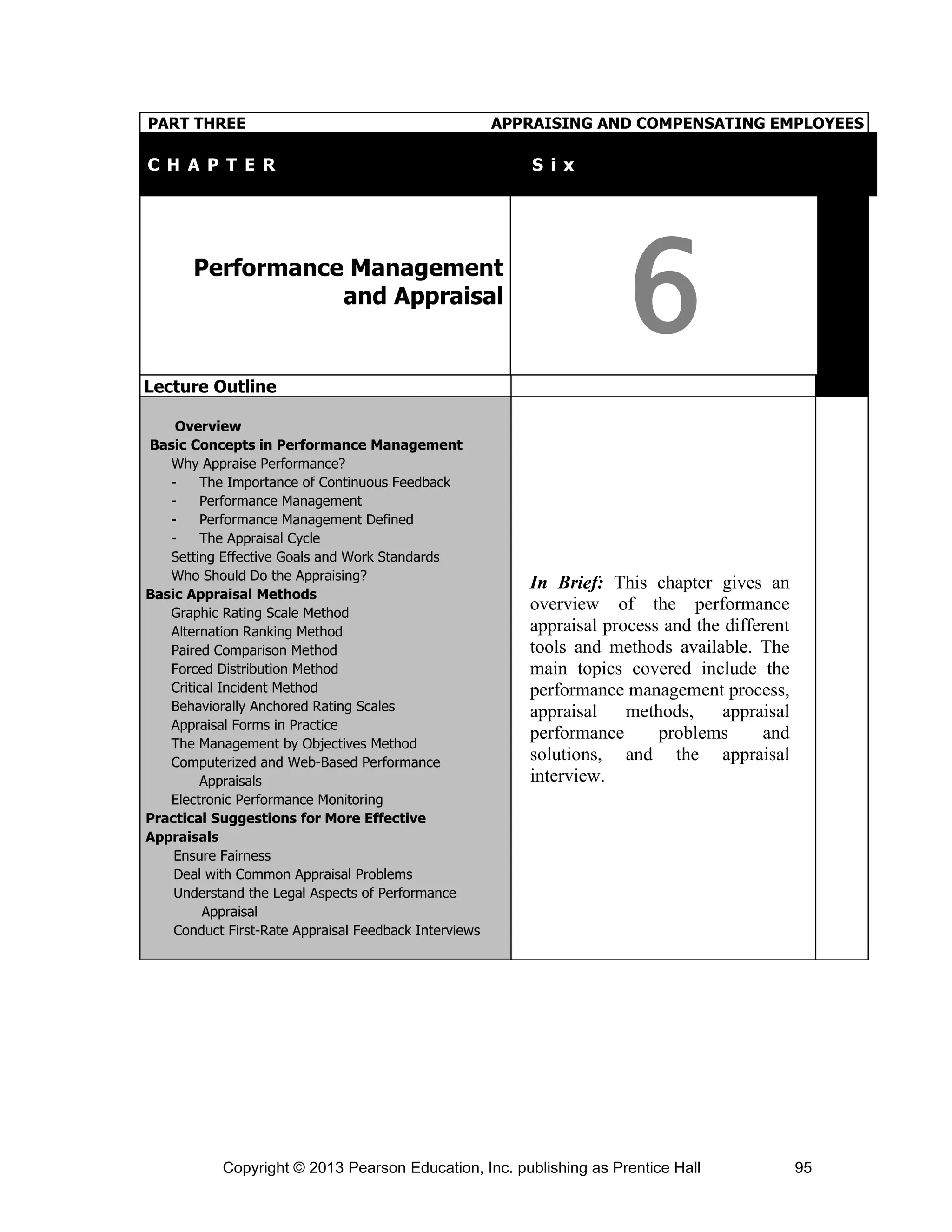
Copyright © 2013 Pearson Education, Inc. publishing as Prentice Hall 95
PART THREE APPRAISING AND COMPENSATING EMPLOYEES
C H A P T E R T S i x
Performance Management
and Appraisal
6
Lecture Outline
Overview
Basic Concepts in Performance Management
Why Appraise Performance?
- The Importance of Continuous Feedback
- Performance Management
- Performance Management Defined
- The Appraisal Cycle
Setting Effective Goals and Work Standards
Who Should Do the Appraising?
Basic Appraisal Methods
Graphic Rating Scale Method
Alternation Ranking Method
Paired Comparison Method
Forced Distribution Method
Critical Incident Method
Behaviorally Anchored Rating Scales
Appraisal Forms in Practice
The Management by Objectives Method
Computerized and Web-Based Performance
Appraisals
Electronic Performance Monitoring
Practical Suggestions for More Effective
Appraisals
Ensure Fairness
Deal with Common Appraisal Problems
Understand the Legal Aspects of Performance
Appraisal
Conduct First-Rate Appraisal Feedback Interviews
In Brief: This chapter gives an
overview of the performance
appraisal process and the different
tools and methods available. The
main topics covered include the
performance management process,
appraisal methods, appraisal
performance problems and
solutions, and the appraisal
interview.
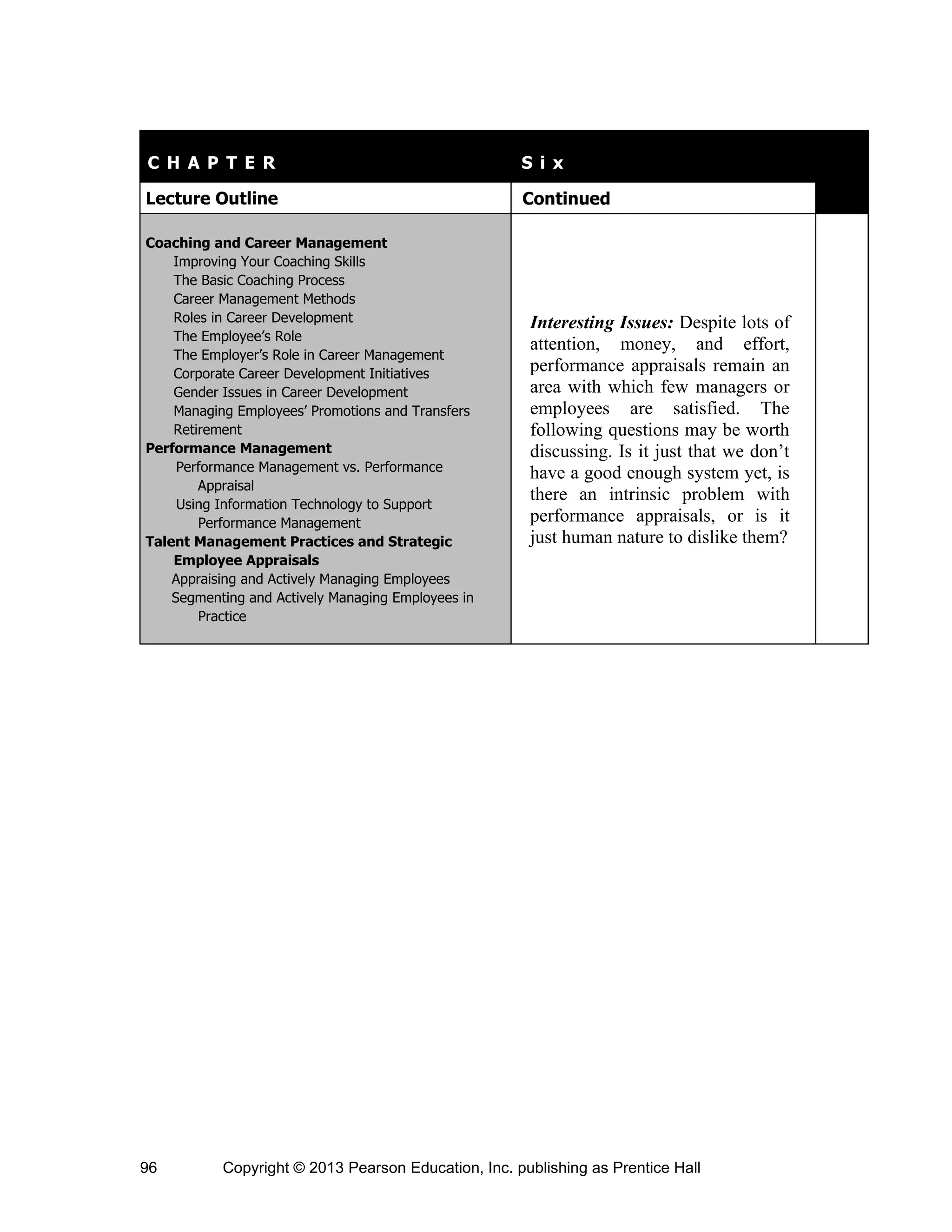
Copyright © 2013 Pearson Education, Inc. publishing as Prentice Hall
96
C H A P T E R T S i x
Lecture Outline Continued
Coaching and Career Management
Improving Your Coaching Skills
The Basic Coaching Process
Career Management Methods
Roles in Career Development
The Employee’s Role
The Employer’s Role in Career Management
Corporate Career Development Initiatives
Gender Issues in Career Development
Managing Employees’ Promotions and Transfers
Retirement
Performance Management
Performance Management vs. Performance
Appraisal
Using Information Technology to Support
Performance Management
Talent Management Practices and Strategic
Employee Appraisals
Appraising and Actively Managing Employees
Segmenting and Actively Managing Employees in
Practice
Interesting Issues: Despite lots of
attention, money, and effort,
performance appraisals remain an
area with which few managers or
employees are satisfied. The
following questions may be worth
discussing. Is it just that we don’t
have a good enough system yet, is
there an intrinsic problem with
performance appraisals, or is it
just human nature to dislike them?
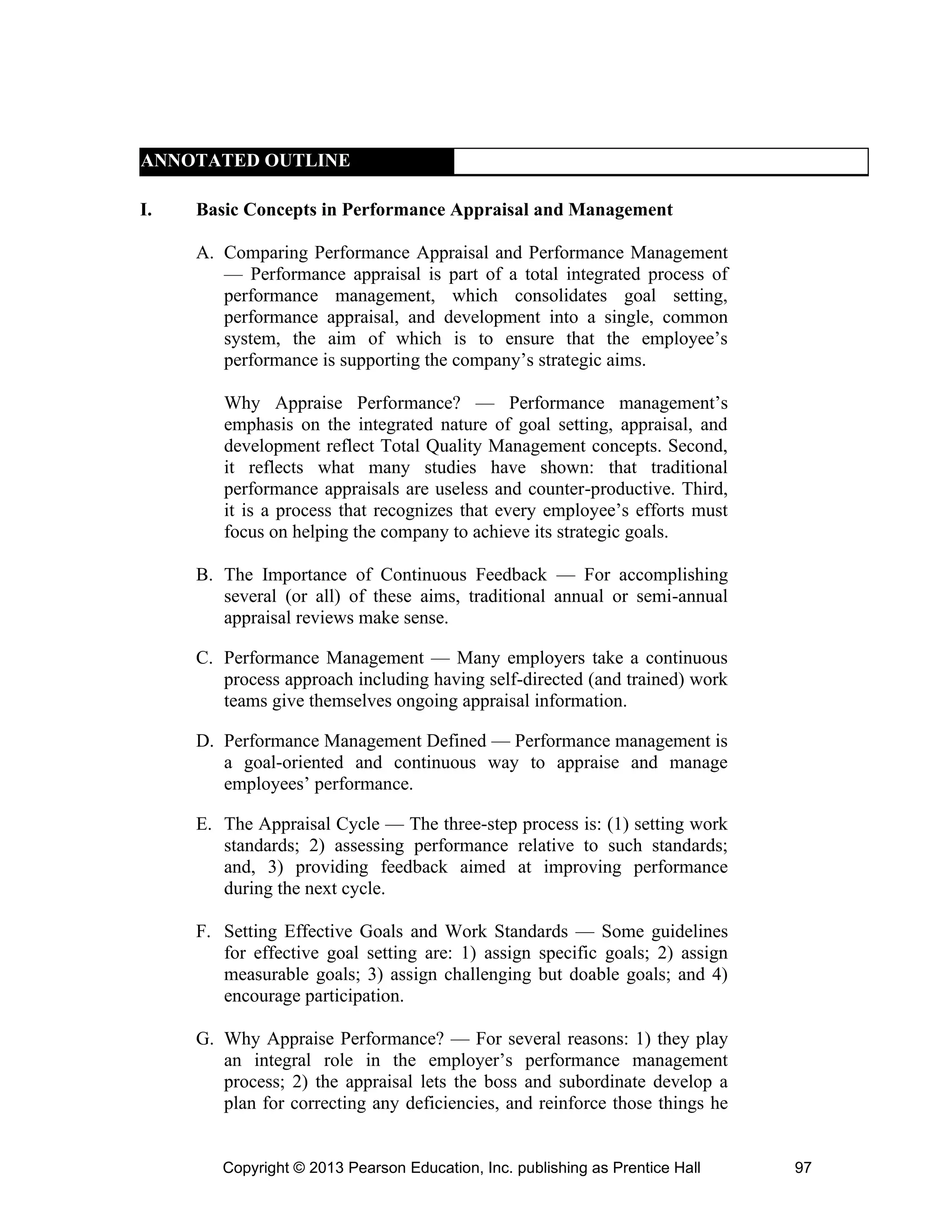
Copyright © 2013 Pearson Education, Inc. publishing as Prentice Hall 97
ANNOTATED OUTLINE
I. Basic Concepts in Performance Appraisal and Management
A. Comparing Performance Appraisal and Performance Management
— Performance appraisal is part of a total integrated process of
performance management, which consolidates goal setting,
performance appraisal, and development into a single, common
system, the aim of which is to ensure that the employee’s
performance is supporting the company’s strategic aims.
Why Appraise Performance? — Performance management’s
emphasis on the integrated nature of goal setting, appraisal, and
development reflect Total Quality Management concepts. Second,
it reflects what many studies have shown: that traditional
performance appraisals are useless and counter-productive. Third,
it is a process that recognizes that every employee’s efforts must
focus on helping the company to achieve its strategic goals.
B. The Importance of Continuous Feedback — For accomplishing
several (or all) of these aims, traditional annual or semi-annual
appraisal reviews make sense.
C. Performance Management — Many employers take a continuous
process approach including having self-directed (and trained) work
teams give themselves ongoing appraisal information.
D. Performance Management Defined — Performance management is
a goal-oriented and continuous way to appraise and manage
employees’ performance.
E. The Appraisal Cycle — The three-step process is: (1) setting work
standards; 2) assessing performance relative to such standards;
and, 3) providing feedback aimed at improving performance
during the next cycle.
F. Setting Effective Goals and Work Standards — Some guidelines
for effective goal setting are: 1) assign specific goals; 2) assign
measurable goals; 3) assign challenging but doable goals; and 4)
encourage participation.
G. Why Appraise Performance? — For several reasons: 1) they play
an integral role in the employer’s performance management
process; 2) the appraisal lets the boss and subordinate develop a
plan for correcting any deficiencies, and reinforce those things he
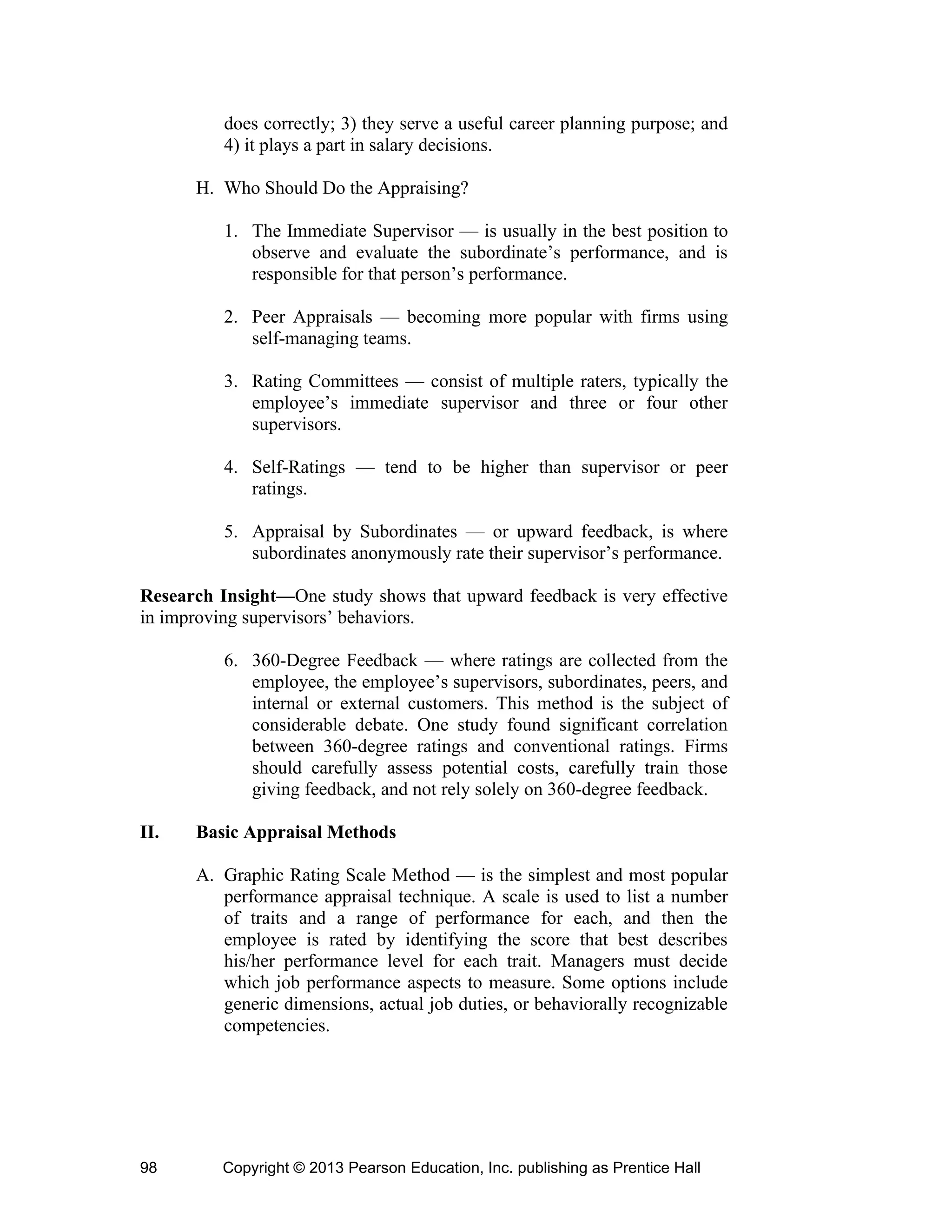
Copyright © 2013 Pearson Education, Inc. publishing as Prentice Hall
98
does correctly; 3) they serve a useful career planning purpose; and
4) it plays a part in salary decisions.
H. Who Should Do the Appraising?
1. The Immediate Supervisor — is usually in the best position to
observe and evaluate the subordinate’s performance, and is
responsible for that person’s performance.
2. Peer Appraisals — becoming more popular with firms using
self-managing teams.
3. Rating Committees — consist of multiple raters, typically the
employee’s immediate supervisor and three or four other
supervisors.
4. Self-Ratings — tend to be higher than supervisor or peer
ratings.
5. Appraisal by Subordinates — or upward feedback, is where
subordinates anonymously rate their supervisor’s performance.
Research Insight—One study shows that upward feedback is very effective
in improving supervisors’ behaviors.
6. 360-Degree Feedback — where ratings are collected from the
employee, the employee’s supervisors, subordinates, peers, and
internal or external customers. This method is the subject of
considerable debate. One study found significant correlation
between 360-degree ratings and conventional ratings. Firms
should carefully assess potential costs, carefully train those
giving feedback, and not rely solely on 360-degree feedback.
II. Basic Appraisal Methods
A. Graphic Rating Scale Method — is the simplest and most popular
performance appraisal technique. A scale is used to list a number
of traits and a range of performance for each, and then the
employee is rated by identifying the score that best describes
his/her performance level for each trait. Managers must decide
which job performance aspects to measure. Some options include
generic dimensions, actual job duties, or behaviorally recognizable
competencies.
Copyright © 2013 Pearson Education, Inc. publishing as Prentice Hall 99
B. Alternation Ranking Method — involves employees being ranked
from best to worst on a particular trait, choosing highest, then
lowest, next highest, next lowest, and so forth until all are ranked.
C. Paired Comparison Method — involves ranking employees by
making a chart of all possible pairs of employees for each trait and
indicating which is the better employee of the pair.
D. Forced Distribution Method — Predetermined percentages of rates
are placed in various performance categories; similar to grading on
a curve.
Teaching Tip: Discuss what the ramifications of using the forced distribution
method for class grades would be. Students will have strong opinions.
E. Critical Incident Method — a supervisor keeps a detailed record of
uncommonly good or undesirable examples of an employee’s
work-related behavior, and reviews it with the employee at
predetermined times.
F. Behaviorally Anchored Rating Scales (BARS) — combine the
benefits of narratives, critical incidents, and quantified scales, by
anchoring a scale with specific behavioral examples of good or
poor performance. The five steps in developing a BARS are: 1)
generate critical incidents; 2) develop performance dimensions; 3)
reallocate incidents; 4) scale the incidents; and 5) develop final
instrument. The advantages of BARS include a more accurate
gauge, clearer standards, feedback, independent dimensions, and
consistency.
G. Appraisal Forms in Practice — involve rating the employee’s
performance for each performance factor, writing down examples
and an improvement plan, aiding the employee in understanding
where his/her performance was good or bad, and summarizing by
focusing on problem solving.
H. Management by Objectives (MBO) — requires the manager to set
specific measurable goals with each employee and then
periodically discuss his/her progress toward these goals. The
process consists of six steps: 1) set the organization’s goals; 2) set
departmental goals; 3) discuss departmental goals; 4) mutually
define expected results; 5) conduct performance reviews; and 6)
provide feedback.
I. Computerized and Web-Based Performance Appraisal — generally
enables managers to keep notes on subordinates during the year,
Copyright © 2013 Pearson Education, Inc. publishing as Prentice Hall
100
rate employees on a series of performance traits, and then generate
written text to support each part of the appraisal. About one-third
of employers use online performance management tools for at least
some employees.
J. Electronic Performance Monitoring — systems used to allow
managers access to their employees’ computers and telephones.
III. Practical Suggestions for More Effective Appraisals Few
supervisory tasks are as complex and poorly administered than
appraisals.
A. Ensure Fairness — The first challenge is to make sure the
subordinate views the appraisal as fair. Many managers don’t focus
on the developmental aspect of the appraisal, but instead use it for
political purposes.
B. Deal with Common Appraisal Problems — It can be difficult to
rate performance for several reasons. Much depends on a good
rating, including career progress, or being able to obtain a raise.
There are also technical problems that can affect the fairness of the
process.
1. Unclear Standards — Ambiguous traits and degrees of merit
can result in an unfair appraisal.
2. Halo Effect — the influence of a rater’s general impression on
ratings of specific qualities, can be a problem.
3. Central Tendency — involves supervisors sticking to the
middle of the rating scales, thus rating everyone approximately
average.
4. Leniency or Strictness — Supervisors have the tendency to rate
everyone either high or low.
5. Bias — the tendency to allow individual differences such as
age, race, and sex to affect the appraisal ratings employees
receive is a problem.
Research Insight — Bias can influence the way a person appraises another
person. In one study, for example, the identical employee was rated differently
if pregnant.
Copyright © 2013 Pearson Education, Inc. publishing as Prentice Hall 101
C. Understand the Legal Aspect of Performance Appraisal —
Performance appraisals have legal implications, because they often
affect raises, promotions, training, and other HR actions.
D. Conduct First-Rate Appraisal Feedback Interviews — an interview
in which the supervisor and subordinate review the appraisal and
make plans to remedy deficiencies and reinforce strengths.
E. Preparing for the Appraisal Interview
Step 1 — give the subordinate enough notice to review his/her
work. Step 2 — Study his/her job description.
Step 3 — Choose the right place for the interview and schedule
enough time for it.
F. Conducting the Interview — Prepare for the interview by
conducting the interview in a private area without interruptions.
Talk in terms of objective, observable work data using examples.
Get agreement with the employee of how you will know
improvement has occurred. Ensure the process is fair and learn
how to deal with defensiveness.
IV. Coaching and Career Management
A. Improving Your Coaching Skills — Coaching means educating,
instructing, and training subordinates. Mentoring means advising,
counseling, and guiding. Coaching focuses on teaching shorter-
term job related skills, mentoring on helping employees navigate
longer-term career hazards.
B. The Basic Coaching Process — Preparing to coach involves
understanding the problem, the employee, and his or her skills.
Planning requires reaching consensus on the problem and on what
to change. Finally, once agreement is reached, educating,
instructing, training and ongoing encouragement are the important
steps in the change process.
V. Career Management Methods
A. Mentoring — Having a mentor — a senior person in the firm who
can be a sounding board for your career questions and concerns —
can enhance career satisfaction and success.
B. The Employee’s Role — An individual must accept responsibility
for his/her own career; assess his/her own interests, skills, and
values; and take the steps required to ensure a happy and fulfilling
Copyright © 2013 Pearson Education, Inc. publishing as Prentice Hall
102
career. Finding a mentor who can be a sounding board is often
helpful. Mentoring programs can be informal or formal.
Copyright © 2013 Pearson Education, Inc. publishing as Prentice Hall 103
B. The Employer’s Role — Employers can support career
development efforts in many ways. There are several
organizational career-planning practices. The means for helping to
further an employee’s career depends on the length of time the
employee has been with the firm.
C. Gender Issues in Career Development—Women and men face
different challenges as they advance through their careers. Women
face the glass ceiling. Minority women may be particularly at risk.
D. Managing Employees’ Promotions and Transfers
1. Making Promotion Decisions — Promotions usually provide
opportunities to reward the exceptional performance of tested
and loyal employees. However, unfairness, arbitrariness, or
secrecy can diminish the effectiveness of the promotion
process for all concerned.
2. Handling Transfers — Transfers are moves from one job to
another, usually with no change in salary or grade. The
frequent relocating of transfer employees has been assumed to
have a damaging effect on transferees’ family life. Transfers
are also costly financially.
E. Retirement—Some employers are instituting formal preretirement
counseling aimed at easing the passage of their employees into
retirement. A large majority of employees have said they expect to
continue to work beyond the normal retirement age. Part-time
employment is an alternative to outright retirement. Employers can
benefit from retirement planning by becoming able to anticipate
labor shortages.
1. Create a Culture that Honors Experience — Changing cultures
that are explicitly or implicitly biased against older workers
can help make a company more attractive to retirees.
2. Modify Selection Procedures
3. Offer Flexible Work — Redesigning jobs to include
telecommuting and other options will attract and retain
workers.
4. Phased retirement — Phased retirement programs combine
reduced work hours, job change, and reduced responsibilities.
VI. Performance Management
Copyright © 2013 Pearson Education, Inc. publishing as Prentice Hall
104
A. Performance management vs. Performance Appraisal — refers to an ongoing,
continuous process of deciding upon goals, evaluating results and providing
feedback. It is always goal-directed.
B. Using Information Technology to Support Performance Management —
allows the supervisor to assign financial and nonfinancila goals to each team’s
acitivities and to keep all employees informed of their goals.
Copyright © 2013 Pearson Education, Inc. publishing as Prentice Hall 105
VII. Talent Management Practices and Strategic Employee Appraisals
A. Appraising and Actively Managing Employees — Several examples of
strategically managing employees performance and value to the organization
are provided.
B. Segmenting and Actively Managing Employees in Practice — Compass
Group, Tesco PLC, McKinsey Consulting and others are highlighted as
examples.
Copyright © 2013 Pearson Education, Inc. publishing as Prentice Hall
106
KEY TERMS
Performance appraisal Evaluating an employee’s current or past performance
relative to his/her performance standards.
Performance management Is the continuous process of identifying, measuring, and
developing the performance of individuals and teams and
aligning their performance with the organization’s goals.
Performance appraisal Involves this three-step process:
process 1. Setting work standards
2. Assessing the employee’s actual performance relative to
those standards
3. Providing feedback to the employee
Peer appraisal Appraisal of an employee by his or her peers.
Upward feedback Appraisals in which subordinates rate their supervisors’
performance.
Graphic rating scale Lists a number of traits and a range of performance for
each.
Alternation ranking This method is used to indicate the employee who is the
method highest on the trait being measured and also the one who is
the lowest.
Paired comparison method An appraisal method in which every subordinate to be rated
is paired with and compared to every other subordinate on
each trait.
Forced distribution method The manager places predetermined percentages of
subordinates in performance categories.
Critical incident method Entails keeping a record of uncommonly good or
undesirable examples of an employee’s work-related
behaviors and reviewing it with the employee periodically.
Management by objective This method requires the manager to set measurable goals
with each employee and then periodically discuss the
latter’s progress toward these goals.
Halo effect Means that the rating of a subordinate on one trait
influences the way you rate the person on other traits.
Copyright © 2013 Pearson Education, Inc. publishing as Prentice Hall 107
Central tendency Refers to a tendency to rate all employees about average.
Appraisal interview An interview in which the supervisor and subordinate
review the appraisal and make plans to remedy deficiencies
and reinforce strengths.
Coaching Means educating, instructing, and training subordinates.
Copyright © 2013 Pearson Education, Inc. publishing as Prentice Hall
108
Career management A process for enabling employees to better understand and
develop their career skills and interests and to use these
skills and interests both within the company and even after
they leave the firm.
DISCUSSION QUESTIONS
1. Discuss the pros and cons of at least four performance appraisal tools. The text
lists nine different performance appraisal tools (methods). Students might discuss the
pros and cons of any four of these nine. (Examples of some of the pros and cons are:
Graphic Rating Scale method is easy to use, simple, and does not take much time to
administer. However, different supervisors may interpret a numerical rating
differently, and the traits rated may or may not relate to performance.)
2. Explain how you would use the alternation ranking method, the paired
comparison method, and the forced distribution method. The alternation method
would be used by listing all employees to be rated, deciding who is the best in a trait
to be rated, and who is the worst. Then decide who is the second best, and the second
worst, the third best and the third worst, and so on, until all the employees have been
ranked for that trait. Then do the same with the next trait to be rated. With the paired
comparison, for each trait to be rated, the supervisor would have a sheet with
employee names in pairs; every employee name is paired with every other name. For
each pair, the supervisor would circle the one of the two that is better in that trait.
Forced distribution gives the supervisor a set rating scale (such as 1 through 5). The
supervisor is limited to giving a predetermined percentage of his/her employees’
rating. For example: 15 percent can get a 1, 20 percent can get a 2, 30 percent can get
a 3, and so forth.
3. Explain the problems to be avoided in appraising performance. The five main
rating-scale problems listed in the text are: 1) unclear standards; 2) halo effect; 3)
central tendency; 4) leniency or strictness; and 5) bias. Students should define and
describe them, not simply list them.
4. Discuss the pros and cons of using different potential raters to appraise a
person’s performance. The advantages of using several raters (either a rating
committee or a combination of peer, supervisor, and subordinate ratings) are that the
ratings tend to be more valid than those of one individual rater. The negatives might
include the time and cost involved, as well as problems with the amount of daily
contact that some raters may not have with the employee being rated.
5. Explain how to conduct an appraisal interview. There are four things listed in the
text to keep in mind: 1) be direct and specific; 2) don’t get personal; 3) encourage the
person to talk; and 4) don’t tiptoe around. Students should expound on these basic
principles of conducting the interview.
Copyright © 2013 Pearson Education, Inc. publishing as Prentice Hall 109
INDIVIDUAL AND GROUP ACTIVITIES
1. Working individually or in groups, develop a graphic rating scale for the
following jobs: secretary, engineer, and directory assistance operator. Job
characteristics may include but not be limited to: Secretary—quantity of work,
frequency of errors, attendance, and initiative; Engineer—initiative, significance of
contribution to the organization, problem-solving skills, frequency of errors, and
communication skills; Directory Assistance Operator—speed, attendance, accuracy,
and friendliness.
2. Working individually or in groups, describe the advantages and disadvantages
of using the forced distribution appraisal method for college professors. The
disadvantages include decreased morale, interdepartmental inequities, and unfair
rankings. The advantages would include steering clear of many of the biases listed, as
well as overcoming the central tendency problem.
3. Working individually or in groups, develop, over the period of a week, a set of
critical incidents covering the classroom performance of one of your instructors.
If you had the class conduct a job analysis and create a job description for an
instructor in Chapter 3, it would be helpful to refer to that to help identify what kinds
of behavior and tasks the instructor should be doing. This will give a good basis for
students to observe and watch for critical incidents. If they find critical incidents that
are not based in these other documents, it will be a good opportunity to go back and
review how all this ties together and that we haven’t communicated to the instructor
in the job description these behaviors or tasks for which they are now wanting to rate
them.
4. Working individually or in groups, evaluate the rating scale in Figure 6.1.
Discuss ways to improve it. There are many things that might be suggested for
improvements. These suggestions might include but not be limited to: clearer
explanation of the rating scale (what does “very descriptive” mean?), consider
reducing the rating scale from seven points to four or five, provide behavioral anchors
for the scale points, and rework the items so that each one is only rating one trait or
behavior (some have several).
HR in Action Case Incident 1: Appraising the Secretaries at Sweetwater U
1. Do you think that the experts’ recommendations will be sufficient to get most of
the administrators to fill out the rating forms properly? Why? Why not? What
additional actions (if any) do you think will be necessary? Although controversial,
APPLICATION EXERCISES
Copyright © 2013 Pearson Education, Inc. publishing as Prentice Hall
110
the recommendations would, in fact, encourage administrators to fill the forms out
correctly. Using the more detailed form and not tying the performance ratings to
salary increases would allow the managers to feel more free about rating the
secretaries accurately. There would, however, need to be some strong training
sessions (both for administrators and secretaries) to help them understand the new
system. Because all secretaries have traditionally received the same salary increases,
and have been pleased with that, it would be advisable to consider lowering the
maximum increase to an amount that could be given to all secretaries while staying
within budget. Then all secretaries with a satisfactory rating or better would receive
that increase.
2. Do you think that Vice President Winchester would be better off dropping
graphic rating forms, substituting instead one of the other techniques we
discussed in this chapter such as a ranking method? Why? Certainly other
methods could be used. He has already had a taste of what would result if he went to
a forced distribution or other ranking method. A BARS system might be best, but it
could be costly to develop if the clerical staff has positions that are significantly
different.
3. What performance appraisal system would you develop for the secretaries if you
were Rob Winchester? Defend your answer. If the development costs are not too
great, the BARS system would give the strongest solution to the current situation. The
behavioral anchors would make it more difficult to just rate everyone at the top. It
would also help to eliminate the different interpretations of what the rating scales
mean.
Continuing Case: Carter Cleaning Company
1. Is Jennifer right about the need to evaluate the workers formally? The
managers? Why or why not? Based on the information presented in the chapter, the
students need to determine if the workers and managers should be evaluated formally
or informally, and they need to provide reasons for their decision. Of course she is
right! Jennifer already outlined some of the reasons for the need for appraisals:
probationary period, motivation, feedback, and so on. It is not clear that objectives
and goals have been clearly established and communicated. Also, it is important to tie
salary, promotion, and disciplinary decisions to these goals. Without it, employees
will do what they prefer or enjoy doing. With it, they should understand what the
priorities are and what they need to be doing.
2. Develop a performance appraisal method for the workers and managers in each
store. The students need to be familiar with different appraisal methods discussed in
the chapter. They should use the sample appraisal forms given in the chapter as
guides.
Copyright © 2013 Pearson Education, Inc. publishing as Prentice Hall 111
Experiential Exercise: Setting Goals and Appraising an Instructor
Purpose: The purpose of this exercise is to give you practice in developing and using a
performance appraisal system.
Required Understanding: You are going to develop a performance appraisal form for
an instructor and should therefore be thoroughly familiar with the discussion of
performance appraisals in this chapter.
How to Set up the Exercise: Divide the class into groups of four or five students. 1)
First, based on what you now know about performance appraisals, do you think Figure
6.1 is an effective scale for appraising instructors? Why? 2) Next, the group should
develop its own tool for appraising the instructor. 3) Last, have a spokesperson from each
group put his/her group’s appraisal tool on the board.
Exploring the Variety of Random
Documents with Different Content
III. MILITARY CAMPAIGNS
1861
Late in April, 1861, the Confederate government moved its capital
from Montgomery, Ala., to Richmond, Va. This transfer was intended
to bind Virginia closer to the other Southern states and to put the
Confederate government nearer Washington when the time came to
discuss the peace treaty. In reality the move backfired. It made
Richmond the primary Federal target and Virginia the major
battleground of the Civil War.
Few engagements occurred in 1861, when neither North nor South
had a highly organized, efficient army. What both sides in 1861 called
armies were more like armed and unruly mobs. Yet President Lincoln
and the Congress, hoping to end the war quickly, were anxious to
capture Richmond.
As a result, Federal forces made three thrusts into Virginia. They first
moved from Ohio into the pro-Northern counties of western Virginia,
where Confederate regiments as “green” as the Federal units were
stationed. In a series of small battles, including Philippi (June 3), Rich
Mountain (July 11), and Corrick’s Ford (July 13), the Federals were
victorious. In 1863 this region entered the Union as the loyal state of
West Virginia.
The other two Federal invasions were less successful. The main
Virginia defenses stretched from Norfolk northward to the Potomac
River, thence westward to Harpers Ferry. Early in June, Gen.
Benjamin F. Butler left Fort Monroe with a Federal force and struck at
Richmond by way of the peninsula between the James and York
rivers. At Big Bethel Church, just west of Yorktown, Confederates
attacked and sent Butler’s men stampeding back to their base at Fort
Monroe.
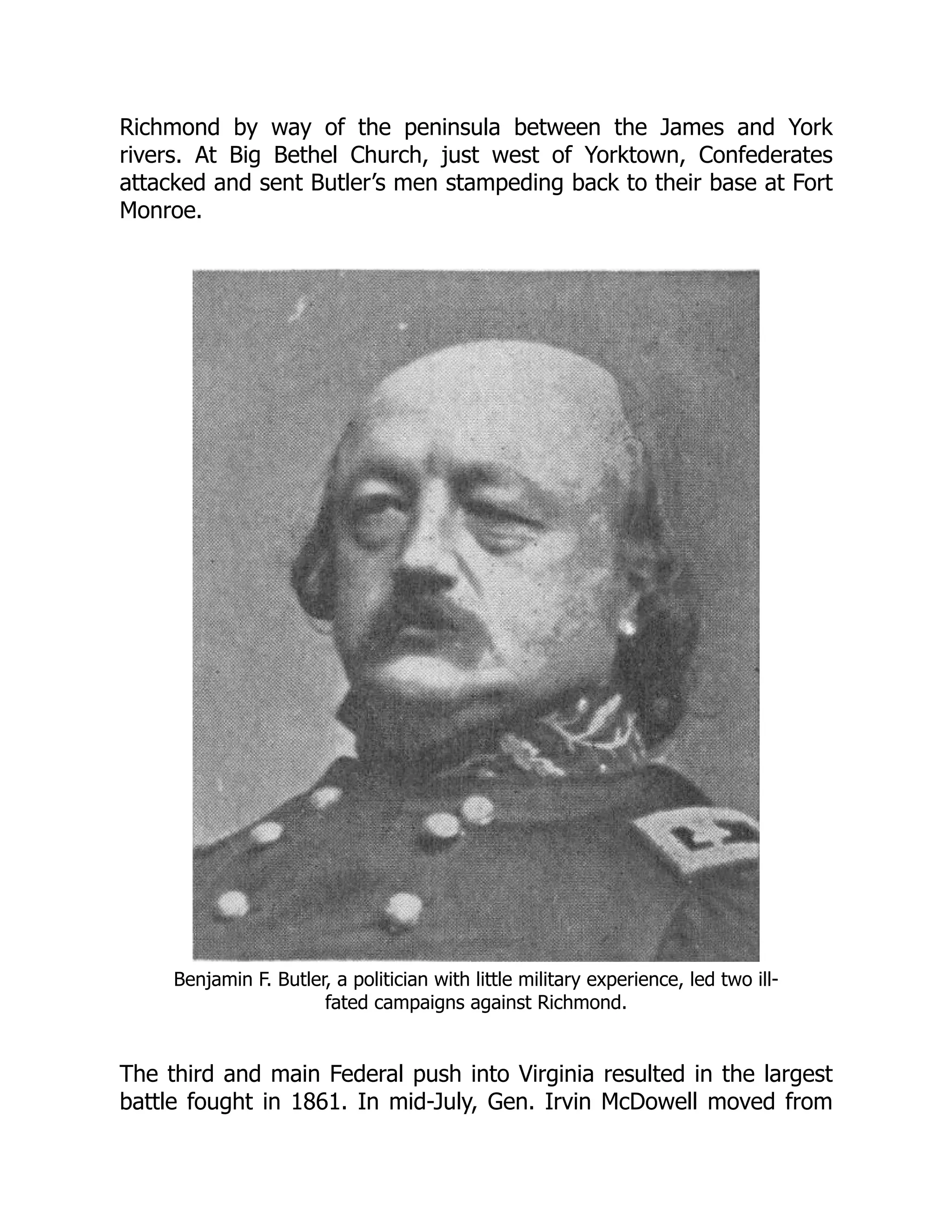
Benjamin F. Butler, a politician with little military experience, led two ill-
fated campaigns against Richmond.
The third and main Federal push into Virginia resulted in the largest
battle fought in 1861. In mid-July, Gen. Irvin McDowell moved from
12
Washington with some 35,000 recruits. McDowell’s ultimate target
was Richmond, but first he had to capture the important railroad
junction of Manassas. Through espionage agents the Confederates
learned of McDowell’s advance. Quickly Gens. P. G. T.
Beauregard and Joseph E. Johnston concentrated 30,000
Southern troops near Manassas to block the Federal move. On a very
hot Sunday, July 21, McDowell attacked Beauregard and Johnston
near a stream known as Bull Run. As in the case of many Civil War
battles, the main attack was against the flank (or end) of the line,
while for deception a lesser assault force struck at the center of the
defending force’s position.
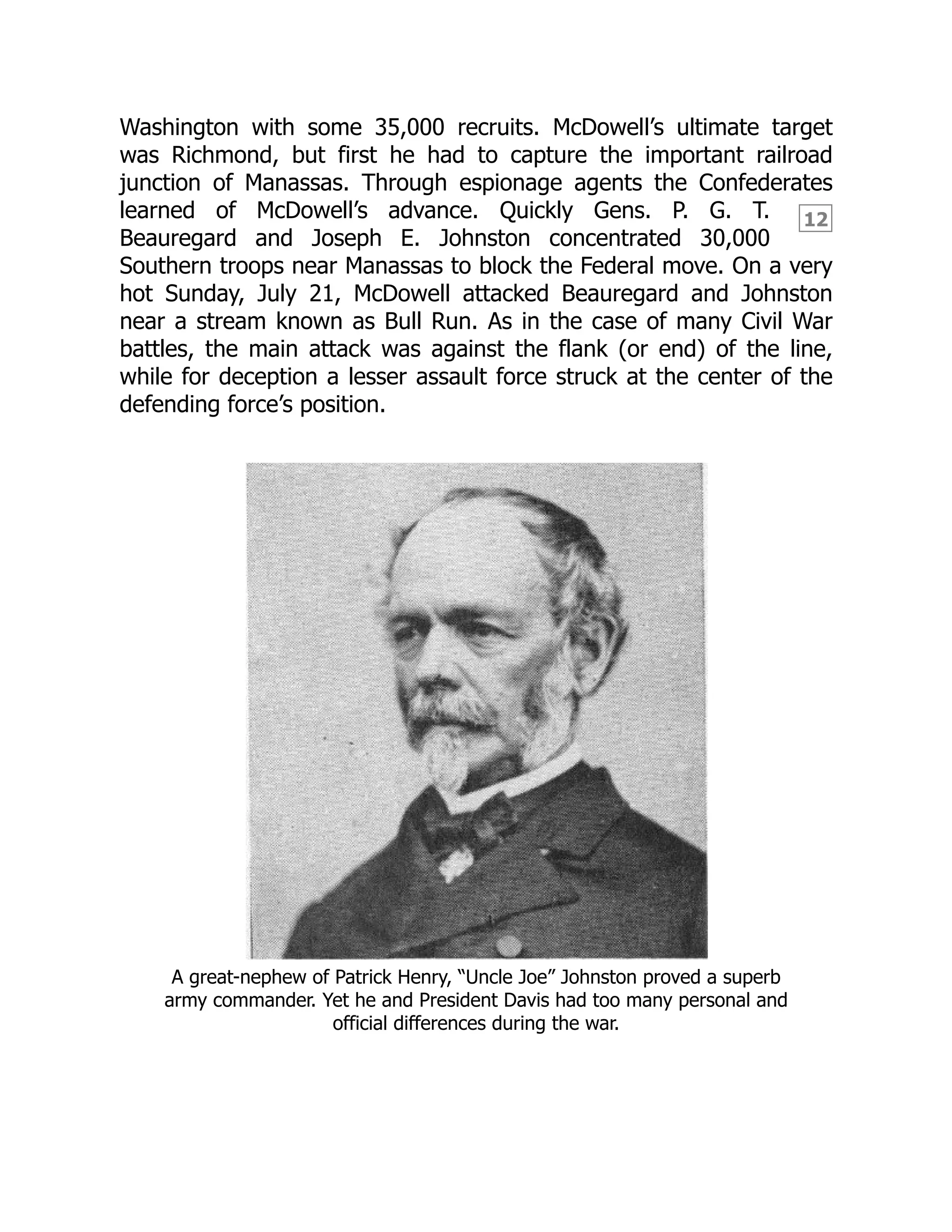
A great-nephew of Patrick Henry, “Uncle Joe” Johnston proved a superb
army commander. Yet he and President Davis had too many personal and
official differences during the war.
13
The Federals might have won a smashing victory that day but for a
stubborn brigade of Virginians under Gen. Thomas J. Jackson. The
refusal of Jackson and his men to give ground not only helped save
the day for the South but also earned for that general and his brigade
the name “Stonewall.”
Losses in the battle of First Manassas, or First Bull Run, were much
less than those in the larger battles to come. The Federals lost 2,896
men killed, wounded, and missing. The Confederates suffered 1,982
casualties.
This battle at Manassas had several important effects. Southerners
were convinced that Yankees were poor fighters, and that the war
would be brief. On the other hand, Northerners realized that
defeating the Confederacy would take longer than anticipated. Thus,
while Southerners celebrated a great victory, the North began raising
and equipping large armies for full-scale war.
A month later occurred an engagement in the West. On August 10, a
Federal army sought out and attacked a Confederate force at Wilson’s
Creek, near Springfield, Mo. In this battle, often called “Bull Run of
the West,” the Federals met defeat. The Union commander, Gen.
Nathaniel Lyon, was killed in the midst of the fighting.
On October 21, the North suffered another costly setback. Near Ball’s
Bluff, Va., Confederate defenders all but annihilated a Federal
scouting force. The “Ball’s Bluff disaster” spurred into action the
“Committee on the Conduct of the War.” Seven U. S. congressmen
made up this investigating body. Although not one had had army
training, they continually inquired into the military affairs of every
Federal army and often embarrassed generals in the field.
While Confederates in 1861 won most of the battles, Lincoln and his
government by no means felt defeated. Gen. George B. McClellan
was building an army at Washington that would soon number
100,000 volunteer troops. This force would be the largest ever
amassed in the Western Hemisphere up to that time. Moreover, the
North had won a few victories. On November 7, a Federal amphibious
force had captured Port Royal, S. C., thus gaining a beachhead on the
South Atlantic coast. Yet on that same day, another Federal army
suffered defeat at Belmont, Mo. The losing general was an unknown
officer from Illinois, and this was his first Civil War battle. His name
was Ulysses S. Grant.
1862 IN THE WEST
War’s full fury struck in 1862. To understand the complicated
movements of many armies, bear in mind two points:
(1) Not one, but two, separate areas of military operations existed.
The Appalachian Mountains, extending in an almost unbroken line
from Pennsylvania to Alabama, prevented armies from moving freely
from eastern states (Virginia, the Carolinas, etc.) to western or trans-
Appalachian states (Tennessee, Kentucky, etc.), and vice versa. As a
result, different armies in the East (east of the mountains) and in the
West fought practically two almost independent wars. Only in 1864
were the campaigns of the two areas effectively coordinated.
(2) In the 1800’s, in contrast to modern military tactics, an invading
army did not always move directly against an enemy force. Rather, its
primary target was usually an important city. Once the invading army
was in motion, the defending force then tried to place itself between
the invader and his target. This set the stage for battle. Five such
Confederate cities became principal Federal targets. In the East was
Richmond; in the West were New Orleans and Vicksburg, both
strongholds on the all-important Mississippi River, and Chattanooga
and Atlanta, vital railroad centers.
Bearing these two points in mind, let us turn to the Western
campaigns of 1862.
14
At the beginning of 1862 some 48,000 Confederate soldiers guarded
a 600-mile line extending from the Appalachian Mountains westward
to the Mississippi River. Obviously the Southern defenses were thinly
manned. Early in February, Gen. Ulysses S. Grant left Cairo, Ill., with
15,000 men to attack the center of this line. His goal was to gain
control of two important rivers, the Tennessee and the Cumberland.
To protect these streams, the Confederates had constructed twin
forts in Tennessee just south of the Kentucky border. Fort Henry
guarded the Tennessee; Fort Donelson stood menacingly on the
banks of the Cumberland. On February 6 a Federal river fleet
cooperating with Grant battered Fort Henry into submission.
Ten days later Grant had surrounded Fort Donelson and its 12,000
defenders. Answering the Confederate commander’s request for
surrender terms, Grant replied: “No terms but unconditional
surrender.” Thereafter, U. S. Grant was “Unconditional Surrender”
Grant.
Grant’s victories brought great rejoicing in the North. Some writers
consider the Henry-Donelson campaign as “the critical operation” of
the Civil War. Capture of these forts assured Union control of
Kentucky and Tennessee and opened Mississippi and Alabama to
Federal invasion. The loss of the forts was a severe blow to Southern
morale. With these successes the North had also demonstrated its
ability and willingness to fight.
Meanwhile, an important battle occurred farther to the west for
control of Arkansas and Missouri. On March 7-8, at Pea Ridge (or
Elkhorn Tavern), Ark., a Confederate army of 16,000 men attacked
12,000 Federals under Gen. Samuel R. Curtis. Most of the
Confederates lacked uniforms and were armed with shotguns and
squirrel rifles. This force also included 3,500 Indians of the Creek,
Choctaw, Cherokee, Chickasaw and Seminole tribes. After two days of
fighting, a Federal counterattack broke the Confederate “army.” With
the defeat at Pea Ridge the Confederates permanently lost Missouri
and northern Arkansas.
15
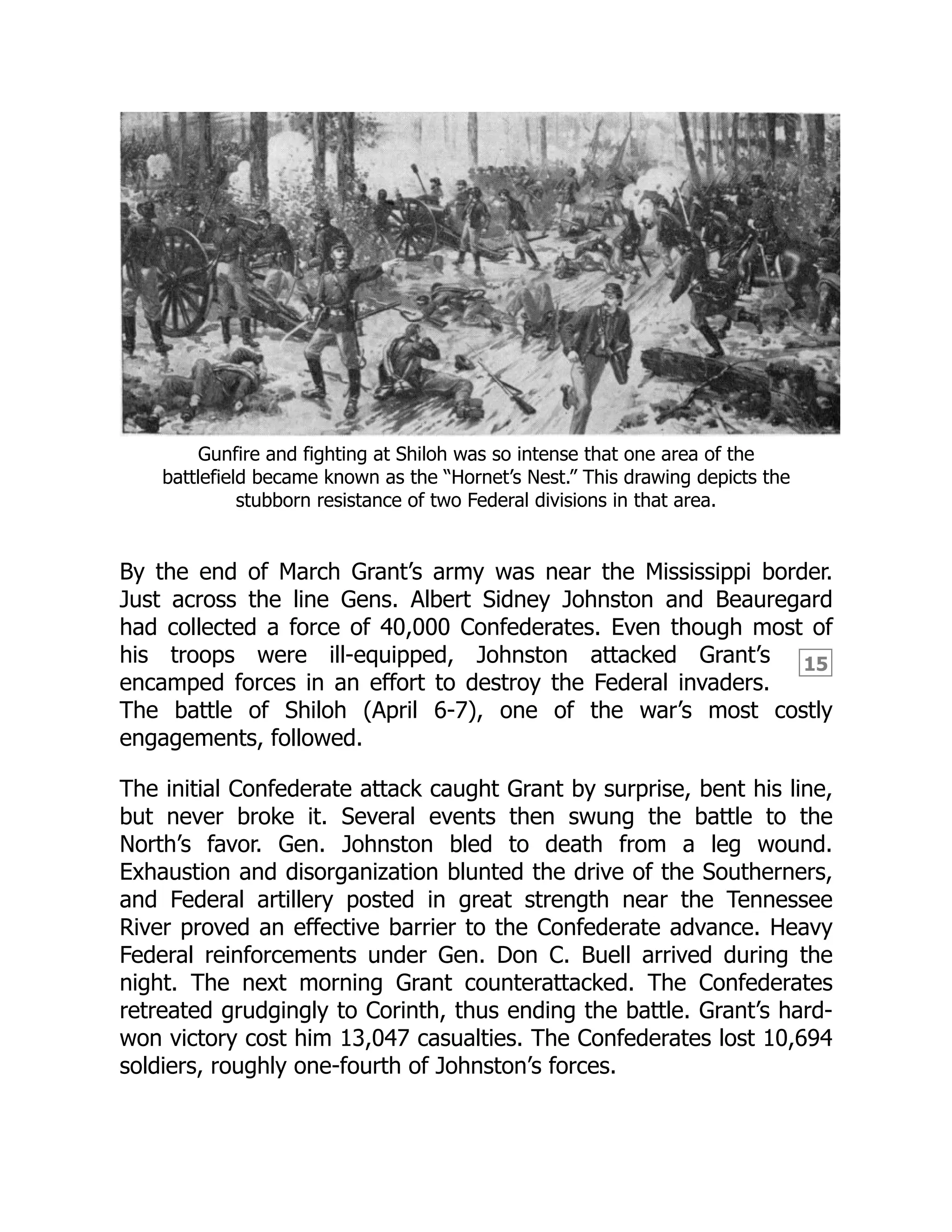
Gunfire and fighting at Shiloh was so intense that one area of the
battlefield became known as the “Hornet’s Nest.” This drawing depicts the
stubborn resistance of two Federal divisions in that area.
By the end of March Grant’s army was near the Mississippi border.
Just across the line Gens. Albert Sidney Johnston and Beauregard
had collected a force of 40,000 Confederates. Even though most of
his troops were ill-equipped, Johnston attacked Grant’s
encamped forces in an effort to destroy the Federal invaders.
The battle of Shiloh (April 6-7), one of the war’s most costly
engagements, followed.
The initial Confederate attack caught Grant by surprise, bent his line,
but never broke it. Several events then swung the battle to the
North’s favor. Gen. Johnston bled to death from a leg wound.
Exhaustion and disorganization blunted the drive of the Southerners,
and Federal artillery posted in great strength near the Tennessee
River proved an effective barrier to the Confederate advance. Heavy
Federal reinforcements under Gen. Don C. Buell arrived during the
night. The next morning Grant counterattacked. The Confederates
retreated grudgingly to Corinth, thus ending the battle. Grant’s hard-
won victory cost him 13,047 casualties. The Confederates lost 10,694
soldiers, roughly one-fourth of Johnston’s forces.
16
For the next four months the armies of Grant and Bragg (who
eventually succeeded to command) did not meet in battle. However,
three significant events took place elsewhere in the Western theater.
One was the Federal capture of the mouth of the Mississippi River. In
April a fleet under Flag Officer David G. Farragut blasted its way
upriver past Forts Jackson and St. Philip. By the end of May the
strategic river cities of New Orleans, Baton Rouge and Natchez were
under Federal control. Yet a river attack on Vicksburg failed.
The second event was one of the boldest raids in American history. In
April James J. Andrews, a Federal espionage agent, and twenty-one
Northern soldiers sneaked through Confederate territory to Big
Shanty Station, Ga., only thirty miles from Atlanta. There they stole
the engine “General” and two cars of a Western & Atlantic passenger
train. The Federals’ plan was to race up the tracks to Chattanooga,
removing rails, burning bridges, and thus ruining this important line.
The coup might have succeeded but for the perseverance of a
handful of citizens and soldiers, who gave immediate pursuit on foot,
by handcar, and eventually on an engine (“The Texas”) running in
reverse. All of the raiders were soon captured. Andrews and seven of
his men were subsequently hanged in Atlanta.
Southern raiders soon gained a measure of revenge. In July, 1862,
Col. John Hunt Morgan led his Confederate cavalrymen on a two-
week slash through Kentucky. Morgan won four small battles,
captured 1,200 Federals, and returned safely to Tennessee with less
than 100 casualties. In December Morgan again struck into Kentucky.
This “Christmas Raid” netted 1,900 prisoners and large quantities of
horses and military stores.
Shortly after Morgan’s First Kentucky Raid, Gen. Bragg invaded the
same state. Bragg hoped to occupy the chief cities and, by “military
persuasion,” to bring Kentucky into the Confederacy. Yet
caution eventually got the better of Bragg. He retreated, even
after winning a tactical victory over Gen. Don C. Buell at Perryville on
October 8. This invasion marked the end of Confederate efforts to
wrest Kentucky from the Union.
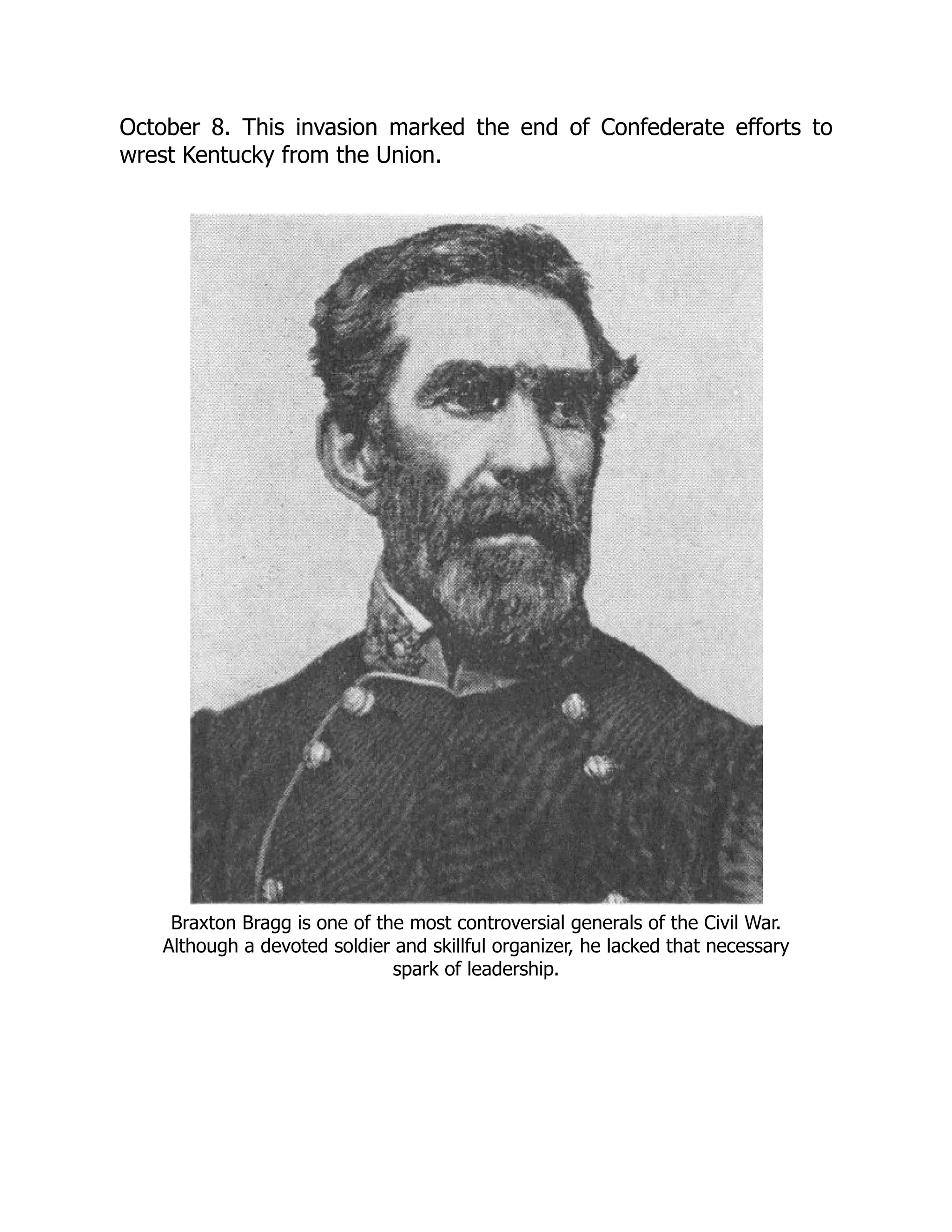
Braxton Bragg is one of the most controversial generals of the Civil War.
Although a devoted soldier and skillful organizer, he lacked that necessary
spark of leadership.
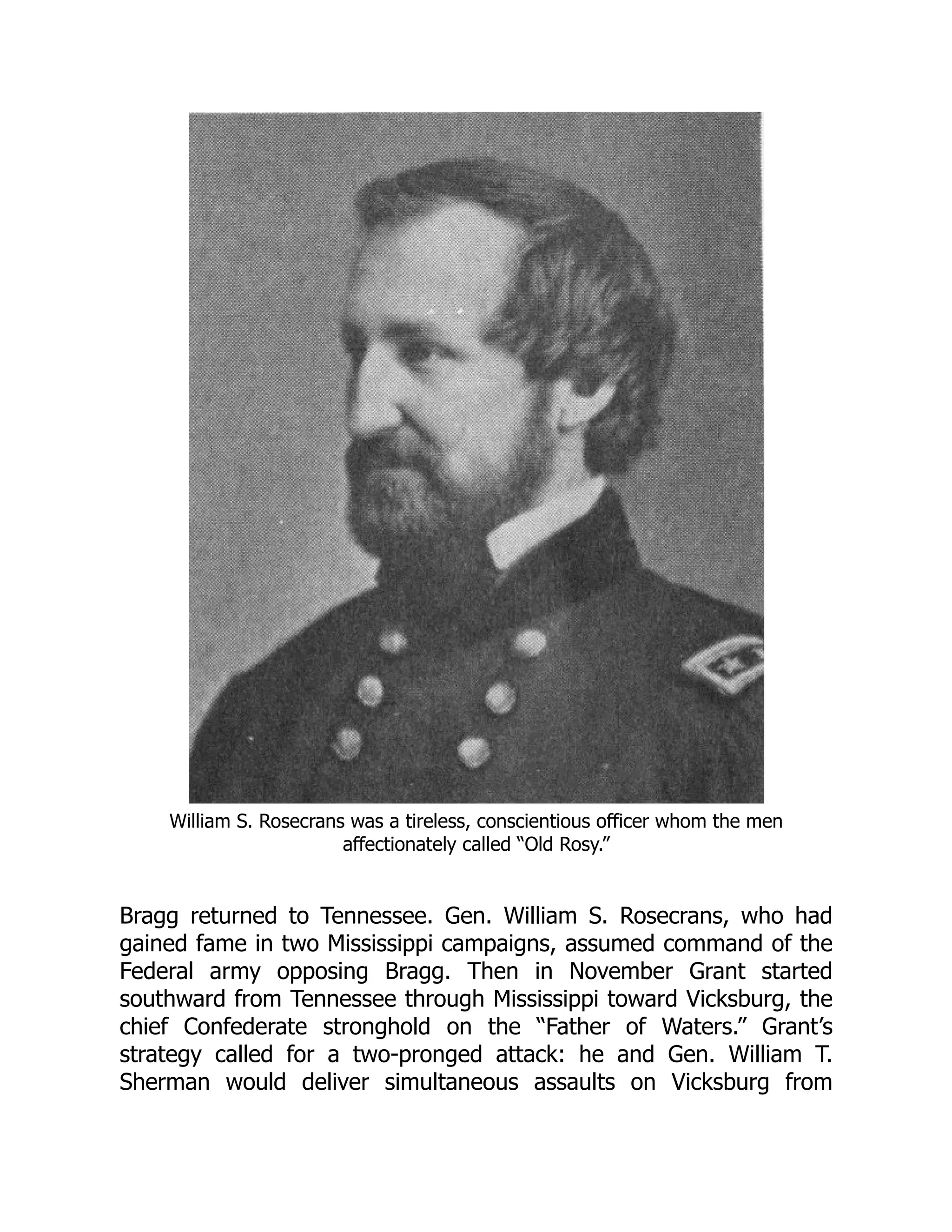
William S. Rosecrans was a tireless, conscientious officer whom the men
affectionately called “Old Rosy.”
Bragg returned to Tennessee. Gen. William S. Rosecrans, who had
gained fame in two Mississippi campaigns, assumed command of the
Federal army opposing Bragg. Then in November Grant started
southward from Tennessee through Mississippi toward Vicksburg, the
chief Confederate stronghold on the “Father of Waters.” Grant’s
strategy called for a two-pronged attack: he and Gen. William T.
Sherman would deliver simultaneous assaults on Vicksburg from
17
different directions. The plan was a costly failure. Confederate cavalry
under Gen. Earl Van Dorn destroyed Grant’s main supply base at
Holly Springs. Grant was forced to fall back to Memphis. Sherman’s
assaults on December 28-29 at Chickasaw Bayou were repulsed with
heavy losses. Grant then moved his entire army down the Mississippi
and prepared to take Vicksburg by attack or siege.
The final Western engagement of 1862 began on the last day of the
year near Murfreesboro, Tenn. For the better part of four days
Bragg’s Confederate army waged a desperate fight along the banks of
Stone’s River with Rosecrans’s Federal forces. Tactically the battle was
a draw. Yet the Federals lost 31% in killed, wounded, and missing,
while the Confederates suffered 25% casualties.
1862 IN THE EAST
For seven months McClellan’s large army lay inactive around
Washington. Finally Lincoln, his patience exhausted, ordered
McClellan to advance into Virginia. McClellan dismissed the dangerous
overland route to Richmond. Rather, he proposed to transport his
forces by water to Fort Monroe. Thence he would advance westward
on Richmond by way of the same peninsula where Butler had met
defeat the preceding year. This was the framework of the Peninsular
Campaign.
The creation of the Army of the Potomac was the work largely of George
B. McClellan. In 1864 he ran unsuccessfully as Democratic candidate for
President.
Lincoln finally agreed to the plan. To protect Washington, however,
he ordered McDowell’s corps of 37,000 soldiers to remain in the
Fredericksburg-Manassas area.
By April McClellan was on the Virginia peninsula with 105,000 men.
In the meantime, Gen. Joseph E. Johnston, commanding the
Confederate forces in Virginia, had concentrated his small army on
18
the peninsula between McClellan and Richmond. McClellan slowly
advanced westward; Johnston, with only 60,000 men, had no choice
but to fall back and fight delaying actions. Driving rains turned the
country into a vast sea of mud. By the end of May McClellan’s army
had reached Seven Pines. The spires of Richmond were visible, nine
miles away.
But Seven Pines was as close as McClellan ever got to the
Confederate capital. Johnston noticed that the Federal army had been
divided into two parts by the flooded Chickahominy River. He then
launched attacks against McClellan’s left (southern) flank. The muddy
battles of Seven Pines and Fair Oaks (May 31-June 1) permanently
halted McClellan’s advance. Johnston was seriously wounded in the
fighting, and Gen. Robert E. Lee assumed command of the
Confederate forces on the Peninsula.
Elsewhere in Virginia, in the Shenandoah Valley, Gen. “Stonewall”
Jackson was performing brilliantly in what became known as the
Valley Campaign. Control of the Valley was vital to both sides. This
narrow slit of land between two ranges of mountains is a direct
avenue into both North and South. Neither side could move safely
between the mountains and the seacoast unless the Valley’s
northern door—the region around Winchester—was shut.
Thomas J. “Stonewall” Jackson was a man of both military genius and
peculiar habits. Known as “Old Jack” to his men, he was probably one of
the most devout soldiers of the war.
When McClellan moved up the Peninsula, Gen. Nathaniel P. Banks
and another Federal army advanced southward into the Valley.
Jackson had only 8,500 men at his command. Yet he was determined
to hold Banks at Winchester and McDowell at Fredericksburg so as to
prevent them from reinforcing McClellan. On March 23 Jackson
attacked part of Banks’s army at Kernstown. The wily Confederate
was repulsed, but his daring prevented Banks and McDowell from
marching to the aid of McClellan.
Soon three separate Federal armies entered the Valley for the sole
purpose of destroying Jackson. Reinforced by Gen. Richard S. Ewell’s
division, Jackson and his “foot cavalry” then swung into high gear.
The full impact of “Stonewall’s” successes in the Valley Campaign can
be seen from statistics. Between March 22 and June 9 the
Confederates marched 630 miles, fought 4 major battles and
numerous skirmishes, defeated 3 Federal armies totaling over 60,000
troops, inflicted 7,000 casualties, and captured 10,000 muskets and 9
cannon. Jackson’s army, never exceeding 17,000 men, accomplished
all this at a cost of 3 cannon and 3,100 casualties. And all the while,
Jackson kept Washington under threat of attack.
After a week of rest, Jackson moved rapidly to Richmond to assist
Lee in a new campaign against McClellan. By then Lee had verified
that McClellan’s army was still dangerously astride the swollen
Chickahominy. The Confederate commander obtained this information
from his colorful cavalry chief, Gen. J. E. B. “Jeb” Stuart, who in mid-
June boldly rode all the way around McClellan’s huge army. On the
basis of Stuart’s report, Lee attacked McClellan’s exposed right flank
north of the river in the first of a series of battles known as the Seven
Days Campaign.
19
A full beard concealed the fact that “Jeb” Stuart at the time of the
Peninsular Campaign was only twenty-nine years old.
On June 26 the Confederates launched their offensive at
Mechanicsville, northeast of Richmond. They suffered defeat
from Federal troops under Gen. FitzJohn Porter. Lee struck again on
June 27 and finally broke the Federal lines at Gaines’s Mill after an
all-day fight. McClellan then ordered his army to retire to Harrison’s
Landing, the Federal supply base on the James River. Lee’s troops
tried again and again to destroy the Federal army. But after hard
fighting at Savage Station (June 29), Frayser’s Farm (June 30), White
Oak Swamp (June 30), and Malvern Hill (July 1), McClellan safely
reached Harrison’s Landing and the protection of a Federal river fleet.
His dream of capturing Richmond had ended.
In a few weeks another Federal threat confronted Lee. Gen. John
Pope moved overland from Washington with a newly formed army.
His target was also Richmond. Lee shifted his army northward to
block the advance. On August 9 Jackson checked Pope’s lead
elements at Cedar Run, a few miles south of Culpeper. Then, while
Pope warily eyed Lee’s main force, Jackson’s men swept around the
Federal right flank and captured Pope’s all-important supply base at
Manassas. An angry Pope turned around and started in pursuit of
Jackson.
Pope soon found Jackson. But Gen. James Longstreet, commanding
the other half of Lee’s army, found Pope. The August 28-30 campaign
of Second Manassas—or Second Bull Run—resulted. As in the first
battle in that area, the Federals met defeat. Pope managed to check
a thrust by Lee at Chantilly (September 1), then retired to
Washington.
Virginia was now clear of Federal forces. The time was ripe, Lee
thought, to invade the North. Success might secure Maryland for the
Confederacy and bring official recognition to the Southern nation
from England and France. Then both foreign powers would send
supplies, and possibly troops, to aid the Southern cause.
Lee’s grayclad regiments waded across the Potomac River on
September 5, 1862. At Frederick, Md., Lee divided his army. Jackson
marched southward to capture Harpers Ferry and keep the Valley
avenue open, while Lee proceeded westward to Sharpsburg.
20
Harpers Ferry first gained prominence in history with John Brown’s 1859
raid. During the Civil War it was a key point in Eastern military operations.
Meanwhile, Lincoln assigned what was left of Pope’s force to
McClellan and sent “Little Mac” in pursuit of the Confederate
invaders. On September 14 McClellan fought his way through the
passes of South Mountain, Maryland. The next day, as McClellan’s
troops converged on Lee, Jackson seized Harpers Ferry. Jackson then
hastened northward and rejoined Lee at Sharpsburg late on
September 16.
Wednesday, September 17, produced the largest one-day bloodbath
on American soil. From sunrise until dusk Federal units made
repeated assaults on Lee’s lines. Had McClellan thrown his entire
army against Lee’s position, the weight of numbers probably would
have destroyed the Army of Northern Virginia. Instead, the Federal
commander shifted his attacks from one sector to another. Casualties
mounted frightfully in such areas as the East Wood, West Wood,
Dunker Church, Sunken Road, and around Burnside’s Bridge. By
nightfall Lee’s battered army still held its position. McClellan had lost
12,000 men, the Confederates 9,000.
21
The battle of Antietam Creek ended Lee’s invasion, and he retired to
Virginia. Five days after the engagement, Lincoln issued his
preliminary Emancipation Proclamation. This document promised
freedom to all slaves in Confederate-held territory after January 1,
1863. As such, it converted the war into a struggle for human
freedom and deterred European nations from granting aid or
recognition to the Confederacy. Many historians therefore maintain
that Antietam Creek and its aftermath were the turning points of the
Civil War.
For six weeks after Antietam, McClellan seemed to make little effort
to resume the campaign against Lee. Lincoln tired of waiting; on
November 5 he replaced McClellan with Gen. Ambrose E. Burnside.
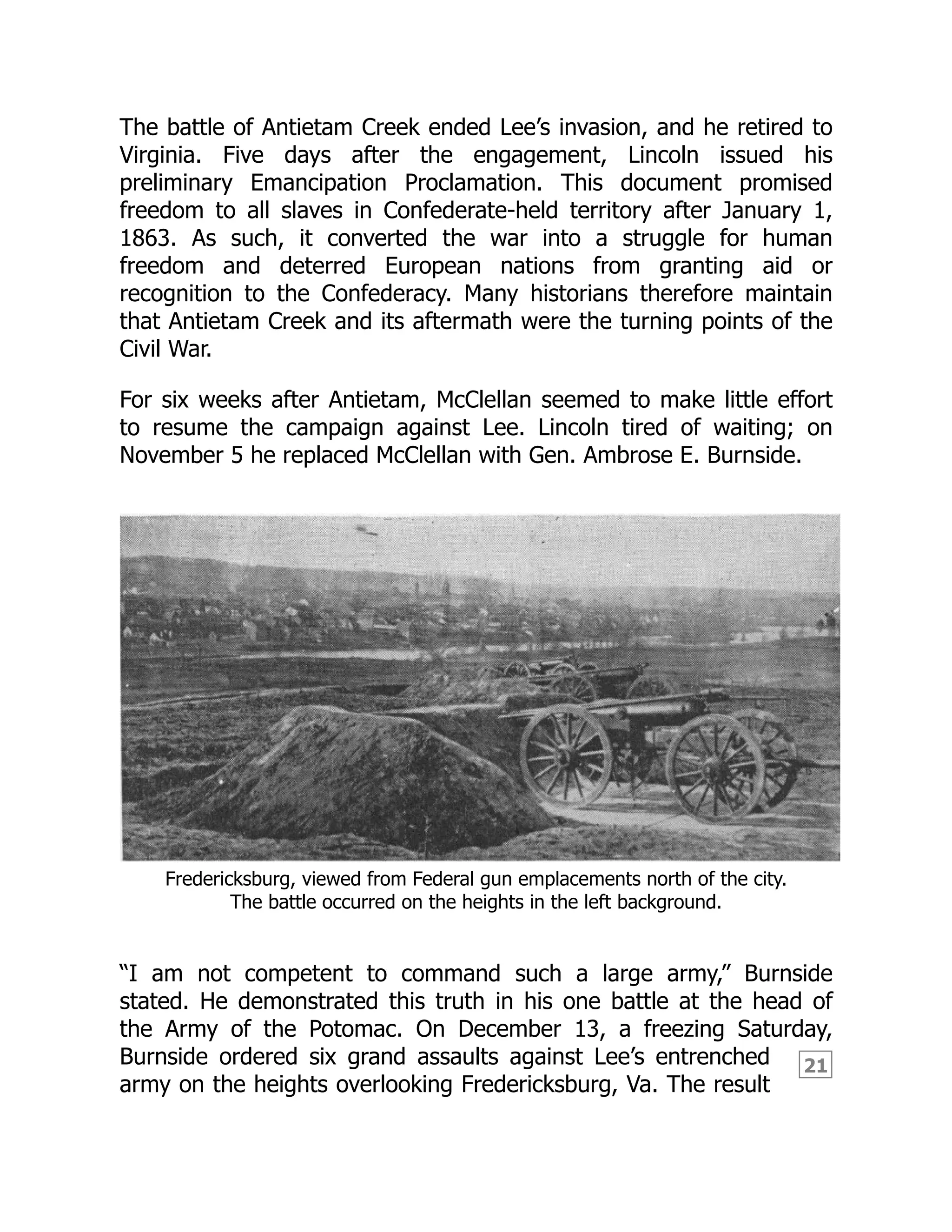
Fredericksburg, viewed from Federal gun emplacements north of the city.
The battle occurred on the heights in the left background.
“I am not competent to command such a large army,” Burnside
stated. He demonstrated this truth in his one battle at the head of
the Army of the Potomac. On December 13, a freezing Saturday,
Burnside ordered six grand assaults against Lee’s entrenched
army on the heights overlooking Fredericksburg, Va. The result
was a useless slaughter, and a defeated Burnside wept over the
killing and wounding of 10,000 of his men. Confederate losses were
less than half that number.
A few weeks later Burnside attempted a secret march around Lee’s
left (western) flank. The Federal army bogged down in winter mud
and made barely a mile a day. This “Mud March” finished Burnside.
He soon relinquished command to Gen. Joseph Hooker, a strong-
willed officer known to the soldiers as “Fighting Joe.”
1863 IN THE WEST
Cavalry raids by both sides occupied the early months of this third
year of conflict. One of the longest was that of Col. Benjamin H.
Grierson and 17,000 Federal horsemen. Leaving La Grange, Tenn., in
April, Grierson’s troopers wrecked railroads and supply depots all the
way to Baton Rouge, La. The raid lasted two weeks and helped clear
the way for Grant’s campaign against Vicksburg.
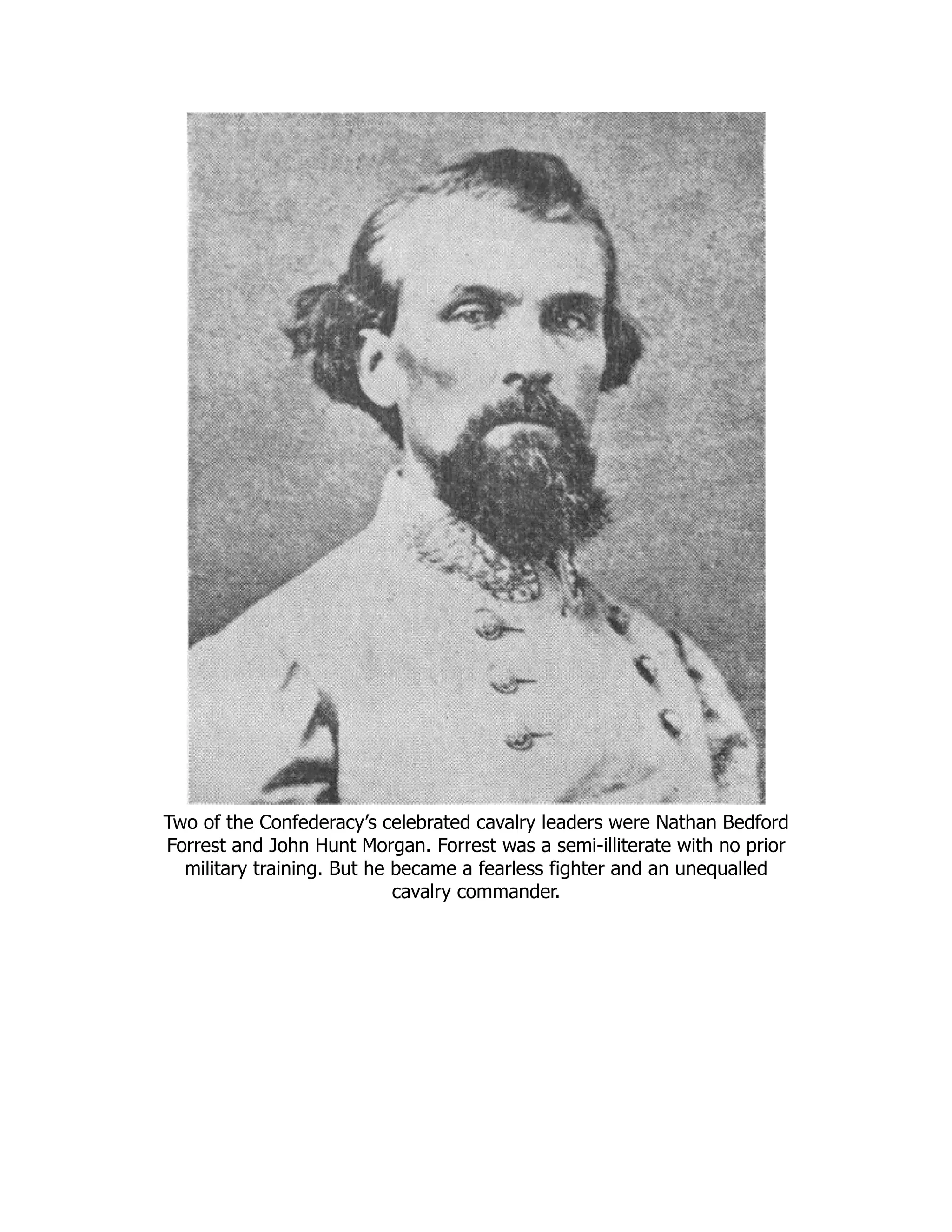
Two of the Confederacy’s celebrated cavalry leaders were Nathan Bedford
Forrest and John Hunt Morgan. Forrest was a semi-illiterate with no prior
military training. But he became a fearless fighter and an unequalled
cavalry commander.
22
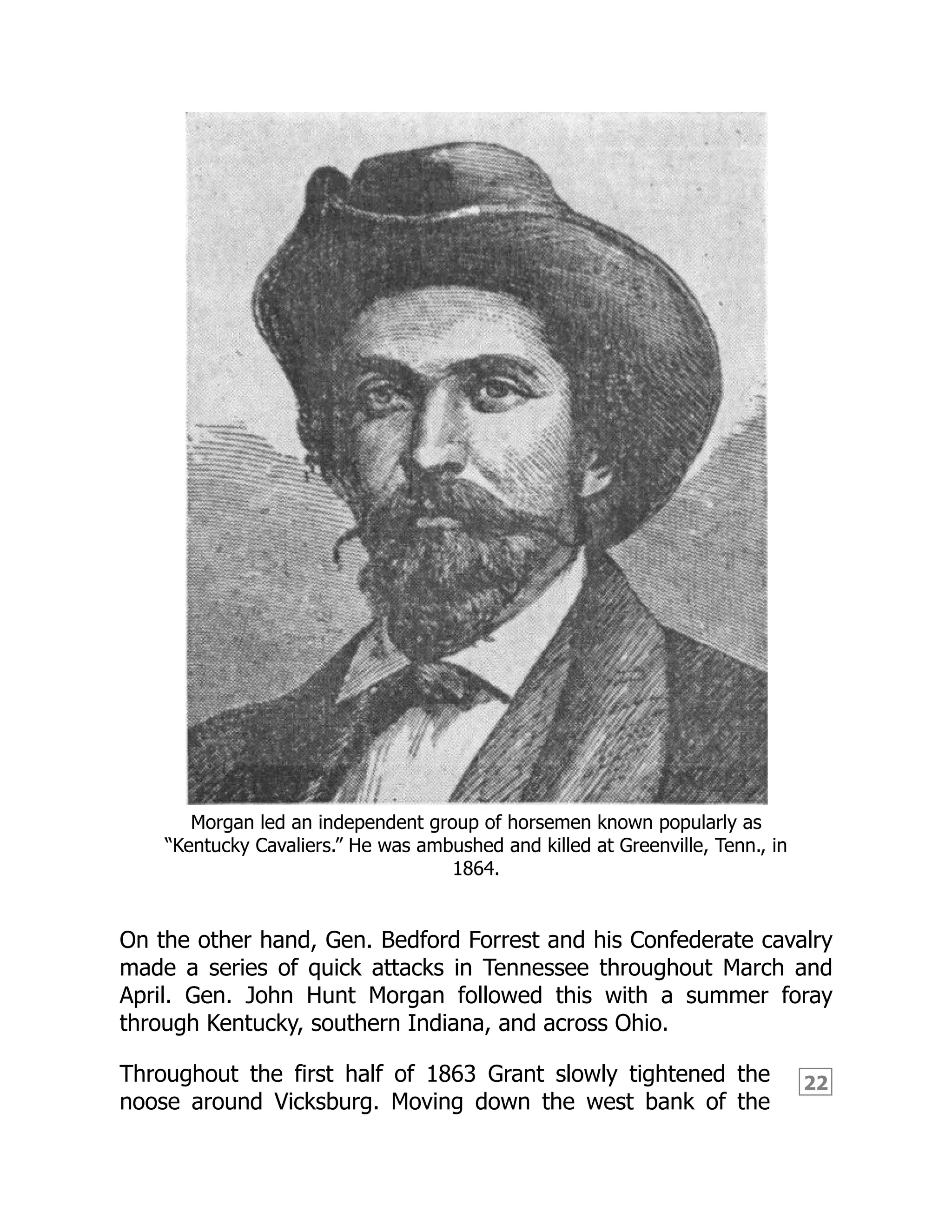
Morgan led an independent group of horsemen known popularly as
“Kentucky Cavaliers.” He was ambushed and killed at Greenville, Tenn., in
1864.
On the other hand, Gen. Bedford Forrest and his Confederate cavalry
made a series of quick attacks in Tennessee throughout March and
April. Gen. John Hunt Morgan followed this with a summer foray
through Kentucky, southern Indiana, and across Ohio.
Throughout the first half of 1863 Grant slowly tightened the
noose around Vicksburg. Moving down the west bank of the


Framework for Human Resource Management 7th Edition Gary Dessler Solutions Manual

  • 1.
    Framework for HumanResource Management 7th Edition Gary Dessler Solutions Manual install download https://testbankfan.com/product/framework-for-human-resource- management-7th-edition-gary-dessler-solutions-manual/ Download more testbank from https://testbankfan.com
  • 2.
    We believe theseproducts will be a great fit for you. Click the link to download now, or visit testbankfan.com to discover even more! Framework for Human Resource Management 7th Edition Gary Dessler Test Bank https://testbankfan.com/product/framework-for-human-resource- management-7th-edition-gary-dessler-test-bank/ Human Resource Management 14th Edition Gary Dessler Solutions Manual https://testbankfan.com/product/human-resource-management-14th- edition-gary-dessler-solutions-manual/ Human Resource Management 13th Edition Gary Dessler Solutions Manual https://testbankfan.com/product/human-resource-management-13th- edition-gary-dessler-solutions-manual/ Human Resource Management 14th Edition Gary Dessler Test Bank https://testbankfan.com/product/human-resource-management-14th- edition-gary-dessler-test-bank/
  • 3.
    Human Resource Management13th Edition Gary Dessler Test Bank https://testbankfan.com/product/human-resource-management-13th- edition-gary-dessler-test-bank/ Fundamentals of Human Resource Management 4th Edition Gary Dessler Solutions Manual https://testbankfan.com/product/fundamentals-of-human-resource- management-4th-edition-gary-dessler-solutions-manual/ Fundamentals of Human Resource Management 4th Edition Gary Dessler Test Bank https://testbankfan.com/product/fundamentals-of-human-resource- management-4th-edition-gary-dessler-test-bank/ Fundamentals of Human Resource Management 3rd Edition Gary Dessler Test Bank https://testbankfan.com/product/fundamentals-of-human-resource- management-3rd-edition-gary-dessler-test-bank/ Human Resource Management 15th Edition Dessler Solutions Manual https://testbankfan.com/product/human-resource-management-15th- edition-dessler-solutions-manual/
  • 4.
    Copyright © 2013Pearson Education, Inc. publishing as Prentice Hall 95 PART THREE APPRAISING AND COMPENSATING EMPLOYEES C H A P T E R T S i x Performance Management and Appraisal 6 Lecture Outline Overview Basic Concepts in Performance Management Why Appraise Performance? - The Importance of Continuous Feedback - Performance Management - Performance Management Defined - The Appraisal Cycle Setting Effective Goals and Work Standards Who Should Do the Appraising? Basic Appraisal Methods Graphic Rating Scale Method Alternation Ranking Method Paired Comparison Method Forced Distribution Method Critical Incident Method Behaviorally Anchored Rating Scales Appraisal Forms in Practice The Management by Objectives Method Computerized and Web-Based Performance Appraisals Electronic Performance Monitoring Practical Suggestions for More Effective Appraisals Ensure Fairness Deal with Common Appraisal Problems Understand the Legal Aspects of Performance Appraisal Conduct First-Rate Appraisal Feedback Interviews In Brief: This chapter gives an overview of the performance appraisal process and the different tools and methods available. The main topics covered include the performance management process, appraisal methods, appraisal performance problems and solutions, and the appraisal interview.
  • 5.
    Copyright © 2013Pearson Education, Inc. publishing as Prentice Hall 96 C H A P T E R T S i x Lecture Outline Continued Coaching and Career Management Improving Your Coaching Skills The Basic Coaching Process Career Management Methods Roles in Career Development The Employee’s Role The Employer’s Role in Career Management Corporate Career Development Initiatives Gender Issues in Career Development Managing Employees’ Promotions and Transfers Retirement Performance Management Performance Management vs. Performance Appraisal Using Information Technology to Support Performance Management Talent Management Practices and Strategic Employee Appraisals Appraising and Actively Managing Employees Segmenting and Actively Managing Employees in Practice Interesting Issues: Despite lots of attention, money, and effort, performance appraisals remain an area with which few managers or employees are satisfied. The following questions may be worth discussing. Is it just that we don’t have a good enough system yet, is there an intrinsic problem with performance appraisals, or is it just human nature to dislike them?
  • 6.
    Copyright © 2013Pearson Education, Inc. publishing as Prentice Hall 97 ANNOTATED OUTLINE I. Basic Concepts in Performance Appraisal and Management A. Comparing Performance Appraisal and Performance Management — Performance appraisal is part of a total integrated process of performance management, which consolidates goal setting, performance appraisal, and development into a single, common system, the aim of which is to ensure that the employee’s performance is supporting the company’s strategic aims. Why Appraise Performance? — Performance management’s emphasis on the integrated nature of goal setting, appraisal, and development reflect Total Quality Management concepts. Second, it reflects what many studies have shown: that traditional performance appraisals are useless and counter-productive. Third, it is a process that recognizes that every employee’s efforts must focus on helping the company to achieve its strategic goals. B. The Importance of Continuous Feedback — For accomplishing several (or all) of these aims, traditional annual or semi-annual appraisal reviews make sense. C. Performance Management — Many employers take a continuous process approach including having self-directed (and trained) work teams give themselves ongoing appraisal information. D. Performance Management Defined — Performance management is a goal-oriented and continuous way to appraise and manage employees’ performance. E. The Appraisal Cycle — The three-step process is: (1) setting work standards; 2) assessing performance relative to such standards; and, 3) providing feedback aimed at improving performance during the next cycle. F. Setting Effective Goals and Work Standards — Some guidelines for effective goal setting are: 1) assign specific goals; 2) assign measurable goals; 3) assign challenging but doable goals; and 4) encourage participation. G. Why Appraise Performance? — For several reasons: 1) they play an integral role in the employer’s performance management process; 2) the appraisal lets the boss and subordinate develop a plan for correcting any deficiencies, and reinforce those things he
  • 7.
    Copyright © 2013Pearson Education, Inc. publishing as Prentice Hall 98 does correctly; 3) they serve a useful career planning purpose; and 4) it plays a part in salary decisions. H. Who Should Do the Appraising? 1. The Immediate Supervisor — is usually in the best position to observe and evaluate the subordinate’s performance, and is responsible for that person’s performance. 2. Peer Appraisals — becoming more popular with firms using self-managing teams. 3. Rating Committees — consist of multiple raters, typically the employee’s immediate supervisor and three or four other supervisors. 4. Self-Ratings — tend to be higher than supervisor or peer ratings. 5. Appraisal by Subordinates — or upward feedback, is where subordinates anonymously rate their supervisor’s performance. Research Insight—One study shows that upward feedback is very effective in improving supervisors’ behaviors. 6. 360-Degree Feedback — where ratings are collected from the employee, the employee’s supervisors, subordinates, peers, and internal or external customers. This method is the subject of considerable debate. One study found significant correlation between 360-degree ratings and conventional ratings. Firms should carefully assess potential costs, carefully train those giving feedback, and not rely solely on 360-degree feedback. II. Basic Appraisal Methods A. Graphic Rating Scale Method — is the simplest and most popular performance appraisal technique. A scale is used to list a number of traits and a range of performance for each, and then the employee is rated by identifying the score that best describes his/her performance level for each trait. Managers must decide which job performance aspects to measure. Some options include generic dimensions, actual job duties, or behaviorally recognizable competencies.
  • 8.
    Copyright © 2013Pearson Education, Inc. publishing as Prentice Hall 99 B. Alternation Ranking Method — involves employees being ranked from best to worst on a particular trait, choosing highest, then lowest, next highest, next lowest, and so forth until all are ranked. C. Paired Comparison Method — involves ranking employees by making a chart of all possible pairs of employees for each trait and indicating which is the better employee of the pair. D. Forced Distribution Method — Predetermined percentages of rates are placed in various performance categories; similar to grading on a curve. Teaching Tip: Discuss what the ramifications of using the forced distribution method for class grades would be. Students will have strong opinions. E. Critical Incident Method — a supervisor keeps a detailed record of uncommonly good or undesirable examples of an employee’s work-related behavior, and reviews it with the employee at predetermined times. F. Behaviorally Anchored Rating Scales (BARS) — combine the benefits of narratives, critical incidents, and quantified scales, by anchoring a scale with specific behavioral examples of good or poor performance. The five steps in developing a BARS are: 1) generate critical incidents; 2) develop performance dimensions; 3) reallocate incidents; 4) scale the incidents; and 5) develop final instrument. The advantages of BARS include a more accurate gauge, clearer standards, feedback, independent dimensions, and consistency. G. Appraisal Forms in Practice — involve rating the employee’s performance for each performance factor, writing down examples and an improvement plan, aiding the employee in understanding where his/her performance was good or bad, and summarizing by focusing on problem solving. H. Management by Objectives (MBO) — requires the manager to set specific measurable goals with each employee and then periodically discuss his/her progress toward these goals. The process consists of six steps: 1) set the organization’s goals; 2) set departmental goals; 3) discuss departmental goals; 4) mutually define expected results; 5) conduct performance reviews; and 6) provide feedback. I. Computerized and Web-Based Performance Appraisal — generally enables managers to keep notes on subordinates during the year,
  • 9.
    Copyright © 2013Pearson Education, Inc. publishing as Prentice Hall 100 rate employees on a series of performance traits, and then generate written text to support each part of the appraisal. About one-third of employers use online performance management tools for at least some employees. J. Electronic Performance Monitoring — systems used to allow managers access to their employees’ computers and telephones. III. Practical Suggestions for More Effective Appraisals Few supervisory tasks are as complex and poorly administered than appraisals. A. Ensure Fairness — The first challenge is to make sure the subordinate views the appraisal as fair. Many managers don’t focus on the developmental aspect of the appraisal, but instead use it for political purposes. B. Deal with Common Appraisal Problems — It can be difficult to rate performance for several reasons. Much depends on a good rating, including career progress, or being able to obtain a raise. There are also technical problems that can affect the fairness of the process. 1. Unclear Standards — Ambiguous traits and degrees of merit can result in an unfair appraisal. 2. Halo Effect — the influence of a rater’s general impression on ratings of specific qualities, can be a problem. 3. Central Tendency — involves supervisors sticking to the middle of the rating scales, thus rating everyone approximately average. 4. Leniency or Strictness — Supervisors have the tendency to rate everyone either high or low. 5. Bias — the tendency to allow individual differences such as age, race, and sex to affect the appraisal ratings employees receive is a problem. Research Insight — Bias can influence the way a person appraises another person. In one study, for example, the identical employee was rated differently if pregnant.
  • 10.
    Copyright © 2013Pearson Education, Inc. publishing as Prentice Hall 101 C. Understand the Legal Aspect of Performance Appraisal — Performance appraisals have legal implications, because they often affect raises, promotions, training, and other HR actions. D. Conduct First-Rate Appraisal Feedback Interviews — an interview in which the supervisor and subordinate review the appraisal and make plans to remedy deficiencies and reinforce strengths. E. Preparing for the Appraisal Interview Step 1 — give the subordinate enough notice to review his/her work. Step 2 — Study his/her job description. Step 3 — Choose the right place for the interview and schedule enough time for it. F. Conducting the Interview — Prepare for the interview by conducting the interview in a private area without interruptions. Talk in terms of objective, observable work data using examples. Get agreement with the employee of how you will know improvement has occurred. Ensure the process is fair and learn how to deal with defensiveness. IV. Coaching and Career Management A. Improving Your Coaching Skills — Coaching means educating, instructing, and training subordinates. Mentoring means advising, counseling, and guiding. Coaching focuses on teaching shorter- term job related skills, mentoring on helping employees navigate longer-term career hazards. B. The Basic Coaching Process — Preparing to coach involves understanding the problem, the employee, and his or her skills. Planning requires reaching consensus on the problem and on what to change. Finally, once agreement is reached, educating, instructing, training and ongoing encouragement are the important steps in the change process. V. Career Management Methods A. Mentoring — Having a mentor — a senior person in the firm who can be a sounding board for your career questions and concerns — can enhance career satisfaction and success. B. The Employee’s Role — An individual must accept responsibility for his/her own career; assess his/her own interests, skills, and values; and take the steps required to ensure a happy and fulfilling
  • 11.
    Copyright © 2013Pearson Education, Inc. publishing as Prentice Hall 102 career. Finding a mentor who can be a sounding board is often helpful. Mentoring programs can be informal or formal.
  • 12.
    Copyright © 2013Pearson Education, Inc. publishing as Prentice Hall 103 B. The Employer’s Role — Employers can support career development efforts in many ways. There are several organizational career-planning practices. The means for helping to further an employee’s career depends on the length of time the employee has been with the firm. C. Gender Issues in Career Development—Women and men face different challenges as they advance through their careers. Women face the glass ceiling. Minority women may be particularly at risk. D. Managing Employees’ Promotions and Transfers 1. Making Promotion Decisions — Promotions usually provide opportunities to reward the exceptional performance of tested and loyal employees. However, unfairness, arbitrariness, or secrecy can diminish the effectiveness of the promotion process for all concerned. 2. Handling Transfers — Transfers are moves from one job to another, usually with no change in salary or grade. The frequent relocating of transfer employees has been assumed to have a damaging effect on transferees’ family life. Transfers are also costly financially. E. Retirement—Some employers are instituting formal preretirement counseling aimed at easing the passage of their employees into retirement. A large majority of employees have said they expect to continue to work beyond the normal retirement age. Part-time employment is an alternative to outright retirement. Employers can benefit from retirement planning by becoming able to anticipate labor shortages. 1. Create a Culture that Honors Experience — Changing cultures that are explicitly or implicitly biased against older workers can help make a company more attractive to retirees. 2. Modify Selection Procedures 3. Offer Flexible Work — Redesigning jobs to include telecommuting and other options will attract and retain workers. 4. Phased retirement — Phased retirement programs combine reduced work hours, job change, and reduced responsibilities. VI. Performance Management
  • 13.
    Copyright © 2013Pearson Education, Inc. publishing as Prentice Hall 104 A. Performance management vs. Performance Appraisal — refers to an ongoing, continuous process of deciding upon goals, evaluating results and providing feedback. It is always goal-directed. B. Using Information Technology to Support Performance Management — allows the supervisor to assign financial and nonfinancila goals to each team’s acitivities and to keep all employees informed of their goals.
  • 14.
    Copyright © 2013Pearson Education, Inc. publishing as Prentice Hall 105 VII. Talent Management Practices and Strategic Employee Appraisals A. Appraising and Actively Managing Employees — Several examples of strategically managing employees performance and value to the organization are provided. B. Segmenting and Actively Managing Employees in Practice — Compass Group, Tesco PLC, McKinsey Consulting and others are highlighted as examples.
  • 15.
    Copyright © 2013Pearson Education, Inc. publishing as Prentice Hall 106 KEY TERMS Performance appraisal Evaluating an employee’s current or past performance relative to his/her performance standards. Performance management Is the continuous process of identifying, measuring, and developing the performance of individuals and teams and aligning their performance with the organization’s goals. Performance appraisal Involves this three-step process: process 1. Setting work standards 2. Assessing the employee’s actual performance relative to those standards 3. Providing feedback to the employee Peer appraisal Appraisal of an employee by his or her peers. Upward feedback Appraisals in which subordinates rate their supervisors’ performance. Graphic rating scale Lists a number of traits and a range of performance for each. Alternation ranking This method is used to indicate the employee who is the method highest on the trait being measured and also the one who is the lowest. Paired comparison method An appraisal method in which every subordinate to be rated is paired with and compared to every other subordinate on each trait. Forced distribution method The manager places predetermined percentages of subordinates in performance categories. Critical incident method Entails keeping a record of uncommonly good or undesirable examples of an employee’s work-related behaviors and reviewing it with the employee periodically. Management by objective This method requires the manager to set measurable goals with each employee and then periodically discuss the latter’s progress toward these goals. Halo effect Means that the rating of a subordinate on one trait influences the way you rate the person on other traits.
  • 16.
    Copyright © 2013Pearson Education, Inc. publishing as Prentice Hall 107 Central tendency Refers to a tendency to rate all employees about average. Appraisal interview An interview in which the supervisor and subordinate review the appraisal and make plans to remedy deficiencies and reinforce strengths. Coaching Means educating, instructing, and training subordinates.
  • 17.
    Copyright © 2013Pearson Education, Inc. publishing as Prentice Hall 108 Career management A process for enabling employees to better understand and develop their career skills and interests and to use these skills and interests both within the company and even after they leave the firm. DISCUSSION QUESTIONS 1. Discuss the pros and cons of at least four performance appraisal tools. The text lists nine different performance appraisal tools (methods). Students might discuss the pros and cons of any four of these nine. (Examples of some of the pros and cons are: Graphic Rating Scale method is easy to use, simple, and does not take much time to administer. However, different supervisors may interpret a numerical rating differently, and the traits rated may or may not relate to performance.) 2. Explain how you would use the alternation ranking method, the paired comparison method, and the forced distribution method. The alternation method would be used by listing all employees to be rated, deciding who is the best in a trait to be rated, and who is the worst. Then decide who is the second best, and the second worst, the third best and the third worst, and so on, until all the employees have been ranked for that trait. Then do the same with the next trait to be rated. With the paired comparison, for each trait to be rated, the supervisor would have a sheet with employee names in pairs; every employee name is paired with every other name. For each pair, the supervisor would circle the one of the two that is better in that trait. Forced distribution gives the supervisor a set rating scale (such as 1 through 5). The supervisor is limited to giving a predetermined percentage of his/her employees’ rating. For example: 15 percent can get a 1, 20 percent can get a 2, 30 percent can get a 3, and so forth. 3. Explain the problems to be avoided in appraising performance. The five main rating-scale problems listed in the text are: 1) unclear standards; 2) halo effect; 3) central tendency; 4) leniency or strictness; and 5) bias. Students should define and describe them, not simply list them. 4. Discuss the pros and cons of using different potential raters to appraise a person’s performance. The advantages of using several raters (either a rating committee or a combination of peer, supervisor, and subordinate ratings) are that the ratings tend to be more valid than those of one individual rater. The negatives might include the time and cost involved, as well as problems with the amount of daily contact that some raters may not have with the employee being rated. 5. Explain how to conduct an appraisal interview. There are four things listed in the text to keep in mind: 1) be direct and specific; 2) don’t get personal; 3) encourage the person to talk; and 4) don’t tiptoe around. Students should expound on these basic principles of conducting the interview.
  • 18.
    Copyright © 2013Pearson Education, Inc. publishing as Prentice Hall 109 INDIVIDUAL AND GROUP ACTIVITIES 1. Working individually or in groups, develop a graphic rating scale for the following jobs: secretary, engineer, and directory assistance operator. Job characteristics may include but not be limited to: Secretary—quantity of work, frequency of errors, attendance, and initiative; Engineer—initiative, significance of contribution to the organization, problem-solving skills, frequency of errors, and communication skills; Directory Assistance Operator—speed, attendance, accuracy, and friendliness. 2. Working individually or in groups, describe the advantages and disadvantages of using the forced distribution appraisal method for college professors. The disadvantages include decreased morale, interdepartmental inequities, and unfair rankings. The advantages would include steering clear of many of the biases listed, as well as overcoming the central tendency problem. 3. Working individually or in groups, develop, over the period of a week, a set of critical incidents covering the classroom performance of one of your instructors. If you had the class conduct a job analysis and create a job description for an instructor in Chapter 3, it would be helpful to refer to that to help identify what kinds of behavior and tasks the instructor should be doing. This will give a good basis for students to observe and watch for critical incidents. If they find critical incidents that are not based in these other documents, it will be a good opportunity to go back and review how all this ties together and that we haven’t communicated to the instructor in the job description these behaviors or tasks for which they are now wanting to rate them. 4. Working individually or in groups, evaluate the rating scale in Figure 6.1. Discuss ways to improve it. There are many things that might be suggested for improvements. These suggestions might include but not be limited to: clearer explanation of the rating scale (what does “very descriptive” mean?), consider reducing the rating scale from seven points to four or five, provide behavioral anchors for the scale points, and rework the items so that each one is only rating one trait or behavior (some have several). HR in Action Case Incident 1: Appraising the Secretaries at Sweetwater U 1. Do you think that the experts’ recommendations will be sufficient to get most of the administrators to fill out the rating forms properly? Why? Why not? What additional actions (if any) do you think will be necessary? Although controversial, APPLICATION EXERCISES
  • 19.
    Copyright © 2013Pearson Education, Inc. publishing as Prentice Hall 110 the recommendations would, in fact, encourage administrators to fill the forms out correctly. Using the more detailed form and not tying the performance ratings to salary increases would allow the managers to feel more free about rating the secretaries accurately. There would, however, need to be some strong training sessions (both for administrators and secretaries) to help them understand the new system. Because all secretaries have traditionally received the same salary increases, and have been pleased with that, it would be advisable to consider lowering the maximum increase to an amount that could be given to all secretaries while staying within budget. Then all secretaries with a satisfactory rating or better would receive that increase. 2. Do you think that Vice President Winchester would be better off dropping graphic rating forms, substituting instead one of the other techniques we discussed in this chapter such as a ranking method? Why? Certainly other methods could be used. He has already had a taste of what would result if he went to a forced distribution or other ranking method. A BARS system might be best, but it could be costly to develop if the clerical staff has positions that are significantly different. 3. What performance appraisal system would you develop for the secretaries if you were Rob Winchester? Defend your answer. If the development costs are not too great, the BARS system would give the strongest solution to the current situation. The behavioral anchors would make it more difficult to just rate everyone at the top. It would also help to eliminate the different interpretations of what the rating scales mean. Continuing Case: Carter Cleaning Company 1. Is Jennifer right about the need to evaluate the workers formally? The managers? Why or why not? Based on the information presented in the chapter, the students need to determine if the workers and managers should be evaluated formally or informally, and they need to provide reasons for their decision. Of course she is right! Jennifer already outlined some of the reasons for the need for appraisals: probationary period, motivation, feedback, and so on. It is not clear that objectives and goals have been clearly established and communicated. Also, it is important to tie salary, promotion, and disciplinary decisions to these goals. Without it, employees will do what they prefer or enjoy doing. With it, they should understand what the priorities are and what they need to be doing. 2. Develop a performance appraisal method for the workers and managers in each store. The students need to be familiar with different appraisal methods discussed in the chapter. They should use the sample appraisal forms given in the chapter as guides.
  • 20.
    Copyright © 2013Pearson Education, Inc. publishing as Prentice Hall 111 Experiential Exercise: Setting Goals and Appraising an Instructor Purpose: The purpose of this exercise is to give you practice in developing and using a performance appraisal system. Required Understanding: You are going to develop a performance appraisal form for an instructor and should therefore be thoroughly familiar with the discussion of performance appraisals in this chapter. How to Set up the Exercise: Divide the class into groups of four or five students. 1) First, based on what you now know about performance appraisals, do you think Figure 6.1 is an effective scale for appraising instructors? Why? 2) Next, the group should develop its own tool for appraising the instructor. 3) Last, have a spokesperson from each group put his/her group’s appraisal tool on the board.
  • 21.
    Exploring the Varietyof Random Documents with Different Content
  • 22.
    III. MILITARY CAMPAIGNS 1861 Latein April, 1861, the Confederate government moved its capital from Montgomery, Ala., to Richmond, Va. This transfer was intended to bind Virginia closer to the other Southern states and to put the Confederate government nearer Washington when the time came to discuss the peace treaty. In reality the move backfired. It made Richmond the primary Federal target and Virginia the major battleground of the Civil War. Few engagements occurred in 1861, when neither North nor South had a highly organized, efficient army. What both sides in 1861 called armies were more like armed and unruly mobs. Yet President Lincoln and the Congress, hoping to end the war quickly, were anxious to capture Richmond. As a result, Federal forces made three thrusts into Virginia. They first moved from Ohio into the pro-Northern counties of western Virginia, where Confederate regiments as “green” as the Federal units were stationed. In a series of small battles, including Philippi (June 3), Rich Mountain (July 11), and Corrick’s Ford (July 13), the Federals were victorious. In 1863 this region entered the Union as the loyal state of West Virginia. The other two Federal invasions were less successful. The main Virginia defenses stretched from Norfolk northward to the Potomac River, thence westward to Harpers Ferry. Early in June, Gen. Benjamin F. Butler left Fort Monroe with a Federal force and struck at
  • 23.
    Richmond by wayof the peninsula between the James and York rivers. At Big Bethel Church, just west of Yorktown, Confederates attacked and sent Butler’s men stampeding back to their base at Fort Monroe. Benjamin F. Butler, a politician with little military experience, led two ill- fated campaigns against Richmond. The third and main Federal push into Virginia resulted in the largest battle fought in 1861. In mid-July, Gen. Irvin McDowell moved from
  • 24.
    12 Washington with some35,000 recruits. McDowell’s ultimate target was Richmond, but first he had to capture the important railroad junction of Manassas. Through espionage agents the Confederates learned of McDowell’s advance. Quickly Gens. P. G. T. Beauregard and Joseph E. Johnston concentrated 30,000 Southern troops near Manassas to block the Federal move. On a very hot Sunday, July 21, McDowell attacked Beauregard and Johnston near a stream known as Bull Run. As in the case of many Civil War battles, the main attack was against the flank (or end) of the line, while for deception a lesser assault force struck at the center of the defending force’s position. A great-nephew of Patrick Henry, “Uncle Joe” Johnston proved a superb army commander. Yet he and President Davis had too many personal and official differences during the war.
  • 25.
    13 The Federals mighthave won a smashing victory that day but for a stubborn brigade of Virginians under Gen. Thomas J. Jackson. The refusal of Jackson and his men to give ground not only helped save the day for the South but also earned for that general and his brigade the name “Stonewall.” Losses in the battle of First Manassas, or First Bull Run, were much less than those in the larger battles to come. The Federals lost 2,896 men killed, wounded, and missing. The Confederates suffered 1,982 casualties. This battle at Manassas had several important effects. Southerners were convinced that Yankees were poor fighters, and that the war would be brief. On the other hand, Northerners realized that defeating the Confederacy would take longer than anticipated. Thus, while Southerners celebrated a great victory, the North began raising and equipping large armies for full-scale war. A month later occurred an engagement in the West. On August 10, a Federal army sought out and attacked a Confederate force at Wilson’s Creek, near Springfield, Mo. In this battle, often called “Bull Run of the West,” the Federals met defeat. The Union commander, Gen. Nathaniel Lyon, was killed in the midst of the fighting. On October 21, the North suffered another costly setback. Near Ball’s Bluff, Va., Confederate defenders all but annihilated a Federal scouting force. The “Ball’s Bluff disaster” spurred into action the “Committee on the Conduct of the War.” Seven U. S. congressmen made up this investigating body. Although not one had had army training, they continually inquired into the military affairs of every Federal army and often embarrassed generals in the field. While Confederates in 1861 won most of the battles, Lincoln and his government by no means felt defeated. Gen. George B. McClellan was building an army at Washington that would soon number 100,000 volunteer troops. This force would be the largest ever amassed in the Western Hemisphere up to that time. Moreover, the
  • 26.
    North had wona few victories. On November 7, a Federal amphibious force had captured Port Royal, S. C., thus gaining a beachhead on the South Atlantic coast. Yet on that same day, another Federal army suffered defeat at Belmont, Mo. The losing general was an unknown officer from Illinois, and this was his first Civil War battle. His name was Ulysses S. Grant. 1862 IN THE WEST War’s full fury struck in 1862. To understand the complicated movements of many armies, bear in mind two points: (1) Not one, but two, separate areas of military operations existed. The Appalachian Mountains, extending in an almost unbroken line from Pennsylvania to Alabama, prevented armies from moving freely from eastern states (Virginia, the Carolinas, etc.) to western or trans- Appalachian states (Tennessee, Kentucky, etc.), and vice versa. As a result, different armies in the East (east of the mountains) and in the West fought practically two almost independent wars. Only in 1864 were the campaigns of the two areas effectively coordinated. (2) In the 1800’s, in contrast to modern military tactics, an invading army did not always move directly against an enemy force. Rather, its primary target was usually an important city. Once the invading army was in motion, the defending force then tried to place itself between the invader and his target. This set the stage for battle. Five such Confederate cities became principal Federal targets. In the East was Richmond; in the West were New Orleans and Vicksburg, both strongholds on the all-important Mississippi River, and Chattanooga and Atlanta, vital railroad centers. Bearing these two points in mind, let us turn to the Western campaigns of 1862.
  • 27.
    14 At the beginningof 1862 some 48,000 Confederate soldiers guarded a 600-mile line extending from the Appalachian Mountains westward to the Mississippi River. Obviously the Southern defenses were thinly manned. Early in February, Gen. Ulysses S. Grant left Cairo, Ill., with 15,000 men to attack the center of this line. His goal was to gain control of two important rivers, the Tennessee and the Cumberland. To protect these streams, the Confederates had constructed twin forts in Tennessee just south of the Kentucky border. Fort Henry guarded the Tennessee; Fort Donelson stood menacingly on the banks of the Cumberland. On February 6 a Federal river fleet cooperating with Grant battered Fort Henry into submission. Ten days later Grant had surrounded Fort Donelson and its 12,000 defenders. Answering the Confederate commander’s request for surrender terms, Grant replied: “No terms but unconditional surrender.” Thereafter, U. S. Grant was “Unconditional Surrender” Grant. Grant’s victories brought great rejoicing in the North. Some writers consider the Henry-Donelson campaign as “the critical operation” of the Civil War. Capture of these forts assured Union control of Kentucky and Tennessee and opened Mississippi and Alabama to Federal invasion. The loss of the forts was a severe blow to Southern morale. With these successes the North had also demonstrated its ability and willingness to fight. Meanwhile, an important battle occurred farther to the west for control of Arkansas and Missouri. On March 7-8, at Pea Ridge (or Elkhorn Tavern), Ark., a Confederate army of 16,000 men attacked 12,000 Federals under Gen. Samuel R. Curtis. Most of the Confederates lacked uniforms and were armed with shotguns and squirrel rifles. This force also included 3,500 Indians of the Creek, Choctaw, Cherokee, Chickasaw and Seminole tribes. After two days of fighting, a Federal counterattack broke the Confederate “army.” With the defeat at Pea Ridge the Confederates permanently lost Missouri and northern Arkansas.
  • 28.
    15 Gunfire and fightingat Shiloh was so intense that one area of the battlefield became known as the “Hornet’s Nest.” This drawing depicts the stubborn resistance of two Federal divisions in that area. By the end of March Grant’s army was near the Mississippi border. Just across the line Gens. Albert Sidney Johnston and Beauregard had collected a force of 40,000 Confederates. Even though most of his troops were ill-equipped, Johnston attacked Grant’s encamped forces in an effort to destroy the Federal invaders. The battle of Shiloh (April 6-7), one of the war’s most costly engagements, followed. The initial Confederate attack caught Grant by surprise, bent his line, but never broke it. Several events then swung the battle to the North’s favor. Gen. Johnston bled to death from a leg wound. Exhaustion and disorganization blunted the drive of the Southerners, and Federal artillery posted in great strength near the Tennessee River proved an effective barrier to the Confederate advance. Heavy Federal reinforcements under Gen. Don C. Buell arrived during the night. The next morning Grant counterattacked. The Confederates retreated grudgingly to Corinth, thus ending the battle. Grant’s hard- won victory cost him 13,047 casualties. The Confederates lost 10,694 soldiers, roughly one-fourth of Johnston’s forces.
  • 29.
    16 For the nextfour months the armies of Grant and Bragg (who eventually succeeded to command) did not meet in battle. However, three significant events took place elsewhere in the Western theater. One was the Federal capture of the mouth of the Mississippi River. In April a fleet under Flag Officer David G. Farragut blasted its way upriver past Forts Jackson and St. Philip. By the end of May the strategic river cities of New Orleans, Baton Rouge and Natchez were under Federal control. Yet a river attack on Vicksburg failed. The second event was one of the boldest raids in American history. In April James J. Andrews, a Federal espionage agent, and twenty-one Northern soldiers sneaked through Confederate territory to Big Shanty Station, Ga., only thirty miles from Atlanta. There they stole the engine “General” and two cars of a Western & Atlantic passenger train. The Federals’ plan was to race up the tracks to Chattanooga, removing rails, burning bridges, and thus ruining this important line. The coup might have succeeded but for the perseverance of a handful of citizens and soldiers, who gave immediate pursuit on foot, by handcar, and eventually on an engine (“The Texas”) running in reverse. All of the raiders were soon captured. Andrews and seven of his men were subsequently hanged in Atlanta. Southern raiders soon gained a measure of revenge. In July, 1862, Col. John Hunt Morgan led his Confederate cavalrymen on a two- week slash through Kentucky. Morgan won four small battles, captured 1,200 Federals, and returned safely to Tennessee with less than 100 casualties. In December Morgan again struck into Kentucky. This “Christmas Raid” netted 1,900 prisoners and large quantities of horses and military stores. Shortly after Morgan’s First Kentucky Raid, Gen. Bragg invaded the same state. Bragg hoped to occupy the chief cities and, by “military persuasion,” to bring Kentucky into the Confederacy. Yet caution eventually got the better of Bragg. He retreated, even after winning a tactical victory over Gen. Don C. Buell at Perryville on
  • 30.
    October 8. Thisinvasion marked the end of Confederate efforts to wrest Kentucky from the Union. Braxton Bragg is one of the most controversial generals of the Civil War. Although a devoted soldier and skillful organizer, he lacked that necessary spark of leadership.
  • 31.
    William S. Rosecranswas a tireless, conscientious officer whom the men affectionately called “Old Rosy.” Bragg returned to Tennessee. Gen. William S. Rosecrans, who had gained fame in two Mississippi campaigns, assumed command of the Federal army opposing Bragg. Then in November Grant started southward from Tennessee through Mississippi toward Vicksburg, the chief Confederate stronghold on the “Father of Waters.” Grant’s strategy called for a two-pronged attack: he and Gen. William T. Sherman would deliver simultaneous assaults on Vicksburg from
  • 32.
    17 different directions. Theplan was a costly failure. Confederate cavalry under Gen. Earl Van Dorn destroyed Grant’s main supply base at Holly Springs. Grant was forced to fall back to Memphis. Sherman’s assaults on December 28-29 at Chickasaw Bayou were repulsed with heavy losses. Grant then moved his entire army down the Mississippi and prepared to take Vicksburg by attack or siege. The final Western engagement of 1862 began on the last day of the year near Murfreesboro, Tenn. For the better part of four days Bragg’s Confederate army waged a desperate fight along the banks of Stone’s River with Rosecrans’s Federal forces. Tactically the battle was a draw. Yet the Federals lost 31% in killed, wounded, and missing, while the Confederates suffered 25% casualties. 1862 IN THE EAST For seven months McClellan’s large army lay inactive around Washington. Finally Lincoln, his patience exhausted, ordered McClellan to advance into Virginia. McClellan dismissed the dangerous overland route to Richmond. Rather, he proposed to transport his forces by water to Fort Monroe. Thence he would advance westward on Richmond by way of the same peninsula where Butler had met defeat the preceding year. This was the framework of the Peninsular Campaign.
  • 33.
    The creation ofthe Army of the Potomac was the work largely of George B. McClellan. In 1864 he ran unsuccessfully as Democratic candidate for President. Lincoln finally agreed to the plan. To protect Washington, however, he ordered McDowell’s corps of 37,000 soldiers to remain in the Fredericksburg-Manassas area. By April McClellan was on the Virginia peninsula with 105,000 men. In the meantime, Gen. Joseph E. Johnston, commanding the Confederate forces in Virginia, had concentrated his small army on
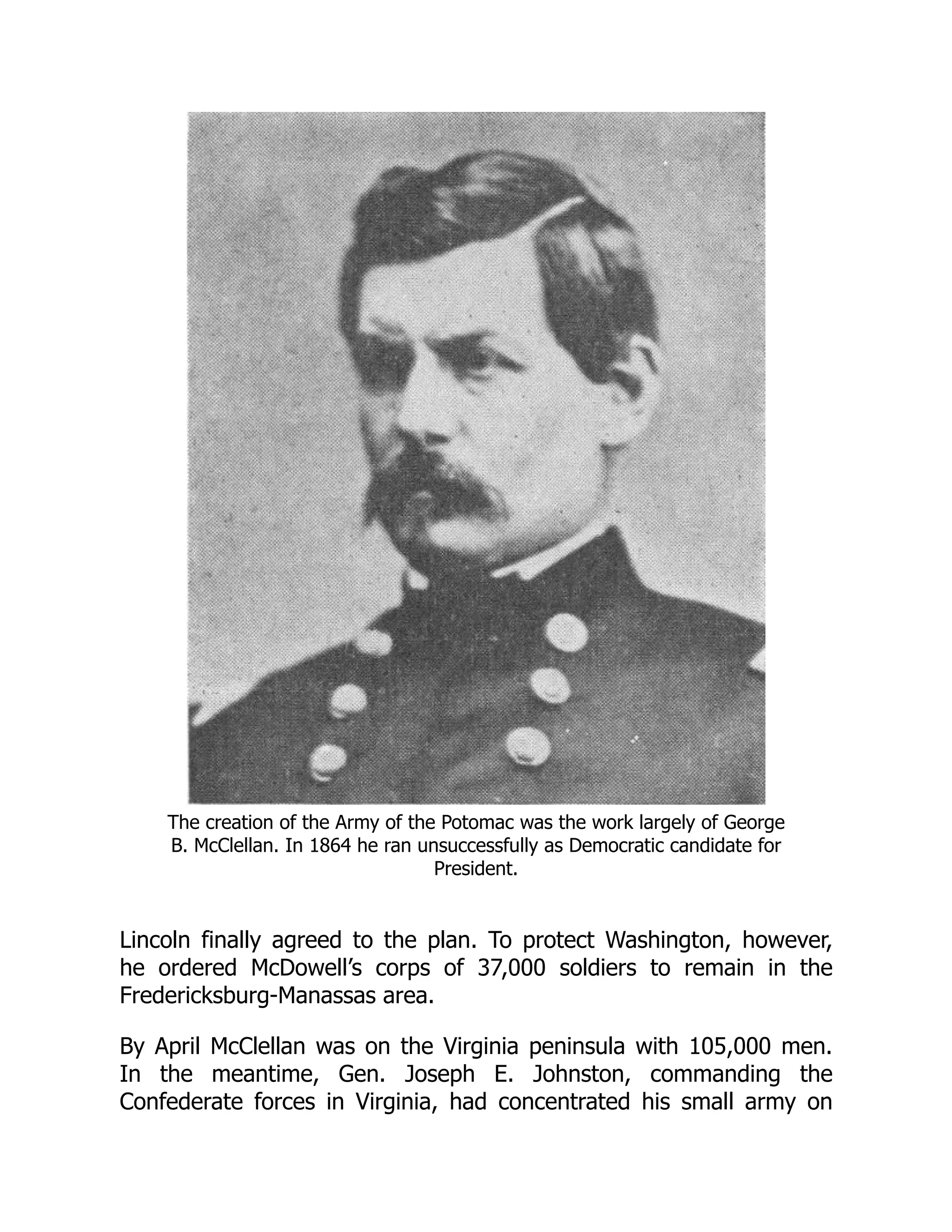
  • 34.
    18 the peninsula betweenMcClellan and Richmond. McClellan slowly advanced westward; Johnston, with only 60,000 men, had no choice but to fall back and fight delaying actions. Driving rains turned the country into a vast sea of mud. By the end of May McClellan’s army had reached Seven Pines. The spires of Richmond were visible, nine miles away. But Seven Pines was as close as McClellan ever got to the Confederate capital. Johnston noticed that the Federal army had been divided into two parts by the flooded Chickahominy River. He then launched attacks against McClellan’s left (southern) flank. The muddy battles of Seven Pines and Fair Oaks (May 31-June 1) permanently halted McClellan’s advance. Johnston was seriously wounded in the fighting, and Gen. Robert E. Lee assumed command of the Confederate forces on the Peninsula. Elsewhere in Virginia, in the Shenandoah Valley, Gen. “Stonewall” Jackson was performing brilliantly in what became known as the Valley Campaign. Control of the Valley was vital to both sides. This narrow slit of land between two ranges of mountains is a direct avenue into both North and South. Neither side could move safely between the mountains and the seacoast unless the Valley’s northern door—the region around Winchester—was shut.
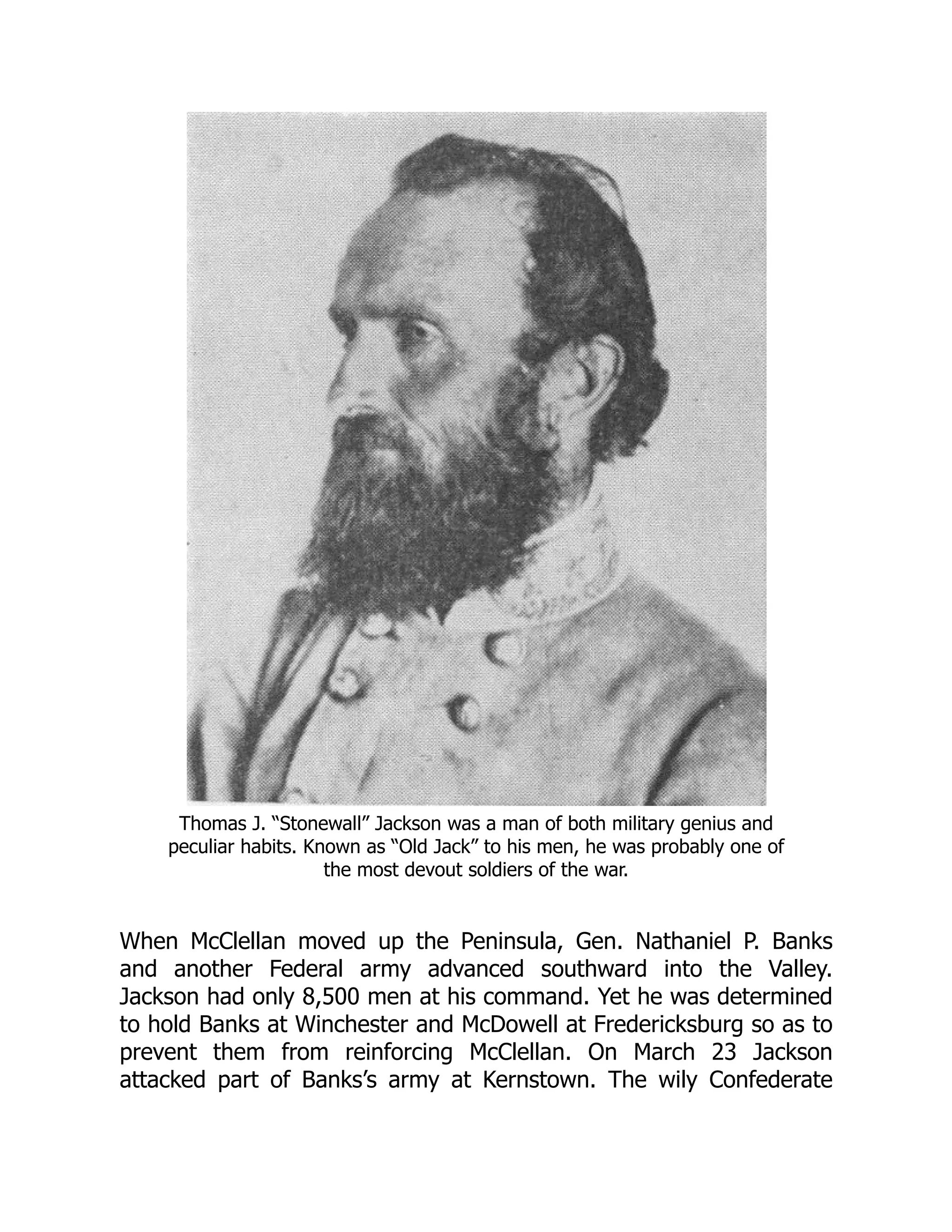
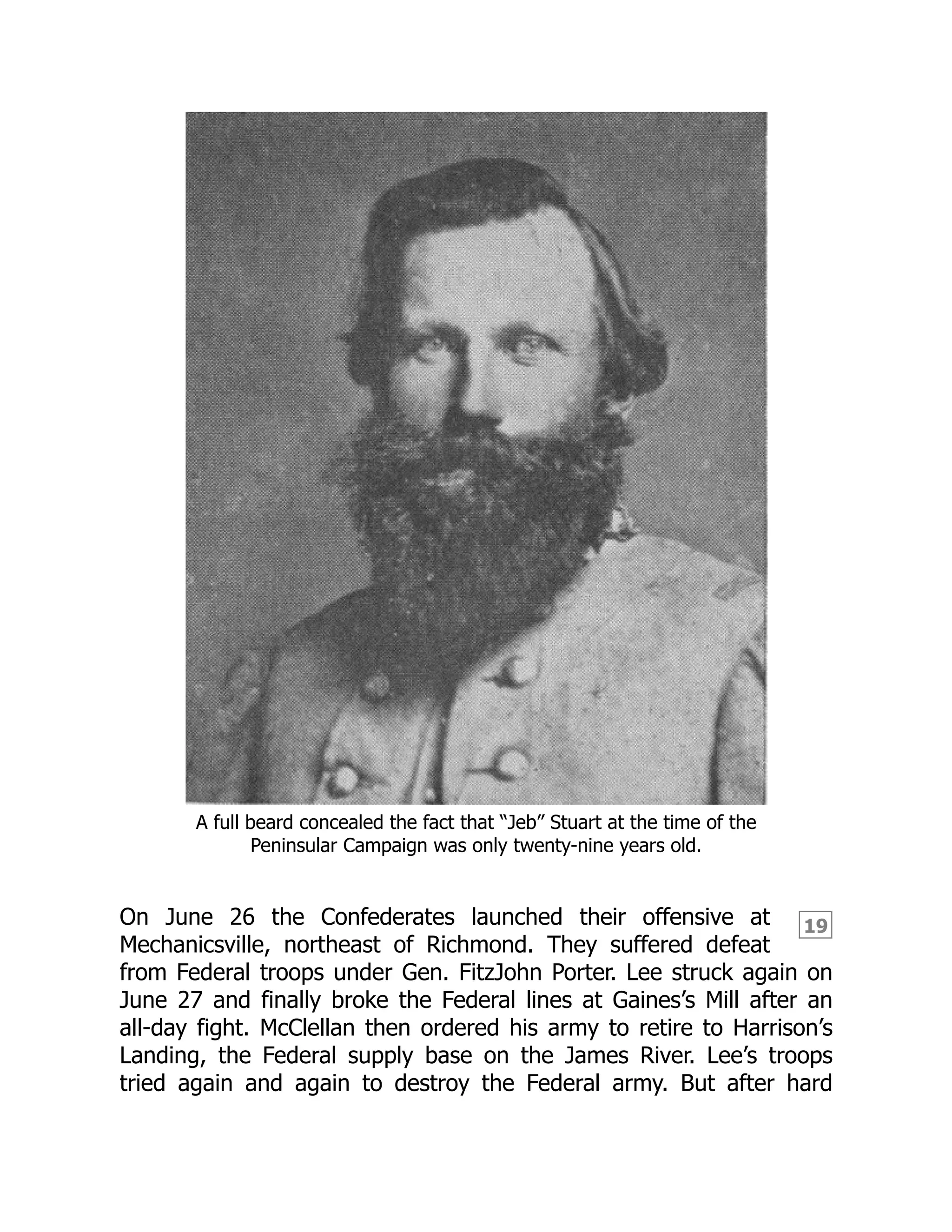
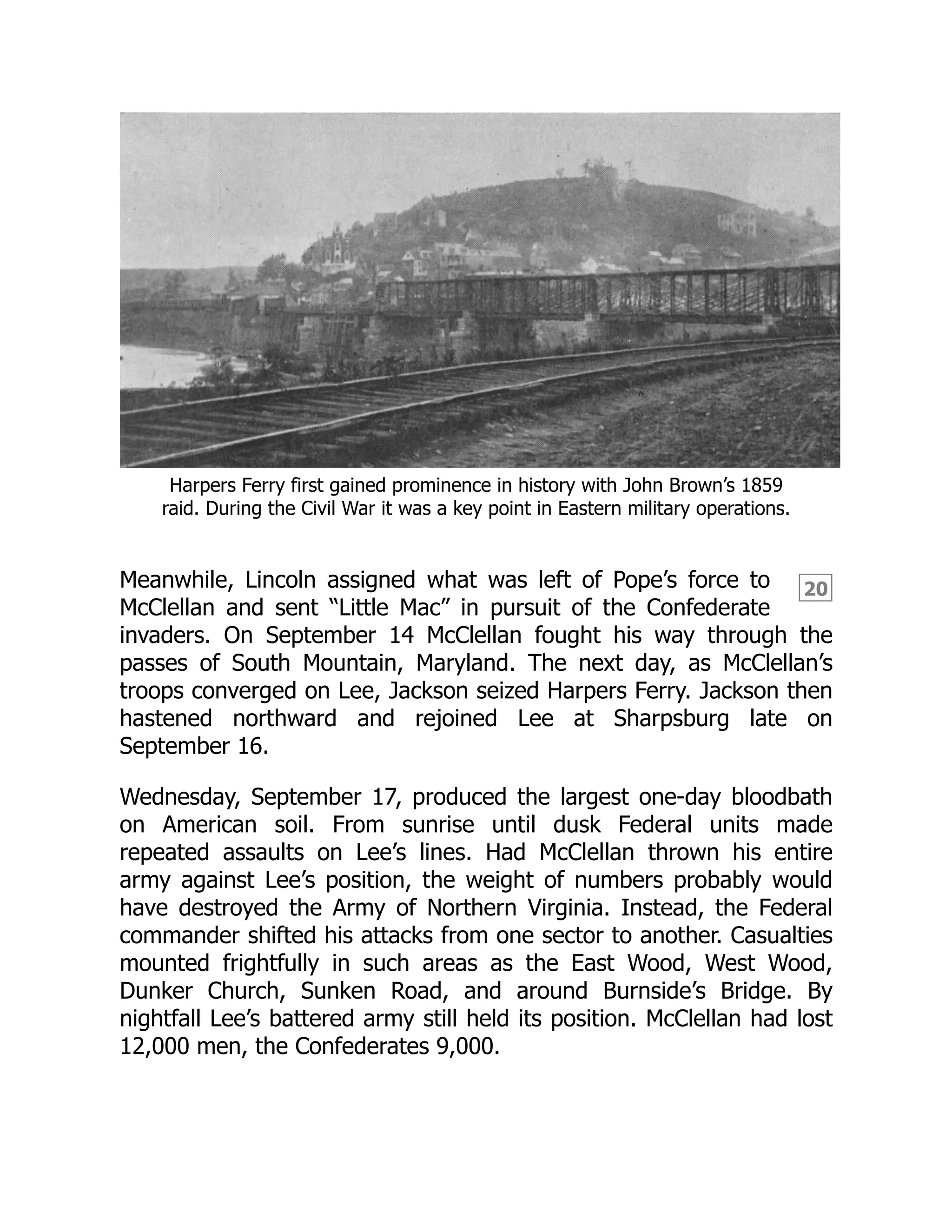
  • 35.
    Thomas J. “Stonewall”Jackson was a man of both military genius and peculiar habits. Known as “Old Jack” to his men, he was probably one of the most devout soldiers of the war. When McClellan moved up the Peninsula, Gen. Nathaniel P. Banks and another Federal army advanced southward into the Valley. Jackson had only 8,500 men at his command. Yet he was determined to hold Banks at Winchester and McDowell at Fredericksburg so as to prevent them from reinforcing McClellan. On March 23 Jackson attacked part of Banks’s army at Kernstown. The wily Confederate
  • 36.
    was repulsed, buthis daring prevented Banks and McDowell from marching to the aid of McClellan. Soon three separate Federal armies entered the Valley for the sole purpose of destroying Jackson. Reinforced by Gen. Richard S. Ewell’s division, Jackson and his “foot cavalry” then swung into high gear. The full impact of “Stonewall’s” successes in the Valley Campaign can be seen from statistics. Between March 22 and June 9 the Confederates marched 630 miles, fought 4 major battles and numerous skirmishes, defeated 3 Federal armies totaling over 60,000 troops, inflicted 7,000 casualties, and captured 10,000 muskets and 9 cannon. Jackson’s army, never exceeding 17,000 men, accomplished all this at a cost of 3 cannon and 3,100 casualties. And all the while, Jackson kept Washington under threat of attack. After a week of rest, Jackson moved rapidly to Richmond to assist Lee in a new campaign against McClellan. By then Lee had verified that McClellan’s army was still dangerously astride the swollen Chickahominy. The Confederate commander obtained this information from his colorful cavalry chief, Gen. J. E. B. “Jeb” Stuart, who in mid- June boldly rode all the way around McClellan’s huge army. On the basis of Stuart’s report, Lee attacked McClellan’s exposed right flank north of the river in the first of a series of battles known as the Seven Days Campaign.
  • 37.
    19 A full beardconcealed the fact that “Jeb” Stuart at the time of the Peninsular Campaign was only twenty-nine years old. On June 26 the Confederates launched their offensive at Mechanicsville, northeast of Richmond. They suffered defeat from Federal troops under Gen. FitzJohn Porter. Lee struck again on June 27 and finally broke the Federal lines at Gaines’s Mill after an all-day fight. McClellan then ordered his army to retire to Harrison’s Landing, the Federal supply base on the James River. Lee’s troops tried again and again to destroy the Federal army. But after hard
  • 38.
    fighting at SavageStation (June 29), Frayser’s Farm (June 30), White Oak Swamp (June 30), and Malvern Hill (July 1), McClellan safely reached Harrison’s Landing and the protection of a Federal river fleet. His dream of capturing Richmond had ended. In a few weeks another Federal threat confronted Lee. Gen. John Pope moved overland from Washington with a newly formed army. His target was also Richmond. Lee shifted his army northward to block the advance. On August 9 Jackson checked Pope’s lead elements at Cedar Run, a few miles south of Culpeper. Then, while Pope warily eyed Lee’s main force, Jackson’s men swept around the Federal right flank and captured Pope’s all-important supply base at Manassas. An angry Pope turned around and started in pursuit of Jackson. Pope soon found Jackson. But Gen. James Longstreet, commanding the other half of Lee’s army, found Pope. The August 28-30 campaign of Second Manassas—or Second Bull Run—resulted. As in the first battle in that area, the Federals met defeat. Pope managed to check a thrust by Lee at Chantilly (September 1), then retired to Washington. Virginia was now clear of Federal forces. The time was ripe, Lee thought, to invade the North. Success might secure Maryland for the Confederacy and bring official recognition to the Southern nation from England and France. Then both foreign powers would send supplies, and possibly troops, to aid the Southern cause. Lee’s grayclad regiments waded across the Potomac River on September 5, 1862. At Frederick, Md., Lee divided his army. Jackson marched southward to capture Harpers Ferry and keep the Valley avenue open, while Lee proceeded westward to Sharpsburg.
  • 39.
    20 Harpers Ferry firstgained prominence in history with John Brown’s 1859 raid. During the Civil War it was a key point in Eastern military operations. Meanwhile, Lincoln assigned what was left of Pope’s force to McClellan and sent “Little Mac” in pursuit of the Confederate invaders. On September 14 McClellan fought his way through the passes of South Mountain, Maryland. The next day, as McClellan’s troops converged on Lee, Jackson seized Harpers Ferry. Jackson then hastened northward and rejoined Lee at Sharpsburg late on September 16. Wednesday, September 17, produced the largest one-day bloodbath on American soil. From sunrise until dusk Federal units made repeated assaults on Lee’s lines. Had McClellan thrown his entire army against Lee’s position, the weight of numbers probably would have destroyed the Army of Northern Virginia. Instead, the Federal commander shifted his attacks from one sector to another. Casualties mounted frightfully in such areas as the East Wood, West Wood, Dunker Church, Sunken Road, and around Burnside’s Bridge. By nightfall Lee’s battered army still held its position. McClellan had lost 12,000 men, the Confederates 9,000.
  • 40.
    21 The battle ofAntietam Creek ended Lee’s invasion, and he retired to Virginia. Five days after the engagement, Lincoln issued his preliminary Emancipation Proclamation. This document promised freedom to all slaves in Confederate-held territory after January 1, 1863. As such, it converted the war into a struggle for human freedom and deterred European nations from granting aid or recognition to the Confederacy. Many historians therefore maintain that Antietam Creek and its aftermath were the turning points of the Civil War. For six weeks after Antietam, McClellan seemed to make little effort to resume the campaign against Lee. Lincoln tired of waiting; on November 5 he replaced McClellan with Gen. Ambrose E. Burnside. Fredericksburg, viewed from Federal gun emplacements north of the city. The battle occurred on the heights in the left background. “I am not competent to command such a large army,” Burnside stated. He demonstrated this truth in his one battle at the head of the Army of the Potomac. On December 13, a freezing Saturday, Burnside ordered six grand assaults against Lee’s entrenched army on the heights overlooking Fredericksburg, Va. The result
  • 41.
    was a uselessslaughter, and a defeated Burnside wept over the killing and wounding of 10,000 of his men. Confederate losses were less than half that number. A few weeks later Burnside attempted a secret march around Lee’s left (western) flank. The Federal army bogged down in winter mud and made barely a mile a day. This “Mud March” finished Burnside. He soon relinquished command to Gen. Joseph Hooker, a strong- willed officer known to the soldiers as “Fighting Joe.” 1863 IN THE WEST Cavalry raids by both sides occupied the early months of this third year of conflict. One of the longest was that of Col. Benjamin H. Grierson and 17,000 Federal horsemen. Leaving La Grange, Tenn., in April, Grierson’s troopers wrecked railroads and supply depots all the way to Baton Rouge, La. The raid lasted two weeks and helped clear the way for Grant’s campaign against Vicksburg.
  • 42.
    Two of theConfederacy’s celebrated cavalry leaders were Nathan Bedford Forrest and John Hunt Morgan. Forrest was a semi-illiterate with no prior military training. But he became a fearless fighter and an unequalled cavalry commander.
  • 43.
    22 Morgan led anindependent group of horsemen known popularly as “Kentucky Cavaliers.” He was ambushed and killed at Greenville, Tenn., in 1864. On the other hand, Gen. Bedford Forrest and his Confederate cavalry made a series of quick attacks in Tennessee throughout March and April. Gen. John Hunt Morgan followed this with a summer foray through Kentucky, southern Indiana, and across Ohio. Throughout the first half of 1863 Grant slowly tightened the noose around Vicksburg. Moving down the west bank of the