Performance
Management
System
Performance management system is a holistic, ongoing process that
focuses on the continuous improvement of an individual's performance
through setting objectives, providing regular feedback, coaching, and
recognizing achievements.
It's about aligning an employee's day-to-day work with the strategic goals of
the organization and ensuring that they have the necessary support and
resources to fulfill their role effectively.
1. Skills and Abilities:
Employees need to have the right skills and knowledge for their jobs. When they
have the right training, they can do their work better.
2. Motivation:
When people are motivated, they work harder. This can come from feeling good
about their work or from rewards like bonuses or praise. Companies can help by
recognizing and rewarding good work.
3. Work Environment:
A positive and supportive workplace makes a big difference. Employees who feel
comfortable and part of a good team are likelier to perform well.
4. Leadership:
Good leaders guide and support their teams. They provide clear goals and
encourage employees, which helps improve performance.
Determinants
5. Training and Development:
Ongoing training helps employees learn new skills and grow in their jobs.
Companies that invest in their employees’ growth often see better performance.
6. Job Design:
How a job is set up matters. Jobs that are interesting and allow for independence
can make employees more engaged and motivated.
7. Organizational Culture:
A strong company culture that values hard work and teamwork can improve
performance. Employees are more dedicated when they feel connected to the
company’s goals.
8. Resources and Tools:
Having the right tools and resources is important. When employees have what they
need to do their jobs well, they can perform better.
Determinants
Temperature:
Extreme temperatures—too hot or cold—can reduce comfort and
concentration. Optimal workplace temperatures enhance efficiency.
Lighting:
Poor lighting can cause eye strain and fatigue, while natural light boosts
energy, mood, and focus
Noise Levels:
Excessive noise creates stress and distractions, while a quiet or
sound-optimized space promotes focus and productivity.
Ergonomics:
Uncomfortable furniture or improper workstation setups can lead to
physical discomfort, reducing output and increasing absenteeism.
Workplace Culture:
A positive culture encourages collaboration and motivation, while a
toxic environment reduces morale and performance.
Environmental Factors as
Performance
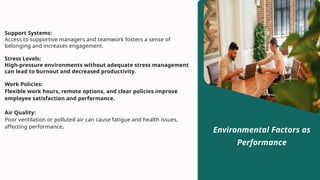
Support Systems:
Access to supportive managers and teamwork fosters a sense of
belonging and increases engagement.
Stress Levels:
High-pressure environments without adequate stress management
can lead to burnout and decreased productivity.
Work Policies:
Flexible work hours, remote options, and clear policies improve
employee satisfaction and performance.
Air Quality:
Poor ventilation or polluted air can cause fatigue and health issues,
affecting performance.
Environmental Factors as
Performance
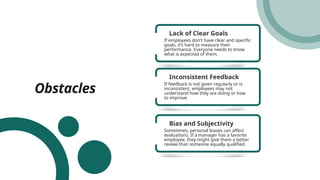
Obstacles
If employees don’t have clear and specific
goals, it’s hard to measure their
performance. Everyone needs to know
what is expected of them.
Lack of Clear Goals
If feedback is not given regularly or is
inconsistent, employees may not
understand how they are doing or how
to improve.
Inconsistent Feedback
Sometimes, personal biases can affect
evaluations. If a manager has a favorite
employee, they might give them a better
review than someone equally qualified.
Bias and Subjectivity
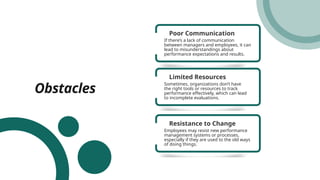
Obstacles
If there’s a lack of communication
between managers and employees, it can
lead to misunderstandings about
performance expectations and results.
Poor Communication
Sometimes, organizations don’t have
the right tools or resources to track
performance effectively, which can lead
to incomplete evaluations.
Limited Resources
Employees may resist new performance
management systems or processes,
especially if they are used to the old ways
of doing things.
Resistance to Change
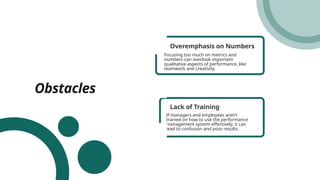
Obstacles
Focusing too much on metrics and
numbers can overlook important
qualitative aspects of performance, like
teamwork and creativity.
Overemphasis on Numbers
If managers and employees aren’t
trained on how to use the performance
management system effectively, it can
lead to confusion and poor results.
Lack of Training
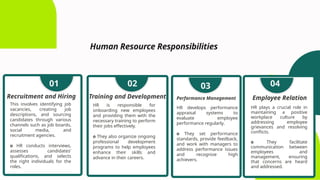
Human Resource Responsibilities
This involves identifying job
vacancies, creating job
descriptions, and sourcing
candidates through various
channels such as job boards,
social media, and
recruitment agencies.
o HR conducts interviews,
assesses candidates'
qualifications, and selects
the right individuals for the
roles.
Recruitment and Hiring
01
HR is responsible for
onboarding new employees
and providing them with the
necessary training to perform
their jobs effectively.
o They also organize ongoing
professional development
programs to help employees
enhance their skills and
advance in their careers.
Training and Development
02
HR develops performance
appraisal systems to
evaluate employee
performance regularly.
o They set performance
standards, provide feedback,
and work with managers to
address performance issues
and recognize high
achievers.
Performance Management
03
HR plays a crucial role in
maintaining a positive
workplace culture by
addressing employee
grievances and resolving
conflicts.
o They facilitate
communication between
employees and
management, ensuring
that concerns are heard
and addressed.
Employee Relation
04
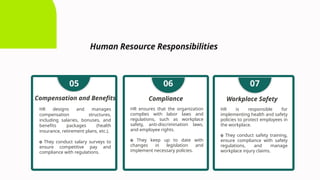
Human Resource Responsibilities
HR designs and manages
compensation structures,
including salaries, bonuses, and
benefits packages (health
insurance, retirement plans, etc.).
o They conduct salary surveys to
ensure competitive pay and
compliance with regulations.
Compensation and Benefits
05
HR ensures that the organization
complies with labor laws and
regulations, such as workplace
safety, anti-discrimination laws,
and employee rights.
o They keep up to date with
changes in legislation and
implement necessary policies.
Compliance
06
HR is responsible for
implementing health and safety
policies to protect employees in
the workplace.
o They conduct safety training,
ensure compliance with safety
regulations, and manage
workplace injury claims.
Workplace Safety
07
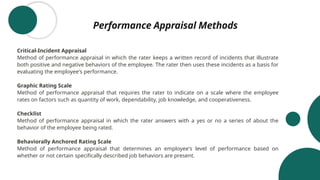
Performance Appraisal System
Process of determining and communicating to
an employee how he or she is performing on
the job and, ideally, establishing a plan of
improvement.
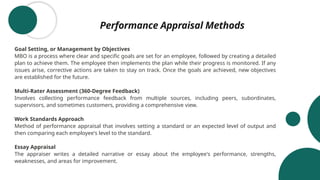
Performance Appraisal Methods
Goal Setting, or Management by Objectives
MBO is a process where clear and specific goals are set for an employee, followed by creating a detailed
plan to achieve them. The employee then implements the plan while their progress is monitored. If any
issues arise, corrective actions are taken to stay on track. Once the goals are achieved, new objectives
are established for the future.
Multi-Rater Assessment (360-Degree Feedback)
Involves collecting performance feedback from multiple sources, including peers, subordinates,
supervisors, and sometimes customers, providing a comprehensive view.
Work Standards Approach
Method of performance appraisal that involves setting a standard or an expected level of output and
then comparing each employee's level to the standard.
Essay Appraisal
The appraiser writes a detailed narrative or essay about the employee's performance, strengths,
weaknesses, and areas for improvement.
Performance Appraisal Methods
Critical-Incident Appraisal
Method of performance appraisal in which the rater keeps a written record of incidents that illustrate
both positive and negative behaviors of the employee. The rater then uses these incidents as a basis for
evaluating the employee's performance.
Graphic Rating Scale
Method of performance appraisal that requires the rater to indicate on a scale where the employee
rates on factors such as quantity of work, dependability, job knowledge, and cooperativeness.
Checklist
Method of performance appraisal in which the rater answers with a yes or no a series of about the
behavior of the employee being rated.
Behaviorally Anchored Rating Scale
Method of performance appraisal that determines an employee's level of performance based on
whether or not certain specifically described job behaviors are present.
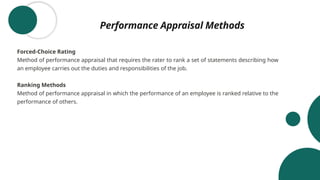
Performance Appraisal Methods
Forced-Choice Rating
Method of performance appraisal that requires the rater to rank a set of statements describing how
an employee carries out the duties and responsibilities of the job.
Ranking Methods
Method of performance appraisal in which the performance of an employee is ranked relative to the
performance of others.
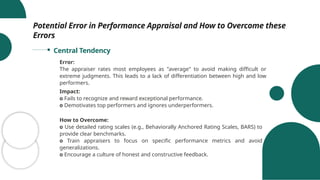
Potential Error in Performance Appraisal and How to Overcome these
Errors
Central Tendency
Error:
The appraiser rates most employees as "average" to avoid making difficult or
extreme judgments. This leads to a lack of differentiation between high and low
performers.
Impact:
o Fails to recognize and reward exceptional performance.
o Demotivates top performers and ignores underperformers.
How to Overcome:
o Use detailed rating scales (e.g., Behaviorally Anchored Rating Scales, BARS) to
provide clear benchmarks.
o Train appraisers to focus on specific performance metrics and avoid
generalizations.
o Encourage a culture of honest and constructive feedback.
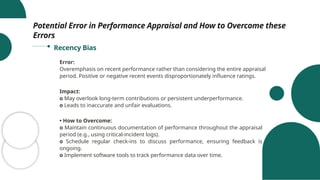
Potential Error in Performance Appraisal and How to Overcome these
Errors
Recency Bias
Error:
Overemphasis on recent performance rather than considering the entire appraisal
period. Positive or negative recent events disproportionately influence ratings.
Impact:
o May overlook long-term contributions or persistent underperformance.
o Leads to inaccurate and unfair evaluations.
• How to Overcome:
o Maintain continuous documentation of performance throughout the appraisal
period (e.g., using critical-incident logs).
o Schedule regular check-ins to discuss performance, ensuring feedback is
ongoing.
o Implement software tools to track performance data over time.
Potential Error in Performance Appraisal and How to Overcome these
Errors
Halo Effect
Error:
Allowing one positive trait (e.g., punctuality or friendliness) to overly influence the
overall evaluation, leading to inflated ratings.
Impact:
o Masks weaknesses or areas needing improvement.
o Reduces the effectiveness of the appraisal for professional development.
How to Overcome:
o Evaluate employees on a criterion-by-criterion basis rather than an overall
impression.
o Use structured appraisal forms with multiple, independent performance
factors.
o Provide training to appraisers to recognize and mitigate bias.
General Solutions to Avoid These Errors
• Appraiser Training: Educate evaluators on common biases and how to
overcome them.
• Multi-Rater Feedback: Incorporate input from multiple sources (e.g., 360-degree
feedback) to balance perspectives.
• Standardized Tools: Use consistent, objective tools like rating scales or checklists.
• Performance Tracking Systems: Implement technology to record and analyze
performance trends.
• Regular Reviews: Conduct mid-year or quarterly reviews to capture ongoing
performance.
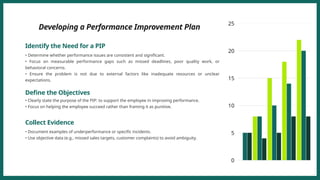
Developing a Performance Improvement Plan
Identify the Need for a PIP
• Determine whether performance issues are consistent and significant.
• Focus on measurable performance gaps such as missed deadlines, poor quality work, or
behavioral concerns.
• Ensure the problem is not due to external factors like inadequate resources or unclear
expectations.
Define the Objectives
• Clearly state the purpose of the PIP: to support the employee in improving performance.
• Focus on helping the employee succeed rather than framing it as punitive.
Collect Evidence
• Document examples of underperformance or specific incidents.
• Use objective data (e.g., missed sales targets, customer complaints) to avoid ambiguity.
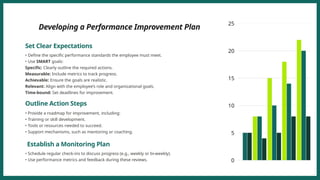
Developing a Performance Improvement Plan
Set Clear Expectations
• Define the specific performance standards the employee must meet.
• Use SMART goals:
Specific: Clearly outline the required actions.
Measurable: Include metrics to track progress.
Achievable: Ensure the goals are realistic.
Relevant: Align with the employee’s role and organizational goals.
Time-bound: Set deadlines for improvement.
Outline Action Steps
• Provide a roadmap for improvement, including:
• Training or skill development.
• Tools or resources needed to succeed.
• Support mechanisms, such as mentoring or coaching.
Establish a Monitoring Plan
• Schedule regular check-ins to discuss progress (e.g., weekly or bi-weekly).
• Use performance metrics and feedback during these reviews.
Developing a Performance Improvement Plan
Communicate Effectively
• Meet with the employee to discuss the PIP in detail.
• Use a collaborative tone, emphasizing that the PIP is a supportive tool.
• Address any concerns or misunderstandings about the process.
Document Everything
• Record the details of the PIP, including:
Performance gaps identified.
Agreed-upon goals and actions.
Timelines and progress check-ins.
Have both parties (manager and employee) sign the document to ensure clarity and
accountability.
Provide Support and Resources
• Offer necessary tools, training, or guidance to help the employee improve.
• Assign a mentor or coach if needed.
Developing a Performance Improvement Plan
Evaluate Progress and Make Decisions
• After the PIP timeline ends, assess whether the employee met the performance goals.
• Based on results, decide:
Successful completion: Recognize improvement and reintegrate the employee fully.
Partial progress: Extend the PIP with revised goals.
No improvement: Consider further actions, such as reassignment or termination.
Performance Appraisal and the Law
Equal Employment Opportunity (EEO) Laws
Anti-Discrimination Laws: Ensure performance appraisals do not discriminate based on race, gender, age,
disability, religion, national origin, or other protected categories. This is mandated by laws like Title VII of the
Civil Rights Act of 1964, Age Discrimination in Employment Act (ADEA), and the Americans with Disabilities Act
(ADA).
Impartial Criteria: Appraisals should be based on job-related criteria that apply equally to all employees.
Ensure that evaluations are fair and unbiased by focusing on performance, not personal characteristics.
Consistency and Fairness
Avoiding Bias: Legal claims can arise from performance appraisals that are perceived as unfair or biased.
Managers must ensure their appraisals are consistent across all employees. Common biases such as halo
effect, leniency bias, or recency effect can lead to claims of discrimination or unfair treatment.
Standardized Evaluation Criteria: Establish clear, standardized criteria for evaluating performance to reduce
subjectivity and bias. This helps ensure that all employees are treated fairly and equally.
Performance Appraisal and the Law
Documentation and Record-Keeping
Legal Documentation: Proper documentation is essential for defending decisions related to employment
actions such as promotions, terminations, or disciplinary actions. Record keeping of performance appraisals
ensures that the process is transparent and that there is a clear trail of feedback and development.
Retention Periods: Keep records of performance evaluations in compliance with local or federal regulations
regarding employee records retention. Typically, performance appraisals should be stored for at least 3 to 5
years.
ADA and Reasonable Accommodations
Accommodations for Disabilities: Under the Americans with Disabilities Act (ADA), employees with disabilities
may need accommodations to perform their jobs effectively. Performance appraisals should take into account
any accommodations that have been made and assess performance based on the employee’s ability to perform
the job with those accommodations.
Non-Discriminatory Practices: Avoid penalizing employees for disabilities or conditions that are protected
under law. Instead, appraise their performance based on their ability to meet job requirements with reasonable
accommodations.
THANK YOU

performance management system, Determine

  • 1.
  • 2.
    Performance management systemis a holistic, ongoing process that focuses on the continuous improvement of an individual's performance through setting objectives, providing regular feedback, coaching, and recognizing achievements. It's about aligning an employee's day-to-day work with the strategic goals of the organization and ensuring that they have the necessary support and resources to fulfill their role effectively.
  • 3.
    1. Skills andAbilities: Employees need to have the right skills and knowledge for their jobs. When they have the right training, they can do their work better. 2. Motivation: When people are motivated, they work harder. This can come from feeling good about their work or from rewards like bonuses or praise. Companies can help by recognizing and rewarding good work. 3. Work Environment: A positive and supportive workplace makes a big difference. Employees who feel comfortable and part of a good team are likelier to perform well. 4. Leadership: Good leaders guide and support their teams. They provide clear goals and encourage employees, which helps improve performance. Determinants
  • 4.
    5. Training andDevelopment: Ongoing training helps employees learn new skills and grow in their jobs. Companies that invest in their employees’ growth often see better performance. 6. Job Design: How a job is set up matters. Jobs that are interesting and allow for independence can make employees more engaged and motivated. 7. Organizational Culture: A strong company culture that values hard work and teamwork can improve performance. Employees are more dedicated when they feel connected to the company’s goals. 8. Resources and Tools: Having the right tools and resources is important. When employees have what they need to do their jobs well, they can perform better. Determinants
  • 5.
    Temperature: Extreme temperatures—too hotor cold—can reduce comfort and concentration. Optimal workplace temperatures enhance efficiency. Lighting: Poor lighting can cause eye strain and fatigue, while natural light boosts energy, mood, and focus Noise Levels: Excessive noise creates stress and distractions, while a quiet or sound-optimized space promotes focus and productivity. Ergonomics: Uncomfortable furniture or improper workstation setups can lead to physical discomfort, reducing output and increasing absenteeism. Workplace Culture: A positive culture encourages collaboration and motivation, while a toxic environment reduces morale and performance. Environmental Factors as Performance
  • 6.
    Support Systems: Access tosupportive managers and teamwork fosters a sense of belonging and increases engagement. Stress Levels: High-pressure environments without adequate stress management can lead to burnout and decreased productivity. Work Policies: Flexible work hours, remote options, and clear policies improve employee satisfaction and performance. Air Quality: Poor ventilation or polluted air can cause fatigue and health issues, affecting performance. Environmental Factors as Performance
  • 7.
    Obstacles If employees don’thave clear and specific goals, it’s hard to measure their performance. Everyone needs to know what is expected of them. Lack of Clear Goals If feedback is not given regularly or is inconsistent, employees may not understand how they are doing or how to improve. Inconsistent Feedback Sometimes, personal biases can affect evaluations. If a manager has a favorite employee, they might give them a better review than someone equally qualified. Bias and Subjectivity
  • 8.
    Obstacles If there’s alack of communication between managers and employees, it can lead to misunderstandings about performance expectations and results. Poor Communication Sometimes, organizations don’t have the right tools or resources to track performance effectively, which can lead to incomplete evaluations. Limited Resources Employees may resist new performance management systems or processes, especially if they are used to the old ways of doing things. Resistance to Change
  • 9.
    Obstacles Focusing too muchon metrics and numbers can overlook important qualitative aspects of performance, like teamwork and creativity. Overemphasis on Numbers If managers and employees aren’t trained on how to use the performance management system effectively, it can lead to confusion and poor results. Lack of Training
  • 10.
    Human Resource Responsibilities Thisinvolves identifying job vacancies, creating job descriptions, and sourcing candidates through various channels such as job boards, social media, and recruitment agencies. o HR conducts interviews, assesses candidates' qualifications, and selects the right individuals for the roles. Recruitment and Hiring 01 HR is responsible for onboarding new employees and providing them with the necessary training to perform their jobs effectively. o They also organize ongoing professional development programs to help employees enhance their skills and advance in their careers. Training and Development 02 HR develops performance appraisal systems to evaluate employee performance regularly. o They set performance standards, provide feedback, and work with managers to address performance issues and recognize high achievers. Performance Management 03 HR plays a crucial role in maintaining a positive workplace culture by addressing employee grievances and resolving conflicts. o They facilitate communication between employees and management, ensuring that concerns are heard and addressed. Employee Relation 04
  • 11.
    Human Resource Responsibilities HRdesigns and manages compensation structures, including salaries, bonuses, and benefits packages (health insurance, retirement plans, etc.). o They conduct salary surveys to ensure competitive pay and compliance with regulations. Compensation and Benefits 05 HR ensures that the organization complies with labor laws and regulations, such as workplace safety, anti-discrimination laws, and employee rights. o They keep up to date with changes in legislation and implement necessary policies. Compliance 06 HR is responsible for implementing health and safety policies to protect employees in the workplace. o They conduct safety training, ensure compliance with safety regulations, and manage workplace injury claims. Workplace Safety 07
  • 12.
    Performance Appraisal System Processof determining and communicating to an employee how he or she is performing on the job and, ideally, establishing a plan of improvement.
  • 13.
    Performance Appraisal Methods GoalSetting, or Management by Objectives MBO is a process where clear and specific goals are set for an employee, followed by creating a detailed plan to achieve them. The employee then implements the plan while their progress is monitored. If any issues arise, corrective actions are taken to stay on track. Once the goals are achieved, new objectives are established for the future. Multi-Rater Assessment (360-Degree Feedback) Involves collecting performance feedback from multiple sources, including peers, subordinates, supervisors, and sometimes customers, providing a comprehensive view. Work Standards Approach Method of performance appraisal that involves setting a standard or an expected level of output and then comparing each employee's level to the standard. Essay Appraisal The appraiser writes a detailed narrative or essay about the employee's performance, strengths, weaknesses, and areas for improvement.
  • 14.
    Performance Appraisal Methods Critical-IncidentAppraisal Method of performance appraisal in which the rater keeps a written record of incidents that illustrate both positive and negative behaviors of the employee. The rater then uses these incidents as a basis for evaluating the employee's performance. Graphic Rating Scale Method of performance appraisal that requires the rater to indicate on a scale where the employee rates on factors such as quantity of work, dependability, job knowledge, and cooperativeness. Checklist Method of performance appraisal in which the rater answers with a yes or no a series of about the behavior of the employee being rated. Behaviorally Anchored Rating Scale Method of performance appraisal that determines an employee's level of performance based on whether or not certain specifically described job behaviors are present.
  • 15.
    Performance Appraisal Methods Forced-ChoiceRating Method of performance appraisal that requires the rater to rank a set of statements describing how an employee carries out the duties and responsibilities of the job. Ranking Methods Method of performance appraisal in which the performance of an employee is ranked relative to the performance of others.
  • 16.
    Potential Error inPerformance Appraisal and How to Overcome these Errors Central Tendency Error: The appraiser rates most employees as "average" to avoid making difficult or extreme judgments. This leads to a lack of differentiation between high and low performers. Impact: o Fails to recognize and reward exceptional performance. o Demotivates top performers and ignores underperformers. How to Overcome: o Use detailed rating scales (e.g., Behaviorally Anchored Rating Scales, BARS) to provide clear benchmarks. o Train appraisers to focus on specific performance metrics and avoid generalizations. o Encourage a culture of honest and constructive feedback.
  • 17.
    Potential Error inPerformance Appraisal and How to Overcome these Errors Recency Bias Error: Overemphasis on recent performance rather than considering the entire appraisal period. Positive or negative recent events disproportionately influence ratings. Impact: o May overlook long-term contributions or persistent underperformance. o Leads to inaccurate and unfair evaluations. • How to Overcome: o Maintain continuous documentation of performance throughout the appraisal period (e.g., using critical-incident logs). o Schedule regular check-ins to discuss performance, ensuring feedback is ongoing. o Implement software tools to track performance data over time.
  • 18.
    Potential Error inPerformance Appraisal and How to Overcome these Errors Halo Effect Error: Allowing one positive trait (e.g., punctuality or friendliness) to overly influence the overall evaluation, leading to inflated ratings. Impact: o Masks weaknesses or areas needing improvement. o Reduces the effectiveness of the appraisal for professional development. How to Overcome: o Evaluate employees on a criterion-by-criterion basis rather than an overall impression. o Use structured appraisal forms with multiple, independent performance factors. o Provide training to appraisers to recognize and mitigate bias.
  • 19.
    General Solutions toAvoid These Errors • Appraiser Training: Educate evaluators on common biases and how to overcome them. • Multi-Rater Feedback: Incorporate input from multiple sources (e.g., 360-degree feedback) to balance perspectives. • Standardized Tools: Use consistent, objective tools like rating scales or checklists. • Performance Tracking Systems: Implement technology to record and analyze performance trends. • Regular Reviews: Conduct mid-year or quarterly reviews to capture ongoing performance.
  • 20.
    Developing a PerformanceImprovement Plan Identify the Need for a PIP • Determine whether performance issues are consistent and significant. • Focus on measurable performance gaps such as missed deadlines, poor quality work, or behavioral concerns. • Ensure the problem is not due to external factors like inadequate resources or unclear expectations. Define the Objectives • Clearly state the purpose of the PIP: to support the employee in improving performance. • Focus on helping the employee succeed rather than framing it as punitive. Collect Evidence • Document examples of underperformance or specific incidents. • Use objective data (e.g., missed sales targets, customer complaints) to avoid ambiguity.
  • 21.
    Developing a PerformanceImprovement Plan Set Clear Expectations • Define the specific performance standards the employee must meet. • Use SMART goals: Specific: Clearly outline the required actions. Measurable: Include metrics to track progress. Achievable: Ensure the goals are realistic. Relevant: Align with the employee’s role and organizational goals. Time-bound: Set deadlines for improvement. Outline Action Steps • Provide a roadmap for improvement, including: • Training or skill development. • Tools or resources needed to succeed. • Support mechanisms, such as mentoring or coaching. Establish a Monitoring Plan • Schedule regular check-ins to discuss progress (e.g., weekly or bi-weekly). • Use performance metrics and feedback during these reviews.
  • 22.
    Developing a PerformanceImprovement Plan Communicate Effectively • Meet with the employee to discuss the PIP in detail. • Use a collaborative tone, emphasizing that the PIP is a supportive tool. • Address any concerns or misunderstandings about the process. Document Everything • Record the details of the PIP, including: Performance gaps identified. Agreed-upon goals and actions. Timelines and progress check-ins. Have both parties (manager and employee) sign the document to ensure clarity and accountability. Provide Support and Resources • Offer necessary tools, training, or guidance to help the employee improve. • Assign a mentor or coach if needed.
  • 23.
    Developing a PerformanceImprovement Plan Evaluate Progress and Make Decisions • After the PIP timeline ends, assess whether the employee met the performance goals. • Based on results, decide: Successful completion: Recognize improvement and reintegrate the employee fully. Partial progress: Extend the PIP with revised goals. No improvement: Consider further actions, such as reassignment or termination.
  • 24.
    Performance Appraisal andthe Law Equal Employment Opportunity (EEO) Laws Anti-Discrimination Laws: Ensure performance appraisals do not discriminate based on race, gender, age, disability, religion, national origin, or other protected categories. This is mandated by laws like Title VII of the Civil Rights Act of 1964, Age Discrimination in Employment Act (ADEA), and the Americans with Disabilities Act (ADA). Impartial Criteria: Appraisals should be based on job-related criteria that apply equally to all employees. Ensure that evaluations are fair and unbiased by focusing on performance, not personal characteristics. Consistency and Fairness Avoiding Bias: Legal claims can arise from performance appraisals that are perceived as unfair or biased. Managers must ensure their appraisals are consistent across all employees. Common biases such as halo effect, leniency bias, or recency effect can lead to claims of discrimination or unfair treatment. Standardized Evaluation Criteria: Establish clear, standardized criteria for evaluating performance to reduce subjectivity and bias. This helps ensure that all employees are treated fairly and equally.
  • 25.
    Performance Appraisal andthe Law Documentation and Record-Keeping Legal Documentation: Proper documentation is essential for defending decisions related to employment actions such as promotions, terminations, or disciplinary actions. Record keeping of performance appraisals ensures that the process is transparent and that there is a clear trail of feedback and development. Retention Periods: Keep records of performance evaluations in compliance with local or federal regulations regarding employee records retention. Typically, performance appraisals should be stored for at least 3 to 5 years. ADA and Reasonable Accommodations Accommodations for Disabilities: Under the Americans with Disabilities Act (ADA), employees with disabilities may need accommodations to perform their jobs effectively. Performance appraisals should take into account any accommodations that have been made and assess performance based on the employee’s ability to perform the job with those accommodations. Non-Discriminatory Practices: Avoid penalizing employees for disabilities or conditions that are protected under law. Instead, appraise their performance based on their ability to meet job requirements with reasonable accommodations.
  • 26.