

PERFORMANCEPERFORMANCE
EVALUATIONEVALUATION
Industrial PsychologyIndustrial Psychology
Grace S. De Guzman- RapsingGrace S. De Guzman- Rapsing
What is Performance?What is Performance?
Performance is accomplishment ofPerformance is accomplishment of
the task assigned to an employeethe task assigned to an employee
through his/her effort, commitment,through his/her effort, commitment,
knowledge, skills and taking intoknowledge, skills and taking into
account factors that may help oraccount factors that may help or
hinder his/her performance such as ahinder his/her performance such as a
conducive working environment andconducive working environment and
availability of modern officeavailability of modern office
equipmentequipment
Performance = Output + BehaviorPerformance = Output + Behavior
Output – “What have you done?”Output – “What have you done?”
Result/sResult/s
Behavior – “How have you done it”Behavior – “How have you done it”
ProcessProcess
What is Performance Evaluation?What is Performance Evaluation?
Performance Evaluation is a methodPerformance Evaluation is a method
by which the individual worker’sby which the individual worker’s
efficiency in performing his/herefficiency in performing his/her
duties during a given period isduties during a given period is
evaluated on the basis of pre-evaluated on the basis of pre-
determined standards or establisheddetermined standards or established
goals mutually set and agreed upongoals mutually set and agreed upon
by the employee and supervisor.by the employee and supervisor.
Purposes of Performance AppraisalPurposes of Performance Appraisal
For the Worker:For the Worker:
– Means of reinforcement (praise, payMeans of reinforcement (praise, pay
raises)raises)
– Career Advancement (promotion,Career Advancement (promotion,
increased responsibility)increased responsibility)
– Information about work goal attainmentInformation about work goal attainment
– Source of feedback to improveSource of feedback to improve
performanceperformance
Purposes of Performance AppraisalPurposes of Performance Appraisal
For the Supervisor:For the Supervisor:
– Basis for making personnel decisionBasis for making personnel decision
(promotions, firings, etc.)(promotions, firings, etc.)
– Assessment of worker’s goal attainmentAssessment of worker’s goal attainment
– Opportunity to provide constructiveOpportunity to provide constructive
feedback to workersfeedback to workers
– Opportunity to interact withOpportunity to interact with
subordinatessubordinates
Purposes of Performance AppraisalPurposes of Performance Appraisal
For the Organization:For the Organization:
– Assessment of productivity of individualsAssessment of productivity of individuals
and work unitsand work units
– Enhance organizational effectivenessEnhance organizational effectiveness
and productivityand productivity
– Means of recognizing and motivatingMeans of recognizing and motivating
workersworkers
– Source of information for personnelSource of information for personnel
training needstraining needs
REASONS FORREASONS FOR
EVALUATING EMPLOYEESEVALUATING EMPLOYEES
Providing feedback (employeeProviding feedback (employee
performance/ training)performance/ training)
Determining salary increasesDetermining salary increases
Making promotion decisionsMaking promotion decisions
Making termination decisionsMaking termination decisions
Effective Performance AppraisalEffective Performance Appraisal
lead to:lead to:
PRODUCTIVITYPRODUCTIVITY
EFFECTIVENESSEFFECTIVENESS
EFFICIENCYEFFICIENCY
What is Performance Goal?What is Performance Goal?
Performance target refers toPerformance target refers to
activities and level of performanceactivities and level of performance
expected of an employee in terms ofexpected of an employee in terms of
quantity, quality and time which thequantity, quality and time which the
supervisor and the subordinatesupervisor and the subordinate
mutually discuss and agree upon atmutually discuss and agree upon at
the beginning of the rating periodthe beginning of the rating period
based on the activities normallybased on the activities normally
required by the programs and thrustrequired by the programs and thrust
of the office.of the office.
Why is Performance GoalWhy is Performance Goal
Important?Important?
Performance goals are importantPerformance goals are important
because they define the quantity andbecause they define the quantity and
quality of work an individual isquality of work an individual is
expected to accomplish within aexpected to accomplish within a
given period. Performance targetsgiven period. Performance targets
automatically become the bases forautomatically become the bases for
comparing his or her actualcomparing his or her actual
accomplishment at any point in timeaccomplishment at any point in time
within the rating periodwithin the rating period
Performance Evaluation System/Performance Evaluation System/
ProcessProcess
Expectation PlanningExpectation Planning
– Provide necessary information toProvide necessary information to
develop goalsdevelop goals
– Available to answer questions which theAvailable to answer questions which the
employee may have or discussemployee may have or discuss
suggestionssuggestions
– Review tentative goals and programReview tentative goals and program
stepssteps
Expectation PlanningExpectation Planning
– Program steps and rating standardsProgram steps and rating standards
Clearly understand the rationale and sourcesClearly understand the rationale and sources
of the goalsof the goals
Feel that goals and performance standardsFeel that goals and performance standards
are fair and achievableare fair and achievable
Understand how their jobs contribute to theUnderstand how their jobs contribute to the
overall effectiveness of the work groupoverall effectiveness of the work group
Observe that the superior is open andObserve that the superior is open and
responsive to displayed needs and concernsresponsive to displayed needs and concerns
Expectation PlanningExpectation Planning
– GOALS (objectives) – what is to be oneGOALS (objectives) – what is to be one
– PROGRAM STEPS – how the goal is to bePROGRAM STEPS – how the goal is to be
achievedachieved
– RATING STANDARDS – how theRATING STANDARDS – how the
performance via the goal is to beperformance via the goal is to be
measuredmeasured
Progress Review (Monitoring,Progress Review (Monitoring,
Documentation and Feedback)Documentation and Feedback)
– A formal meeting between the rater andA formal meeting between the rater and
the ratee to:the ratee to:
Discuss the accomplishment of goals andDiscuss the accomplishment of goals and
program stepsprogram steps
Problems being encounteredProblems being encountered
Any changes in the planAny changes in the plan
Progress ReviewProgress Review
– Superior:Superior:
Provide timely FEEDBACK and assistanceProvide timely FEEDBACK and assistance
Identify less than satisfactory performanceIdentify less than satisfactory performance
and take remedial stepsand take remedial steps
Document progress and action plans to beDocument progress and action plans to be
used as reference for evaluationused as reference for evaluation
Compliment excellent, highly satisfactoryCompliment excellent, highly satisfactory
and improved performanceand improved performance
Make necessary revisions in goals and/orMake necessary revisions in goals and/or
program stepsprogram steps
Progress ReviewProgress Review
– Subordinate:Subordinate:
Be informed about assessment of work progressBe informed about assessment of work progress
Negotiate with rater any possible changes in goalsNegotiate with rater any possible changes in goals
and/ program stepsand/ program steps
Provide feedback to rater on problems encounteredProvide feedback to rater on problems encountered
Participate in the formulation of action plansParticipate in the formulation of action plans
Acquire a feeling of fairness since performance isAcquire a feeling of fairness since performance is
constantly reviewed prior to performance evaluationconstantly reviewed prior to performance evaluation
Evaluation (Feedback, Plans forEvaluation (Feedback, Plans for
employee’s future developmentalemployee’s future developmental
program)program)
– ““Moment of Truth”Moment of Truth”
– Give Recognition/ PraiseGive Recognition/ Praise
– Constructive CriticismConstructive Criticism
FOCUS OF APPRAISALFOCUS OF APPRAISAL
DIMENSIONSDIMENSIONS
TraitsTraits
CompetenciesCompetencies
Tasks typesTasks types
GoalsGoals
Trait-Focused PerformanceTrait-Focused Performance
DimensionsDimensions
AA trait-focused systemtrait-focused system concentrates onconcentrates on
such employee attributes as dependability,such employee attributes as dependability,
honesty, and courtesy. Though commonlyhonesty, and courtesy. Though commonly
used, trait-focused performance appraisalused, trait-focused performance appraisal
instruments are not a good idea becauseinstruments are not a good idea because
they provide poor feedback and thus willthey provide poor feedback and thus will
not result in employee development andnot result in employee development and
growthgrowth
Competency-focusedCompetency-focused dimensionsdimensions
concentrate on the employee’sconcentrate on the employee’s
knowledge, skills, and abilities.knowledge, skills, and abilities.
– competency-focused dimensions mightcompetency-focused dimensions might
include writing skills, oral presentationinclude writing skills, oral presentation
skills, and driving skills.skills, and driving skills.
The advantage to organizingThe advantage to organizing
dimensions by competencies is thatdimensions by competencies is that
it is easy to provide feedback andit is easy to provide feedback and
suggest the steps necessary tosuggest the steps necessary to
correct deficienciescorrect deficiencies
Task-focusedTask-focused dimensions aredimensions are
organized by the similarity of tasksorganized by the similarity of tasks
that are performedthat are performed
To organize the appraisal on theTo organize the appraisal on the
basis ofbasis of goalsgoals to be accomplished byto be accomplished by
the employeethe employee
Contextual PerformanceContextual Performance
– Effort an employee makes to get alongEffort an employee makes to get along
with peers, improve the organization,with peers, improve the organization,
and perform tasks that are needed butand perform tasks that are needed but
not necessarily an official part ofnot necessarily an official part of
employee’s job description.employee’s job description.
– Not only the technical aspects that areNot only the technical aspects that are
being addressed but the contextualbeing addressed but the contextual
aspects as well. Not only effectiveaspects as well. Not only effective
workers but good organizationalworkers but good organizational
citizens.citizens.
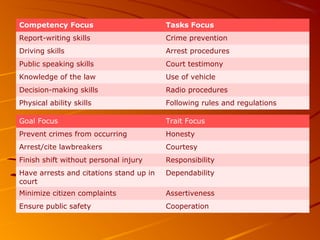
Four Ways to FocusFour Ways to Focus
Performance DimensionsPerformance Dimensions
Competency Focus Tasks Focus
Report-writing skills Crime prevention
Driving skills Arrest procedures
Public speaking skills Court testimony
Knowledge of the law Use of vehicle
Decision-making skills Radio procedures
Physical ability skills Following rules and regulations
Goal Focus Trait Focus
Prevent crimes from occurring Honesty
Arrest/cite lawbreakers Courtesy
Finish shift without personal injury Responsibility
Have arrests and citations stand up in
court
Dependability
Minimize citizen complaints Assertiveness
Ensure public safety Cooperation
ACCURATE PERFORMANCEACCURATE PERFORMANCE
MEASURESMEASURES
Performance should be accuratelyPerformance should be accurately
measured so employees will knowmeasured so employees will know
where they can improve.where they can improve.
Knowing where to improve shouldKnowing where to improve should
lead to training employees tolead to training employees to
develop new skills to improve.develop new skills to improve.
An accurate measure ofAn accurate measure of
performance, our measure must beperformance, our measure must be
valid and reliablevalid and reliable,, acceptable andacceptable and
feasible, specific, and based on thefeasible, specific, and based on the
mission and objectivesmission and objectives..
Valid and ReliableValid and Reliable
Objective, Uniform in application,Objective, Uniform in application,
Consistent in effect, and Has jobConsistent in effect, and Has job
relatednessrelatedness
Valid and ReliableValid and Reliable
• A valid measure is “true and correct.A valid measure is “true and correct.
When a measure has validity, it is aWhen a measure has validity, it is a
factual measure that measures thefactual measure that measures the
process that you wanted to measure.process that you wanted to measure.
• A reliable measure is consistent; itA reliable measure is consistent; it
works in generally the same wayworks in generally the same way
each time we use iteach time we use it
Acceptable and feasibleAcceptable and feasible
Acceptability means that the use ofAcceptability means that the use of
the measure is satisfactory orthe measure is satisfactory or
appropriate to the people who mustappropriate to the people who must
use ituse it
Acceptability must include whetherAcceptability must include whether
or not the evaluation tool is feasibleor not the evaluation tool is feasible
SpecificSpecific
Evaluation measures need to beEvaluation measures need to be
specific enough to identify what isspecific enough to identify what is
going well and what is not.going well and what is not.
SpecificSpecific means that the formsmeans that the forms
provide enough information forprovide enough information for
everyone to understand what level ofeveryone to understand what level of
performance has been achieved by aperformance has been achieved by a
particular employee within a well-particular employee within a well-
defined job.defined job.
Based on the Mission andBased on the Mission and
ObjectivesObjectives
Performance management systemPerformance management system
leads to the achievement of theleads to the achievement of the
organizational mission and objectivesorganizational mission and objectives
Performance AppraisalPerformance Appraisal
Measurement and Forms1Measurement and Forms1
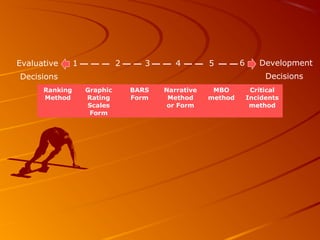
Ranking
Method
Graphic
Rating
Scales
Form
BARS
Form
Narrative
Method
or Form
MBO
method
Critical
Incidents
method
2 3 4 5 61Evaluative Development
Decisions Decisions
TheThe critical incidents methodcritical incidents method is ais a
performance appraisal method inperformance appraisal method in
which a manager keeps a writtenwhich a manager keeps a written
record of positive and negativerecord of positive and negative
performance of employeesperformance of employees
throughout the performance periodthroughout the performance period
Critical incidents are importantCritical incidents are important
employee actions, not minor ones,employee actions, not minor ones,
which help or hurt performance.which help or hurt performance.
Usually written by the managerUsually written by the manager
and/or is in the form ofand/or is in the form of
documentation, such as a warningdocumentation, such as a warning
that is given, performance reports,that is given, performance reports,
or a letter from a happy customeror a letter from a happy customer
thanking the employee for doing athanking the employee for doing a
great jobgreat job
Management by ObjectivesManagement by Objectives (MBO)(MBO)
method is a process in whichmethod is a process in which
managers and employees jointly setmanagers and employees jointly set
objectives for the employees,objectives for the employees,
periodically evaluate performance,periodically evaluate performance,
and reward according to the resultsand reward according to the results
MBOMBO is also referred to as workis also referred to as work
planning and review, goalsplanning and review, goals
management, goals and controls,management, goals and controls,
and management by resultsand management by results
Narrative formNarrative form requires a manager torequires a manager to
write a statement about thewrite a statement about the
employee’s performance.employee’s performance.
Graphic Rating Scale form is aGraphic Rating Scale form is a
performance appraisal checklist onperformance appraisal checklist on
which a manager simply rateswhich a manager simply rates
performance on a continuum such asperformance on a continuum such as
excellent, good, average, fair andexcellent, good, average, fair and
poorpoor
Behaviorally Anchored Rating ScaleBehaviorally Anchored Rating Scale
(BARS) form is a performance(BARS) form is a performance
appraisal that provides a descriptionappraisal that provides a description
of each assessment along aof each assessment along a
continuum.continuum.
The ranking method is aThe ranking method is a
performance appraisal method that isperformance appraisal method that is
used to evaluate employeeused to evaluate employee
performance from best to worst.performance from best to worst.
Common Problems With theCommon Problems With the
Performance AppraisalPerformance Appraisal
ProcessProcess
Bias is simply a personality-basedBias is simply a personality-based
tendency, either toward or againsttendency, either toward or against
something. In the case ofsomething. In the case of
performance assessment, bias isperformance assessment, bias is
toward or against an individualtoward or against an individual
employee.employee.
All human beings have biases, butAll human beings have biases, but
supervisors especially cannot affordsupervisors especially cannot afford
to allow their biases to enter intoto allow their biases to enter into
their evaluation of subordinates intheir evaluation of subordinates in
the firmthe firm
Stereotyping is mentally classifying aStereotyping is mentally classifying a
person into an affinity group, andperson into an affinity group, and
then identifying the person as havingthen identifying the person as having
the same assumed characteristics asthe same assumed characteristics as
the group. Though stereotyping isthe group. Though stereotyping is
almost always assumed to bealmost always assumed to be
negative, there are many incidents ofnegative, there are many incidents of
positive stereotypespositive stereotypes
Halo error occurs when the evaluatorHalo error occurs when the evaluator
has a generally positive impressionhas a generally positive impression
of an individual.of an individual.
Horns error – negative impressionHorns error – negative impression
Distributional ErrorDistributional Error
– Severity or strictness error, the raterSeverity or strictness error, the rater
evaluates everyone, or nearly everyone,evaluates everyone, or nearly everyone,
as below average.as below average.
– Central tendency error occurs whenCentral tendency error occurs when
raters evaluate everyone under theirraters evaluate everyone under their
control as average—nobody is eithercontrol as average—nobody is either
really good or really badreally good or really bad
– Leniency error occurs when the raterLeniency error occurs when the rater
evaluates all others as above average.evaluates all others as above average.
Leniency error, therefore, is basically aLeniency error, therefore, is basically a
form of grade inflation.form of grade inflation.
Similarity errorSimilarity error
– This error occurs when raters evaluateThis error occurs when raters evaluate
subordinates that they consider moresubordinates that they consider more
similar to themselves as bettersimilar to themselves as better
employees, and subordinates that theyemployees, and subordinates that they
consider different from themselves asconsider different from themselves as
poorer employees.poorer employees.
Proximity errorProximity error
– This error states that similar marks mayThis error states that similar marks may
be given to items that are nearbe given to items that are near
(proximate to) each other on the(proximate to) each other on the
performance appraisal form, regardlessperformance appraisal form, regardless
of differences in performance on thoseof differences in performance on those
measures.measures.
– We can avoid proximity error byWe can avoid proximity error by
objectively evaluating employees’ actualobjectively evaluating employees’ actual
performance on each and every item onperformance on each and every item on
the assessment form.the assessment form.
Recency error.Recency error.
– This error occurs when raters use onlyThis error occurs when raters use only
the last few weeks or month of a ratingthe last few weeks or month of a rating
period as evidence of their ratings ofperiod as evidence of their ratings of
others.others.
Contrast errorContrast error
– In contrast error, the rater comparesIn contrast error, the rater compares
and contrasts performance between twoand contrasts performance between two
employees, rather than using absoluteemployees, rather than using absolute
measures of performance to measuremeasures of performance to measure
each employee.each employee.
Attribution errorAttribution error
– In simplified terms, attribution is aIn simplified terms, attribution is a
process where an individualprocess where an individual assumesassumes
reasons or motivations (such asreasons or motivations (such as
attitudes, values, or beliefs) for anattitudes, values, or beliefs) for an
observed behavior.observed behavior.
– attribution error in performanceattribution error in performance
appraisal might occur when the raterappraisal might occur when the rater
observes an employee action—such asobserves an employee action—such as
an argumentative answer to a questionan argumentative answer to a question
—and assumes that the individual has a—and assumes that the individual has a
negative attitude toward the job and isnegative attitude toward the job and is
a poor performer. This may not be true,a poor performer. This may not be true,
and in such a case the rater would beand in such a case the rater would be
guilty of an attribution error.guilty of an attribution error.

Performance evaluation

  • 1.
  • 2.
    What is Performance?Whatis Performance? Performance is accomplishment ofPerformance is accomplishment of the task assigned to an employeethe task assigned to an employee through his/her effort, commitment,through his/her effort, commitment, knowledge, skills and taking intoknowledge, skills and taking into account factors that may help oraccount factors that may help or hinder his/her performance such as ahinder his/her performance such as a conducive working environment andconducive working environment and availability of modern officeavailability of modern office equipmentequipment
  • 3.
    Performance = Output+ BehaviorPerformance = Output + Behavior Output – “What have you done?”Output – “What have you done?” Result/sResult/s Behavior – “How have you done it”Behavior – “How have you done it” ProcessProcess
  • 4.
    What is PerformanceEvaluation?What is Performance Evaluation? Performance Evaluation is a methodPerformance Evaluation is a method by which the individual worker’sby which the individual worker’s efficiency in performing his/herefficiency in performing his/her duties during a given period isduties during a given period is evaluated on the basis of pre-evaluated on the basis of pre- determined standards or establisheddetermined standards or established goals mutually set and agreed upongoals mutually set and agreed upon by the employee and supervisor.by the employee and supervisor.
  • 5.
    Purposes of PerformanceAppraisalPurposes of Performance Appraisal For the Worker:For the Worker: – Means of reinforcement (praise, payMeans of reinforcement (praise, pay raises)raises) – Career Advancement (promotion,Career Advancement (promotion, increased responsibility)increased responsibility) – Information about work goal attainmentInformation about work goal attainment – Source of feedback to improveSource of feedback to improve performanceperformance
  • 6.
    Purposes of PerformanceAppraisalPurposes of Performance Appraisal For the Supervisor:For the Supervisor: – Basis for making personnel decisionBasis for making personnel decision (promotions, firings, etc.)(promotions, firings, etc.) – Assessment of worker’s goal attainmentAssessment of worker’s goal attainment – Opportunity to provide constructiveOpportunity to provide constructive feedback to workersfeedback to workers – Opportunity to interact withOpportunity to interact with subordinatessubordinates
  • 7.
    Purposes of PerformanceAppraisalPurposes of Performance Appraisal For the Organization:For the Organization: – Assessment of productivity of individualsAssessment of productivity of individuals and work unitsand work units – Enhance organizational effectivenessEnhance organizational effectiveness and productivityand productivity – Means of recognizing and motivatingMeans of recognizing and motivating workersworkers – Source of information for personnelSource of information for personnel training needstraining needs
  • 8.
    REASONS FORREASONS FOR EVALUATINGEMPLOYEESEVALUATING EMPLOYEES
  • 9.
    Providing feedback (employeeProvidingfeedback (employee performance/ training)performance/ training) Determining salary increasesDetermining salary increases Making promotion decisionsMaking promotion decisions Making termination decisionsMaking termination decisions
  • 10.
    Effective Performance AppraisalEffectivePerformance Appraisal lead to:lead to: PRODUCTIVITYPRODUCTIVITY EFFECTIVENESSEFFECTIVENESS EFFICIENCYEFFICIENCY
  • 11.
    What is PerformanceGoal?What is Performance Goal? Performance target refers toPerformance target refers to activities and level of performanceactivities and level of performance expected of an employee in terms ofexpected of an employee in terms of quantity, quality and time which thequantity, quality and time which the supervisor and the subordinatesupervisor and the subordinate mutually discuss and agree upon atmutually discuss and agree upon at the beginning of the rating periodthe beginning of the rating period based on the activities normallybased on the activities normally required by the programs and thrustrequired by the programs and thrust of the office.of the office.
  • 12.
    Why is PerformanceGoalWhy is Performance Goal Important?Important? Performance goals are importantPerformance goals are important because they define the quantity andbecause they define the quantity and quality of work an individual isquality of work an individual is expected to accomplish within aexpected to accomplish within a given period. Performance targetsgiven period. Performance targets automatically become the bases forautomatically become the bases for comparing his or her actualcomparing his or her actual accomplishment at any point in timeaccomplishment at any point in time within the rating periodwithin the rating period
  • 13.
    Performance Evaluation System/PerformanceEvaluation System/ ProcessProcess Expectation PlanningExpectation Planning – Provide necessary information toProvide necessary information to develop goalsdevelop goals – Available to answer questions which theAvailable to answer questions which the employee may have or discussemployee may have or discuss suggestionssuggestions – Review tentative goals and programReview tentative goals and program stepssteps
  • 14.
    Expectation PlanningExpectation Planning –Program steps and rating standardsProgram steps and rating standards Clearly understand the rationale and sourcesClearly understand the rationale and sources of the goalsof the goals Feel that goals and performance standardsFeel that goals and performance standards are fair and achievableare fair and achievable Understand how their jobs contribute to theUnderstand how their jobs contribute to the overall effectiveness of the work groupoverall effectiveness of the work group Observe that the superior is open andObserve that the superior is open and responsive to displayed needs and concernsresponsive to displayed needs and concerns
  • 15.
    Expectation PlanningExpectation Planning –GOALS (objectives) – what is to be oneGOALS (objectives) – what is to be one – PROGRAM STEPS – how the goal is to bePROGRAM STEPS – how the goal is to be achievedachieved – RATING STANDARDS – how theRATING STANDARDS – how the performance via the goal is to beperformance via the goal is to be measuredmeasured
  • 16.
    Progress Review (Monitoring,ProgressReview (Monitoring, Documentation and Feedback)Documentation and Feedback) – A formal meeting between the rater andA formal meeting between the rater and the ratee to:the ratee to: Discuss the accomplishment of goals andDiscuss the accomplishment of goals and program stepsprogram steps Problems being encounteredProblems being encountered Any changes in the planAny changes in the plan
  • 17.
    Progress ReviewProgress Review –Superior:Superior: Provide timely FEEDBACK and assistanceProvide timely FEEDBACK and assistance Identify less than satisfactory performanceIdentify less than satisfactory performance and take remedial stepsand take remedial steps Document progress and action plans to beDocument progress and action plans to be used as reference for evaluationused as reference for evaluation Compliment excellent, highly satisfactoryCompliment excellent, highly satisfactory and improved performanceand improved performance Make necessary revisions in goals and/orMake necessary revisions in goals and/or program stepsprogram steps
  • 18.
    Progress ReviewProgress Review –Subordinate:Subordinate: Be informed about assessment of work progressBe informed about assessment of work progress Negotiate with rater any possible changes in goalsNegotiate with rater any possible changes in goals and/ program stepsand/ program steps Provide feedback to rater on problems encounteredProvide feedback to rater on problems encountered Participate in the formulation of action plansParticipate in the formulation of action plans Acquire a feeling of fairness since performance isAcquire a feeling of fairness since performance is constantly reviewed prior to performance evaluationconstantly reviewed prior to performance evaluation
  • 19.
    Evaluation (Feedback, PlansforEvaluation (Feedback, Plans for employee’s future developmentalemployee’s future developmental program)program) – ““Moment of Truth”Moment of Truth” – Give Recognition/ PraiseGive Recognition/ Praise – Constructive CriticismConstructive Criticism
  • 20.
    FOCUS OF APPRAISALFOCUSOF APPRAISAL DIMENSIONSDIMENSIONS
  • 21.
  • 22.
    Trait-Focused PerformanceTrait-Focused Performance DimensionsDimensions AAtrait-focused systemtrait-focused system concentrates onconcentrates on such employee attributes as dependability,such employee attributes as dependability, honesty, and courtesy. Though commonlyhonesty, and courtesy. Though commonly used, trait-focused performance appraisalused, trait-focused performance appraisal instruments are not a good idea becauseinstruments are not a good idea because they provide poor feedback and thus willthey provide poor feedback and thus will not result in employee development andnot result in employee development and growthgrowth
  • 23.
    Competency-focusedCompetency-focused dimensionsdimensions concentrate onthe employee’sconcentrate on the employee’s knowledge, skills, and abilities.knowledge, skills, and abilities. – competency-focused dimensions mightcompetency-focused dimensions might include writing skills, oral presentationinclude writing skills, oral presentation skills, and driving skills.skills, and driving skills.
  • 24.
    The advantage toorganizingThe advantage to organizing dimensions by competencies is thatdimensions by competencies is that it is easy to provide feedback andit is easy to provide feedback and suggest the steps necessary tosuggest the steps necessary to correct deficienciescorrect deficiencies
  • 25.
    Task-focusedTask-focused dimensions aredimensionsare organized by the similarity of tasksorganized by the similarity of tasks that are performedthat are performed
  • 26.
    To organize theappraisal on theTo organize the appraisal on the basis ofbasis of goalsgoals to be accomplished byto be accomplished by the employeethe employee
  • 27.
    Contextual PerformanceContextual Performance –Effort an employee makes to get alongEffort an employee makes to get along with peers, improve the organization,with peers, improve the organization, and perform tasks that are needed butand perform tasks that are needed but not necessarily an official part ofnot necessarily an official part of employee’s job description.employee’s job description. – Not only the technical aspects that areNot only the technical aspects that are being addressed but the contextualbeing addressed but the contextual aspects as well. Not only effectiveaspects as well. Not only effective workers but good organizationalworkers but good organizational citizens.citizens.
  • 28.
    Four Ways toFocusFour Ways to Focus Performance DimensionsPerformance Dimensions
  • 29.
    Competency Focus TasksFocus Report-writing skills Crime prevention Driving skills Arrest procedures Public speaking skills Court testimony Knowledge of the law Use of vehicle Decision-making skills Radio procedures Physical ability skills Following rules and regulations Goal Focus Trait Focus Prevent crimes from occurring Honesty Arrest/cite lawbreakers Courtesy Finish shift without personal injury Responsibility Have arrests and citations stand up in court Dependability Minimize citizen complaints Assertiveness Ensure public safety Cooperation
  • 31.
  • 32.
    Performance should beaccuratelyPerformance should be accurately measured so employees will knowmeasured so employees will know where they can improve.where they can improve. Knowing where to improve shouldKnowing where to improve should lead to training employees tolead to training employees to develop new skills to improve.develop new skills to improve.
  • 33.
    An accurate measureofAn accurate measure of performance, our measure must beperformance, our measure must be valid and reliablevalid and reliable,, acceptable andacceptable and feasible, specific, and based on thefeasible, specific, and based on the mission and objectivesmission and objectives..
  • 34.
    Valid and ReliableValidand Reliable Objective, Uniform in application,Objective, Uniform in application, Consistent in effect, and Has jobConsistent in effect, and Has job relatednessrelatedness
  • 35.
    Valid and ReliableValidand Reliable • A valid measure is “true and correct.A valid measure is “true and correct. When a measure has validity, it is aWhen a measure has validity, it is a factual measure that measures thefactual measure that measures the process that you wanted to measure.process that you wanted to measure. • A reliable measure is consistent; itA reliable measure is consistent; it works in generally the same wayworks in generally the same way each time we use iteach time we use it
  • 36.
    Acceptable and feasibleAcceptableand feasible Acceptability means that the use ofAcceptability means that the use of the measure is satisfactory orthe measure is satisfactory or appropriate to the people who mustappropriate to the people who must use ituse it
  • 37.
    Acceptability must includewhetherAcceptability must include whether or not the evaluation tool is feasibleor not the evaluation tool is feasible
  • 38.
    SpecificSpecific Evaluation measures needto beEvaluation measures need to be specific enough to identify what isspecific enough to identify what is going well and what is not.going well and what is not. SpecificSpecific means that the formsmeans that the forms provide enough information forprovide enough information for everyone to understand what level ofeveryone to understand what level of performance has been achieved by aperformance has been achieved by a particular employee within a well-particular employee within a well- defined job.defined job.
  • 39.
    Based on theMission andBased on the Mission and ObjectivesObjectives Performance management systemPerformance management system leads to the achievement of theleads to the achievement of the organizational mission and objectivesorganizational mission and objectives
  • 40.
  • 41.
  • 42.
    TheThe critical incidentsmethodcritical incidents method is ais a performance appraisal method inperformance appraisal method in which a manager keeps a writtenwhich a manager keeps a written record of positive and negativerecord of positive and negative performance of employeesperformance of employees throughout the performance periodthroughout the performance period
  • 43.
    Critical incidents areimportantCritical incidents are important employee actions, not minor ones,employee actions, not minor ones, which help or hurt performance.which help or hurt performance.
  • 44.
    Usually written bythe managerUsually written by the manager and/or is in the form ofand/or is in the form of documentation, such as a warningdocumentation, such as a warning that is given, performance reports,that is given, performance reports, or a letter from a happy customeror a letter from a happy customer thanking the employee for doing athanking the employee for doing a great jobgreat job
  • 45.
    Management by ObjectivesManagementby Objectives (MBO)(MBO) method is a process in whichmethod is a process in which managers and employees jointly setmanagers and employees jointly set objectives for the employees,objectives for the employees, periodically evaluate performance,periodically evaluate performance, and reward according to the resultsand reward according to the results
  • 46.
    MBOMBO is alsoreferred to as workis also referred to as work planning and review, goalsplanning and review, goals management, goals and controls,management, goals and controls, and management by resultsand management by results
  • 47.
    Narrative formNarrative formrequires a manager torequires a manager to write a statement about thewrite a statement about the employee’s performance.employee’s performance.
  • 48.
    Graphic Rating Scaleform is aGraphic Rating Scale form is a performance appraisal checklist onperformance appraisal checklist on which a manager simply rateswhich a manager simply rates performance on a continuum such asperformance on a continuum such as excellent, good, average, fair andexcellent, good, average, fair and poorpoor
  • 49.
    Behaviorally Anchored RatingScaleBehaviorally Anchored Rating Scale (BARS) form is a performance(BARS) form is a performance appraisal that provides a descriptionappraisal that provides a description of each assessment along aof each assessment along a continuum.continuum.
  • 50.
    The ranking methodis aThe ranking method is a performance appraisal method that isperformance appraisal method that is used to evaluate employeeused to evaluate employee performance from best to worst.performance from best to worst.
  • 51.
    Common Problems WiththeCommon Problems With the Performance AppraisalPerformance Appraisal ProcessProcess
  • 52.
    Bias is simplya personality-basedBias is simply a personality-based tendency, either toward or againsttendency, either toward or against something. In the case ofsomething. In the case of performance assessment, bias isperformance assessment, bias is toward or against an individualtoward or against an individual employee.employee.
  • 53.
    All human beingshave biases, butAll human beings have biases, but supervisors especially cannot affordsupervisors especially cannot afford to allow their biases to enter intoto allow their biases to enter into their evaluation of subordinates intheir evaluation of subordinates in the firmthe firm
  • 54.
    Stereotyping is mentallyclassifying aStereotyping is mentally classifying a person into an affinity group, andperson into an affinity group, and then identifying the person as havingthen identifying the person as having the same assumed characteristics asthe same assumed characteristics as the group. Though stereotyping isthe group. Though stereotyping is almost always assumed to bealmost always assumed to be negative, there are many incidents ofnegative, there are many incidents of positive stereotypespositive stereotypes
  • 55.
    Halo error occurswhen the evaluatorHalo error occurs when the evaluator has a generally positive impressionhas a generally positive impression of an individual.of an individual. Horns error – negative impressionHorns error – negative impression
  • 56.
    Distributional ErrorDistributional Error –Severity or strictness error, the raterSeverity or strictness error, the rater evaluates everyone, or nearly everyone,evaluates everyone, or nearly everyone, as below average.as below average. – Central tendency error occurs whenCentral tendency error occurs when raters evaluate everyone under theirraters evaluate everyone under their control as average—nobody is eithercontrol as average—nobody is either really good or really badreally good or really bad
  • 57.
    – Leniency erroroccurs when the raterLeniency error occurs when the rater evaluates all others as above average.evaluates all others as above average. Leniency error, therefore, is basically aLeniency error, therefore, is basically a form of grade inflation.form of grade inflation.
  • 58.
    Similarity errorSimilarity error –This error occurs when raters evaluateThis error occurs when raters evaluate subordinates that they consider moresubordinates that they consider more similar to themselves as bettersimilar to themselves as better employees, and subordinates that theyemployees, and subordinates that they consider different from themselves asconsider different from themselves as poorer employees.poorer employees.
  • 59.
    Proximity errorProximity error –This error states that similar marks mayThis error states that similar marks may be given to items that are nearbe given to items that are near (proximate to) each other on the(proximate to) each other on the performance appraisal form, regardlessperformance appraisal form, regardless of differences in performance on thoseof differences in performance on those measures.measures. – We can avoid proximity error byWe can avoid proximity error by objectively evaluating employees’ actualobjectively evaluating employees’ actual performance on each and every item onperformance on each and every item on the assessment form.the assessment form.
  • 60.
    Recency error.Recency error. –This error occurs when raters use onlyThis error occurs when raters use only the last few weeks or month of a ratingthe last few weeks or month of a rating period as evidence of their ratings ofperiod as evidence of their ratings of others.others.
  • 61.
    Contrast errorContrast error –In contrast error, the rater comparesIn contrast error, the rater compares and contrasts performance between twoand contrasts performance between two employees, rather than using absoluteemployees, rather than using absolute measures of performance to measuremeasures of performance to measure each employee.each employee.
  • 62.
    Attribution errorAttribution error –In simplified terms, attribution is aIn simplified terms, attribution is a process where an individualprocess where an individual assumesassumes reasons or motivations (such asreasons or motivations (such as attitudes, values, or beliefs) for anattitudes, values, or beliefs) for an observed behavior.observed behavior.
  • 63.
    – attribution errorin performanceattribution error in performance appraisal might occur when the raterappraisal might occur when the rater observes an employee action—such asobserves an employee action—such as an argumentative answer to a questionan argumentative answer to a question —and assumes that the individual has a—and assumes that the individual has a negative attitude toward the job and isnegative attitude toward the job and is a poor performer. This may not be true,a poor performer. This may not be true, and in such a case the rater would beand in such a case the rater would be guilty of an attribution error.guilty of an attribution error.