Welcome
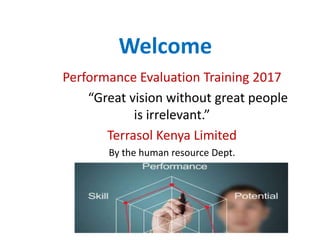
Performance Evaluation Training 2017
“Great vision without great people
is irrelevant.”
Terrasol Kenya Limited
By the human resource Dept.
Definitions
Performance - The accomplishment of a given task
measured against preset known standards of accuracy,
completeness, cost, and speed. In a contract, performance
is deemed to be the fulfillment of an obligation, in a
manner that releases the performer from all liabilities
under the contract.
Evaluation - is a systematic determination of a subject's
merit, worth and significance, using criteria governed by a
set of standards, or a rigorous analysis of completed or
ongoing activities that determine or support management
accountability, effectiveness.
Technical terminology Commonly
used:
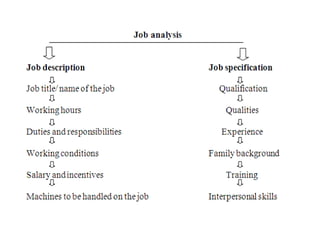
• Job description - It is an organized, factual statement
of the duties and responsibilities of a specific job. In
brief, it should tell what is to be done, how it is to be
done, and why. It is a standard of function, in that it
defines the appropriate and authorized content of a
job.
• Job specification - It is a statement of the minimum
acceptable human qualities necessary to perform a
job properly. It is a standard of personnel and
designates the qualities required for acceptable
performance.
Cont. on the terminologies
• Job Analysis - It is the process of studying and
collecting information relating to the operations and
responsibilities of a specific job. The immediate
products of this analysis are job descriptions and job
specifications.
• Job Evaluation - It is a systematic and orderly process
of determining the worth of a job in relation to other
jobs. The objective of this process is to determine the
correct rate of pay. It is therefore not the same as job
analysis. Rather it follows the job analysis process,
which provides the basic data to be evaluated.
Cont. on the Terminologies
• Vision – is a clear, comprehensive photograph of an
organization/ individual at some point in the future. It
provides direction because it describes what the
organizations need to be like, to be successful in the
future.
• Why have a vision? - If you don’t know where you are
going, you probably aren’t going to get there.
Identifying where you want to go in relationship to
where you are is the key to identifying those areas you
need to improve.
• Vision Is powerful and a motivator to human activity,
vision is the energy of progress. (Proverbs 29:18)
Cont. on the Terminologies
Mission – A higher calling or meaning, a reason for being.
Often this the reasons the company/ individual were first
created to fill a need in the society or the market place.
A Mission statement concerns what the organization is
all about; while vision statement is what the organization
wants to become. If you say that you have a mission, you
mean that you have a strong commitment and sense of
duty to do or achieve something.
A mission serve as filters to separate what is important
from what is not, clearly state which markets will be
served and how, and communicate a sense of intended
direction to the entire organization.
• Values – this are the traits or qualities that are considered
worthwhile they represent the organization or individual
highest priority and deeply held driving force. Value
statements are grounded in value and define how people
want to behave with each other in the organization.
• Goal – this are the expected or desired outcome of a
planning process. Goals are usually broad, general
expression of the guiding management and aspiration of
cliental
• Objectives – are precise target that are necessary to
achieve goals
Cont. on the terminologies
• Standards - performance standards provide the
employee with specific performance expectations for
each major duty. They are the observable behaviors
and actions which explain how the job is to be done,
plus the results that are expected for satisfactory job
performance. They tell the employee what a good job
looks like. The purpose of performance standards is to
communicate expectations.
Purpose of Performance Evaluation
A performance evaluation is designed to evaluate how you
are performing in your role and to identify any areas
where training may be required.
Many employees feel nervous about their performance
evaluation and consider it as a negative meeting, designed
for their manager to reprimand them. This is not the case
though and the performance review is a two-way street;
opportunities to discuss how you feel you are getting on in
your job and for your manager to also articulate their own
views.
Performance Evaluation Workshop
Purpose of Evaluation:
• Optimize Performance (to maximize efficiency,
make useful as possible)
• Continuous process (Success is not a
destination but a working progress)
• Two-way process
Purpose of Evaluation
 Opportunity: (A chance for progress or advancement, as in a career.
"If you prepare yourself ... you will be able to grasp opportunity for
broader experience when it appears" (Eleanor Roosevelt).
 Identify and correct: (You identify the opportunity and if there be
need for reshuffle of duties and department for the growth of the
organization, for growth after every evaluation correction are
inevitable.
 Reinforcement: (reinforcement is a consequence that will
strengthen an organism's future behavior, Reinforcement theory
proposes that you can change someone's behavior by using
reinforcement, punishment, and extinction.
 Document performance: (A performance review is designed to
evaluate how you are performing in your role and to identify any
areas where training may be required per your Job description, and
previous records of your appraisals.
Purpose of Evaluation
In Employee Development
Supervisor
Personal Bias: (Effort should be made to make the
performance management free from the influence of
interpersonal relationship)
Feedback: (An extensive review of feedback and goal
setting studies reveal that both are necessary to
improved performance)
Performance Evaluation Workshop
Performance Feedback should be: -
• Developmental than judgmental.
• Individualized to fit the specific person and
situation;
• Focused on the behavior or action you are
concerned with, not on the person or their
personality;
• Delivered in a timely fashion, as soon as possible
after the positive or negative action and before
the next performance.
Purpose of Evaluation
Employee Development (cont.)
Job Expectation (Unclear or conflicting job
expectations can be a main cause of stress in
employees, the things you want from a job such as
responsibility, satisfaction, and good pay:)
Performance expectation (the things an employer
expects from their employee doing a job which are
usually listed as part of a job description :)
Purpose of Evaluation
Employee Development (Cont.)
Coaching (Job coaching refers to the training of an
employee, through structured intervention techniques
to help the employee learn to perform job tasks to the
employer's specifications In addition to job-site training,
job coaching includes related assessment, job
development, counseling, advocacy, travel training and
other services needed to maintain the employment.)
Reinforce (Rewards are used to reinforce the behavior
you want and punishments are used to prevent the
behavior you do not want. Extinction is a means to stop
someone from performing a learned behavior.)
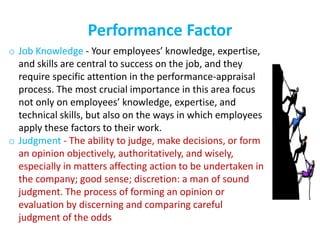
Performance Factor
o Job Knowledge - Your employees’ knowledge, expertise,
and skills are central to success on the job, and they
require specific attention in the performance-appraisal
process. The most crucial importance in this area focus
not only on employees’ knowledge, expertise, and
technical skills, but also on the ways in which employees
apply these factors to their work.
o Judgment - The ability to judge, make decisions, or form
an opinion objectively, authoritatively, and wisely,
especially in matters affecting action to be undertaken in
the company; good sense; discretion: a man of sound
judgment. The process of forming an opinion or
evaluation by discerning and comparing careful
judgment of the odds
o Reliability and commitment to the Job: - The ability to be relied on
or depended on, as for accuracy, honesty, or achievement. The
degree of stability exhibited when a measurement is repeated
under identical conditions.
o Customer Service - Customer service is the act of taking care of the
customer's needs by providing and delivering professional, helpful,
high quality service and assistance before, during, and after the
customer's requirements are met.
o Productivity - the quality, state, or fact of being able to generate,
create, enhance, or bring forth goods and services: the rate at which
goods and services having exchange value are brought forth or
produced.
o Communication skills - the art or study of using language effectively
and persuasively: the abilities in the areas of language
understanding, communicating expressively, and practical language
skills.
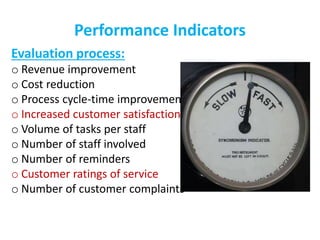
Performance Indicators
Evaluation process:
o Revenue improvement
o Cost reduction
o Process cycle-time improvement
o Increased customer satisfaction
o Volume of tasks per staff
o Number of staff involved
o Number of reminders
o Customer ratings of service
o Number of customer complaints
Be SMART to Effectively Perform.
One way to evaluate the relevance of a highly performing employee
is to use the SMART criteria. The letters are typically taken to stand
for specific, measurable, attainable, relevant, time-bound. In other
words:
o Is your objective Specific?
o Can you Measure progress towards that goal?
o Is the goal realistically Attainable?
o How Relevant is the goal to your organization?
o What is the Time-frame for achieving this goal?
Performance Evaluation Workshop
Performance Factor
Performance Evaluation Workshop
Interpersonal Skills
 Both social skills and interpersonal skills refer to the same thing
your ability to interact with others. Interpersonal skills also help
you to develop relationships with people. Strong relationships with
the people you work with will help you succeed in the workplace.
 Research shows that poor interpersonal skills are the number one
reason why people don’t get along, don’t get promoted or, even
worse, lose their jobs.
 Here are seven interpersonal skills tips that will help you develop
strong relationships and get along great with people in the
workplace:
Performance Evaluation Workshop
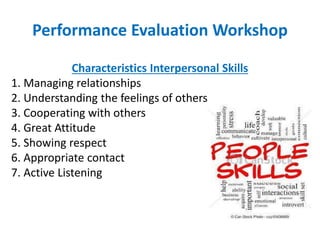
Characteristics Interpersonal Skills
1. Managing relationships
2. Understanding the feelings of others
3. Cooperating with others
4. Great Attitude
5. Showing respect
6. Appropriate contact
7. Active Listening
Interpersonal Skills
 Managing Relationship - Have a difficult coworker or manager? Always
remain polite and professional towards that person. If you need to confront
that person make sure you do it thoughtfully. You never know! A difficult
coworker could become a friend over time.
 Understanding the feelings of others - The ability to understand and relate to
the feelings of others is called empathy. Having empathy will help you
develop strong relationships with other people. When you have empathy,
people feel that you understand them and how they feel.
 Having a Great Attitude - Having an overall positive attitude will affect many
aspects of your work. A great attitude will help you cope with pressure and
stress as well as help you be more flexible in your job. Always sharing a
positive attitude will help you grow in your position and ultimately help you
move forward in your career.
5 Ways to Improve Your Attitude and
Succeed at Work:
 Avoid negative thinking and complaining
 Spend time with people who have a positive
attitude
 Be thankful for your job
 Give yourself a chance to recharge
 Reward yourself for doing a good job
Cont. Interpersonal Skills
• Showing respect - When you show respect for others in the
workplace, people will show respect for you. You can show
respect for others by being polite and using your manners. Always
remember to say please and thank you. When people are talking
to you, listen to what they are saying and make eye contact to
show that you are listening. Wait until other people have finished
talking before you respond so that you don’t cause them to forget
what they wanted to say.
• Appropriate Contact - The way you act toward people at work will
determine whether or not they feel comfortable around you. Start
by always standing an appropriate distance away from the person
with whom you are talking. Some people don’t like to be touched,
so it is important that you respect people’s personal space.
Besides a simple pat on the back or handshake, it is best not to
touch people in the workplace.
Cont. Interpersonal Skills
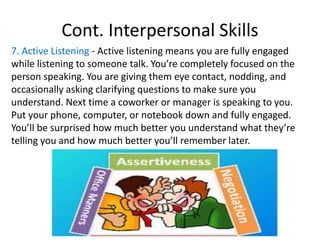
7. Active Listening - Active listening means you are fully engaged
while listening to someone talk. You’re completely focused on the
person speaking. You are giving them eye contact, nodding, and
occasionally asking clarifying questions to make sure you
understand. Next time a coworker or manager is speaking to you.
Put your phone, computer, or notebook down and fully engaged.
You’ll be surprised how much better you understand what they’re
telling you and how much better you’ll remember later.
Conclusion/ Questions and comment
session
In conclusion performance evaluation is a collaborative
process, which goal is to provide a feedback good and bad)
on job performance with the ultimate aim of improving
performance to the farms mission, vision, value and
strategic Initiatives.
 The true measure of the value of any business leader and
manager is performance. Brian Tracy
 Don't lower your expectations to meet your performance. Raise
your level of performance to meet your expectations. Expect the
best of yourself, and then do what is necessary to make it a
reality. Ralph Marston

Welcome performance training workshop

  • 1.
    Welcome Performance Evaluation Training2017 “Great vision without great people is irrelevant.” Terrasol Kenya Limited By the human resource Dept.
  • 2.
    Definitions Performance - Theaccomplishment of a given task measured against preset known standards of accuracy, completeness, cost, and speed. In a contract, performance is deemed to be the fulfillment of an obligation, in a manner that releases the performer from all liabilities under the contract. Evaluation - is a systematic determination of a subject's merit, worth and significance, using criteria governed by a set of standards, or a rigorous analysis of completed or ongoing activities that determine or support management accountability, effectiveness.
  • 3.
    Technical terminology Commonly used: •Job description - It is an organized, factual statement of the duties and responsibilities of a specific job. In brief, it should tell what is to be done, how it is to be done, and why. It is a standard of function, in that it defines the appropriate and authorized content of a job. • Job specification - It is a statement of the minimum acceptable human qualities necessary to perform a job properly. It is a standard of personnel and designates the qualities required for acceptable performance.
  • 4.
    Cont. on theterminologies • Job Analysis - It is the process of studying and collecting information relating to the operations and responsibilities of a specific job. The immediate products of this analysis are job descriptions and job specifications. • Job Evaluation - It is a systematic and orderly process of determining the worth of a job in relation to other jobs. The objective of this process is to determine the correct rate of pay. It is therefore not the same as job analysis. Rather it follows the job analysis process, which provides the basic data to be evaluated.
  • 6.
    Cont. on theTerminologies • Vision – is a clear, comprehensive photograph of an organization/ individual at some point in the future. It provides direction because it describes what the organizations need to be like, to be successful in the future. • Why have a vision? - If you don’t know where you are going, you probably aren’t going to get there. Identifying where you want to go in relationship to where you are is the key to identifying those areas you need to improve. • Vision Is powerful and a motivator to human activity, vision is the energy of progress. (Proverbs 29:18)
  • 7.
    Cont. on theTerminologies Mission – A higher calling or meaning, a reason for being. Often this the reasons the company/ individual were first created to fill a need in the society or the market place. A Mission statement concerns what the organization is all about; while vision statement is what the organization wants to become. If you say that you have a mission, you mean that you have a strong commitment and sense of duty to do or achieve something. A mission serve as filters to separate what is important from what is not, clearly state which markets will be served and how, and communicate a sense of intended direction to the entire organization.
  • 8.
    • Values –this are the traits or qualities that are considered worthwhile they represent the organization or individual highest priority and deeply held driving force. Value statements are grounded in value and define how people want to behave with each other in the organization. • Goal – this are the expected or desired outcome of a planning process. Goals are usually broad, general expression of the guiding management and aspiration of cliental • Objectives – are precise target that are necessary to achieve goals
  • 9.
    Cont. on theterminologies • Standards - performance standards provide the employee with specific performance expectations for each major duty. They are the observable behaviors and actions which explain how the job is to be done, plus the results that are expected for satisfactory job performance. They tell the employee what a good job looks like. The purpose of performance standards is to communicate expectations.
  • 10.
    Purpose of PerformanceEvaluation A performance evaluation is designed to evaluate how you are performing in your role and to identify any areas where training may be required. Many employees feel nervous about their performance evaluation and consider it as a negative meeting, designed for their manager to reprimand them. This is not the case though and the performance review is a two-way street; opportunities to discuss how you feel you are getting on in your job and for your manager to also articulate their own views.
  • 11.
    Performance Evaluation Workshop Purposeof Evaluation: • Optimize Performance (to maximize efficiency, make useful as possible) • Continuous process (Success is not a destination but a working progress) • Two-way process
  • 12.
    Purpose of Evaluation Opportunity: (A chance for progress or advancement, as in a career. "If you prepare yourself ... you will be able to grasp opportunity for broader experience when it appears" (Eleanor Roosevelt).  Identify and correct: (You identify the opportunity and if there be need for reshuffle of duties and department for the growth of the organization, for growth after every evaluation correction are inevitable.  Reinforcement: (reinforcement is a consequence that will strengthen an organism's future behavior, Reinforcement theory proposes that you can change someone's behavior by using reinforcement, punishment, and extinction.  Document performance: (A performance review is designed to evaluate how you are performing in your role and to identify any areas where training may be required per your Job description, and previous records of your appraisals.
  • 13.
    Purpose of Evaluation InEmployee Development Supervisor Personal Bias: (Effort should be made to make the performance management free from the influence of interpersonal relationship) Feedback: (An extensive review of feedback and goal setting studies reveal that both are necessary to improved performance)
  • 14.
    Performance Evaluation Workshop PerformanceFeedback should be: - • Developmental than judgmental. • Individualized to fit the specific person and situation; • Focused on the behavior or action you are concerned with, not on the person or their personality; • Delivered in a timely fashion, as soon as possible after the positive or negative action and before the next performance.
  • 15.
    Purpose of Evaluation EmployeeDevelopment (cont.) Job Expectation (Unclear or conflicting job expectations can be a main cause of stress in employees, the things you want from a job such as responsibility, satisfaction, and good pay:) Performance expectation (the things an employer expects from their employee doing a job which are usually listed as part of a job description :)
  • 16.
    Purpose of Evaluation EmployeeDevelopment (Cont.) Coaching (Job coaching refers to the training of an employee, through structured intervention techniques to help the employee learn to perform job tasks to the employer's specifications In addition to job-site training, job coaching includes related assessment, job development, counseling, advocacy, travel training and other services needed to maintain the employment.) Reinforce (Rewards are used to reinforce the behavior you want and punishments are used to prevent the behavior you do not want. Extinction is a means to stop someone from performing a learned behavior.)
  • 17.
    Performance Factor o JobKnowledge - Your employees’ knowledge, expertise, and skills are central to success on the job, and they require specific attention in the performance-appraisal process. The most crucial importance in this area focus not only on employees’ knowledge, expertise, and technical skills, but also on the ways in which employees apply these factors to their work. o Judgment - The ability to judge, make decisions, or form an opinion objectively, authoritatively, and wisely, especially in matters affecting action to be undertaken in the company; good sense; discretion: a man of sound judgment. The process of forming an opinion or evaluation by discerning and comparing careful judgment of the odds
  • 18.
    o Reliability andcommitment to the Job: - The ability to be relied on or depended on, as for accuracy, honesty, or achievement. The degree of stability exhibited when a measurement is repeated under identical conditions. o Customer Service - Customer service is the act of taking care of the customer's needs by providing and delivering professional, helpful, high quality service and assistance before, during, and after the customer's requirements are met. o Productivity - the quality, state, or fact of being able to generate, create, enhance, or bring forth goods and services: the rate at which goods and services having exchange value are brought forth or produced. o Communication skills - the art or study of using language effectively and persuasively: the abilities in the areas of language understanding, communicating expressively, and practical language skills.
  • 19.
    Performance Indicators Evaluation process: oRevenue improvement o Cost reduction o Process cycle-time improvement o Increased customer satisfaction o Volume of tasks per staff o Number of staff involved o Number of reminders o Customer ratings of service o Number of customer complaints
  • 20.
    Be SMART toEffectively Perform. One way to evaluate the relevance of a highly performing employee is to use the SMART criteria. The letters are typically taken to stand for specific, measurable, attainable, relevant, time-bound. In other words: o Is your objective Specific? o Can you Measure progress towards that goal? o Is the goal realistically Attainable? o How Relevant is the goal to your organization? o What is the Time-frame for achieving this goal?
  • 21.
  • 22.
    Performance Evaluation Workshop InterpersonalSkills  Both social skills and interpersonal skills refer to the same thing your ability to interact with others. Interpersonal skills also help you to develop relationships with people. Strong relationships with the people you work with will help you succeed in the workplace.  Research shows that poor interpersonal skills are the number one reason why people don’t get along, don’t get promoted or, even worse, lose their jobs.  Here are seven interpersonal skills tips that will help you develop strong relationships and get along great with people in the workplace:
  • 23.
    Performance Evaluation Workshop CharacteristicsInterpersonal Skills 1. Managing relationships 2. Understanding the feelings of others 3. Cooperating with others 4. Great Attitude 5. Showing respect 6. Appropriate contact 7. Active Listening
  • 24.
    Interpersonal Skills  ManagingRelationship - Have a difficult coworker or manager? Always remain polite and professional towards that person. If you need to confront that person make sure you do it thoughtfully. You never know! A difficult coworker could become a friend over time.  Understanding the feelings of others - The ability to understand and relate to the feelings of others is called empathy. Having empathy will help you develop strong relationships with other people. When you have empathy, people feel that you understand them and how they feel.  Having a Great Attitude - Having an overall positive attitude will affect many aspects of your work. A great attitude will help you cope with pressure and stress as well as help you be more flexible in your job. Always sharing a positive attitude will help you grow in your position and ultimately help you move forward in your career.
  • 25.
    5 Ways toImprove Your Attitude and Succeed at Work:  Avoid negative thinking and complaining  Spend time with people who have a positive attitude  Be thankful for your job  Give yourself a chance to recharge  Reward yourself for doing a good job
  • 26.
    Cont. Interpersonal Skills •Showing respect - When you show respect for others in the workplace, people will show respect for you. You can show respect for others by being polite and using your manners. Always remember to say please and thank you. When people are talking to you, listen to what they are saying and make eye contact to show that you are listening. Wait until other people have finished talking before you respond so that you don’t cause them to forget what they wanted to say. • Appropriate Contact - The way you act toward people at work will determine whether or not they feel comfortable around you. Start by always standing an appropriate distance away from the person with whom you are talking. Some people don’t like to be touched, so it is important that you respect people’s personal space. Besides a simple pat on the back or handshake, it is best not to touch people in the workplace.
  • 27.
    Cont. Interpersonal Skills 7.Active Listening - Active listening means you are fully engaged while listening to someone talk. You’re completely focused on the person speaking. You are giving them eye contact, nodding, and occasionally asking clarifying questions to make sure you understand. Next time a coworker or manager is speaking to you. Put your phone, computer, or notebook down and fully engaged. You’ll be surprised how much better you understand what they’re telling you and how much better you’ll remember later.
  • 28.
    Conclusion/ Questions andcomment session In conclusion performance evaluation is a collaborative process, which goal is to provide a feedback good and bad) on job performance with the ultimate aim of improving performance to the farms mission, vision, value and strategic Initiatives.  The true measure of the value of any business leader and manager is performance. Brian Tracy  Don't lower your expectations to meet your performance. Raise your level of performance to meet your expectations. Expect the best of yourself, and then do what is necessary to make it a reality. Ralph Marston