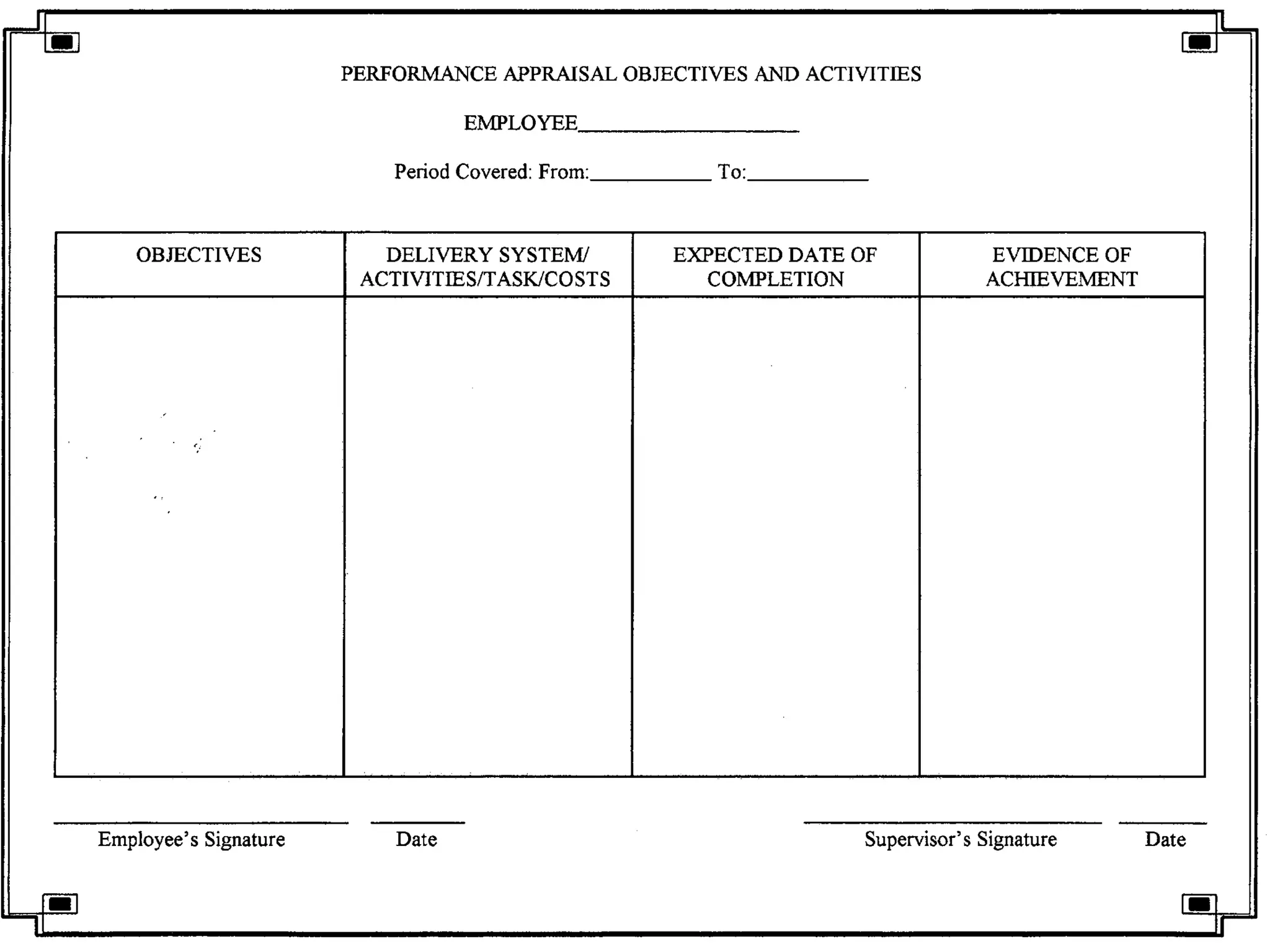
PERFORMANCE APPRAISAL Year: 2008-2009
Performance Appraisals  Explained Performance Appraisal -  tool used to provide the employee with Performance feedback Improved employee development Increased employee productivity A safeguard for the College and employees from legal liability
Performance Appraisals: Common Mistakes Failure to conduct evaluations Failure to evaluate all employees Failure to conduct evaluations regularly and punctually Failure to document negative  and  positive performance Failure to document performance and behavioral deficiencies
Performance Appraisals: Common Mistakes (cont’d) Failure to establish consequences of performance deficiencies Disallowing employees opportunity comment on their appraisals Using the appraisal to retaliate against an employee
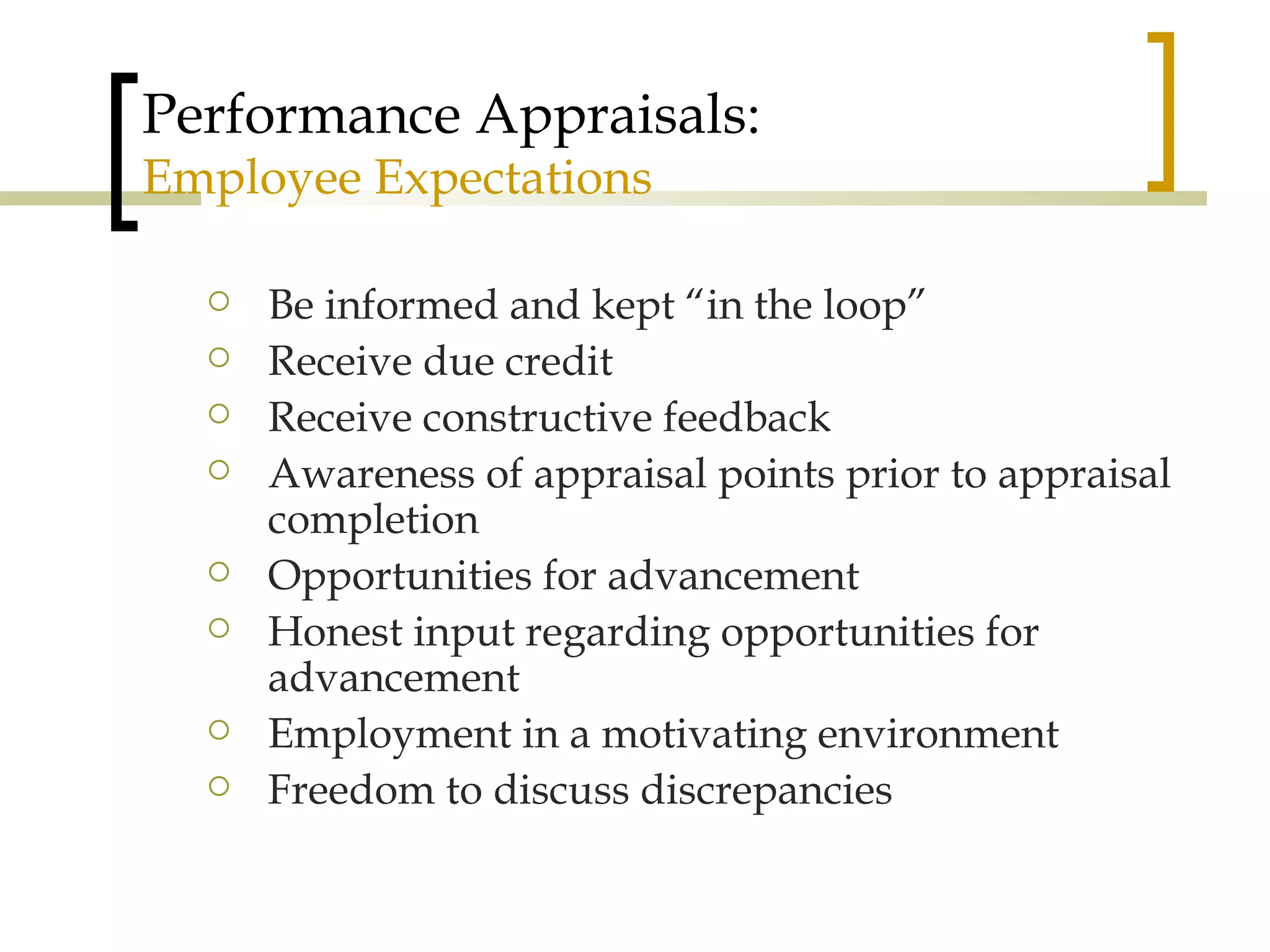
Performance Appraisals: Employee Expectations Be informed and kept “in the loop” Receive due credit Receive constructive feedback Awareness of appraisal points prior to appraisal completion Opportunities for advancement Honest input regarding opportunities for advancement  Employment in a motivating environment Freedom to discuss discrepancies
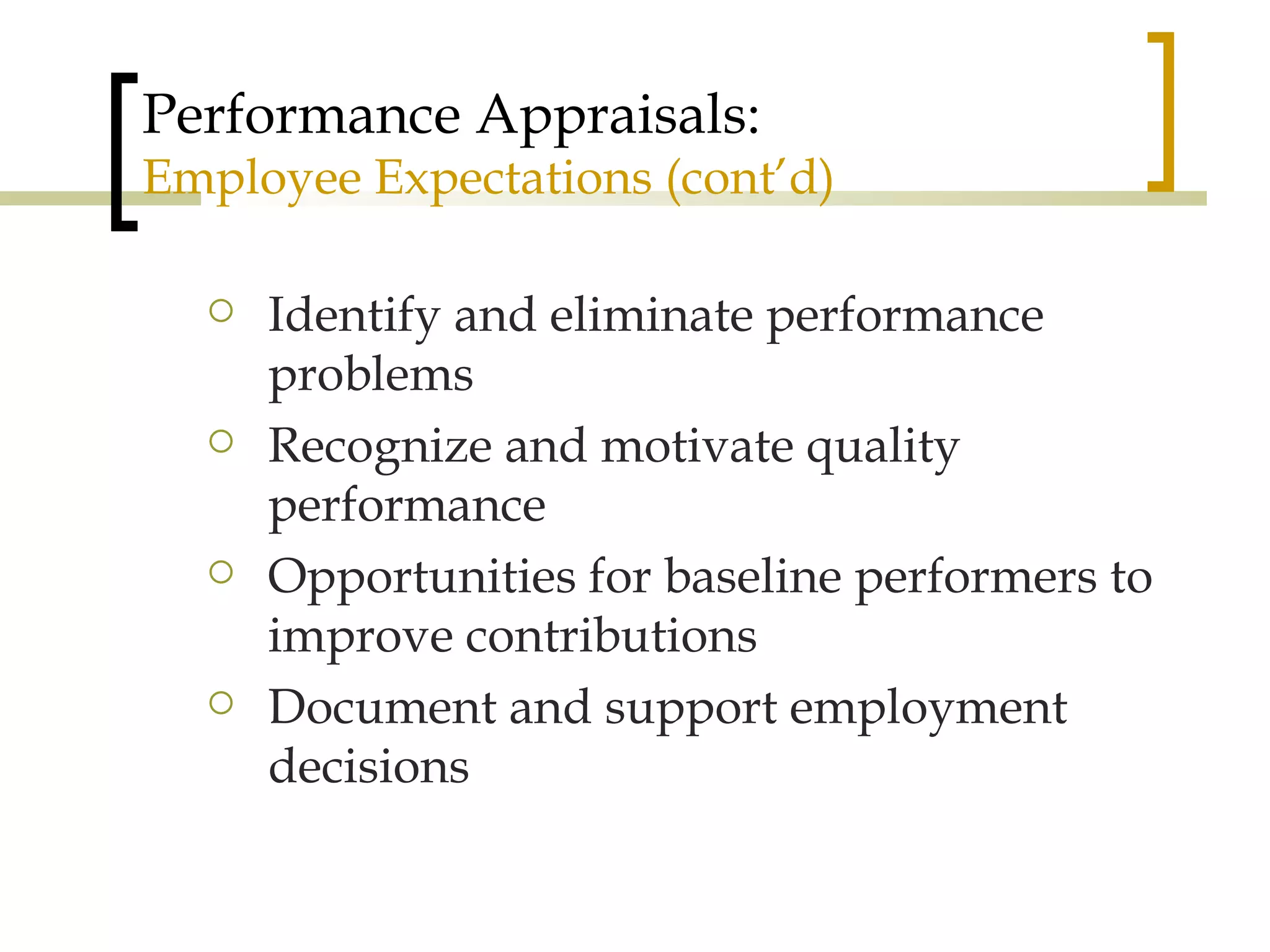
Performance Appraisals: Employee Expectations (cont’d) Identify and eliminate performance problems Recognize and motivate quality performance Opportunities for baseline performers to improve contributions Document and support employment decisions
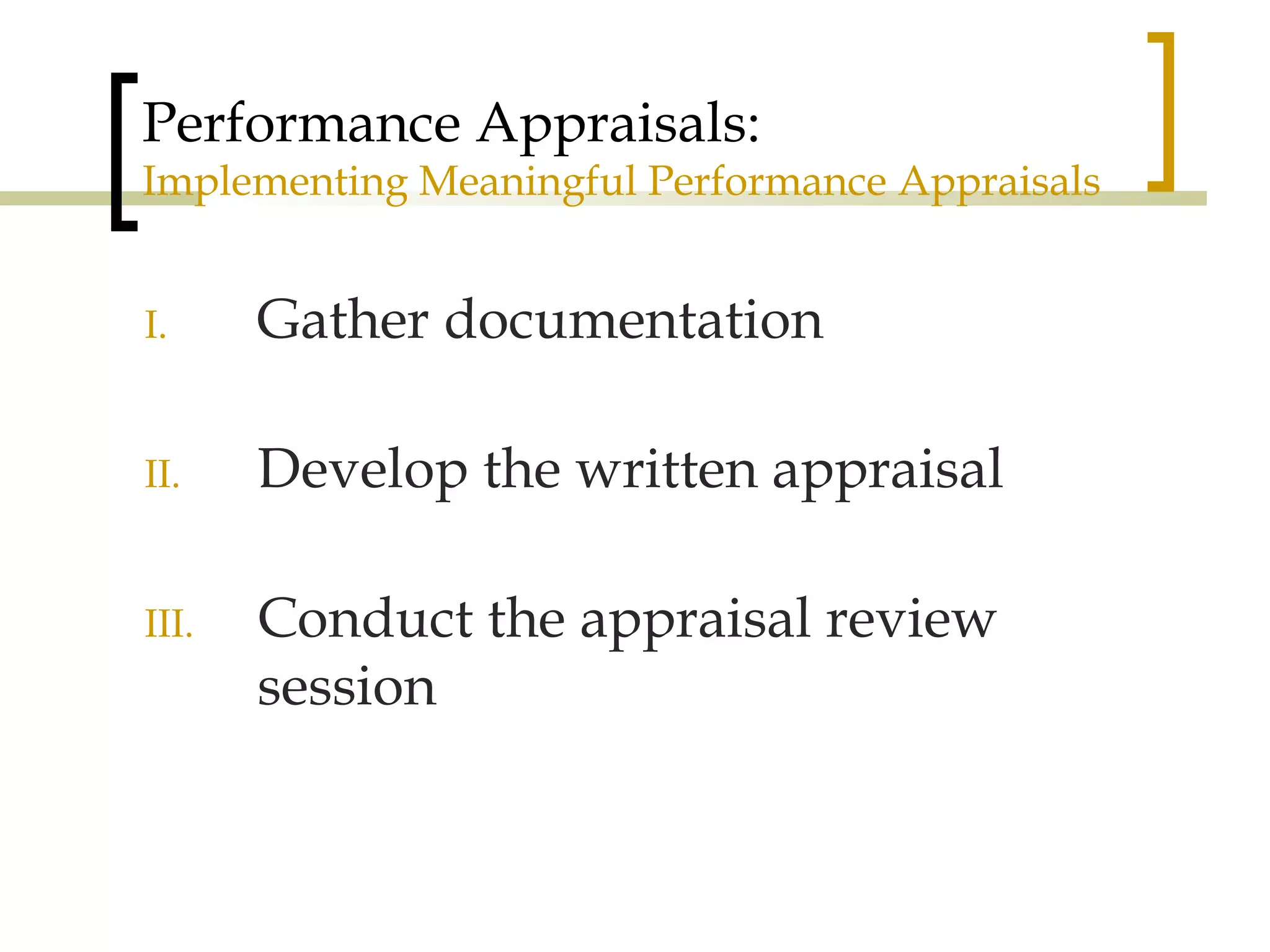
Performance Appraisals: Implementing Meaningful Performance Appraisals Gather documentation Develop the written appraisal Conduct the appraisal review session
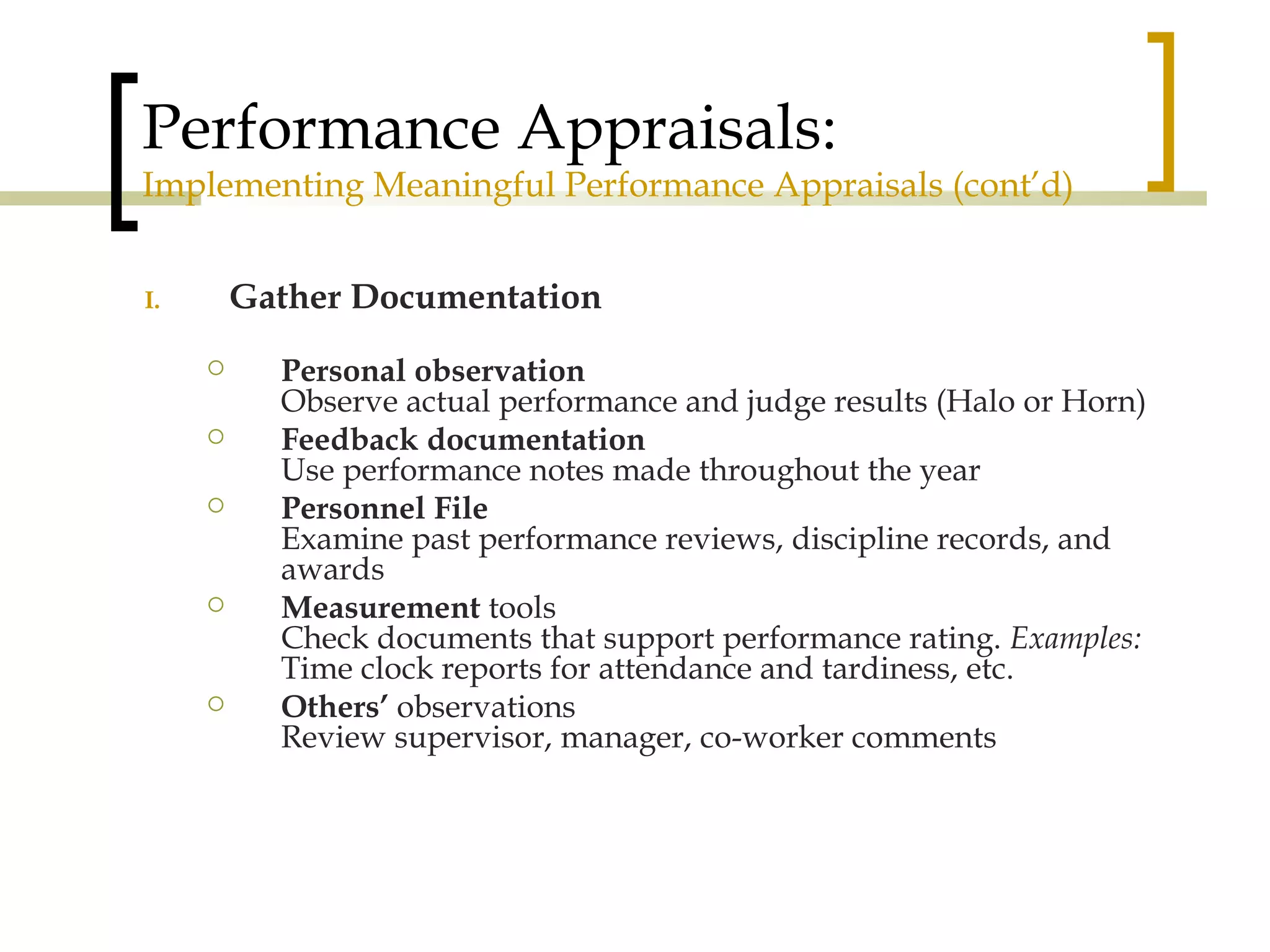
Performance Appraisals: Implementing Meaningful Performance Appraisals (cont’d) Gather Documentation Personal observation Observe actual performance and judge results (Halo or Horn) Feedback documentation Use performance notes made throughout the year Personnel File Examine past performance reviews, discipline records, and awards Measurement  tools Check documents that support performance rating.  Examples:  Time clock reports for attendance and tardiness, etc. Others’  observations Review   supervisor, manager, co-worker comments
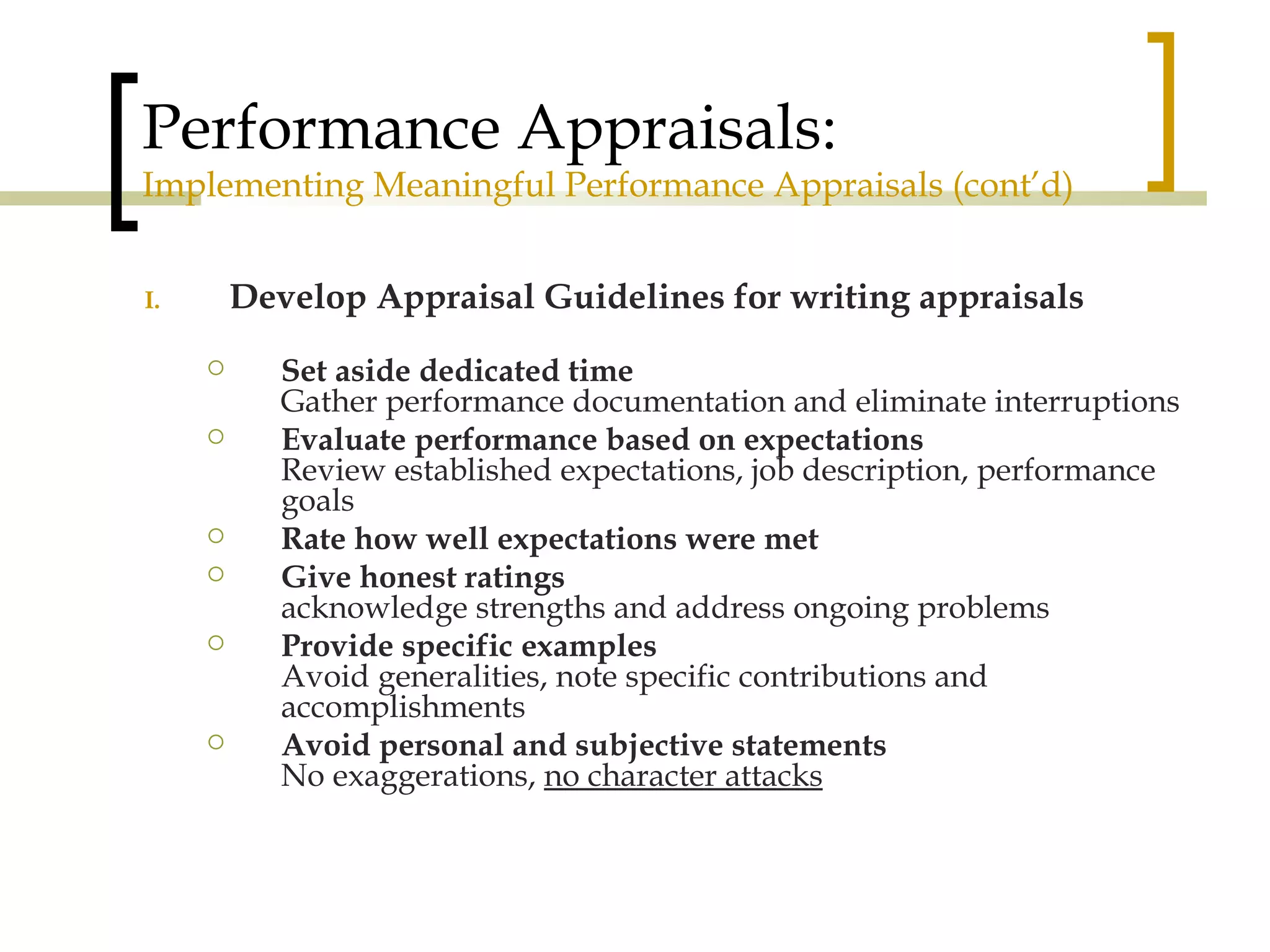
Performance Appraisals: Implementing Meaningful Performance Appraisals (cont’d) Develop Appraisal Guidelines for writing appraisals Set aside dedicated time Gather performance documentation and eliminate interruptions Evaluate performance based on expectations Review established expectations, job description, performance goals Rate how well expectations were met Give honest ratings acknowledge strengths and address ongoing problems Provide specific examples Avoid generalities, note specific contributions and accomplishments Avoid personal and subjective statements No exaggerations,  no character attacks
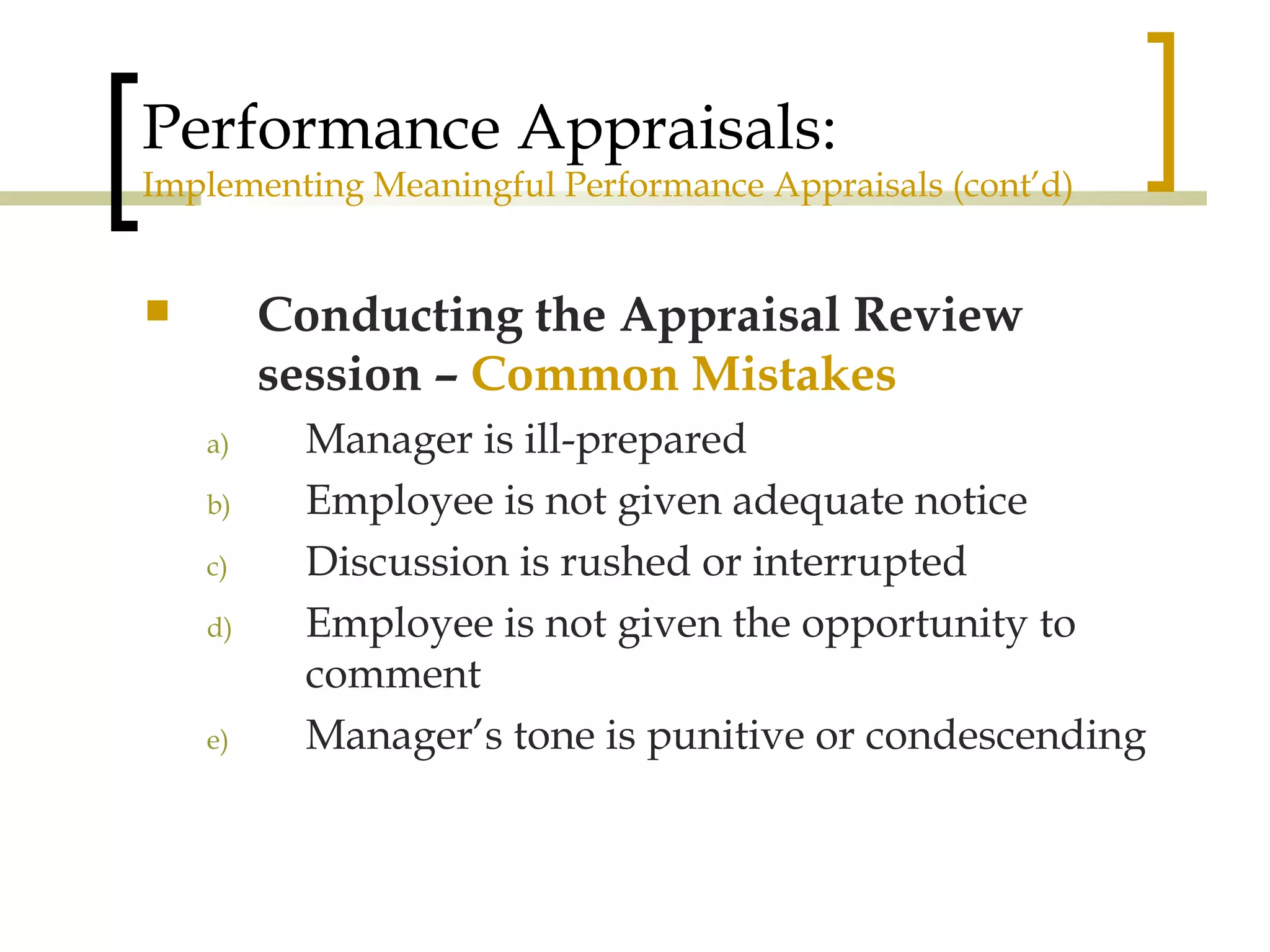
Performance Appraisals: Implementing Meaningful Performance Appraisals (cont’d) Conducting the Appraisal Review session –  Common Mistakes Manager is ill-prepared Employee is not given adequate notice Discussion is rushed or interrupted Employee is not given the opportunity to comment Manager’s tone is punitive or condescending
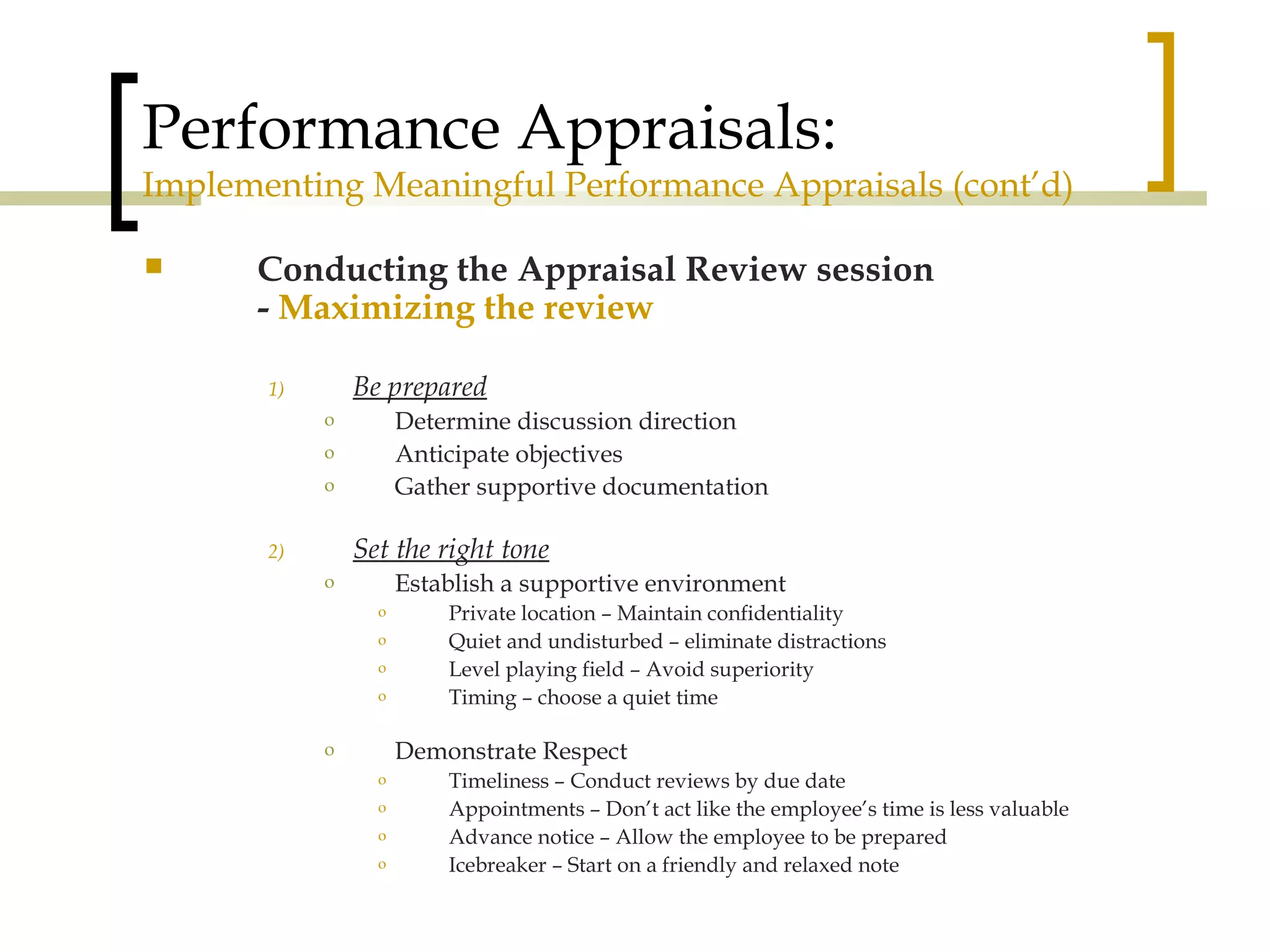
Performance Appraisals: Implementing Meaningful Performance Appraisals (cont’d) Conducting the Appraisal Review session -  Maximizing the review Be prepared Determine discussion direction Anticipate objectives Gather supportive documentation Set the right tone Establish a supportive environment Private location – Maintain confidentiality Quiet and undisturbed – eliminate distractions Level playing field – Avoid superiority Timing – choose a quiet time Demonstrate Respect Timeliness – Conduct reviews by due date Appointments – Don’t act like the employee’s time is less valuable Advance notice – Allow the employee to be prepared  Icebreaker – Start on a friendly and relaxed note
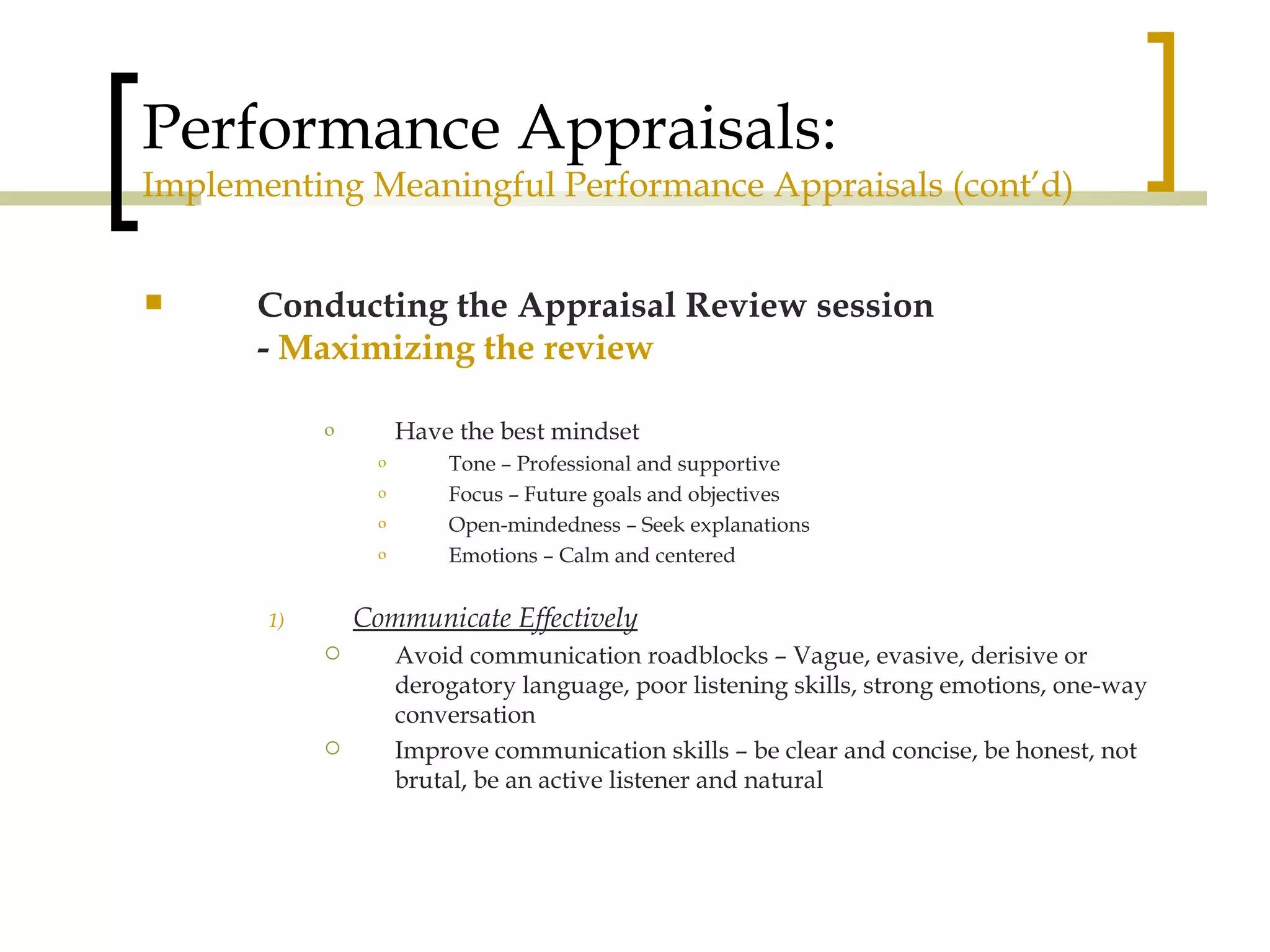
Performance Appraisals: Implementing Meaningful Performance Appraisals (cont’d) Conducting the Appraisal Review session -  Maximizing the review Have the best mindset Tone – Professional and supportive Focus – Future goals and objectives Open-mindedness – Seek explanations Emotions – Calm and centered Communicate Effectively Avoid communication roadblocks – Vague, evasive, derisive or derogatory language, poor listening skills, strong emotions, one-way conversation Improve communication skills – be clear and concise, be honest, not brutal, be an active listener and natural
Performance Appraisals: During the Appraisal Process Potential Emotional Reactions Emotional Distress Hostility Defensiveness Denial
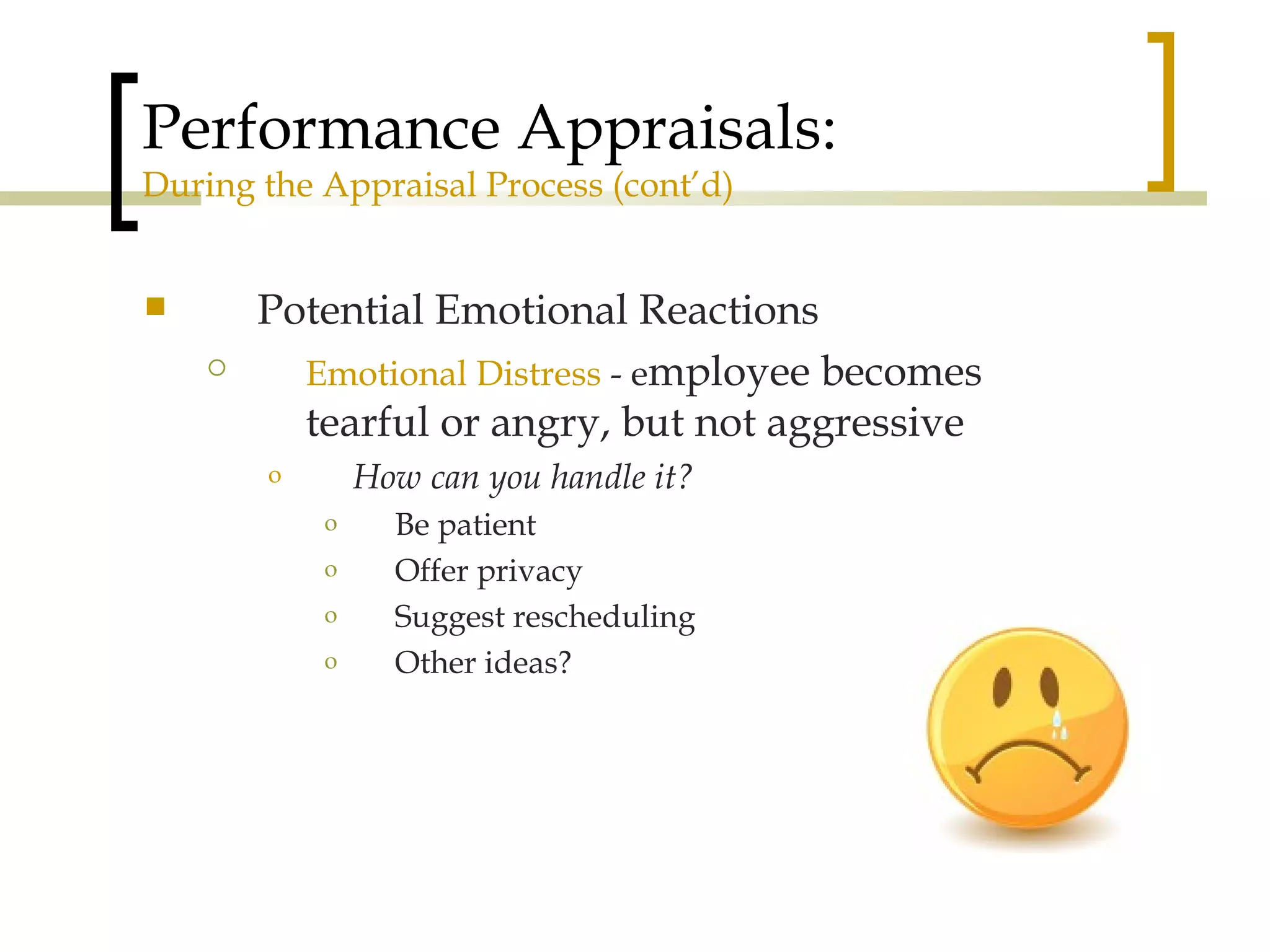
Performance Appraisals: During the Appraisal Process (cont’d) Potential Emotional Reactions Emotional Distress  - e mployee becomes tearful or angry, but not aggressive How can you handle it? Be patient Offer privacy Suggest rescheduling Other ideas?
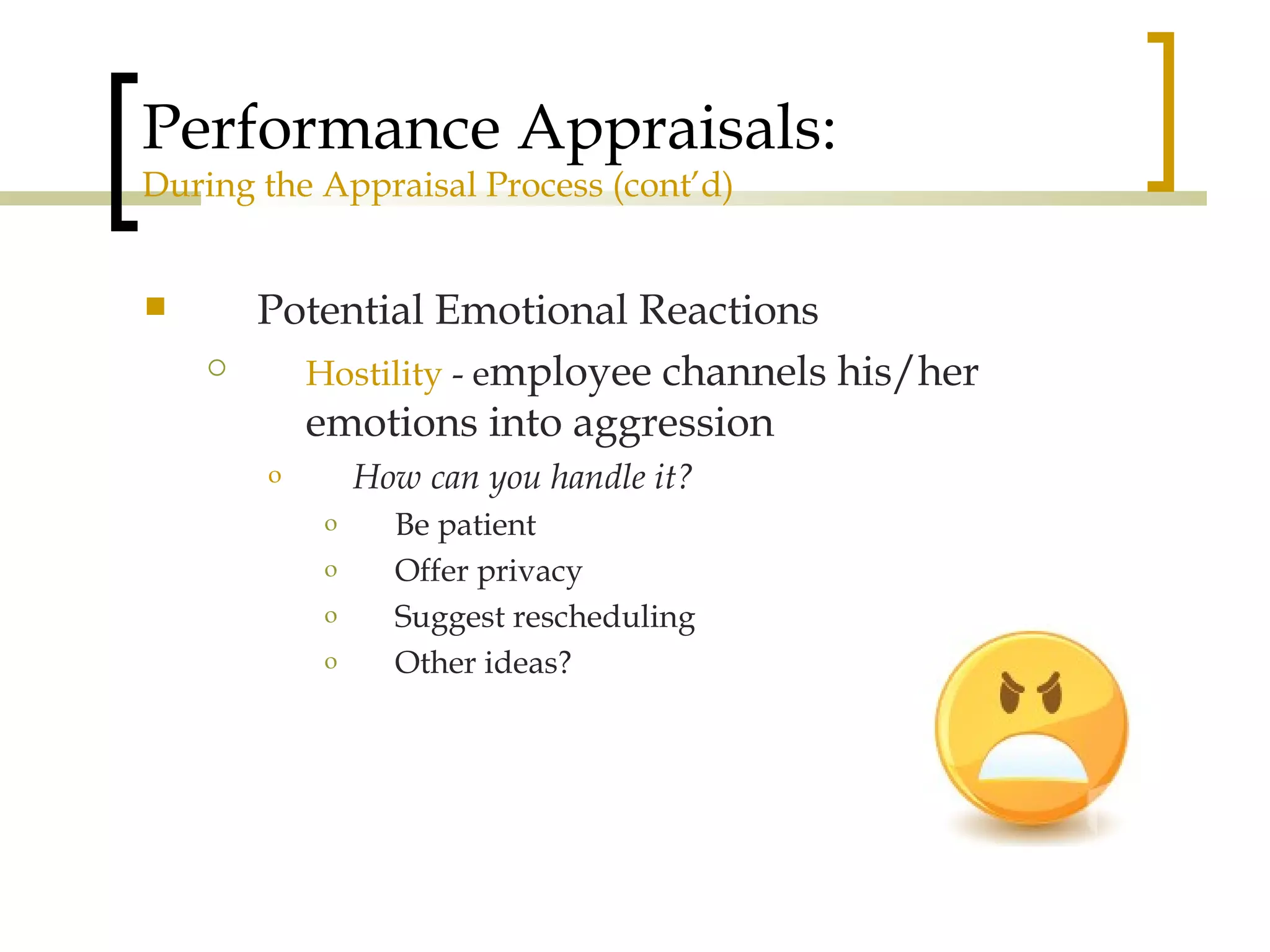
Performance Appraisals: During the Appraisal Process (cont’d) Potential Emotional Reactions Hostility  - e mployee channels his/her emotions into aggression How can you handle it? Be patient Offer privacy Suggest rescheduling Other ideas?
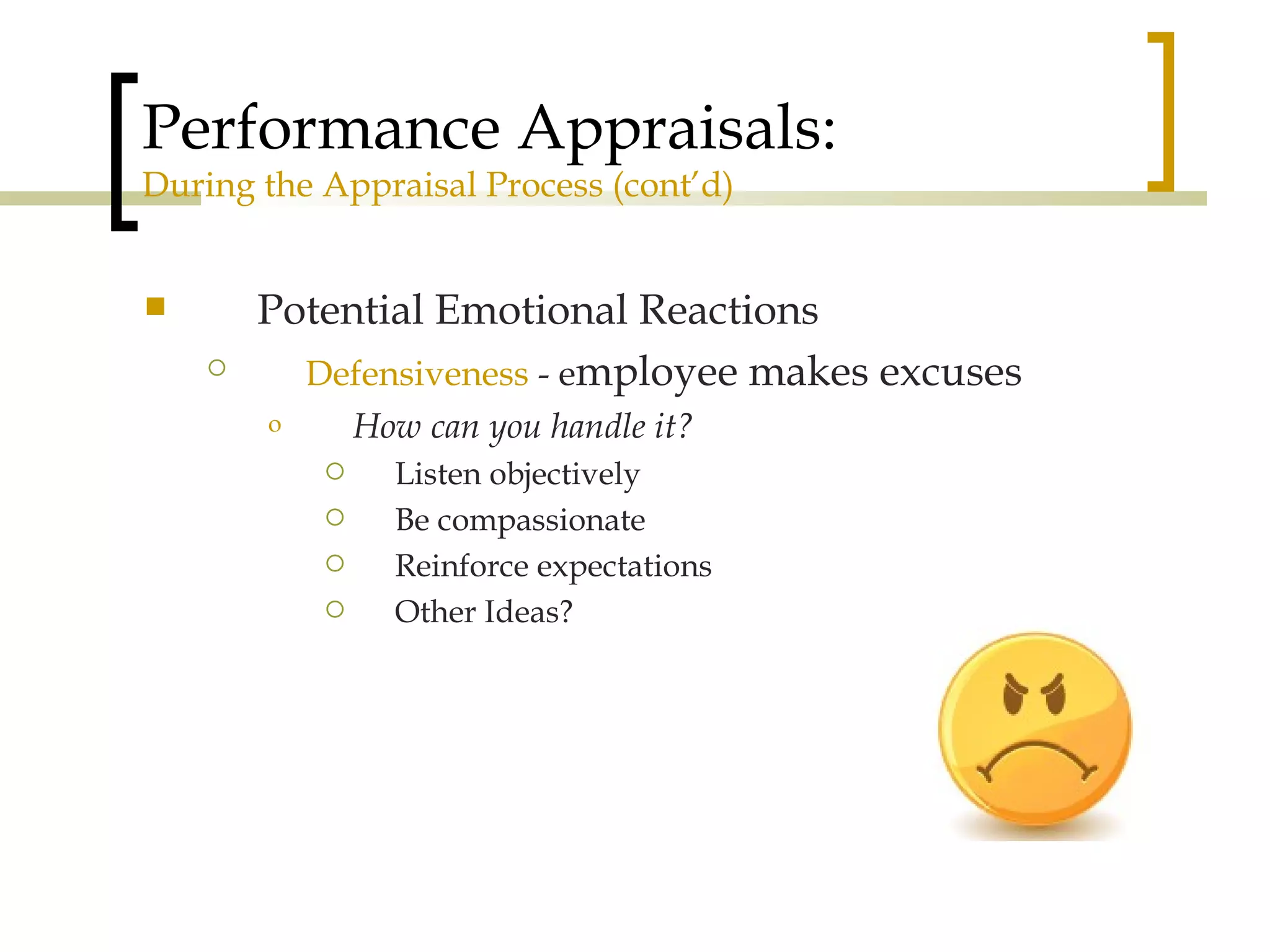
Performance Appraisals: During the Appraisal Process (cont’d) Potential Emotional Reactions Defensiveness  - e mployee makes excuses How can you handle it? Listen objectively Be compassionate Reinforce expectations Other Ideas?
Performance Appraisals: During the Appraisal Process (cont’d) Potential Emotional Reactions Denial  - e mployee insists your evaluation is incorrect How can you handle it? Listen objectively Investigate as necessary Provide supportive documentation Other ideas?
Performance Appraisal  Procedures Instruct employees to complete self-evaluation  (interactive PDF form via HR website) Employees have maximum of  ONE WEEK  to complete and submit self-evaluation Complete Performance Appraisal First-line supervisors shall meet with Director or Dean for  appraisals review prior to meeting with employee Schedule meeting with employee Conduct formal meeting with employee. Review Appraisal and determine goals, timelines, etc. You and employee sign the completed Performance Appraisal form after the meeting Forward copy to employee and turn in completed  ORIGINAL  form to Human Resources (ATTN: Frank Gomez) by February 15, 2008 If you have any questions please call me (956) 872-3646
Successful Meeting  Checklist Discuss each goal or objective established for the employee Explore areas of agreement and disagreement Cover positive skills, traits, accomplishments and growth potential Reinforce employee’s accomplishments Discuss employee’s potential Cover areas in which change is required, expected, demanded or desired
Successful Meeting  Checklist (cont’d) Provide employee goals to correct deficiencies within a specified time period Make training/development recommendations Discuss consequences of non-compliance where applicable Set objectives for next performance appraisal (or specific timeline) Have employee sign appraisal to acknowledge having read it, and give employee an opportunity to comment in it in writing Thank employee for his/her efforts
 

Performance Appraisal

  • 1.
  • 2.
    Performance Appraisals Explained Performance Appraisal - tool used to provide the employee with Performance feedback Improved employee development Increased employee productivity A safeguard for the College and employees from legal liability
  • 3.
    Performance Appraisals: CommonMistakes Failure to conduct evaluations Failure to evaluate all employees Failure to conduct evaluations regularly and punctually Failure to document negative and positive performance Failure to document performance and behavioral deficiencies
  • 4.
    Performance Appraisals: CommonMistakes (cont’d) Failure to establish consequences of performance deficiencies Disallowing employees opportunity comment on their appraisals Using the appraisal to retaliate against an employee
  • 5.
    Performance Appraisals: EmployeeExpectations Be informed and kept “in the loop” Receive due credit Receive constructive feedback Awareness of appraisal points prior to appraisal completion Opportunities for advancement Honest input regarding opportunities for advancement Employment in a motivating environment Freedom to discuss discrepancies
  • 6.
    Performance Appraisals: EmployeeExpectations (cont’d) Identify and eliminate performance problems Recognize and motivate quality performance Opportunities for baseline performers to improve contributions Document and support employment decisions
  • 7.
    Performance Appraisals: ImplementingMeaningful Performance Appraisals Gather documentation Develop the written appraisal Conduct the appraisal review session
  • 8.
    Performance Appraisals: ImplementingMeaningful Performance Appraisals (cont’d) Gather Documentation Personal observation Observe actual performance and judge results (Halo or Horn) Feedback documentation Use performance notes made throughout the year Personnel File Examine past performance reviews, discipline records, and awards Measurement tools Check documents that support performance rating. Examples: Time clock reports for attendance and tardiness, etc. Others’ observations Review supervisor, manager, co-worker comments
  • 9.
    Performance Appraisals: ImplementingMeaningful Performance Appraisals (cont’d) Develop Appraisal Guidelines for writing appraisals Set aside dedicated time Gather performance documentation and eliminate interruptions Evaluate performance based on expectations Review established expectations, job description, performance goals Rate how well expectations were met Give honest ratings acknowledge strengths and address ongoing problems Provide specific examples Avoid generalities, note specific contributions and accomplishments Avoid personal and subjective statements No exaggerations, no character attacks
  • 10.
    Performance Appraisals: ImplementingMeaningful Performance Appraisals (cont’d) Conducting the Appraisal Review session – Common Mistakes Manager is ill-prepared Employee is not given adequate notice Discussion is rushed or interrupted Employee is not given the opportunity to comment Manager’s tone is punitive or condescending
  • 11.
    Performance Appraisals: ImplementingMeaningful Performance Appraisals (cont’d) Conducting the Appraisal Review session - Maximizing the review Be prepared Determine discussion direction Anticipate objectives Gather supportive documentation Set the right tone Establish a supportive environment Private location – Maintain confidentiality Quiet and undisturbed – eliminate distractions Level playing field – Avoid superiority Timing – choose a quiet time Demonstrate Respect Timeliness – Conduct reviews by due date Appointments – Don’t act like the employee’s time is less valuable Advance notice – Allow the employee to be prepared Icebreaker – Start on a friendly and relaxed note
  • 12.
    Performance Appraisals: ImplementingMeaningful Performance Appraisals (cont’d) Conducting the Appraisal Review session - Maximizing the review Have the best mindset Tone – Professional and supportive Focus – Future goals and objectives Open-mindedness – Seek explanations Emotions – Calm and centered Communicate Effectively Avoid communication roadblocks – Vague, evasive, derisive or derogatory language, poor listening skills, strong emotions, one-way conversation Improve communication skills – be clear and concise, be honest, not brutal, be an active listener and natural
  • 13.
    Performance Appraisals: Duringthe Appraisal Process Potential Emotional Reactions Emotional Distress Hostility Defensiveness Denial
  • 14.
    Performance Appraisals: Duringthe Appraisal Process (cont’d) Potential Emotional Reactions Emotional Distress - e mployee becomes tearful or angry, but not aggressive How can you handle it? Be patient Offer privacy Suggest rescheduling Other ideas?
  • 15.
    Performance Appraisals: Duringthe Appraisal Process (cont’d) Potential Emotional Reactions Hostility - e mployee channels his/her emotions into aggression How can you handle it? Be patient Offer privacy Suggest rescheduling Other ideas?
  • 16.
    Performance Appraisals: Duringthe Appraisal Process (cont’d) Potential Emotional Reactions Defensiveness - e mployee makes excuses How can you handle it? Listen objectively Be compassionate Reinforce expectations Other Ideas?
  • 17.
    Performance Appraisals: Duringthe Appraisal Process (cont’d) Potential Emotional Reactions Denial - e mployee insists your evaluation is incorrect How can you handle it? Listen objectively Investigate as necessary Provide supportive documentation Other ideas?
  • 18.
    Performance Appraisal Procedures Instruct employees to complete self-evaluation (interactive PDF form via HR website) Employees have maximum of ONE WEEK to complete and submit self-evaluation Complete Performance Appraisal First-line supervisors shall meet with Director or Dean for appraisals review prior to meeting with employee Schedule meeting with employee Conduct formal meeting with employee. Review Appraisal and determine goals, timelines, etc. You and employee sign the completed Performance Appraisal form after the meeting Forward copy to employee and turn in completed ORIGINAL form to Human Resources (ATTN: Frank Gomez) by February 15, 2008 If you have any questions please call me (956) 872-3646
  • 19.
    Successful Meeting Checklist Discuss each goal or objective established for the employee Explore areas of agreement and disagreement Cover positive skills, traits, accomplishments and growth potential Reinforce employee’s accomplishments Discuss employee’s potential Cover areas in which change is required, expected, demanded or desired
  • 20.
    Successful Meeting Checklist (cont’d) Provide employee goals to correct deficiencies within a specified time period Make training/development recommendations Discuss consequences of non-compliance where applicable Set objectives for next performance appraisal (or specific timeline) Have employee sign appraisal to acknowledge having read it, and give employee an opportunity to comment in it in writing Thank employee for his/her efforts
  • 21.