Lecture 4:   The Historical Context   of Industrial Relations   Niels-Erik Wergin Introduction to HRM
Why study the History of IR? Because “ in no other country do contemporary developments reflect as strongly deep historical origins” as in the UK. (Edwards et al. 1998: 2) With other words: in order to understand the present,  we need to understand the past.
Overview Three topics: The development of trade unions The development of employers’ organisations The development of employment law and IR institutions These 3 topics are related to the 3 actors in IR: labour (employees/unions), capital (employers), and the state
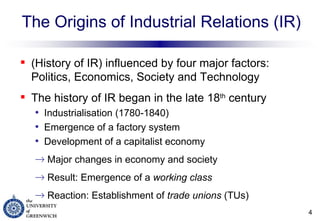
The Origins of Industrial Relations (IR) (History of IR) influenced by four major factors:  Politics, Economics, Society and Technology The history of IR began in the late 18 th  century Industrialisation (1780-1840) Emergence of a factory system Development of a capitalist economy  Major changes in economy and society Result: Emergence of a  working class Reaction: Establishment of  trade unions  (TUs)
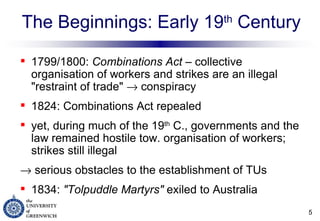
The Beginnings: Early 19 th  Century 1799/1800:  Combinations Act  – collective organisation of workers and strikes are an illegal "restraint of trade"    conspiracy 1824: Combinations Act repealed  yet, during much of the 19 th  C., governments and the law remained hostile tow. organisation of workers; strikes still illegal    serious obstacles to the establishment of TUs 1834:  "Tolpuddle Martyrs"  exiled to Australia
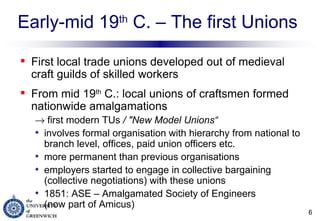
Early-mid 19 th  C. – The first Unions First local trade unions developed out of medieval craft guilds of skilled workers From mid 19 th  C.: local unions of craftsmen formed nationwide amalgamations     first modern TUs  / "New Model Unions“ involves formal organisation with hierarchy from national to branch level, offices, paid union officers etc. more permanent than previous organisations  employers started to engage in collective bargaining (collective negotiations) with these unions 1851: ASE – Amalgamated Society of Engineers  (now part of Amicus)
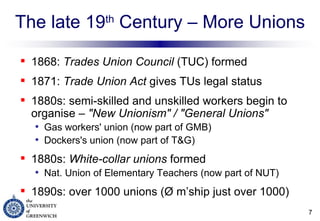
The late 19 th  Century – More Unions 1868:  Trades Union Council  (TUC) formed 1871:  Trade Union Act  gives TUs legal status 1880s: semi-skilled and unskilled workers begin to organise –  "New Unionism" / "General Unions" Gas workers' union (now part of GMB) Dockers's union (now part of T&G) 1880s:  White-collar unions  formed Nat. Union of Elementary Teachers (now part of NUT) 1890s: over 1000 unions ( Ø  m’ship just over 1000)
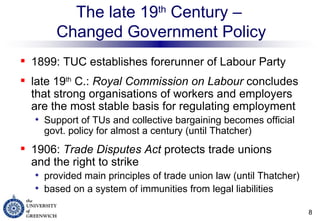
The late 19 th  Century –  Changed Government Policy 1899: TUC establishes forerunner of Labour Party  late 19 th  C.:  Royal Commission on Labour  concludes that strong organisations of workers and employers are the most stable basis for regulating employment Support of TUs and collective bargaining becomes official govt. policy for almost a century (until Thatcher) 1906:  Trade Disputes Act  protects trade unions  and the right to strike  provided main principles of trade union law (until Thatcher) based on a system of immunities from legal liabilities
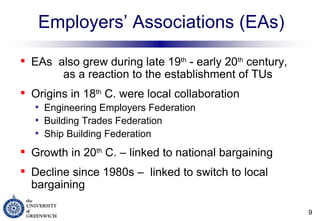
Employers’ Associations (EAs) EAs  also grew during late 19 th  - early 20 th  century,  as a reaction to the establishment of TUs Origins in 18 th  C. were local collaboration Engineering Employers Federation Building Trades Federation Ship Building Federation  Growth in 20 th  C. – linked to national bargaining Decline since 1980s –  linked to switch to local bargaining
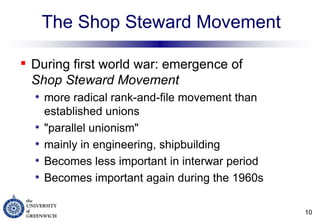
The Shop Steward Movement During first world war: emergence of  Shop Steward Movement more radical rank-and-file movement than established unions "parallel unionism" mainly in engineering, shipbuilding Becomes less important in interwar period Becomes important again during the 1960s
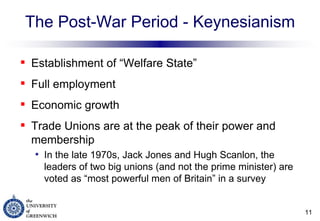
The Post-War Period - Keynesianism Establishment of “Welfare State” Full employment  Economic growth Trade Unions are at the peak of their power and membership  In the late 1970s, Jack Jones and Hugh Scanlon, the leaders of two big unions (and not the prime minister) are voted as “most powerful men of Britain” in a survey
The 1970s 1971: Conservative government introduces  "Industrial Relations Act"   comprehensive legal framework, similar to US system law is resisted by both employers and unions 1974: law is repealed by Labour government 1978/79:  "Winter of Discontent"  – series of long strikes in the public sector    the (Labour) government seemed to have lost control, many people thought that unions were to powerful
The 1980s/90s: Thatcherism 1979-1997:  Conservative governments  (Margaret Thatcher and John Major) Economic policy of liberalisation, deregulation and privatisation Shift from Keynesianism to Neo-liberalism Shift from national to local bargaining  Most radical changes to IR legislation since the industrial revolution Achieved by a series of eight laws on IR
New IR Legislation under  Thatcher and Major Major elements of these laws: restriction of strikes  govt. support for collective bargaining ends end of closed shop regulation of internal union affairs restriction of individual employment rights/protection Weakened TUs considerably: Miners Strike 1984-5 lost Wapping Dispute 1986 lost
Since 1997: “New” Labour The new Labour Government under Tony Blair did not change the legal framework introduced by the conservatives, apart from three major changes: TU recognition legislation Minimum wage Right to strike strengthened Also: support for social partnership and  “new unionism”
Further Readings Edwards, P et al. (1998): “Great Britain: From Partial Collectivism to Neo-liberalism to Where?” In: Ferner, A/Hyman, R (eds.):  Changing Industrial Relations in Europe , pp 1-54. Oxford, Malden: Blackwell. Hyman, R (1995): “The Historical Evolution of British Industrial Relations”. In: Edwards, P (ed.):  Industrial Relations – Theory and Practice in Britain , pp. 27-49. Oxford, Cambridge: Blackwell. Marchington, M/Goodman, J/Berridge, J (2004): “Employment Relations in Britain”. In: Bamber, G/Lansbury, R/Wailes, N (eds.):  International and Comparative Employment Relations – Globalisation and the Developed Market Economies , pp. 36-66. London et al.: Sage.  Salamon, Michael (2000):  Industrial Relations – Theory and Practice  (4 th  ed.). Harlow: Prentice Hall.

Introduction To Industrial Relation

  • 1.
    Lecture 4: The Historical Context of Industrial Relations Niels-Erik Wergin Introduction to HRM
  • 2.
    Why study theHistory of IR? Because “ in no other country do contemporary developments reflect as strongly deep historical origins” as in the UK. (Edwards et al. 1998: 2) With other words: in order to understand the present, we need to understand the past.
  • 3.
    Overview Three topics:The development of trade unions The development of employers’ organisations The development of employment law and IR institutions These 3 topics are related to the 3 actors in IR: labour (employees/unions), capital (employers), and the state
  • 4.
    The Origins ofIndustrial Relations (IR) (History of IR) influenced by four major factors: Politics, Economics, Society and Technology The history of IR began in the late 18 th century Industrialisation (1780-1840) Emergence of a factory system Development of a capitalist economy Major changes in economy and society Result: Emergence of a working class Reaction: Establishment of trade unions (TUs)
  • 5.
    The Beginnings: Early19 th Century 1799/1800: Combinations Act – collective organisation of workers and strikes are an illegal "restraint of trade"  conspiracy 1824: Combinations Act repealed yet, during much of the 19 th C., governments and the law remained hostile tow. organisation of workers; strikes still illegal  serious obstacles to the establishment of TUs 1834: "Tolpuddle Martyrs" exiled to Australia
  • 6.
    Early-mid 19 th C. – The first Unions First local trade unions developed out of medieval craft guilds of skilled workers From mid 19 th C.: local unions of craftsmen formed nationwide amalgamations  first modern TUs / "New Model Unions“ involves formal organisation with hierarchy from national to branch level, offices, paid union officers etc. more permanent than previous organisations employers started to engage in collective bargaining (collective negotiations) with these unions 1851: ASE – Amalgamated Society of Engineers (now part of Amicus)
  • 7.
    The late 19th Century – More Unions 1868: Trades Union Council (TUC) formed 1871: Trade Union Act gives TUs legal status 1880s: semi-skilled and unskilled workers begin to organise – "New Unionism" / "General Unions" Gas workers' union (now part of GMB) Dockers's union (now part of T&G) 1880s: White-collar unions formed Nat. Union of Elementary Teachers (now part of NUT) 1890s: over 1000 unions ( Ø m’ship just over 1000)
  • 8.
    The late 19th Century – Changed Government Policy 1899: TUC establishes forerunner of Labour Party late 19 th C.: Royal Commission on Labour concludes that strong organisations of workers and employers are the most stable basis for regulating employment Support of TUs and collective bargaining becomes official govt. policy for almost a century (until Thatcher) 1906: Trade Disputes Act protects trade unions and the right to strike provided main principles of trade union law (until Thatcher) based on a system of immunities from legal liabilities
  • 9.
    Employers’ Associations (EAs)EAs also grew during late 19 th - early 20 th century, as a reaction to the establishment of TUs Origins in 18 th C. were local collaboration Engineering Employers Federation Building Trades Federation Ship Building Federation Growth in 20 th C. – linked to national bargaining Decline since 1980s – linked to switch to local bargaining
  • 10.
    The Shop StewardMovement During first world war: emergence of Shop Steward Movement more radical rank-and-file movement than established unions "parallel unionism" mainly in engineering, shipbuilding Becomes less important in interwar period Becomes important again during the 1960s
  • 11.
    The Post-War Period- Keynesianism Establishment of “Welfare State” Full employment Economic growth Trade Unions are at the peak of their power and membership In the late 1970s, Jack Jones and Hugh Scanlon, the leaders of two big unions (and not the prime minister) are voted as “most powerful men of Britain” in a survey
  • 12.
    The 1970s 1971:Conservative government introduces "Industrial Relations Act" comprehensive legal framework, similar to US system law is resisted by both employers and unions 1974: law is repealed by Labour government 1978/79: "Winter of Discontent" – series of long strikes in the public sector  the (Labour) government seemed to have lost control, many people thought that unions were to powerful
  • 13.
    The 1980s/90s: Thatcherism1979-1997: Conservative governments (Margaret Thatcher and John Major) Economic policy of liberalisation, deregulation and privatisation Shift from Keynesianism to Neo-liberalism Shift from national to local bargaining Most radical changes to IR legislation since the industrial revolution Achieved by a series of eight laws on IR
  • 14.
    New IR Legislationunder Thatcher and Major Major elements of these laws: restriction of strikes govt. support for collective bargaining ends end of closed shop regulation of internal union affairs restriction of individual employment rights/protection Weakened TUs considerably: Miners Strike 1984-5 lost Wapping Dispute 1986 lost
  • 15.
    Since 1997: “New”Labour The new Labour Government under Tony Blair did not change the legal framework introduced by the conservatives, apart from three major changes: TU recognition legislation Minimum wage Right to strike strengthened Also: support for social partnership and “new unionism”
  • 16.
    Further Readings Edwards,P et al. (1998): “Great Britain: From Partial Collectivism to Neo-liberalism to Where?” In: Ferner, A/Hyman, R (eds.): Changing Industrial Relations in Europe , pp 1-54. Oxford, Malden: Blackwell. Hyman, R (1995): “The Historical Evolution of British Industrial Relations”. In: Edwards, P (ed.): Industrial Relations – Theory and Practice in Britain , pp. 27-49. Oxford, Cambridge: Blackwell. Marchington, M/Goodman, J/Berridge, J (2004): “Employment Relations in Britain”. In: Bamber, G/Lansbury, R/Wailes, N (eds.): International and Comparative Employment Relations – Globalisation and the Developed Market Economies , pp. 36-66. London et al.: Sage.  Salamon, Michael (2000): Industrial Relations – Theory and Practice (4 th ed.). Harlow: Prentice Hall.

Editor's Notes

  • #5 These three factors are closely linked – they happened simultaneously, and conditioned each other
  • #7 Craft guilds: their functions were sometimes only marginally related to IR