








INTRODUCTION
• Performance appraisal, also known as employee
appraisal, is a method by which the job
performance of an employee is evaluated
(generally in terms of quality, quantity, cost and
time). Performance appraisal is a part of career
development
What is Performance Appraisal
PA is the method of evaluating the
behaviour of the employees in the
workplace, normally including both
quantitative and qualitative aspect of the
job.
PERFORMANCE APPRAISAL :
Performance Appraisal (PA) refers
to all those procedures that are used
to evaluate the personality,
performance, potential, of its group
members
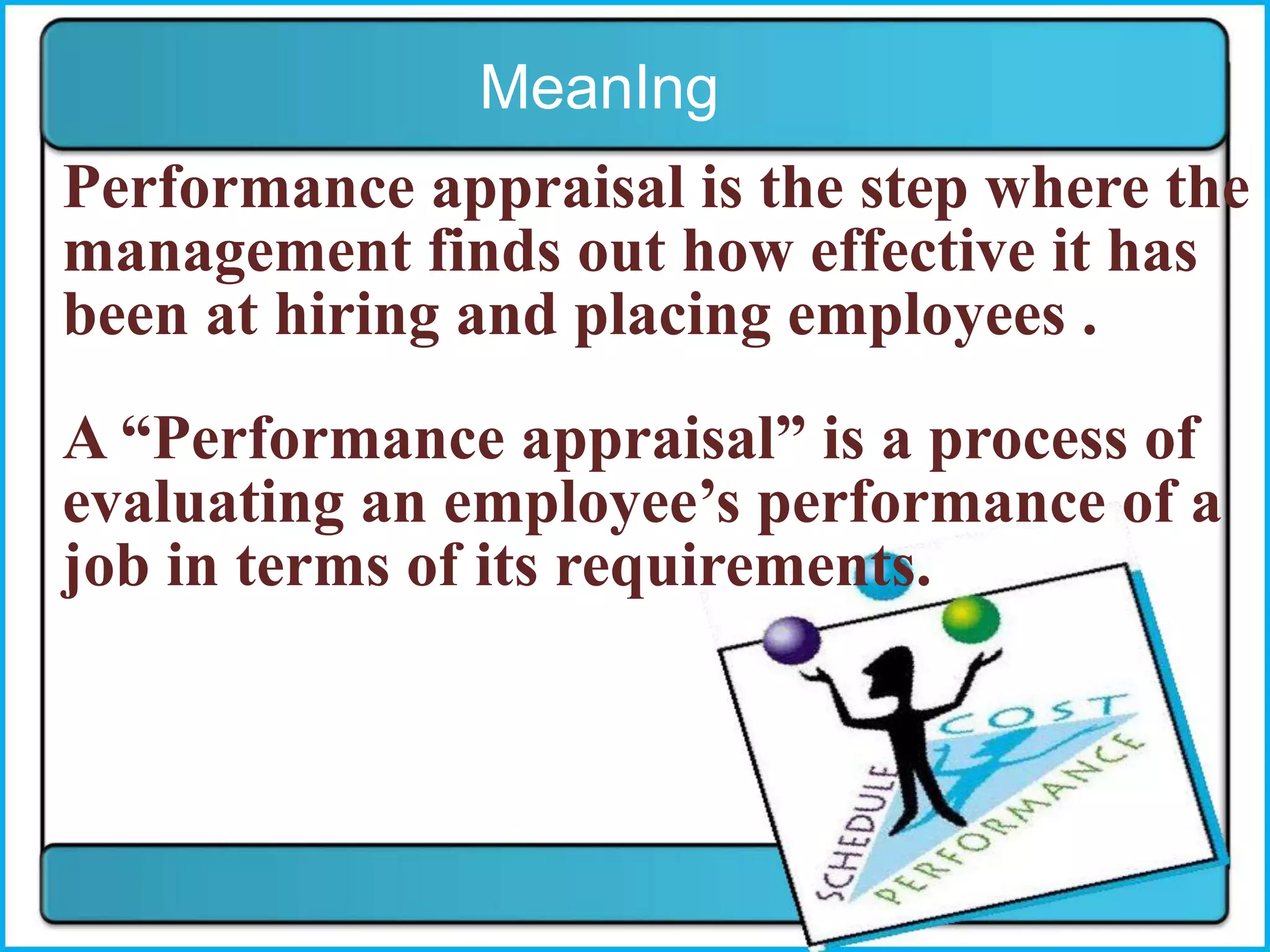
MeanIng
Performance appraisal is the step where the
management finds out how effective it has
been at hiring and placing employees .
A “Performance appraisal” is a process of
evaluating an employee’s performance of a
job in terms of its requirements.
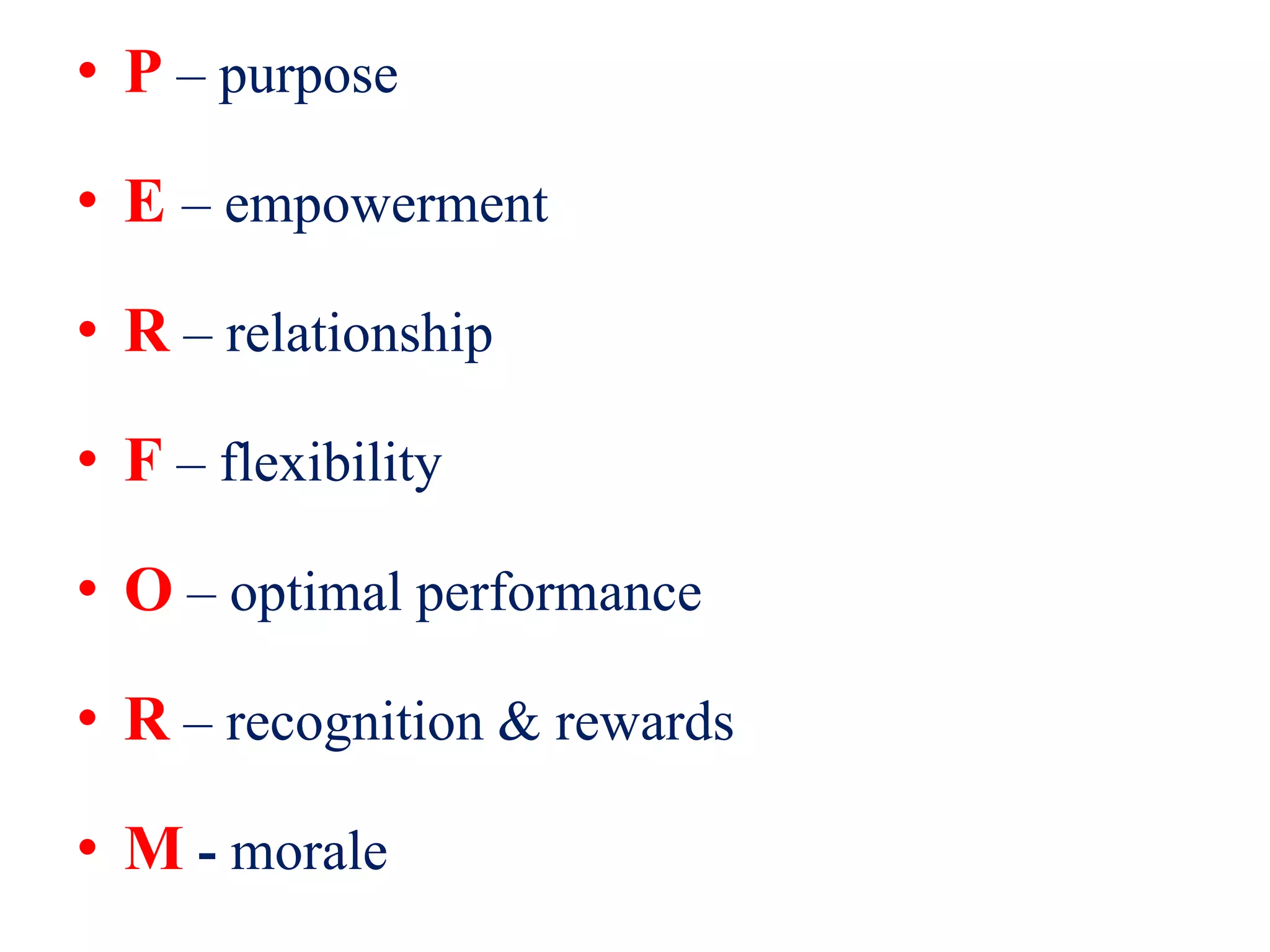
• P – purpose
• E – empowerment
• R – relationship
• F – flexibility
• O – optimal performance
• R – recognition & rewards
• M - morale
DEFINITION
Performance appraisal
• According to Flippo, a prominent
personality in the field of Human
resources, "performance appraisal is
the systematic, periodic and an
impartial rating of an employee’s
excellence in the matters pertaining
to his present job and his potential
for a better job."
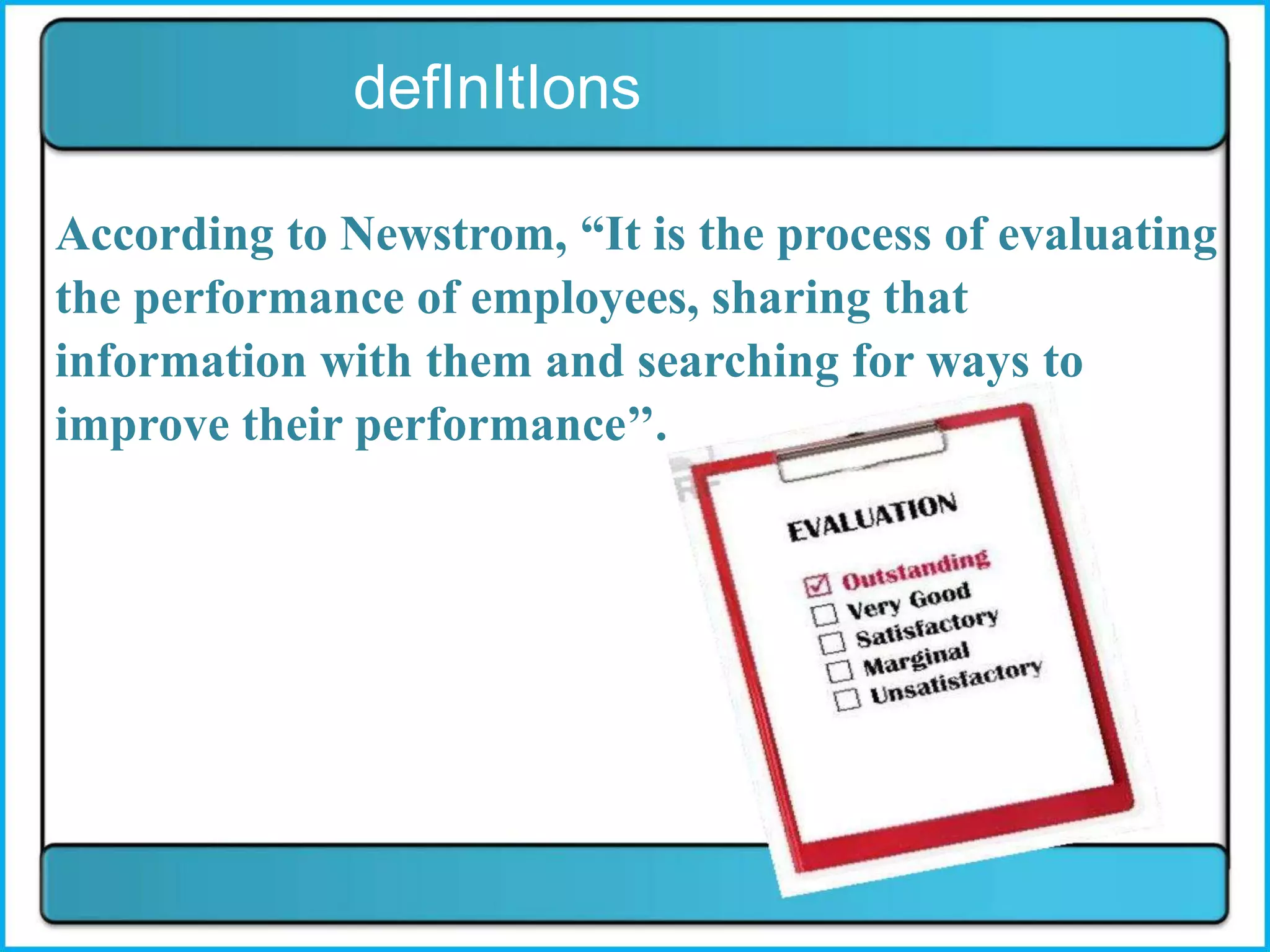
defInItIons
According to Newstrom, “It is the process of evaluating
the performance of employees, sharing that
information with them and searching for ways to
improve their performance’’.
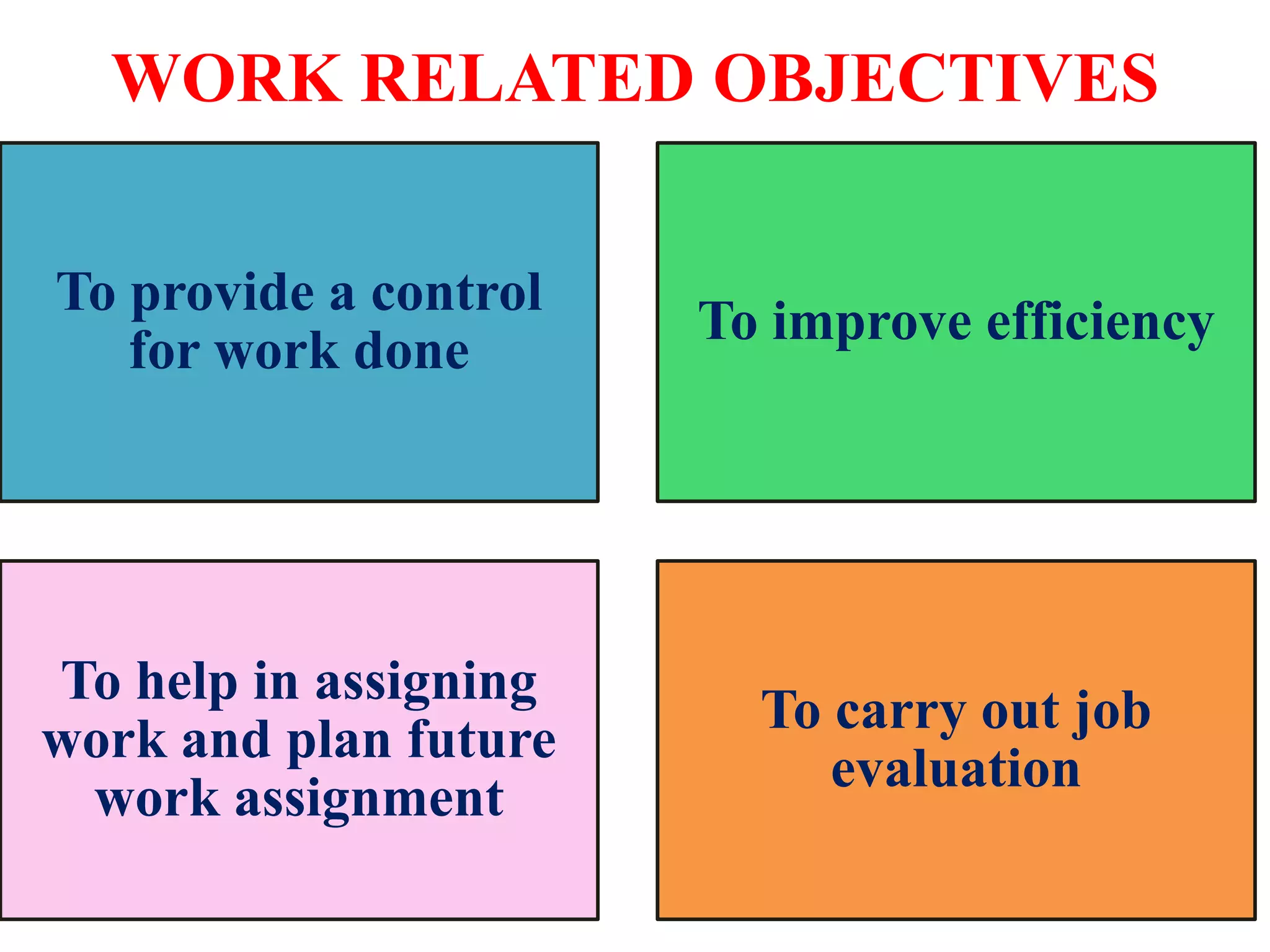
WORK RELATED OBJECTIVES
To provide a control
for work done
To improve efficiency
To help in assigning
work and plan future
work assignment
To carry out job
evaluation
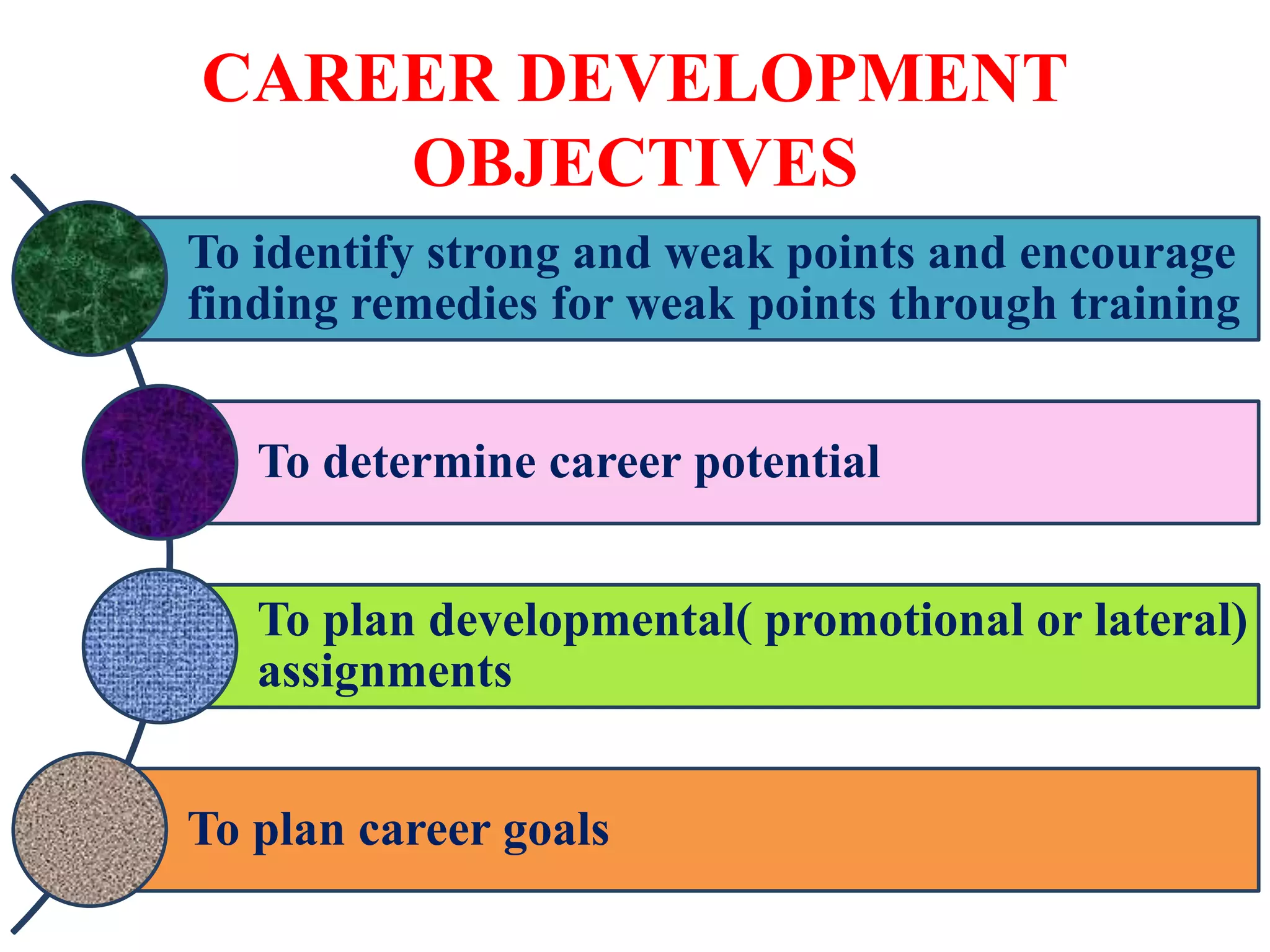
CAREER DEVELOPMENT
OBJECTIVES
To identify strong and weak points and encourage
finding remedies for weak points through training
To determine career potential
To plan developmental( promotional or lateral)
assignments
To plan career goals
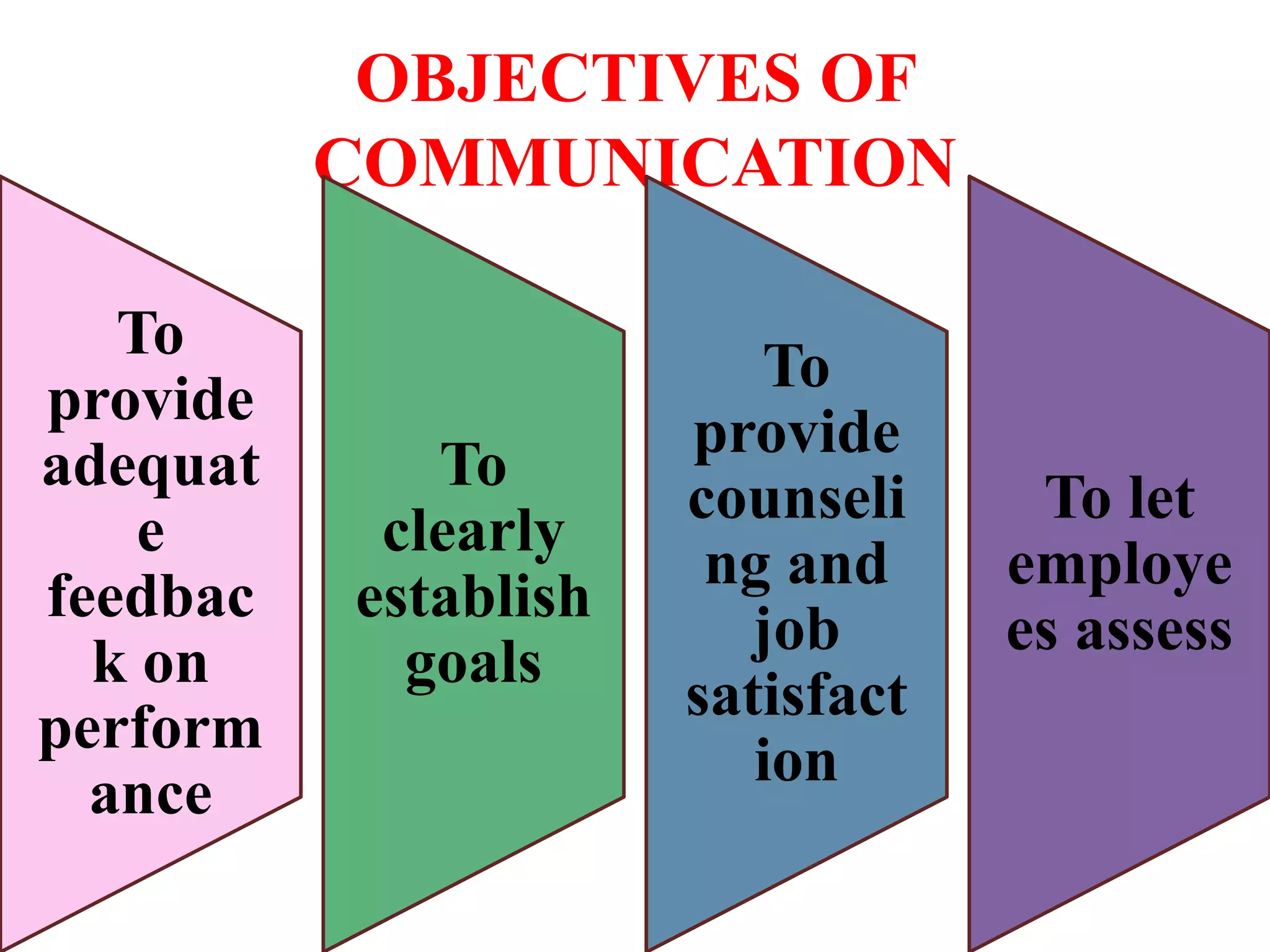
OBJECTIVES OF
COMMUNICATION
To
provide
adequat
e
feedbac
k on
perform
ance
To
clearly
establish
goals
To
provide
counseli
ng and
job
satisfact
ion
To let
employe
es assess
ADMINISTRATIVE OBJECTIVES
To serve as a basis for
promotion or demotion
To serve as a basis for
allocating incentives
To serve as a basis for
determining transfers
To serve as a basis for
termination
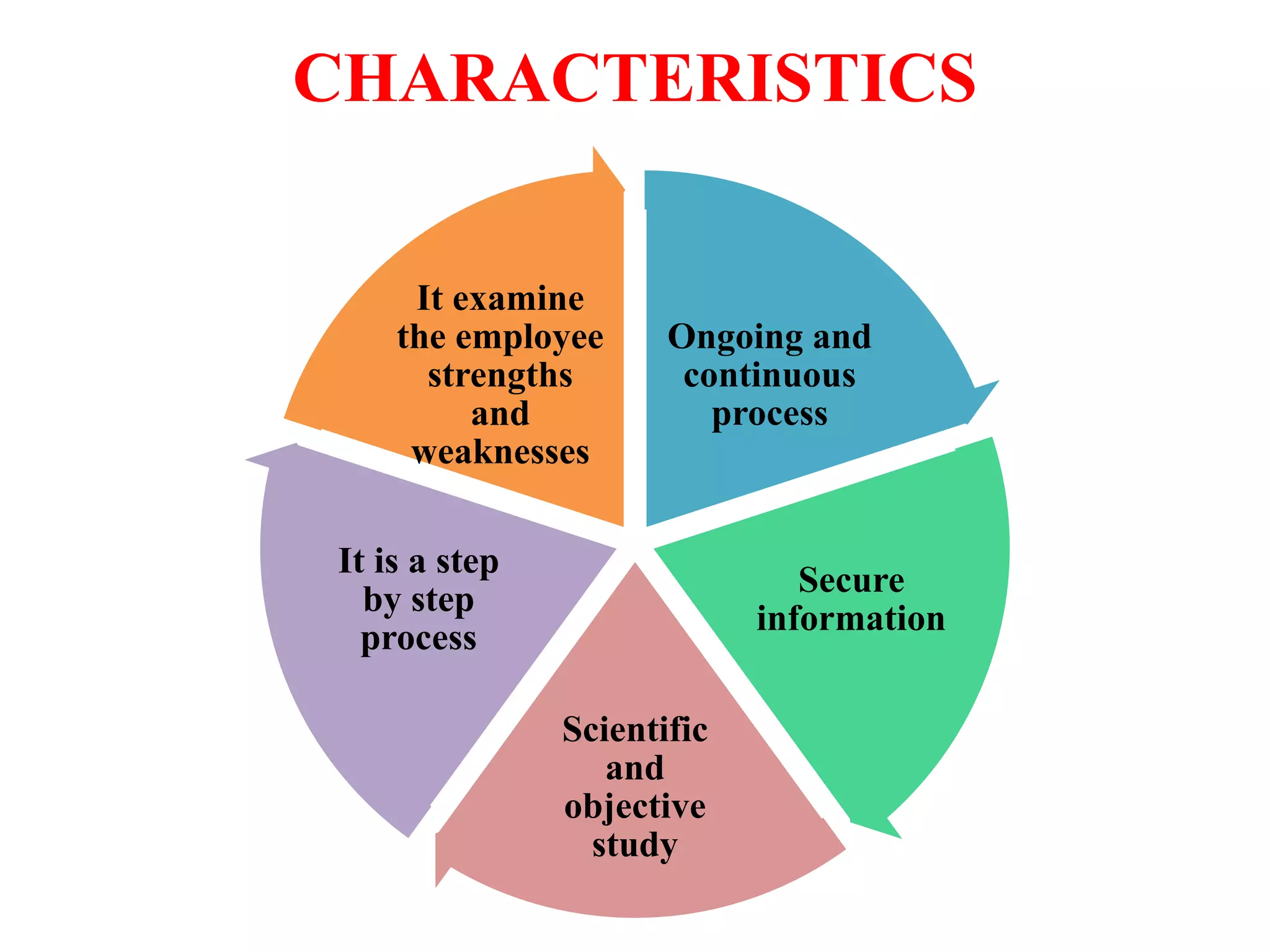
CHARACTERISTICS
Ongoing and
continuous
process
Secure
information
Scientific
and
objective
study
It is a step
by step
process
It examine
the employee
strengths
and
weaknesses
WHY CONDUCT A
PERFORMANCE
APPRAISAL/NEED OF
PERFORMANCE APPRAISAL
Provide information about the performance
ranks.
Provide feedback about level of achievement
and behaviour of the subordinate
Provide information which helps to counsel the
employees.
Provide information to diagnose the deficiency
of the employees
Provide training and development needs
of the employees.
Form a basis for personnel decisions:
salary increases, promotions, disciplinary
actions, etc
Facilitate communication between
employee and administraton
WHEN TO CONDUCT A
PERFORMANCE APPRAISAL
The performance review must occur
atleast once in a year
However, as a part of Performance
Management, the performance review is a
continuing, ongoing activity
PERSONS INVOLVED IN
PERFORMANCE APPRAISAL
• The Appraisee
• The Appraiser
• HR Department
CONTENT OF
PERFORMANCE
MANAGEMENT
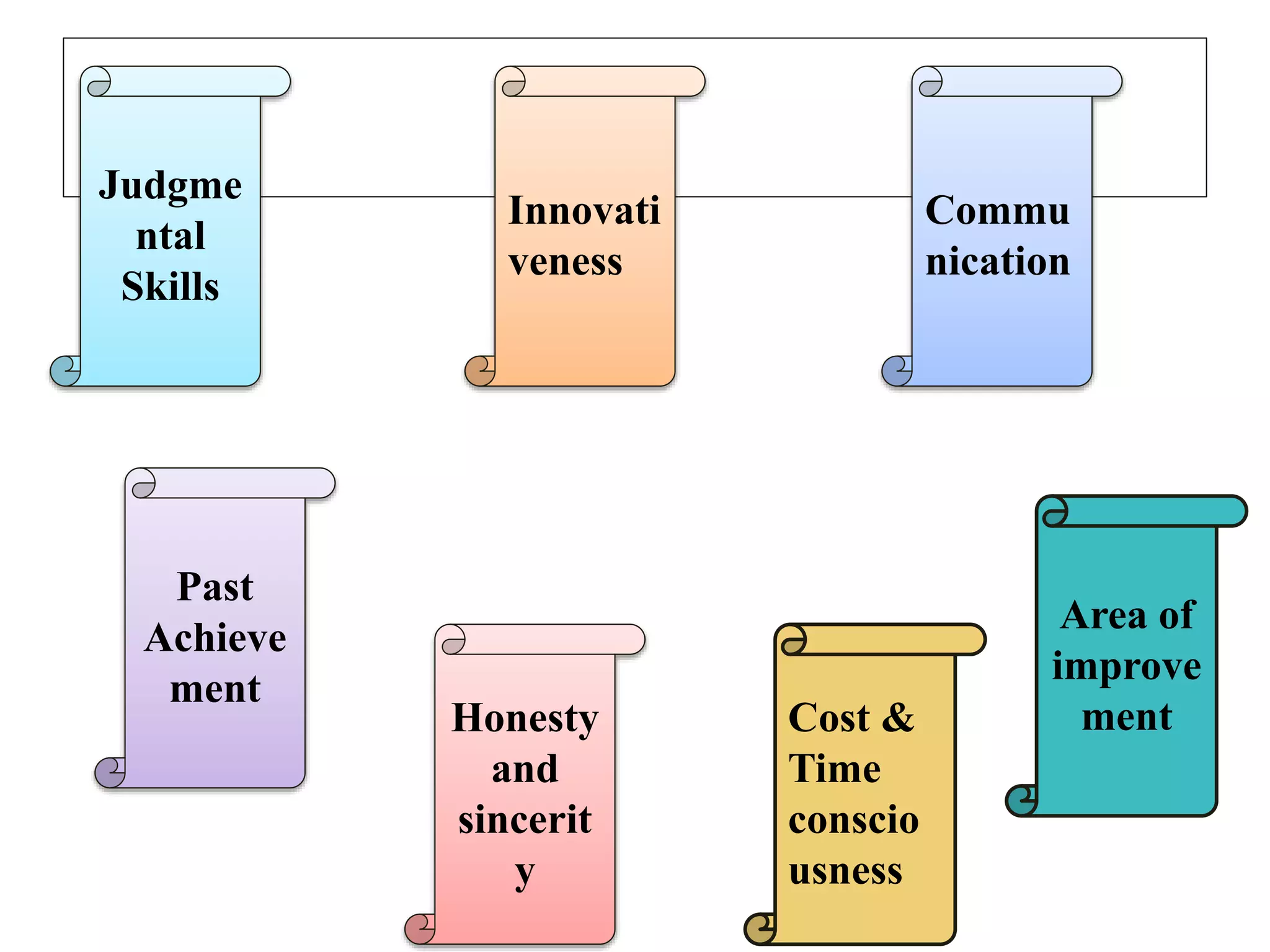
Regular
ity of
the
Attenda
nce
Ability
Initiativ
e,
Technic
al skills
Ability
to grasp
new
things
Area of
interest.
Job
Knowle
dge.
Attitude
.
Judgme
ntal
Skills
Past
Achieve
ment
Innovati
veness
Honesty
and
sincerit
y
Cost &
Time
conscio
usness
Area of
improve
ment
Commu
nication
BENEFITS OF
PERFORMANCE
APPRAISAL
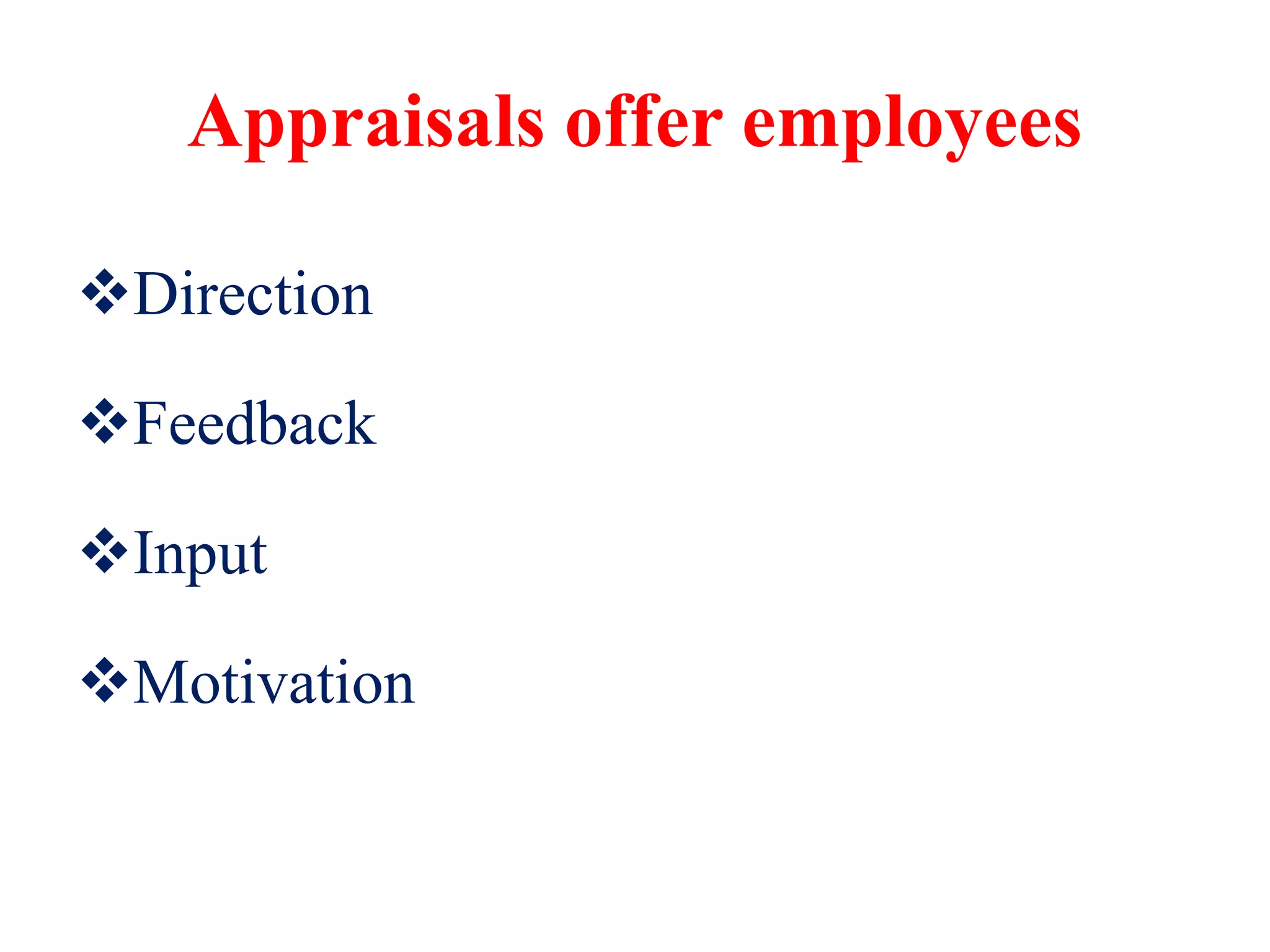
Appraisals offer employees
Direction
Feedback
Input
Motivation
Benefit to the
line/manager/supervisor/team leader
Oppurtunities to
• hear and exchange views and opinions away
from the normal pressure of work
• to identify any potential difficulties or
weaknesses
• An improved understanding of the resources
available to plan for and set objectives for the
next period
Contd…
to think about and clarity their own role
to plan for achieving improved
performance
to plan for further delegation and
coaching
to motivate members of the team
Benefits to the organization
A structured means of identifying and
assessing potential
Up-to-date information regarding the
expectations and aspirations of employees
Information on which to base decisions about
promotions and motivation
An opportunity to review succession planning
• Information about training needs which can
act as a basis for developing training plans
• Updating of employee records (achievements,
new competencies, etc)
• Career counseling
• Communication of information
Important
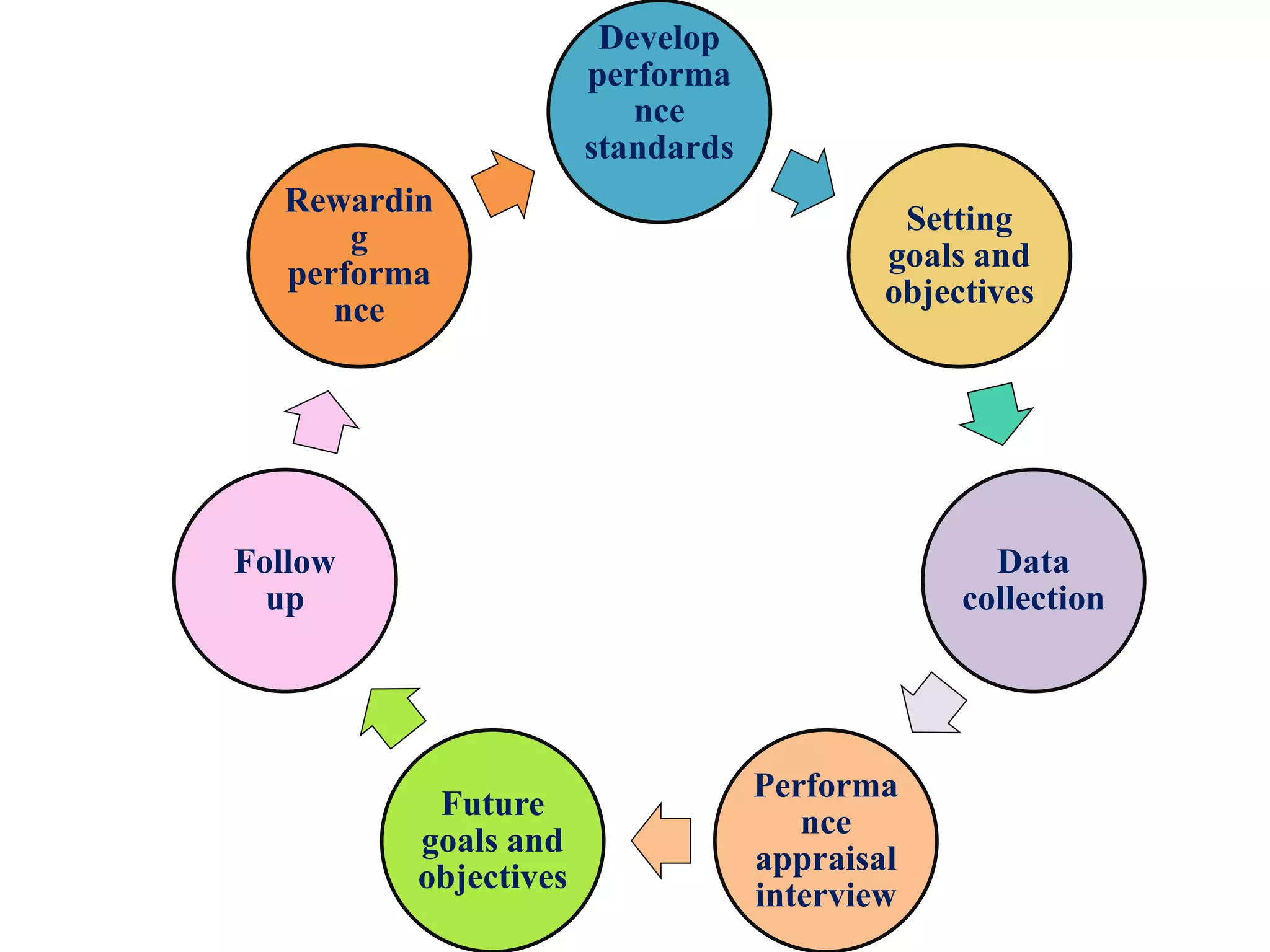
STEPS IN PERFORMANCE
APPRAISAL
Develop
performa
nce
standards
Setting
goals and
objectives
Data
collection
Performa
nce
appraisal
interview
Future
goals and
objectives
Follow
up
Rewardin
g
performa
nce
A. DEVELOP THE STANDARDS
FOR EVALUATION
Performance standards are
• Based on the position, not the individual
• Observable, specific indicators of success
• Meaningful, reasonable and attainable
• Describe “fully satisfactory” performance
once trained
• Expressed in terms of quantity, quality,
timeliness, cost, safety or outcomes
B. SETTING OBJECTIVES
• Specific
• Performance oriented
• Realistic
• Observable
C. DATA COLLECTION
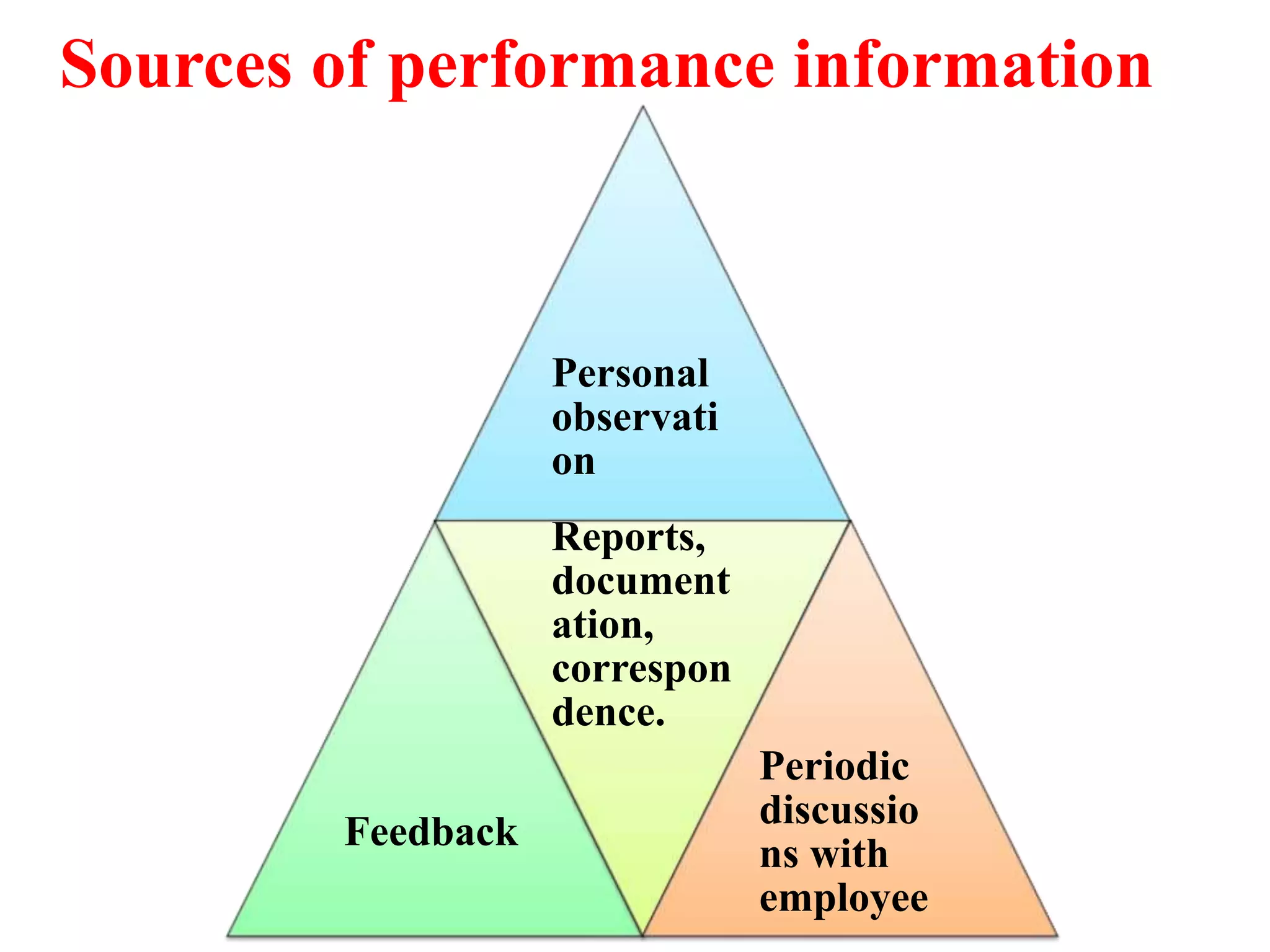
Sources of performance information
Personal
observati
on
Feedback
Reports,
document
ation,
correspon
dence.
Periodic
discussio
ns with
employee
D. PERFORMANCE APPRAISAL
INTERVIEW
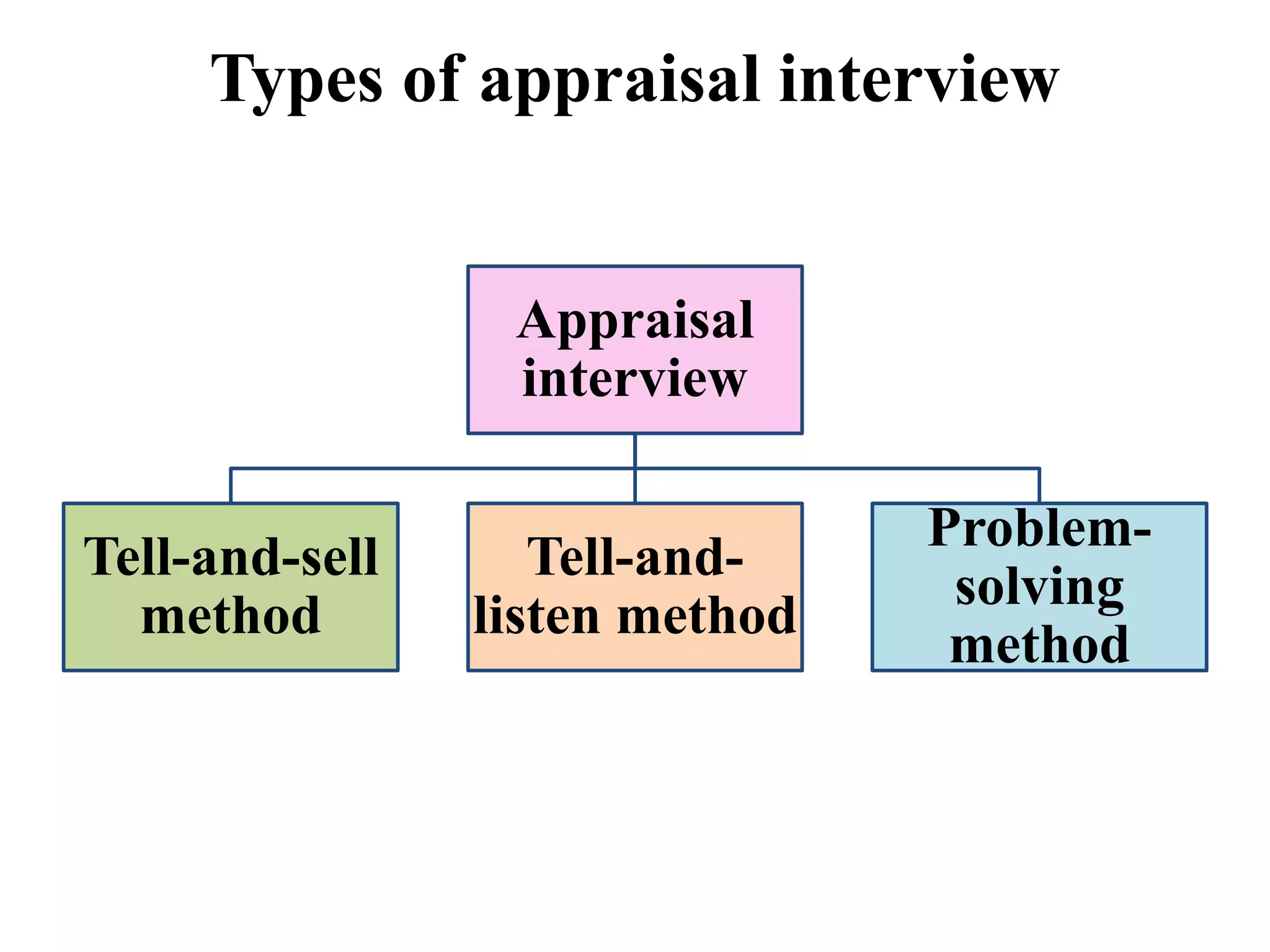
Types of appraisal interview
Appraisal
interview
Tell-and-sell
method
Tell-and-
listen method
Problem-
solving
method
Tell- and- Sell Interviews
Purpose of this interview is
• To let the employee to know how well he is
doing.
• To draw up a plan of improvement for him.
• To gain the employees acceptance of the
evaluation
Tell-and-Listen Interviews
The objective of this interview is to communicate the
evaluation to the employee and then listen
sympathetically to his reactions.
• Supervisor covers strengths/weaknesses for first
half
• Solicits employee’s feelings about comments
• Deal with disagreement, non-defensively
• Negotiate future concrete objectives
The Problem Solving Interview
the aim is not appraisal but development of an
employee
• Discuss strengths &weaknesses since last review
• Explore feelings of sub-ordinate
• Listening, accepting &responding are essential
• Stimulate growth (performance) job
• Discuss problems, needs, innovations,
satisfactions & dissatisfactions since last review
• Listen & respond with goal of helping person
Contd…
• Be ready to suggest specific developmental
activities suitable to each employee’s needs.
• Make sure that the session is truly a
discussion.
• List disagreements: if possible,
disagreements should be resolved before the
end of the interview.
• Make certain that your employees fully
understand your appraisal of their
performance.
Guidelines for conducting the
interview
• Establish a friendly, helpful, purposeful
tone at the outset of the discussion. Be at
ease.
• Ask for the subordinate’s opinion of his or
her performance since the last appraisal.
• Recognize the staff nurse’s
accomplishments and contributions to the
hospital.
Contd…
• Discuss the future as well as the past. Plan
with the employee specific changes in
performance or specific developmental
activities that will allow fuller use of
potential.
• End the discussion on a positive, future –
improvement- oriented note.
• Document the conclusions.
E. FUTURE GOALS AND
OBJECTIVES
• The employer should record specific goals,
targets or benchmarks that the employee will
attempt to achieve.
• Both employer and employee should agree on the
steps to be taken to achieve these targets,
• Both should agree on how the employee’s
progress towards these objectives will be
measured and set a defined timeframe, even if
this is simply the next performance appraisal
F. FOLLOW UP
G. THE PERFORMANCE
EVALUATION REPORT
Class specification and / or informal job
description
Job standards, procedures and regulations.
Established goals, objectives and
Knowledge and abilities to perform the job.
Job relationships required for successful
performance, i.e supervisors, co-workers,
county employees and the public.
Contd…
Quality of work, including the nature and
consequences of errors made during the
evaluation period.
Production rate, if applicable.
Commendations awarded relative to employee
performance.
Use of job skills and efforts to enhance skills.
Ability to work with others.
Attendance, use of sick leave, punctuality
Questions to consider when preparing
to write the performance report
• Did the employee meet or exceed
quantity and quality standards?
• Does the employee have the skills to
perform the job?
• Has the employee increased skill level
and established value to the
organization?
If corrective action was instituted due to errors and
/or complaints that damaged the efficiency of
organizational operations, was it effective?
Has the employee demonstrated job related
efficiency through special efforts and capabilities?
Does the employee follow organizational rules and
standards of the department?
Does the employee utilize supervisory guidance?
Guidelines for the writing of the
Employee Performance Report
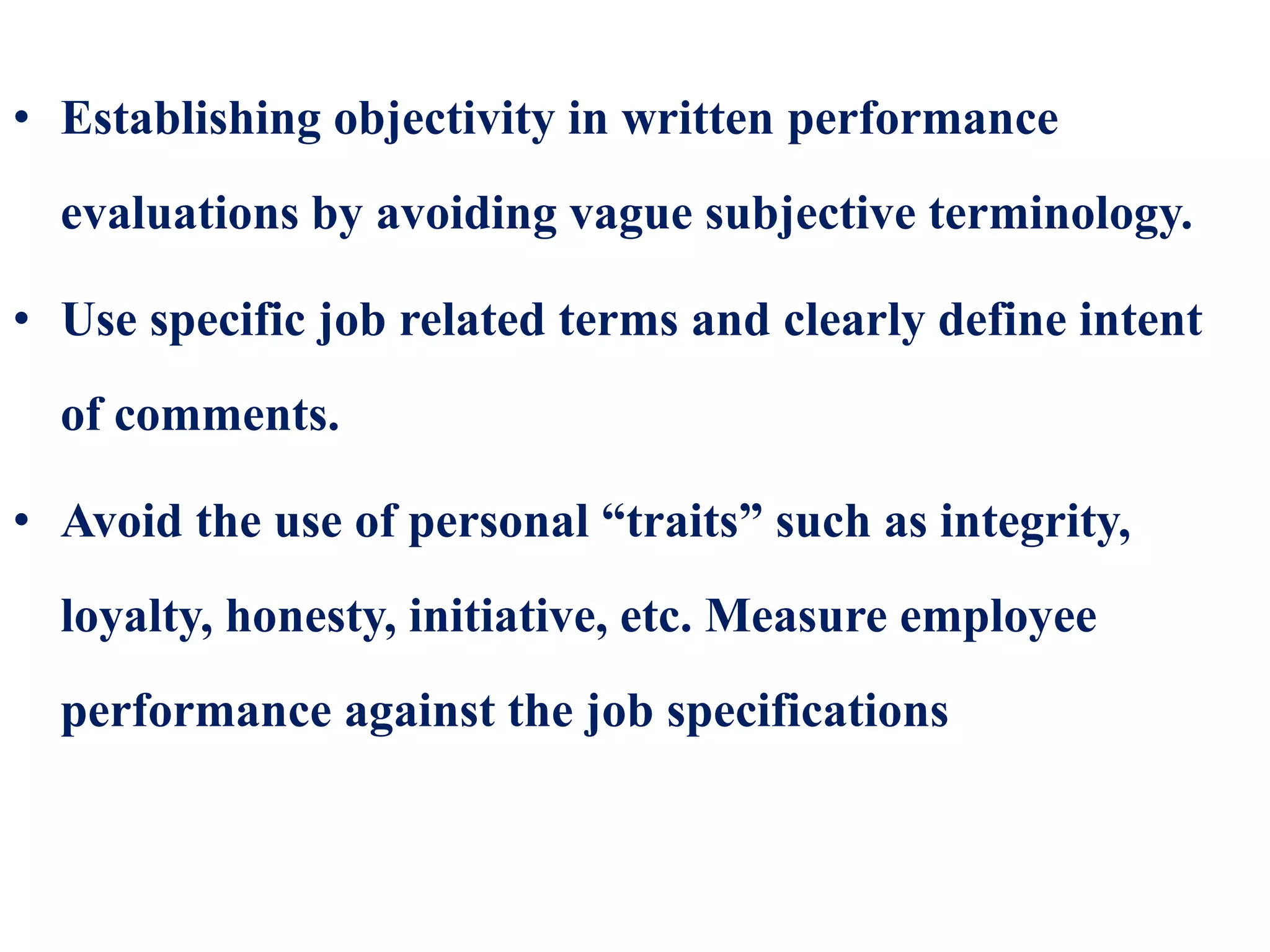
• Establishing objectivity in written performance
evaluations by avoiding vague subjective terminology.
• Use specific job related terms and clearly define intent
of comments.
• Avoid the use of personal “traits” such as integrity,
loyalty, honesty, initiative, etc. Measure employee
performance against the job specifications
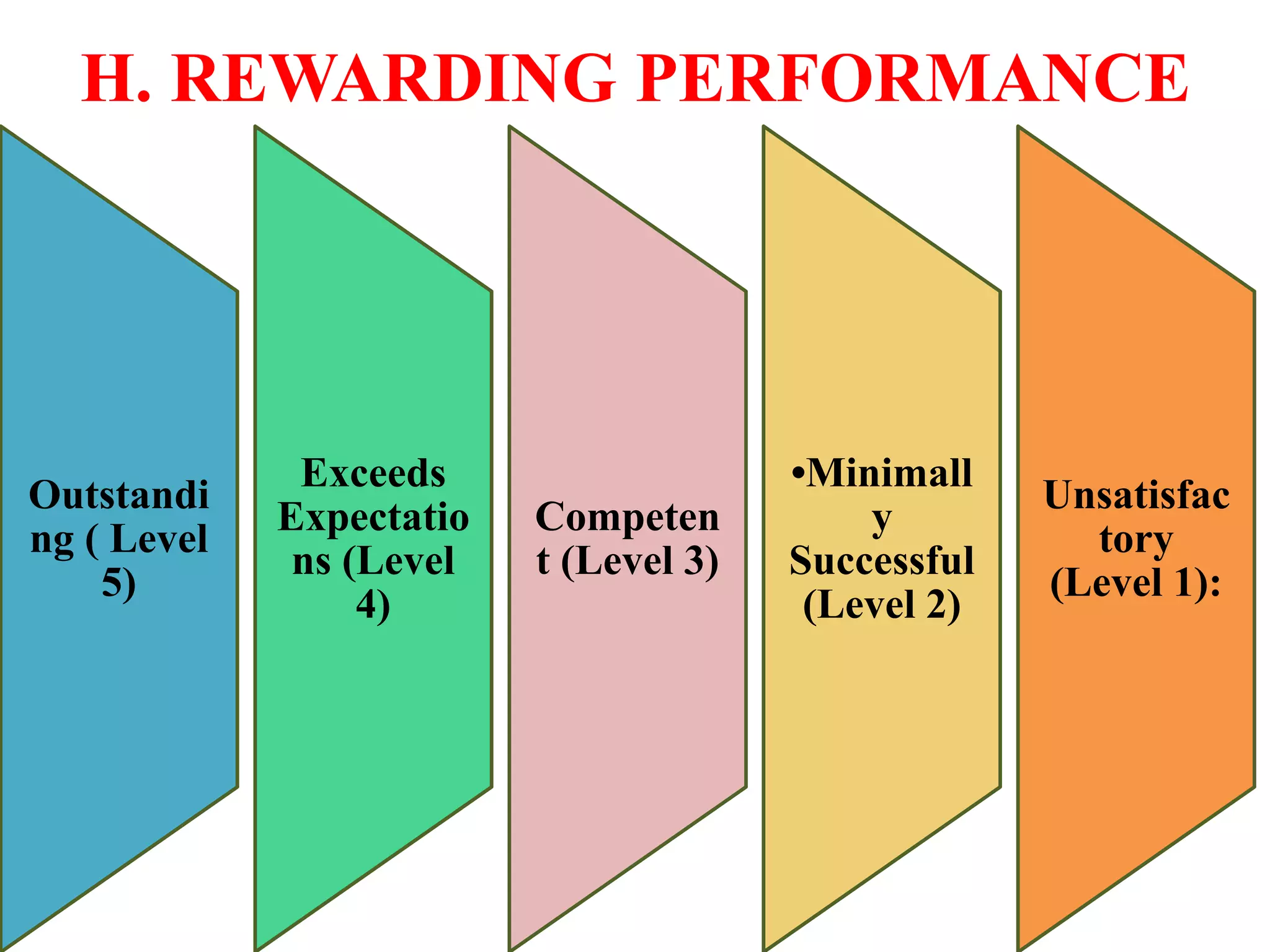
H. REWARDING PERFORMANCE
Outstandi
ng ( Level
5)
Exceeds
Expectatio
ns (Level
4)
Competen
t (Level 3)
•Minimall
y
Successful
(Level 2)
Unsatisfac
tory
(Level 1):
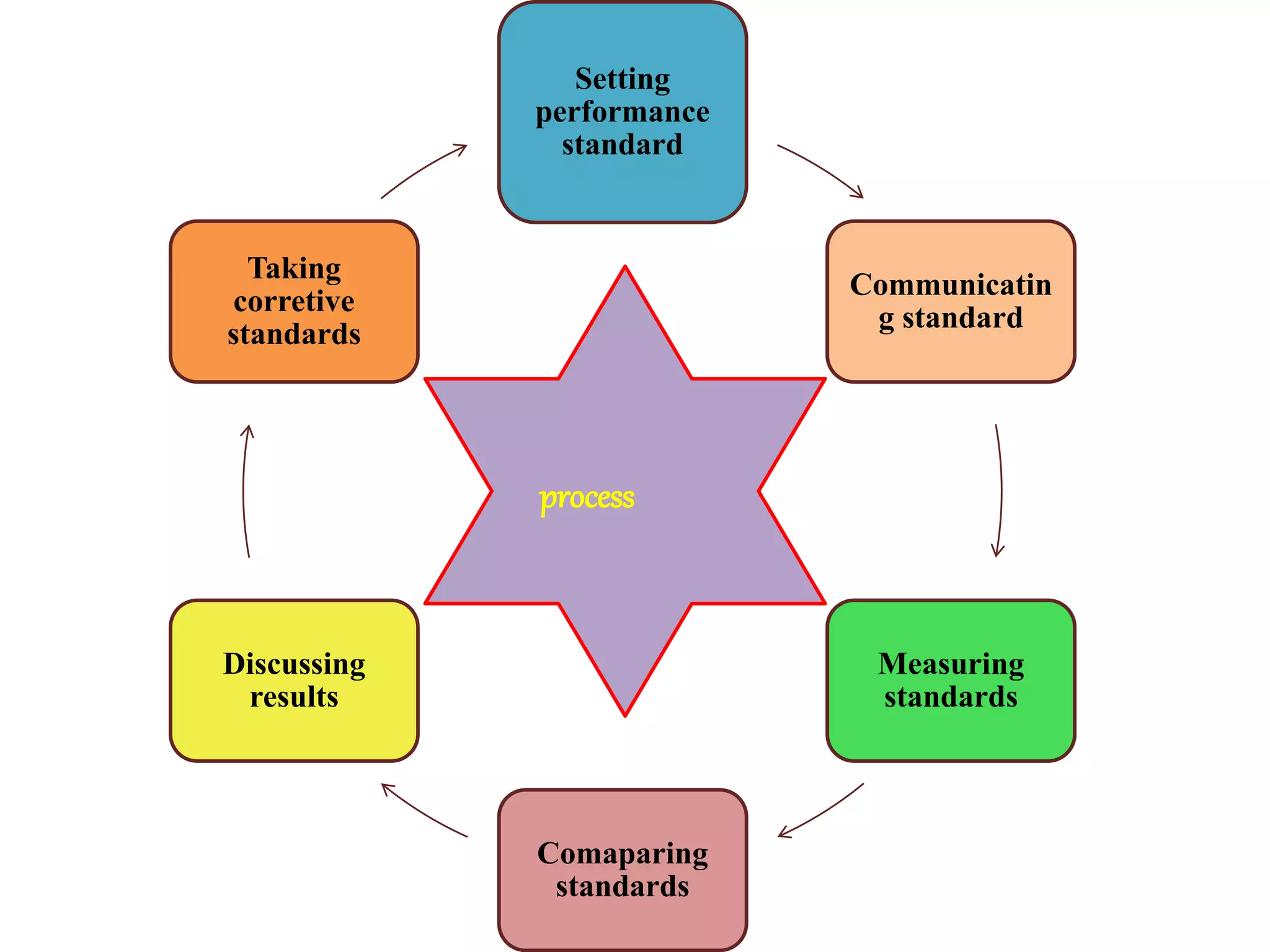
PROCESS OF
PERFORMANCE
APPRAISAL
Setting
performance
standard
Communicatin
g standard
Measuring
standards
Comaparing
standards
Discussing
results
Taking
corretive
standards
process
METHODS OF APPRAISING
PERFORMANCE
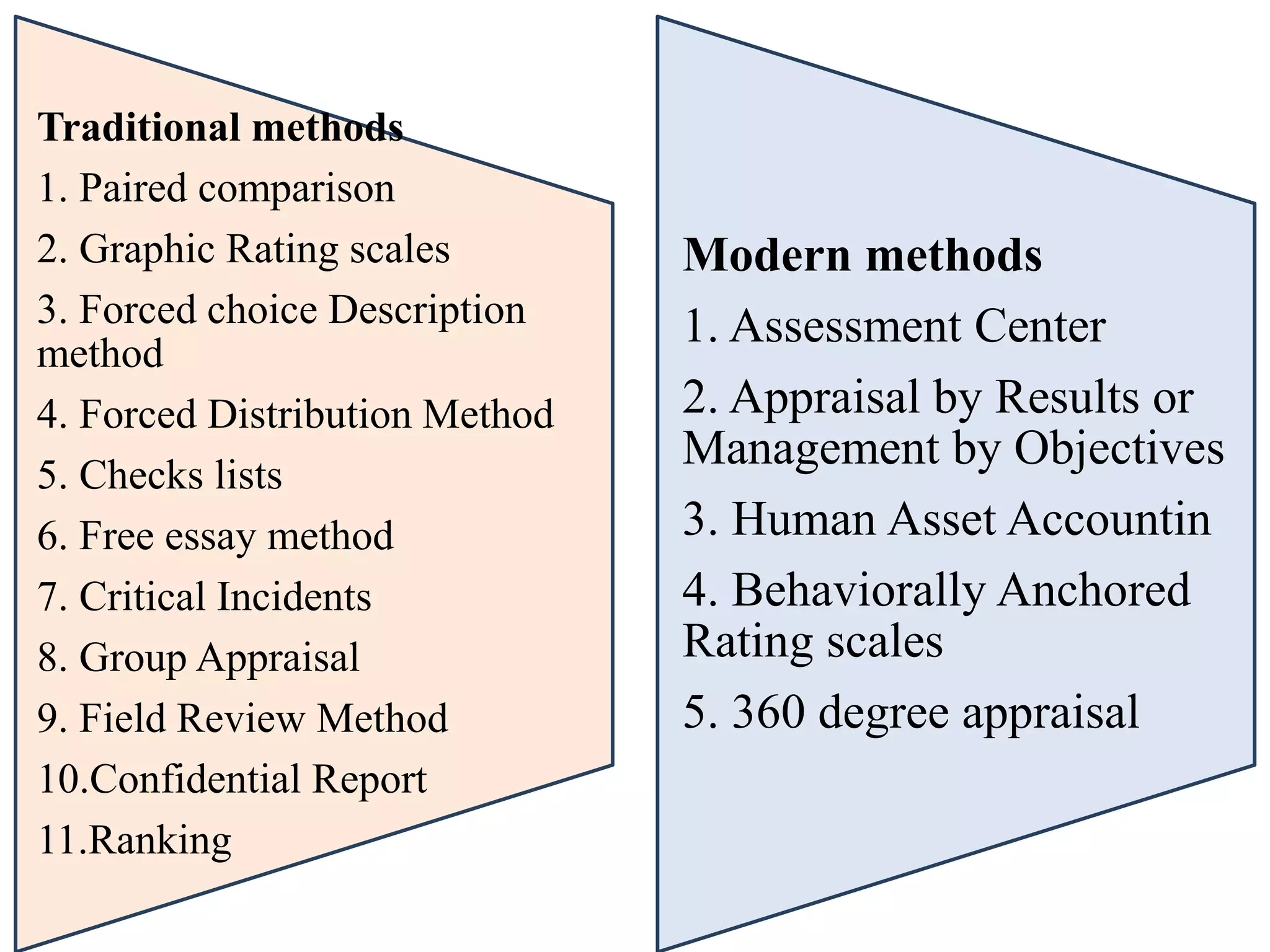
Traditional methods
1. Paired comparison
2. Graphic Rating scales
3. Forced choice Description
method
4. Forced Distribution Method
5. Checks lists
6. Free essay method
7. Critical Incidents
8. Group Appraisal
9. Field Review Method
10.Confidential Report
11.Ranking
Modern methods
1. Assessment Center
2. Appraisal by Results or
Management by Objectives
3. Human Asset Accountin
4. Behaviorally Anchored
Rating scales
5. 360 degree appraisal
Traditional methods of performance
appraisal
1. Essay appraisal method
• This traditional form of appraisal, also known as
"Free Form method" involves a description of the
performance of an employee by his superior.
• The description is an evaluation of the performance
of any individual based on the facts and often
includes examples and evidences to support the
information.
• A major drawback of the method is the
inseparability of the bias of the evaluator
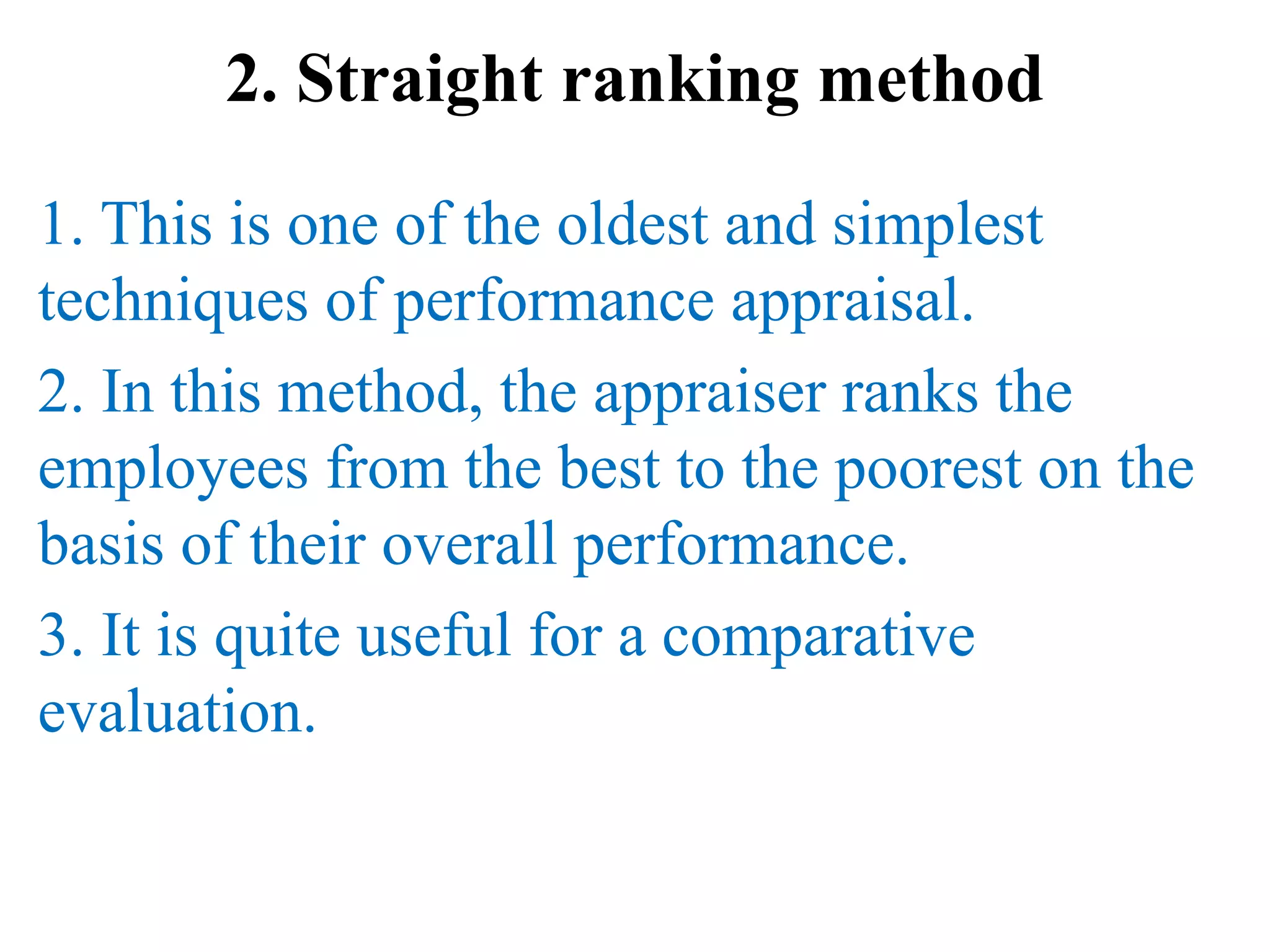
2. Straight ranking method
1. This is one of the oldest and simplest
techniques of performance appraisal.
2. In this method, the appraiser ranks the
employees from the best to the poorest on the
basis of their overall performance.
3. It is quite useful for a comparative
evaluation.
3. Paired comparison
• A better technique of comparison than the
straight ranking method, this method
compares each employee with all others in
the group, one at a time.
• After all the comparisons on the basis of
the overall comparisons, the employees are
given the final rankings.
4. Critical incidents methods
• In this method of Performance appraisal the
evaluator rates the employee on the basis of critical
events and how the employee behaved during those
incidents.
• It includes both negative and positive points
• The drawback of this method is that the supervisor
has to note down the critical incidents and the
employee behavior as and when they occur.
5. Field review
• In this method, a senior member of the Human
Resource department or a training officer discusses
and interviews the supervisors to evaluate and rate
their respective subordinates.
• A major drawback of this method is that it is a
very time consuming method.
• But this method helps to reduce the superiors’
personal bias.
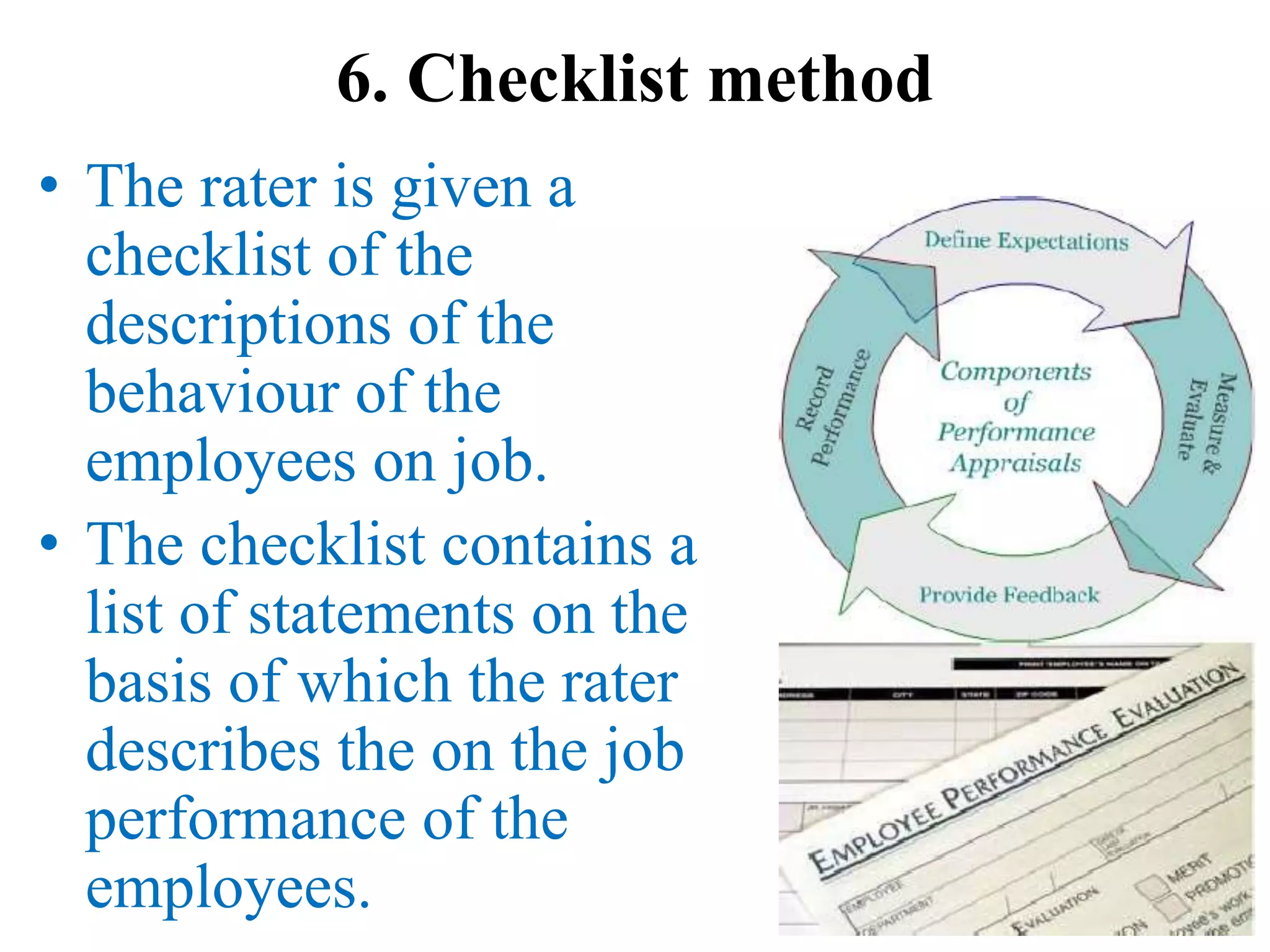
6. Checklist method
• The rater is given a
checklist of the
descriptions of the
behaviour of the
employees on job.
• The checklist contains a
list of statements on the
basis of which the rater
describes the on the job
performance of the
employees.
7. Graphic rating scale
• In this method, an employee’s quality and quantity
of work is assessed in a graphic scale indicating
different degrees of a particular trait.
• The factors taken into consideration include both the
personal characteristics and characteristics related to
the on the job performance of the employees.
• For example a trait like Job Knowledge may be
judged on the range of average, above average,
outstanding or unsatisfactory
8. Forced Distribution
• To eliminate the element of bias from the rater’s
ratings, the evaluator is asked to distribute the
employees in some fixed categories of ratings like
on a normal distribution curve.
• The rater chooses the appropriate fit for the
categories on his own discretion
Modern methods of performance
appraisal
Assessment centre
• An assessment centre typically involves the use
of methods like social/informal events, tests and
exercises, assignments being given to a group of
employees to assess their competencies to take
higher responsibilities in the future.
• Generally, employees are given an assignment
similar to the job they would be expected to perform
if promoted.
• The trained evaluators observe and evaluate
employees as they perform the assigned jobs and are
evaluated on job related characteristics
2. Behaviorally anchored rating
scales
• Is a relatively new technique which combines the
graphic rating scale and critical incidents method.
• It consists of predetermined critical areas of job
performance or sets of behavioral statements
describing important job performance qualities as
good or bad.
• In this method, an employee’s actual job behavior is
judged against the desired behavior by recording and
comparing the behavior with BARS.
3. Human resource accounting
method
Human resources are valuable assets for every
organization. Human resource accounting method
tries to find the relative worth of these assets in the
terms of money.
In this method the Performance appraisal of the
employees is judged in terms of cost and
contribution of the employees.
The cost of employees include all the expenses
incurred on them like their compensation,
recruitment and selection costs, induction and
training costs etc whereas their contribution
includes the total value added (in monetary
terms).
The difference between the cost and the
contribution will be the performance of the
employees.
Ideally, the contribution of the employees should
be greater than the cost incurred on them.
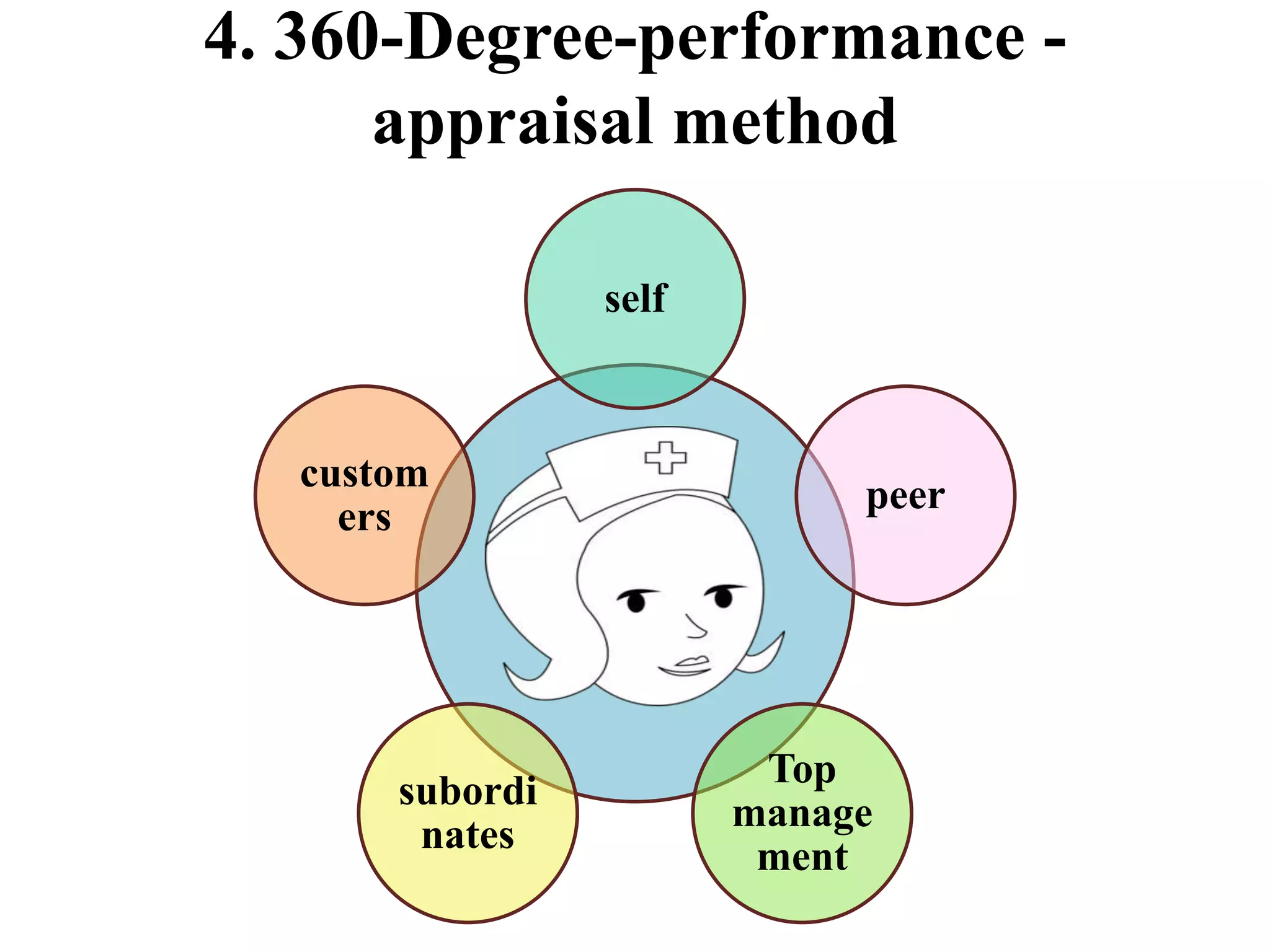
4. 360-Degree-performance -
appraisal method
self
peer
Top
manage
ment
subordi
nates
custom
ers
360 degree feedback, also known as 'multi-rater
feedback', is the most comprehensive appraisal
where the feedback about the employees’
performance comes from all the sources that
come in contact with the employee on his job
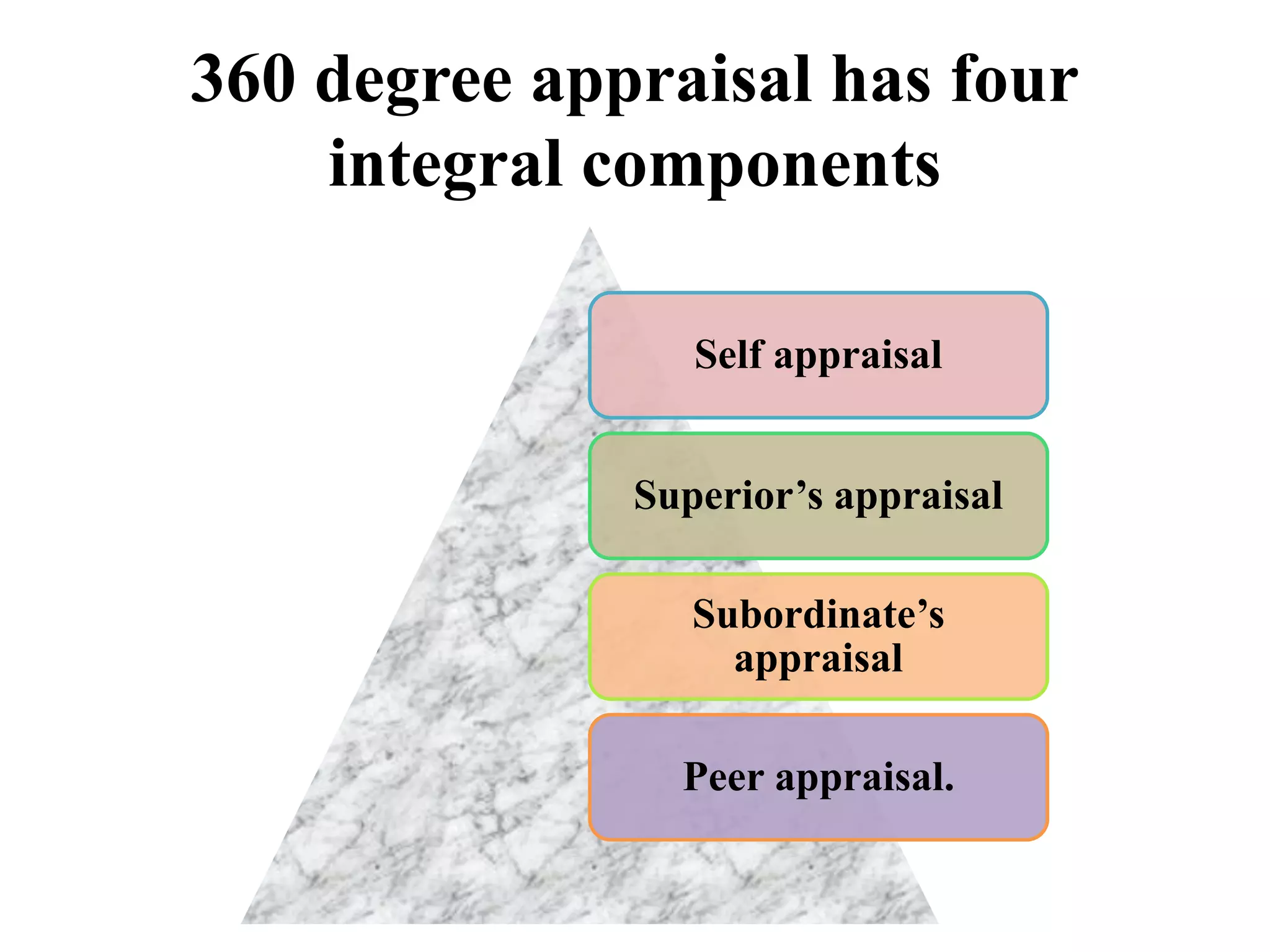
360 degree appraisal has four
integral components
Self appraisal
Superior’s appraisal
Subordinate’s
appraisal
Peer appraisal.
5. “Management by Objectives‟
A process whereby the superior and subordinates
of the organization jointly identify its common
objectives, define each individual’s major areas
of responsibility.
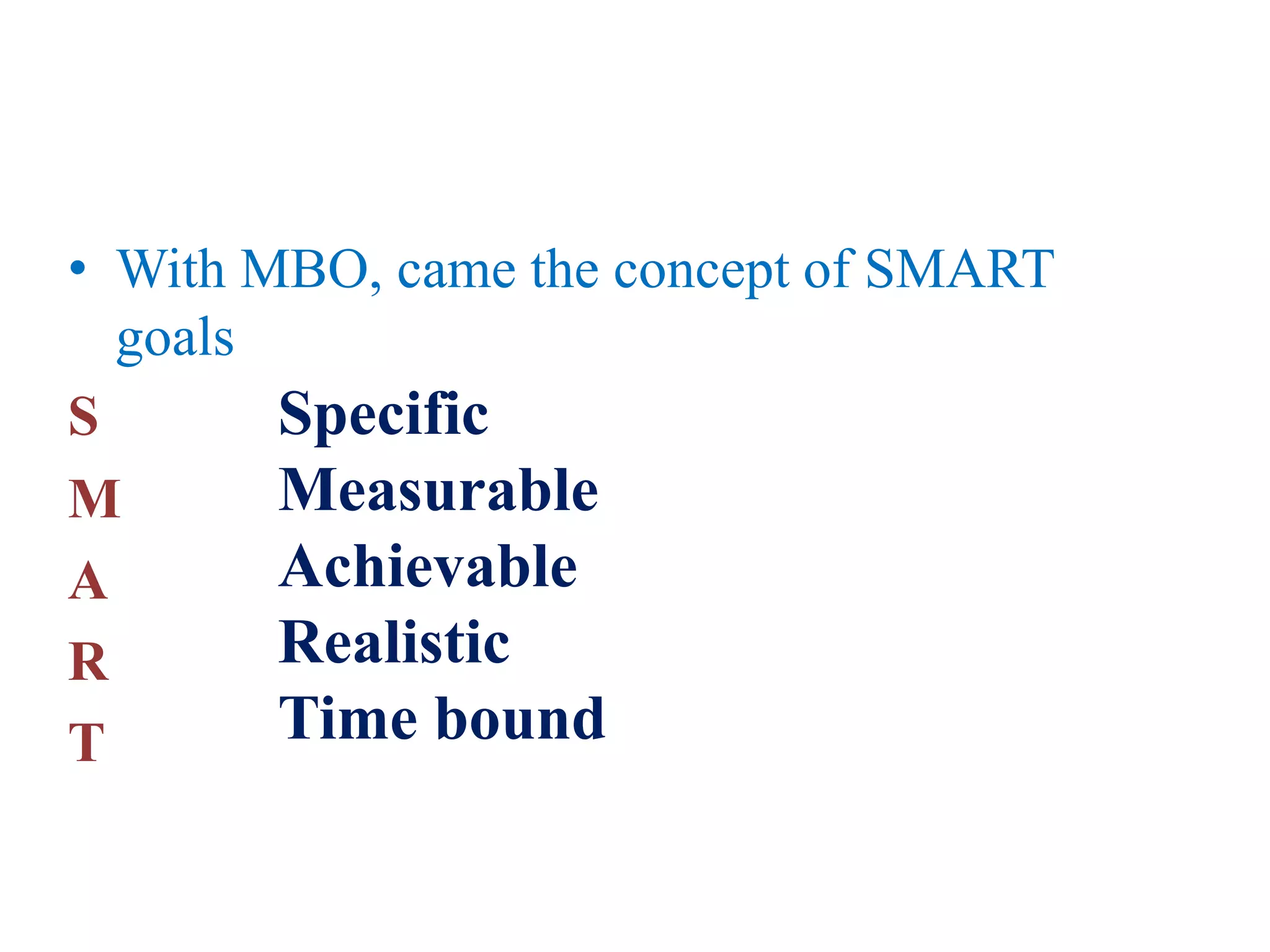
• With MBO, came the concept of SMART
goals
S
M
A
R
T
Specific
Measurable
Achievable
Realistic
Time bound
ERRORS IN WRITING
PERFORMANCE EVALUATIONS
halo effect
Horn effect
pitchfork effect” or “ recency effect
Comparing
Favoritism
Stereotyping
Mirroring
EFFECTIVE MANAGEMENT OF
PERFORMANCE APPRAISAL
• The system should be simple, effective,
efficient and administratively feasible.
• The procedures and uses of the system should
be understood and agreed on by line
management and the employees being rated.
• Factors to be rated should be measurable and
agreed on by managers and subordinates.
• Raters should understand the purpose and nature of
the performance review.
• They should be taught to the use the system,
observe, and write notes, including critical incident
file, organize notes and write evaluations that
include examples of evidence, edit their reports and
conduct effective review interviews.
• Raters should understand the meanings of the
dimensions rated, including the dimensions’ relative
weights. Managers are reported to be able to
distinguish among only three levels of performance:
poor, satisfactory, and outstanding.
• Criticism should promote warmth and the building
of self esteem for both rate and rater.
• The process should be organized and used to
manage employees on a daily basis according to
their needs to be coached.
• Praise or suggestions for improvement should be
done at the time of the event.
• Standards of performance should be set and
modified at the time of the event.
• Performance standards should be valid, reliable
and fair.
• Managers should be rewarded for good
performance evaluation skills.
OBSTACLES TO EFFECTIVE
PERFORMANCE APPRAISAL
• Lack of support from top management
• Resistance on the part of evaluator because:
Performance appraisal demands too much of
supervisors efforts in terms of time,
paperwork, and periodic observation of
subordinates’ performance.
Supervisors do not fully understand the
purposes and procedures of performance
appraisal.
Supervisors lack skills in appraisal techniques.
Overcoming these obstacles
Appraisal should be based on standards Employee
must know the standards in advance
Employee must know the sources of data gathered
for appraisal
Employee should have input in to development of
standards
Appraiser should be someone who has observed
employees work
Appraiser should be someone who the employ trust
and respects
Performance appraisal is not perceived as
being productive.
Evaluator biases and rating errors.
Lack of clear, objective standards of
performance.
Failure to communicate purposes and
Lack of suitable appraisal tool.
Failure to police the appraisal procedure
effectively.
Essentials of an effective appraisal
system
PREPARATION
Employees:
• Review performance
• Think about new goals
Supervisors
• Review performance
• Complete written appraisal
• Think about new goals
• Schedule time and place
Start the Meeting
Lay out agenda
Talk about money
Encourage input
Give good news first
During the Meeting
• Review performance:
• Based on previous goals
• Noting strengths and accomplishments
• Identifying areas for improvement
• Set goals: Based on company goals
• Building on areas that need improvement
Presentation Tips
• Focus on the professional.
• Give objective examples.
• Invite response.
• Listen actively.
• Create “we” mentality.
End the Meeting
Encourage good performance
Lay out action plan
Communicate outcome of goals not met
Confirm understanding
Continuous Feedback
• Formal appraisals
• Informal appraisals
• Open communication
Recognize Good Performance
Verbal
Public
Tangible
Monetary
Identify Poor Performance
Act early
Take the right approach
Deal with employee reaction
Handle continued poor performance
Discipline Poor Performance
Handle Hard Cases
Reviewing
highly
emotional
employees
Rating
former
peers
QUALITIES OF A GOOD
APPRAISAL
Factual
Whole Job
Fair
Whole
Period
no
Surprises
Performance criteria for
Executives
For middle level Managers
Departmental performance
Coordination among employees
Optimal use of resources
Degree of upward communication from
supervisors
Degree of clarity about corporate goals and
policies
For top managers
Profitability and return on capital employed
Contribution to community development
Degree of upward communication from middle-
level executives
Degree of growth and expansion of enterprise.
Extent of achievement of organizational goal
For supervisors
Quality and quantity of output in a given
period
Labor cost per unit of output in a given
period
Material cost per unit in a given period
Rate of absenteeism and turnover of
employees
No of accidents in a given period
Advantages
Provide a record of performance over a period
of time.
Provide an opportunity for a manager to meet
discuss performance.
Provide the employee with their feedback about
their performance
Provide an opportunity for an employee to
discuss issues and clarify expectations.
Can be motivational with the support of a good
reward and compensation
Disadvantages
Very time consuming specially for manager
If not done appropriately, can be a negative
experience.
If not done right it can be a complete waste of
time
Can be stressful for all involved.
Subject to rater errors & bias.
Issues in
appraisal
system
Whose
performance?
When to
evaluate?
Who are the
raters?
Formal and
informal
How to solve?
Appraisal
Design?
What to
evaluate?
What methods?
ROLE OF ADMINISTRATOR
IN PERFORMANCE
APPRAISAL
Manage
and
supervis
e
Apprais
e
perfor
mance Counsel
and train
employees
Monitors
Collect,
interpret
and
evaluate
Develop
and
implement
Understa
nd,interp
ret and
apply
laws
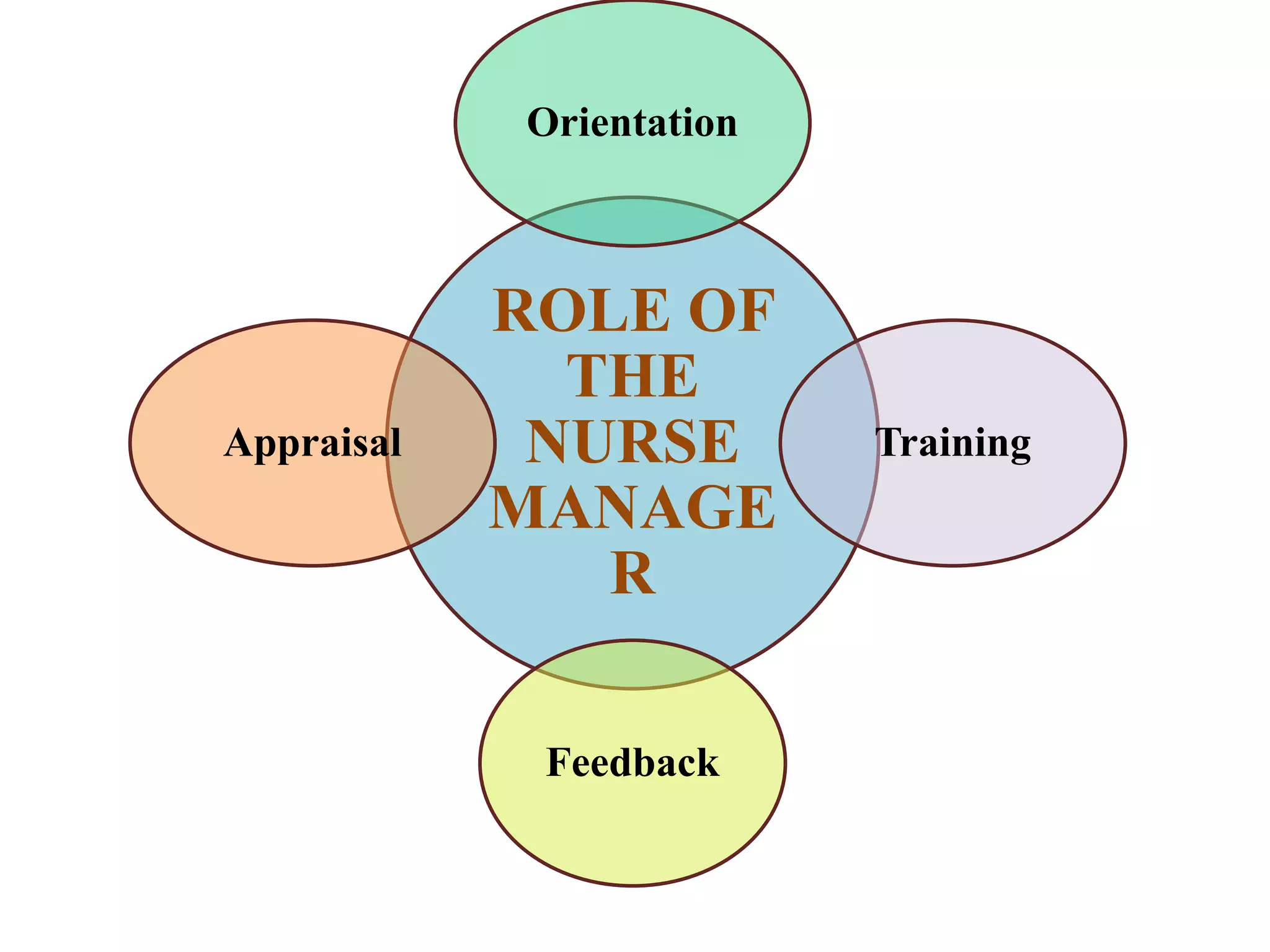
ROLE OF
THE
NURSE
MANAGE
R
Orientation
Training
Feedback
Appraisal
discussion
Evidenced based practice
SEMINAR ON PERFORMANCE APPRAISAL

SEMINAR ON PERFORMANCE APPRAISAL

  • 3.
    INTRODUCTION • Performance appraisal,also known as employee appraisal, is a method by which the job performance of an employee is evaluated (generally in terms of quality, quantity, cost and time). Performance appraisal is a part of career development
  • 4.
    What is PerformanceAppraisal PA is the method of evaluating the behaviour of the employees in the workplace, normally including both quantitative and qualitative aspect of the job.
  • 5.
    PERFORMANCE APPRAISAL : PerformanceAppraisal (PA) refers to all those procedures that are used to evaluate the personality, performance, potential, of its group members
  • 6.
    MeanIng Performance appraisal isthe step where the management finds out how effective it has been at hiring and placing employees . A “Performance appraisal” is a process of evaluating an employee’s performance of a job in terms of its requirements.
  • 7.
    • P –purpose • E – empowerment • R – relationship • F – flexibility • O – optimal performance • R – recognition & rewards • M - morale
  • 8.
    DEFINITION Performance appraisal • Accordingto Flippo, a prominent personality in the field of Human resources, "performance appraisal is the systematic, periodic and an impartial rating of an employee’s excellence in the matters pertaining to his present job and his potential for a better job."
  • 9.
    defInItIons According to Newstrom,“It is the process of evaluating the performance of employees, sharing that information with them and searching for ways to improve their performance’’.
  • 11.
    WORK RELATED OBJECTIVES Toprovide a control for work done To improve efficiency To help in assigning work and plan future work assignment To carry out job evaluation
  • 12.
    CAREER DEVELOPMENT OBJECTIVES To identifystrong and weak points and encourage finding remedies for weak points through training To determine career potential To plan developmental( promotional or lateral) assignments To plan career goals
  • 13.
  • 14.
    ADMINISTRATIVE OBJECTIVES To serveas a basis for promotion or demotion To serve as a basis for allocating incentives To serve as a basis for determining transfers To serve as a basis for termination
  • 15.
    CHARACTERISTICS Ongoing and continuous process Secure information Scientific and objective study It isa step by step process It examine the employee strengths and weaknesses
  • 16.
  • 17.
    Provide information aboutthe performance ranks. Provide feedback about level of achievement and behaviour of the subordinate Provide information which helps to counsel the employees. Provide information to diagnose the deficiency of the employees
  • 18.
    Provide training anddevelopment needs of the employees. Form a basis for personnel decisions: salary increases, promotions, disciplinary actions, etc Facilitate communication between employee and administraton
  • 19.
    WHEN TO CONDUCTA PERFORMANCE APPRAISAL The performance review must occur atleast once in a year However, as a part of Performance Management, the performance review is a continuing, ongoing activity
  • 20.
  • 21.
  • 22.
  • 23.
  • 24.
  • 25.
    Regular ity of the Attenda nce Ability Initiativ e, Technic al skills Ability tograsp new things Area of interest. Job Knowle dge. Attitude .
  • 26.
  • 27.
  • 28.
  • 29.
    Benefit to the line/manager/supervisor/teamleader Oppurtunities to • hear and exchange views and opinions away from the normal pressure of work • to identify any potential difficulties or weaknesses • An improved understanding of the resources available to plan for and set objectives for the next period
  • 30.
    Contd… to think aboutand clarity their own role to plan for achieving improved performance to plan for further delegation and coaching to motivate members of the team
  • 31.
    Benefits to theorganization
  • 32.
    A structured meansof identifying and assessing potential Up-to-date information regarding the expectations and aspirations of employees Information on which to base decisions about promotions and motivation An opportunity to review succession planning
  • 33.
    • Information abouttraining needs which can act as a basis for developing training plans • Updating of employee records (achievements, new competencies, etc) • Career counseling • Communication of information
  • 34.
  • 37.
  • 38.
  • 39.
    A. DEVELOP THESTANDARDS FOR EVALUATION
  • 40.
    Performance standards are •Based on the position, not the individual • Observable, specific indicators of success • Meaningful, reasonable and attainable • Describe “fully satisfactory” performance once trained • Expressed in terms of quantity, quality, timeliness, cost, safety or outcomes
  • 41.
  • 42.
    • Specific • Performanceoriented • Realistic • Observable
  • 43.
  • 44.
    Sources of performanceinformation Personal observati on Feedback Reports, document ation, correspon dence. Periodic discussio ns with employee
  • 45.
  • 46.
    Types of appraisalinterview Appraisal interview Tell-and-sell method Tell-and- listen method Problem- solving method
  • 47.
    Tell- and- SellInterviews Purpose of this interview is • To let the employee to know how well he is doing. • To draw up a plan of improvement for him. • To gain the employees acceptance of the evaluation
  • 48.
    Tell-and-Listen Interviews The objectiveof this interview is to communicate the evaluation to the employee and then listen sympathetically to his reactions. • Supervisor covers strengths/weaknesses for first half • Solicits employee’s feelings about comments • Deal with disagreement, non-defensively • Negotiate future concrete objectives
  • 49.
    The Problem SolvingInterview the aim is not appraisal but development of an employee • Discuss strengths &weaknesses since last review • Explore feelings of sub-ordinate • Listening, accepting &responding are essential • Stimulate growth (performance) job • Discuss problems, needs, innovations, satisfactions & dissatisfactions since last review • Listen & respond with goal of helping person
  • 50.
    Contd… • Be readyto suggest specific developmental activities suitable to each employee’s needs. • Make sure that the session is truly a discussion. • List disagreements: if possible, disagreements should be resolved before the end of the interview. • Make certain that your employees fully understand your appraisal of their performance.
  • 51.
    Guidelines for conductingthe interview • Establish a friendly, helpful, purposeful tone at the outset of the discussion. Be at ease. • Ask for the subordinate’s opinion of his or her performance since the last appraisal. • Recognize the staff nurse’s accomplishments and contributions to the hospital.
  • 52.
    Contd… • Discuss thefuture as well as the past. Plan with the employee specific changes in performance or specific developmental activities that will allow fuller use of potential. • End the discussion on a positive, future – improvement- oriented note. • Document the conclusions.
  • 53.
    E. FUTURE GOALSAND OBJECTIVES • The employer should record specific goals, targets or benchmarks that the employee will attempt to achieve. • Both employer and employee should agree on the steps to be taken to achieve these targets, • Both should agree on how the employee’s progress towards these objectives will be measured and set a defined timeframe, even if this is simply the next performance appraisal
  • 54.
  • 55.
    G. THE PERFORMANCE EVALUATIONREPORT Class specification and / or informal job description Job standards, procedures and regulations. Established goals, objectives and Knowledge and abilities to perform the job. Job relationships required for successful performance, i.e supervisors, co-workers, county employees and the public.
  • 56.
    Contd… Quality of work,including the nature and consequences of errors made during the evaluation period. Production rate, if applicable. Commendations awarded relative to employee performance. Use of job skills and efforts to enhance skills. Ability to work with others. Attendance, use of sick leave, punctuality
  • 57.
    Questions to considerwhen preparing to write the performance report • Did the employee meet or exceed quantity and quality standards? • Does the employee have the skills to perform the job? • Has the employee increased skill level and established value to the organization?
  • 58.
    If corrective actionwas instituted due to errors and /or complaints that damaged the efficiency of organizational operations, was it effective? Has the employee demonstrated job related efficiency through special efforts and capabilities? Does the employee follow organizational rules and standards of the department? Does the employee utilize supervisory guidance?
  • 59.
    Guidelines for thewriting of the Employee Performance Report
  • 60.
    • Establishing objectivityin written performance evaluations by avoiding vague subjective terminology. • Use specific job related terms and clearly define intent of comments. • Avoid the use of personal “traits” such as integrity, loyalty, honesty, initiative, etc. Measure employee performance against the job specifications
  • 61.
    H. REWARDING PERFORMANCE Outstandi ng( Level 5) Exceeds Expectatio ns (Level 4) Competen t (Level 3) •Minimall y Successful (Level 2) Unsatisfac tory (Level 1):
  • 62.
  • 63.
  • 64.
  • 65.
    Traditional methods 1. Pairedcomparison 2. Graphic Rating scales 3. Forced choice Description method 4. Forced Distribution Method 5. Checks lists 6. Free essay method 7. Critical Incidents 8. Group Appraisal 9. Field Review Method 10.Confidential Report 11.Ranking Modern methods 1. Assessment Center 2. Appraisal by Results or Management by Objectives 3. Human Asset Accountin 4. Behaviorally Anchored Rating scales 5. 360 degree appraisal
  • 66.
    Traditional methods ofperformance appraisal
  • 67.
    1. Essay appraisalmethod • This traditional form of appraisal, also known as "Free Form method" involves a description of the performance of an employee by his superior. • The description is an evaluation of the performance of any individual based on the facts and often includes examples and evidences to support the information. • A major drawback of the method is the inseparability of the bias of the evaluator
  • 68.
    2. Straight rankingmethod 1. This is one of the oldest and simplest techniques of performance appraisal. 2. In this method, the appraiser ranks the employees from the best to the poorest on the basis of their overall performance. 3. It is quite useful for a comparative evaluation.
  • 69.
    3. Paired comparison •A better technique of comparison than the straight ranking method, this method compares each employee with all others in the group, one at a time. • After all the comparisons on the basis of the overall comparisons, the employees are given the final rankings.
  • 70.
    4. Critical incidentsmethods • In this method of Performance appraisal the evaluator rates the employee on the basis of critical events and how the employee behaved during those incidents. • It includes both negative and positive points • The drawback of this method is that the supervisor has to note down the critical incidents and the employee behavior as and when they occur.
  • 71.
    5. Field review •In this method, a senior member of the Human Resource department or a training officer discusses and interviews the supervisors to evaluate and rate their respective subordinates. • A major drawback of this method is that it is a very time consuming method. • But this method helps to reduce the superiors’ personal bias.
  • 72.
    6. Checklist method •The rater is given a checklist of the descriptions of the behaviour of the employees on job. • The checklist contains a list of statements on the basis of which the rater describes the on the job performance of the employees.
  • 73.
    7. Graphic ratingscale • In this method, an employee’s quality and quantity of work is assessed in a graphic scale indicating different degrees of a particular trait. • The factors taken into consideration include both the personal characteristics and characteristics related to the on the job performance of the employees. • For example a trait like Job Knowledge may be judged on the range of average, above average, outstanding or unsatisfactory
  • 74.
    8. Forced Distribution •To eliminate the element of bias from the rater’s ratings, the evaluator is asked to distribute the employees in some fixed categories of ratings like on a normal distribution curve. • The rater chooses the appropriate fit for the categories on his own discretion
  • 75.
    Modern methods ofperformance appraisal
  • 76.
    Assessment centre • Anassessment centre typically involves the use of methods like social/informal events, tests and exercises, assignments being given to a group of employees to assess their competencies to take higher responsibilities in the future. • Generally, employees are given an assignment similar to the job they would be expected to perform if promoted. • The trained evaluators observe and evaluate employees as they perform the assigned jobs and are evaluated on job related characteristics
  • 77.
    2. Behaviorally anchoredrating scales • Is a relatively new technique which combines the graphic rating scale and critical incidents method. • It consists of predetermined critical areas of job performance or sets of behavioral statements describing important job performance qualities as good or bad. • In this method, an employee’s actual job behavior is judged against the desired behavior by recording and comparing the behavior with BARS.
  • 78.
    3. Human resourceaccounting method Human resources are valuable assets for every organization. Human resource accounting method tries to find the relative worth of these assets in the terms of money. In this method the Performance appraisal of the employees is judged in terms of cost and contribution of the employees.
  • 79.
    The cost ofemployees include all the expenses incurred on them like their compensation, recruitment and selection costs, induction and training costs etc whereas their contribution includes the total value added (in monetary terms). The difference between the cost and the contribution will be the performance of the employees. Ideally, the contribution of the employees should be greater than the cost incurred on them.
  • 80.
    4. 360-Degree-performance - appraisalmethod self peer Top manage ment subordi nates custom ers
  • 81.
    360 degree feedback,also known as 'multi-rater feedback', is the most comprehensive appraisal where the feedback about the employees’ performance comes from all the sources that come in contact with the employee on his job
  • 82.
    360 degree appraisalhas four integral components Self appraisal Superior’s appraisal Subordinate’s appraisal Peer appraisal.
  • 83.
    5. “Management byObjectives‟ A process whereby the superior and subordinates of the organization jointly identify its common objectives, define each individual’s major areas of responsibility.
  • 84.
    • With MBO,came the concept of SMART goals S M A R T Specific Measurable Achievable Realistic Time bound
  • 85.
    ERRORS IN WRITING PERFORMANCEEVALUATIONS halo effect Horn effect pitchfork effect” or “ recency effect Comparing Favoritism Stereotyping Mirroring
  • 86.
    EFFECTIVE MANAGEMENT OF PERFORMANCEAPPRAISAL • The system should be simple, effective, efficient and administratively feasible. • The procedures and uses of the system should be understood and agreed on by line management and the employees being rated. • Factors to be rated should be measurable and agreed on by managers and subordinates.
  • 87.
    • Raters shouldunderstand the purpose and nature of the performance review. • They should be taught to the use the system, observe, and write notes, including critical incident file, organize notes and write evaluations that include examples of evidence, edit their reports and conduct effective review interviews. • Raters should understand the meanings of the dimensions rated, including the dimensions’ relative weights. Managers are reported to be able to distinguish among only three levels of performance: poor, satisfactory, and outstanding.
  • 88.
    • Criticism shouldpromote warmth and the building of self esteem for both rate and rater. • The process should be organized and used to manage employees on a daily basis according to their needs to be coached. • Praise or suggestions for improvement should be done at the time of the event. • Standards of performance should be set and modified at the time of the event. • Performance standards should be valid, reliable and fair. • Managers should be rewarded for good performance evaluation skills.
  • 89.
  • 90.
    • Lack ofsupport from top management • Resistance on the part of evaluator because: Performance appraisal demands too much of supervisors efforts in terms of time, paperwork, and periodic observation of subordinates’ performance. Supervisors do not fully understand the purposes and procedures of performance appraisal. Supervisors lack skills in appraisal techniques.
  • 91.
    Overcoming these obstacles Appraisalshould be based on standards Employee must know the standards in advance Employee must know the sources of data gathered for appraisal Employee should have input in to development of standards Appraiser should be someone who has observed employees work Appraiser should be someone who the employ trust and respects
  • 92.
    Performance appraisal isnot perceived as being productive. Evaluator biases and rating errors. Lack of clear, objective standards of performance. Failure to communicate purposes and Lack of suitable appraisal tool. Failure to police the appraisal procedure effectively.
  • 93.
    Essentials of aneffective appraisal system
  • 95.
  • 96.
  • 97.
    Supervisors • Review performance •Complete written appraisal • Think about new goals • Schedule time and place
  • 98.
    Start the Meeting Layout agenda Talk about money Encourage input Give good news first
  • 99.
    During the Meeting •Review performance: • Based on previous goals • Noting strengths and accomplishments • Identifying areas for improvement • Set goals: Based on company goals • Building on areas that need improvement
  • 100.
    Presentation Tips • Focuson the professional. • Give objective examples. • Invite response. • Listen actively. • Create “we” mentality.
  • 101.
    End the Meeting Encouragegood performance Lay out action plan Communicate outcome of goals not met Confirm understanding
  • 102.
    Continuous Feedback • Formalappraisals • Informal appraisals • Open communication
  • 103.
  • 104.
    Identify Poor Performance Actearly Take the right approach Deal with employee reaction Handle continued poor performance
  • 105.
  • 106.
  • 107.
    QUALITIES OF AGOOD APPRAISAL
  • 108.
  • 109.
  • 110.
    For middle levelManagers Departmental performance Coordination among employees Optimal use of resources Degree of upward communication from supervisors Degree of clarity about corporate goals and policies
  • 111.
    For top managers Profitabilityand return on capital employed Contribution to community development Degree of upward communication from middle- level executives Degree of growth and expansion of enterprise. Extent of achievement of organizational goal
  • 112.
    For supervisors Quality andquantity of output in a given period Labor cost per unit of output in a given period Material cost per unit in a given period Rate of absenteeism and turnover of employees No of accidents in a given period
  • 113.
    Advantages Provide a recordof performance over a period of time. Provide an opportunity for a manager to meet discuss performance. Provide the employee with their feedback about their performance Provide an opportunity for an employee to discuss issues and clarify expectations. Can be motivational with the support of a good reward and compensation
  • 114.
    Disadvantages Very time consumingspecially for manager If not done appropriately, can be a negative experience. If not done right it can be a complete waste of time Can be stressful for all involved. Subject to rater errors & bias.
  • 115.
    Issues in appraisal system Whose performance? When to evaluate? Whoare the raters? Formal and informal How to solve? Appraisal Design? What to evaluate? What methods?
  • 116.
    ROLE OF ADMINISTRATOR INPERFORMANCE APPRAISAL
  • 117.
  • 118.
  • 120.
  • 121.