HRM 751
PERFORMANCE AND COMPENSATION
MANAGEMENT
(PERFORMANCE APPRAISAL)
Nur Izyan binti Supandi
2012293352
BM7703CF
Outline
 Introduction of Performance Appraisal
 Definition and Purpose
 When?
 Performance appraisal steps/process
 Performance Interview and Feedback
 Definition
 Importance Performance Interview
 Performance Appraisal Methods
 Appraisal Form
 Traditional Methods vs Modern Methods
 Type of appraisal Methods
 Type of Appraiser
 Supervisors, Peers, Subordinates, Self, Customers, Clients and Group
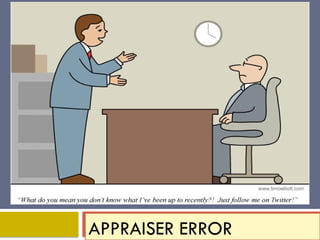
 Appraiser Error
 Judgmental Errors
 Rater Training Program
 Poor Appraisal Forms
 Ineffective Organizational Policies and Practices
INTRODUCTION
Other Terms
Performance appraisal has been synonymous with
 performance review,
 performance evaluation,
 performance assessment,
 performance measurement,
 employee evaluation,
 personnel review,
 staff assessment, and
 service rating
(Aggarwal & Thakur, 2013)
Definition of Performance Appraisal
The observation and assessment of the employee performance against
job-related standards determined by the organization over a certain
period (Eichel and Bender, 1984).
The process of evaluating on employee’s job performance that helpful to,
and often even essential to, accomplishing important goals of all
organization (Kondrasuk, 2012)
Definition of Performance Appraisal
Performance appraisal
provides an annual review and
evaluation of an individual's
job performance (Eastern
Illinois University, 2009)
Performance appraisal is the
process of determining how well
employees do their jobs compared
with a set of standards and
communicating that information to
those employees (Chukwuba, 2011)
Performance appraisal is the
evaluation of employee’s
performance based on the
standard and give feedback
about the assessment .
Purpose of Performance Appraisal
Walsh and Fisher (2005); Faseeh (2013):
(1) To provide feedback about strengths and weaknesses;
(2)To distinguish between individuals to allocate rewards;
(3)To evaluate and maintain the human resource systems of the organization;
and
(4)To create a paper trail of documentation (Murphy
& Cleveland, 1995)
Chattopadhayay and Ghosh (2012),
•It provides a justification for human resource decision such as rewards, career
planning, transfers, training, counseling, mentoring , termination, etc.
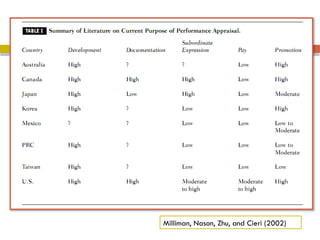
Milliman, Nason, Zhu, and Cieri (2002)
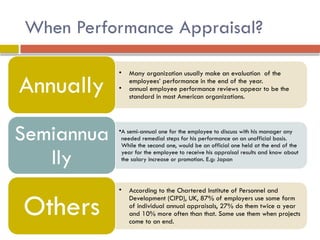
When Performance Appraisal?
• Many organization usually make an evaluation of the
employees’ performance in the end of the year.
• annual employee performance reviews appear to be the
standard in most American organizations.
Annually
•A semi-annual one for the employee to discuss with his manager any
needed remedial steps for his performance on an unofficial basis.
While the second one, would be an official one held at the end of the
year for the employee to receive his appraisal results and know about
the salary increase or promotion. E.g: Japan
Semiannua
lly
• According to the Chartered Institute of Personnel and
Development (CIPD), UK, 87% of employers use some form
of individual annual appraisals, 27% do them twice a year
and 10% more often than that. Some use them when projects
come to an end.
Others
Six Formal Meetings
System
Inauguration
Self-
appraisal
Classical
performance
review
Merit/salary
review
Developme
nt plan
(Aguinis, 2009)
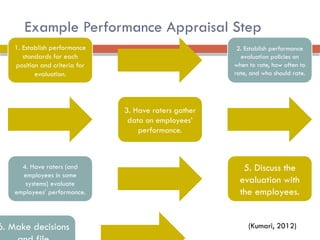
Example Performance Appraisal Step
1. Establish performance
standards for each
position and criteria for
evaluation.
2. Establish performance
evaluation policies on
when to rate, how often to
rate, and who should rate.
3. Have raters gather
data on employees’
performance.
4. Have raters (and
employees in some
systems) evaluate
employees’ performance.
5. Discuss the
evaluation with
the employees.
6. Make decisions (Kumari, 2012)
Example Performance Appraisal Step
Step l: The Initial
(Performance)
Planning Session
• Meeting
individually
to described
expectation
Step II: The Mid-
Point Review
• provide
feedback to
the
employee
during the
primary
performance
period
(West Virginia Division of Personnel
Handbook, 2005)
PERFORMANCE INTERVIEW
AND FEEDBACK
Definition of Performance Interview
a
n
d
a
n
e
m
p
l
o
y
e
e
t
h
a
t
f
o
c
u
s
o
l
p
r
o
c
e
s
s
o
f
e
v
a
l
u
a
t
i
n
g
e
m
p
s
y
s
t
e
m
t
h
a
t
f
u
n
c
t
i
o
n
i
n
s
e
t
h
e
v
a
r
i
o
u
s
a
s
p
e
c
t
o
f
p
e
r
f
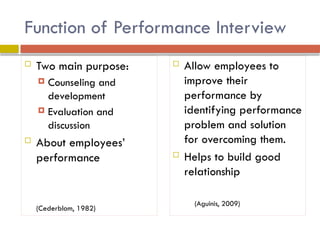
Function of Performance Interview
 Two main purpose:
 Counseling and
development
 Evaluation and
discussion
 About employees’
performance
(Cederblom, 1982)
 Allow employees to
improve their
performance by
identifying performance
problem and solution
for overcoming them.
 Helps to build good
relationship
(Aguinis, 2009)
Importance of Performance Interview
Feedbacks in
Pepsi- Cola
International
Instant
feedback
(Asmuß,
2008)
Coaching
(Cederblom,
1982)
Accountability
based
performance
appraisals
Development
feedback
(Cederblom,
1982)
Human
resource
plan
Explanation of Feedback
Staff members should not receive any surprise feedback
because informal, continuous discussion and feedback
between staff and manager throughout the year
prevents surprises (Boice & Kleiner, 1997).
PERFORMANCE APPRAISAL
METHODS
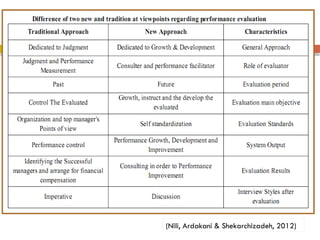
Traditional vs New Approach
Traditional Approach
 This method is based on studying
the personal qualities of the
employees. It may include
knowledge, initiative, loyalty,
leadership and judgment
(Aggarwal & Thakur, 2013).
New Approach
 Performance appraisal is
used for developmental
and motivational purposes
in the organizations
(Gürbüz & Dikmenli, 2007).
Traditional Approach New Approach
(Nili, Ardakani & Shekarchizadeh, 2012)
Methods and Form
SHRM Curriculum Guidebook (2010)
Critical Incident Method
 Keeping a record of uncommonly good or
undesirable examples of an employee's work
related behavior and reviewing it with the
employee at predetermined times.
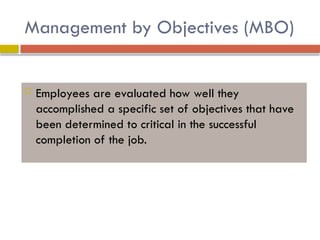
Management by Objectives (MBO)
 Employees are evaluated how well they
accomplished a specific set of objectives that have
been determined to critical in the successful
completion of the job.
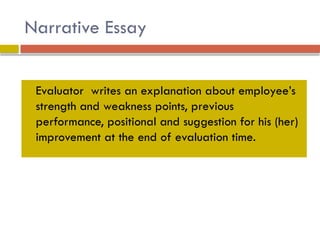
Narrative Essay
 Evaluator writes an explanation about employee’s
strength and weakness points, previous
performance, positional and suggestion for his (her)
improvement at the end of evaluation time.
Rating Scale
Behaviorally
Anchored Rating
Scale (BARS)
•BARS combines elements from critical incident and
graphic rating scale approaches. The supervisor rates
employees’ according to items on a numerical scale.
Graphic
Rating Scale
•A scale that lists a number of traits and a range of
performance for each, the employee is then rated
by identifying the score that best describes his or
her performance for each trait.
Comparative Methods
 Comparative methods
of performance
appraisal seek to
identify one worker’s
standing to others.
 Ranking, paired
comparison, and
forced distribution
Comparative Methods
Ranking Method
Ranking
- employees from best to
worst on a particular trait,
choosing highest, then
lowest, until all ranked
(Aggarwal & Thakur, 2013)
Paired Comparison
- Each person is directly
compared with every other
person being rated.
Forced Distribution
- This method forces a set
percentage of all person
being evaluated into pre-
determined performance
categories.
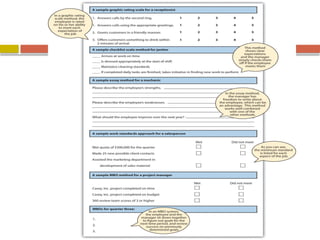
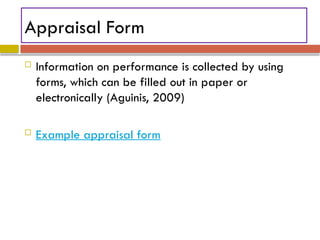
Appraisal Form
 Information on performance is collected by using
forms, which can be filled out in paper or
electronically (Aguinis, 2009)
 Example appraisal form
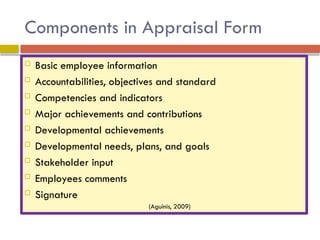
Components in Appraisal Form
 Basic employee information
 Accountabilities, objectives and standard
 Competencies and indicators
 Major achievements and contributions
 Developmental achievements
 Developmental needs, plans, and goals
 Stakeholder input
 Employees comments
 Signature
(Aguinis, 2009)
360 Degree
 is known by a variety of names, including
multisource assessment, 360-degree feedback,
multirater assessment, and three-dimensional or full-
circle appraisal.
 It relies on the input of an employee's superior,
colleagues, subordinates, sometimes customers,
suppliers and/or spouses.
 The information collected and feedback is provided
in full circular fashion top down and back to top.
TYPE OF APPRAISER
•Supervisor:
•Best position to evaluate performance in
relation to strategic organization goals
Supervis
ors
•Peer:
•Must know the level of performance of the employee
being evaluated.
•May be useful when the task of the work unit require
frequent working contact among peers
Peers
•For developmental aspects of performance evaluation
•Subordinates are a valuable source of information regarding
particular aspects of a supervisor or leader’s performance
such as communication, team building or delegation.
•For example Exxon and universities
Subordin
ates
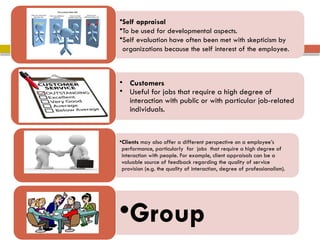
•Self appraisal
•To be used for developmental aspects.
•Self evaluation have often been met with skepticism by
organizations because the self interest of the employee.
Self
• Customers
• Useful for jobs that require a high degree of
interaction with public or with particular job-related
individuals.
Customers
•Clients may also offer a different perspective on a employee’s
performance, particularly for jobs that require a high degree of
interaction with people. For example, client appraisals can be a
valuable source of feedback regarding the quality of service
provision (e.g. the quality of interaction, degree of professionalism).
•Group
APPRAISER ERROR
Appraiser Error
 Appraisal error affect the objectivity of the
appraisal negatively (Boachie-Mensah & Seidu,
2012).
 The problems that affect the validity and
dependability of the Performance appraisal
systems (Kumari, 2012)
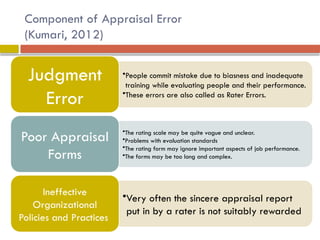
Component of Appraisal Error
(Kumari, 2012)
•People commit mistake due to biasness and inadequate
training while evaluating people and their performance.
•These errors are also called as Rater Errors.
Judgment
Error
•The rating scale may be quite vague and unclear.
•Problems with evaluation standards
•The rating form may ignore important aspects of job performance.
•The forms may be too long and complex.
Poor Appraisal
Forms
•Very often the sincere appraisal report
put in by a rater is not suitably rewarded
Ineffective
Organizational
Policies and Practices
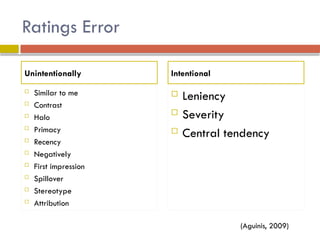
Ratings Error
 Similar to me
 Contrast
 Halo
 Primacy
 Recency
 Negatively
 First impression
 Spillover
 Stereotype
 Attribution
 Leniency
 Severity
 Central tendency
Unintentionally Intentional
(Aguinis, 2009)
Rater Training Programs
 The overall objective of providing raters with tools that
will allow them to implement the performance
management system effectively and effectively (Aguinis,
2009).
 To improve managers’ ability to conduct effective
performance appraisals with dealing errors to eliminate
it from ratings (Inancevich & Konopaske, 2013).
 The example of training such as Rater Error Training,
Frame of Reference Training (FOR), Behavioral
Observation Training, and Self-Leadership Training.
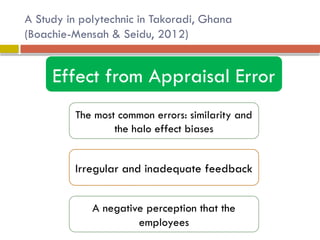
A Study in polytechnic in Takoradi, Ghana
(Boachie-Mensah & Seidu, 2012)
Effect from Appraisal Error
The most common errors: similarity and
the halo effect biases
Irregular and inadequate feedback
A negative perception that the
employees
Support from Previous Study
 In a study of Telecom Industry in Navi Mumbai Region
 the most common appraisal errors in the system are
the similarity (similar-to-me) effect and the halo
effect.
Deming (1982/2000)
Deming was a recognized guru in the quality
movement and famous for his critique of
performance ratings, identifying them as
one of management’s deadly diseases in
the
PA:
 It nourishes short-term performance,
annihilates long-term planning, builds fear,
demolishes team-work, nourishes rivalry
and politics. It leaves people bitter,
crushed, bruised, battered, desolate,
despondent, dejected, feeling inferior,
some even depressed, unfit for work for
weeks after receipt of rating, unable to
comprehend why they are inferior. (p. 102)
Conclusion
 Organizations can benefit a lot from performance
appraisal by seeing it as crucial part of
management responsibility.
 Employee will be motivated and inspired with
positive and constructive feedback from
performance appraisal.
 Effective performance appraisal should eliminate
appraisal error.
THANK YOU..

appraisalyan - 131119080101-phpapp02.pptx

  • 1.
    HRM 751 PERFORMANCE ANDCOMPENSATION MANAGEMENT (PERFORMANCE APPRAISAL) Nur Izyan binti Supandi 2012293352 BM7703CF
  • 2.
    Outline  Introduction ofPerformance Appraisal  Definition and Purpose  When?  Performance appraisal steps/process  Performance Interview and Feedback  Definition  Importance Performance Interview  Performance Appraisal Methods  Appraisal Form  Traditional Methods vs Modern Methods  Type of appraisal Methods  Type of Appraiser  Supervisors, Peers, Subordinates, Self, Customers, Clients and Group  Appraiser Error  Judgmental Errors  Rater Training Program  Poor Appraisal Forms  Ineffective Organizational Policies and Practices
  • 3.
  • 5.
    Other Terms Performance appraisalhas been synonymous with  performance review,  performance evaluation,  performance assessment,  performance measurement,  employee evaluation,  personnel review,  staff assessment, and  service rating (Aggarwal & Thakur, 2013)
  • 6.
    Definition of PerformanceAppraisal The observation and assessment of the employee performance against job-related standards determined by the organization over a certain period (Eichel and Bender, 1984). The process of evaluating on employee’s job performance that helpful to, and often even essential to, accomplishing important goals of all organization (Kondrasuk, 2012)
  • 7.
    Definition of PerformanceAppraisal Performance appraisal provides an annual review and evaluation of an individual's job performance (Eastern Illinois University, 2009) Performance appraisal is the process of determining how well employees do their jobs compared with a set of standards and communicating that information to those employees (Chukwuba, 2011) Performance appraisal is the evaluation of employee’s performance based on the standard and give feedback about the assessment .
  • 8.
    Purpose of PerformanceAppraisal Walsh and Fisher (2005); Faseeh (2013): (1) To provide feedback about strengths and weaknesses; (2)To distinguish between individuals to allocate rewards; (3)To evaluate and maintain the human resource systems of the organization; and (4)To create a paper trail of documentation (Murphy & Cleveland, 1995) Chattopadhayay and Ghosh (2012), •It provides a justification for human resource decision such as rewards, career planning, transfers, training, counseling, mentoring , termination, etc.
  • 9.
    Milliman, Nason, Zhu,and Cieri (2002)
  • 10.
    When Performance Appraisal? •Many organization usually make an evaluation of the employees’ performance in the end of the year. • annual employee performance reviews appear to be the standard in most American organizations. Annually •A semi-annual one for the employee to discuss with his manager any needed remedial steps for his performance on an unofficial basis. While the second one, would be an official one held at the end of the year for the employee to receive his appraisal results and know about the salary increase or promotion. E.g: Japan Semiannua lly • According to the Chartered Institute of Personnel and Development (CIPD), UK, 87% of employers use some form of individual annual appraisals, 27% do them twice a year and 10% more often than that. Some use them when projects come to an end. Others
  • 11.
  • 12.
    Example Performance AppraisalStep 1. Establish performance standards for each position and criteria for evaluation. 2. Establish performance evaluation policies on when to rate, how often to rate, and who should rate. 3. Have raters gather data on employees’ performance. 4. Have raters (and employees in some systems) evaluate employees’ performance. 5. Discuss the evaluation with the employees. 6. Make decisions (Kumari, 2012)
  • 13.
    Example Performance AppraisalStep Step l: The Initial (Performance) Planning Session • Meeting individually to described expectation Step II: The Mid- Point Review • provide feedback to the employee during the primary performance period (West Virginia Division of Personnel Handbook, 2005)
  • 14.
  • 15.
    Definition of PerformanceInterview a n d a n e m p l o y e e t h a t f o c u s o l p r o c e s s o f e v a l u a t i n g e m p s y s t e m t h a t f u n c t i o n i n s e t h e v a r i o u s a s p e c t o f p e r f
  • 16.
    Function of PerformanceInterview  Two main purpose:  Counseling and development  Evaluation and discussion  About employees’ performance (Cederblom, 1982)  Allow employees to improve their performance by identifying performance problem and solution for overcoming them.  Helps to build good relationship (Aguinis, 2009)
  • 17.
    Importance of PerformanceInterview Feedbacks in Pepsi- Cola International Instant feedback (Asmuß, 2008) Coaching (Cederblom, 1982) Accountability based performance appraisals Development feedback (Cederblom, 1982) Human resource plan
  • 18.
    Explanation of Feedback Staffmembers should not receive any surprise feedback because informal, continuous discussion and feedback between staff and manager throughout the year prevents surprises (Boice & Kleiner, 1997).
  • 19.
  • 20.
    Traditional vs NewApproach Traditional Approach  This method is based on studying the personal qualities of the employees. It may include knowledge, initiative, loyalty, leadership and judgment (Aggarwal & Thakur, 2013). New Approach  Performance appraisal is used for developmental and motivational purposes in the organizations (Gürbüz & Dikmenli, 2007). Traditional Approach New Approach
  • 21.
    (Nili, Ardakani &Shekarchizadeh, 2012)
  • 22.
    Methods and Form SHRMCurriculum Guidebook (2010)
  • 23.
    Critical Incident Method Keeping a record of uncommonly good or undesirable examples of an employee's work related behavior and reviewing it with the employee at predetermined times.
  • 24.
    Management by Objectives(MBO)  Employees are evaluated how well they accomplished a specific set of objectives that have been determined to critical in the successful completion of the job.
  • 25.
    Narrative Essay  Evaluatorwrites an explanation about employee’s strength and weakness points, previous performance, positional and suggestion for his (her) improvement at the end of evaluation time.
  • 26.
    Rating Scale Behaviorally Anchored Rating Scale(BARS) •BARS combines elements from critical incident and graphic rating scale approaches. The supervisor rates employees’ according to items on a numerical scale. Graphic Rating Scale •A scale that lists a number of traits and a range of performance for each, the employee is then rated by identifying the score that best describes his or her performance for each trait.
  • 28.
    Comparative Methods  Comparativemethods of performance appraisal seek to identify one worker’s standing to others.  Ranking, paired comparison, and forced distribution
  • 29.
    Comparative Methods Ranking Method Ranking -employees from best to worst on a particular trait, choosing highest, then lowest, until all ranked (Aggarwal & Thakur, 2013) Paired Comparison - Each person is directly compared with every other person being rated. Forced Distribution - This method forces a set percentage of all person being evaluated into pre- determined performance categories.
  • 30.
    Appraisal Form  Informationon performance is collected by using forms, which can be filled out in paper or electronically (Aguinis, 2009)  Example appraisal form
  • 31.
    Components in AppraisalForm  Basic employee information  Accountabilities, objectives and standard  Competencies and indicators  Major achievements and contributions  Developmental achievements  Developmental needs, plans, and goals  Stakeholder input  Employees comments  Signature (Aguinis, 2009)
  • 32.
    360 Degree  isknown by a variety of names, including multisource assessment, 360-degree feedback, multirater assessment, and three-dimensional or full- circle appraisal.  It relies on the input of an employee's superior, colleagues, subordinates, sometimes customers, suppliers and/or spouses.  The information collected and feedback is provided in full circular fashion top down and back to top.
  • 33.
  • 34.
    •Supervisor: •Best position toevaluate performance in relation to strategic organization goals Supervis ors •Peer: •Must know the level of performance of the employee being evaluated. •May be useful when the task of the work unit require frequent working contact among peers Peers •For developmental aspects of performance evaluation •Subordinates are a valuable source of information regarding particular aspects of a supervisor or leader’s performance such as communication, team building or delegation. •For example Exxon and universities Subordin ates
  • 35.
    •Self appraisal •To beused for developmental aspects. •Self evaluation have often been met with skepticism by organizations because the self interest of the employee. Self • Customers • Useful for jobs that require a high degree of interaction with public or with particular job-related individuals. Customers •Clients may also offer a different perspective on a employee’s performance, particularly for jobs that require a high degree of interaction with people. For example, client appraisals can be a valuable source of feedback regarding the quality of service provision (e.g. the quality of interaction, degree of professionalism). •Group
  • 36.
  • 37.
    Appraiser Error  Appraisalerror affect the objectivity of the appraisal negatively (Boachie-Mensah & Seidu, 2012).  The problems that affect the validity and dependability of the Performance appraisal systems (Kumari, 2012)
  • 38.
    Component of AppraisalError (Kumari, 2012) •People commit mistake due to biasness and inadequate training while evaluating people and their performance. •These errors are also called as Rater Errors. Judgment Error •The rating scale may be quite vague and unclear. •Problems with evaluation standards •The rating form may ignore important aspects of job performance. •The forms may be too long and complex. Poor Appraisal Forms •Very often the sincere appraisal report put in by a rater is not suitably rewarded Ineffective Organizational Policies and Practices
  • 39.
    Ratings Error  Similarto me  Contrast  Halo  Primacy  Recency  Negatively  First impression  Spillover  Stereotype  Attribution  Leniency  Severity  Central tendency Unintentionally Intentional (Aguinis, 2009)
  • 40.
    Rater Training Programs The overall objective of providing raters with tools that will allow them to implement the performance management system effectively and effectively (Aguinis, 2009).  To improve managers’ ability to conduct effective performance appraisals with dealing errors to eliminate it from ratings (Inancevich & Konopaske, 2013).  The example of training such as Rater Error Training, Frame of Reference Training (FOR), Behavioral Observation Training, and Self-Leadership Training.
  • 41.
    A Study inpolytechnic in Takoradi, Ghana (Boachie-Mensah & Seidu, 2012) Effect from Appraisal Error The most common errors: similarity and the halo effect biases Irregular and inadequate feedback A negative perception that the employees
  • 42.
    Support from PreviousStudy  In a study of Telecom Industry in Navi Mumbai Region  the most common appraisal errors in the system are the similarity (similar-to-me) effect and the halo effect.
  • 43.
    Deming (1982/2000) Deming wasa recognized guru in the quality movement and famous for his critique of performance ratings, identifying them as one of management’s deadly diseases in the PA:  It nourishes short-term performance, annihilates long-term planning, builds fear, demolishes team-work, nourishes rivalry and politics. It leaves people bitter, crushed, bruised, battered, desolate, despondent, dejected, feeling inferior, some even depressed, unfit for work for weeks after receipt of rating, unable to comprehend why they are inferior. (p. 102)
  • 44.
    Conclusion  Organizations canbenefit a lot from performance appraisal by seeing it as crucial part of management responsibility.  Employee will be motivated and inspired with positive and constructive feedback from performance appraisal.  Effective performance appraisal should eliminate appraisal error.
  • 45.