PERFORMANCE APPRAISAL It is systematic evaluation of the performance of each employee by his superior or some other person trained in the techniques of merit rating by using the same. Is concerned with determining the differences among the employees working in the organisation.
PERFORMANCE APPRAISAL Performance appraisal , also known as  Employee appraisal , is a method by which the  job performance  of an  employee  is evaluated (generally in terms of  quality ,  quantity ,  cost  and  time ).
PA can also be named as: Merit rating Behavioural assessment Employee evaluation Personnel review Employee appraisal Employee assessment
PERFORMANCE APPRAISAL  Performance appraisals of Employees  are necessary to understand each employee’s abilities, competencies and relative merit and worth for the organization. Performance appraisal  takes into account the past performance of the employees and focuses on the improvement of the future performance of the employees.
The aims of a performance appraisal are to: Give feedback on performance to employees.  Identify employee  training  needs.  Form a basis for personnel decisions:  salary  increases,  promotions ,  disciplinary actions , etc.  Provide the opportunity for organizational development.  Facilitate communication between employee and administration  Validate selection techniques and human resource policies to meet federal  Equal Employment Opportunity  requirements
Objectives of PA (Administrative) Salary increase Promotion Training and Development Feedback Pressure on employees
Objectives of PA (Self -    Improvement) People come to know about “How am I doing?” “Where do I stand” Develop the individual skills.
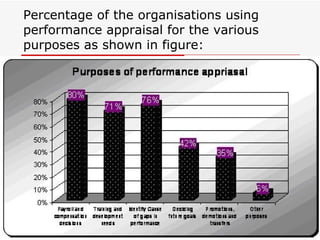
Percentage of the organisations using performance appraisal for the various purposes as shown in figure:
The latest  Mantra  followed by organizations  "get paid according to what you contribute“ Performance appraisal helps to rate the performance of the employees and evaluate their contribution towards the organizational goals.
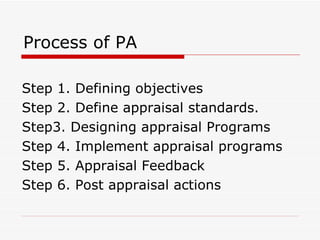
Process of PA Step 1. Defining objectives Step 2. Define appraisal standards. Step3. Designing appraisal Programs Step 4. Implement appraisal programs Step 5. Appraisal Feedback Step 6. Post appraisal actions
Step 1. Defining objectives Decide about the purpose for appraising performance whether it is:- Reward providing Appraisal for training Appraisal for promotions Appraisal for upgradation etc…
Step 2. Define appraisal standards Seeking the answer of the following question:- “What is to be expected from the employee?” “What would be the targets need to be achieved from the employee within given time?”
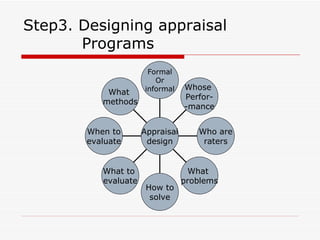
Step3. Designing appraisal    Programs What  methods When to evaluate What to  evaluate How to solve What  problems Who are raters Whose  Perfor- -mance Formal Or informal Appraisal design
Designing the program will reveal the answers of the following questions:- Formal or informal? Types of personnel? Who are the raters? What problems encountered? How to solve the problems? What is to be evaluated? When to evaluate? What methods to be used?
Who can be raters? Immediate supervisor Subordinates Clients Rating committees Self appraisal
Problems of rating that occur in appraisal are: Leniency or severity-  Subjective  assessment Central tendency-  rated near the average or middle of the scale.the attitude of the rater is to play safe. Halo effect-  one aspect of performance affects the entire per. Rater effect-  based on rater’s attitude towards ratee.
Problems of rating that occur in appraisal are: Primacy or recency effects-  influenced by behaviour exhibited by the ratee during early stages of the review period (primacy) or near the end of the review period (recency) Perceptual set-  assessment is influenced by past held beliefs.   Spillover effect-  allowing past performance appraisal ratings to unjustifiably influence current ratings. Status effect -  overrating(high level)  / underrating(low level)
How to solve problems? Provide training to the raters Remedial of the outside factors such as union pressure Typical training programme
What should be rated? Quality Quantity Timeliness Cost effectiveness Need for supervision Interpersonal impact Community service
How often should an employee be assessed ? General trend is to evaluate in Once in three months Once in six months Once in a year  ( 70% of the  organisation)
What methods to be implemented? Traditional or past oriented methods  rating scales  checklists   field review  etc. Modern or future oriented methods   MBO   360 appraisal system  etc.
Step 4. Implement appraisal    programs After deciding the appraisal design, the appraisers conduct the appraisal and they may even conduct the  Interview  if provided in the system.
Step 5. Appraisal Feedback “Most people want feedback as it reflects the their self perception.” But managers put up a question.. “Is it ethical for them to share their honest perceptions of employee performance, at the risk hurting them?”
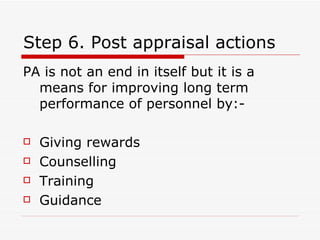
Step 6. Post appraisal actions PA is not an end in itself but it is a means for improving long term performance of personnel by:- Giving rewards Counselling Training Guidance
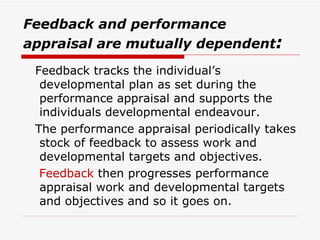
Feedback and performance appraisal are mutually dependent :   Feedback tracks the individual’s developmental plan as set during the performance appraisal and supports the individuals developmental endeavour.  The performance appraisal periodically takes stock of feedback to assess work and developmental targets and objectives.  Feedback   then progresses performance appraisal work and developmental targets and objectives and so it goes on.
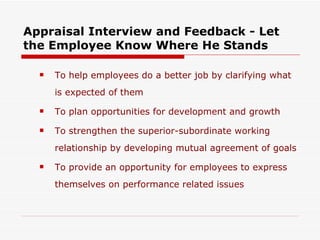
Appraisal Interview and Feedback - Let the Employee Know Where He Stands To help employees do a better job by clarifying what is expected of them To plan opportunities for development and growth To strengthen the superior-subordinate working relationship by developing mutual agreement of goals To provide an opportunity for employees to express themselves on performance related issues

Ppt on pa

  • 1.
    PERFORMANCE APPRAISAL Itis systematic evaluation of the performance of each employee by his superior or some other person trained in the techniques of merit rating by using the same. Is concerned with determining the differences among the employees working in the organisation.
  • 2.
    PERFORMANCE APPRAISAL Performanceappraisal , also known as Employee appraisal , is a method by which the job performance of an employee is evaluated (generally in terms of quality , quantity , cost and time ).
  • 3.
    PA can alsobe named as: Merit rating Behavioural assessment Employee evaluation Personnel review Employee appraisal Employee assessment
  • 4.
    PERFORMANCE APPRAISAL Performance appraisals of Employees are necessary to understand each employee’s abilities, competencies and relative merit and worth for the organization. Performance appraisal takes into account the past performance of the employees and focuses on the improvement of the future performance of the employees.
  • 5.
    The aims ofa performance appraisal are to: Give feedback on performance to employees. Identify employee training needs. Form a basis for personnel decisions: salary increases, promotions , disciplinary actions , etc. Provide the opportunity for organizational development. Facilitate communication between employee and administration Validate selection techniques and human resource policies to meet federal Equal Employment Opportunity requirements
  • 6.
    Objectives of PA(Administrative) Salary increase Promotion Training and Development Feedback Pressure on employees
  • 7.
    Objectives of PA(Self - Improvement) People come to know about “How am I doing?” “Where do I stand” Develop the individual skills.
  • 8.
    Percentage of theorganisations using performance appraisal for the various purposes as shown in figure:
  • 9.
    The latest Mantra followed by organizations "get paid according to what you contribute“ Performance appraisal helps to rate the performance of the employees and evaluate their contribution towards the organizational goals.
  • 10.
    Process of PAStep 1. Defining objectives Step 2. Define appraisal standards. Step3. Designing appraisal Programs Step 4. Implement appraisal programs Step 5. Appraisal Feedback Step 6. Post appraisal actions
  • 11.
    Step 1. Definingobjectives Decide about the purpose for appraising performance whether it is:- Reward providing Appraisal for training Appraisal for promotions Appraisal for upgradation etc…
  • 12.
    Step 2. Defineappraisal standards Seeking the answer of the following question:- “What is to be expected from the employee?” “What would be the targets need to be achieved from the employee within given time?”
  • 13.
    Step3. Designing appraisal Programs What methods When to evaluate What to evaluate How to solve What problems Who are raters Whose Perfor- -mance Formal Or informal Appraisal design
  • 14.
    Designing the programwill reveal the answers of the following questions:- Formal or informal? Types of personnel? Who are the raters? What problems encountered? How to solve the problems? What is to be evaluated? When to evaluate? What methods to be used?
  • 15.
    Who can beraters? Immediate supervisor Subordinates Clients Rating committees Self appraisal
  • 16.
    Problems of ratingthat occur in appraisal are: Leniency or severity- Subjective assessment Central tendency- rated near the average or middle of the scale.the attitude of the rater is to play safe. Halo effect- one aspect of performance affects the entire per. Rater effect- based on rater’s attitude towards ratee.
  • 17.
    Problems of ratingthat occur in appraisal are: Primacy or recency effects- influenced by behaviour exhibited by the ratee during early stages of the review period (primacy) or near the end of the review period (recency) Perceptual set- assessment is influenced by past held beliefs. Spillover effect- allowing past performance appraisal ratings to unjustifiably influence current ratings. Status effect - overrating(high level) / underrating(low level)
  • 18.
    How to solveproblems? Provide training to the raters Remedial of the outside factors such as union pressure Typical training programme
  • 19.
    What should berated? Quality Quantity Timeliness Cost effectiveness Need for supervision Interpersonal impact Community service
  • 20.
    How often shouldan employee be assessed ? General trend is to evaluate in Once in three months Once in six months Once in a year ( 70% of the organisation)
  • 21.
    What methods tobe implemented? Traditional or past oriented methods  rating scales  checklists  field review etc. Modern or future oriented methods  MBO  360 appraisal system etc.
  • 22.
    Step 4. Implementappraisal programs After deciding the appraisal design, the appraisers conduct the appraisal and they may even conduct the Interview if provided in the system.
  • 23.
    Step 5. AppraisalFeedback “Most people want feedback as it reflects the their self perception.” But managers put up a question.. “Is it ethical for them to share their honest perceptions of employee performance, at the risk hurting them?”
  • 24.
    Step 6. Postappraisal actions PA is not an end in itself but it is a means for improving long term performance of personnel by:- Giving rewards Counselling Training Guidance
  • 25.
    Feedback and performanceappraisal are mutually dependent : Feedback tracks the individual’s developmental plan as set during the performance appraisal and supports the individuals developmental endeavour. The performance appraisal periodically takes stock of feedback to assess work and developmental targets and objectives. Feedback then progresses performance appraisal work and developmental targets and objectives and so it goes on.
  • 26.
    Appraisal Interview andFeedback - Let the Employee Know Where He Stands To help employees do a better job by clarifying what is expected of them To plan opportunities for development and growth To strengthen the superior-subordinate working relationship by developing mutual agreement of goals To provide an opportunity for employees to express themselves on performance related issues