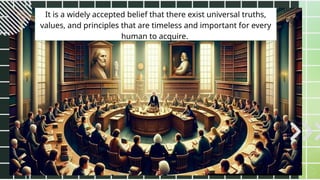
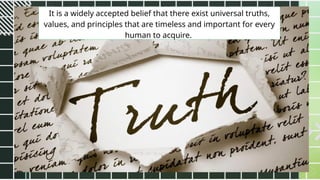
It is awidely accepted belief that there exist universal truths,
values, and principles that are timeless and important for every
human to acquire.
6.
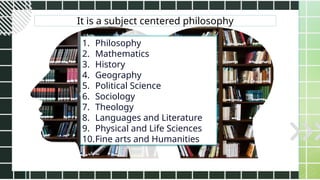
It is asubject centered philosophy
1. Philosophy
2. Mathematics
3. History
4. Geography
5. Political Science
6. Sociology
7. Theology
8. Languages and Literature
9. Physical and Life Sciences
10.Fine arts and Humanities
7.
It is awidely accepted belief that there exist universal truths,
values, and principles that are timeless and important for every
human to acquire.
8.
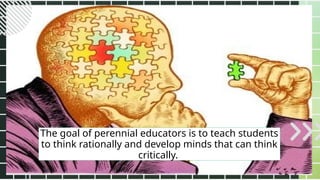
The goal ofperennial educators is to teach students
to think rationally and develop minds that can think
critically.
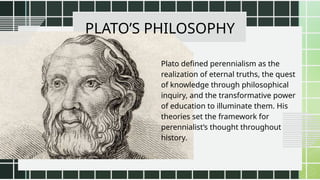
PLATO’S PHILOSOPHY
Plato definedperennialism as the
realization of eternal truths, the quest
of knowledge through philosophical
inquiry, and the transformative power
of education to illuminate them. His
theories set the framework for
perennialist’s thought throughout
history.
11.
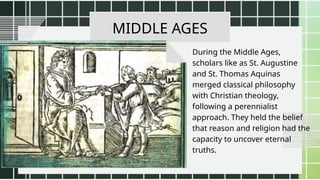
MIDDLE AGES
During theMiddle Ages,
scholars like as St. Augustine
and St. Thomas Aquinas
merged classical philosophy
with Christian theology,
following a perennialist
approach. They held the belief
that reason and religion had the
capacity to uncover eternal
truths.
14.
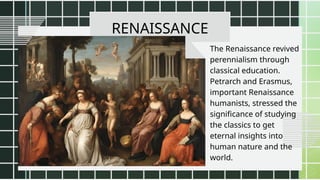
RENAISSANCE
The Renaissance revived
perennialismthrough
classical education.
Petrarch and Erasmus,
important Renaissance
humanists, stressed the
significance of studying
the classics to get
eternal insights into
human nature and the
world.
15.
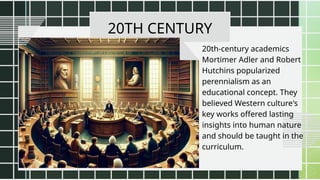
20TH CENTURY
20th-century academics
MortimerAdler and Robert
Hutchins popularized
perennialism as an
educational concept. They
believed Western culture's
key works offered lasting
insights into human nature
and should be taught in the
curriculum.
16.
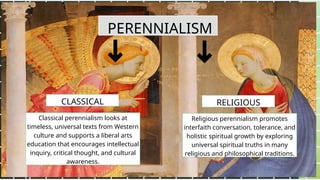
PERENNIALISM
Classical perennialism looksat
timeless, universal texts from Western
culture and supports a liberal arts
education that encourages intellectual
inquiry, critical thought, and cultural
awareness.
Religious perennialism promotes
interfaith conversation, tolerance, and
holistic spiritual growth by exploring
universal spiritual truths in many
religious and philosophical traditions.
CLASSICAL RELIGIOUS
17.
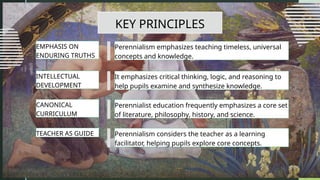
KEY PRINCIPLES
Perennialism emphasizesteaching timeless, universal
concepts and knowledge.
EMPHASIS ON
ENDURING TRUTHS
It emphasizes critical thinking, logic, and reasoning to
help pupils examine and synthesize knowledge.
INTELLECTUAL
DEVELOPMENT
Perennialist education frequently emphasizes a core set
of literature, philosophy, history, and science.
CANONICAL
CURRICULUM
Perennialism considers the teacher as a learning
facilitator, helping pupils explore core concepts.
TEACHER AS GUIDE
18.
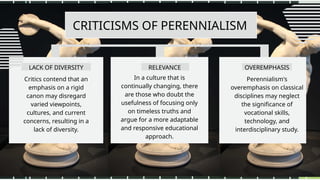
CRITICISMS OF PERENNIALISM
LACKOF DIVERSITY
Critics contend that an
emphasis on a rigid
canon may disregard
varied viewpoints,
cultures, and current
concerns, resulting in a
lack of diversity.
In a culture that is
continually changing, there
are those who doubt the
usefulness of focusing only
on timeless truths and
argue for a more adaptable
and responsive educational
approach.
Perennialism's
overemphasis on classical
disciplines may neglect
the significance of
vocational skills,
technology, and
interdisciplinary study.
RELEVANCE OVEREMPHASIS
19.
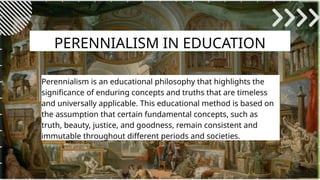
PERENNIALISM IN EDUCATION
Perennialismis an educational philosophy that highlights the
significance of enduring concepts and truths that are timeless
and universally applicable. This educational method is based on
the assumption that certain fundamental concepts, such as
truth, beauty, justice, and goodness, remain consistent and
immutable throughout different periods and societies.
20.
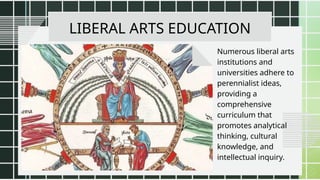
LIBERAL ARTS EDUCATION
Numerousliberal arts
institutions and
universities adhere to
perennialist ideas,
providing a
comprehensive
curriculum that
promotes analytical
thinking, cultural
knowledge, and
intellectual inquiry.
21.
GREAT BOOKS PROGRAMS
Institutionsthat offer
Great Books programs
organize their courses
around famous literary,
philosophical, and
scientific works,
according to a
perennialist approach to
education.
22.
PHILOSOPHY OF EDUCATION
Perennialism
remainsinfluential
in the philosophy of
education,
influencing
discussions and
arguments on
curriculum design,
instructional
methods, and
educational
objectives.
23.
Perennialism is aphilosophical and educational paradigm that
emphasizes the enduring and universal elements of human
knowledge and ideals. Although it has influenced educational
methods and sparked intellectual discussions, it also prompts
continuous conversations about finding the right balance
between traditional and innovative approaches, determining the
extent of educational material, and defining the objectives of
modern education.
CONCLUSION
#3 Perennialiam Values knowledge that transcends tine.
#4 Perennialiam Values knowledge that transcends tine.
#5 Sa madaling salita isa ito sa paniniwala na ang edukasyon ay dapat nakafocus sa mga bagay na kapakipakinabang sa mahabang panahon o tinatawag na perennial.
#6 Sa madaling salita isa ito sa paniniwala na ang edukasyon ay dapat nakafocus sa mga bagay na kapakipakinabang sa mahabang panahon o tinatawag na perennial.
#7 Sa madaling salita isa ito sa paniniwala na ang edukasyon ay dapat nakafocus sa mga bagay na kapakipakinabang sa mahabang panahon o tinatawag na perennial.
#8 Rational – to think with reason. Draw sensible conclusion from facts, logic and data
Critical – to analyze, interpret, evaluate and make judgement about what you read, hear or say.
#9 Perennialiam Values knowledge that transcends tine.
#12 Perennialiam Values knowledge that transcends tine.
#13 Perennialiam Values knowledge that transcends tine.
#16 Classical like mathematics, history, geography, political science, languages and literature, physical and life science , fine arts and humanities