Depth
Perception
Overview
Cue Theory
Monocular Cues
Binocular Cues
Neural Basis
Interaction of
Cues
Cue Theory
We learn to associate a cue (or retinal
or image element) with our
experience of depth in the
environment
Types of cues:
 Oculomotor
 Monocular
 Binocular
Oculomotor Cues
Convergence
 Inward movement of the eyes
 Required to keep image on fovea
 Muscular (afferent) signal cues distance
 More convergence = closer object
Accommodation
 Change in shape of the lens
 Required to keep objects at different
distances in focus
 Afferent signal
Monocular Cues
Using information provided by only one
eye (or at least not requiring two eyes)
leads to many reliable depth cues
Some are mechanical/muscular/bottom
up
Some require top-down processing
Learning plays a major role in all depth
cues
Occlusion
One object hides another, it must be
nearer
Occlusion
Occlusion
Occlusion
Relative vertical position
Location in a frame
Higher is usually
farther
Relative vertical position
Shadows
Where an object casts a shadow
can determine its distance (and
height)
Shadows
Relative size
Smaller retinal image for same size
object means the object is farther
away
Relative size
Relative size
Familiar (template) size
Knowledge of actual size differences
can affect how we interpret relative
distances
Familiar (template) size
April 5,
2020
PSYCH 4041 /
6014
Atmospheric perspective
April 5,
2020
PSYCH 4041 /
6014
Distant objects appear blurry, and also
more blue, due to Rayleigh scattering
Atmospheric perspective
April 5,
2020
PSYCH 4041 /
6014
Atmospheric perspective
April 5,
2020
PSYCH 4041 /
6014
Texture gradient
Evenly spaced items appear more
closely packed in the distance
April 5,
2020
PSYCH 4041 /
6014
Texture gradient
April 5,
2020
PSYCH 4041 /
6014
Texture gradient
April 5,
2020
PSYCH 4041 /
6014
Gradients and Texture?
April 5,
2020
PSYCH 4041 /
6014
Highlight cues
April 5,
2020
PSYCH 4041 /
6014
Areas of light (or dark) signal depth
of objects
Similar to shadows cueing
interposition
Highlight cues
April 5,
2020
PSYCH 4041 /
6014
Parallax
Changes in movement speed due to
distance
Closer objects move faster
Farther objects move slower
April 5,
2020
PSYCH 4041 /
6014
YCH 4041 /
6014
Parallax
April 5,
2020
PS
Deletion/accretion (occlusion)
Objects that appear and take the place
of objects previously in the scene must
be moving in front of the original
objects
Deletion/accretion (occlusion)
Binocular Cues
Convergence of eyes
 Both oculomotor and retinal cues come
from convergence
Binocular disparity
 Difference in the image seen in the left and
right eye
 A retinal effect
 Disparity leads to stereopsis
 Separation can be done by
• Physically separate images presented
• Different colored images
• Polarization
Stereo Vision
Binocular Disparity, cont’d
 Horopter
 From horizon + optical
 All points on this line
(surface) are same distance
as objects at fixation
 Computation of depth
from disparity
 Direction (laterally/nasally) of
disparity determines if object
is in front of or behind the
horopter
 Amount of disparity
determines distance from
the horopter
Random dot stereogram
Only disparity information is
available
 Therefore purely bottom-up
Neural Basis of Depth Perception
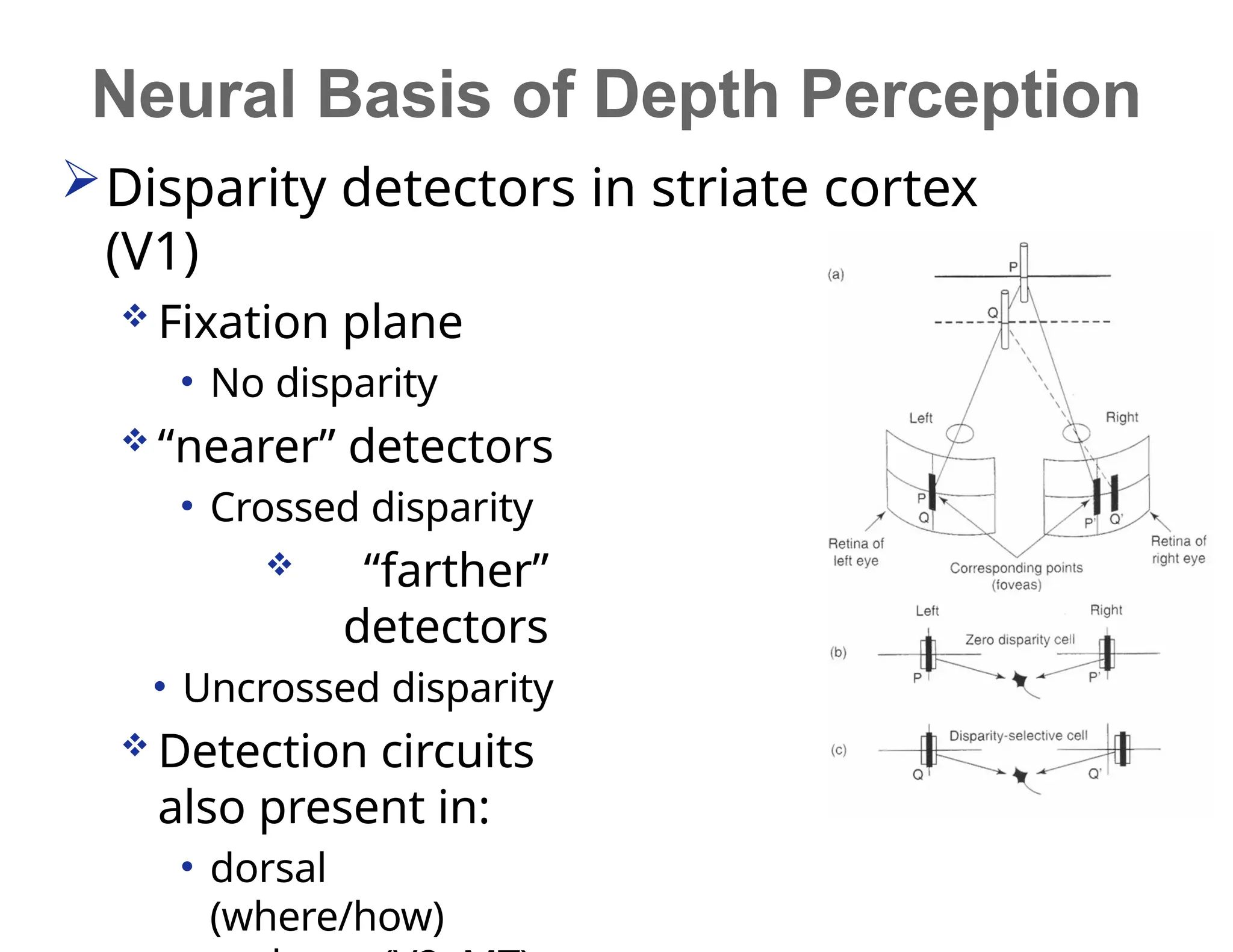
Disparity detectors in striate cortex
(V1)
 Fixation plane
• No disparity
 “nearer” detectors
• Crossed disparity
 “farther”
detectors
• Uncrossed disparity
 Detection circuits
also present in:
• dorsal
(where/how)
Neural Basis, cont’d
April 5,
2020
PSYCH 4041 /
6014
Stereoblindness
 Cannot detect/localize the depth of objects
using disparity at all
• Other monocular cues can still be used
 Partial stereoblindness: cannot detect
depth of objects that are either at, in front,
or behind horopter
• Evidence for 3 sets of disparity detectors
Development of Stereopsis
April 5,
2020
PSYCH 4041 /
6014
Binocular input required early in life
to develop stereo vision
Infants whose eyes are not focused on
same point (crossed or lazy eyes) may not
develop proper stereopsis
 Even if eye condition is later fixed (surgically)
Critical period: ~1-3 years
What does this imply about locus of
stereo vision?
Interaction of cues
April 5,
2020
PSYCH 4041 /
6014
Thoughts…
 There are lots of
cues, both
monocular and
binocular. How do
they interact?
 How does
depth
perception
develop/evolve
?
 Can one eye
work well?
Interaction of Cues, cont’d
April 5,
2020
PSYCH 4041 /
6014
Constructivist approach
 Experience enables inferences about
distances and spatial layout
 We “construct” our environment
(mentally) based on images and cues
 Somewhat computational
Gibson’s Direct Perception approach
 Spatial layout is directly picked up - not
the result of analysis or computation
 Too bottom-up?
One Cue vs. Another?
How can we determine if/when one cue
will override another?
 Recall shadow and shading on vase
April 5,
2020
PSYCH 4041 /
6014
PSYCH 4041 /
6014
Visual Cliff
April 5,
2020
Test to see which visual cues
dominate
 Parallax seemed to be only dominant
cue
 Note: Monocular cue
• What does this say?
Upcoming
April 5,
2020
PSYCH 4041 /
6014
Constancy &
illusions
Camouflage

Depth-perception-visual-on-human-eye.pptx