PEOPLE:
The grit in the machine?
Peter A. Johnson, Fairday Research Ltd.
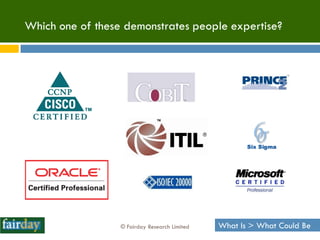
Which one of these demonstrates people expertise?


                  © Fairday Research Limited   What Is > What Could Be
Do we practice Technology, Process, People?

   This is the industry of the technology of information
    therefore technologists abound
   Process frameworks such as ITIL and COBIT are well
    established in this industry
     ITIL   > 15 years old, COBIT > 13 years old
   Why aren‟t projects universally successful?
   Are people the grit in the machine?
     Themystery variable that moderates the relationship
      between process/technology and ITSM performance?

                        © Fairday Research Limited   What Is > What Could Be
ITIL + „What else‟ = Success?
               discussion thread
       In group: ITSM (ITIL) Professionals
       Thread started on 4th September 2009
   Responses included
       “Right attitude and behaviour of staff”
       “Motivation”
       “Culture”
       “Knowledge”
       “Soft skills”
       “Change”
       “Commitment”
       “Learning”

                          © Fairday Research Limited   What Is > What Could Be
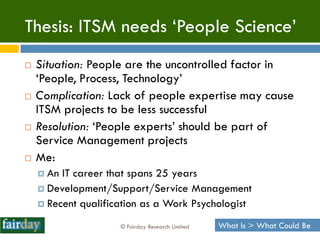
Thesis: ITSM needs „People Science‟
   Situation: People are the uncontrolled factor in
    „People, Process, Technology‟
   Complication: Lack of people expertise may cause
    ITSM projects to be less successful
   Resolution: „People experts‟ should be part of
    Service Management projects
   Me:
     An IT career that spans 25 years
     Development/Support/Service Management
     Recent qualification as a Work Psychologist

                     © Fairday Research Limited   What Is > What Could Be
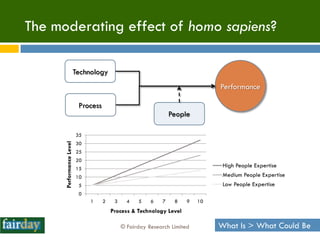
The moderating effect of homo sapiens?

                          Technology
                                                                                Performance

                           Process
                                                                 People

                          35
                          30
      Performance Level


                          25
                          20
                          15
                                                                                 High People Expertise
                          10                                                     Medium People Expertise
                           5                                                     Low People Expertise
                           0
                               1     2    3     4   5    6   7    8    9   10
                                         Process & Technology Level

                                              © Fairday Research Limited        What Is > What Could Be
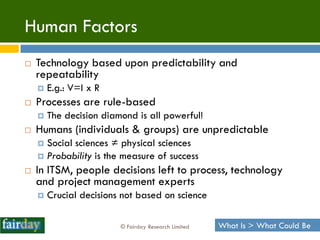
Human Factors
   Technology based upon predictability and
    repeatability
       E.g.: V=I x R
   Processes are rule-based
       The decision diamond is all powerful!
   Humans (individuals & groups) are unpredictable
     Social sciences ≠ physical sciences
     Probability is the measure of success
   In ITSM, people decisions left to process, technology
    and project management experts
       Crucial decisions not based on science

                         © Fairday Research Limited   What Is > What Could Be
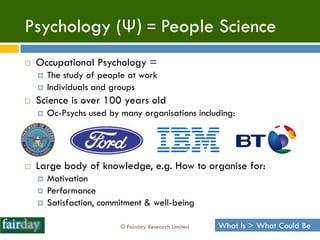
Psychology (Ψ) = People Science
   Occupational Psychology =
       The study of people at work
       Individuals and groups
   Science is over 100 years old
       Oc-Psychs used by many organisations including:


   Large body of knowledge, e.g. How to organise for:
       Motivation
       Performance
       Satisfaction, commitment & well-being

                          © Fairday Research Limited   What Is > What Could Be
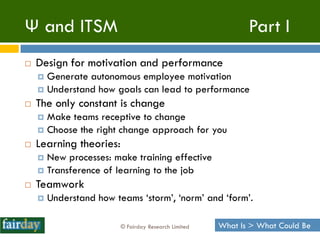
Ψ and ITSM                                                   Part I
   Design for motivation and performance
     Generate autonomous employee motivation
     Understand how goals can lead to performance
   The only constant is change
     Make teams receptive to change
     Choose the right change approach for you
   Learning theories:
     New processes: make training effective
     Transference of learning to the job
   Teamwork
       Understand how teams „storm‟, „norm‟ and „form‟.

                         © Fairday Research Limited   What Is > What Could Be
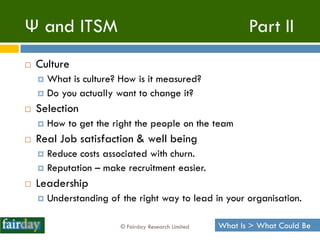
Ψ and ITSM                                                   Part II
   Culture
     What is culture? How is it measured?
     Do you actually want to change it?

   Selection
       How to get the right the people on the team
   Real Job satisfaction & well being
     Reduce costs associated with churn.
     Reputation – make recruitment easier.

   Leadership
       Understanding of the right way to lead in your organisation.

                         © Fairday Research Limited   What Is > What Could Be
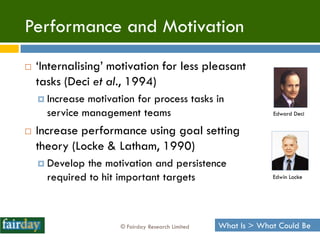
Performance and Motivation
   „Internalising‟ motivation for less pleasant
    tasks (Deci et al., 1994)
     Increase motivation for process tasks in
      service management teams                                  Edward Deci


   Increase performance using goal setting
    theory (Locke & Latham, 1990)
     Develop  the motivation and persistence
      required to hit important targets                         Edwin Locke


                      © Fairday Research Limited   What Is > What Could Be
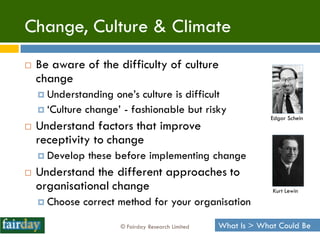
Change, Culture & Climate
   Be aware of the difficulty of culture
    change
     Understanding  one‟s culture is difficult
     „Culture change‟ - fashionable but risky
                                                                 Edgar Schein
   Understand factors that improve
    receptivity to change
     Develop   these before implementing change
   Understand the different approaches to
    organisational change                                        Kurt Lewin
     Choose   correct method for your organisation

                       © Fairday Research Limited   What Is > What Could Be
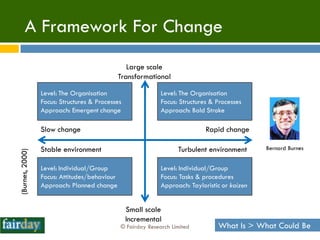
A Framework For Change
                                                 Large scale
                                              Transformational

                 Level: The Organisation                     Level: The Organisation
                 Focus: Structures & Processes               Focus: Structures & Processes
                 Approach: Emergent change                   Approach: Bold Stroke

                 Slow change                                                 Rapid change

                 Stable environment                                Turbulent environment       Bernard Burnes
(Burnes, 2000)


                 Level: Individual/Group                     Level: Individual/Group
                 Focus: Attitudes/behaviour                  Focus: Tasks & procedures
                 Approach: Planned change                    Approach: Tayloristic or kaizen


                                                 Small scale
                                                 Incremental
                                              © Fairday Research Limited         What Is > What Could Be
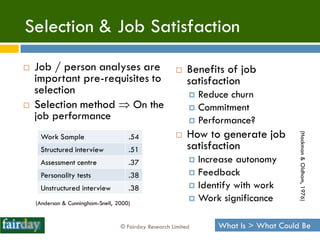
Selection & Job Satisfaction
   Job / person analyses are                              Benefits of job
    important pre-requisites to                             satisfaction
    selection                                                Reduce churn
   Selection method  On the                                Commitment
    job performance                                          Performance?
                                                            How to generate job


                                                                                      (Hackman & Oldham, 1976)
     Work Sample                      .54              
     Structured interview             .51                   satisfaction
     Assessment centre                .37                    Increase autonomy
     Personality tests                .38                    Feedback

     Unstructured interview           .38                    Identify with work
                                                             Work significance
    (Anderson & Cunningham-Snell, 2000)


                                   © Fairday Research Limited     What Is > What Could Be
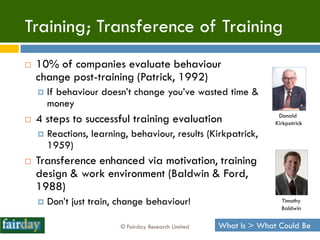
Training; Transference of Training
   10% of companies evaluate behaviour
    change post-training (Patrick, 1992)
       If behaviour doesn‟t change you‟ve wasted time &
        money
   4 steps to successful training evaluation                         Donald
                                                                     Kirkpatrick
       Reactions, learning, behaviour, results (Kirkpatrick,
        1959)
   Transference enhanced via motivation, training
    design & work environment (Baldwin & Ford,
    1988)
       Don‟t just train, change behaviour!                            Timothy
                                                                       Baldwin

                          © Fairday Research Limited   What Is > What Could Be
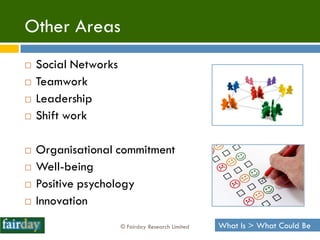
Other Areas
   Social Networks
   Teamwork
   Leadership
   Shift work

   Organisational commitment
   Well-being
   Positive psychology
   Innovation
                      © Fairday Research Limited   What Is > What Could Be
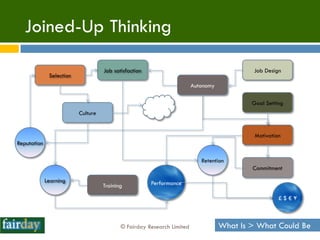
Joined-Up Thinking

                                    Job satisfaction                                       Job Design
              Selection
                                                                        Autonomy

                                                                                           Goal Setting
                          Culture


                                                                                            Motivation
Reputation

                                                                           Retention
                                                                                           Commitment

             Learning                                  Performance
                                    Training

                                                                                                     £$€¥


                                           © Fairday Research Limited              What Is > What Could Be
“ITIL + People Science = SUCCESS!”
   discussion thread
       In group: ITSM (ITIL) Professionals
       Thread started on 4th September 2009
   Responses included
       “Right attitude and behaviour of staff”        
       “Motivation”                                   
       “Culture”                                      
       “Knowledge”                                    
       “Soft skills”                                  
       “Change”                                       
       “Commitment”
                                                       
       “Learning”
                                                       
                          © Fairday Research Limited   What Is > What Could Be
People Expertise:
   British Psychological Society
     www.bps.org.uk

   American Psychological Association
     www.apa.org

   Fairday Research Limited
    What Is - What Could Be.
     www.fairday.co.uk

     hello@fairday.co.uk


                       © Fairday Research Limited   What Is > What Could Be
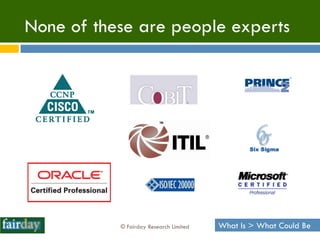
None of these are people experts


           © Fairday Research Limited   What Is > What Could Be
Q&A


                                      Thanks for listening


      © Fairday Research Limited          What Is > What Could Be
References
   Anderson, N. & Cunningham-Snell, N. (1999). Personnel Selection. In N. Chmiel (Ed.)
    Introduction To Work and Organizational Psychology. Oxford: Blackwell
   Baldwin, T. T. & Ford, J. K. (1988). Transfer of training: A review and directions for
    future research. Personnel Psychology, 41, 63-105.
   Burnes, B. (2000). Managing Change. A strategic Approach To Organisational
    Dynamics, (4th edition). Harlow: Pearson
   Deci, E. L., Eghrari, H., Patrick, B. C., and Leone, D. R. (1994). Facilitating
    internalization: the self-determination theory perspective. Journal of Personality, 62,
    119-142
   Hackman J. R., & Oldham, G. R. (1976). Motivation through design of work.
    Organizational Behavior and Human Performance, 16, 250-279.
   Kirkpatrick, D. (1959). Techniques for evaluating training programs. Journal for the
    American Society of Training and Development, 13, 3-9
   Locke, E. A., & Latham, G. P. (1990). A Theory of Goal Setting & Task Performance.
    New Jersey: Prentice Hall
   Patrick, J. (1992). Training: Research and Practice. London: Academic Press


                               © Fairday Research Limited      What Is > What Could Be

People: The Grit in the Machine?

  • 1.
    PEOPLE: The grit inthe machine? Peter A. Johnson, Fairday Research Ltd.
  • 2.
    Which one ofthese demonstrates people expertise? © Fairday Research Limited What Is > What Could Be
  • 3.
    Do we practiceTechnology, Process, People?  This is the industry of the technology of information therefore technologists abound  Process frameworks such as ITIL and COBIT are well established in this industry  ITIL > 15 years old, COBIT > 13 years old  Why aren‟t projects universally successful?  Are people the grit in the machine?  Themystery variable that moderates the relationship between process/technology and ITSM performance? © Fairday Research Limited What Is > What Could Be
  • 4.
    ITIL + „Whatelse‟ = Success?  discussion thread  In group: ITSM (ITIL) Professionals  Thread started on 4th September 2009  Responses included  “Right attitude and behaviour of staff”  “Motivation”  “Culture”  “Knowledge”  “Soft skills”  “Change”  “Commitment”  “Learning” © Fairday Research Limited What Is > What Could Be
  • 5.
    Thesis: ITSM needs„People Science‟  Situation: People are the uncontrolled factor in „People, Process, Technology‟  Complication: Lack of people expertise may cause ITSM projects to be less successful  Resolution: „People experts‟ should be part of Service Management projects  Me:  An IT career that spans 25 years  Development/Support/Service Management  Recent qualification as a Work Psychologist © Fairday Research Limited What Is > What Could Be
  • 6.
    The moderating effectof homo sapiens? Technology Performance Process People 35 30 Performance Level 25 20 15 High People Expertise 10 Medium People Expertise 5 Low People Expertise 0 1 2 3 4 5 6 7 8 9 10 Process & Technology Level © Fairday Research Limited What Is > What Could Be
  • 7.
    Human Factors  Technology based upon predictability and repeatability  E.g.: V=I x R  Processes are rule-based  The decision diamond is all powerful!  Humans (individuals & groups) are unpredictable  Social sciences ≠ physical sciences  Probability is the measure of success  In ITSM, people decisions left to process, technology and project management experts  Crucial decisions not based on science © Fairday Research Limited What Is > What Could Be
  • 8.
    Psychology (Ψ) =People Science  Occupational Psychology =  The study of people at work  Individuals and groups  Science is over 100 years old  Oc-Psychs used by many organisations including:  Large body of knowledge, e.g. How to organise for:  Motivation  Performance  Satisfaction, commitment & well-being © Fairday Research Limited What Is > What Could Be
  • 9.
    Ψ and ITSM Part I  Design for motivation and performance  Generate autonomous employee motivation  Understand how goals can lead to performance  The only constant is change  Make teams receptive to change  Choose the right change approach for you  Learning theories:  New processes: make training effective  Transference of learning to the job  Teamwork  Understand how teams „storm‟, „norm‟ and „form‟. © Fairday Research Limited What Is > What Could Be
  • 10.
    Ψ and ITSM Part II  Culture  What is culture? How is it measured?  Do you actually want to change it?  Selection  How to get the right the people on the team  Real Job satisfaction & well being  Reduce costs associated with churn.  Reputation – make recruitment easier.  Leadership  Understanding of the right way to lead in your organisation. © Fairday Research Limited What Is > What Could Be
  • 11.
    Performance and Motivation  „Internalising‟ motivation for less pleasant tasks (Deci et al., 1994)  Increase motivation for process tasks in service management teams Edward Deci  Increase performance using goal setting theory (Locke & Latham, 1990)  Develop the motivation and persistence required to hit important targets Edwin Locke © Fairday Research Limited What Is > What Could Be
  • 12.
    Change, Culture &Climate  Be aware of the difficulty of culture change  Understanding one‟s culture is difficult  „Culture change‟ - fashionable but risky Edgar Schein  Understand factors that improve receptivity to change  Develop these before implementing change  Understand the different approaches to organisational change Kurt Lewin  Choose correct method for your organisation © Fairday Research Limited What Is > What Could Be
  • 13.
    A Framework ForChange Large scale Transformational Level: The Organisation Level: The Organisation Focus: Structures & Processes Focus: Structures & Processes Approach: Emergent change Approach: Bold Stroke Slow change Rapid change Stable environment Turbulent environment Bernard Burnes (Burnes, 2000) Level: Individual/Group Level: Individual/Group Focus: Attitudes/behaviour Focus: Tasks & procedures Approach: Planned change Approach: Tayloristic or kaizen Small scale Incremental © Fairday Research Limited What Is > What Could Be
  • 14.
    Selection & JobSatisfaction  Job / person analyses are  Benefits of job important pre-requisites to satisfaction selection  Reduce churn  Selection method  On the  Commitment job performance  Performance? How to generate job (Hackman & Oldham, 1976) Work Sample .54  Structured interview .51 satisfaction Assessment centre .37  Increase autonomy Personality tests .38  Feedback Unstructured interview .38  Identify with work  Work significance (Anderson & Cunningham-Snell, 2000) © Fairday Research Limited What Is > What Could Be
  • 15.
    Training; Transference ofTraining  10% of companies evaluate behaviour change post-training (Patrick, 1992)  If behaviour doesn‟t change you‟ve wasted time & money  4 steps to successful training evaluation Donald Kirkpatrick  Reactions, learning, behaviour, results (Kirkpatrick, 1959)  Transference enhanced via motivation, training design & work environment (Baldwin & Ford, 1988)  Don‟t just train, change behaviour! Timothy Baldwin © Fairday Research Limited What Is > What Could Be
  • 16.
    Other Areas  Social Networks  Teamwork  Leadership  Shift work  Organisational commitment  Well-being  Positive psychology  Innovation © Fairday Research Limited What Is > What Could Be
  • 17.
    Joined-Up Thinking Job satisfaction Job Design Selection Autonomy Goal Setting Culture Motivation Reputation Retention Commitment Learning Performance Training £$€¥ © Fairday Research Limited What Is > What Could Be
  • 18.
    “ITIL + PeopleScience = SUCCESS!”  discussion thread  In group: ITSM (ITIL) Professionals  Thread started on 4th September 2009  Responses included  “Right attitude and behaviour of staff”   “Motivation”   “Culture”   “Knowledge”   “Soft skills”   “Change”   “Commitment”   “Learning”  © Fairday Research Limited What Is > What Could Be
  • 19.
    People Expertise:  British Psychological Society  www.bps.org.uk  American Psychological Association  www.apa.org  Fairday Research Limited What Is - What Could Be.  www.fairday.co.uk  hello@fairday.co.uk © Fairday Research Limited What Is > What Could Be
  • 20.
    None of theseare people experts © Fairday Research Limited What Is > What Could Be
  • 21.
    Q&A  Thanks for listening © Fairday Research Limited What Is > What Could Be
  • 22.
    References  Anderson, N. & Cunningham-Snell, N. (1999). Personnel Selection. In N. Chmiel (Ed.) Introduction To Work and Organizational Psychology. Oxford: Blackwell  Baldwin, T. T. & Ford, J. K. (1988). Transfer of training: A review and directions for future research. Personnel Psychology, 41, 63-105.  Burnes, B. (2000). Managing Change. A strategic Approach To Organisational Dynamics, (4th edition). Harlow: Pearson  Deci, E. L., Eghrari, H., Patrick, B. C., and Leone, D. R. (1994). Facilitating internalization: the self-determination theory perspective. Journal of Personality, 62, 119-142  Hackman J. R., & Oldham, G. R. (1976). Motivation through design of work. Organizational Behavior and Human Performance, 16, 250-279.  Kirkpatrick, D. (1959). Techniques for evaluating training programs. Journal for the American Society of Training and Development, 13, 3-9  Locke, E. A., & Latham, G. P. (1990). A Theory of Goal Setting & Task Performance. New Jersey: Prentice Hall  Patrick, J. (1992). Training: Research and Practice. London: Academic Press © Fairday Research Limited What Is > What Could Be