New Employee
      Development Plan


By: Cassidy Daniels
HRD 4340-Summer 2012
4 Stages of Career
         Development
1. Exploration Stage
2. Establishment Stage
3. Maintenance Stage
4. Disengagement Stage
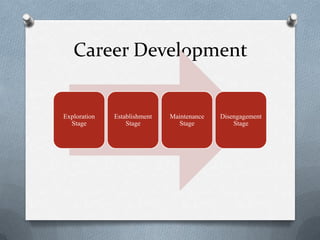
Career Development


Exploration   Establishment   Maintenance   Disengagement
  Stage           Stage          Stage          Stage
The Exploration Stage
O Individuals identify the type of work that interest
  them.
O Seek information about jobs, careers that interest
  them
O Age: Less than 30 years old
O Years on job: less than 2 years
*Orientation and social activities are necessary to
help new employees feel comfortable in the work
environment.
*Examples: group activities, lunch meetings, group
conferences
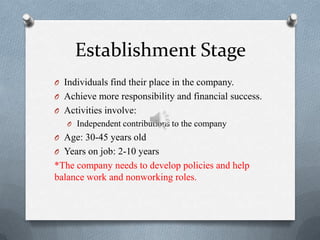
Establishment Stage
O Individuals find their place in the company.
O Achieve more responsibility and financial success.
O Activities involve:
   O Independent contributions to the company
O Age: 30-45 years old
O Years on job: 2-10 years
*The company needs to develop policies and help
balance work and nonworking roles.
Maintenance Stage
O During this stage, individuals are concerned
  with keeping skills up to date.
O Individuals
   O Have years of job experience
   O Job knowledge
O Age: 45-60 years old
O Years on job: more than 10 years
*The company needs to ensure that employees
skills stay up to date.
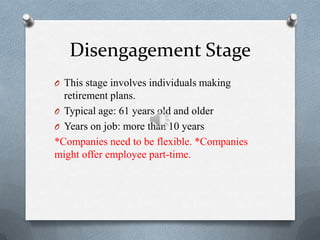
Disengagement Stage
O This stage involves individuals making
  retirement plans.
O Typical age: 61 years old and older
O Years on job: more than 10 years
*Companies need to be flexible. *Companies
might offer employee part-time.
There are 4
approaches to
  Employee
Development
#1: formal Education
O Formal education includes on-site and off-site
  education programs offered by the company.
O These programs involve:
  O Lectures
  O Education games
  O Meetings with customers
*Most companies provide tuition
reimbursement to employees
Pros and Cons of Formal
          Education
O PROS                   O CONS
  O Increase employees     O High cost
    readiness for
    promotion
  O Improve job
    performance
# 2 Assessment
O Involves collecting information and providing
  feedback to employees about their Behavior,
  Communication styles, Values and Skills
O Used to identify employees with managerial
  potential
O Used to measure current managers strengths
  and weaknesses.
Types of assessment tools
O Myers-Briggs Type Indicator (MBTI):
O Assessment Center
O Benchmarks
  O Performance Appraisals
  O 360 Degree Feedback
360-Degree Feedback
1. Understand strengths and
                                      Manager
weaknesses


2. Identify a development
goal
                                                  Subordina
                              peers     Self
                                                     tes
3. Identify how you will
meet your goal

4. Identify the steps that
will help you reach your
goal                                  Customers
Pros and Cons
O PROS                       O Cons
  O Enables someone to         O The time it takes to
    collect many views of        complete the
    performance                  assessment can be long
  O Allows employees to        O honest opinions may
    compare their                not be received
    evaluations with other     O Stress might be put on
    employees                    individuals for giving
  O Performance behavior         feedback
    and improvement
    occur
# 3 Job Experiences
O The relationships, problems, demands and
  tasks that employees face in their jobs
*A major assumption is that development is
most likely to occur when there is a mismatch
between the employee’s skills and past
experiences and the skills required for the job.
How job experiences are used
 for employee Development
                  Promotion


                  Enlarging
         Job
       rotation    current    Transfer
                     job


                  Downward
                    Move
#4 Interpersonal Relationships
 O Employees can develop skills and increase
   their knowledge by interacting with a more
   experienced employee.
2 types of interpersonal
       relationships
O 1. Mentoring
O 2. coaching
PROS AND CONS
O PROS:                  O CONS
1. Both mentor and       1. Lack of time
   trainee can benefit   2. Can be costly
2. Skill development
3. Higher rates of
   promotion
4. Larger salaries
Needs and Interests of
    Different generations
Late 50’s Early 80’s (1945 or before)

• Loyal, want their experience to be valued


Mid 40s to Mid 50’s (1946-1964)

• Are competitive, Want flexible retirement


Mid 20’s to early 40’s (1965-1981)

• Are independent, expect more feedback than older employees


Late 20’s (1982-2000)

• Accept constant change, understand the need for training
The Companies Responsibility
 O Provide development only for top level
   executives, managers
 O Require all employees to devote a number of
   hours on development
 O Ongoing support
 O Motivation
Thank you for your time!

Final exam

  • 1.
    New Employee Development Plan By: Cassidy Daniels HRD 4340-Summer 2012
  • 2.
    4 Stages ofCareer Development 1. Exploration Stage 2. Establishment Stage 3. Maintenance Stage 4. Disengagement Stage
  • 3.
    Career Development Exploration Establishment Maintenance Disengagement Stage Stage Stage Stage
  • 4.
    The Exploration Stage OIndividuals identify the type of work that interest them. O Seek information about jobs, careers that interest them O Age: Less than 30 years old O Years on job: less than 2 years *Orientation and social activities are necessary to help new employees feel comfortable in the work environment. *Examples: group activities, lunch meetings, group conferences
  • 5.
    Establishment Stage O Individualsfind their place in the company. O Achieve more responsibility and financial success. O Activities involve: O Independent contributions to the company O Age: 30-45 years old O Years on job: 2-10 years *The company needs to develop policies and help balance work and nonworking roles.
  • 6.
    Maintenance Stage O Duringthis stage, individuals are concerned with keeping skills up to date. O Individuals O Have years of job experience O Job knowledge O Age: 45-60 years old O Years on job: more than 10 years *The company needs to ensure that employees skills stay up to date.
  • 7.
    Disengagement Stage O Thisstage involves individuals making retirement plans. O Typical age: 61 years old and older O Years on job: more than 10 years *Companies need to be flexible. *Companies might offer employee part-time.
  • 8.
    There are 4 approachesto Employee Development
  • 9.
    #1: formal Education OFormal education includes on-site and off-site education programs offered by the company. O These programs involve: O Lectures O Education games O Meetings with customers *Most companies provide tuition reimbursement to employees
  • 10.
    Pros and Consof Formal Education O PROS O CONS O Increase employees O High cost readiness for promotion O Improve job performance
  • 11.
    # 2 Assessment OInvolves collecting information and providing feedback to employees about their Behavior, Communication styles, Values and Skills O Used to identify employees with managerial potential O Used to measure current managers strengths and weaknesses.
  • 12.
    Types of assessmenttools O Myers-Briggs Type Indicator (MBTI): O Assessment Center O Benchmarks O Performance Appraisals O 360 Degree Feedback
  • 13.
    360-Degree Feedback 1. Understandstrengths and Manager weaknesses 2. Identify a development goal Subordina peers Self tes 3. Identify how you will meet your goal 4. Identify the steps that will help you reach your goal Customers
  • 14.
    Pros and Cons OPROS O Cons O Enables someone to O The time it takes to collect many views of complete the performance assessment can be long O Allows employees to O honest opinions may compare their not be received evaluations with other O Stress might be put on employees individuals for giving O Performance behavior feedback and improvement occur
  • 15.
    # 3 JobExperiences O The relationships, problems, demands and tasks that employees face in their jobs *A major assumption is that development is most likely to occur when there is a mismatch between the employee’s skills and past experiences and the skills required for the job.
  • 16.
    How job experiencesare used for employee Development Promotion Enlarging Job rotation current Transfer job Downward Move
  • 17.
    #4 Interpersonal Relationships O Employees can develop skills and increase their knowledge by interacting with a more experienced employee.
  • 18.
    2 types ofinterpersonal relationships O 1. Mentoring O 2. coaching
  • 19.
    PROS AND CONS OPROS: O CONS 1. Both mentor and 1. Lack of time trainee can benefit 2. Can be costly 2. Skill development 3. Higher rates of promotion 4. Larger salaries
  • 20.
    Needs and Interestsof Different generations Late 50’s Early 80’s (1945 or before) • Loyal, want their experience to be valued Mid 40s to Mid 50’s (1946-1964) • Are competitive, Want flexible retirement Mid 20’s to early 40’s (1965-1981) • Are independent, expect more feedback than older employees Late 20’s (1982-2000) • Accept constant change, understand the need for training
  • 21.
    The Companies Responsibility O Provide development only for top level executives, managers O Require all employees to devote a number of hours on development O Ongoing support O Motivation
  • 22.
    Thank you foryour time!