
WIP controlling - Example line
Unbalanced line
Jesse Uitto
Unbalanced line simulation
• Source: Factory Physics by Wallace Hopp &
Mark Spearman - Chapter 7, Intuition building
exercise 1
• Unlike in the book, in this example there is
only 5, not 6, machines in the third phase.
• More about the theory can be found at
http://jesseuitto.fi/?p=464 (example line 2)
2 h 5 h 10 h 3 h
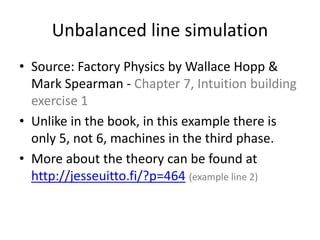
Phase 1
- 1 machine
- 2 hour raw process time
- Capacity 0,5 products/hour
2 h 5 h 10 h 3 h
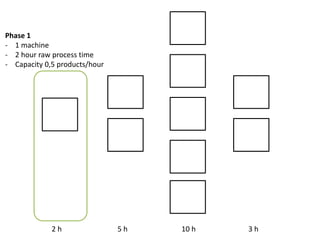
Phase 2
- 2 machines
- 5 hour raw process time
- Capacity 0,4 products/hour
2 h 5 h 10 h 3 h
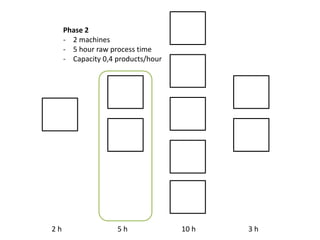
Phase 3
- 5 machines
- 10 hour raw process time
- Capacity 0,5 products/hour
2 h 5 h 10 h 3 h
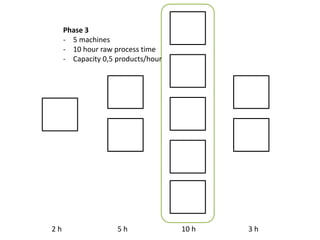
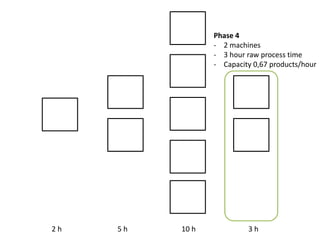
Phase 4
- 2 machines
- 3 hour raw process time
- Capacity 0,67 products/hour
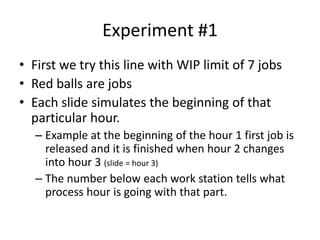
Experiment #1
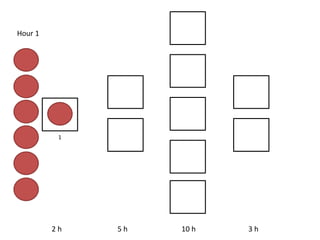
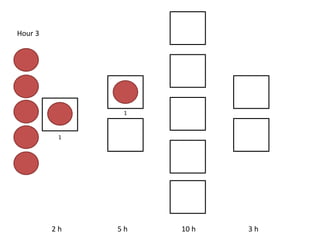
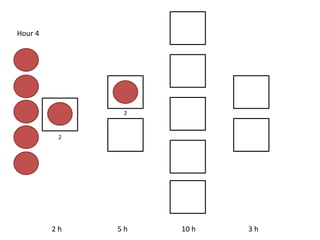
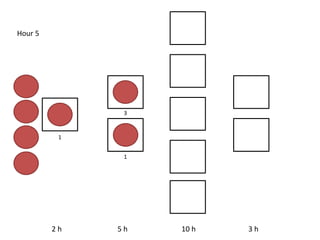
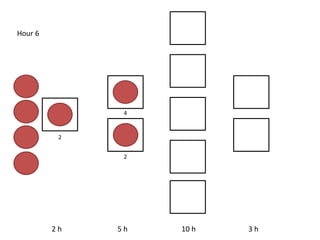
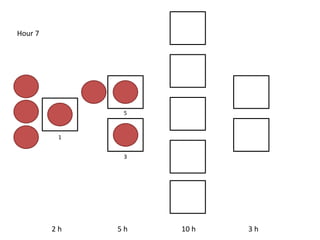
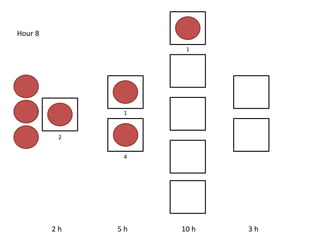
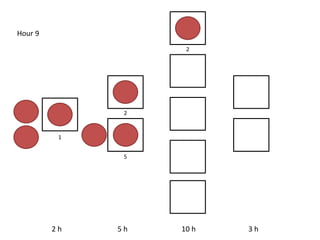
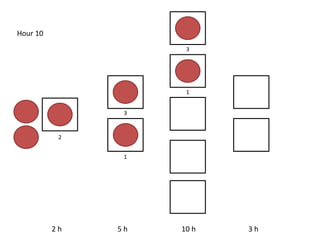
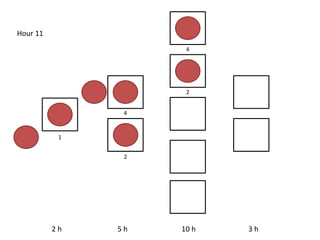
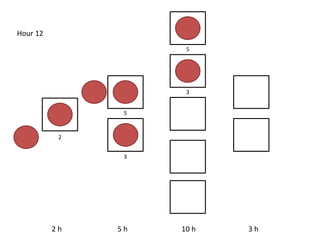
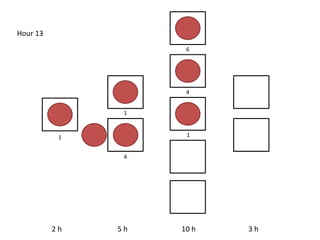
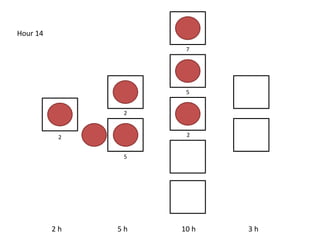
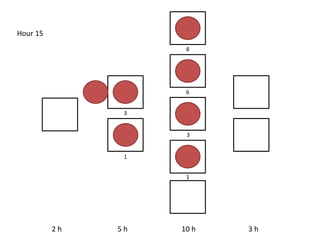
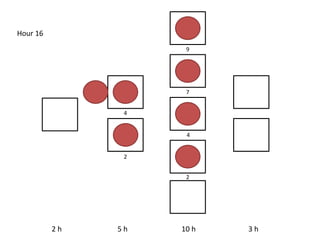
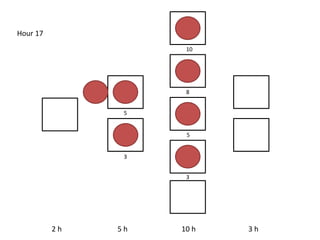
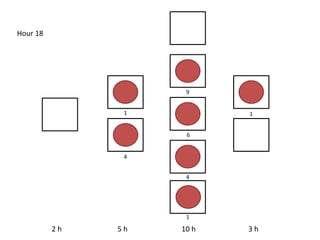
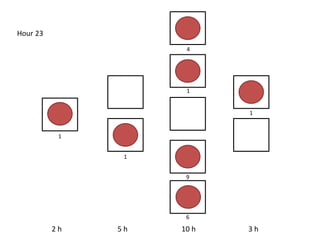
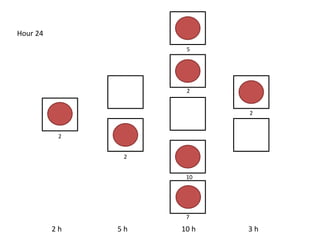
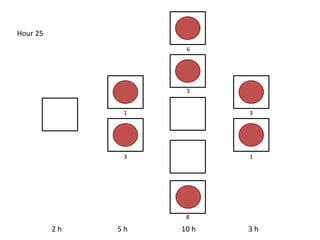
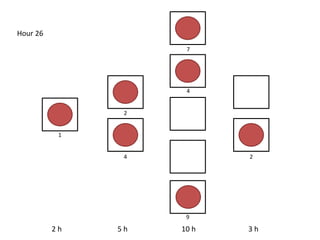
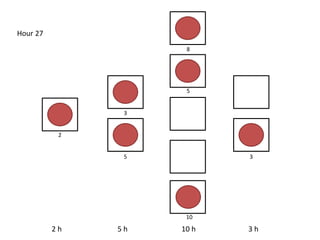
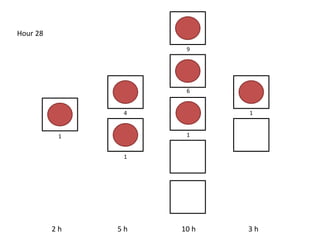
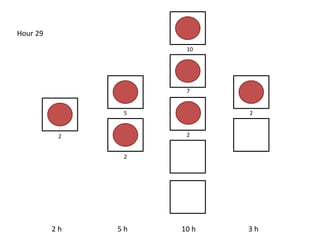
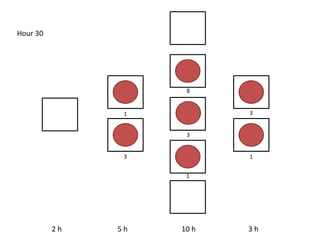
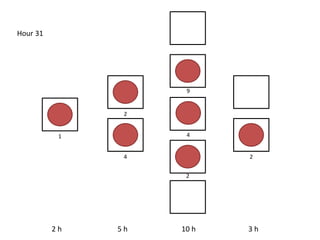
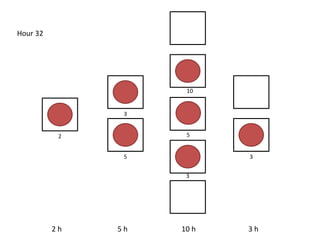
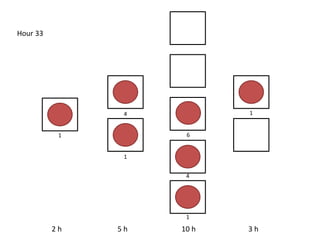
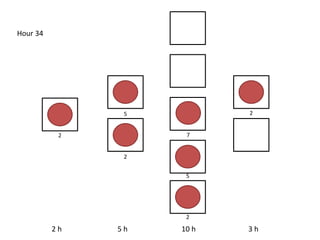
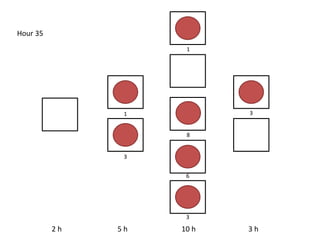
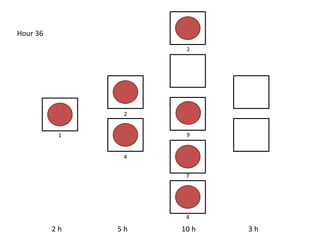
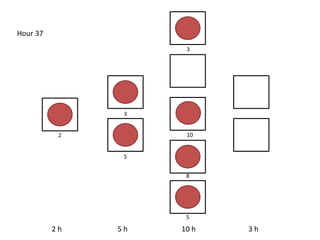
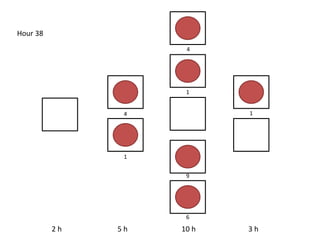
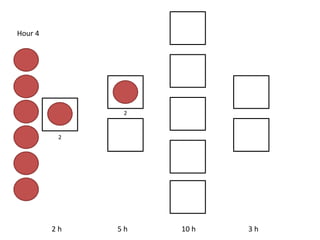
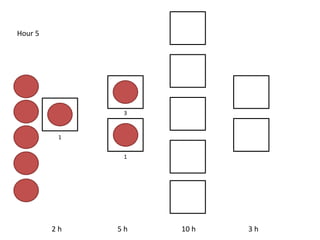
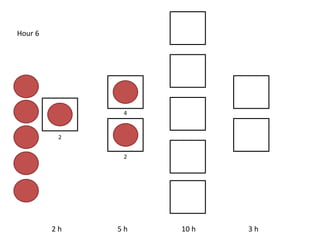
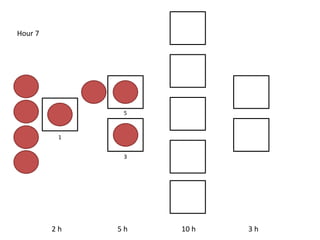
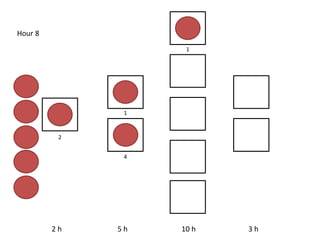
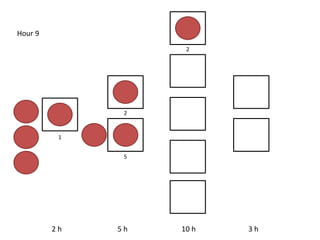
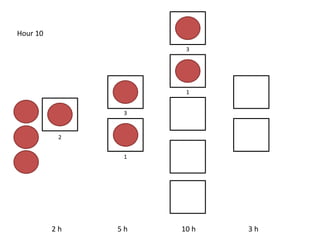
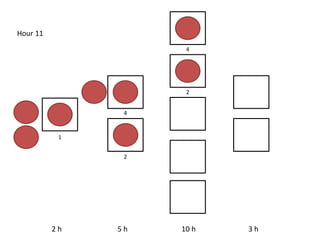
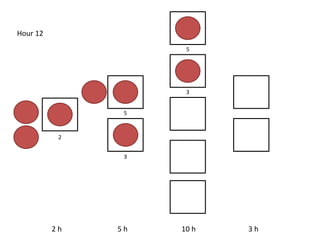
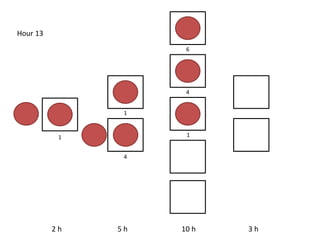
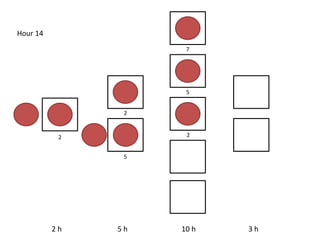
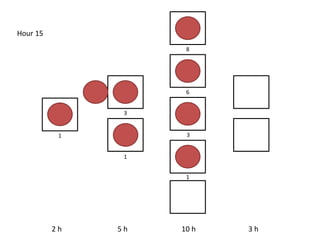
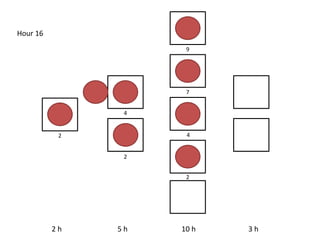
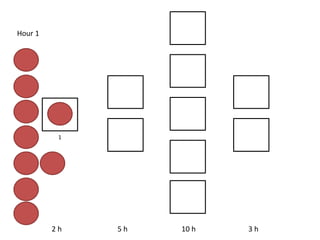
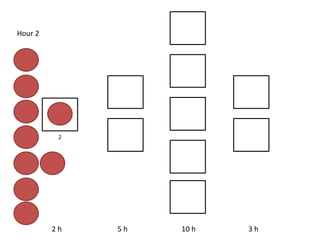
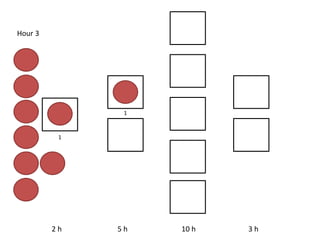
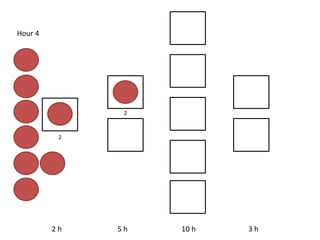
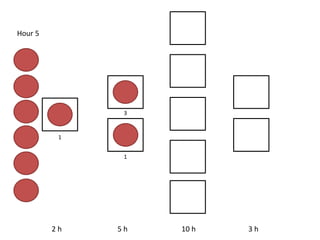
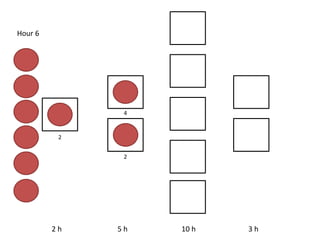
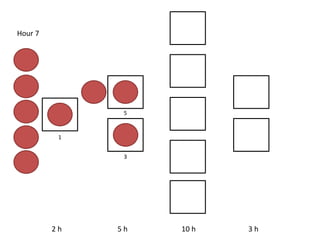
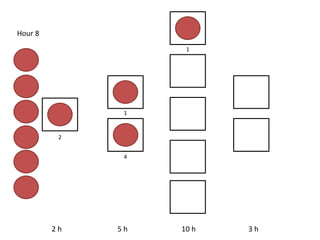
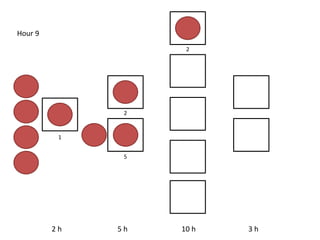
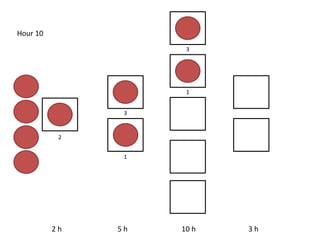
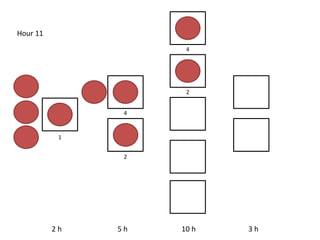
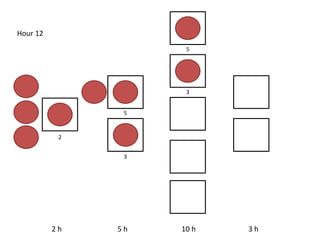
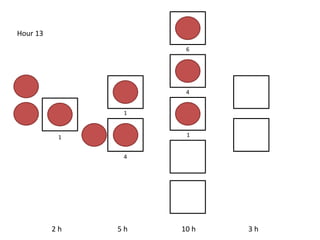
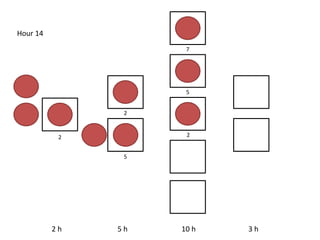
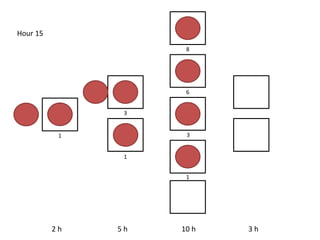
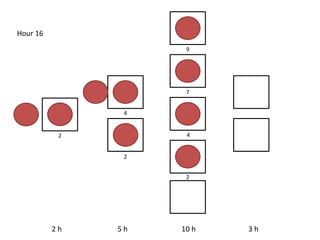
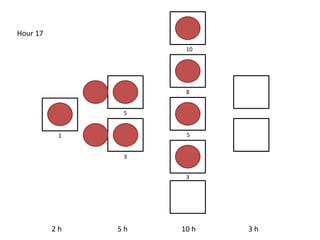
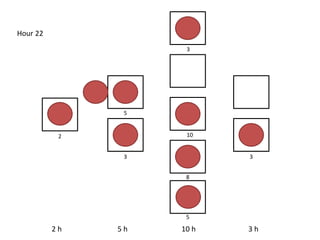
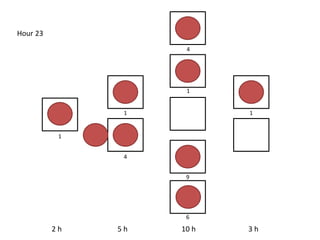
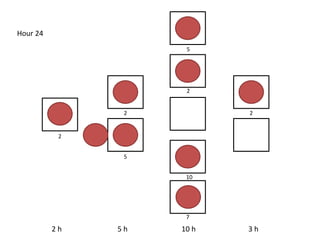
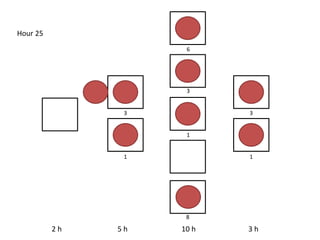
• First we try this line with WIP limit of 7 jobs
• Red balls are jobs
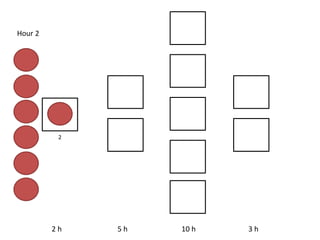
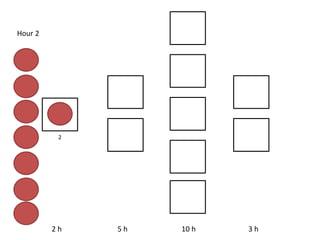
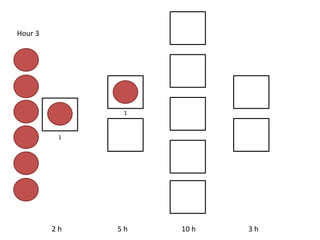
• Each slide simulates the beginning of that
particular hour.
– Example at the beginning of the hour 1 first job is
released and it is finished when hour 2 changes
into hour 3 (slide = hour 3)
– The number below each work station tells what
process hour is going with that part.
2 h 5 h 10 h 3 h
Hour 1
1
2 h 5 h 10 h 3 h
Hour 2
2
2 h 5 h 10 h 3 h
Hour 3
1
1
2 h 5 h 10 h 3 h
Hour 4
2
2
2 h 5 h 10 h 3 h
Hour 5
1
3
1
2 h 5 h 10 h 3 h
Hour 6
2
4
2
2 h 5 h 10 h 3 h
Hour 7
1
5
3
2 h 5 h 10 h 3 h
Hour 8
2
1
4
1
2 h 5 h 10 h 3 h
Hour 9
1
2
5
2
2 h 5 h 10 h 3 h
Hour 10
2
3
1
3
1
2 h 5 h 10 h 3 h
Hour 11
1
4
2
4
2
2 h 5 h 10 h 3 h
Hour 12
2
5
3
5
3
2 h 5 h 10 h 3 h
Hour 13
1
1
4
6
4
1
2 h 5 h 10 h 3 h
Hour 14
2
2
5
7
5
2
2 h 5 h 10 h 3 h
Hour 15
3
1
8
6
3
1
2 h 5 h 10 h 3 h
Hour 16
4
2
9
7
4
2
2 h 5 h 10 h 3 h
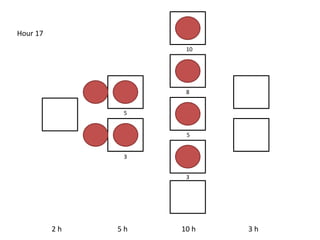
Hour 17
5
3
10
8
5
3
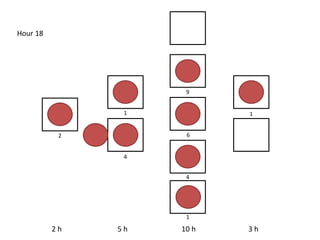
2 h 5 h 10 h 3 h
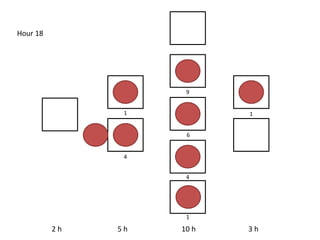
Hour 18
1
4
9
6
4
1
1
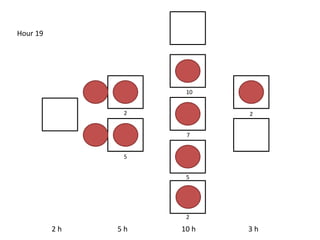
2 h 5 h 10 h 3 h
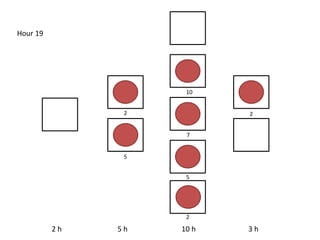
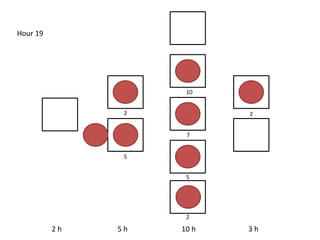
Hour 19
2
5
10
7
5
2
2
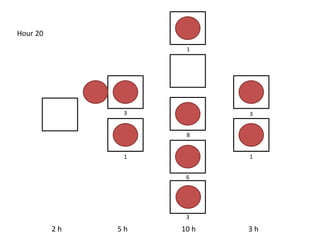
2 h 5 h 10 h 3 h
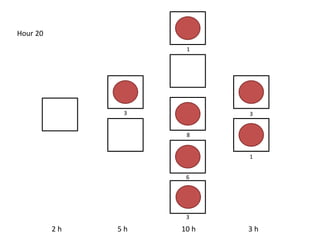
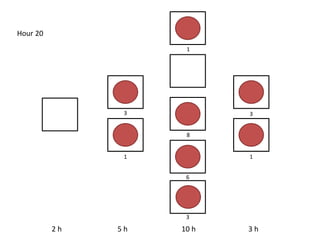
Hour 20
3
8
6
3
3
1
1
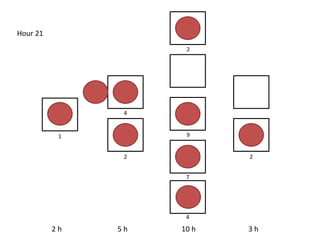
2 h 5 h 10 h 3 h
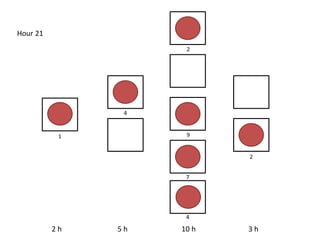
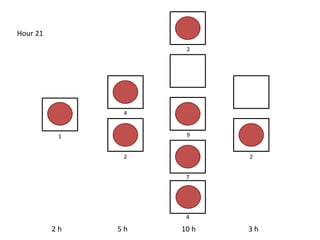
Hour 21
4
9
7
4
2
2
1
2 h 5 h 10 h 3 h
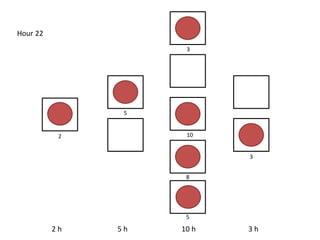
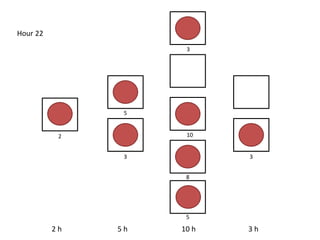
Hour 22
5
10
8
5
3
3
2
2 h 5 h 10 h 3 h
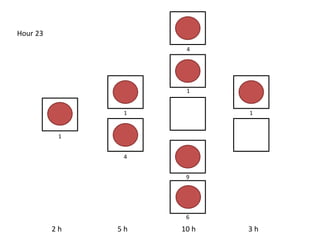
Hour 23
1
9
6
4
1
1
1
2 h 5 h 10 h 3 h
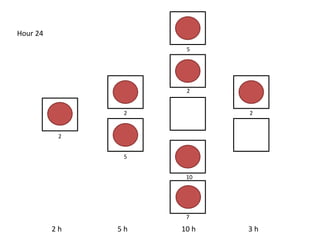
Hour 24
2
10
7
5
2
2
2
2 h 5 h 10 h 3 h
Hour 25
3 1
8
6
1 3
3
2 h 5 h 10 h 3 h
Hour 26
4 2
9
7
2
1
4
2 h 5 h 10 h 3 h
Hour 27
5 3
10
8
3
2
5
2 h 5 h 10 h 3 h
Hour 28
1
1
1
9
4
1
6
2 h 5 h 10 h 3 h
Hour 29
2
2
2
10
5
2
7
2 h 5 h 10 h 3 h
Hour 30
3
1 3
1
1
3
8
2 h 5 h 10 h 3 h
Hour 31
4
2
1
2
2
4
9
2 h 5 h 10 h 3 h
Hour 32
5
3
2
3
3
5
10
2 h 5 h 10 h 3 h
Hour 33
1
4
1
1
4
6
1
2 h 5 h 10 h 3 h
Hour 34
2
5
2
2
5
7
2
2 h 5 h 10 h 3 h
Hour 35
3
1
3
1
6
8
3
2 h 5 h 10 h 3 h
Hour 36
4
2
4
2
7
91
2 h 5 h 10 h 3 h
Hour 37
5
3
5
3
8
102
2 h 5 h 10 h 3 h
Hour 38
1
4
6
4
9
1
1
Notices of simulation with WIP = 7
• This hour 38 is exactly the same as hour 18 so
it starts to go round between hours 18 -> 37
• Notice that after the beginning there is no
queue in front of the phase 2.
– Actually during the hours 20-24 both stations at
phase 2 aren’t even fully utilized.
– Bottleneck station should be fully utilized, right ?
• So let’s try this with an WIP level of 8 jobs
2 h 5 h 10 h 3 h
Hour 1
1
2 h 5 h 10 h 3 h
Hour 2
2
2 h 5 h 10 h 3 h
Hour 3
1
1
2 h 5 h 10 h 3 h
Hour 4
2
2
2 h 5 h 10 h 3 h
Hour 5
1
3
1
2 h 5 h 10 h 3 h
Hour 6
2
4
2
2 h 5 h 10 h 3 h
Hour 7
1
5
3
2 h 5 h 10 h 3 h
Hour 8
2
1
4
1
2 h 5 h 10 h 3 h
Hour 9
1
2
5
2
2 h 5 h 10 h 3 h
Hour 10
2
3
1
3
1
2 h 5 h 10 h 3 h
Hour 11
1
4
2
4
2
2 h 5 h 10 h 3 h
Hour 12
2
5
3
5
3
2 h 5 h 10 h 3 h
Hour 13
1
1
4
6
4
1
2 h 5 h 10 h 3 h
Hour 14
2
2
5
7
5
2
2 h 5 h 10 h 3 h
Hour 15
3
1
8
6
3
1
1
2 h 5 h 10 h 3 h
Hour 16
4
2
9
7
4
2
2
2 h 5 h 10 h 3 h
Hour 17
5
3
10
8
5
3
2 h 5 h 10 h 3 h
Hour 18
1
4
9
6
4
1
1
2 h 5 h 10 h 3 h
Hour 19
2
5
10
7
5
2
2
2 h 5 h 10 h 3 h
Hour 20
3
8
6
3
3
1
11
2 h 5 h 10 h 3 h
Hour 21
4
9
7
4
2
2
1
2
2 h 5 h 10 h 3 h
Hour 22
5
10
8
5
3
3
2
3
2 h 5 h 10 h 3 h
Hour 23
4
9
6
4
1
1
1
1
2 h 5 h 10 h 3 h
Hour 24
5
10
7
5
2
2
2
2
2 h 5 h 10 h 3 h
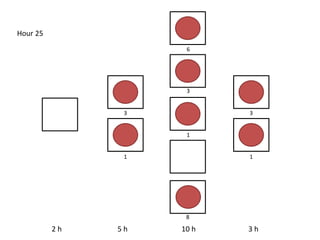
Hour 25
1 1
8
6
3 3
3
1
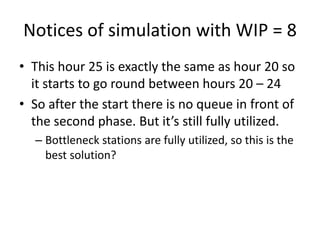
Notices of simulation with WIP = 8
• This hour 25 is exactly the same as hour 20 so
it starts to go round between hours 20 – 24
• So after the start there is no queue in front of
the second phase. But it’s still fully utilized.
– Bottleneck stations are fully utilized, so this is the
best solution?
• Let’s try this once again with WIP limit of 9
jobs
2 h 5 h 10 h 3 h
Hour 1
1
2 h 5 h 10 h 3 h
Hour 2
2
2 h 5 h 10 h 3 h
Hour 3
1
1
2 h 5 h 10 h 3 h
Hour 4
2
2
2 h 5 h 10 h 3 h
Hour 5
1
3
1
2 h 5 h 10 h 3 h
Hour 6
2
4
2
2 h 5 h 10 h 3 h
Hour 7
1
5
3
2 h 5 h 10 h 3 h
Hour 8
2
1
4
1
2 h 5 h 10 h 3 h
Hour 9
1
2
5
2
2 h 5 h 10 h 3 h
Hour 10
2
3
1
3
1
2 h 5 h 10 h 3 h
Hour 11
1
4
2
4
2
2 h 5 h 10 h 3 h
Hour 12
2
5
3
5
3
2 h 5 h 10 h 3 h
Hour 13
1
1
4
6
4
1
2 h 5 h 10 h 3 h
Hour 14
2
2
5
7
5
2
2 h 5 h 10 h 3 h
Hour 15
3
1
8
6
3
1
1
2 h 5 h 10 h 3 h
Hour 16
4
2
9
7
4
2
2
2 h 5 h 10 h 3 h
Hour 17
5
3
10
8
5
3
1
2 h 5 h 10 h 3 h
Hour 18
1
4
9
6
4
1
1
2
2 h 5 h 10 h 3 h
Hour 19
2
5
10
7
5
2
2
2 h 5 h 10 h 3 h
Hour 20
3
8
6
3
3
1
11
2 h 5 h 10 h 3 h
Hour 21
4
9
7
4
2
2
1
2
2 h 5 h 10 h 3 h
Hour 22
5
10
8
5
3
3
2
3
2 h 5 h 10 h 3 h
Hour 23
4
9
6
4
1
1
1
1
2 h 5 h 10 h 3 h
Hour 24
5
10
7
5
2
2
2
2
2 h 5 h 10 h 3 h
Hour 25
1 1
8
6
3 3
3
1
Notices of simulation with WIP = 9
• Notice that here too hour 25 is same than
hour 20. So it goes same round than with WIP
of 8 jobs
• Now after the start there is always 1 job in
queue waiting to be processed at the second
phase
Variability at the phase 2
• If process time at the second phase would be
shorter they could take a new job from the
queue. On the other hand it would mean that
stations have variability and they would also
have longer process times which would
increase the queue.
Differences
• With WIP limit of 7 second work phase
sometimes starves and is not fully utilized. So the
cycle time for the line is same as theoretical raw
process time T0 = 20 h
• With second example and WIP limit of 8 jobs the
second phase is always fully utilized. And still
there is no queue in front of it. So the cycle time
still remains at 20 hours.
• With the WIP of 9 jobs there is always queue in
front of the second phase. After the start when
all the WIP is in use, jobs will wait 2 hours to get
processed at the phase 2.
– So the cycle time is 22 hours
Summarize
• As calculated in post (http://jesseuitto.fi/?p=464) Critical
WIP is W0 = rb* T0 = 0,4 * 20 = 8 jobs
– In simulations we noticed that line works quite
perfectly with this WIP limit.
• Machines at second phase are fully utilized
• No queues in the line
• Cycle time = raw process time T0
• So if we have perfect line with no variability,
no loss, optimum situation would be to limit
the WIP for 8 jobs
– Achieve maximum TH with minimum WIP and CT

Penny Fab Example Simulation

  • 1.
    WIP controlling -Example line Unbalanced line Jesse Uitto
  • 2.
    Unbalanced line simulation •Source: Factory Physics by Wallace Hopp & Mark Spearman - Chapter 7, Intuition building exercise 1 • Unlike in the book, in this example there is only 5, not 6, machines in the third phase. • More about the theory can be found at http://jesseuitto.fi/?p=464 (example line 2)
  • 3.
    2 h 5h 10 h 3 h Phase 1 - 1 machine - 2 hour raw process time - Capacity 0,5 products/hour
  • 4.
    2 h 5h 10 h 3 h Phase 2 - 2 machines - 5 hour raw process time - Capacity 0,4 products/hour
  • 5.
    2 h 5h 10 h 3 h Phase 3 - 5 machines - 10 hour raw process time - Capacity 0,5 products/hour
  • 6.
    2 h 5h 10 h 3 h Phase 4 - 2 machines - 3 hour raw process time - Capacity 0,67 products/hour
  • 7.
    Experiment #1 • Firstwe try this line with WIP limit of 7 jobs • Red balls are jobs • Each slide simulates the beginning of that particular hour. – Example at the beginning of the hour 1 first job is released and it is finished when hour 2 changes into hour 3 (slide = hour 3) – The number below each work station tells what process hour is going with that part.
  • 8.
    2 h 5h 10 h 3 h Hour 1 1
  • 9.
    2 h 5h 10 h 3 h Hour 2 2
  • 10.
    2 h 5h 10 h 3 h Hour 3 1 1
  • 11.
    2 h 5h 10 h 3 h Hour 4 2 2
  • 12.
    2 h 5h 10 h 3 h Hour 5 1 3 1
  • 13.
    2 h 5h 10 h 3 h Hour 6 2 4 2
  • 14.
    2 h 5h 10 h 3 h Hour 7 1 5 3
  • 15.
    2 h 5h 10 h 3 h Hour 8 2 1 4 1
  • 16.
    2 h 5h 10 h 3 h Hour 9 1 2 5 2
  • 17.
    2 h 5h 10 h 3 h Hour 10 2 3 1 3 1
  • 18.
    2 h 5h 10 h 3 h Hour 11 1 4 2 4 2
  • 19.
    2 h 5h 10 h 3 h Hour 12 2 5 3 5 3
  • 20.
    2 h 5h 10 h 3 h Hour 13 1 1 4 6 4 1
  • 21.
    2 h 5h 10 h 3 h Hour 14 2 2 5 7 5 2
  • 22.
    2 h 5h 10 h 3 h Hour 15 3 1 8 6 3 1
  • 23.
    2 h 5h 10 h 3 h Hour 16 4 2 9 7 4 2
  • 24.
    2 h 5h 10 h 3 h Hour 17 5 3 10 8 5 3
  • 25.
    2 h 5h 10 h 3 h Hour 18 1 4 9 6 4 1 1
  • 26.
    2 h 5h 10 h 3 h Hour 19 2 5 10 7 5 2 2
  • 27.
    2 h 5h 10 h 3 h Hour 20 3 8 6 3 3 1 1
  • 28.
    2 h 5h 10 h 3 h Hour 21 4 9 7 4 2 2 1
  • 29.
    2 h 5h 10 h 3 h Hour 22 5 10 8 5 3 3 2
  • 30.
    2 h 5h 10 h 3 h Hour 23 1 9 6 4 1 1 1
  • 31.
    2 h 5h 10 h 3 h Hour 24 2 10 7 5 2 2 2
  • 32.
    2 h 5h 10 h 3 h Hour 25 3 1 8 6 1 3 3
  • 33.
    2 h 5h 10 h 3 h Hour 26 4 2 9 7 2 1 4
  • 34.
    2 h 5h 10 h 3 h Hour 27 5 3 10 8 3 2 5
  • 35.
    2 h 5h 10 h 3 h Hour 28 1 1 1 9 4 1 6
  • 36.
    2 h 5h 10 h 3 h Hour 29 2 2 2 10 5 2 7
  • 37.
    2 h 5h 10 h 3 h Hour 30 3 1 3 1 1 3 8
  • 38.
    2 h 5h 10 h 3 h Hour 31 4 2 1 2 2 4 9
  • 39.
    2 h 5h 10 h 3 h Hour 32 5 3 2 3 3 5 10
  • 40.
    2 h 5h 10 h 3 h Hour 33 1 4 1 1 4 6 1
  • 41.
    2 h 5h 10 h 3 h Hour 34 2 5 2 2 5 7 2
  • 42.
    2 h 5h 10 h 3 h Hour 35 3 1 3 1 6 8 3
  • 43.
    2 h 5h 10 h 3 h Hour 36 4 2 4 2 7 91
  • 44.
    2 h 5h 10 h 3 h Hour 37 5 3 5 3 8 102
  • 45.
    2 h 5h 10 h 3 h Hour 38 1 4 6 4 9 1 1
  • 46.
    Notices of simulationwith WIP = 7 • This hour 38 is exactly the same as hour 18 so it starts to go round between hours 18 -> 37 • Notice that after the beginning there is no queue in front of the phase 2. – Actually during the hours 20-24 both stations at phase 2 aren’t even fully utilized. – Bottleneck station should be fully utilized, right ? • So let’s try this with an WIP level of 8 jobs
  • 47.
    2 h 5h 10 h 3 h Hour 1 1
  • 48.
    2 h 5h 10 h 3 h Hour 2 2
  • 49.
    2 h 5h 10 h 3 h Hour 3 1 1
  • 50.
    2 h 5h 10 h 3 h Hour 4 2 2
  • 51.
    2 h 5h 10 h 3 h Hour 5 1 3 1
  • 52.
    2 h 5h 10 h 3 h Hour 6 2 4 2
  • 53.
    2 h 5h 10 h 3 h Hour 7 1 5 3
  • 54.
    2 h 5h 10 h 3 h Hour 8 2 1 4 1
  • 55.
    2 h 5h 10 h 3 h Hour 9 1 2 5 2
  • 56.
    2 h 5h 10 h 3 h Hour 10 2 3 1 3 1
  • 57.
    2 h 5h 10 h 3 h Hour 11 1 4 2 4 2
  • 58.
    2 h 5h 10 h 3 h Hour 12 2 5 3 5 3
  • 59.
    2 h 5h 10 h 3 h Hour 13 1 1 4 6 4 1
  • 60.
    2 h 5h 10 h 3 h Hour 14 2 2 5 7 5 2
  • 61.
    2 h 5h 10 h 3 h Hour 15 3 1 8 6 3 1 1
  • 62.
    2 h 5h 10 h 3 h Hour 16 4 2 9 7 4 2 2
  • 63.
    2 h 5h 10 h 3 h Hour 17 5 3 10 8 5 3
  • 64.
    2 h 5h 10 h 3 h Hour 18 1 4 9 6 4 1 1
  • 65.
    2 h 5h 10 h 3 h Hour 19 2 5 10 7 5 2 2
  • 66.
    2 h 5h 10 h 3 h Hour 20 3 8 6 3 3 1 11
  • 67.
    2 h 5h 10 h 3 h Hour 21 4 9 7 4 2 2 1 2
  • 68.
    2 h 5h 10 h 3 h Hour 22 5 10 8 5 3 3 2 3
  • 69.
    2 h 5h 10 h 3 h Hour 23 4 9 6 4 1 1 1 1
  • 70.
    2 h 5h 10 h 3 h Hour 24 5 10 7 5 2 2 2 2
  • 71.
    2 h 5h 10 h 3 h Hour 25 1 1 8 6 3 3 3 1
  • 72.
    Notices of simulationwith WIP = 8 • This hour 25 is exactly the same as hour 20 so it starts to go round between hours 20 – 24 • So after the start there is no queue in front of the second phase. But it’s still fully utilized. – Bottleneck stations are fully utilized, so this is the best solution? • Let’s try this once again with WIP limit of 9 jobs
  • 73.
    2 h 5h 10 h 3 h Hour 1 1
  • 74.
    2 h 5h 10 h 3 h Hour 2 2
  • 75.
    2 h 5h 10 h 3 h Hour 3 1 1
  • 76.
    2 h 5h 10 h 3 h Hour 4 2 2
  • 77.
    2 h 5h 10 h 3 h Hour 5 1 3 1
  • 78.
    2 h 5h 10 h 3 h Hour 6 2 4 2
  • 79.
    2 h 5h 10 h 3 h Hour 7 1 5 3
  • 80.
    2 h 5h 10 h 3 h Hour 8 2 1 4 1
  • 81.
    2 h 5h 10 h 3 h Hour 9 1 2 5 2
  • 82.
    2 h 5h 10 h 3 h Hour 10 2 3 1 3 1
  • 83.
    2 h 5h 10 h 3 h Hour 11 1 4 2 4 2
  • 84.
    2 h 5h 10 h 3 h Hour 12 2 5 3 5 3
  • 85.
    2 h 5h 10 h 3 h Hour 13 1 1 4 6 4 1
  • 86.
    2 h 5h 10 h 3 h Hour 14 2 2 5 7 5 2
  • 87.
    2 h 5h 10 h 3 h Hour 15 3 1 8 6 3 1 1
  • 88.
    2 h 5h 10 h 3 h Hour 16 4 2 9 7 4 2 2
  • 89.
    2 h 5h 10 h 3 h Hour 17 5 3 10 8 5 3 1
  • 90.
    2 h 5h 10 h 3 h Hour 18 1 4 9 6 4 1 1 2
  • 91.
    2 h 5h 10 h 3 h Hour 19 2 5 10 7 5 2 2
  • 92.
    2 h 5h 10 h 3 h Hour 20 3 8 6 3 3 1 11
  • 93.
    2 h 5h 10 h 3 h Hour 21 4 9 7 4 2 2 1 2
  • 94.
    2 h 5h 10 h 3 h Hour 22 5 10 8 5 3 3 2 3
  • 95.
    2 h 5h 10 h 3 h Hour 23 4 9 6 4 1 1 1 1
  • 96.
    2 h 5h 10 h 3 h Hour 24 5 10 7 5 2 2 2 2
  • 97.
    2 h 5h 10 h 3 h Hour 25 1 1 8 6 3 3 3 1
  • 98.
    Notices of simulationwith WIP = 9 • Notice that here too hour 25 is same than hour 20. So it goes same round than with WIP of 8 jobs • Now after the start there is always 1 job in queue waiting to be processed at the second phase
  • 99.
    Variability at thephase 2 • If process time at the second phase would be shorter they could take a new job from the queue. On the other hand it would mean that stations have variability and they would also have longer process times which would increase the queue.
  • 100.
    Differences • With WIPlimit of 7 second work phase sometimes starves and is not fully utilized. So the cycle time for the line is same as theoretical raw process time T0 = 20 h • With second example and WIP limit of 8 jobs the second phase is always fully utilized. And still there is no queue in front of it. So the cycle time still remains at 20 hours. • With the WIP of 9 jobs there is always queue in front of the second phase. After the start when all the WIP is in use, jobs will wait 2 hours to get processed at the phase 2. – So the cycle time is 22 hours
  • 101.
    Summarize • As calculatedin post (http://jesseuitto.fi/?p=464) Critical WIP is W0 = rb* T0 = 0,4 * 20 = 8 jobs – In simulations we noticed that line works quite perfectly with this WIP limit. • Machines at second phase are fully utilized • No queues in the line • Cycle time = raw process time T0 • So if we have perfect line with no variability, no loss, optimum situation would be to limit the WIP for 8 jobs – Achieve maximum TH with minimum WIP and CT