LEARNING ASSESSMENT
(FCE3501)
TOPIC 1
INTRODUCTION
Faculty of Educational Studies
Universiti Putra Malaysia
2
Basic concepts in Assessment and
Evaluation
• Test
• Measurements
• Assessment
• Evaluation
Test
• An instrument or systematic procedures for
measuring sample of behavior by posing a set
of questions in a uniform manner. Designed to
measure any quality, ability, skill or
knowledge.
Measurement
• Assignment of numbers (quantity), uses
variety of instrument: test, rating scale. It is
the process of obtaining numerical description
of the degree of individual possesses.
Quantifying of how much does learner
learned.
Evaluation
• It is a process because it includes a series of
steps. It is concerned with making judgments
on the worth or value of a performance,
answer the question “how good, adequate, or
desirable”. It is also the process of obtaining,
analyzing and interpreting information to
determent the extent to which students
achieve instructional objective.
Assessment
• Process by which evidence of student
achievement is obtained and evaluated.
Information is obtained relative to objective it
include testing, interpreting and placing
information in context. It is the process of
gathering and organizing data- the basis for
decision making (evaluation).
8
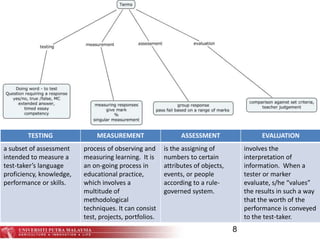
TESTING MEASUREMENT ASSESSMENT EVALUATION
a subset of assessment
intended to measure a
test-taker’s language
proficiency, knowledge,
performance or skills.
process of observing and
measuring learning. It is
an on-going process in
educational practice,
which involves a
multitude of
methodological
techniques. It can consist
test, projects, portfolios.
is the assigning of
numbers to certain
attributes of objects,
events, or people
according to a rule-
governed system.
involves the
interpretation of
information. When a
tester or marker
evaluate, s/he “values”
the results in such a way
that the worth of the
performance is conveyed
to the test-taker.
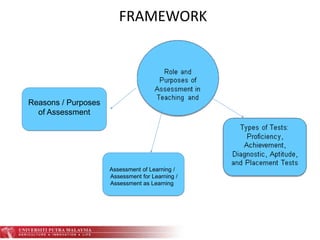
FRAMEWORK
Reasons / Purposes
of Assessment
Assessment of Learning /
Assessment for Learning /
Assessment as Learning
Types of tests
Henning (1987) identifies six kinds of information that tests provide
about students. They are:
• Diagnostic and feedback
• Screening and selection
• Placement
• Program evaluation
• Providing research criteria
• Assessment of attitudes and socio-psychological differences
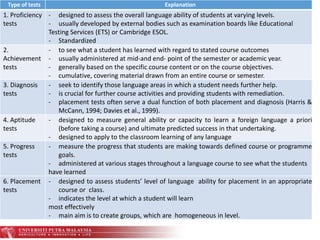
Type of tests Explanation
1. Proficiency
tests
- designed to assess the overall language ability of students at varying levels.
- usually developed by external bodies such as examination boards like Educational
Testing Services (ETS) or Cambridge ESOL.
- Standardized
2.
Achievement
tests
- to see what a student has learned with regard to stated course outcomes
- usually administered at mid-and end- point of the semester or academic year.
- generally based on the specific course content or on the course objectives.
- cumulative, covering material drawn from an entire course or semester.
3. Diagnosis
tests
- seek to identify those language areas in which a student needs further help.
- is crucial for further course activities and providing students with remediation.
- placement tests often serve a dual function of both placement and diagnosis (Harris &
McCann, 1994; Davies et al., 1999).
4. Aptitude
tests
- designed to measure general ability or capacity to learn a foreign language a priori
(before taking a course) and ultimate predicted success in that undertaking.
- designed to apply to the classroom learning of any language
5. Progress
tests
- measure the progress that students are making towards defined course or programme
goals.
- administered at various stages throughout a language course to see what the students
have learned
6. Placement
tests
- designed to assess students’ level of language ability for placement in an appropriate
course or class.
- indicates the level at which a student will learn
most effectively
- main aim is to create groups, which are homogeneous in level.
Assessment OF Learning
• Enable students to demonstrate what they know and can do
• This type of assessment is also known as summative assessment.
• provide the focus to improve student achievement, give everyone
the information they need to improve student achievement, and
apply the pressure needed to motivate teachers to work harder to
teach and learn.
• Establishes a classroom culture that encourages interaction and the use of
assessment tools
• Occurs throughout a learning sequence and is planned when teachers design
teaching and learning activities
• Involves teachers sharing learning intentions and explicit assessment criteria with
students
• Involves teachers and students setting and monitoring student progress against
learning goals
• Require teachers to ascertain students’ prior knowledge, perceptions and
misconceptions
• Is roughly equivalent to formative assessment – assessment is intended to promote
further improvement of student learning during the learning process. Students are
provided valuable feedback on their own learning
Assessment FOR Learning
14
Assessment AS Learning
• Promotes students’ self-esteem and self-confidence through an
understanding of how they learn to learn
• Develop students’ capacity to reflect on the learning and to
contribute to their future learning goals
• Enhance students’ life-long learning skills
• Emphasis the process of learning as it is experienced by the student
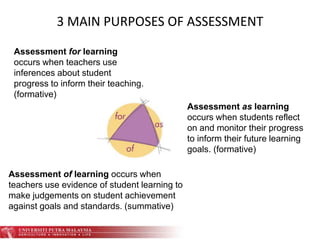
Assessment for learning
occurs when teachers use
inferences about student
progress to inform their teaching.
(formative)
Assessment as learning
occurs when students reflect
on and monitor their progress
to inform their future learning
goals. (formative)
Assessment of learning occurs when
teachers use evidence of student learning to
make judgements on student achievement
against goals and standards. (summative)
3 MAIN PURPOSES OF ASSESSMENT
TEACHERS’ ROLE IN ASSESSMENT
for LEARNING
Assessment for learning occurs throughout the learning process.
It is interactive, with teachers:
• aligning instruction
• identifying particular learning needs of students or groups
• selecting and adapting materials and resources
• creating differentiated teaching strategies and learning
opportunities for helping individual students move forward in
their learning
• Providing immediate feedback and direction to students
16
TEACHERS’ ROLE IN ASSESSMENT
as LEARNING
“The teachers’ role in promoting the development of
independent learners through assessment as learning is
to:
• model and teach the skills of self-assessment
• guide students in setting their own goals, and
monitoring their progress toward them
• provide exemplars and models of good practice and
quality work that reflect curriculum outcomes
• work with students to develop clear criteria of good
practice
17
TEACHERS’ ROLES IN ASSESSMENT
of LEARNING
• a range of alternative mechanisms for
assessing the same outcomes
• public and defensible reference points for
making judgements
• • transparent approaches to interpretation
• • descriptions of the assessment process
• • strategies for recourse in the event of
disagreement about the decisions.
18
19
Activity
 In pairs or small groups discuss the types of
assessment of learning used in your school.
 How is the information/data from these used?
20
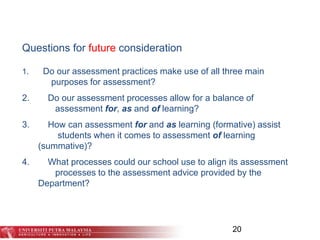
Questions for future consideration
1. Do our assessment practices make use of all three main
purposes for assessment?
2. Do our assessment processes allow for a balance of
assessment for, as and of learning?
3. How can assessment for and as learning (formative) assist
students when it comes to assessment of learning
(summative)?
4. What processes could our school use to align its assessment
processes to the assessment advice provided by the
Department?
21
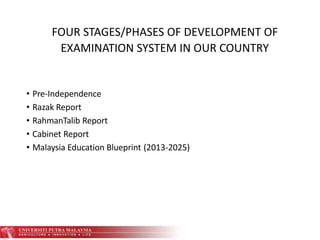
FOUR STAGES/PHASES OF DEVELOPMENT OF
EXAMINATION SYSTEM IN OUR COUNTRY
• Pre-Independence
• Razak Report
• RahmanTalib Report
• Cabinet Report
• Malaysia Education Blueprint (2013-2025)
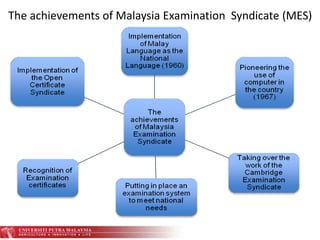
The achievements of Malaysia Examination Syndicate (MES)
24
MALAYSIAN CONTEXT (KSSR)
1. to realign the education system from one that focuses on
academic excellence to a more holistic one
2. To ensure a more systematic mastery of knowledge by
emphasising on assessment of each child.
3. To achieve the aspiration of National Philosophy of Education
towards developing well rounded learners (JERIS)
4. to reduce exam-oriented learning among learners
5. to evaluate learners’ learning progress
School-Based Assessment
SBE Component:
Academic:
•School Assessment (using Performance Standards)
•Centralised Assessment Non-academic:
•Physical Activities, Sports and Co-curricular Assessment (PAJSK : eg; SEGAK)
•Psychometric/Psychological Tests (Aptitude test, Personality test)
SBE features:
•Assessment for and of learning
•Standard-referenced Assessment (Performance Standard)
•*Formative tests which are assessed using Bands 1 to 6, HOTS (Higher Order
Thinking Skills)
•Holistic
•Integrated
SBE Instrument (WHO):
•Teachers
•Rationale:
•- Can continuously monitor their pupils’ growth
•- Can provide constructive feedback to help improve pupils’ learning
abilities
•- Better understand the context and environment most conducive to
assess pupils
•- Appraise and provide feedback based on the Performance Standards
HOW:
Observation, Performance, Project, Product,Hands on, Written Essays,
Pencil and Paper, Worksheet, Open ended discussion, Quizzes,
Checklist,Homework.
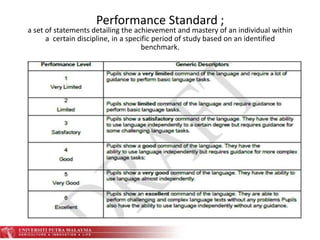
Performance Standard ;
a set of statements detailing the achievement and mastery of an individual within
a certain discipline, in a specific period of study based on an identified
benchmark.
TERIMA KASIH / THANK YOU
www.upm.edu.my

Penaksiran Akademik

  • 1.
    LEARNING ASSESSMENT (FCE3501) TOPIC 1 INTRODUCTION Facultyof Educational Studies Universiti Putra Malaysia
  • 2.
  • 3.
    Basic concepts inAssessment and Evaluation • Test • Measurements • Assessment • Evaluation
  • 4.
    Test • An instrumentor systematic procedures for measuring sample of behavior by posing a set of questions in a uniform manner. Designed to measure any quality, ability, skill or knowledge.
  • 5.
    Measurement • Assignment ofnumbers (quantity), uses variety of instrument: test, rating scale. It is the process of obtaining numerical description of the degree of individual possesses. Quantifying of how much does learner learned.
  • 6.
    Evaluation • It isa process because it includes a series of steps. It is concerned with making judgments on the worth or value of a performance, answer the question “how good, adequate, or desirable”. It is also the process of obtaining, analyzing and interpreting information to determent the extent to which students achieve instructional objective.
  • 7.
    Assessment • Process bywhich evidence of student achievement is obtained and evaluated. Information is obtained relative to objective it include testing, interpreting and placing information in context. It is the process of gathering and organizing data- the basis for decision making (evaluation).
  • 8.
    8 TESTING MEASUREMENT ASSESSMENTEVALUATION a subset of assessment intended to measure a test-taker’s language proficiency, knowledge, performance or skills. process of observing and measuring learning. It is an on-going process in educational practice, which involves a multitude of methodological techniques. It can consist test, projects, portfolios. is the assigning of numbers to certain attributes of objects, events, or people according to a rule- governed system. involves the interpretation of information. When a tester or marker evaluate, s/he “values” the results in such a way that the worth of the performance is conveyed to the test-taker.
  • 9.
    FRAMEWORK Reasons / Purposes ofAssessment Assessment of Learning / Assessment for Learning / Assessment as Learning
  • 10.
    Types of tests Henning(1987) identifies six kinds of information that tests provide about students. They are: • Diagnostic and feedback • Screening and selection • Placement • Program evaluation • Providing research criteria • Assessment of attitudes and socio-psychological differences
  • 11.
    Type of testsExplanation 1. Proficiency tests - designed to assess the overall language ability of students at varying levels. - usually developed by external bodies such as examination boards like Educational Testing Services (ETS) or Cambridge ESOL. - Standardized 2. Achievement tests - to see what a student has learned with regard to stated course outcomes - usually administered at mid-and end- point of the semester or academic year. - generally based on the specific course content or on the course objectives. - cumulative, covering material drawn from an entire course or semester. 3. Diagnosis tests - seek to identify those language areas in which a student needs further help. - is crucial for further course activities and providing students with remediation. - placement tests often serve a dual function of both placement and diagnosis (Harris & McCann, 1994; Davies et al., 1999). 4. Aptitude tests - designed to measure general ability or capacity to learn a foreign language a priori (before taking a course) and ultimate predicted success in that undertaking. - designed to apply to the classroom learning of any language 5. Progress tests - measure the progress that students are making towards defined course or programme goals. - administered at various stages throughout a language course to see what the students have learned 6. Placement tests - designed to assess students’ level of language ability for placement in an appropriate course or class. - indicates the level at which a student will learn most effectively - main aim is to create groups, which are homogeneous in level.
  • 12.
    Assessment OF Learning •Enable students to demonstrate what they know and can do • This type of assessment is also known as summative assessment. • provide the focus to improve student achievement, give everyone the information they need to improve student achievement, and apply the pressure needed to motivate teachers to work harder to teach and learn.
  • 13.
    • Establishes aclassroom culture that encourages interaction and the use of assessment tools • Occurs throughout a learning sequence and is planned when teachers design teaching and learning activities • Involves teachers sharing learning intentions and explicit assessment criteria with students • Involves teachers and students setting and monitoring student progress against learning goals • Require teachers to ascertain students’ prior knowledge, perceptions and misconceptions • Is roughly equivalent to formative assessment – assessment is intended to promote further improvement of student learning during the learning process. Students are provided valuable feedback on their own learning Assessment FOR Learning
  • 14.
    14 Assessment AS Learning •Promotes students’ self-esteem and self-confidence through an understanding of how they learn to learn • Develop students’ capacity to reflect on the learning and to contribute to their future learning goals • Enhance students’ life-long learning skills • Emphasis the process of learning as it is experienced by the student
  • 15.
    Assessment for learning occurswhen teachers use inferences about student progress to inform their teaching. (formative) Assessment as learning occurs when students reflect on and monitor their progress to inform their future learning goals. (formative) Assessment of learning occurs when teachers use evidence of student learning to make judgements on student achievement against goals and standards. (summative) 3 MAIN PURPOSES OF ASSESSMENT
  • 16.
    TEACHERS’ ROLE INASSESSMENT for LEARNING Assessment for learning occurs throughout the learning process. It is interactive, with teachers: • aligning instruction • identifying particular learning needs of students or groups • selecting and adapting materials and resources • creating differentiated teaching strategies and learning opportunities for helping individual students move forward in their learning • Providing immediate feedback and direction to students 16
  • 17.
    TEACHERS’ ROLE INASSESSMENT as LEARNING “The teachers’ role in promoting the development of independent learners through assessment as learning is to: • model and teach the skills of self-assessment • guide students in setting their own goals, and monitoring their progress toward them • provide exemplars and models of good practice and quality work that reflect curriculum outcomes • work with students to develop clear criteria of good practice 17
  • 18.
    TEACHERS’ ROLES INASSESSMENT of LEARNING • a range of alternative mechanisms for assessing the same outcomes • public and defensible reference points for making judgements • • transparent approaches to interpretation • • descriptions of the assessment process • • strategies for recourse in the event of disagreement about the decisions. 18
  • 19.
    19 Activity  In pairsor small groups discuss the types of assessment of learning used in your school.  How is the information/data from these used?
  • 20.
    20 Questions for futureconsideration 1. Do our assessment practices make use of all three main purposes for assessment? 2. Do our assessment processes allow for a balance of assessment for, as and of learning? 3. How can assessment for and as learning (formative) assist students when it comes to assessment of learning (summative)? 4. What processes could our school use to align its assessment processes to the assessment advice provided by the Department?
  • 21.
  • 22.
    FOUR STAGES/PHASES OFDEVELOPMENT OF EXAMINATION SYSTEM IN OUR COUNTRY • Pre-Independence • Razak Report • RahmanTalib Report • Cabinet Report • Malaysia Education Blueprint (2013-2025)
  • 23.
    The achievements ofMalaysia Examination Syndicate (MES)
  • 24.
  • 25.
    MALAYSIAN CONTEXT (KSSR) 1.to realign the education system from one that focuses on academic excellence to a more holistic one 2. To ensure a more systematic mastery of knowledge by emphasising on assessment of each child. 3. To achieve the aspiration of National Philosophy of Education towards developing well rounded learners (JERIS) 4. to reduce exam-oriented learning among learners 5. to evaluate learners’ learning progress School-Based Assessment
  • 26.
    SBE Component: Academic: •School Assessment(using Performance Standards) •Centralised Assessment Non-academic: •Physical Activities, Sports and Co-curricular Assessment (PAJSK : eg; SEGAK) •Psychometric/Psychological Tests (Aptitude test, Personality test) SBE features: •Assessment for and of learning •Standard-referenced Assessment (Performance Standard) •*Formative tests which are assessed using Bands 1 to 6, HOTS (Higher Order Thinking Skills) •Holistic •Integrated
  • 27.
    SBE Instrument (WHO): •Teachers •Rationale: •-Can continuously monitor their pupils’ growth •- Can provide constructive feedback to help improve pupils’ learning abilities •- Better understand the context and environment most conducive to assess pupils •- Appraise and provide feedback based on the Performance Standards HOW: Observation, Performance, Project, Product,Hands on, Written Essays, Pencil and Paper, Worksheet, Open ended discussion, Quizzes, Checklist,Homework.
  • 28.
    Performance Standard ; aset of statements detailing the achievement and mastery of an individual within a certain discipline, in a specific period of study based on an identified benchmark.
  • 29.
    TERIMA KASIH /THANK YOU www.upm.edu.my