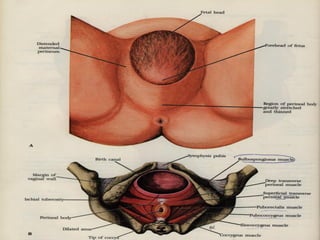
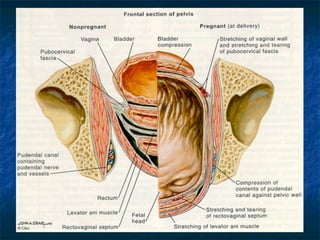

Pelvic Floor Dysfunction
Khalid Sait FRCSC
Professor
( Gynecological Oncology)
Faculty of Medicine
King Abdulaziz University
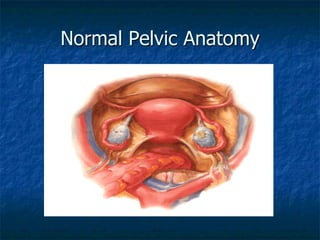
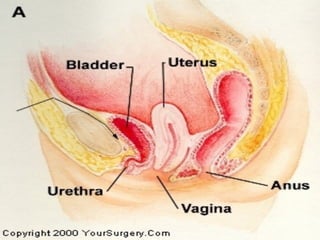
Normal Pelvic Anatomy
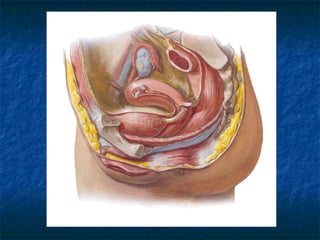
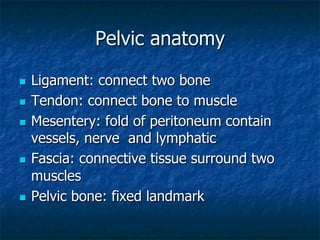
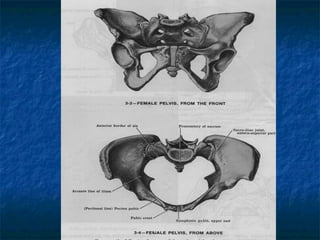
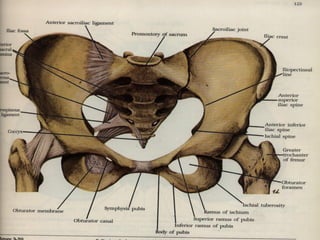
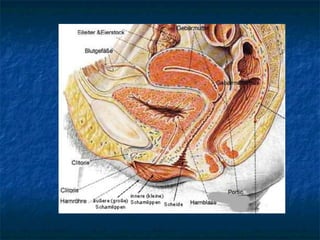
Pelvic anatomy
n  Ligament: connect two bone
n  Tendon: connect bone to muscle
n  Mesentery: fold of peritoneum contain
vessels, nerve and lymphatic
n  Fascia: connective tissue surround two
muscles
n  Pelvic bone: fixed landmark
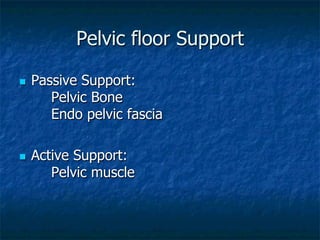
Pelvic floor Support
n  Passive Support:
Pelvic Bone
Endo pelvic fascia
n  Active Support:
Pelvic muscle
Endopelvic fascia
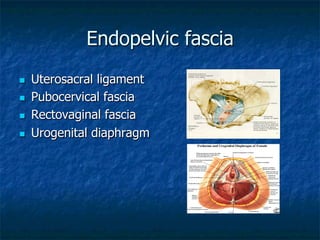
n  Uterosacral ligament
n  Pubocervical fascia
n  Rectovaginal fascia
n  Urogenital diaphragm
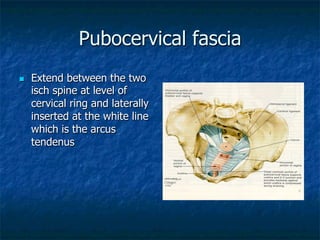
Pubocervical fascia
n  Extend between the two
isch spine at level of
cervical ring and laterally
inserted at the white line
which is the arcus
tendenus
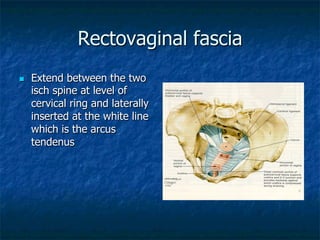
Rectovaginal fascia
n  Extend between the two
isch spine at level of
cervical ring and laterally
inserted at the white line
which is the arcus
tendenus
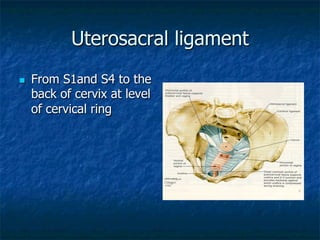
Uterosacral ligament
n  From S1and S4 to the
back of cervix at level
of cervical ring
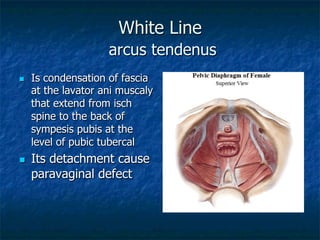
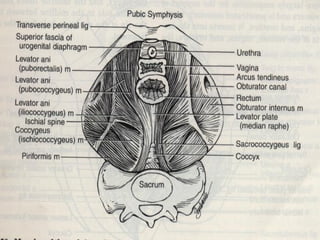
White Line
arcus tendenus
n  Is condensation of fascia
at the lavator ani muscaly
that extend from isch
spine to the back of
sympesis pubis at the
level of pubic tubercal
n  Its detachment cause
paravaginal defect
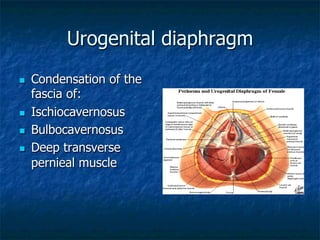
Urogenital diaphragm
n  Condensation of the
fascia of:
n  Ischiocavernosus
n  Bulbocavernosus
n  Deep transverse
pernieal muscle
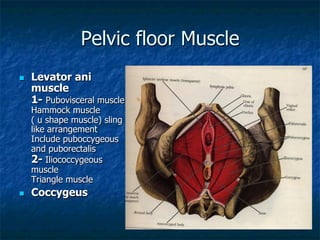
Pelvic floor Muscle
n  Levator ani
muscle
1- Pubovisceral muscle
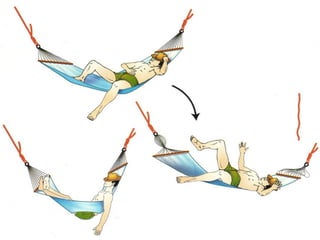
Hammock muscle
( u shape muscle) sling
like arrangement
Include puboccygeous
and puborectalis
2- Iliococcygeous
muscle
Triangle muscle
n  Coccygeus
Pelvic support
n  Not important in pelvic support:
Urogenital diaphragm
Superficial perineal muscle
Bulbocavernosus muscle
Round ligament
Broad ligament
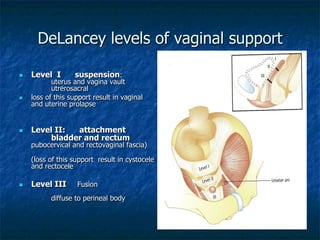
DeLancey levels of vaginal support
n  Level I suspension:
uterus and vagina vault
utrerosacral
n  loss of this support result in vaginal
and uterine prolapse
n  Level II: attachment
bladder and rectum
pubocervical and rectovaginal fascia)
(loss of this support result in cystocele
and rectocele
n  Level III Fusion
diffuse to perineal body
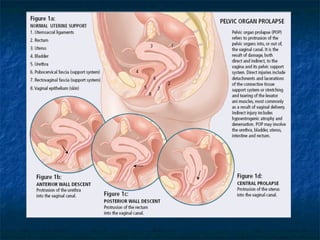
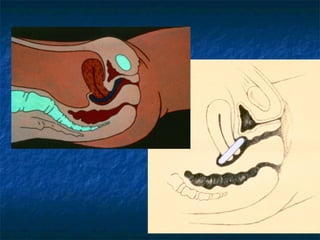
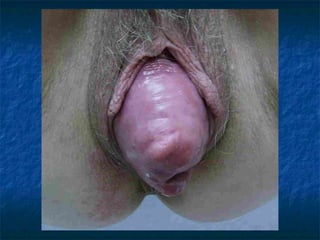
Pelvic Organ Prolapse (POP)
Protrusion of the pelvic organs into, or
out of, the vaginal canal
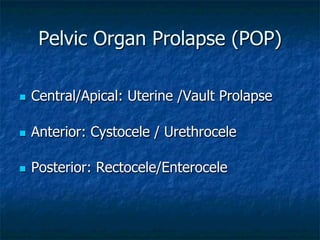
Pelvic Organ Prolapse (POP)
n  Central/Apical: Uterine /Vault Prolapse
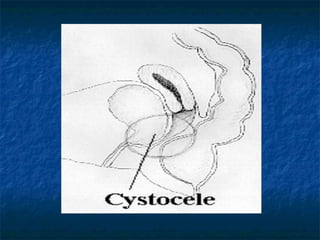
n  Anterior: Cystocele / Urethrocele
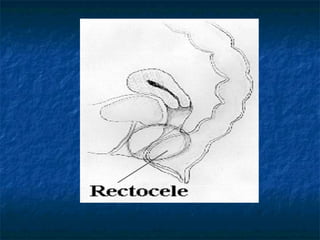
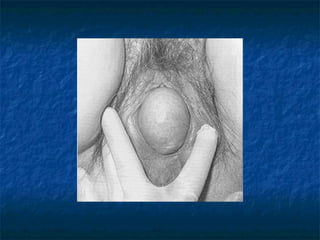
n  Posterior: Rectocele/Enterocele
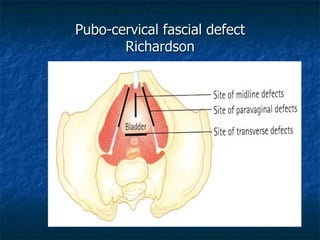
Pubo-cervical fascial defect
Richardson
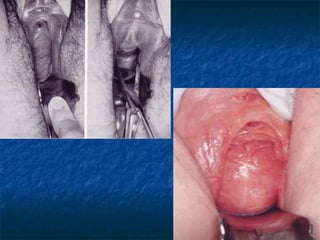
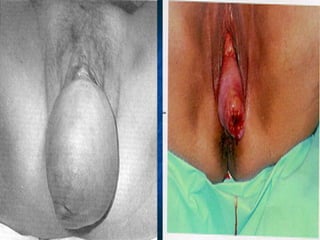
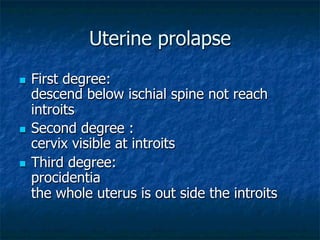
Uterine prolapse
n  First degree:
descend below ischial spine not reach
introits
n  Second degree :
cervix visible at introits
n  Third degree:
procidentia
the whole uterus is out side the introits
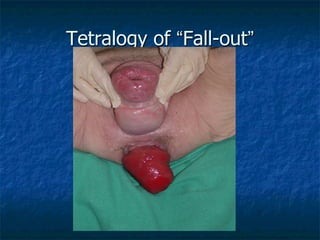
Tetralogy of “Fall-out”
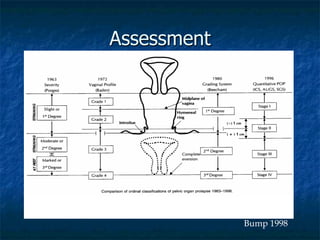
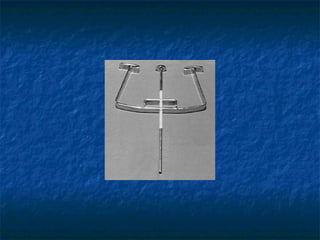
Assessment
Bump 1998
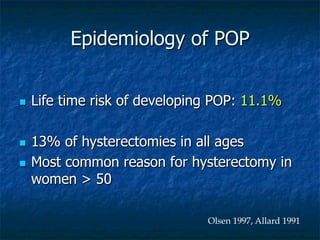
Epidemiology of POP
n  Life time risk of developing POP: 11.1%
n  13% of hysterectomies in all ages
n  Most common reason for hysterectomy in
women > 50
Olsen 1997, Allard 1991
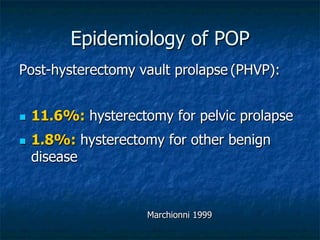
Epidemiology of POP
Post-hysterectomy vault prolapse (PHVP):
n  11.6%: hysterectomy for pelvic prolapse
n  1.8%: hysterectomy for other benign
disease
Marchionni 1999
Etiology & Contributing Factors
n  Childbirth
n  Congenital weakness of fibro muscular support
( white > black)
n  Aging / Estrogen deficiency
n  Increased intra-abdominal pressure
n  Repetitive pelvic pressure (Lifting or Coughing)
n  Neurological disease (eg. Spina bifida)
n  Connective tissue ( eg. Ehlers-Danlos syndrome)
Damage to pelvic support
n  Neuromuscular damage
n  Connective tissue damage
Symptoms and Signs
n  A symptomatic
n  Heaviness / full feeling in the pelvis
n  Some thing coming down
n  Lump in vagina
n  Urinary symptoms( up to anuria)
n  Difficult in defection
n  Difficulty in walking
n  Vaginal discharge and bleeding
n  Dysparonia ( the muscle are slack)
n  Vagina flatus ( whoopee cushion)
Management of POP
Management
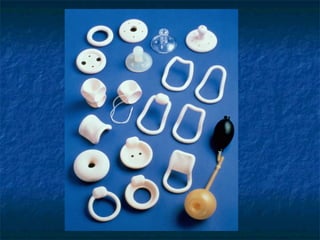
n  Treat underlying cause
n  Conservative: Kegal /Passaries
n  Surgical
Kegal Exercise
n  Find the right muscle:
Lavator ani muscle
(Hammock muscle/Triangle muscle)
1- stop the flow of urine
2- stop passing gas
3- squeezes your finger in vagina
n  How frequent you do
n  Repeat but don't overdo it
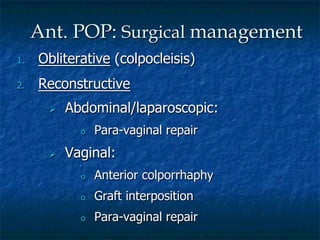
1.  Obliterative (colpocleisis)
2.  Reconstructive
Ø  Abdominal/laparoscopic:
o  Para-vaginal repair
Ø  Vaginal:
o  Anterior colporrhaphy
o  Graft interposition
o  Para-vaginal repair
Ant. POP: Surgical management
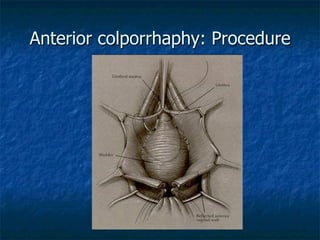
Anterior colporrhaphy: Procedure
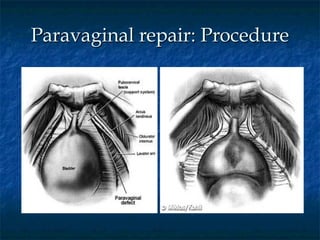
Paravaginal repair: Procedure
1.  Obliterative (colpocleisis)
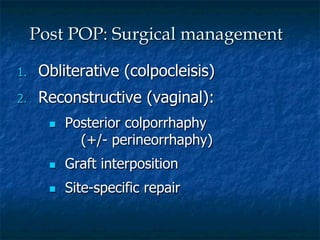
2.  Reconstructive (vaginal):
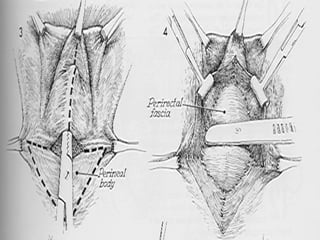
n  Posterior colporrhaphy
(+/- perineorrhaphy)
n  Graft interposition
n  Site-specific repair
Post POP: Surgical management
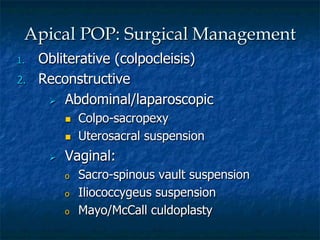
1.  Obliterative (colpocleisis)
2.  Reconstructive
Ø  Abdominal/laparoscopic
n  Colpo-sacropexy
n  Uterosacral suspension
Ø  Vaginal:
o  Sacro-spinous vault suspension
o  Iliococcygeus suspension
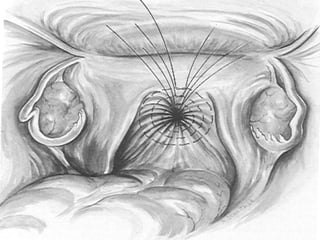
o  Mayo/McCall culdoplasty
Apical POP: Surgical Management
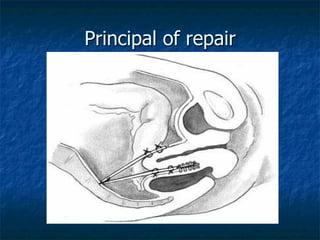
Principal of repair
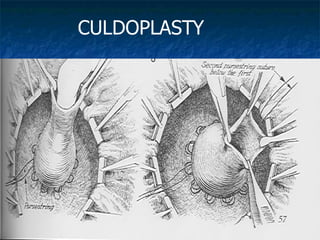
CULDOPLASTY
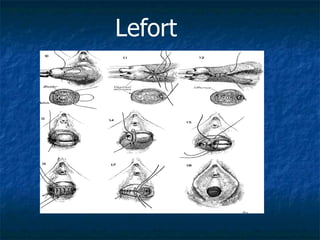
Lefort
Pelvic prolapse student

Pelvic prolapse student

  • 1.
    Pelvic Floor Dysfunction KhalidSait FRCSC Professor ( Gynecological Oncology) Faculty of Medicine King Abdulaziz University
  • 2.
  • 4.
    Pelvic anatomy n  Ligament:connect two bone n  Tendon: connect bone to muscle n  Mesentery: fold of peritoneum contain vessels, nerve and lymphatic n  Fascia: connective tissue surround two muscles n  Pelvic bone: fixed landmark
  • 5.
    Pelvic floor Support n Passive Support: Pelvic Bone Endo pelvic fascia n  Active Support: Pelvic muscle
  • 8.
    Endopelvic fascia n  Uterosacralligament n  Pubocervical fascia n  Rectovaginal fascia n  Urogenital diaphragm
  • 9.
    Pubocervical fascia n  Extendbetween the two isch spine at level of cervical ring and laterally inserted at the white line which is the arcus tendenus
  • 10.
    Rectovaginal fascia n  Extendbetween the two isch spine at level of cervical ring and laterally inserted at the white line which is the arcus tendenus
  • 11.
    Uterosacral ligament n  FromS1and S4 to the back of cervix at level of cervical ring
  • 12.
    White Line arcus tendenus n Is condensation of fascia at the lavator ani muscaly that extend from isch spine to the back of sympesis pubis at the level of pubic tubercal n  Its detachment cause paravaginal defect
  • 13.
    Urogenital diaphragm n  Condensationof the fascia of: n  Ischiocavernosus n  Bulbocavernosus n  Deep transverse pernieal muscle
  • 14.
    Pelvic floor Muscle n Levator ani muscle 1- Pubovisceral muscle Hammock muscle ( u shape muscle) sling like arrangement Include puboccygeous and puborectalis 2- Iliococcygeous muscle Triangle muscle n  Coccygeus
  • 18.
    Pelvic support n  Notimportant in pelvic support: Urogenital diaphragm Superficial perineal muscle Bulbocavernosus muscle Round ligament Broad ligament
  • 19.
    DeLancey levels ofvaginal support n  Level I suspension: uterus and vagina vault utrerosacral n  loss of this support result in vaginal and uterine prolapse n  Level II: attachment bladder and rectum pubocervical and rectovaginal fascia) (loss of this support result in cystocele and rectocele n  Level III Fusion diffuse to perineal body
  • 20.
    Pelvic Organ Prolapse(POP) Protrusion of the pelvic organs into, or out of, the vaginal canal
  • 22.
    Pelvic Organ Prolapse(POP) n  Central/Apical: Uterine /Vault Prolapse n  Anterior: Cystocele / Urethrocele n  Posterior: Rectocele/Enterocele
  • 25.
  • 34.
    Uterine prolapse n  Firstdegree: descend below ischial spine not reach introits n  Second degree : cervix visible at introits n  Third degree: procidentia the whole uterus is out side the introits
  • 35.
  • 36.
  • 38.
    Epidemiology of POP n Life time risk of developing POP: 11.1% n  13% of hysterectomies in all ages n  Most common reason for hysterectomy in women > 50 Olsen 1997, Allard 1991
  • 39.
    Epidemiology of POP Post-hysterectomyvault prolapse (PHVP): n  11.6%: hysterectomy for pelvic prolapse n  1.8%: hysterectomy for other benign disease Marchionni 1999
  • 40.
  • 41.
    Etiology & ContributingFactors n  Childbirth n  Congenital weakness of fibro muscular support ( white > black) n  Aging / Estrogen deficiency n  Increased intra-abdominal pressure n  Repetitive pelvic pressure (Lifting or Coughing) n  Neurological disease (eg. Spina bifida) n  Connective tissue ( eg. Ehlers-Danlos syndrome)
  • 42.
    Damage to pelvicsupport n  Neuromuscular damage n  Connective tissue damage
  • 43.
    Symptoms and Signs n A symptomatic n  Heaviness / full feeling in the pelvis n  Some thing coming down n  Lump in vagina n  Urinary symptoms( up to anuria) n  Difficult in defection n  Difficulty in walking n  Vaginal discharge and bleeding n  Dysparonia ( the muscle are slack) n  Vagina flatus ( whoopee cushion)
  • 44.
  • 46.
    Management n  Treat underlyingcause n  Conservative: Kegal /Passaries n  Surgical
  • 47.
    Kegal Exercise n  Findthe right muscle: Lavator ani muscle (Hammock muscle/Triangle muscle) 1- stop the flow of urine 2- stop passing gas 3- squeezes your finger in vagina n  How frequent you do n  Repeat but don't overdo it
  • 50.
    1.  Obliterative (colpocleisis) 2. Reconstructive Ø  Abdominal/laparoscopic: o  Para-vaginal repair Ø  Vaginal: o  Anterior colporrhaphy o  Graft interposition o  Para-vaginal repair Ant. POP: Surgical management
  • 51.
  • 52.
  • 53.
    1.  Obliterative (colpocleisis) 2. Reconstructive (vaginal): n  Posterior colporrhaphy (+/- perineorrhaphy) n  Graft interposition n  Site-specific repair Post POP: Surgical management
  • 56.
    1.  Obliterative (colpocleisis) 2. Reconstructive Ø  Abdominal/laparoscopic n  Colpo-sacropexy n  Uterosacral suspension Ø  Vaginal: o  Sacro-spinous vault suspension o  Iliococcygeus suspension o  Mayo/McCall culdoplasty Apical POP: Surgical Management
  • 57.
  • 59.
  • 61.