Dr Kaustuv Bhattacharyya
E-mail: amikaustuv@gmail.com
M.Ed. Course 2.2.4
11/02/22 © Dr Kaustuv Bhattacharyya, WBES
Peer tutoring
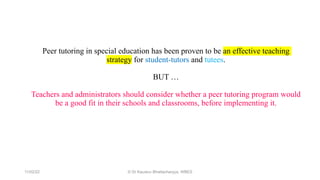
Peer tutoring in special education has been proven to be an effective teaching
strategy for student-tutors and tutees.
BUT …
Teachers and administrators should consider whether a peer tutoring program would
be a good fit in their schools and classrooms, before implementing it.
11/02/22 © Dr Kaustuv Bhattacharyya, WBES
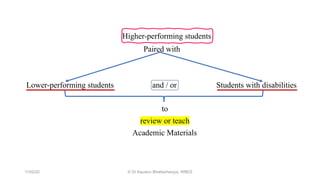
Higher-performing students
Paired with
Lower-performing students and / or Students with disabilities
to
review or teach
Academic Materials
11/02/22 © Dr Kaustuv Bhattacharyya, WBES
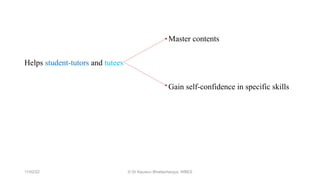
Master contents
Helps student-tutors and tutees
Gain self-confidence in specific skills
11/02/22 © Dr Kaustuv Bhattacharyya, WBES
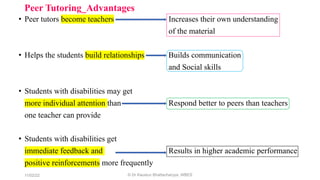
Peer Tutoring_Advantages
• Peer tutors become teachers Increases their own understanding
of the material
• Helps the students build relationships Builds communication
and Social skills
• Students with disabilities may get
more individual attention than Respond better to peers than teachers
one teacher can provide
• Students with disabilities get
immediate feedback and Results in higher academic performance
positive reinforcements more frequently
11/02/22 © Dr Kaustuv Bhattacharyya, WBES
Peer tutoring_Disadvantages
• Planning and preparing requires additional time and organization for the
classroom teacher.
• Peer tutors must be trained, monitored, and graded, which takes time and energy
away from other important classroom tasks.
• Some parents are opposed to peer tutoring because they do not see the benefits for
their child. This means that teachers must educate and convince parents of the
benefits.
11/02/22 © Dr Kaustuv Bhattacharyya, WBES
Implementation
In order to know if a Peer tutoring strategy is successful, teachers need to have
specific and measurable objectives for both the peer-tutors and peer-tutees in
different subjects.
11/02/22 © Dr Kaustuv Bhattacharyya, WBES

Peer Tutoring for Children with Disabilities

  • 1.
    Dr Kaustuv Bhattacharyya E-mail:amikaustuv@gmail.com M.Ed. Course 2.2.4 11/02/22 © Dr Kaustuv Bhattacharyya, WBES Peer tutoring
  • 2.
    Peer tutoring inspecial education has been proven to be an effective teaching strategy for student-tutors and tutees. BUT … Teachers and administrators should consider whether a peer tutoring program would be a good fit in their schools and classrooms, before implementing it. 11/02/22 © Dr Kaustuv Bhattacharyya, WBES
  • 3.
    Higher-performing students Paired with Lower-performingstudents and / or Students with disabilities to review or teach Academic Materials 11/02/22 © Dr Kaustuv Bhattacharyya, WBES
  • 4.
    Master contents Helps student-tutorsand tutees Gain self-confidence in specific skills 11/02/22 © Dr Kaustuv Bhattacharyya, WBES
  • 5.
    Peer Tutoring_Advantages • Peertutors become teachers Increases their own understanding of the material • Helps the students build relationships Builds communication and Social skills • Students with disabilities may get more individual attention than Respond better to peers than teachers one teacher can provide • Students with disabilities get immediate feedback and Results in higher academic performance positive reinforcements more frequently 11/02/22 © Dr Kaustuv Bhattacharyya, WBES
  • 6.
    Peer tutoring_Disadvantages • Planningand preparing requires additional time and organization for the classroom teacher. • Peer tutors must be trained, monitored, and graded, which takes time and energy away from other important classroom tasks. • Some parents are opposed to peer tutoring because they do not see the benefits for their child. This means that teachers must educate and convince parents of the benefits. 11/02/22 © Dr Kaustuv Bhattacharyya, WBES
  • 7.
    Implementation In order toknow if a Peer tutoring strategy is successful, teachers need to have specific and measurable objectives for both the peer-tutors and peer-tutees in different subjects. 11/02/22 © Dr Kaustuv Bhattacharyya, WBES