Bike and Pedestrian GIS Seattle DOT Chad Lynch, SDOT GIS  Amalia Leighton, SvR Design Co.
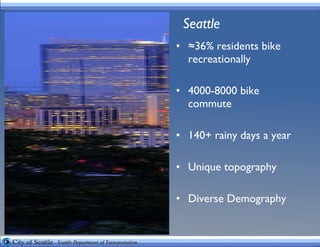
Seattle ≈ 36% residents bike recreationally 4000-8000 bike commute 140+ rainy days a year Unique topography Diverse Demography
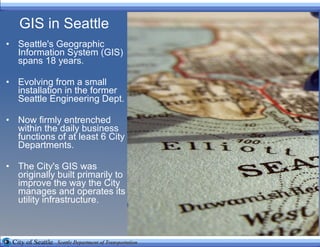
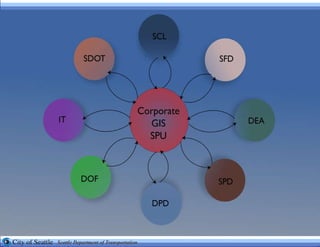
GIS in Seattle Seattle's Geographic Information System (GIS) spans 18 years.  Evolving from a small installation in the former Seattle Engineering Dept. Now firmly entrenched within the daily business functions of at least 6 City Departments. The City's GIS was originally built primarily to improve the way the City manages and operates its utility infrastructure.
 
 
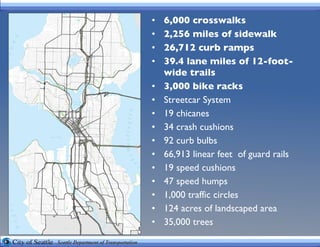
6,000 crosswalks   2,256 miles of sidewalk 26,712 curb ramps   39.4 lane miles of 12-foot-wide trails  3,000 bike racks   Streetcar System 19 chicanes  34 crash cushions  92 curb bulbs  66,913 linear feet  of guard rails 19 speed cushions  47 speed humps  1,000 traffic circles  124 acres of landscaped area 35,000 trees
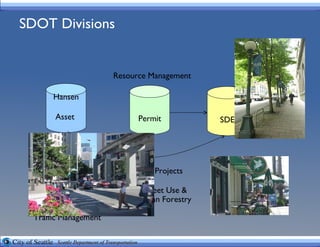
SDOT Divisions Hansen Asset  Mgmnt SDE Street Maintenance Traffic Management Major Projects Policy and Planning Resource Management Permit Capitol Projects & Roadway Structures Street Use & Urban Forestry
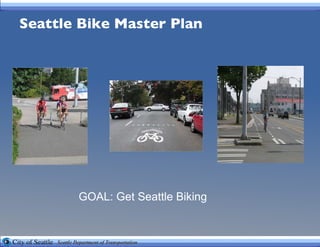
Seattle Bike Master Plan GOAL: Get Seattle Biking
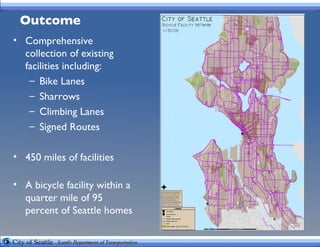
Outcome Comprehensive collection of existing facilities including: Bike Lanes Sharrows Climbing Lanes Signed Routes 450 miles of facilities A bicycle facility within a quarter mile of 95 percent of Seattle homes
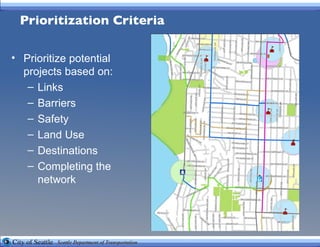
Prioritization Criteria Prioritize potential projects based on: Links Barriers Safety Land Use Destinations Completing the network
Lessons Learned #1   Data should be project based, not segment based. #2   Field names should correspond with the  prioritization criteria for transparency to data  users.   # 3   GIS analyst should help develop the prioritization  criteria
Pedestrian Master Plan
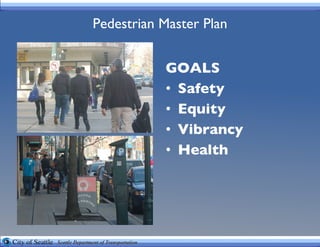
Pedestrian Master Plan GOALS Safety Equity  Vibrancy Health
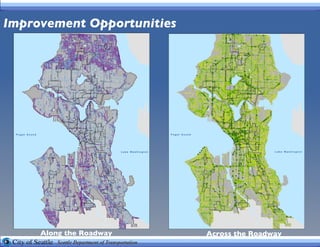
Improvement   Opportunities Along the Roadway Across the Roadway
Improvement   Opportunities 25% of Seattle does not have sidewalks Total Funding (2009-2014):  $60-72 million  ($10-12 million per year)  Maintenance (e.g., sidewalk repair, crosswalk re-striping):  $17-23 million ($3-3.8 million per year)  New Infrastructure (e.g., sidewalks, signals, curb ramps):  $43-$49 million ($7-8 million per year)
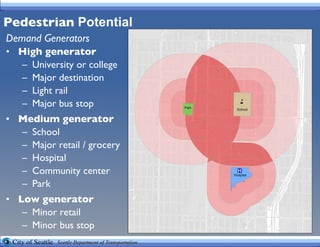
Pedestrian   Potential Demand Generators High generator University or college  Major destination Light rail Major bus stop Medium generator School Major retail / grocery Hospital Community center Park Low generator Minor retail Minor bus stop
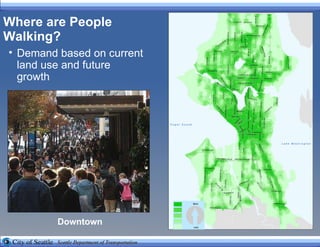
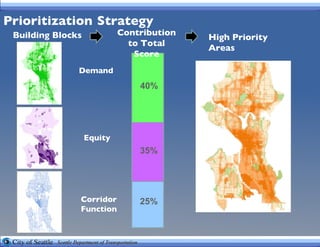
Where are People Walking? Demand based on current land use and future growth Downtown
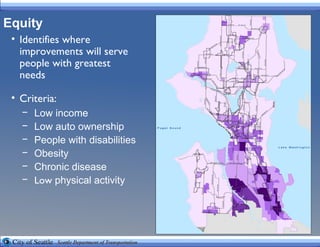
Equity Low income Low auto ownership People with disabilities Obesity Chronic disease Low  physical activity Identifies where improvements will serve people with greatest needs  Criteria:
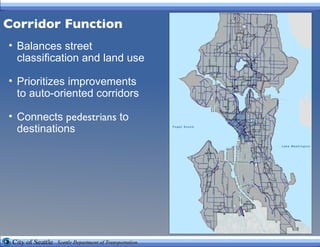
Corridor Function Balances street classification and land use Prioritizes improvements to auto-oriented corridors Connects  pedestrians  to destinations
Prioritization   Strategy Transportation This map shows the combination of the highest  pedestrian demand areas, locations with specific socioeconomic characteristics, and the weighted values for each street type. Demand Equity Building Blocks Contribution to Total Score High Priority Areas 25% 35% 40% Corridor Function
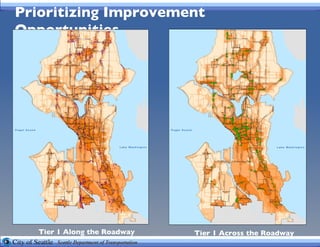
Prioritizing Improvement Opportunities Tier 1 Along the Roadway Tier 1 Across the Roadway
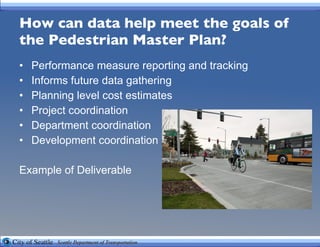
How can data help meet the goals of the Pedestrian Master Plan? Performance measure reporting and tracking Informs future data gathering Planning level cost estimates Project coordination Department coordination Development coordination Example of Deliverable
Questions? Chad Lynch Seattle Department of Transportation Policy and Planning [email_address] Amalia Leighton SvR Design Company Civil Engineer [email_address]

Peer exchange

  • 1.
    Bike and PedestrianGIS Seattle DOT Chad Lynch, SDOT GIS Amalia Leighton, SvR Design Co.
  • 2.
    Seattle ≈ 36%residents bike recreationally 4000-8000 bike commute 140+ rainy days a year Unique topography Diverse Demography
  • 3.
    GIS in SeattleSeattle's Geographic Information System (GIS) spans 18 years. Evolving from a small installation in the former Seattle Engineering Dept. Now firmly entrenched within the daily business functions of at least 6 City Departments. The City's GIS was originally built primarily to improve the way the City manages and operates its utility infrastructure.
  • 4.
  • 5.
  • 6.
    6,000 crosswalks 2,256 miles of sidewalk 26,712 curb ramps 39.4 lane miles of 12-foot-wide trails 3,000 bike racks Streetcar System 19 chicanes 34 crash cushions 92 curb bulbs 66,913 linear feet of guard rails 19 speed cushions 47 speed humps 1,000 traffic circles 124 acres of landscaped area 35,000 trees
  • 7.
    SDOT Divisions HansenAsset Mgmnt SDE Street Maintenance Traffic Management Major Projects Policy and Planning Resource Management Permit Capitol Projects & Roadway Structures Street Use & Urban Forestry
  • 8.
    Seattle Bike MasterPlan GOAL: Get Seattle Biking
  • 9.
    Outcome Comprehensive collectionof existing facilities including: Bike Lanes Sharrows Climbing Lanes Signed Routes 450 miles of facilities A bicycle facility within a quarter mile of 95 percent of Seattle homes
  • 10.
    Prioritization Criteria Prioritizepotential projects based on: Links Barriers Safety Land Use Destinations Completing the network
  • 11.
    Lessons Learned #1 Data should be project based, not segment based. #2 Field names should correspond with the prioritization criteria for transparency to data users. # 3 GIS analyst should help develop the prioritization criteria
  • 12.
  • 13.
    Pedestrian Master PlanGOALS Safety Equity Vibrancy Health
  • 14.
    Improvement Opportunities Along the Roadway Across the Roadway
  • 15.
    Improvement Opportunities 25% of Seattle does not have sidewalks Total Funding (2009-2014): $60-72 million ($10-12 million per year) Maintenance (e.g., sidewalk repair, crosswalk re-striping): $17-23 million ($3-3.8 million per year) New Infrastructure (e.g., sidewalks, signals, curb ramps): $43-$49 million ($7-8 million per year)
  • 16.
    Pedestrian Potential Demand Generators High generator University or college Major destination Light rail Major bus stop Medium generator School Major retail / grocery Hospital Community center Park Low generator Minor retail Minor bus stop
  • 17.
    Where are PeopleWalking? Demand based on current land use and future growth Downtown
  • 18.
    Equity Low incomeLow auto ownership People with disabilities Obesity Chronic disease Low physical activity Identifies where improvements will serve people with greatest needs Criteria:
  • 19.
    Corridor Function Balancesstreet classification and land use Prioritizes improvements to auto-oriented corridors Connects pedestrians to destinations
  • 20.
    Prioritization Strategy Transportation This map shows the combination of the highest pedestrian demand areas, locations with specific socioeconomic characteristics, and the weighted values for each street type. Demand Equity Building Blocks Contribution to Total Score High Priority Areas 25% 35% 40% Corridor Function
  • 21.
    Prioritizing Improvement OpportunitiesTier 1 Along the Roadway Tier 1 Across the Roadway
  • 22.
    How can datahelp meet the goals of the Pedestrian Master Plan? Performance measure reporting and tracking Informs future data gathering Planning level cost estimates Project coordination Department coordination Development coordination Example of Deliverable
  • 23.
    Questions? Chad LynchSeattle Department of Transportation Policy and Planning [email_address] Amalia Leighton SvR Design Company Civil Engineer [email_address]

Editor's Notes

  • #9 This is a plan for all users On-road bicycle facilities. Install 380 miles of bicycle lanes, specially marked shared lanes, bicycle boulevards, and signed routes to provide options for bicyclists of all levels. Crossing improvements. Improvements at key connections and across major barriers. Multi-use trail facilities. A 60-mile Urban Trails and Bikeways System (i.e. Burke Gilman and Chief Sealth). Citywide bicycle destination signs program . Install 240 miles of signed bicycle routes. Programs to encourage and educate users. Bike racks and Seattle Bicycling Guide Map. Complete Streets implementation. Immediately applied to all current and future projects. Bicycle facilities on 59 percent (280 miles) of Seattle’s arterial streets Bicycle lanes, climbing lanes, and sharrows included in repaving projects Arterial crossing improvements on bicycle routes Bicycle lanes (100 miles) Climbing lanes (30 miles) Shared lane pavement markings (109 miles) Other facilities (47 miles) Paved shoulders Wide outside lanes Peak hour bus/bike
  • #12 #1 Data should be project based, not segment based. Projects should be determined by Bike Program staff or advisory boards. Projects may be determined by facility type or geographic location. #2 Field names should correspond with the prioritization criteria for transparency to data users. # 3 GIS analyst should help develop the prioritization criteria Helps ensure that the organization has or could obtain/create the necessary data and to ensure that the queries align with software capabilities.
  • #15 Along the roadway relative opportunity based on: Average daily traffic Motor vehicle speed Buffer and sidewalk width Slope of sidewalk Presence of parking and curb Across the roadway: Identify and compare opportunities to improve infrastructure based on: Average daily traffic Motor vehicle speed Road width Presence of traffic signals, curb ramps, and crosswalks
  • #17 Examine demand at an eighth, a quarter, and a half mile radius from each destination Use layer strategy to determine “hot spots” where these destinations are located in proximity to each other. Weight is assigned to features to account for the assumption that certain destinations will generate relatively more pedestrian traffic than others (a light rail station will generate more pedestrian traffic than a bus stop).
  • #18 Generate and quantify a defendable approximation of pedestrian demand Can see the differences between areas such as downtown, Capitol Hill, West Seattle, and the University District
  • #19 Original criteria: Low income Low auto ownership People with disabilities Population over 65 Population under 18 Obesity Diabetes (proxy for chronic disease) Asthma Final criteria: Low income Low auto ownership People with disabilities Obesity Diabetes Low physical activity REMOVED: age and asthma
  • #20 Along the roadway relative opportunity based on: Average daily traffic Motor vehicle speed Buffer and sidewalk width Slope of sidewalk Presence of parking and curb Across the roadway: Identify and compare opportunities to improve infrastructure based on: Average daily traffic Motor vehicle speed Road width Presence of traffic signals, curb ramps, and crosswalks
  • #21 Goals Establish relative importance of different projects and areas Establish objective criteria and process for decision making Create a blueprint for implementing broader policy goals Outcomes Identify priority project areas and specific projects
  • #22 The prioritization and opportunities analysis are combined to highlight areas that have both the greatest need. This approach highlights potential areas where infrastructure projects such as new sidewalks or pedestrian crossing islands are likely to have the biggest potential impact. Map on the left shows the highest improvement opportunities along the roadway in areas of highest priority. Map on the right shows the highest improvement opportunities across the roadway in areas of highest priority.