MOVE
SEATTLE
Seattle Department
of Transportation
Mayor Edward B. Murray’s
Spring 2015
10-Year Strategic Vision for Transportation
Moving Seattle forward will
require us all to...
...Organize our actions
around our core values
...Think about Seattle,
today and tomorrow
...Integrate our
modal plans
...Prioritize projects
page 1
page 6
page 38
page 30
Dear friends,
My vision for Seattle is one where people can safely and comfortably
get around; where people can choose from a variety of reliable,
affordable, easy-to-use travel options; where the way we design our
streets and sidewalks contributes to our quality of life and economic
vibrancy; and where we harness innovation to expand choices and
improve the environment.
In many ways, we are close to achieving this vision. More people are
walking, biking, and using transit than ever before. Our light rail and
streetcar networks are expanding. New tools like Pronto Cycle Share
and a variety of car share and ride share options are making it easier
to get around without having to own a car.
At the same time, we recognize that many people today rely on a
personal vehicle as their best or only travel option. We need to make
travel for all more efficient and predictable and we can do this by
offering everyone more high-quality choices. Fewer cars on the road
mean that when you do have to drive, you’ll be up against less traffic.
It also means that freight deliveries and transit will make it to their
destinations on time.
And while we are making strides, we must also face the reality that
we are the fastest-growing major city in the country. Our ability to
keep pace with this growth is being put to the test as many of our
streets, sidewalks, and bridges are in need of repair. With greater
demand on a street system that isn’t expanding, we need to figure
out how to move more people and goods in a set amount of space.
This is no small task.
My Move Seattle strategy describes a holistic transportation
approach, linked to land use, that integrates our bicycle, pedestrian,
transit, and freight plans. It overlays these plans and highlights
streets where we should focus investments to improve safety
and mobility for all travelers. It includes a 10-year project list
and maintenance and operations priorities, complete with cost
projections. You will also find a series of strategic goals and a set
of performance metrics to be tracked annually, so we can measure
success and so you can hold us accountable.
At the end of the day, the way in which people and goods move about
Seattle serves as a key indicator of our quality of life. Move Seattle
sets forth my strategy for a safe, affordable, interconnected, vibrant,
and innovative transportation system that will contribute to an even
greater Seattle.
Sincerely,
Mayor Edward Murray
Office of the Mayor
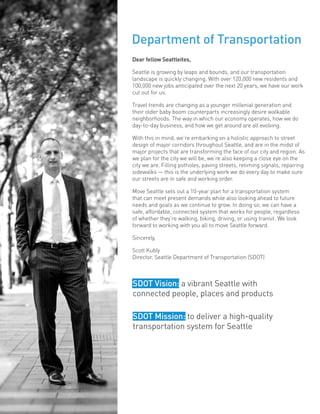
Dear fellow Seattleites,
Seattle is growing by leaps and bounds, and our transportation
landscape is quickly changing. With over 120,000 new residents and
100,000 new jobs anticipated over the next 20 years, we have our work
cut out for us.
Travel trends are changing as a younger millenial generation and
their older baby boom counterparts increasingly desire walkable
neighborhoods. The way in which our economy operates, how we do
day-to-day business, and how we get around are all evolving.
With this in mind, we’re embarking on a holistic approach to street
design of major corridors throughout Seattle, and are in the midst of
major projects that are transforming the face of our city and region. As
we plan for the city we will be, we’re also keeping a close eye on the
city we are. Filling potholes, paving streets, retiming signals, repairing
sidewalks — this is the underlying work we do every day to make sure
our streets are in safe and working order.
Move Seattle sets out a 10-year plan for a transportation system
that can meet present demands while also looking ahead to future
needs and goals as we continue to grow. In doing so, we can have a
safe, affordable, connected system that works for people, regardless
of whether they’re walking, biking, driving, or using transit. We look
forward to working with you all to move Seattle forward.
Sincerely,
Scott Kubly
Director, Seattle Department of Transportation (SDOT)
Department of Transportation
SDOT Vision: a vibrant Seattle with
connected people, places and products
SDOT Mission: to deliver a high-quality
transportation system for Seattle
Seattle today is
facing the challenges
that come with being
one of the fastest-
growing major cities
in the country.
SEATTLE TODAY
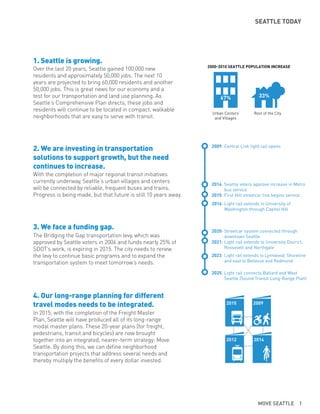
Over the last 20 years, Seattle gained 100,000 new
residents and approximately 50,000 jobs. The next 10
years are projected to bring 60,000 residents and another
50,000 jobs. This is great news for our economy and a
test for our transportation and land use planning. As
Seattle’s Comprehensive Plan directs, these jobs and
residents will continue to be located in compact, walkable
neighborhoods that are easy to serve with transit.
1. Seattle is growing.
With the completion of major regional transit initiatives
currently underway, Seattle’s urban villages and centers
will be connected by reliable, frequent buses and trains.
Progress is being made, but that future is still 10 years away.
The Bridging the Gap transportation levy, which was
approved by Seattle voters in 2006 and funds nearly 25% of
SDOT’s work, is expiring in 2015. The city needs to renew
the levy to continue basic programs and to expand the
transportation system to meet tomorrow’s needs.
In 2015, with the completion of the Freight Master
Plan, Seattle will have produced all of its long-range
modal master plans. These 20-year plans (for freight,
pedestrians, transit and bicycles) are now brought
together into an integrated, nearer-term strategy: Move
Seattle. By doing this, we can define neighborhood
transportation projects that address several needs and
thereby multiply the benefits of every dollar invested.
2. We are investing in transportation
solutions to support growth, but the need
continues to increase.
3. We face a funding gap.
4. Our long-range planning for different
travel modes needs to be integrated.
2000-2010 SEATTLE POPULATION INCREASE
Urban Centers
and Villages
67%
Rest of the City
33%
2014: Seattle voters approve increase in Metro
bus service
2015: First Hill streetcar line begins service
2016: Light rail extends to University of
Washington through Capitol Hill
2020: Streetcar system connected through
downtown Seattle
2021: Light rail extends to University District,
Roosevelt and Northgate
2023: Light rail extends to Lynnwood, Shoreline
and east to Bellevue and Redmond
2025: Light rail connects Ballard and West
Seattle (Sound Transit Long-Range Plan)
2009: Central Link light rail opens
2015 2009
2012 2014
MOVE SEATTLE 1
At the same time,
global trends are
reshaping our
transportation
needs and the tools
available to meet
them.
2
SEATTLE TODAY
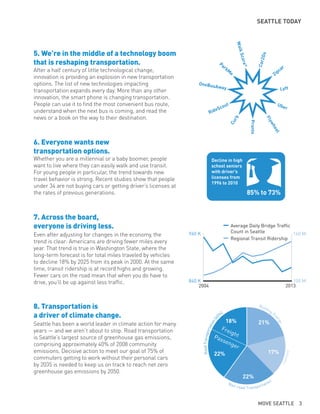
After a half century of little technological change,
innovation is providing an explosion in new transportation
options. The list of new technologies impacting
transportation expands every day. More than any other
innovation, the smart phone is changing transportation.
People can use it to find the most convenient bus route,
understand when the next bus is coming, and read the
news or a book on the way to their destination.
5. We’re in the middle of a technology boom
that is reshaping transportation.
Whether you are a millennial or a baby boomer, people
want to live where they can easily walk and use transit.
For young people in particular, the trend towards new
travel behavior is strong. Recent studies show that people
under 34 are not buying cars or getting driver’s licenses at
the rates of previous generations.
Even after adjusting for changes in the economy, the
trend is clear: Americans are driving fewer miles every
year. That trend is true in Washington State, where the
long-term forecast is for total miles traveled by vehicles
to decline 18% by 2025 from its peak in 2000. At the same
time, transit ridership is at record highs and growing.
Fewer cars on the road mean that when you do have to
drive, you’ll be up against less traffic.
Seattle has been a world leader in climate action for many
years — and we aren’t about to stop. Road transportation
is Seattle’s largest source of greenhouse gas emissions,
comprising approximately 40% of 2008 community
emissions. Decisive action to meet our goal of 75% of
commuters getting to work without their personal cars
by 2035 is needed to keep us on track to reach net zero
greenhouse gas emissions by 2050.
6. Everyone wants new
transportation options.
7. Across the board,
everyone is driving less.
8. Transportation is
a driver of climate change.
2004 2013
Average Daily Bridge Traffic
Count in Seattle
Regional Transit Ridership
960 K
840 K
160 M
100 M
2004 2013
18%
22%
FreightPassenger
21%
22%
17%
RoadTransportation(4
0%
)
Building En
ergy
Industry
Non-road Transportation
Decline in high
school seniors
with driver’s
licenses from
1996 to 2010
85% to 73%
Car2Go
Zipcar
Lyft
Uber
Flywheel
Pronto
Curb
RideScout
OneBusAway
ParkM
e
WalkScore®
MOVE SEATTLE 3
We are ready to meet
these challenges
head on as we
progress towards the
Seattle of tomorrow.
4
SEATTLE TOMORROW
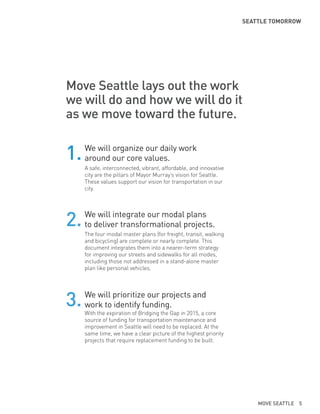
Move Seattle lays out the work
we will do and how we will do it
as we move toward the future.
A safe, interconnected, vibrant, affordable, and innovative
city are the pillars of Mayor Murray’s vision for Seattle.
These values support our vision for transportation in our
city.
We will organize our daily work
around our core values.1.
The four modal master plans (for freight, transit, walking
and bicycling) are complete or nearly complete. This
document integrates them into a nearer-term strategy
for improving our streets and sidewalks for all modes,
including those not addressed in a stand-alone master
plan like personal vehicles.
We will integrate our modal plans
to deliver transformational projects.2.
With the expiration of Bridging the Gap in 2015, a core
source of funding for transportation maintenance and
improvement in Seattle will need to be replaced. At the
same time, we have a clear picture of the highest priority
projects that require replacement funding to be built.
We will prioritize our projects and
work to identify funding.3.
MOVE SEATTLE 5
Organizing our daily
work around our
core values.
6
OUR CORE VALUES
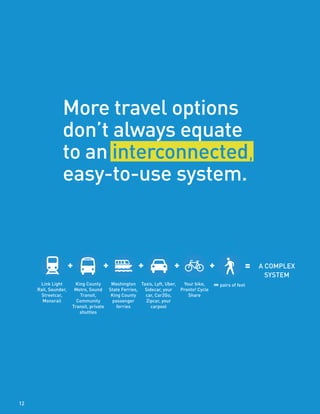
More travel options don’t always equate to an
easy-to-use, interconnected system. Our goal is
to provide an easy-to-use, reliable transportation
system that gives you the options you want when
you need them.
An Interconnected City
A vibrant city is one where the streets and
sidewalks hum with economic and social activity,
where people meet and shop and enjoy the
beautiful city we live in side by side with goods
delivery and freight shipping. Our goal is to use
Seattle’s streets and sidewalks to improve the
city’s health, prosperity and happiness.
A Vibrant City
Our goal is to give all people high-quality and
low-cost transportation options that allow them
to spend their money on things other than
transportation. The transportation system in an
affordable city improves the lives of all travelers:
those with the latest model smart phones in their
pockets and those without.
An Affordable City
Demographic changes and technological
innovation are radically reshaping transportation.
Our goal is to understand and plan for the
changes of tomorrow, while delivering great
service today. This includes newer, more nimble
approaches to delivering projects and programs to
our customers.
An Innovative City
We will not accept traffic deaths as an inevitable
part of traveling together in a safe city. Our goal is
to eliminate serious and fatal crashes in Seattle.
Safety also means being prepared for a natural
disaster by seismically reinforcing our bridges to
withstand earthquakes.
A Safe City
These are our five core values.
MOVE SEATTLE 7
We will not accept
traffic deaths as an
inevitable part of
traveling together in
a safe city.
8
SAFETY
OUR CORE VALUES
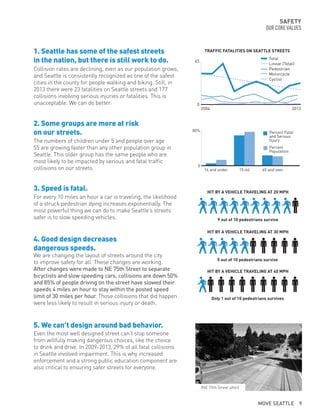
Collision rates are declining, even as our population grows,
and Seattle is consistently recognized as one of the safest
cities in the county for people walking and biking. Still, in
2013 there were 23 fatalities on Seattle streets and 177
collisions involving serious injuries or fatalities. This is
unacceptable. We can do better.
1. Seattle has some of the safest streets
in the nation, but there is still work to do.
The numbers of children under 5 and people over age
55 are growing faster than any other population group in
Seattle. This older group has the same people who are
most likely to be impacted by serious and fatal traffic
collisions on our streets.
For every 10 miles an hour a car is traveling, the likelihood
of a struck pedestrian dying increases exponentially. The
most powerful thing we can do to make Seattle’s streets
safer is to slow speeding vehicles.
We are changing the layout of streets around the city
to improve safety for all. These changes are working.
After changes were made to NE 75th Street to separate
bicyclists and slow speeding cars, collisions are down 50%
and 85% of people driving on the street have slowed their
speeds 4 miles an hour to stay within the posted speed
limit of 30 miles per hour. Those collisions that did happen
were less likely to result in serious injury or death.
Even the most well designed street can’t stop someone
from willfully making dangerous choices, like the choice
to drink and drive. In 2009-2013, 29% of all fatal collisions
in Seattle involved impairment. This is why increased
enforcement and a strong public education component are
also critical to ensuring safer streets for everyone.
2. Some groups are more at risk
on our streets.
3. Speed is fatal.
4. Good design decreases
dangerous speeds.
5. We can’t design around bad behavior.
9 out of 10 pedestrians survive
HIT BY A VEHICLE TRAVELING AT 20 MPH
HIT BY A VEHICLE TRAVELING AT 30 MPH
HIT BY A VEHICLE TRAVELING AT 40 MPH
5 out of 10 pedestrians survive
Only 1 out of 10 pedestrians survives
Percent Fatal
and Serious
Injury
Percent
Population
14 and under 15-64 65 and over
0
80%
TRAFFIC FATALITIES ON SEATTLE STREETS
45
0
2004 2013
Total
Linear (Total)
Pedestrian
Motorcycle
Cyclist
(NE 75th Street after)
MOVE SEATTLE 9
Our goal is to eliminate serious and fatal
crashes in Seattle.
Our 10-year outcomes
for safety investment include:
•	 Repair, replace, and operate bridges to
support safe travel and seismic resiliency
•	 Repair sidewalks and support healthy tree
growth in areas of high pedestrian demand
to enhance safety and support walkable
neighborhoods
•	 Repair damaged residential sidewalks
through innovative cost-sharing solutions to
support walkable neighborhoods
•	 Evaluate and address safety concerns and
crash locations quickly and effectively
•	 Implement safety programs along corridors
with high levels of crashes
•	 Improve safety in school zones
•	 Improve pavement markings, replace aging
signs and add lighting to enhance visibility
and increase safety
•	 Build the core citywide grid of protected bike
lanes and neighborhood greenways
•	 Provide education programs to help
pedestrians, bicyclists and motorists travel
safely and efficiently
•	 Repair damaged or closed public stairways
to connect neighborhoods and improve
accessibility
•	 Identify and fix failing retaining walls and
minimize landslides to protect public
infrastructure and private property
Investing approximately $835 million over the next 10
years will help us eliminate serious and fatal crashes
and reduce the risk of people being injured through
failing infrastructure in Seattle.
(NE 125th Street before)
(NE 125th Street after)
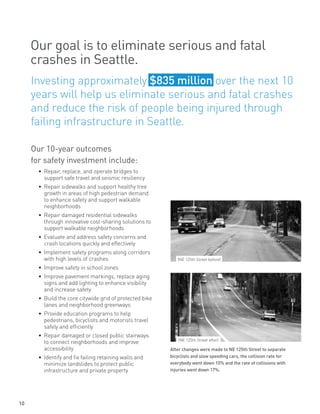
After changes were made to NE 125th Street to separate
bicyclists and slow speeding cars, the collision rate for
everybody went down 10% and the rate of collisions with
injuries went down 17%.
10
SAFETY
OUR CORE VALUES
Roll out a coordinated
Vision Zero program:
•	 Implement 20 mph speed zones in residential
areas on a neighborhood-by-neighborhood
basis, starting with areas with the highest
crash rates
•	 Carry out 5 corridor safety projects, including
on Rainier Ave S, 35th Ave SW, Lake City Way,
and SW Roxbury St
•	 Reduce arterial speed limits to 30 mph or
lower to improve safety
•	 Create a traffic safety education kit for
community groups and schools to promote
road safety and Vision Zero
•	 Partner with Seattle Police Department to
conduct routine enforcement in areas with
high crash rates
•	 Partner with SPD to install at least 12 new
school zone cameras
•	 Improve school walking routes at up to 12
locations and upgrade school zone signage at
up to 15 locations each year
Repair critical infrastructure to
increase safety:
•	 Repair up to 25 blocks of damaged sidewalk
each year
•	 Complete construction of the Yesler Avenue
over Fourth Avenue bridge replacement and
begin construction of the seismic retrofit
of the 45th Avenue Viaduct East Bridge
Approach and the replacement of the Post
Avenue Bridge
•	 Begin seismic retrofit of Seattle’s remaining
unreinforced bridges
•	 Rehabilitate up to 5 stairways each year
Prioritize pedestrians:
•	 Make the 27% of the city without sidewalks
more walkable — through constructing up
to 30 new blocks of sidewalks connecting
to transit stops and community centers
and identifying new funding tools and
partnerships to increase sidewalk
construction
•	 Use high-reflectivity crosswalk markings on
all projects
•	 Modify signal timing to favor pedestrians in
neighborhood business districts
•	 Install up to 25 pedestrian countdown signals
each year
•	 Help employers develop walking programs
for employees in Seattle’s most walkable
neighborhoods
Build out an all ages and abilities
bike network:
•	 Build up to 50 miles of the highest-
priority protected bike lane segments
connecting to and through downtown and
new neighborhood greenways to improve
pedestrian and bicycle travel to and through
our neighborhoods
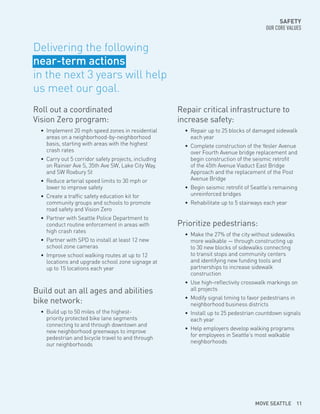
Delivering the following
near-term actions
in the next 3 years will help
us meet our goal.
MOVE SEATTLE 11
Link Light
Rail, Sounder,
Streetcar,
Monorail
King County
Metro, Sound
Transit,
Community
Transit, private
shuttles
Washington
State Ferries,
King County
passenger
ferries
Taxis, Lyft, Uber,
Sidecar, your
car, Car2Go,
Zipcar, your
carpool
Your bike,
Pronto! Cycle
Share
∞ pairs of feet
+ + + + + = A COMPLEX
SYSTEM
More travel options
don’t always equate
to an interconnected,
easy-to-use system.
A COMPLEX
SYSTEM
12
INTERCONNECTED
OUR CORE VALUES
What does reliability mean? It means life can be
predictable — you to get to work on time, your kid gets to
school on time, and you don’t miss the start of a movie.
A key to building a reliable transportation system is
to build a system that is resilient — a system that has
enough alternate routes and modes for people that it isn’t
paralyzed by a construction project, a stadium event, a
crash or a bridge opening. Better information for travelers
and more viable transportation options all contribute to a
more resilient, reliable system.
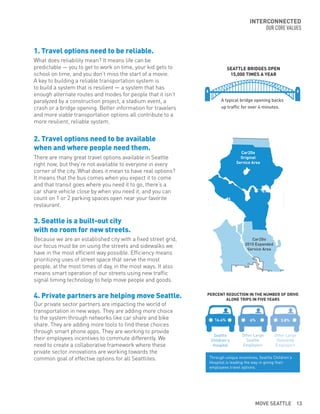
1. Travel options need to be reliable.
There are many great travel options available in Seattle
right now, but they’re not available to everyone in every
corner of the city. What does it mean to have real options?
It means that the bus comes when you expect it to come
and that transit goes where you need it to go, there’s a
car share vehicle close by when you need it, and you can
count on 1 or 2 parking spaces open near your favorite
restaurant.
Because we are an established city with a fixed street grid,
our focus must be on using the streets and sidewalks we
have in the most efficient way possible. Efficiency means
prioritizing uses of street space that serve the most
people, at the most times of day, in the most ways. It also
means smart operation of our streets using new traffic
signal timing technology to help move people and goods.
Our private sector partners are impacting the world of
transportation in new ways. They are adding more choice
to the system through networks like car share and bike
share. They are adding more tools to find these choices
through smart phone apps. They are working to provide
their employees incentives to commute differently. We
need to create a collaborative framework where these
private sector innovations are working towards the
common goal of effective options for all Seattlites.
2. Travel options need to be available
when and where people need them.
3. Seattle is a built-out city
with no room for new streets.
4. Private partners are helping move Seattle.
SEATTLE BRIDGES OPEN
15,000 TIMES A YEAR
Car2Go
Original
Service Area
Car2Go
2015 Expanded
Service Area
PERCENT REDUCTION IN THE NUMBER OF DRIVE
ALONE TRIPS IN FIVE YEARS
Seattle
Children’s
Hospital
Through unique incentives, Seattle Children’s
Hospital is leading the way in giving their
employees travel options.
Other Large
Seattle
Employers
6%
Other Large
Statewide
Employers
3.8%16.4%
A typical bridge opening backs
up traffic for over 4 minutes.
MOVE SEATTLE 13
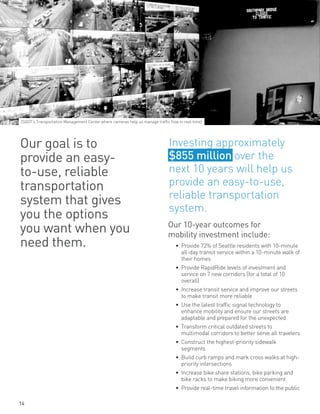
Our 10-year outcomes for
mobility investment include:
•	 Provide 72% of Seattle residents with 10-minute
all-day transit service within a 10-minute walk of
their homes
•	 Provide RapidRide levels of investment and
service on 7 new corridors (for a total of 10
overall)
•	 Increase transit service and improve our streets
to make transit more reliable
•	 Use the latest traffic signal technology to
enhance mobility and ensure our streets are
adaptable and prepared for the unexpected
•	 Transform critical outdated streets to
multimodal corridors to better serve all travelers
•	 Construct the highest-priority sidewalk
segments
•	 Build curb ramps and mark cross walks at high-
priority intersections
•	 Increase bike share stations, bike parking and
bike racks to make biking more convenient
•	 Provide real-time travel information to the public
Our goal is to
provide an easy-
to-use, reliable
transportation
system that gives
you the options
you want when you
need them.
Investing approximately
$855 million over the
next 10 years will help us
provide an easy-to-use,
reliable transportation
system.
(SDOT’s Transportation Management Center where cameras help us manage traffic flow in real-time)
14
Enhance mobility and access:
•	 Synchronize the downtown signal system
•	 Establish a 24-hour Traffic Management
Center to better manage traffic and incident
response 24/7
•	 Implement adaptive signal control along the
Mercer Corridor, Denny Way, and 23rd Avenue
•	 Develop an iconic Seattle transit map to make
Seattle’s transit system easier to understand
•	 Expand Transit Screen displays to 20
buildings to improve access to transportation
information
•	 Partner to design and launch a real-time
multimodal travel and wayfinding app
•	 Define a wayfinding system with our regional
partners that all travelers can rely on
Improve transit and maximize bus
service and ridership growth:
•	 Implement “Always on Time” bus routes by
focusing transit capital improvements on the
routes that serve most Seattle residents
•	 Ensure that 75% of Seattle households are
within a 10-minute walk of bus routes with
service every 15 minutes or better
•	 Install red bus-only lanes and transit priority
improvements at pinch points and implement
targeted enforcement to ensure bus-only
lanes operate effectively
•	 Upgrade bus stops and stations by
implementing a street furniture program and
adding real-time information signs and better
lighting to busy bus stops
•	 Begin construction of bus rapid transit on
Madison Street
•	 Begin construction of the Center City
Streetcar Connector and the Broadway
Extension on Capitol Hill
Bump up Seattle’s bikeability:
•	 Install 1,500 bike parking spaces over the
next three years
•	 Encourage businesses to install bike racks
in the right of way and work with building
owners to increase quality off-street bike
parking
•	 Enhance bicycle commute programs
available to employees
INTERCONNECTED
OUR CORE VALUES
Delivering the following
near-term actions
in the next 3 years will help
us meet our goal.
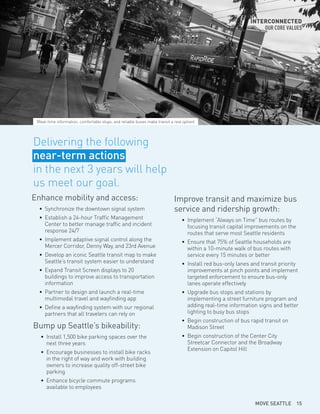
(Real-time information, comfortable stops, and reliable buses make transit a real option)
MOVE SEATTLE 15
A vibrant city is one
where the streets and
sidewalks hum with
activity.
16
VIBRANT
OUR CORE VALUES
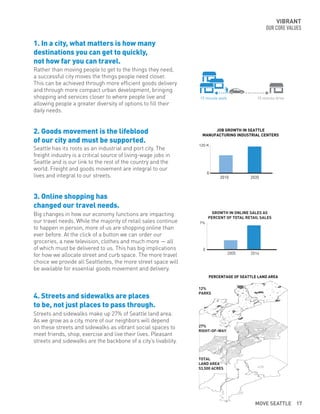
Rather than moving people to get to the things they need,
a successful city moves the things people need closer.
This can be achieved through more efficient goods delivery
and through more compact urban development, bringing
shopping and services closer to where people live and
allowing people a greater diversity of options to fill their
daily needs.
1. In a city, what matters is how many
destinations you can get to quickly,
not how far you can travel.
Seattle has its roots as an industrial and port city. The
freight industry is a critical source of living-wage jobs in
Seattle and is our link to the rest of the country and the
world. Freight and goods movement are integral to our
lives and integral to our streets.
Big changes in how our economy functions are impacting
our travel needs. While the majority of retail sales continue
to happen in person, more of us are shopping online than
ever before. At the click of a button we can order our
groceries, a new television, clothes and much more — all
of which must be delivered to us. This has big implications
for how we allocate street and curb space. The more travel
choice we provide all Seattleites, the more street space will
be available for essential goods movement and delivery.
Streets and sidewalks make up 27% of Seattle land area.
As we grow as a city, more of our neighbors will depend
on these streets and sidewalks as vibrant social spaces to
meet friends, shop, exercise and live their lives. Pleasant
streets and sidewalks are the backbone of a city’s livability.
2. Goods movement is the lifeblood
of our city and must be supported.
3. Online shopping has
changed our travel needs.
4. Streets and sidewalks are places
to be, not just places to pass through.
15 minute walk 15 minute drive
2010 2035
JOB GROWTH IN SEATTLE
MANUFACTURING INDUSTRIAL CENTERS
0
120 K
GROWTH IN ONLINE SALES AS
PERCENT OF TOTAL RETAIL SALES
2005 2014
0
7%
27.5%
53,535 Acres
Seattle
Total Land Area
14,718 Acres
Right-of-Way
6,276 Acres
Parks & Open Sp
12%
12%
PARKS
27%
RIGHT-OF-WAY
TOTAL
LAND AREA
53,500 ACRES
STREETS, SIDEWALKS AND PARKS AS A
PERCENTAGE OF SEATTLE LAND AREA
27.5%
Parks & Open Space
12%
MOVE SEATTLE 17
Our goal is to use Seattle’s streets and
sidewalks to improve the city’s health,
prosperity and happiness.
Our 10-year outcomes for
economic development and
placemaking investment include:
•	 Fund implementation of the Freight Master Plan
•	 Coordinate public and private construction
happening in the street to support new
development and infrastructure upgrades, while
keeping people and goods moving
•	 Pave local streets to enhance access and reduce
contaminated runoff to local waterways
•	 Partner with communities and other departments
to design and build the highest-priority
neighborhood street projects
•	 Manage on-street parking and loading to
support business district vitality and livable,
accessible neighborhoods
•	 Develop and maintain great new public
places in our streets and sidewalks
•	 Protect, preserve, and plant street tree
canopy and improve landscaped areas
to promote environmental health and
encourage walkability
•	 Repair, reinforce, or fill areaways to preserve
neighborhood character and create a better
foundation for streets and sidewalks
•	 Clean and maintain streets and sidewalks to
enhance safety, comfort, and water quality
Investing approximately
$370 million over the
next 10 years will help us
improve Seattle’s health,
happiness, and prosperity.
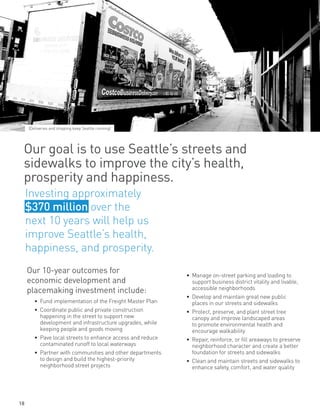
(Deliveries and shipping keep Seattle running)
18
Create more places for people in our
streets and sidewalks:
•	 Launch a new Summer Parkways program that
opens streets to people walking and biking, with
2 events in 2015
•	 Pilot new pedestrian-only streets in areas with
high pedestrian and low vehicle demand
•	 Pilot a volunteer urban forest steward program
•	 Work with community organizations and
the Department of Neighborhoods to pilot a
gardening in the right-of-way (GROW) program
•	 Formalize the Parklet Program and pilot
“Streateries”, a second type of parklet that allows
sidewalk cafes
•	 Launch a “Pavement to Parks/Plazas Program”
at up to 12 locations
•	 Complete the Freight Master Plan
•	 Make spot improvements to help trucks move
more quickly at key bottlenecks
•	 Pilot freight-only lanes in the Greater Duwamish
Manufacturing and Industrial Center
•	 Ramp up the monitoring and collection of truck
volume data within Seattle’s two manufacturing
and industrial centers and connecting corridors
•	 Pilot commercial vehicle loading zone (CVLZ)
pricing with innovative technology to improve
access for commercial and passenger loading
activities
•	 Replace all 2,100 aging parking pay stations with
new technology
•	 Implement time-of-day rates and pay-by-plate
for on-street paid parking and develop pricing
strategies to encourage more pay-by-phone
transactions
•	 Work with at least 3 neighborhoods each year to
develop community access and parking plans
Improve mobility for freight and
delivery vehicles:
Delivering the following
near-term actions
in the next 3 years will help
us meet our goal.
VIBRANT
OUR CORE VALUES
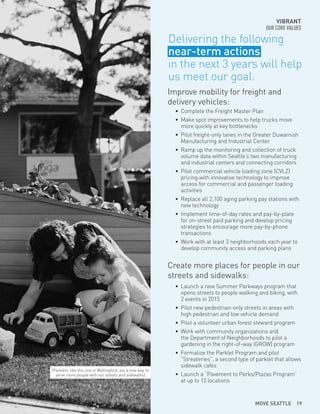
(Parklets, like this one in Wallingford, are a new way to
serve more people with our streets and sidewalks)
MOVE SEATTLE 19
Transportation costs
are significant for
the average Seattle
family. This impacts
the affordability of
our city.
20
AFFORDABLE
OUR CORE VALUES
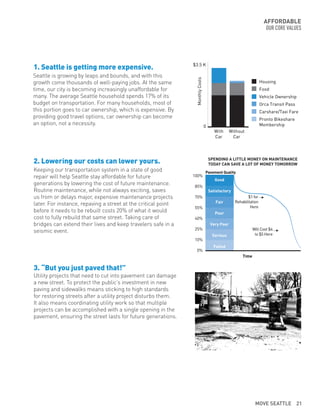
Seattle is growing by leaps and bounds, and with this
growth come thousands of well-paying jobs. At the same
time, our city is becoming increasingly unaffordable for
many. The average Seattle household spends 17% of its
budget on transportation. For many households, most of
this portion goes to car ownership, which is expensive. By
providing good travel options, car ownership can become
an option, not a necessity.
1. Seattle is getting more expensive.
Keeping our transportation system in a state of good
repair will help Seattle stay affordable for future
generations by lowering the cost of future maintenance.
Routine maintenance, while not always exciting, saves
us from or delays major, expensive maintenance projects
later. For instance, repaving a street at the critical point
before it needs to be rebuilt costs 20% of what it would
cost to fully rebuild that same street. Taking care of
bridges can extend their lives and keep travelers safe in a
seismic event.
Utility projects that need to cut into pavement can damage
a new street. To protect the public’s investment in new
paving and sidewalks means sticking to high standards
for restoring streets after a utility project disturbs them.
It also means coordinating utility work so that multiple
projects can be accomplished with a single opening in the
pavement, ensuring the street lasts for future generations.
2. Lowering our costs can lower yours.
3. “But you just paved that!”
With
Car
Without
Car
$3.5 K
0
Housing
Food
Vehicle Ownership
Orca Transit Pass
Carshare/Taxi Fare
Pronto Bikeshare
Membership
MonthlyCosts
Time
Pavement Quality
$1 for
Rehabilitation
Here
Will Cost $4
to $5 Here
100%
85%
70%
55%
40%
25%
10%
0%
Good
Satisfactory
Fair
Poor
Very Poor
Serious
Failed
SPENDING A LITTLE MONEY ON MAINTENANCE
TODAY CAN SAVE A LOT OF MONEY TOMORROW
MOVE SEATTLE 21
Our goal is to give people high-quality and
low-cost transportation options that allow
them to spend their money on things other
than transportation.
Our 10-year outcomes
for affordability investment include:
•	 Repave and maintain major streets to support
transit, pedestrian and bicycle travel, and local
deliveries and other vehicles
•	 Expand the use of cost-effective preventative
maintenance techniques to extend the useful
life of pavement and reduce the need for
pothole repair and costly street reconstruction
•	 Strengthen the “Access Seattle” program,
coordinating public and private construction
activities and ensuring safe travel through
construction zones
•	 Provide new strategies, tools, and assistance
to Seattle travelers as they explore options for
living car-free or with fewer cars
Investing approximately
$830 million over
the next 10 years will
help us provide high-
quality, low-cost travel
options for everyone,
better coordinate and
leverage public and
private investments, and
better preserve existing
infrastructure.
(We’re redesigning streets like Broadway to provide many low-cost travel choices)
22
Make it easier for more people to
walk, bike, and use transit and car
share services:
•	 Develop and implement a new travel options
program for low-income and non-English
speaking residents that provides education,
encouragement, and access to transit, bike
share, car share, and other travel options
•	 Expand travel options programming to five
multifamily residential buildings throughout
the city
•	 Launch focused travel demand management
programs in South Lake Union and Pike/Pine
to improve transportation in these congested
neighborhoods
•	 Explore opportunities to require new
development to provide transit passes
and other travel options as a condition of
development approval
Use our resources efficiently to
save money:
•	 Coordinate projects so that when a street is
resurfaced we look for opportunities to make
improvements called for in the modal plans
•	 Expand SDOT’s microsurfacing program (a
protective seal coat that extends the life of
pavement) to at least 40 miles of residential
streets, and expand SDOT’s cracksealing
program to at least 56 miles of streets,
to maximize the value we get out of our
maintenance dollars
•	 Complete the repaving of portions of 23rd
Avenue, 3rd Avenue, 4th Avenue S, Renton
Avenue South, Roosevelt Way Northeast and
South Spokane Street
•	 Extend the life of Seattle’s streets by
partnering with transit agencies and
other cities in the region to lobby for the
manufacture and purchase of lighter buses
Identify new funding sources:
•	 Explore a code change to allow limited
advertising in the right of way — new revenue
would support downtown streetscapes and
transportation projects
•	 Seek additional sponsorship opportunities to
expand bike share
•	 With other city departments, consider the
implementation of impact fees or other
funding tools to ensure that new development
contributes to the cost of infrastructure
needed to accommodate growth
•	 Investigate opportunities to increase private
investment in the improvement of Seattle’s
transportation system
Strengthen the
“Access Seattle” Program:
•	 Ensure SDOT, public and private utility, and
private construction projects in streets and
sidewalks are fully coordinated, to minimize
disruption to the traveler and minimize
“rework”
•	 Lengthen the moratorium for cutting into
newly-installed pavement (from 3 years to
5) and increase requirements for restoring
pavement that has been disturbed
•	 Launch a “Car Light Living” program to
promote alternatives to owning a personal
vehicle when moving to Seattle
•	 Expand the Community Parking and Access
Program and ensure that small businesses/
employers have information about and
access to discounted transit passes, bike
share and car share memberships
•	 Work with Metro to provide more reduced
fare ORCA LIFT cards to low-income Seattle
households
•	 Increase direct training and other support
services to employers with employee
commute programs
Delivering the following
near-term actions
in the next 3 years will help
us meet our goal.
AFFORDABLE
OUR CORE VALUES
MOVE SEATTLE 23
Demographic
changes and
technological
innovation are
radically reshaping
transportation.
24
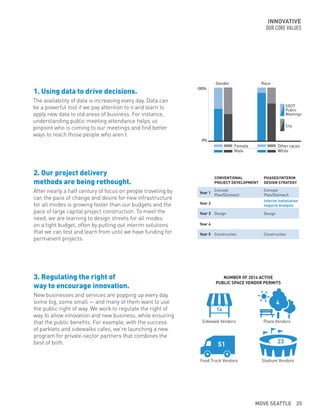
The availability of data is increasing every day. Data can
be a powerful tool if we pay attention to it and learn to
apply new data to old areas of business. For instance,
understanding public meeting attendance helps us
pinpoint who is coming to our meetings and find better
ways to reach those people who aren’t.
1. Using data to drive decisions.
After nearly a half century of focus on people traveling by
car, the pace of change and desire for new infrastructure
for all modes is growing faster than our budgets and the
pace of large capital project construction. To meet the
need, we are learning to design streets for all modes
on a tight budget, often by putting out interim solutions
that we can test and learn from until we have funding for
permanent projects.
New businesses and services are popping up every day,
some big, some small — and many of them want to use
the public right of way. We work to regulate the right of
way to allow innovation and new business, while ensuring
that the public benefits. For example, with the success
of parklets and sidewalks cafes, we’re launching a new
program for private-sector partners that combines the
best of both.
2. Our project delivery
methods are being rethought.
3. Regulating the right of
way to encourage innovation.
INNOVATIVE
OUR CORE VALUES
Sidewalk Vendors
NUMBER OF 2014 ACTIVE
PUBLIC SPACE VENDOR PERMITS
Plaza Vendors
Food Truck Vendors Stadium Vendors
4
51 23
14
CONVENTIONAL
PROJECT DEVELOPMENT
Concept
Plan/Outreach
Design
Construction
PHASED/INTERIM
DESIGN STRATEGY
Concept
Plan/Outreach
Interim Installation
Impacts Analysis
Design
Construction
Year 1
Year 2
Year 3
Year 4
Year 5
Female
RaceGender
Male
0%
SDOT
Public
Meetings
City
Other races
White
100%
MOVE SEATTLE 25
Our goal is to understand and plan for the
changes of tomorrow, while delivering great
service today.
Experiment with new materials and
technologies:
•	 Help lay the groundwork for citywide broadband
by reviewing conduit installation standards and
leveraging existing traffic system conduit, private
development, paving and infrastructure projects
for cost-effective broadband deployment
•	 Pilot rain-sensor traffic signal technology to give
pedestrians and people biking extra crossing
time or shorter wait times when it rains or
snows
•	 Test up to 15 projects per year with an adaptive
approach that uses creative, low-cost materials
to make quick changes to our streets and
sidewalks
•	 Partner with King County Metro or other transit
service providers to pilot automated transit
vehicles and expand the use of battery-powered
buses to reduce carbon emissions
Innovation should infuse
everything we do as an
organization.
Delivering the following
near-term actions
in the next 3 years
will help us meet our
investment goals for
safety, interconnectivity,
vibrancy, and affordability.
26
Capitalize on the potential of
Seattle’s minority and women-
owned businesses:
•	 Remain accountable to our goals for using
minority- and women-owned businesses by
implementing a compliance reporting system
•	 Change the culture of city contracting by
launching a women and minority business
enterprise advocate program
•	 Establish higher standards for women and
minority-owned business inclusion plans in
locally-funded projects
Roll out new standards for public
outreach and engagement:
•	 Reboot our outreach process with a focus on
predictability, effectiveness, and hearing from
a more representative cross-section of the
Seattle public
•	 Engage in community planning efforts in 7
neighborhoods in 2015
Test new ways of doing existing
business:
•	 Improve our efficiency in delivering projects
by investing in technologies such as providing
field access to our inspectors so they can
have real-time information to do their jobs,
and integrating our internal data systems to
reduce duplication
•	 Develop and empower an innovations team
of SDOT staff to concentrate on critical
emerging initiatives that require a nimble,
cross-departmental approach
INNOVATIVE
Our Core Values
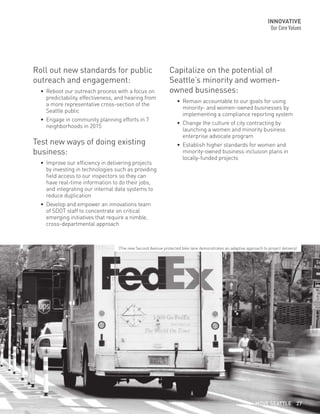
(The new Second Avenue protected bike lane demonstrates an adaptive approach to project delivery)
MOVE SEATTLE 27
These measures,
trends and targets
help us track and
report on our
progress towards
our goals.
28
Measures Baseline*
Desired
Trend
2025
Goal
Safety
Interconnectivity
Vibrancy
Affordability
Innovation
Annual rate of pedestrian collisions (per 100,000 residents) 61 Decrease Decrease x
Annual rate of bicycle collisions per 1,000 bicycle commuters (from
American Community Survey data)
32 Decrease Decrease x
Annual rate of all collisions (per million annual daily trips) 54.8 Decrease Decrease x
Annual number of fatalities and serious injuries by all modes of
travel
23 fatalities 174
serious injuries
Decrease 0 x
x
Percentage of potholes repaired within 3 days of notification
Percentage of households within a 10-minute walk of a
frequent transit route running every 10 minutes or better
88% 90% x x
Percentage of sidewalk repair requests responded
to within 5 days of notification
New measure
in 2015
Increase
Increase
Increase 35%
80% x x
26% (2015) Increase 72% x
Percentage of “Seattle” bus route (routes with 80% of stops in
Seattle) trips that are reliable (on-time in the afternoon peak period)
67.5% Increase 80% x
Percentage of Seattle residents who drive alone to work
(Single Occupant Vehicle)
49% (2012) Decrease
25% or
less SOV
by 2035
x x
Percentage of destinations (business districts, schools, community
centers and similar destinations) with adjacent sidewalks, and
within 1/4 mile of an all ages and abilities bicycle facility and
the Frequent Transit Network
33% (2012) Increase 75% x
Annual number of public space permits in streets and sidewalks
(parklets, sidewalk cafes, food trucks) and temporary activation
permits (play streets, block parties, special events)
Long term – 318
Temporary – 115
Increase 5%
annually
50%
increase
x
Percent of on-street paid parking areas with occupancies within the
range of 1-2 available spaces per block face
46%
5-Year average:
9.6 injuries
125 days lost
Increase 75% x
Number of workplace injuries and days lost due to injury
(per 100 employees full-time)
Decrease
3% per year
Reduce by
30%
x
Percentage of annual hours for employees set aside for training
1% for current
employees; 2.5%
for new
employees
Maintain Maintain x
Percentage of SDOT projects and programs using the Inclusive
Outreach and Public Engagement toolkit
Projects: 100%
Programs: begin
tracking in 2015
Increase 100% x
Percentage of all purchasing, prime and subconsultant** contract
dollars issued to women- and minority-owned firms
18%
New measure
in 2015
New measure
in 2015
Increase
0.5% every
year
23% x
Percentage of capital projects delivered on time
Increase to
meet target
90% x
Percentage of capital projects delivered on budget
Increase to
meet target
90% x
Percentage of SDOT Customer Satisfaction Survey respondents who
respond “Satisfied” or “Extremely Satisfied” to the following
question: How satisfied are our customers with work and services
by SDOT to build and maintain Seattle as a whole?
68% Increase 75% x x x x x
*2013 unless noted otherwise
** Tracked for project contracts with Inclusion Plans
Percentage Frequent Transit Network that is maintained and
modernized by rehabilitating the pavement
22% (2014)
TRACKING SUCCESS
OUR CORE VALUES
MOVE SEATTLE 29
We are
integrating
our modal
plans to deliver
transformational
projects.
30
What are the modal master plans?
Streets of the past half-century were designed
primarily for cars. We are focused on designing
streets for the future based on our four citywide
master plans for transit, pedestrian, freight (in
development) and bicycle modes. They identify our
future networks, projects, and programs. These
20-year plans detail key investments, policies, and
objective data-driven priorities that will greatly
improve travel by each mode. Thousands of people
from all over Seattle helped put these plans together.
They have been adopted by City Council, and
collectively they spell out a shared vision for how we
move people and goods in Seattle.
INTEGRATING PLANS
How do we integrate and prioritize
the recommendations in the modal
master plans?
Because of Seattle’s topography and street grid
patterns, specific streets are important in all of our
plans for people on foot, on bicycle, in a truck, in a car,
or on transit. These streets also provide the most direct
connections to major destinations throughout the city.
Our streets can’t expand to fit all these different types
of travel, so how do we integrate the plans to design
streets that work today and tomorrow?
(Dexter Avenue — a street that works for all users)
MOVE SEATTLE 31
A
B
P
FREIGHTTRANSIT
BIKE
PEDESTRIAN
IS IT IN AN AREA WHERE MANY PEOPLE
WALK OR WANT TO WALK? DOES IT SERVE OUR
INDUSTRIAL AND MANUFACTURING CENTERS? WHAT ARE THE
MAJOR DESTINATIONS ALONG THE STREET (OFFICES, SHOPS, HIGHER
DENSITY HOUSING)? IS IT A TRANSIT ROUTE FOR THOUSANDS OF RIDERS A DAY?
ARE THERE BICYCLE OR OTHER SAFETY ISSUES THAT MUST BE ADDRESSED? ARE THERE
KEY NEEDS FOR FREIGHT DELIVERIES, ON-STREET CAR OR BIKE PARKING, OR GATHERING
SPACES FOR PEOPLE? IS IT IN AN AREA WHERE MANY PEOPLE WALK OR WANT TO WALK? DOES IT
SERVE OUR INDUSTRIAL AND MANUFACTURING CENTERS? WHAT ARE THE MAJOR DESTINATIONS ALONG
THE STREET (OFFICES, SHOPS, HIGHER DENSITY HOUSING)? IS IT A TRANSIT ROUTE FOR THOUSANDS OF
RIDERS A DAY? ARE THERE BICYCLE OR OTHER SAFETY ISSUES THAT MUST BE ADDRESSED? ARE THERE KEY
NEEDS FOR FREIGHT DELIVERIES, ON-STREET CAR OR BIKE PARKING, OR GATHERING SPACES FOR PEOPLE? IS IT
IN AN AREA WHERE MANY PEOPLE WALK OR WANT TO WALK? DOES IT SERVE OUR INDUSTRIAL AND
MANUFACTURING CENTERS? WHAT ARE THE MAJOR DESTINATIONS ALONG THE STREET (OFFICES, SHOPS, HIGHER
DENSITY HOUSING)? IS IT A TRANSIT ROUTE FOR THOUSANDS OF RIDERS A DAY? ARE THERE BICYCLE OR OTHER SAFETY
ISSUES THAT MUST BE ADDRESSED? ARE THERE KEY NEEDS FOR FREIGHT DELIVERIES, ON-STREET CAR OR BIKE
PARKING, OR GATHERING SPACES FOR PEOPLE? IS IT IN AN AREA WHERE MANY PEOPLE WALK OR WANT TO WALK? DOES
IT SERVE OUR INDUSTRIAL AND MANUFACTURING CENTERS? WHAT ARE THE MAJOR DESTINATIONS ALONG THE STREET
(OFFICES, SHOPS, HIGHER DENSITY HOUSING)? IS IT A TRANSIT ROUTE FOR THOUSANDS OF RIDERS A DAY? ARE THERE
BICYCLE OR OTHER SAFETY ISSUES THAT MUST BE ADDRESSED? ARE THERE KEY NEEDS FOR FREIGHT DELIVERIES,
ON-STREET CAR OR BIKE PARKING, OR GATHERING SPACES FOR PEOPLE? IS IT IN AN AREA WHERE MANY PEOPLE WALK
OR WANT TO WALK? DOES IT SERVE OUR INDUSTRIAL AND MANUFACTURING CENTERS? WHAT ARE THE MAJOR
DESTINATIONS ALONG THE STREET (OFFICES, SHOPS, HIGHER DENSITY HOUSING)? IS IT A TRANSIT ROUTE FOR
THOUSANDS OF RIDERS A DAY? ARE THERE BICYCLE OR OTHER SAFETY ISSUES THAT MUST BE ADDRESSED? ARE
THERE KEY NEEDS FOR FREIGHT DELIVERIES, ON-STREET CAR OR BIKE PARKING, OR GATHERING SPACES FOR
PEOPLE? IS IT IN AN AREA WHERE MANY PEOPLE WALK OR WANT TO WALK? DOES IT SERVE OUR INDUSTRIAL
AND MANUFACTURING CENTERS? WHAT ARE THE MAJOR DESTINATIONS ALONG THE STREET (OFFICES, SHOPS,
HIGHER DENSITY HOUSING)? IS IT A TRANSIT ROUTE FOR THOUSANDS OF RIDERS A DAY? ARE THERE
BICYCLE OR OTHER SAFETY ISSUES THAT MUST BE ADDRESSED? ARE THERE KEY NEEDS FOR FREIGHT
DELIVERIES, ON-STREET CAR OR BIKE PARKING, OR GATHERING SPACES FOR PEOPLE? IS IT IN AN
AREA WHERE MANY PEOPLE WALK OR WANT TO WALK? DOES IT SERVE OUR INDUSTRIAL AND
MANUFACTURING CENTERS? WHAT ARE THE MAJOR DESTINATIONS ALONG THE STREET
(OFFICES, SHOPS, HIGHER DENSITY HOUSING)? IS IT A TRANSIT ROUTE FOR
THOUSANDS OF RIDERS A DAY? ARE THERE BICYCLE OR OTHER SAFETY
ISSUES THAT MUST BE ADDRESSED? ARE THERE KEY NEEDS
FOR FREIGHT DELIVERIES, ON-STREET CAR OR BIKE
PARKING, OR GATHERING SPACES
PROJECT
BIKE
PEDESTRIAN
TRANSIT
FREIGHT
2%
65%
13%20%
Going from plan to project.
Step 1: Overlay
the modal plans
Overlay the needs in the modal
plans to identify where priority
corridors for many modes exist.
Step 3: Develop
alternatives
We look at different ways
we can allocate space in the
street based on the users and
needs identified.
1
2
3
Step 2: Identify the major
purposes of the street
Each street in our city is different and
they serve different land uses, so the
purpose and design of each project will
be distinctive.
32
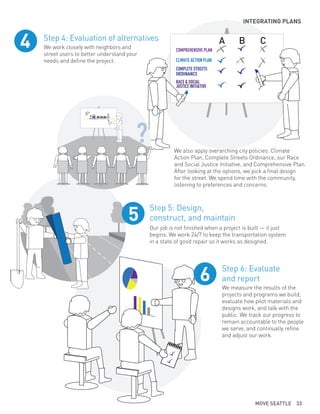
We work closely with neighbors and
street users to better understand your
needs and define the project.
Step 4: Evaluation of alternatives
4
Step 5: Design,
construct, and maintain
Our job is not finished when a project is built — it just
begins. We work 24/7 to keep the transportation system
in a state of good repair so it works as designed.
5
Step 6: Evaluate
and report
We measure the results of the
projects and programs we build,
evaluate how pilot materials and
designs work, and talk with the
public. We track our progress to
remain accountable to the people
we serve, and continually refine
and adjust our work.
6
COMPREHENSIVE PLAN
CLIMATE ACTION PLAN
COMPLETE STREETS
ORDINANCE
RACE & SOCIAL
JUSTICE INITIATIVE
A B C
A
P
?
INTEGRATING PLANS
We also apply overarching city policies: Climate
Action Plan, Complete Streets Ordinance, our Race
and Social Justice Initiative, and Comprehensive Plan.
After looking at the options, we pick a final design
for the street. We spend time with the community,
listening to preferences and concerns.
MOVE SEATTLE 33
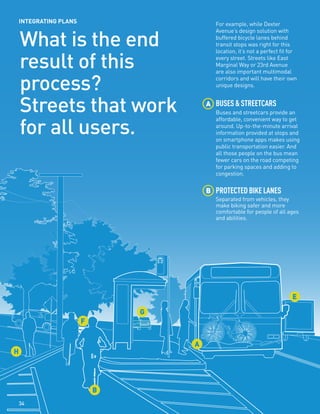
What is the end
result of this
process?
Streets that work
for all users.
BUSES & STREETCARS
Buses and streetcars provide an
affordable, convenient way to get
around. Up-to-the-minute arrival
information provided at stops and
on smartphone apps makes using
public transportation easier. And
all those people on the bus mean
fewer cars on the road competing
for parking spaces and adding to
congestion.
PROTECTED BIKE LANES
Separated from vehicles, they
make biking safer and more
comfortable for people of all ages
and abilities.
For example, while Dexter
Avenue’s design solution with
buffered bicycle lanes behind
transit stops was right for this
location, it’s not a perfect fit for
every street. Streets like East
Marginal Way or 23rd Avenue
are also important multimodal
corridors and will have their own
unique designs.
INTEGRATING PLANS
A
B
F
H
G
A
B
E
34
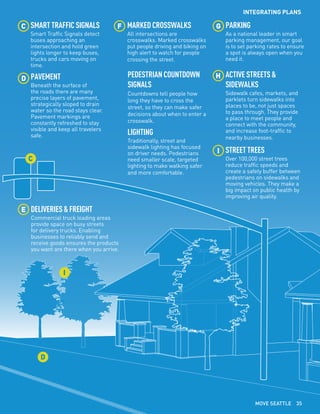
PAVEMENT
Beneath the surface of
the roads there are many
precise layers of pavement,
strategically sloped to drain
water so the road stays clear.
Pavement markings are
constantly refreshed to stay
visible and keep all travelers
safe. LIGHTING
Traditionally, street and
sidewalk lighting has focused
on driver needs. Pedestrians
need smaller scale, targeted
lighting to make walking safer
and more comfortable.
ACTIVE STREETS &
SIDEWALKS
Sidewalk cafes, markets, and
parklets turn sidewalks into
places to be, not just spaces
to pass through. They provide
a place to meet people and
connect with the community,
and increase foot-traffic to
nearby businesses.
STREET TREES
Over 100,000 street trees
reduce traffic speeds and
create a safety buffer between
pedestrians on sidewalks and
moving vehicles. They make a
big impact on public health by
improving air quality.
PARKING
As a national leader in smart
parking management, our goal
is to set parking rates to ensure
a spot is always open when you
need it.
PEDESTRIAN COUNTDOWN
SIGNALS
Countdowns tell people how
long they have to cross the
street, so they can make safer
decisions about when to enter a
crosswalk.
SMART TRAFFIC SIGNALS
Smart Traffic Signals detect
buses approaching an
intersection and hold green
lights longer to keep buses,
trucks and cars moving on
time.
MARKED CROSSWALKS
All intersections are
crosswalks. Marked crosswalks
put people driving and biking on
high alert to watch for people
crossing the street.
DELIVERIES & FREIGHT
Commercial truck loading areas
provide space on busy streets
for delivery trucks. Enabling
businesses to reliably send and
receive goods ensures the products
you want are there when you arrive.
C
I
D
C
D
F G
H
I
E
INTEGRATING PLANS
MOVE SEATTLE 35
POTENTIAL
PROJECTS
QUANTITAT
IVE
QUALITAT
IVE
Major Truck Streets
Bicycle Master Plan
Recommended
Bike Network
Transit Master Plan
Frequent Transit
Network
Pedestrian Master Plan
High Priority Areas
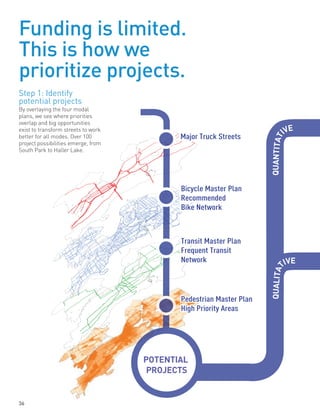
Funding is limited.
This is how we
prioritize projects.
By overlaying the four modal
plans, we see where priorities
overlap and big opportunities
exist to transform streets to work
better for all modes. Over 100
project possibilities emerge, from
South Park to Haller Lake.
Step 1: Identify
potential projects
36
Safe City
Interconnected City
Vibrant City
Affordable City
Can traffic or community impacts can be lessened by
timing a project differently or pairing it with other work?
Does the project require specific windows of partner
participation or is it eligible for specific grants?
Does the project have the support of multiple
constituencies or feature public-private partnerships?
Is there a fair distribution of investment and
benefits among different communities?
Does a project scope or timing help avoid major
maintenance costs down the road?
Leveraging opportunities
Funding availability
(grants, contributions)
Community support
Existing commitments
Geographic equity
Avoidance of major maintenance
Are there signed agreements in place or other official
commitments or is a substantial amount of work
already complete?
Support priority corridors
AdvanceCompleteStreetsImplementation
Community equity and health
Environmental stewardship
Support areas of future growth
Infrastructure condition
Safety and risk
Safe City
Interconnected City
Vibrant City
Affordable City
Can traffic or community impacts can be lessened by
timing a project differently or pairing it with other work?
Does the project require specific windows of partner
participation or is it eligible for specific grants?
Does the project have the support of multiple
constituencies or feature public-private partnerships?
Is there a fair distribution of investment and
benefits among different communities?
Does a project scope or timing help avoid major
maintenance costs down the road?
Leveraging opportunities
Funding availability
(grants, contributions)
Community support
Existing commitments
Geographic equity
Avoidance of major maintenance
Are there signed agreements in place or other official
commitments or is a substantial amount of work
already complete?
Support priority corridors
AdvanceCompleteStreetsImplementation
Community equity and health
Environmental stewardship
Support areas of future growth
Infrastructure condition
Safety and risk
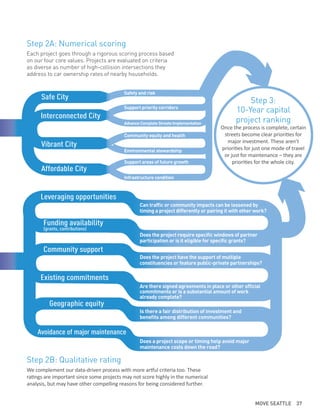
Step 3:
10-Year capital
project ranking
Once the process is complete, certain
streets become clear priorities for
major investment. These aren’t
priorities for just one mode of travel
or just for maintenance – they are
priorities for the whole city.
Step 2A: Numerical scoring
Each project goes through a rigorous scoring process based
on our four core values. Projects are evaluated on criteria
as diverse as number of high-collision intersections they
address to car ownership rates of nearby households.
Step 2B: Qualitative rating
We complement our data-driven process with more artful criteria too. These
ratings are important since some projects may not score highly in the numerical
analysis, but may have other compelling reasons for being considered further.
MOVE SEATTLE 37
Here are the
projects we would
like to design and
build in the next
10 years.
38
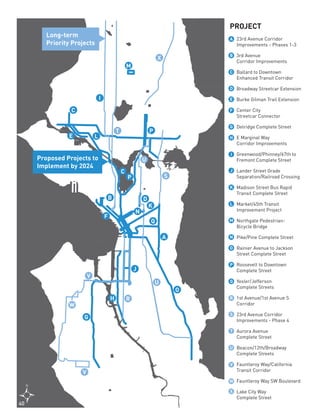
The following map and project sheets
detail a proposal for future SDOT
multimodal project investment. These
are our biggest capital investments
and are in addition to the ongoing
programmatic spending and
maintenance and operations detailed
in the first section of this document.
The proposal depends on future funding to replace the
Bridging the Gap transportation levy and should be
viewed as draft until replacement funding is secured.
City Council will further prioritize and shape this list
as they adopt future 6-year Capital Improvement
Programs in the city budget. The list also will be updated
periodically to reflect new long-range planning efforts,
like the completion of the Freight Master Plan. Design
and construction schedules of these projects will be
driven by many factors, such as funding availability,
coordination with other major construction projects, or
urgent safety or maintenance needs.
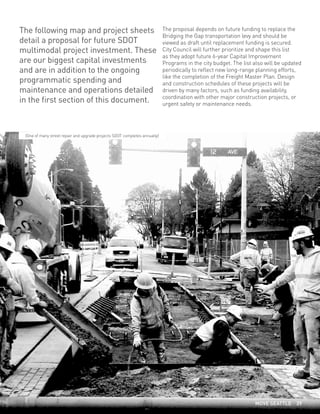
(One of many street repair and upgrade projects SDOT completes annually)
MOVE SEATTLE 39
PROJECT
A 23rd Avenue Corridor
Improvements - Phases 1-3
B 3rd Avenue
Corridor Improvements
C Ballard to Downtown
Enhanced Transit Corridor
D Broadway Streetcar Extension
E Burke Gilman Trail Extension
F Center City
Streetcar Connector
G Delridge Complete Street
H E Marginal Way
Corridor Improvements
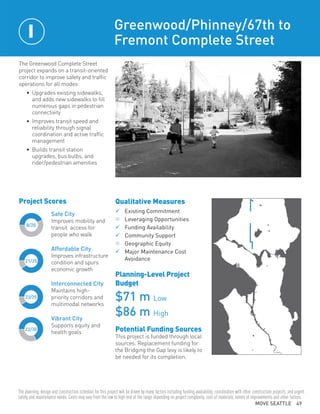
I Greenwood/Phinney/67th to
Fremont Complete Street
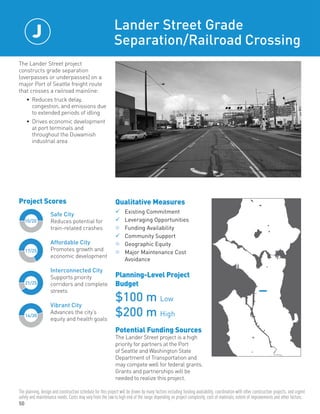
J Lander Street Grade
Separation/Railroad Crossing
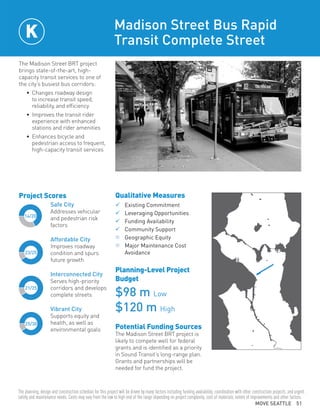
K Madison Street Bus Rapid
Transit Complete Street
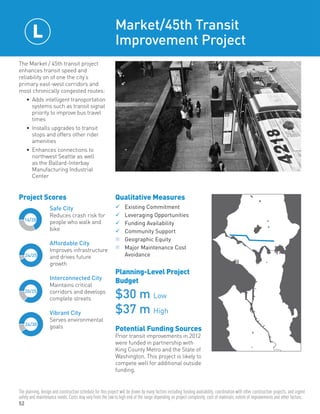
L Market/45th Transit
Improvement Project
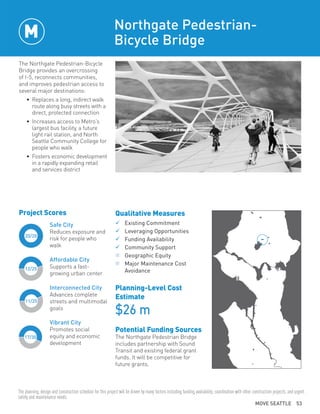
M Northgate Pedestrian-
Bicycle Bridge
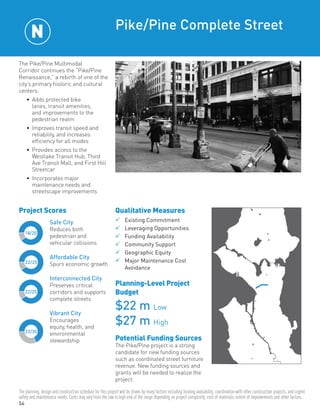
N Pike/Pine Complete Street
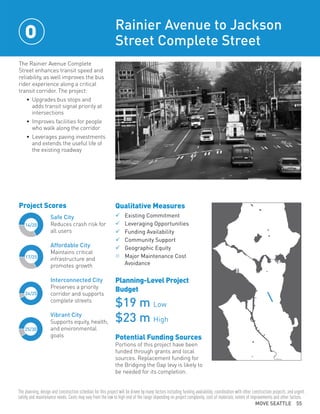
O Rainier Avenue to Jackson
Street Complete Street
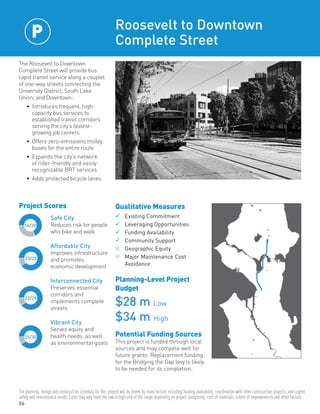
P Roosevelt to Downtown
Complete Street
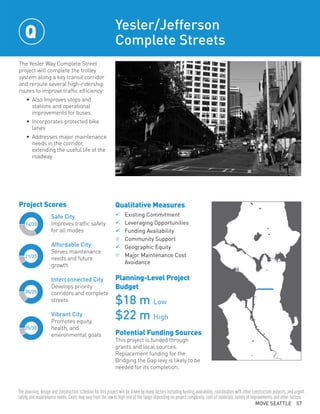
Q Yesler/Jefferson
Complete Streets
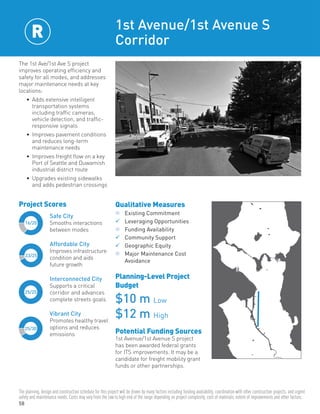
R 1st Avenue/1st Avenue S
Corridor
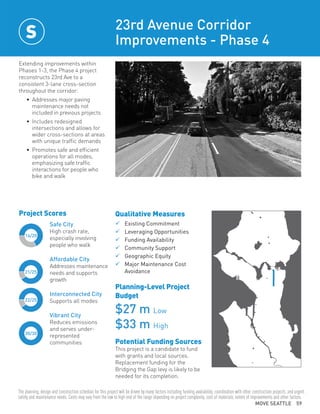
S 23rd Avenue Corridor
Improvements - Phase 4
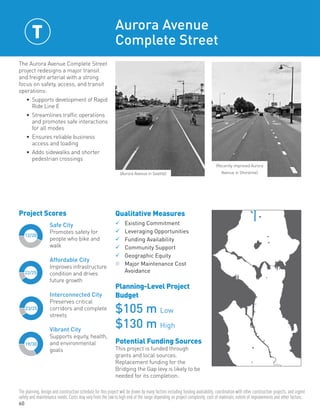
T Aurora Avenue
Complete Street
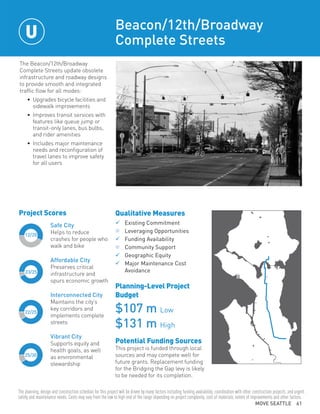
U Beacon/12th/Broadway
Complete Streets
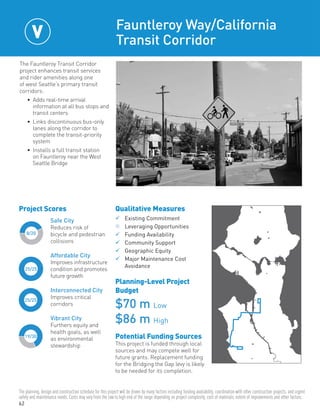
V Fauntleroy Way/California
Transit Corridor
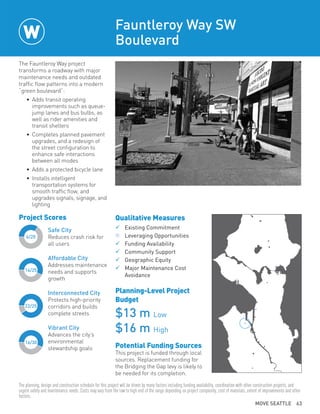
Fauntleroy Way SW Boulevard
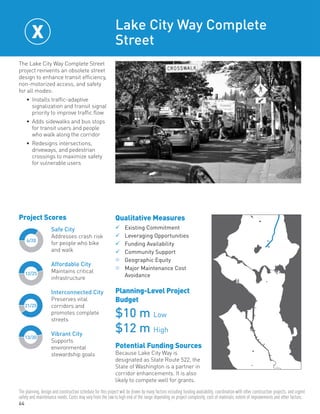
X Lake City Way
Complete Street
Proposed Projects to
Implement by 2024
Long-term
Priority Projects
P
P
C
C
F
B D
K
Q
J
H
G
A
O
N
E L
M
I
U
U
V
V
W
R
S
T
X
A
B
C
D
E
F
G
H
I
J
K
L
M
N
O
P
Q
R
S
T
U
V
W
X
40
MOVE SEATTLE 41
Project Scores
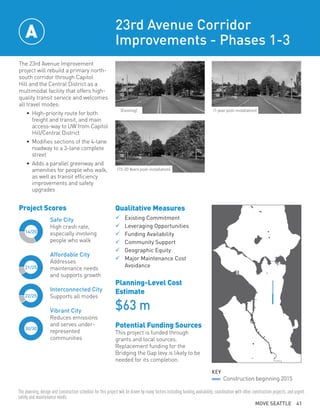
The 23rd Avenue Improvement
project will rebuild a primary north-
south corridor through Capitol
Hill and the Central District as a
multimodal facility that offers high-
quality transit service and welcomes
all travel modes:
•	 High-priority route for both
freight and transit, and main
access-way to UW from Capitol
Hill/Central District
•	 Modifies sections of the 4-lane
roadway to a 3-lane complete
street
•	 Adds a parallel greenway and
amenities for people who walk,
as well as transit efficiency
improvements and safety
upgrades
23rd Avenue Corridor
Improvements - Phases 1-3
Qualitative Measures
	Existing Commitment	
	Leveraging Opportunities	
	Funding Availability	
	Community Support	
	Geographic Equity
	Major Maintenance Cost
	Avoidance
Planning-Level Cost
Estimate
$63 m
Potential Funding Sources
This project is funded through
grants and local sources.
Replacement funding for the
Bridging the Gap levy is likely to be
needed for its completion.
14/20
30/30
21/25
22/25
Safe City
High crash rate,
especially involving
people who walk
Affordable City
Addresses
maintenance needs
and supports growth
Interconnected City
Supports all modes
Vibrant City
Reduces emissions
and serves under-
represented
communities
KEY
Construction beginning 2015
A
(15-20 Years post-installation)
(Existing) (1 year post-installation)
The planning, design and construction schedule for this project will be driven by many factors including funding availability, coordination with other construction projects, and urgent
safety and maintenance needs.
42
Project Scores
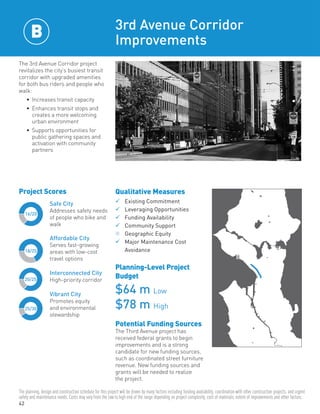
The 3rd Avenue Corridor project
revitalizes the city’s busiest transit
corridor with upgraded amenities
for both bus riders and people who
walk:
•	 Increases transit capacity
•	 Enhances transit stops and
creates a more welcoming
urban environment
•	 Supports opportunities for
public gathering spaces and
activation with community
partners
3rd Avenue Corridor
Improvements
Qualitative Measures
	Existing Commitment	
	Leveraging Opportunities	
	Funding Availability	
	Community Support	
n	Geographic Equity
	Major Maintenance Cost
	Avoidance
Planning-Level Project
Budget
$64 m Low
$78 m High
Potential Funding Sources
The Third Avenue project has
received federal grants to begin
improvements and is a strong
candidate for new funding sources,
such as coordinated street furniture
revenue. New funding sources and
grants will be needed to realize
the project.
16/20
25/30
20/25
18/25
Safe City
Addresses safety needs
of people who bike and
walk
Affordable City
Serves fast-growing
areas with low-cost
travel options
Interconnected City
High-priority corridor
Vibrant City
Promotes equity
and environmental
stewardship
The planning, design and construction schedule for this project will be driven by many factors including funding availability, coordination with other construction projects, and urgent
safety and maintenance needs. Costs may vary from the low to high end of the range depending on project complexity, cost of materials, extent of improvements and other factors.
B
MOVE SEATTLE 43
Project Scores
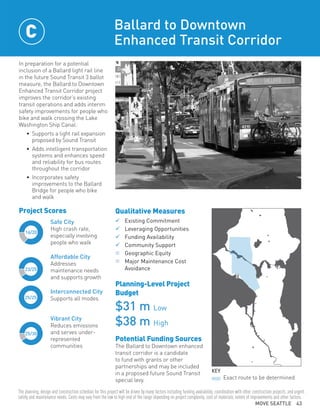
In preparation for a potential
inclusion of a Ballard light rail line
in the future Sound Transit 3 ballot
measure, the Ballard to Downtown
Enhanced Transit Corridor project
improves the corridor’s existing
transit operations and adds interim
safety improvements for people who
bike and walk crossing the Lake
Washington Ship Canal:
•	 Supports a light rail expansion
proposed by Sound Transit
•	 Adds intelligent transportation
systems and enhances speed
and reliability for bus routes
throughout the corridor
•	 Incorporates safety
improvements to the Ballard
Bridge for people who bike
and walk
Ballard to Downtown
Enhanced Transit Corridor
Qualitative Measures
	Existing Commitment	
	Leveraging Opportunities	
	Funding Availability	
	Community Support	
n	Geographic Equity
n	Major Maintenance Cost
	Avoidance
Planning-Level Project
Budget
$31 m Low
$38 m High
Potential Funding Sources
The Ballard to Downtown enhanced
transit corridor is a candidate
to fund with grants or other
partnerships and may be included
in a proposed future Sound Transit
special levy.
16/20
25/30
25/25
23/25
Safe City
High crash rate,
especially involving
people who walk
Affordable City
Addresses
maintenance needs
and supports growth
Interconnected City
Supports all modes
Vibrant City
Reduces emissions
and serves under-
represented
communities
KEY
Exact route to be determined
C
The planning, design and construction schedule for this project will be driven by many factors including funding availability, coordination with other construction projects, and urgent
safety and maintenance needs. Costs may vary from the low to high end of the range depending on project complexity, cost of materials, extent of improvements and other factors.
44
Project Scores
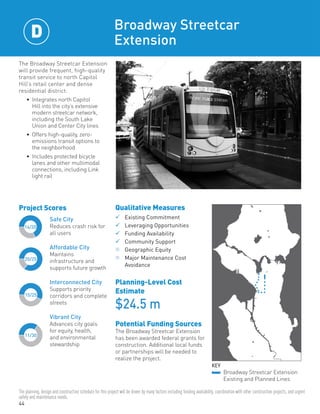
The Broadway Streetcar Extension
will provide frequent, high-quality
transit service to north Capitol
Hill’s retail center and dense
residential district:
•	 Integrates north Capitol
Hill into the city’s extensive
modern streetcar network,
including the South Lake
Union and Center City lines
•	 Offers high-quality, zero-
emissions transit options to
the neighborhood
•	 Includes protected bicycle
lanes and other multimodal
connections, including Link
light rail
Broadway Streetcar
Extension
Qualitative Measures
	Existing Commitment	
	Leveraging Opportunities	
	Funding Availability	
	Community Support	
n	Geographic Equity
n	Major Maintenance Cost
	Avoidance
Planning-Level Cost
Estimate
$24.5 m
Potential Funding Sources
The Broadway Streetcar Extension
has been awarded federal grants for
construction. Additional local funds
or partnerships will be needed to
realize the project.
20/25
15/25
11/30
14/20
Safe City
Reduces crash risk for
all users
Affordable City
Maintains
infrastructure and
supports future growth
Interconnected City
Supports priority
corridors and complete
streets
Vibrant City
Advances city goals
for equity, health,
and environmental
stewardship
KEY
Broadway Streetcar Extension
Existing and Planned Lines
D
The planning, design and construction schedule for this project will be driven by many factors including funding availability, coordination with other construction projects, and urgent
safety and maintenance needs.
MOVE SEATTLE 45
Project Scores
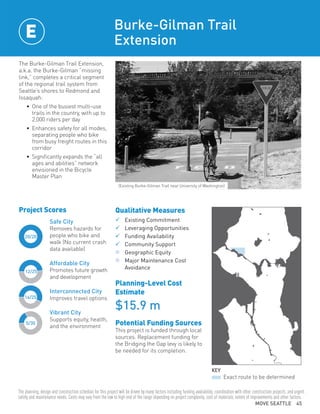
The Burke-Gilman Trail Extension,
a.k.a. the Burke-Gilman “missing
link,” completes a critical segment
of the regional trail system from
Seattle’s shores to Redmond and
Issaquah:
•	 One of the busiest multi-use
trails in the country, with up to
2,000 riders per day
•	 Enhances safety for all modes,
separating people who bike
from busy freight routes in this
corridor
•	 Significantly expands the “all
ages and abilities” network
envisioned in the Bicycle
Master Plan
Burke-Gilman Trail
Extension
Qualitative Measures
	Existing Commitment	
	Leveraging Opportunities	
	Funding Availability	
	Community Support	
n	Geographic Equity
n	Major Maintenance Cost
	Avoidance
Planning-Level Cost
Estimate
$15.9 m
Potential Funding Sources
This project is funded through local
sources. Replacement funding for
the Bridging the Gap levy is likely to
be needed for its completion.
20/20
14/25
12/25
5/30
Safe City
Removes hazards for
people who bike and
walk (No current crash
data available)
Affordable City
Promotes future growth
and development
Interconnected City
Improves travel options
Vibrant City
Supports equity, health,
and the environment
KEY
Exact route to be determined
E
The planning, design and construction schedule for this project will be driven by many factors including funding availability, coordination with other construction projects, and urgent
safety and maintenance needs. Costs may vary from the low to high end of the range depending on project complexity, cost of materials, extent of improvements and other factors.
(Existing Burke-Gilman Trail near University of Washington)
46
Project Scores
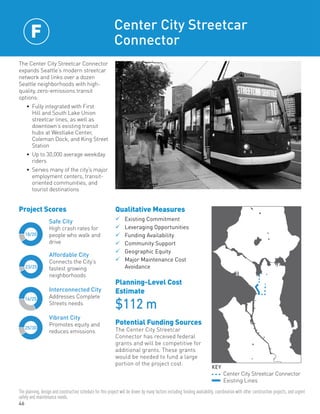
The Center City Streetcar Connector
expands Seattle’s modern streetcar
network and links over a dozen
Seattle neighborhoods with high-
quality, zero-emissions transit
options:
•	 Fully integrated with First
Hill and South Lake Union
streetcar lines, as well as
downtown’s existing transit
hubs at Westlake Center,
Coleman Dock, and King Street
Station
•	 Up to 30,000 average weekday
riders
•	 Serves many of the city’s major
employment centers, transit-
oriented communities, and
tourist destinations
Center City Streetcar
Connector
Safe City
High crash rates for
people who walk and
drive
Affordable City
Connects the City’s
fastest growing
neighborhoods
Interconnected City
Addresses Complete
Streets needs
Vibrant City
Promotes equity and
reduces emissions
18/20
23/25
25/30
16/25
Qualitative Measures
	Existing Commitment	
	Leveraging Opportunities	
	Funding Availability	
	Community Support	
	Geographic Equity
	Major Maintenance Cost
	Avoidance
Planning-Level Cost
Estimate
$112 m
Potential Funding Sources
The Center City Streetcar
Connector has received federal
grants and will be competitive for
additional grants. These grants
would be needed to fund a large
portion of the project cost.
KEY
Center City Streetcar Connector
Existing Lines
F
The planning, design and construction schedule for this project will be driven by many factors including funding availability, coordination with other construction projects, and urgent
safety and maintenance needs.
MOVE SEATTLE 47
Project Scores
The Delridge Complete Street
project improves pavement
conditions, enhances safety, and
improves traffic operations for all
modes:
•	 Adds transit lanes and
improves transit speed and
reliability
•	 Includes protected bike lanes,
sidewalk improvements,
and amenities for walkers
and transit riders along the
corridor
•	 Streamlines traffic operations
and improves multimodal
connections between transit,
freight, people who walk, and
general-purpose vehicles
Delridge Complete Street
Qualitative Measures
	Existing Commitment	
	Leveraging Opportunities	
n	Funding Availability	
	Community Support	
	Geographic Equity
	Major Maintenance Cost
	Avoidance
Planning-Level Project
Budget
$38 m Low
$47 m High
Potential Funding Sources
This project is funded through local
sources and may compete well for
future grants. Replacement funding
for the Bridging the Gap levy is likely
to be needed for its completion.
4/20
14/30
19/25
15/25
Safe City
Supports safety needs
for all modes
Affordable City
Improves infrastructure
condition
Interconnected City
Serves high-priority
corridors and complete
streets
Vibrant City
Drives equity, health,
and environmental
outcomes
G
The planning, design and construction schedule for this project will be driven by many factors including funding availability, coordination with other construction projects, and urgent
safety and maintenance needs. Costs may vary from the low to high end of the range depending on project complexity, cost of materials, extent of improvements and other factors.
48
Project Scores
The E Marginal Way project
reconstructs a core freight route
to heavy haul vehicle standards
and offers safety and operational
improvements for all users:
•	 Serves SODO’s freight
terminals and the center of the
Duwamish industrial district
•	 Invests in major maintenance
needs
•	 Incorporates separate bicycle
and pedestrian facilities while
maintaining freight efficiency
E Marginal Way Corridor
Improvements
Qualitative Measures
	Existing Commitment	
	Leveraging Opportunities	
	Funding Availability	
	Community Support	
	Geographic Equity
	Major Maintenance Cost
	Avoidance
Planning-Level Project
Budget
$40 m Low
$49 m High
Potential Funding Sources
E Marginal Way is a priority corridor
for regional freight operations. It
is likely to compete well for state
or federal grant funds, and may
engage other partnerships.
21/25
6/20
24/25
19/30
Safe City
Reduces conflicts for
people who walk and
bike
Affordable City
Improves infrastructure
and supports growth
Interconnected City
Maintains a critical
corridor and develops
multimodal networks
Vibrant City
Furthers environmental
stewardship goals
H
The planning, design and construction schedule for this project will be driven by many factors including funding availability, coordination with other construction projects, and urgent
safety and maintenance needs. Costs may vary from the low to high end of the range depending on project complexity, cost of materials, extent of improvements and other factors.
MOVE SEATTLE 49
Project Scores
The Greenwood Complete Street
project expands on a transit-oriented
corridor to improve safety and traffic
operations for all modes:
•	 Upgrades existing sidewalks,
and adds new sidewalks to fill
numerous gaps in pedestrian
connectivity
•	 Improves transit speed and
reliability through signal
coordination and active traffic
management
•	 Builds transit station
upgrades, bus bulbs, and
rider/pedestrian amenities
Greenwood/Phinney/67th to
Fremont Complete Street
Qualitative Measures
	Existing Commitment	
n	Leveraging Opportunities	
	Funding Availability	
	Community Support	
n	Geographic Equity
	Major Maintenance Cost
	Avoidance
Planning-Level Project
Budget
$71 m Low
$86 m High
Potential Funding Sources
This project is funded through local
sources. Replacement funding for
the Bridging the Gap levy is likely to
be needed for its completion.
21/25
23/25
8/20
22/30
Safe City
Improves mobility and
transit access for
people who walk
Affordable City
Improves infrastructure
condition and spurs
economic growth
Interconnected City
Maintains high-
priority corridors and
multimodal networks
Vibrant City
Supports equity and
health goals
I
The planning, design and construction schedule for this project will be driven by many factors including funding availability, coordination with other construction projects, and urgent
safety and maintenance needs. Costs may vary from the low to high end of the range depending on project complexity, cost of materials, extent of improvements and other factors.
50
Project Scores
The Lander Street project
constructs grade separation
(overpasses or underpasses) on a
major Port of Seattle freight route
that crosses a railroad mainline:
•	 Reduces truck delay,
congestion, and emissions due
to extended periods of idling
•	 Drives economic development
at port terminals and
throughout the Duwamish
industrial area
Lander Street Grade
Separation/Railroad Crossing
Qualitative Measures
	Existing Commitment	
	Leveraging Opportunities	
n	Funding Availability	
	Community Support	
n	Geographic Equity
n	Major Maintenance Cost
	Avoidance
Planning-Level Project
Budget
$100 m Low
$200 m High
Potential Funding Sources
The Lander Street project is a high
priority for partners at the Port
of Seattle and Washington State
Department of Transportation and
may compete well for federal grants.
Grants and partnerships will be
needed to realize this project.
10/20
21/25
17/25
14/30
Safe City
Reduces potential for
train-related crashes
Affordable City
Promotes growth and
economic development
Interconnected City
Supports priority
corridors and complete
streets
Vibrant City
Advances the city’s
equity and health goals
J
The planning, design and construction schedule for this project will be driven by many factors including funding availability, coordination with other construction projects, and urgent
safety and maintenance needs. Costs may vary from the low to high end of the range depending on project complexity, cost of materials, extent of improvements and other factors.
MOVE SEATTLE 51
Project Scores
The Madison Street BRT project
brings state-of-the-art, high-
capacity transit services to one of
the city’s busiest bus corridors:
•	 Changes roadway design
to increase transit speed,
reliability, and efficiency
•	 Improves the transit rider
experience with enhanced
stations and rider amenities
•	 Enhances bicycle and
pedestrian access to frequent,
high-capacity transit services
Madison Street Bus Rapid
Transit Complete Street
Qualitative Measures
	Existing Commitment	
	Leveraging Opportunities	
	Funding Availability	
	Community Support	
n	Geographic Equity
n	Major Maintenance Cost
	Avoidance
Planning-Level Project
Budget
$98 m Low
$120 m High
Potential Funding Sources
The Madison Street BRT project is
likely to compete well for federal
grants and is identified as a priority
in Sound Transit’s long-range plan.
Grants and partnerships will be
needed for fund the project.
21/25
14/20
25/30
23/25
Safe City
Addresses vehicular
and pedestrian risk
factors
Affordable City
Improves roadway
condition and spurs
future growth
Interconnected City
Serves high-priority
corridors and develops
complete streets
Vibrant City
Supports equity and
health, as well as
environmental goals
K
The planning, design and construction schedule for this project will be driven by many factors including funding availability, coordination with other construction projects, and urgent
safety and maintenance needs. Costs may vary from the low to high end of the range depending on project complexity, cost of materials, extent of improvements and other factors.
52
Project Scores
The Market / 45th transit project
enhances transit speed and
reliability on of one the city’s
primary east-west corridors and
most chronically congested routes:
•	 Adds intelligent transportation
systems such as transit signal
priority to improve bus travel
times
•	 Installs upgrades to transit
stops and offers other rider
amenities
•	 Enhances connections to
northwest Seattle as well
as the Ballard-Interbay
Manufacturing Industrial
Center
Market/45th Transit
Improvement Project
Qualitative Measures
	Existing Commitment	
	Leveraging Opportunities	
	Funding Availability	
	Community Support	
n	Geographic Equity
n	Major Maintenance Cost
	Avoidance
Planning-Level Project
Budget
$30 m Low
$37 m High
Potential Funding Sources
Prior transit improvements in 2012
were funded in partnership with
King County Metro and the State of
Washington. This project is likely to
compete well for additional outside
funding.
24/25
20/25
24/30
14/20
Safe City
Reduces crash risk for
people who walk and
bike
Affordable City
Improves infrastructure
and drives future
growth
Interconnected City
Maintains critical
corridors and develops
complete streets
Vibrant City
Serves environmental
goals
L
The planning, design and construction schedule for this project will be driven by many factors including funding availability, coordination with other construction projects, and urgent
safety and maintenance needs. Costs may vary from the low to high end of the range depending on project complexity, cost of materials, extent of improvements and other factors.
MOVE SEATTLE 53
Project Scores
The Northgate Pedestrian-Bicycle
Bridge provides an overcrossing
of I-5, reconnects communities,
and improves pedestrian access to
several major destinations:
•	 Replaces a long, indirect walk
route along busy streets with a
direct, protected connection
•	 Increases access to Metro’s
largest bus facility, a future
light rail station, and North
Seattle Community College for
people who walk
•	 Fosters economic development
in a rapidly expanding retail
and services district
Northgate Pedestrian-
Bicycle Bridge
Qualitative Measures
	Existing Commitment	
	Leveraging Opportunities	
	Funding Availability	
	Community Support	
n	Geographic Equity
n	Major Maintenance Cost
	Avoidance
Planning-Level Cost
Estimate
$26 m
Potential Funding Sources
The Northgate Pedestrian Bridge
includes partnership with Sound
Transit and existing federal grant
funds. It will be competitive for
future grants.
17/30
20/20
12/25
11/25
Safe City
Reduces exposure and
risk for people who
walk
Affordable City
Supports a fast-
growing urban center
Interconnected City
Advances complete
streets and multimodal
goals
Vibrant City
Promotes social
equity and economic
development
M
The planning, design and construction schedule for this project will be driven by many factors including funding availability, coordination with other construction projects, and urgent
safety and maintenance needs.
54
Project Scores
The Pike/Pine Multimodal
Corridor continues the “Pike/Pine
Renaissance,” a rebirth of one of the
city’s primary historic and cultural
centers:
•	 Adds protected bike
lanes, transit amenities,
and improvements to the
pedestrian realm
•	 Improves transit speed and
reliability, and increases
efficiency for all modes
•	 Provides access to the
Westlake Transit Hub, Third
Ave Transit Mall, and First Hill
Streetcar
•	 Incorporates major
maintenance needs and
streetscape improvements
Pike/Pine Complete Street
Qualitative Measures
	Existing Commitment	
	Leveraging Opportunities	
	Funding Availability	
	Community Support	
	Geographic Equity
	Major Maintenance Cost
	Avoidance
Planning-Level Project
Budget
$22 m Low
$27 m High
Potential Funding Sources
The Pike/Pine project is a strong
candidate for new funding sources
such as coordinated street furniture
revenue. New funding sources and
grants will be needed to realize the
project.
22/25
22/25
22/30
18/20
Safe City
Reduces both
pedestrian and
vehicular collisions
Affordable City
Spurs economic growth
Interconnected City
Preserves critical
corridors and supports
complete streets
Vibrant City
Encourages
equity, health, and
environmental
stewardship
N
The planning, design and construction schedule for this project will be driven by many factors including funding availability, coordination with other construction projects, and urgent
safety and maintenance needs. Costs may vary from the low to high end of the range depending on project complexity, cost of materials, extent of improvements and other factors.
MOVE SEATTLE 55
Qualitative Measures
	Existing Commitment	
	Leveraging Opportunities	
	Funding Availability	
	Community Support	
	Geographic Equity
n	Major Maintenance Cost
	Avoidance
Planning-Level Project
Budget
$19 m Low
$23 m High
Potential Funding Sources
Portions of this project have been
funded through grants and local
sources. Replacement funding for
the Bridging the Gap levy is likely to
be needed for its completion.
14/20
The Rainier Avenue Complete
Street enhances transit speed and
reliability, as well improves the bus
rider experience along a critical
transit corridor. The project:
•	 Upgrades bus stops and
adds transit signal priority at
intersections
•	 Improves facilities for people
who walk along the corridor
•	 Leverages paving investments
and extends the useful life of
the existing roadway
Rainier Avenue to Jackson
Street Complete Street
24/25
17/25
25/30
Project Scores
Safe City
Reduces crash risk for
all users
Affordable City
Maintains critical
infrastructure and
promotes growth
Interconnected City
Preserves a priority
corridor and supports
complete streets
Vibrant City
Supports equity, health,
and environmental
goals
O
The planning, design and construction schedule for this project will be driven by many factors including funding availability, coordination with other construction projects, and urgent
safety and maintenance needs. Costs may vary from the low to high end of the range depending on project complexity, cost of materials, extent of improvements and other factors.
56
14/20
22/25
25/30
23/25
Safe City
Reduces risk for people
who bike and walk
Affordable City
Improves infrastructure
and promotes
economic development
Interconnected City
Preserves essential
corridors and
implements complete
streets
Vibrant City
Serves equity and
health needs, as well
as environmental goals
Project Scores
The Roosevelt to Downtown
Complete Street will provide bus
rapid transit service along a couplet
of one-way streets connecting the
University District, South Lake
Union, and Downtown:
•	 Introduces frequent, high-
capacity bus services to
established transit corridors
serving the city’s fastest-
growing job centers
•	 Offers zero-emissions trolley
buses for the entire route
•	 Expands the city’s network
of rider-friendly and easily
recognizable BRT services
•	 Adds protected bicycle lanes
Roosevelt to Downtown
Complete Street
Qualitative Measures
	Existing Commitment	
	Leveraging Opportunities	
	Funding Availability	
	Community Support	
n	Geographic Equity
n	Major Maintenance Cost
	Avoidance
Planning-Level Project
Budget
$28 m Low
$34 m High
Potential Funding Sources
This project is funded through local
sources and may compete well for
future grants. Replacement funding
for the Bridging the Gap levy is likely
to be needed for its completion.
P
The planning, design and construction schedule for this project will be driven by many factors including funding availability, coordination with other construction projects, and urgent
safety and maintenance needs. Costs may vary from the low to high end of the range depending on project complexity, cost of materials, extent of improvements and other factors.
MOVE SEATTLE 57
Project Scores
The Yesler Way Complete Street
project will complete the trolley
system along a key transit corridor
and reroute several high-ridership
routes to improve traffic efficiency:
•	 Also Improves stops and
stations and operational
improvements for buses
•	 Incorporates protected bike
lanes
•	 Addresses major maintenance
needs in the corridor,
extending the useful life of the
roadway
Yesler/Jefferson
Complete Streets
Qualitative Measures
	Existing Commitment	
	Leveraging Opportunities	
	Funding Availability	
n	Community Support	
	Geographic Equity
n	Major Maintenance Cost
	Avoidance
Planning-Level Project
Budget
$18 m Low
$22 m High
Potential Funding Sources
This project is funded through
grants and local sources.
Replacement funding for the
Bridging the Gap levy is likely to be
needed for its completion.
14/20
21/25
20/25
25/30
25/30
Safe City
Improves traffic safety
for all modes
Affordable City
Serves maintenance
needs and future
growth
Interconnected City
Develops priority
corridors and complete
streets
Vibrant City
Promotes equity,
health, and
environmental goals
Q
The planning, design and construction schedule for this project will be driven by many factors including funding availability, coordination with other construction projects, and urgent
safety and maintenance needs. Costs may vary from the low to high end of the range depending on project complexity, cost of materials, extent of improvements and other factors.
58
Project Scores
The 1st Ave/1st Ave S project
improves operating efficiency and
safety for all modes, and addresses
major maintenance needs at key
locations:
•	 Adds extensive intelligent
transportation systems
including traffic cameras,
vehicle detection, and traffic-
responsive signals
•	 Improves pavement conditions
and reduces long-term
maintenance needs
•	 Improves freight flow on a key
Port of Seattle and Duwamish
industrial district route
•	 Upgrades existing sidewalks
and adds pedestrian crossings
1st Avenue/1st Avenue S
Corridor
Qualitative Measures
n	Existing Commitment	
	Leveraging Opportunities	
n	Funding Availability	
	Community Support	
	Geographic Equity
n	Major Maintenance Cost
	Avoidance
Planning-Level Project
Budget
$10 m Low
$12 m High
Potential Funding Sources
1st Avenue/1st Avenue S project
has been awarded federal grants
for ITS improvements. It may be a
candidate for freight mobility grant
funds or other partnerships.
Safe City
Smooths interactions
between modes
Affordable City
Improves infrastructure
condition and aids
future growth
Interconnected City
Supports a critical
corridor and advances
complete streets goals
Vibrant City
Promotes healthy travel
options and reduces
emissions
16/20
23/25
25/25
25/30
R
The planning, design and construction schedule for this project will be driven by many factors including funding availability, coordination with other construction projects, and urgent
safety and maintenance needs. Costs may vary from the low to high end of the range depending on project complexity, cost of materials, extent of improvements and other factors.
MOVE SEATTLE 59
Project Scores Qualitative Measures
	Existing Commitment	
	Leveraging Opportunities	
	Funding Availability	
	Community Support	
	Geographic Equity
	Major Maintenance Cost
	Avoidance
Planning-Level Project
Budget
$27 m Low
$33 m High
Potential Funding Sources
This project is a candidate to fund
with grants and local sources.
Replacement funding for the
Bridging the Gap levy is likely to be
needed for its completion.
14/20
30/30
21/25
22/25
Safe City
High crash rate,
especially involving
people who walk
Affordable City
Addresses maintenance
needs and supports
growth
Interconnected City
Supports all modes
Vibrant City
Reduces emissions
and serves under-
represented
communities
Extending improvements within
Phases 1-3, the Phase 4 project
reconstructs 23rd Ave to a
consistent 3-lane cross-section
throughout the corridor:
•	 Addresses major paving
maintenance needs not
included in previous projects
•	 Includes redesigned
intersections and allows for
wider cross-sections at areas
with unique traffic demands
•	 Promotes safe and efficient
operations for all modes,
emphasizing safe traffic
interactions for people who
bike and walk
23rd Avenue Corridor
Improvements - Phase 4S
The planning, design and construction schedule for this project will be driven by many factors including funding availability, coordination with other construction projects, and urgent
safety and maintenance needs. Costs may vary from the low to high end of the range depending on project complexity, cost of materials, extent of improvements and other factors.
60
Project Scores Qualitative Measures
	Existing Commitment	
	Leveraging Opportunities	
	Funding Availability	
	Community Support	
	Geographic Equity
n	Major Maintenance Cost
	Avoidance
Planning-Level Project
Budget
$105 m Low
$130 m High
Potential Funding Sources
This project is funded through
grants and local sources.
Replacement funding for the
Bridging the Gap levy is likely to be
needed for its completion.
22/25
23/25
19/30
Safe City
Promotes safety for
people who bike and
walk
Affordable City
Improves infrastructure
condition and drives
future growth
Interconnected City
Preserves critical
corridors and complete
streets
Vibrant City
Supports equity, health,
and environmental
goals
12/20
The Aurora Avenue Complete Street
project redesigns a major transit
and freight arterial with a strong
focus on safety, access, and transit
operations:
•	 Supports development of Rapid
Ride Line E
•	 Streamlines traffic operations
and promotes safe interactions
for all modes
•	 Ensures reliable business
access and loading
•	 Adds sidewalks and shorter
pedestrian crossings
Aurora Avenue
Complete StreetT
The planning, design and construction schedule for this project will be driven by many factors including funding availability, coordination with other construction projects, and urgent
safety and maintenance needs. Costs may vary from the low to high end of the range depending on project complexity, cost of materials, extent of improvements and other factors.
(Aurora Avenue in Seattle)
(Recently improved Aurora
Avenue in Shoreline)
MOVE SEATTLE 61
Project Scores
The Beacon/12th/Broadway
Complete Streets update obsolete
infrastructure and roadway designs
to provide smooth and integrated
traffic flow for all modes:
•	 Upgrades bicycle facilities and
sidewalk improvements
•	 Improves transit services with
features like queue jump or
transit-only lanes, bus bulbs,
and rider amenities
•	 Includes major maintenance
needs and reconfiguration of
travel lanes to improve safety
for all users
Beacon/12th/Broadway
Complete Streets
Qualitative Measures
	Existing Commitment	
n	Leveraging Opportunities	
	Funding Availability	
n	Community Support	
	Geographic Equity
	Major Maintenance Cost
	Avoidance
Planning-Level Project
Budget
$107 m Low
$131 m High
Potential Funding Sources
This project is funded through local
sources and may compete well for
future grants. Replacement funding
for the Bridging the Gap levy is likely
to be needed for its completion.
22/25
25/30
12/20
23/25
Safe City
Helps to reduce
crashes for people who
walk and bike
Affordable City
Preserves critical
infrastructure and
spurs economic growth
Interconnected City
Maintains the city’s
key corridors and
implements complete
streets
Vibrant City
Supports equity and
health goals, as well
as environmental
stewardship
U
The planning, design and construction schedule for this project will be driven by many factors including funding availability, coordination with other construction projects, and urgent
safety and maintenance needs. Costs may vary from the low to high end of the range depending on project complexity, cost of materials, extent of improvements and other factors.
62
25/25
25/25
8/20
19/30
Safe City
Reduces risk of
bicycle and pedestrian
collisions
Affordable City
Improves infrastructure
condition and promotes
future growth
Interconnected City
Improves critical
corridors
Vibrant City
Furthers equity and
health goals, as well
as environmental
stewardship
Project Scores
The Fauntleroy Transit Corridor
project enhances transit services
and rider amenities along one
of west Seattle’s primary transit
corridors:
•	 Adds real-time arrival
information at all bus stops and
transit centers
•	 Links discontinuous bus-only
lanes along the corridor to
complete the transit-priority
system
•	 Installs a full transit station
on Fauntleroy near the West
Seattle Bridge
Fauntleroy Way/California
Transit Corridor
Qualitative Measures
	Existing Commitment	
n	Leveraging Opportunities	
	Funding Availability	
	Community Support	
	Geographic Equity
	Major Maintenance Cost
	Avoidance
Planning-Level Project
Budget
$70 m Low
$86 m High
Potential Funding Sources
This project is funded through local
sources and may compete well for
future grants. Replacement funding
for the Bridging the Gap levy is likely
to be needed for its completion.
V
The planning, design and construction schedule for this project will be driven by many factors including funding availability, coordination with other construction projects, and urgent
safety and maintenance needs. Costs may vary from the low to high end of the range depending on project complexity, cost of materials, extent of improvements and other factors.
MOVE SEATTLE 63
Project Scores
The Fauntleroy Way project
transforms a roadway with major
maintenance needs and outdated
traffic flow patterns into a modern
“green boulevard”:
•	 Adds transit operating
improvements such as queue-
jump lanes and bus bulbs, as
well as rider amenities and
transit shelters
•	 Completes planned pavement
upgrades, and a redesign of
the street configuration to
enhance safe interactions
between all modes
•	 Adds a protected bicycle lane
•	 Installs intelligent
transportation systems for
smooth traffic flow, and
upgrades signals, signage, and
lighting
Fauntleroy Way SW
Boulevard
Qualitative Measures
	Existing Commitment	
n	Leveraging Opportunities	
	Funding Availability	
	Community Support	
	Geographic Equity
	Major Maintenance Cost
	Avoidance
Planning-Level Project
Budget
$13 m Low
$16 m High
Potential Funding Sources
This project is funded through local
sources. Replacement funding for
the Bridging the Gap levy is likely to
be needed for its completion.
22/25
6/20
16/30
14/25
Safe City
Reduces crash risk for
all users
Affordable City
Addresses maintenance
needs and supports
growth
Interconnected City
Protects high-priority
corridors and builds
complete streets
Vibrant City
Advances the city’s
environmental
stewardship goals
The planning, design and construction schedule for this project will be driven by many factors including funding availability, coordination with other construction projects, and
urgent safety and maintenance needs. Costs may vary from the low to high end of the range depending on project complexity, cost of materials, extent of improvements and other
factors.
W
64
Project Scores
The Lake City Way Complete Street
project reinvents an obsolete street
design to enhance transit efficiency,
non-motorized access, and safety
for all modes:
•	 Installs traffic-adaptive
signalization and transit signal
priority to improve traffic flow
•	 Adds sidewalks and bus stops
for transit users and people
who walk along the corridor
•	 Redesigns intersections,
driveways, and pedestrian
crossings to maximize safety
for vulnerable users
Lake City Way Complete
Street
Qualitative Measures
	Existing Commitment	
	Leveraging Opportunities	
	Funding Availability	
	Community Support	
n	Geographic Equity
n	Major Maintenance Cost
	Avoidance
Planning-Level Project
Budget
$10 m Low
$12 m High
Potential Funding Sources
Because Lake City Way is
designated as State Route 522, the
State of Washington is a partner in
corridor enhancements. It is also
likely to compete well for grants.
21/25
6/20
12/25
13/30
Safe City
Addresses crash risk
for people who bike
and walk
Affordable City
Maintains critical
infrastructure
Interconnected City
Preserves vital
corridors and
promotes complete
streets
Vibrant City
Supports
environmental
stewardship goals
X
The planning, design and construction schedule for this project will be driven by many factors including funding availability, coordination with other construction projects, and urgent
safety and maintenance needs. Costs may vary from the low to high end of the range depending on project complexity, cost of materials, extent of improvements and other factors.
MOVE SEATTLE 65
In 2015, we will define
a funding strategy
for the critical
maintenance
required as well as
transformative capital
projects needed to
manage a growing
Seattle.
66
SEATTLE TOMORROW
2016 2017 2018 2019 2020 2021 2022 2023 2024
New/External Funding
$400 M
$300 M
$200 M
$100 M
$0
Existing Funding
Transit Measure
This strategy will involve existing
funding sources as well as
identification of new, ongoing
funding sources. At the same
time, we will also develop a long-
term capital funding strategy
to move large, transformative
projects forward.
The voter-approved Bridging the Gap
transportation levy expires in 2015. For the
past nine years, it has provided 20-25% of
SDOT’s annual budget. It has provided funding
for everything from tree trimming for safety, to
implementation of the Bicycle and Pedestrian
Master Plans, to a large annual road repaving
program.
A replacement source of funding for those
activities and many others will be a cornerstone
of any long-term funding plan for the department.
Seattle’s transportation funding landscape is
complex. We pay for our work with a variety of
different revenue sources, each with its own
rules and restrictions. With the expiration of the
first Bridging the Gap property levy at the end of
2015, SDOT will have about $110 million a year
in ongoing transportation revenues. The largest
two are SDOT’s share of the City’s General Fund
and the Commercial Parking Tax, which combined
represent nearly 80% of that $110 million. Other
sources include School Zone Camera revenue —
used to make safety improvements around schools
— as well as the City’s share of the State’s Gas Tax
and the $20 Vehicle License Fee.
In addition to on-going revenue, SDOT relies on
a mix of one time revenues such as grants from
the state and federal government, partnerships
with other agencies, street vacation fees and
Real Estate Excise Tax. In order to complete the
projects identified in Move Seattle, SDOT also
needs to identify and secure new funding sources.
These sources may include things as revenue from
advertising on transit shelters and other street
furniture; new types of partnerships with property
owners or businesses; or new and creative
financing and funding sources.
This graph shows the funding needed to achieve the Move Seattle vision.
MOVE SEATTLE 67
68
Acknowledgements
Ed Murray
Mayor
Scott Kubly
SDOT Director
Hannah McIntosh,
Allison Schwartz,
Andrew Glass Hastings,
SDOT Staff
Move Seattle represents the work of many SDOT staff including:
Krista Bunch, Dori Costa, Tracy Krawczyk, Bill LaBorde, Chad
Lynch, Ian Macek, Brian Macik,Terry Martin, Michelle Marx,
Tom Mazzella, Chisaki Muraki-Valdovinos, Kevin O’Neill, Chris
Ruffini, Tim Skeel, Jim Storment, Mayumi Thompson, Jude
Willcher, Lorelei Williams
Consultant Team
Sam Schwartz Engineering
Michael Flynn,
Vig Krishnamurthy,
Ben Rosenblatt,
Sarah Kellerman,
Photo Credits
All photos are courtesy of the City of Seattle,
except for: Wendi Dunlap, p.62; flickr.com #bejan p.68
Sources
Page 9: U.S. Census Bureau, Decennial Census 100% Count Data, (2000, 2010), Retrieved
from http://www.seattle.gov/dpd/Research/Population_Demographics/Overview/
Page 11: U.S. PIRG, Millennials in Motion, (2014, October 14), Retrieved from http://www.
uspirg.org/reports/usp/millennials-motion
Page 21: Washington State Department of Transportation, Commute Trip Reduction
Program Data from 2007-2013, (2014).
Page 25: Puget Sound Regional Council, Travel Demand Forecast, (2013), Retrieved from
http://www.psrc.org/data/forecasts/travel-demand-forecast/
Page 25: U.S. Department of Commerce, U.S. Census Bureau News, (2014, November
18), Retrieved from http://www.census.gov/retail/mrts/www/data/pdf/ec_current.pdf
Page 29: U.S. Department of Labor Bureau of Labor Statistics, Consumer Expenditures
for the Seattle-Tacoma-Bremerton Area: 2011-2012, (2014, January 7), Retrieved from
http://www.bls.gov/regions/west/news-release/consumerexpenditures_seattle.htm
Page 33: National Association of City Transportation Officials, Urban Street Design Guide
from Pilot to Permanent, (2013), Retrieved from http://nacto.org/usdg/interim-design-
strategies/from-pilot-to-permanent/
Planner/Designer
Lead Planner
Project Director
Strategic Advisor, SDOT
Senior Policy Advisor, Office of the Mayor
Project Manager
MOVE SEATTLE 69
MOVE
SEATTLE

Move seatte finaldraft-2-25-online

  • 1.
    MOVE SEATTLE Seattle Department of Transportation MayorEdward B. Murray’s Spring 2015 10-Year Strategic Vision for Transportation
  • 2.
    Moving Seattle forwardwill require us all to...
  • 3.
    ...Organize our actions aroundour core values ...Think about Seattle, today and tomorrow ...Integrate our modal plans ...Prioritize projects page 1 page 6 page 38 page 30
  • 4.
    Dear friends, My visionfor Seattle is one where people can safely and comfortably get around; where people can choose from a variety of reliable, affordable, easy-to-use travel options; where the way we design our streets and sidewalks contributes to our quality of life and economic vibrancy; and where we harness innovation to expand choices and improve the environment. In many ways, we are close to achieving this vision. More people are walking, biking, and using transit than ever before. Our light rail and streetcar networks are expanding. New tools like Pronto Cycle Share and a variety of car share and ride share options are making it easier to get around without having to own a car. At the same time, we recognize that many people today rely on a personal vehicle as their best or only travel option. We need to make travel for all more efficient and predictable and we can do this by offering everyone more high-quality choices. Fewer cars on the road mean that when you do have to drive, you’ll be up against less traffic. It also means that freight deliveries and transit will make it to their destinations on time. And while we are making strides, we must also face the reality that we are the fastest-growing major city in the country. Our ability to keep pace with this growth is being put to the test as many of our streets, sidewalks, and bridges are in need of repair. With greater demand on a street system that isn’t expanding, we need to figure out how to move more people and goods in a set amount of space. This is no small task. My Move Seattle strategy describes a holistic transportation approach, linked to land use, that integrates our bicycle, pedestrian, transit, and freight plans. It overlays these plans and highlights streets where we should focus investments to improve safety and mobility for all travelers. It includes a 10-year project list and maintenance and operations priorities, complete with cost projections. You will also find a series of strategic goals and a set of performance metrics to be tracked annually, so we can measure success and so you can hold us accountable. At the end of the day, the way in which people and goods move about Seattle serves as a key indicator of our quality of life. Move Seattle sets forth my strategy for a safe, affordable, interconnected, vibrant, and innovative transportation system that will contribute to an even greater Seattle. Sincerely, Mayor Edward Murray Office of the Mayor
  • 5.
    Dear fellow Seattleites, Seattleis growing by leaps and bounds, and our transportation landscape is quickly changing. With over 120,000 new residents and 100,000 new jobs anticipated over the next 20 years, we have our work cut out for us. Travel trends are changing as a younger millenial generation and their older baby boom counterparts increasingly desire walkable neighborhoods. The way in which our economy operates, how we do day-to-day business, and how we get around are all evolving. With this in mind, we’re embarking on a holistic approach to street design of major corridors throughout Seattle, and are in the midst of major projects that are transforming the face of our city and region. As we plan for the city we will be, we’re also keeping a close eye on the city we are. Filling potholes, paving streets, retiming signals, repairing sidewalks — this is the underlying work we do every day to make sure our streets are in safe and working order. Move Seattle sets out a 10-year plan for a transportation system that can meet present demands while also looking ahead to future needs and goals as we continue to grow. In doing so, we can have a safe, affordable, connected system that works for people, regardless of whether they’re walking, biking, driving, or using transit. We look forward to working with you all to move Seattle forward. Sincerely, Scott Kubly Director, Seattle Department of Transportation (SDOT) Department of Transportation SDOT Vision: a vibrant Seattle with connected people, places and products SDOT Mission: to deliver a high-quality transportation system for Seattle
  • 6.
    Seattle today is facingthe challenges that come with being one of the fastest- growing major cities in the country.
  • 7.
    SEATTLE TODAY Over thelast 20 years, Seattle gained 100,000 new residents and approximately 50,000 jobs. The next 10 years are projected to bring 60,000 residents and another 50,000 jobs. This is great news for our economy and a test for our transportation and land use planning. As Seattle’s Comprehensive Plan directs, these jobs and residents will continue to be located in compact, walkable neighborhoods that are easy to serve with transit. 1. Seattle is growing. With the completion of major regional transit initiatives currently underway, Seattle’s urban villages and centers will be connected by reliable, frequent buses and trains. Progress is being made, but that future is still 10 years away. The Bridging the Gap transportation levy, which was approved by Seattle voters in 2006 and funds nearly 25% of SDOT’s work, is expiring in 2015. The city needs to renew the levy to continue basic programs and to expand the transportation system to meet tomorrow’s needs. In 2015, with the completion of the Freight Master Plan, Seattle will have produced all of its long-range modal master plans. These 20-year plans (for freight, pedestrians, transit and bicycles) are now brought together into an integrated, nearer-term strategy: Move Seattle. By doing this, we can define neighborhood transportation projects that address several needs and thereby multiply the benefits of every dollar invested. 2. We are investing in transportation solutions to support growth, but the need continues to increase. 3. We face a funding gap. 4. Our long-range planning for different travel modes needs to be integrated. 2000-2010 SEATTLE POPULATION INCREASE Urban Centers and Villages 67% Rest of the City 33% 2014: Seattle voters approve increase in Metro bus service 2015: First Hill streetcar line begins service 2016: Light rail extends to University of Washington through Capitol Hill 2020: Streetcar system connected through downtown Seattle 2021: Light rail extends to University District, Roosevelt and Northgate 2023: Light rail extends to Lynnwood, Shoreline and east to Bellevue and Redmond 2025: Light rail connects Ballard and West Seattle (Sound Transit Long-Range Plan) 2009: Central Link light rail opens 2015 2009 2012 2014 MOVE SEATTLE 1
  • 8.
    At the sametime, global trends are reshaping our transportation needs and the tools available to meet them. 2
  • 9.
    SEATTLE TODAY After ahalf century of little technological change, innovation is providing an explosion in new transportation options. The list of new technologies impacting transportation expands every day. More than any other innovation, the smart phone is changing transportation. People can use it to find the most convenient bus route, understand when the next bus is coming, and read the news or a book on the way to their destination. 5. We’re in the middle of a technology boom that is reshaping transportation. Whether you are a millennial or a baby boomer, people want to live where they can easily walk and use transit. For young people in particular, the trend towards new travel behavior is strong. Recent studies show that people under 34 are not buying cars or getting driver’s licenses at the rates of previous generations. Even after adjusting for changes in the economy, the trend is clear: Americans are driving fewer miles every year. That trend is true in Washington State, where the long-term forecast is for total miles traveled by vehicles to decline 18% by 2025 from its peak in 2000. At the same time, transit ridership is at record highs and growing. Fewer cars on the road mean that when you do have to drive, you’ll be up against less traffic. Seattle has been a world leader in climate action for many years — and we aren’t about to stop. Road transportation is Seattle’s largest source of greenhouse gas emissions, comprising approximately 40% of 2008 community emissions. Decisive action to meet our goal of 75% of commuters getting to work without their personal cars by 2035 is needed to keep us on track to reach net zero greenhouse gas emissions by 2050. 6. Everyone wants new transportation options. 7. Across the board, everyone is driving less. 8. Transportation is a driver of climate change. 2004 2013 Average Daily Bridge Traffic Count in Seattle Regional Transit Ridership 960 K 840 K 160 M 100 M 2004 2013 18% 22% FreightPassenger 21% 22% 17% RoadTransportation(4 0% ) Building En ergy Industry Non-road Transportation Decline in high school seniors with driver’s licenses from 1996 to 2010 85% to 73% Car2Go Zipcar Lyft Uber Flywheel Pronto Curb RideScout OneBusAway ParkM e WalkScore® MOVE SEATTLE 3
  • 10.
    We are readyto meet these challenges head on as we progress towards the Seattle of tomorrow. 4
  • 11.
    SEATTLE TOMORROW Move Seattlelays out the work we will do and how we will do it as we move toward the future. A safe, interconnected, vibrant, affordable, and innovative city are the pillars of Mayor Murray’s vision for Seattle. These values support our vision for transportation in our city. We will organize our daily work around our core values.1. The four modal master plans (for freight, transit, walking and bicycling) are complete or nearly complete. This document integrates them into a nearer-term strategy for improving our streets and sidewalks for all modes, including those not addressed in a stand-alone master plan like personal vehicles. We will integrate our modal plans to deliver transformational projects.2. With the expiration of Bridging the Gap in 2015, a core source of funding for transportation maintenance and improvement in Seattle will need to be replaced. At the same time, we have a clear picture of the highest priority projects that require replacement funding to be built. We will prioritize our projects and work to identify funding.3. MOVE SEATTLE 5
  • 12.
    Organizing our daily workaround our core values. 6
  • 13.
    OUR CORE VALUES Moretravel options don’t always equate to an easy-to-use, interconnected system. Our goal is to provide an easy-to-use, reliable transportation system that gives you the options you want when you need them. An Interconnected City A vibrant city is one where the streets and sidewalks hum with economic and social activity, where people meet and shop and enjoy the beautiful city we live in side by side with goods delivery and freight shipping. Our goal is to use Seattle’s streets and sidewalks to improve the city’s health, prosperity and happiness. A Vibrant City Our goal is to give all people high-quality and low-cost transportation options that allow them to spend their money on things other than transportation. The transportation system in an affordable city improves the lives of all travelers: those with the latest model smart phones in their pockets and those without. An Affordable City Demographic changes and technological innovation are radically reshaping transportation. Our goal is to understand and plan for the changes of tomorrow, while delivering great service today. This includes newer, more nimble approaches to delivering projects and programs to our customers. An Innovative City We will not accept traffic deaths as an inevitable part of traveling together in a safe city. Our goal is to eliminate serious and fatal crashes in Seattle. Safety also means being prepared for a natural disaster by seismically reinforcing our bridges to withstand earthquakes. A Safe City These are our five core values. MOVE SEATTLE 7
  • 14.
    We will notaccept traffic deaths as an inevitable part of traveling together in a safe city. 8
  • 15.
    SAFETY OUR CORE VALUES Collisionrates are declining, even as our population grows, and Seattle is consistently recognized as one of the safest cities in the county for people walking and biking. Still, in 2013 there were 23 fatalities on Seattle streets and 177 collisions involving serious injuries or fatalities. This is unacceptable. We can do better. 1. Seattle has some of the safest streets in the nation, but there is still work to do. The numbers of children under 5 and people over age 55 are growing faster than any other population group in Seattle. This older group has the same people who are most likely to be impacted by serious and fatal traffic collisions on our streets. For every 10 miles an hour a car is traveling, the likelihood of a struck pedestrian dying increases exponentially. The most powerful thing we can do to make Seattle’s streets safer is to slow speeding vehicles. We are changing the layout of streets around the city to improve safety for all. These changes are working. After changes were made to NE 75th Street to separate bicyclists and slow speeding cars, collisions are down 50% and 85% of people driving on the street have slowed their speeds 4 miles an hour to stay within the posted speed limit of 30 miles per hour. Those collisions that did happen were less likely to result in serious injury or death. Even the most well designed street can’t stop someone from willfully making dangerous choices, like the choice to drink and drive. In 2009-2013, 29% of all fatal collisions in Seattle involved impairment. This is why increased enforcement and a strong public education component are also critical to ensuring safer streets for everyone. 2. Some groups are more at risk on our streets. 3. Speed is fatal. 4. Good design decreases dangerous speeds. 5. We can’t design around bad behavior. 9 out of 10 pedestrians survive HIT BY A VEHICLE TRAVELING AT 20 MPH HIT BY A VEHICLE TRAVELING AT 30 MPH HIT BY A VEHICLE TRAVELING AT 40 MPH 5 out of 10 pedestrians survive Only 1 out of 10 pedestrians survives Percent Fatal and Serious Injury Percent Population 14 and under 15-64 65 and over 0 80% TRAFFIC FATALITIES ON SEATTLE STREETS 45 0 2004 2013 Total Linear (Total) Pedestrian Motorcycle Cyclist (NE 75th Street after) MOVE SEATTLE 9
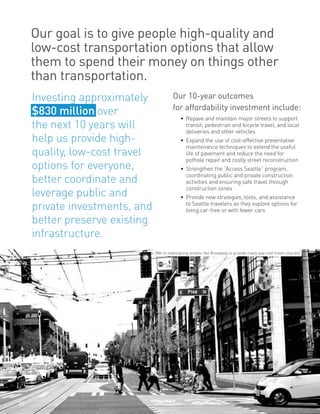
  • 16.
    Our goal isto eliminate serious and fatal crashes in Seattle. Our 10-year outcomes for safety investment include: • Repair, replace, and operate bridges to support safe travel and seismic resiliency • Repair sidewalks and support healthy tree growth in areas of high pedestrian demand to enhance safety and support walkable neighborhoods • Repair damaged residential sidewalks through innovative cost-sharing solutions to support walkable neighborhoods • Evaluate and address safety concerns and crash locations quickly and effectively • Implement safety programs along corridors with high levels of crashes • Improve safety in school zones • Improve pavement markings, replace aging signs and add lighting to enhance visibility and increase safety • Build the core citywide grid of protected bike lanes and neighborhood greenways • Provide education programs to help pedestrians, bicyclists and motorists travel safely and efficiently • Repair damaged or closed public stairways to connect neighborhoods and improve accessibility • Identify and fix failing retaining walls and minimize landslides to protect public infrastructure and private property Investing approximately $835 million over the next 10 years will help us eliminate serious and fatal crashes and reduce the risk of people being injured through failing infrastructure in Seattle. (NE 125th Street before) (NE 125th Street after) After changes were made to NE 125th Street to separate bicyclists and slow speeding cars, the collision rate for everybody went down 10% and the rate of collisions with injuries went down 17%. 10
  • 17.
    SAFETY OUR CORE VALUES Rollout a coordinated Vision Zero program: • Implement 20 mph speed zones in residential areas on a neighborhood-by-neighborhood basis, starting with areas with the highest crash rates • Carry out 5 corridor safety projects, including on Rainier Ave S, 35th Ave SW, Lake City Way, and SW Roxbury St • Reduce arterial speed limits to 30 mph or lower to improve safety • Create a traffic safety education kit for community groups and schools to promote road safety and Vision Zero • Partner with Seattle Police Department to conduct routine enforcement in areas with high crash rates • Partner with SPD to install at least 12 new school zone cameras • Improve school walking routes at up to 12 locations and upgrade school zone signage at up to 15 locations each year Repair critical infrastructure to increase safety: • Repair up to 25 blocks of damaged sidewalk each year • Complete construction of the Yesler Avenue over Fourth Avenue bridge replacement and begin construction of the seismic retrofit of the 45th Avenue Viaduct East Bridge Approach and the replacement of the Post Avenue Bridge • Begin seismic retrofit of Seattle’s remaining unreinforced bridges • Rehabilitate up to 5 stairways each year Prioritize pedestrians: • Make the 27% of the city without sidewalks more walkable — through constructing up to 30 new blocks of sidewalks connecting to transit stops and community centers and identifying new funding tools and partnerships to increase sidewalk construction • Use high-reflectivity crosswalk markings on all projects • Modify signal timing to favor pedestrians in neighborhood business districts • Install up to 25 pedestrian countdown signals each year • Help employers develop walking programs for employees in Seattle’s most walkable neighborhoods Build out an all ages and abilities bike network: • Build up to 50 miles of the highest- priority protected bike lane segments connecting to and through downtown and new neighborhood greenways to improve pedestrian and bicycle travel to and through our neighborhoods Delivering the following near-term actions in the next 3 years will help us meet our goal. MOVE SEATTLE 11
  • 18.
    Link Light Rail, Sounder, Streetcar, Monorail KingCounty Metro, Sound Transit, Community Transit, private shuttles Washington State Ferries, King County passenger ferries Taxis, Lyft, Uber, Sidecar, your car, Car2Go, Zipcar, your carpool Your bike, Pronto! Cycle Share ∞ pairs of feet + + + + + = A COMPLEX SYSTEM More travel options don’t always equate to an interconnected, easy-to-use system. A COMPLEX SYSTEM 12
  • 19.
    INTERCONNECTED OUR CORE VALUES Whatdoes reliability mean? It means life can be predictable — you to get to work on time, your kid gets to school on time, and you don’t miss the start of a movie. A key to building a reliable transportation system is to build a system that is resilient — a system that has enough alternate routes and modes for people that it isn’t paralyzed by a construction project, a stadium event, a crash or a bridge opening. Better information for travelers and more viable transportation options all contribute to a more resilient, reliable system. 1. Travel options need to be reliable. There are many great travel options available in Seattle right now, but they’re not available to everyone in every corner of the city. What does it mean to have real options? It means that the bus comes when you expect it to come and that transit goes where you need it to go, there’s a car share vehicle close by when you need it, and you can count on 1 or 2 parking spaces open near your favorite restaurant. Because we are an established city with a fixed street grid, our focus must be on using the streets and sidewalks we have in the most efficient way possible. Efficiency means prioritizing uses of street space that serve the most people, at the most times of day, in the most ways. It also means smart operation of our streets using new traffic signal timing technology to help move people and goods. Our private sector partners are impacting the world of transportation in new ways. They are adding more choice to the system through networks like car share and bike share. They are adding more tools to find these choices through smart phone apps. They are working to provide their employees incentives to commute differently. We need to create a collaborative framework where these private sector innovations are working towards the common goal of effective options for all Seattlites. 2. Travel options need to be available when and where people need them. 3. Seattle is a built-out city with no room for new streets. 4. Private partners are helping move Seattle. SEATTLE BRIDGES OPEN 15,000 TIMES A YEAR Car2Go Original Service Area Car2Go 2015 Expanded Service Area PERCENT REDUCTION IN THE NUMBER OF DRIVE ALONE TRIPS IN FIVE YEARS Seattle Children’s Hospital Through unique incentives, Seattle Children’s Hospital is leading the way in giving their employees travel options. Other Large Seattle Employers 6% Other Large Statewide Employers 3.8%16.4% A typical bridge opening backs up traffic for over 4 minutes. MOVE SEATTLE 13
  • 20.
    Our 10-year outcomesfor mobility investment include: • Provide 72% of Seattle residents with 10-minute all-day transit service within a 10-minute walk of their homes • Provide RapidRide levels of investment and service on 7 new corridors (for a total of 10 overall) • Increase transit service and improve our streets to make transit more reliable • Use the latest traffic signal technology to enhance mobility and ensure our streets are adaptable and prepared for the unexpected • Transform critical outdated streets to multimodal corridors to better serve all travelers • Construct the highest-priority sidewalk segments • Build curb ramps and mark cross walks at high- priority intersections • Increase bike share stations, bike parking and bike racks to make biking more convenient • Provide real-time travel information to the public Our goal is to provide an easy- to-use, reliable transportation system that gives you the options you want when you need them. Investing approximately $855 million over the next 10 years will help us provide an easy-to-use, reliable transportation system. (SDOT’s Transportation Management Center where cameras help us manage traffic flow in real-time) 14
  • 21.
    Enhance mobility andaccess: • Synchronize the downtown signal system • Establish a 24-hour Traffic Management Center to better manage traffic and incident response 24/7 • Implement adaptive signal control along the Mercer Corridor, Denny Way, and 23rd Avenue • Develop an iconic Seattle transit map to make Seattle’s transit system easier to understand • Expand Transit Screen displays to 20 buildings to improve access to transportation information • Partner to design and launch a real-time multimodal travel and wayfinding app • Define a wayfinding system with our regional partners that all travelers can rely on Improve transit and maximize bus service and ridership growth: • Implement “Always on Time” bus routes by focusing transit capital improvements on the routes that serve most Seattle residents • Ensure that 75% of Seattle households are within a 10-minute walk of bus routes with service every 15 minutes or better • Install red bus-only lanes and transit priority improvements at pinch points and implement targeted enforcement to ensure bus-only lanes operate effectively • Upgrade bus stops and stations by implementing a street furniture program and adding real-time information signs and better lighting to busy bus stops • Begin construction of bus rapid transit on Madison Street • Begin construction of the Center City Streetcar Connector and the Broadway Extension on Capitol Hill Bump up Seattle’s bikeability: • Install 1,500 bike parking spaces over the next three years • Encourage businesses to install bike racks in the right of way and work with building owners to increase quality off-street bike parking • Enhance bicycle commute programs available to employees INTERCONNECTED OUR CORE VALUES Delivering the following near-term actions in the next 3 years will help us meet our goal. (Real-time information, comfortable stops, and reliable buses make transit a real option) MOVE SEATTLE 15
  • 22.
    A vibrant cityis one where the streets and sidewalks hum with activity. 16
  • 23.
    VIBRANT OUR CORE VALUES Ratherthan moving people to get to the things they need, a successful city moves the things people need closer. This can be achieved through more efficient goods delivery and through more compact urban development, bringing shopping and services closer to where people live and allowing people a greater diversity of options to fill their daily needs. 1. In a city, what matters is how many destinations you can get to quickly, not how far you can travel. Seattle has its roots as an industrial and port city. The freight industry is a critical source of living-wage jobs in Seattle and is our link to the rest of the country and the world. Freight and goods movement are integral to our lives and integral to our streets. Big changes in how our economy functions are impacting our travel needs. While the majority of retail sales continue to happen in person, more of us are shopping online than ever before. At the click of a button we can order our groceries, a new television, clothes and much more — all of which must be delivered to us. This has big implications for how we allocate street and curb space. The more travel choice we provide all Seattleites, the more street space will be available for essential goods movement and delivery. Streets and sidewalks make up 27% of Seattle land area. As we grow as a city, more of our neighbors will depend on these streets and sidewalks as vibrant social spaces to meet friends, shop, exercise and live their lives. Pleasant streets and sidewalks are the backbone of a city’s livability. 2. Goods movement is the lifeblood of our city and must be supported. 3. Online shopping has changed our travel needs. 4. Streets and sidewalks are places to be, not just places to pass through. 15 minute walk 15 minute drive 2010 2035 JOB GROWTH IN SEATTLE MANUFACTURING INDUSTRIAL CENTERS 0 120 K GROWTH IN ONLINE SALES AS PERCENT OF TOTAL RETAIL SALES 2005 2014 0 7% 27.5% 53,535 Acres Seattle Total Land Area 14,718 Acres Right-of-Way 6,276 Acres Parks & Open Sp 12% 12% PARKS 27% RIGHT-OF-WAY TOTAL LAND AREA 53,500 ACRES STREETS, SIDEWALKS AND PARKS AS A PERCENTAGE OF SEATTLE LAND AREA 27.5% Parks & Open Space 12% MOVE SEATTLE 17
  • 24.
    Our goal isto use Seattle’s streets and sidewalks to improve the city’s health, prosperity and happiness. Our 10-year outcomes for economic development and placemaking investment include: • Fund implementation of the Freight Master Plan • Coordinate public and private construction happening in the street to support new development and infrastructure upgrades, while keeping people and goods moving • Pave local streets to enhance access and reduce contaminated runoff to local waterways • Partner with communities and other departments to design and build the highest-priority neighborhood street projects • Manage on-street parking and loading to support business district vitality and livable, accessible neighborhoods • Develop and maintain great new public places in our streets and sidewalks • Protect, preserve, and plant street tree canopy and improve landscaped areas to promote environmental health and encourage walkability • Repair, reinforce, or fill areaways to preserve neighborhood character and create a better foundation for streets and sidewalks • Clean and maintain streets and sidewalks to enhance safety, comfort, and water quality Investing approximately $370 million over the next 10 years will help us improve Seattle’s health, happiness, and prosperity. (Deliveries and shipping keep Seattle running) 18
  • 25.
    Create more placesfor people in our streets and sidewalks: • Launch a new Summer Parkways program that opens streets to people walking and biking, with 2 events in 2015 • Pilot new pedestrian-only streets in areas with high pedestrian and low vehicle demand • Pilot a volunteer urban forest steward program • Work with community organizations and the Department of Neighborhoods to pilot a gardening in the right-of-way (GROW) program • Formalize the Parklet Program and pilot “Streateries”, a second type of parklet that allows sidewalk cafes • Launch a “Pavement to Parks/Plazas Program” at up to 12 locations • Complete the Freight Master Plan • Make spot improvements to help trucks move more quickly at key bottlenecks • Pilot freight-only lanes in the Greater Duwamish Manufacturing and Industrial Center • Ramp up the monitoring and collection of truck volume data within Seattle’s two manufacturing and industrial centers and connecting corridors • Pilot commercial vehicle loading zone (CVLZ) pricing with innovative technology to improve access for commercial and passenger loading activities • Replace all 2,100 aging parking pay stations with new technology • Implement time-of-day rates and pay-by-plate for on-street paid parking and develop pricing strategies to encourage more pay-by-phone transactions • Work with at least 3 neighborhoods each year to develop community access and parking plans Improve mobility for freight and delivery vehicles: Delivering the following near-term actions in the next 3 years will help us meet our goal. VIBRANT OUR CORE VALUES (Parklets, like this one in Wallingford, are a new way to serve more people with our streets and sidewalks) MOVE SEATTLE 19
  • 26.
    Transportation costs are significantfor the average Seattle family. This impacts the affordability of our city. 20
  • 27.
    AFFORDABLE OUR CORE VALUES Seattleis growing by leaps and bounds, and with this growth come thousands of well-paying jobs. At the same time, our city is becoming increasingly unaffordable for many. The average Seattle household spends 17% of its budget on transportation. For many households, most of this portion goes to car ownership, which is expensive. By providing good travel options, car ownership can become an option, not a necessity. 1. Seattle is getting more expensive. Keeping our transportation system in a state of good repair will help Seattle stay affordable for future generations by lowering the cost of future maintenance. Routine maintenance, while not always exciting, saves us from or delays major, expensive maintenance projects later. For instance, repaving a street at the critical point before it needs to be rebuilt costs 20% of what it would cost to fully rebuild that same street. Taking care of bridges can extend their lives and keep travelers safe in a seismic event. Utility projects that need to cut into pavement can damage a new street. To protect the public’s investment in new paving and sidewalks means sticking to high standards for restoring streets after a utility project disturbs them. It also means coordinating utility work so that multiple projects can be accomplished with a single opening in the pavement, ensuring the street lasts for future generations. 2. Lowering our costs can lower yours. 3. “But you just paved that!” With Car Without Car $3.5 K 0 Housing Food Vehicle Ownership Orca Transit Pass Carshare/Taxi Fare Pronto Bikeshare Membership MonthlyCosts Time Pavement Quality $1 for Rehabilitation Here Will Cost $4 to $5 Here 100% 85% 70% 55% 40% 25% 10% 0% Good Satisfactory Fair Poor Very Poor Serious Failed SPENDING A LITTLE MONEY ON MAINTENANCE TODAY CAN SAVE A LOT OF MONEY TOMORROW MOVE SEATTLE 21
  • 28.
    Our goal isto give people high-quality and low-cost transportation options that allow them to spend their money on things other than transportation. Our 10-year outcomes for affordability investment include: • Repave and maintain major streets to support transit, pedestrian and bicycle travel, and local deliveries and other vehicles • Expand the use of cost-effective preventative maintenance techniques to extend the useful life of pavement and reduce the need for pothole repair and costly street reconstruction • Strengthen the “Access Seattle” program, coordinating public and private construction activities and ensuring safe travel through construction zones • Provide new strategies, tools, and assistance to Seattle travelers as they explore options for living car-free or with fewer cars Investing approximately $830 million over the next 10 years will help us provide high- quality, low-cost travel options for everyone, better coordinate and leverage public and private investments, and better preserve existing infrastructure. (We’re redesigning streets like Broadway to provide many low-cost travel choices) 22
  • 29.
    Make it easierfor more people to walk, bike, and use transit and car share services: • Develop and implement a new travel options program for low-income and non-English speaking residents that provides education, encouragement, and access to transit, bike share, car share, and other travel options • Expand travel options programming to five multifamily residential buildings throughout the city • Launch focused travel demand management programs in South Lake Union and Pike/Pine to improve transportation in these congested neighborhoods • Explore opportunities to require new development to provide transit passes and other travel options as a condition of development approval Use our resources efficiently to save money: • Coordinate projects so that when a street is resurfaced we look for opportunities to make improvements called for in the modal plans • Expand SDOT’s microsurfacing program (a protective seal coat that extends the life of pavement) to at least 40 miles of residential streets, and expand SDOT’s cracksealing program to at least 56 miles of streets, to maximize the value we get out of our maintenance dollars • Complete the repaving of portions of 23rd Avenue, 3rd Avenue, 4th Avenue S, Renton Avenue South, Roosevelt Way Northeast and South Spokane Street • Extend the life of Seattle’s streets by partnering with transit agencies and other cities in the region to lobby for the manufacture and purchase of lighter buses Identify new funding sources: • Explore a code change to allow limited advertising in the right of way — new revenue would support downtown streetscapes and transportation projects • Seek additional sponsorship opportunities to expand bike share • With other city departments, consider the implementation of impact fees or other funding tools to ensure that new development contributes to the cost of infrastructure needed to accommodate growth • Investigate opportunities to increase private investment in the improvement of Seattle’s transportation system Strengthen the “Access Seattle” Program: • Ensure SDOT, public and private utility, and private construction projects in streets and sidewalks are fully coordinated, to minimize disruption to the traveler and minimize “rework” • Lengthen the moratorium for cutting into newly-installed pavement (from 3 years to 5) and increase requirements for restoring pavement that has been disturbed • Launch a “Car Light Living” program to promote alternatives to owning a personal vehicle when moving to Seattle • Expand the Community Parking and Access Program and ensure that small businesses/ employers have information about and access to discounted transit passes, bike share and car share memberships • Work with Metro to provide more reduced fare ORCA LIFT cards to low-income Seattle households • Increase direct training and other support services to employers with employee commute programs Delivering the following near-term actions in the next 3 years will help us meet our goal. AFFORDABLE OUR CORE VALUES MOVE SEATTLE 23
  • 30.
  • 31.
    The availability ofdata is increasing every day. Data can be a powerful tool if we pay attention to it and learn to apply new data to old areas of business. For instance, understanding public meeting attendance helps us pinpoint who is coming to our meetings and find better ways to reach those people who aren’t. 1. Using data to drive decisions. After nearly a half century of focus on people traveling by car, the pace of change and desire for new infrastructure for all modes is growing faster than our budgets and the pace of large capital project construction. To meet the need, we are learning to design streets for all modes on a tight budget, often by putting out interim solutions that we can test and learn from until we have funding for permanent projects. New businesses and services are popping up every day, some big, some small — and many of them want to use the public right of way. We work to regulate the right of way to allow innovation and new business, while ensuring that the public benefits. For example, with the success of parklets and sidewalks cafes, we’re launching a new program for private-sector partners that combines the best of both. 2. Our project delivery methods are being rethought. 3. Regulating the right of way to encourage innovation. INNOVATIVE OUR CORE VALUES Sidewalk Vendors NUMBER OF 2014 ACTIVE PUBLIC SPACE VENDOR PERMITS Plaza Vendors Food Truck Vendors Stadium Vendors 4 51 23 14 CONVENTIONAL PROJECT DEVELOPMENT Concept Plan/Outreach Design Construction PHASED/INTERIM DESIGN STRATEGY Concept Plan/Outreach Interim Installation Impacts Analysis Design Construction Year 1 Year 2 Year 3 Year 4 Year 5 Female RaceGender Male 0% SDOT Public Meetings City Other races White 100% MOVE SEATTLE 25
  • 32.
    Our goal isto understand and plan for the changes of tomorrow, while delivering great service today. Experiment with new materials and technologies: • Help lay the groundwork for citywide broadband by reviewing conduit installation standards and leveraging existing traffic system conduit, private development, paving and infrastructure projects for cost-effective broadband deployment • Pilot rain-sensor traffic signal technology to give pedestrians and people biking extra crossing time or shorter wait times when it rains or snows • Test up to 15 projects per year with an adaptive approach that uses creative, low-cost materials to make quick changes to our streets and sidewalks • Partner with King County Metro or other transit service providers to pilot automated transit vehicles and expand the use of battery-powered buses to reduce carbon emissions Innovation should infuse everything we do as an organization. Delivering the following near-term actions in the next 3 years will help us meet our investment goals for safety, interconnectivity, vibrancy, and affordability. 26
  • 33.
    Capitalize on thepotential of Seattle’s minority and women- owned businesses: • Remain accountable to our goals for using minority- and women-owned businesses by implementing a compliance reporting system • Change the culture of city contracting by launching a women and minority business enterprise advocate program • Establish higher standards for women and minority-owned business inclusion plans in locally-funded projects Roll out new standards for public outreach and engagement: • Reboot our outreach process with a focus on predictability, effectiveness, and hearing from a more representative cross-section of the Seattle public • Engage in community planning efforts in 7 neighborhoods in 2015 Test new ways of doing existing business: • Improve our efficiency in delivering projects by investing in technologies such as providing field access to our inspectors so they can have real-time information to do their jobs, and integrating our internal data systems to reduce duplication • Develop and empower an innovations team of SDOT staff to concentrate on critical emerging initiatives that require a nimble, cross-departmental approach INNOVATIVE Our Core Values (The new Second Avenue protected bike lane demonstrates an adaptive approach to project delivery) MOVE SEATTLE 27
  • 34.
    These measures, trends andtargets help us track and report on our progress towards our goals. 28
  • 35.
    Measures Baseline* Desired Trend 2025 Goal Safety Interconnectivity Vibrancy Affordability Innovation Annual rateof pedestrian collisions (per 100,000 residents) 61 Decrease Decrease x Annual rate of bicycle collisions per 1,000 bicycle commuters (from American Community Survey data) 32 Decrease Decrease x Annual rate of all collisions (per million annual daily trips) 54.8 Decrease Decrease x Annual number of fatalities and serious injuries by all modes of travel 23 fatalities 174 serious injuries Decrease 0 x x Percentage of potholes repaired within 3 days of notification Percentage of households within a 10-minute walk of a frequent transit route running every 10 minutes or better 88% 90% x x Percentage of sidewalk repair requests responded to within 5 days of notification New measure in 2015 Increase Increase Increase 35% 80% x x 26% (2015) Increase 72% x Percentage of “Seattle” bus route (routes with 80% of stops in Seattle) trips that are reliable (on-time in the afternoon peak period) 67.5% Increase 80% x Percentage of Seattle residents who drive alone to work (Single Occupant Vehicle) 49% (2012) Decrease 25% or less SOV by 2035 x x Percentage of destinations (business districts, schools, community centers and similar destinations) with adjacent sidewalks, and within 1/4 mile of an all ages and abilities bicycle facility and the Frequent Transit Network 33% (2012) Increase 75% x Annual number of public space permits in streets and sidewalks (parklets, sidewalk cafes, food trucks) and temporary activation permits (play streets, block parties, special events) Long term – 318 Temporary – 115 Increase 5% annually 50% increase x Percent of on-street paid parking areas with occupancies within the range of 1-2 available spaces per block face 46% 5-Year average: 9.6 injuries 125 days lost Increase 75% x Number of workplace injuries and days lost due to injury (per 100 employees full-time) Decrease 3% per year Reduce by 30% x Percentage of annual hours for employees set aside for training 1% for current employees; 2.5% for new employees Maintain Maintain x Percentage of SDOT projects and programs using the Inclusive Outreach and Public Engagement toolkit Projects: 100% Programs: begin tracking in 2015 Increase 100% x Percentage of all purchasing, prime and subconsultant** contract dollars issued to women- and minority-owned firms 18% New measure in 2015 New measure in 2015 Increase 0.5% every year 23% x Percentage of capital projects delivered on time Increase to meet target 90% x Percentage of capital projects delivered on budget Increase to meet target 90% x Percentage of SDOT Customer Satisfaction Survey respondents who respond “Satisfied” or “Extremely Satisfied” to the following question: How satisfied are our customers with work and services by SDOT to build and maintain Seattle as a whole? 68% Increase 75% x x x x x *2013 unless noted otherwise ** Tracked for project contracts with Inclusion Plans Percentage Frequent Transit Network that is maintained and modernized by rehabilitating the pavement 22% (2014) TRACKING SUCCESS OUR CORE VALUES MOVE SEATTLE 29
  • 36.
    We are integrating our modal plansto deliver transformational projects. 30
  • 37.
    What are themodal master plans? Streets of the past half-century were designed primarily for cars. We are focused on designing streets for the future based on our four citywide master plans for transit, pedestrian, freight (in development) and bicycle modes. They identify our future networks, projects, and programs. These 20-year plans detail key investments, policies, and objective data-driven priorities that will greatly improve travel by each mode. Thousands of people from all over Seattle helped put these plans together. They have been adopted by City Council, and collectively they spell out a shared vision for how we move people and goods in Seattle. INTEGRATING PLANS How do we integrate and prioritize the recommendations in the modal master plans? Because of Seattle’s topography and street grid patterns, specific streets are important in all of our plans for people on foot, on bicycle, in a truck, in a car, or on transit. These streets also provide the most direct connections to major destinations throughout the city. Our streets can’t expand to fit all these different types of travel, so how do we integrate the plans to design streets that work today and tomorrow? (Dexter Avenue — a street that works for all users) MOVE SEATTLE 31
  • 38.
    A B P FREIGHTTRANSIT BIKE PEDESTRIAN IS IT INAN AREA WHERE MANY PEOPLE WALK OR WANT TO WALK? DOES IT SERVE OUR INDUSTRIAL AND MANUFACTURING CENTERS? WHAT ARE THE MAJOR DESTINATIONS ALONG THE STREET (OFFICES, SHOPS, HIGHER DENSITY HOUSING)? IS IT A TRANSIT ROUTE FOR THOUSANDS OF RIDERS A DAY? ARE THERE BICYCLE OR OTHER SAFETY ISSUES THAT MUST BE ADDRESSED? ARE THERE KEY NEEDS FOR FREIGHT DELIVERIES, ON-STREET CAR OR BIKE PARKING, OR GATHERING SPACES FOR PEOPLE? IS IT IN AN AREA WHERE MANY PEOPLE WALK OR WANT TO WALK? DOES IT SERVE OUR INDUSTRIAL AND MANUFACTURING CENTERS? WHAT ARE THE MAJOR DESTINATIONS ALONG THE STREET (OFFICES, SHOPS, HIGHER DENSITY HOUSING)? IS IT A TRANSIT ROUTE FOR THOUSANDS OF RIDERS A DAY? ARE THERE BICYCLE OR OTHER SAFETY ISSUES THAT MUST BE ADDRESSED? ARE THERE KEY NEEDS FOR FREIGHT DELIVERIES, ON-STREET CAR OR BIKE PARKING, OR GATHERING SPACES FOR PEOPLE? IS IT IN AN AREA WHERE MANY PEOPLE WALK OR WANT TO WALK? DOES IT SERVE OUR INDUSTRIAL AND MANUFACTURING CENTERS? WHAT ARE THE MAJOR DESTINATIONS ALONG THE STREET (OFFICES, SHOPS, HIGHER DENSITY HOUSING)? IS IT A TRANSIT ROUTE FOR THOUSANDS OF RIDERS A DAY? ARE THERE BICYCLE OR OTHER SAFETY ISSUES THAT MUST BE ADDRESSED? ARE THERE KEY NEEDS FOR FREIGHT DELIVERIES, ON-STREET CAR OR BIKE PARKING, OR GATHERING SPACES FOR PEOPLE? IS IT IN AN AREA WHERE MANY PEOPLE WALK OR WANT TO WALK? DOES IT SERVE OUR INDUSTRIAL AND MANUFACTURING CENTERS? WHAT ARE THE MAJOR DESTINATIONS ALONG THE STREET (OFFICES, SHOPS, HIGHER DENSITY HOUSING)? IS IT A TRANSIT ROUTE FOR THOUSANDS OF RIDERS A DAY? ARE THERE BICYCLE OR OTHER SAFETY ISSUES THAT MUST BE ADDRESSED? ARE THERE KEY NEEDS FOR FREIGHT DELIVERIES, ON-STREET CAR OR BIKE PARKING, OR GATHERING SPACES FOR PEOPLE? IS IT IN AN AREA WHERE MANY PEOPLE WALK OR WANT TO WALK? DOES IT SERVE OUR INDUSTRIAL AND MANUFACTURING CENTERS? WHAT ARE THE MAJOR DESTINATIONS ALONG THE STREET (OFFICES, SHOPS, HIGHER DENSITY HOUSING)? IS IT A TRANSIT ROUTE FOR THOUSANDS OF RIDERS A DAY? ARE THERE BICYCLE OR OTHER SAFETY ISSUES THAT MUST BE ADDRESSED? ARE THERE KEY NEEDS FOR FREIGHT DELIVERIES, ON-STREET CAR OR BIKE PARKING, OR GATHERING SPACES FOR PEOPLE? IS IT IN AN AREA WHERE MANY PEOPLE WALK OR WANT TO WALK? DOES IT SERVE OUR INDUSTRIAL AND MANUFACTURING CENTERS? WHAT ARE THE MAJOR DESTINATIONS ALONG THE STREET (OFFICES, SHOPS, HIGHER DENSITY HOUSING)? IS IT A TRANSIT ROUTE FOR THOUSANDS OF RIDERS A DAY? ARE THERE BICYCLE OR OTHER SAFETY ISSUES THAT MUST BE ADDRESSED? ARE THERE KEY NEEDS FOR FREIGHT DELIVERIES, ON-STREET CAR OR BIKE PARKING, OR GATHERING SPACES FOR PEOPLE? IS IT IN AN AREA WHERE MANY PEOPLE WALK OR WANT TO WALK? DOES IT SERVE OUR INDUSTRIAL AND MANUFACTURING CENTERS? WHAT ARE THE MAJOR DESTINATIONS ALONG THE STREET (OFFICES, SHOPS, HIGHER DENSITY HOUSING)? IS IT A TRANSIT ROUTE FOR THOUSANDS OF RIDERS A DAY? ARE THERE BICYCLE OR OTHER SAFETY ISSUES THAT MUST BE ADDRESSED? ARE THERE KEY NEEDS FOR FREIGHT DELIVERIES, ON-STREET CAR OR BIKE PARKING, OR GATHERING SPACES PROJECT BIKE PEDESTRIAN TRANSIT FREIGHT 2% 65% 13%20% Going from plan to project. Step 1: Overlay the modal plans Overlay the needs in the modal plans to identify where priority corridors for many modes exist. Step 3: Develop alternatives We look at different ways we can allocate space in the street based on the users and needs identified. 1 2 3 Step 2: Identify the major purposes of the street Each street in our city is different and they serve different land uses, so the purpose and design of each project will be distinctive. 32
  • 39.
    We work closelywith neighbors and street users to better understand your needs and define the project. Step 4: Evaluation of alternatives 4 Step 5: Design, construct, and maintain Our job is not finished when a project is built — it just begins. We work 24/7 to keep the transportation system in a state of good repair so it works as designed. 5 Step 6: Evaluate and report We measure the results of the projects and programs we build, evaluate how pilot materials and designs work, and talk with the public. We track our progress to remain accountable to the people we serve, and continually refine and adjust our work. 6 COMPREHENSIVE PLAN CLIMATE ACTION PLAN COMPLETE STREETS ORDINANCE RACE & SOCIAL JUSTICE INITIATIVE A B C A P ? INTEGRATING PLANS We also apply overarching city policies: Climate Action Plan, Complete Streets Ordinance, our Race and Social Justice Initiative, and Comprehensive Plan. After looking at the options, we pick a final design for the street. We spend time with the community, listening to preferences and concerns. MOVE SEATTLE 33
  • 40.
    What is theend result of this process? Streets that work for all users. BUSES & STREETCARS Buses and streetcars provide an affordable, convenient way to get around. Up-to-the-minute arrival information provided at stops and on smartphone apps makes using public transportation easier. And all those people on the bus mean fewer cars on the road competing for parking spaces and adding to congestion. PROTECTED BIKE LANES Separated from vehicles, they make biking safer and more comfortable for people of all ages and abilities. For example, while Dexter Avenue’s design solution with buffered bicycle lanes behind transit stops was right for this location, it’s not a perfect fit for every street. Streets like East Marginal Way or 23rd Avenue are also important multimodal corridors and will have their own unique designs. INTEGRATING PLANS A B F H G A B E 34
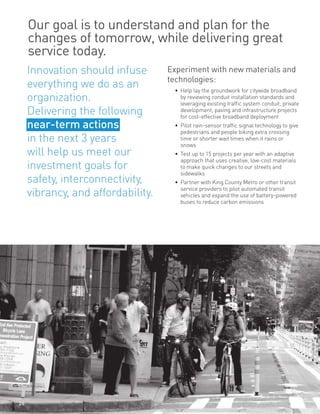
  • 41.
    PAVEMENT Beneath the surfaceof the roads there are many precise layers of pavement, strategically sloped to drain water so the road stays clear. Pavement markings are constantly refreshed to stay visible and keep all travelers safe. LIGHTING Traditionally, street and sidewalk lighting has focused on driver needs. Pedestrians need smaller scale, targeted lighting to make walking safer and more comfortable. ACTIVE STREETS & SIDEWALKS Sidewalk cafes, markets, and parklets turn sidewalks into places to be, not just spaces to pass through. They provide a place to meet people and connect with the community, and increase foot-traffic to nearby businesses. STREET TREES Over 100,000 street trees reduce traffic speeds and create a safety buffer between pedestrians on sidewalks and moving vehicles. They make a big impact on public health by improving air quality. PARKING As a national leader in smart parking management, our goal is to set parking rates to ensure a spot is always open when you need it. PEDESTRIAN COUNTDOWN SIGNALS Countdowns tell people how long they have to cross the street, so they can make safer decisions about when to enter a crosswalk. SMART TRAFFIC SIGNALS Smart Traffic Signals detect buses approaching an intersection and hold green lights longer to keep buses, trucks and cars moving on time. MARKED CROSSWALKS All intersections are crosswalks. Marked crosswalks put people driving and biking on high alert to watch for people crossing the street. DELIVERIES & FREIGHT Commercial truck loading areas provide space on busy streets for delivery trucks. Enabling businesses to reliably send and receive goods ensures the products you want are there when you arrive. C I D C D F G H I E INTEGRATING PLANS MOVE SEATTLE 35
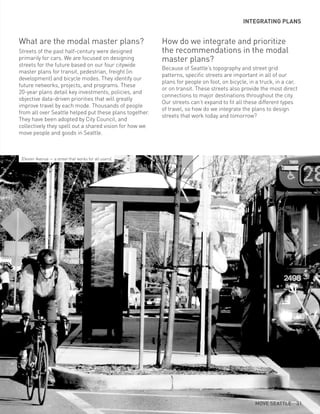
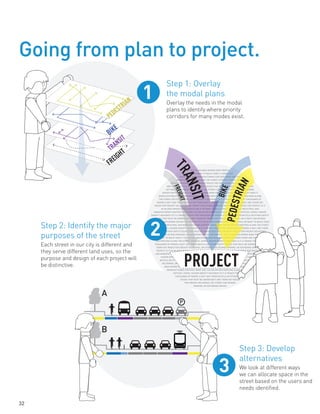
  • 42.
    POTENTIAL PROJECTS QUANTITAT IVE QUALITAT IVE Major Truck Streets BicycleMaster Plan Recommended Bike Network Transit Master Plan Frequent Transit Network Pedestrian Master Plan High Priority Areas Funding is limited. This is how we prioritize projects. By overlaying the four modal plans, we see where priorities overlap and big opportunities exist to transform streets to work better for all modes. Over 100 project possibilities emerge, from South Park to Haller Lake. Step 1: Identify potential projects 36
  • 43.
    Safe City Interconnected City VibrantCity Affordable City Can traffic or community impacts can be lessened by timing a project differently or pairing it with other work? Does the project require specific windows of partner participation or is it eligible for specific grants? Does the project have the support of multiple constituencies or feature public-private partnerships? Is there a fair distribution of investment and benefits among different communities? Does a project scope or timing help avoid major maintenance costs down the road? Leveraging opportunities Funding availability (grants, contributions) Community support Existing commitments Geographic equity Avoidance of major maintenance Are there signed agreements in place or other official commitments or is a substantial amount of work already complete? Support priority corridors AdvanceCompleteStreetsImplementation Community equity and health Environmental stewardship Support areas of future growth Infrastructure condition Safety and risk Safe City Interconnected City Vibrant City Affordable City Can traffic or community impacts can be lessened by timing a project differently or pairing it with other work? Does the project require specific windows of partner participation or is it eligible for specific grants? Does the project have the support of multiple constituencies or feature public-private partnerships? Is there a fair distribution of investment and benefits among different communities? Does a project scope or timing help avoid major maintenance costs down the road? Leveraging opportunities Funding availability (grants, contributions) Community support Existing commitments Geographic equity Avoidance of major maintenance Are there signed agreements in place or other official commitments or is a substantial amount of work already complete? Support priority corridors AdvanceCompleteStreetsImplementation Community equity and health Environmental stewardship Support areas of future growth Infrastructure condition Safety and risk Step 3: 10-Year capital project ranking Once the process is complete, certain streets become clear priorities for major investment. These aren’t priorities for just one mode of travel or just for maintenance – they are priorities for the whole city. Step 2A: Numerical scoring Each project goes through a rigorous scoring process based on our four core values. Projects are evaluated on criteria as diverse as number of high-collision intersections they address to car ownership rates of nearby households. Step 2B: Qualitative rating We complement our data-driven process with more artful criteria too. These ratings are important since some projects may not score highly in the numerical analysis, but may have other compelling reasons for being considered further. MOVE SEATTLE 37
  • 44.
    Here are the projectswe would like to design and build in the next 10 years. 38
  • 45.
    The following mapand project sheets detail a proposal for future SDOT multimodal project investment. These are our biggest capital investments and are in addition to the ongoing programmatic spending and maintenance and operations detailed in the first section of this document. The proposal depends on future funding to replace the Bridging the Gap transportation levy and should be viewed as draft until replacement funding is secured. City Council will further prioritize and shape this list as they adopt future 6-year Capital Improvement Programs in the city budget. The list also will be updated periodically to reflect new long-range planning efforts, like the completion of the Freight Master Plan. Design and construction schedules of these projects will be driven by many factors, such as funding availability, coordination with other major construction projects, or urgent safety or maintenance needs. (One of many street repair and upgrade projects SDOT completes annually) MOVE SEATTLE 39
  • 46.
    PROJECT A 23rd AvenueCorridor Improvements - Phases 1-3 B 3rd Avenue Corridor Improvements C Ballard to Downtown Enhanced Transit Corridor D Broadway Streetcar Extension E Burke Gilman Trail Extension F Center City Streetcar Connector G Delridge Complete Street H E Marginal Way Corridor Improvements I Greenwood/Phinney/67th to Fremont Complete Street J Lander Street Grade Separation/Railroad Crossing K Madison Street Bus Rapid Transit Complete Street L Market/45th Transit Improvement Project M Northgate Pedestrian- Bicycle Bridge N Pike/Pine Complete Street O Rainier Avenue to Jackson Street Complete Street P Roosevelt to Downtown Complete Street Q Yesler/Jefferson Complete Streets R 1st Avenue/1st Avenue S Corridor S 23rd Avenue Corridor Improvements - Phase 4 T Aurora Avenue Complete Street U Beacon/12th/Broadway Complete Streets V Fauntleroy Way/California Transit Corridor Fauntleroy Way SW Boulevard X Lake City Way Complete Street Proposed Projects to Implement by 2024 Long-term Priority Projects P P C C F B D K Q J H G A O N E L M I U U V V W R S T X A B C D E F G H I J K L M N O P Q R S T U V W X 40
  • 47.
    MOVE SEATTLE 41 ProjectScores The 23rd Avenue Improvement project will rebuild a primary north- south corridor through Capitol Hill and the Central District as a multimodal facility that offers high- quality transit service and welcomes all travel modes: • High-priority route for both freight and transit, and main access-way to UW from Capitol Hill/Central District • Modifies sections of the 4-lane roadway to a 3-lane complete street • Adds a parallel greenway and amenities for people who walk, as well as transit efficiency improvements and safety upgrades 23rd Avenue Corridor Improvements - Phases 1-3 Qualitative Measures  Existing Commitment  Leveraging Opportunities  Funding Availability  Community Support  Geographic Equity  Major Maintenance Cost Avoidance Planning-Level Cost Estimate $63 m Potential Funding Sources This project is funded through grants and local sources. Replacement funding for the Bridging the Gap levy is likely to be needed for its completion. 14/20 30/30 21/25 22/25 Safe City High crash rate, especially involving people who walk Affordable City Addresses maintenance needs and supports growth Interconnected City Supports all modes Vibrant City Reduces emissions and serves under- represented communities KEY Construction beginning 2015 A (15-20 Years post-installation) (Existing) (1 year post-installation) The planning, design and construction schedule for this project will be driven by many factors including funding availability, coordination with other construction projects, and urgent safety and maintenance needs.
  • 48.
    42 Project Scores The 3rdAvenue Corridor project revitalizes the city’s busiest transit corridor with upgraded amenities for both bus riders and people who walk: • Increases transit capacity • Enhances transit stops and creates a more welcoming urban environment • Supports opportunities for public gathering spaces and activation with community partners 3rd Avenue Corridor Improvements Qualitative Measures  Existing Commitment  Leveraging Opportunities  Funding Availability  Community Support n Geographic Equity  Major Maintenance Cost Avoidance Planning-Level Project Budget $64 m Low $78 m High Potential Funding Sources The Third Avenue project has received federal grants to begin improvements and is a strong candidate for new funding sources, such as coordinated street furniture revenue. New funding sources and grants will be needed to realize the project. 16/20 25/30 20/25 18/25 Safe City Addresses safety needs of people who bike and walk Affordable City Serves fast-growing areas with low-cost travel options Interconnected City High-priority corridor Vibrant City Promotes equity and environmental stewardship The planning, design and construction schedule for this project will be driven by many factors including funding availability, coordination with other construction projects, and urgent safety and maintenance needs. Costs may vary from the low to high end of the range depending on project complexity, cost of materials, extent of improvements and other factors. B
  • 49.
    MOVE SEATTLE 43 ProjectScores In preparation for a potential inclusion of a Ballard light rail line in the future Sound Transit 3 ballot measure, the Ballard to Downtown Enhanced Transit Corridor project improves the corridor’s existing transit operations and adds interim safety improvements for people who bike and walk crossing the Lake Washington Ship Canal: • Supports a light rail expansion proposed by Sound Transit • Adds intelligent transportation systems and enhances speed and reliability for bus routes throughout the corridor • Incorporates safety improvements to the Ballard Bridge for people who bike and walk Ballard to Downtown Enhanced Transit Corridor Qualitative Measures  Existing Commitment  Leveraging Opportunities  Funding Availability  Community Support n Geographic Equity n Major Maintenance Cost Avoidance Planning-Level Project Budget $31 m Low $38 m High Potential Funding Sources The Ballard to Downtown enhanced transit corridor is a candidate to fund with grants or other partnerships and may be included in a proposed future Sound Transit special levy. 16/20 25/30 25/25 23/25 Safe City High crash rate, especially involving people who walk Affordable City Addresses maintenance needs and supports growth Interconnected City Supports all modes Vibrant City Reduces emissions and serves under- represented communities KEY Exact route to be determined C The planning, design and construction schedule for this project will be driven by many factors including funding availability, coordination with other construction projects, and urgent safety and maintenance needs. Costs may vary from the low to high end of the range depending on project complexity, cost of materials, extent of improvements and other factors.
  • 50.
    44 Project Scores The BroadwayStreetcar Extension will provide frequent, high-quality transit service to north Capitol Hill’s retail center and dense residential district: • Integrates north Capitol Hill into the city’s extensive modern streetcar network, including the South Lake Union and Center City lines • Offers high-quality, zero- emissions transit options to the neighborhood • Includes protected bicycle lanes and other multimodal connections, including Link light rail Broadway Streetcar Extension Qualitative Measures  Existing Commitment  Leveraging Opportunities  Funding Availability  Community Support n Geographic Equity n Major Maintenance Cost Avoidance Planning-Level Cost Estimate $24.5 m Potential Funding Sources The Broadway Streetcar Extension has been awarded federal grants for construction. Additional local funds or partnerships will be needed to realize the project. 20/25 15/25 11/30 14/20 Safe City Reduces crash risk for all users Affordable City Maintains infrastructure and supports future growth Interconnected City Supports priority corridors and complete streets Vibrant City Advances city goals for equity, health, and environmental stewardship KEY Broadway Streetcar Extension Existing and Planned Lines D The planning, design and construction schedule for this project will be driven by many factors including funding availability, coordination with other construction projects, and urgent safety and maintenance needs.
  • 51.
    MOVE SEATTLE 45 ProjectScores The Burke-Gilman Trail Extension, a.k.a. the Burke-Gilman “missing link,” completes a critical segment of the regional trail system from Seattle’s shores to Redmond and Issaquah: • One of the busiest multi-use trails in the country, with up to 2,000 riders per day • Enhances safety for all modes, separating people who bike from busy freight routes in this corridor • Significantly expands the “all ages and abilities” network envisioned in the Bicycle Master Plan Burke-Gilman Trail Extension Qualitative Measures  Existing Commitment  Leveraging Opportunities  Funding Availability  Community Support n Geographic Equity n Major Maintenance Cost Avoidance Planning-Level Cost Estimate $15.9 m Potential Funding Sources This project is funded through local sources. Replacement funding for the Bridging the Gap levy is likely to be needed for its completion. 20/20 14/25 12/25 5/30 Safe City Removes hazards for people who bike and walk (No current crash data available) Affordable City Promotes future growth and development Interconnected City Improves travel options Vibrant City Supports equity, health, and the environment KEY Exact route to be determined E The planning, design and construction schedule for this project will be driven by many factors including funding availability, coordination with other construction projects, and urgent safety and maintenance needs. Costs may vary from the low to high end of the range depending on project complexity, cost of materials, extent of improvements and other factors. (Existing Burke-Gilman Trail near University of Washington)
  • 52.
    46 Project Scores The CenterCity Streetcar Connector expands Seattle’s modern streetcar network and links over a dozen Seattle neighborhoods with high- quality, zero-emissions transit options: • Fully integrated with First Hill and South Lake Union streetcar lines, as well as downtown’s existing transit hubs at Westlake Center, Coleman Dock, and King Street Station • Up to 30,000 average weekday riders • Serves many of the city’s major employment centers, transit- oriented communities, and tourist destinations Center City Streetcar Connector Safe City High crash rates for people who walk and drive Affordable City Connects the City’s fastest growing neighborhoods Interconnected City Addresses Complete Streets needs Vibrant City Promotes equity and reduces emissions 18/20 23/25 25/30 16/25 Qualitative Measures  Existing Commitment  Leveraging Opportunities  Funding Availability  Community Support  Geographic Equity  Major Maintenance Cost Avoidance Planning-Level Cost Estimate $112 m Potential Funding Sources The Center City Streetcar Connector has received federal grants and will be competitive for additional grants. These grants would be needed to fund a large portion of the project cost. KEY Center City Streetcar Connector Existing Lines F The planning, design and construction schedule for this project will be driven by many factors including funding availability, coordination with other construction projects, and urgent safety and maintenance needs.
  • 53.
    MOVE SEATTLE 47 ProjectScores The Delridge Complete Street project improves pavement conditions, enhances safety, and improves traffic operations for all modes: • Adds transit lanes and improves transit speed and reliability • Includes protected bike lanes, sidewalk improvements, and amenities for walkers and transit riders along the corridor • Streamlines traffic operations and improves multimodal connections between transit, freight, people who walk, and general-purpose vehicles Delridge Complete Street Qualitative Measures  Existing Commitment  Leveraging Opportunities n Funding Availability  Community Support  Geographic Equity  Major Maintenance Cost Avoidance Planning-Level Project Budget $38 m Low $47 m High Potential Funding Sources This project is funded through local sources and may compete well for future grants. Replacement funding for the Bridging the Gap levy is likely to be needed for its completion. 4/20 14/30 19/25 15/25 Safe City Supports safety needs for all modes Affordable City Improves infrastructure condition Interconnected City Serves high-priority corridors and complete streets Vibrant City Drives equity, health, and environmental outcomes G The planning, design and construction schedule for this project will be driven by many factors including funding availability, coordination with other construction projects, and urgent safety and maintenance needs. Costs may vary from the low to high end of the range depending on project complexity, cost of materials, extent of improvements and other factors.
  • 54.
    48 Project Scores The EMarginal Way project reconstructs a core freight route to heavy haul vehicle standards and offers safety and operational improvements for all users: • Serves SODO’s freight terminals and the center of the Duwamish industrial district • Invests in major maintenance needs • Incorporates separate bicycle and pedestrian facilities while maintaining freight efficiency E Marginal Way Corridor Improvements Qualitative Measures  Existing Commitment  Leveraging Opportunities  Funding Availability  Community Support  Geographic Equity  Major Maintenance Cost Avoidance Planning-Level Project Budget $40 m Low $49 m High Potential Funding Sources E Marginal Way is a priority corridor for regional freight operations. It is likely to compete well for state or federal grant funds, and may engage other partnerships. 21/25 6/20 24/25 19/30 Safe City Reduces conflicts for people who walk and bike Affordable City Improves infrastructure and supports growth Interconnected City Maintains a critical corridor and develops multimodal networks Vibrant City Furthers environmental stewardship goals H The planning, design and construction schedule for this project will be driven by many factors including funding availability, coordination with other construction projects, and urgent safety and maintenance needs. Costs may vary from the low to high end of the range depending on project complexity, cost of materials, extent of improvements and other factors.
  • 55.
    MOVE SEATTLE 49 ProjectScores The Greenwood Complete Street project expands on a transit-oriented corridor to improve safety and traffic operations for all modes: • Upgrades existing sidewalks, and adds new sidewalks to fill numerous gaps in pedestrian connectivity • Improves transit speed and reliability through signal coordination and active traffic management • Builds transit station upgrades, bus bulbs, and rider/pedestrian amenities Greenwood/Phinney/67th to Fremont Complete Street Qualitative Measures  Existing Commitment n Leveraging Opportunities  Funding Availability  Community Support n Geographic Equity  Major Maintenance Cost Avoidance Planning-Level Project Budget $71 m Low $86 m High Potential Funding Sources This project is funded through local sources. Replacement funding for the Bridging the Gap levy is likely to be needed for its completion. 21/25 23/25 8/20 22/30 Safe City Improves mobility and transit access for people who walk Affordable City Improves infrastructure condition and spurs economic growth Interconnected City Maintains high- priority corridors and multimodal networks Vibrant City Supports equity and health goals I The planning, design and construction schedule for this project will be driven by many factors including funding availability, coordination with other construction projects, and urgent safety and maintenance needs. Costs may vary from the low to high end of the range depending on project complexity, cost of materials, extent of improvements and other factors.
  • 56.
    50 Project Scores The LanderStreet project constructs grade separation (overpasses or underpasses) on a major Port of Seattle freight route that crosses a railroad mainline: • Reduces truck delay, congestion, and emissions due to extended periods of idling • Drives economic development at port terminals and throughout the Duwamish industrial area Lander Street Grade Separation/Railroad Crossing Qualitative Measures  Existing Commitment  Leveraging Opportunities n Funding Availability  Community Support n Geographic Equity n Major Maintenance Cost Avoidance Planning-Level Project Budget $100 m Low $200 m High Potential Funding Sources The Lander Street project is a high priority for partners at the Port of Seattle and Washington State Department of Transportation and may compete well for federal grants. Grants and partnerships will be needed to realize this project. 10/20 21/25 17/25 14/30 Safe City Reduces potential for train-related crashes Affordable City Promotes growth and economic development Interconnected City Supports priority corridors and complete streets Vibrant City Advances the city’s equity and health goals J The planning, design and construction schedule for this project will be driven by many factors including funding availability, coordination with other construction projects, and urgent safety and maintenance needs. Costs may vary from the low to high end of the range depending on project complexity, cost of materials, extent of improvements and other factors.
  • 57.
    MOVE SEATTLE 51 ProjectScores The Madison Street BRT project brings state-of-the-art, high- capacity transit services to one of the city’s busiest bus corridors: • Changes roadway design to increase transit speed, reliability, and efficiency • Improves the transit rider experience with enhanced stations and rider amenities • Enhances bicycle and pedestrian access to frequent, high-capacity transit services Madison Street Bus Rapid Transit Complete Street Qualitative Measures  Existing Commitment  Leveraging Opportunities  Funding Availability  Community Support n Geographic Equity n Major Maintenance Cost Avoidance Planning-Level Project Budget $98 m Low $120 m High Potential Funding Sources The Madison Street BRT project is likely to compete well for federal grants and is identified as a priority in Sound Transit’s long-range plan. Grants and partnerships will be needed for fund the project. 21/25 14/20 25/30 23/25 Safe City Addresses vehicular and pedestrian risk factors Affordable City Improves roadway condition and spurs future growth Interconnected City Serves high-priority corridors and develops complete streets Vibrant City Supports equity and health, as well as environmental goals K The planning, design and construction schedule for this project will be driven by many factors including funding availability, coordination with other construction projects, and urgent safety and maintenance needs. Costs may vary from the low to high end of the range depending on project complexity, cost of materials, extent of improvements and other factors.
  • 58.
    52 Project Scores The Market/ 45th transit project enhances transit speed and reliability on of one the city’s primary east-west corridors and most chronically congested routes: • Adds intelligent transportation systems such as transit signal priority to improve bus travel times • Installs upgrades to transit stops and offers other rider amenities • Enhances connections to northwest Seattle as well as the Ballard-Interbay Manufacturing Industrial Center Market/45th Transit Improvement Project Qualitative Measures  Existing Commitment  Leveraging Opportunities  Funding Availability  Community Support n Geographic Equity n Major Maintenance Cost Avoidance Planning-Level Project Budget $30 m Low $37 m High Potential Funding Sources Prior transit improvements in 2012 were funded in partnership with King County Metro and the State of Washington. This project is likely to compete well for additional outside funding. 24/25 20/25 24/30 14/20 Safe City Reduces crash risk for people who walk and bike Affordable City Improves infrastructure and drives future growth Interconnected City Maintains critical corridors and develops complete streets Vibrant City Serves environmental goals L The planning, design and construction schedule for this project will be driven by many factors including funding availability, coordination with other construction projects, and urgent safety and maintenance needs. Costs may vary from the low to high end of the range depending on project complexity, cost of materials, extent of improvements and other factors.
  • 59.
    MOVE SEATTLE 53 ProjectScores The Northgate Pedestrian-Bicycle Bridge provides an overcrossing of I-5, reconnects communities, and improves pedestrian access to several major destinations: • Replaces a long, indirect walk route along busy streets with a direct, protected connection • Increases access to Metro’s largest bus facility, a future light rail station, and North Seattle Community College for people who walk • Fosters economic development in a rapidly expanding retail and services district Northgate Pedestrian- Bicycle Bridge Qualitative Measures  Existing Commitment  Leveraging Opportunities  Funding Availability  Community Support n Geographic Equity n Major Maintenance Cost Avoidance Planning-Level Cost Estimate $26 m Potential Funding Sources The Northgate Pedestrian Bridge includes partnership with Sound Transit and existing federal grant funds. It will be competitive for future grants. 17/30 20/20 12/25 11/25 Safe City Reduces exposure and risk for people who walk Affordable City Supports a fast- growing urban center Interconnected City Advances complete streets and multimodal goals Vibrant City Promotes social equity and economic development M The planning, design and construction schedule for this project will be driven by many factors including funding availability, coordination with other construction projects, and urgent safety and maintenance needs.
  • 60.
    54 Project Scores The Pike/PineMultimodal Corridor continues the “Pike/Pine Renaissance,” a rebirth of one of the city’s primary historic and cultural centers: • Adds protected bike lanes, transit amenities, and improvements to the pedestrian realm • Improves transit speed and reliability, and increases efficiency for all modes • Provides access to the Westlake Transit Hub, Third Ave Transit Mall, and First Hill Streetcar • Incorporates major maintenance needs and streetscape improvements Pike/Pine Complete Street Qualitative Measures  Existing Commitment  Leveraging Opportunities  Funding Availability  Community Support  Geographic Equity  Major Maintenance Cost Avoidance Planning-Level Project Budget $22 m Low $27 m High Potential Funding Sources The Pike/Pine project is a strong candidate for new funding sources such as coordinated street furniture revenue. New funding sources and grants will be needed to realize the project. 22/25 22/25 22/30 18/20 Safe City Reduces both pedestrian and vehicular collisions Affordable City Spurs economic growth Interconnected City Preserves critical corridors and supports complete streets Vibrant City Encourages equity, health, and environmental stewardship N The planning, design and construction schedule for this project will be driven by many factors including funding availability, coordination with other construction projects, and urgent safety and maintenance needs. Costs may vary from the low to high end of the range depending on project complexity, cost of materials, extent of improvements and other factors.
  • 61.
    MOVE SEATTLE 55 QualitativeMeasures  Existing Commitment  Leveraging Opportunities  Funding Availability  Community Support  Geographic Equity n Major Maintenance Cost Avoidance Planning-Level Project Budget $19 m Low $23 m High Potential Funding Sources Portions of this project have been funded through grants and local sources. Replacement funding for the Bridging the Gap levy is likely to be needed for its completion. 14/20 The Rainier Avenue Complete Street enhances transit speed and reliability, as well improves the bus rider experience along a critical transit corridor. The project: • Upgrades bus stops and adds transit signal priority at intersections • Improves facilities for people who walk along the corridor • Leverages paving investments and extends the useful life of the existing roadway Rainier Avenue to Jackson Street Complete Street 24/25 17/25 25/30 Project Scores Safe City Reduces crash risk for all users Affordable City Maintains critical infrastructure and promotes growth Interconnected City Preserves a priority corridor and supports complete streets Vibrant City Supports equity, health, and environmental goals O The planning, design and construction schedule for this project will be driven by many factors including funding availability, coordination with other construction projects, and urgent safety and maintenance needs. Costs may vary from the low to high end of the range depending on project complexity, cost of materials, extent of improvements and other factors.
  • 62.
    56 14/20 22/25 25/30 23/25 Safe City Reduces riskfor people who bike and walk Affordable City Improves infrastructure and promotes economic development Interconnected City Preserves essential corridors and implements complete streets Vibrant City Serves equity and health needs, as well as environmental goals Project Scores The Roosevelt to Downtown Complete Street will provide bus rapid transit service along a couplet of one-way streets connecting the University District, South Lake Union, and Downtown: • Introduces frequent, high- capacity bus services to established transit corridors serving the city’s fastest- growing job centers • Offers zero-emissions trolley buses for the entire route • Expands the city’s network of rider-friendly and easily recognizable BRT services • Adds protected bicycle lanes Roosevelt to Downtown Complete Street Qualitative Measures  Existing Commitment  Leveraging Opportunities  Funding Availability  Community Support n Geographic Equity n Major Maintenance Cost Avoidance Planning-Level Project Budget $28 m Low $34 m High Potential Funding Sources This project is funded through local sources and may compete well for future grants. Replacement funding for the Bridging the Gap levy is likely to be needed for its completion. P The planning, design and construction schedule for this project will be driven by many factors including funding availability, coordination with other construction projects, and urgent safety and maintenance needs. Costs may vary from the low to high end of the range depending on project complexity, cost of materials, extent of improvements and other factors.
  • 63.
    MOVE SEATTLE 57 ProjectScores The Yesler Way Complete Street project will complete the trolley system along a key transit corridor and reroute several high-ridership routes to improve traffic efficiency: • Also Improves stops and stations and operational improvements for buses • Incorporates protected bike lanes • Addresses major maintenance needs in the corridor, extending the useful life of the roadway Yesler/Jefferson Complete Streets Qualitative Measures  Existing Commitment  Leveraging Opportunities  Funding Availability n Community Support  Geographic Equity n Major Maintenance Cost Avoidance Planning-Level Project Budget $18 m Low $22 m High Potential Funding Sources This project is funded through grants and local sources. Replacement funding for the Bridging the Gap levy is likely to be needed for its completion. 14/20 21/25 20/25 25/30 25/30 Safe City Improves traffic safety for all modes Affordable City Serves maintenance needs and future growth Interconnected City Develops priority corridors and complete streets Vibrant City Promotes equity, health, and environmental goals Q The planning, design and construction schedule for this project will be driven by many factors including funding availability, coordination with other construction projects, and urgent safety and maintenance needs. Costs may vary from the low to high end of the range depending on project complexity, cost of materials, extent of improvements and other factors.
  • 64.
    58 Project Scores The 1stAve/1st Ave S project improves operating efficiency and safety for all modes, and addresses major maintenance needs at key locations: • Adds extensive intelligent transportation systems including traffic cameras, vehicle detection, and traffic- responsive signals • Improves pavement conditions and reduces long-term maintenance needs • Improves freight flow on a key Port of Seattle and Duwamish industrial district route • Upgrades existing sidewalks and adds pedestrian crossings 1st Avenue/1st Avenue S Corridor Qualitative Measures n Existing Commitment  Leveraging Opportunities n Funding Availability  Community Support  Geographic Equity n Major Maintenance Cost Avoidance Planning-Level Project Budget $10 m Low $12 m High Potential Funding Sources 1st Avenue/1st Avenue S project has been awarded federal grants for ITS improvements. It may be a candidate for freight mobility grant funds or other partnerships. Safe City Smooths interactions between modes Affordable City Improves infrastructure condition and aids future growth Interconnected City Supports a critical corridor and advances complete streets goals Vibrant City Promotes healthy travel options and reduces emissions 16/20 23/25 25/25 25/30 R The planning, design and construction schedule for this project will be driven by many factors including funding availability, coordination with other construction projects, and urgent safety and maintenance needs. Costs may vary from the low to high end of the range depending on project complexity, cost of materials, extent of improvements and other factors.
  • 65.
    MOVE SEATTLE 59 ProjectScores Qualitative Measures  Existing Commitment  Leveraging Opportunities  Funding Availability  Community Support  Geographic Equity  Major Maintenance Cost Avoidance Planning-Level Project Budget $27 m Low $33 m High Potential Funding Sources This project is a candidate to fund with grants and local sources. Replacement funding for the Bridging the Gap levy is likely to be needed for its completion. 14/20 30/30 21/25 22/25 Safe City High crash rate, especially involving people who walk Affordable City Addresses maintenance needs and supports growth Interconnected City Supports all modes Vibrant City Reduces emissions and serves under- represented communities Extending improvements within Phases 1-3, the Phase 4 project reconstructs 23rd Ave to a consistent 3-lane cross-section throughout the corridor: • Addresses major paving maintenance needs not included in previous projects • Includes redesigned intersections and allows for wider cross-sections at areas with unique traffic demands • Promotes safe and efficient operations for all modes, emphasizing safe traffic interactions for people who bike and walk 23rd Avenue Corridor Improvements - Phase 4S The planning, design and construction schedule for this project will be driven by many factors including funding availability, coordination with other construction projects, and urgent safety and maintenance needs. Costs may vary from the low to high end of the range depending on project complexity, cost of materials, extent of improvements and other factors.
  • 66.
    60 Project Scores QualitativeMeasures  Existing Commitment  Leveraging Opportunities  Funding Availability  Community Support  Geographic Equity n Major Maintenance Cost Avoidance Planning-Level Project Budget $105 m Low $130 m High Potential Funding Sources This project is funded through grants and local sources. Replacement funding for the Bridging the Gap levy is likely to be needed for its completion. 22/25 23/25 19/30 Safe City Promotes safety for people who bike and walk Affordable City Improves infrastructure condition and drives future growth Interconnected City Preserves critical corridors and complete streets Vibrant City Supports equity, health, and environmental goals 12/20 The Aurora Avenue Complete Street project redesigns a major transit and freight arterial with a strong focus on safety, access, and transit operations: • Supports development of Rapid Ride Line E • Streamlines traffic operations and promotes safe interactions for all modes • Ensures reliable business access and loading • Adds sidewalks and shorter pedestrian crossings Aurora Avenue Complete StreetT The planning, design and construction schedule for this project will be driven by many factors including funding availability, coordination with other construction projects, and urgent safety and maintenance needs. Costs may vary from the low to high end of the range depending on project complexity, cost of materials, extent of improvements and other factors. (Aurora Avenue in Seattle) (Recently improved Aurora Avenue in Shoreline)
  • 67.
    MOVE SEATTLE 61 ProjectScores The Beacon/12th/Broadway Complete Streets update obsolete infrastructure and roadway designs to provide smooth and integrated traffic flow for all modes: • Upgrades bicycle facilities and sidewalk improvements • Improves transit services with features like queue jump or transit-only lanes, bus bulbs, and rider amenities • Includes major maintenance needs and reconfiguration of travel lanes to improve safety for all users Beacon/12th/Broadway Complete Streets Qualitative Measures  Existing Commitment n Leveraging Opportunities  Funding Availability n Community Support  Geographic Equity  Major Maintenance Cost Avoidance Planning-Level Project Budget $107 m Low $131 m High Potential Funding Sources This project is funded through local sources and may compete well for future grants. Replacement funding for the Bridging the Gap levy is likely to be needed for its completion. 22/25 25/30 12/20 23/25 Safe City Helps to reduce crashes for people who walk and bike Affordable City Preserves critical infrastructure and spurs economic growth Interconnected City Maintains the city’s key corridors and implements complete streets Vibrant City Supports equity and health goals, as well as environmental stewardship U The planning, design and construction schedule for this project will be driven by many factors including funding availability, coordination with other construction projects, and urgent safety and maintenance needs. Costs may vary from the low to high end of the range depending on project complexity, cost of materials, extent of improvements and other factors.
  • 68.
    62 25/25 25/25 8/20 19/30 Safe City Reduces riskof bicycle and pedestrian collisions Affordable City Improves infrastructure condition and promotes future growth Interconnected City Improves critical corridors Vibrant City Furthers equity and health goals, as well as environmental stewardship Project Scores The Fauntleroy Transit Corridor project enhances transit services and rider amenities along one of west Seattle’s primary transit corridors: • Adds real-time arrival information at all bus stops and transit centers • Links discontinuous bus-only lanes along the corridor to complete the transit-priority system • Installs a full transit station on Fauntleroy near the West Seattle Bridge Fauntleroy Way/California Transit Corridor Qualitative Measures  Existing Commitment n Leveraging Opportunities  Funding Availability  Community Support  Geographic Equity  Major Maintenance Cost Avoidance Planning-Level Project Budget $70 m Low $86 m High Potential Funding Sources This project is funded through local sources and may compete well for future grants. Replacement funding for the Bridging the Gap levy is likely to be needed for its completion. V The planning, design and construction schedule for this project will be driven by many factors including funding availability, coordination with other construction projects, and urgent safety and maintenance needs. Costs may vary from the low to high end of the range depending on project complexity, cost of materials, extent of improvements and other factors.
  • 69.
    MOVE SEATTLE 63 ProjectScores The Fauntleroy Way project transforms a roadway with major maintenance needs and outdated traffic flow patterns into a modern “green boulevard”: • Adds transit operating improvements such as queue- jump lanes and bus bulbs, as well as rider amenities and transit shelters • Completes planned pavement upgrades, and a redesign of the street configuration to enhance safe interactions between all modes • Adds a protected bicycle lane • Installs intelligent transportation systems for smooth traffic flow, and upgrades signals, signage, and lighting Fauntleroy Way SW Boulevard Qualitative Measures  Existing Commitment n Leveraging Opportunities  Funding Availability  Community Support  Geographic Equity  Major Maintenance Cost Avoidance Planning-Level Project Budget $13 m Low $16 m High Potential Funding Sources This project is funded through local sources. Replacement funding for the Bridging the Gap levy is likely to be needed for its completion. 22/25 6/20 16/30 14/25 Safe City Reduces crash risk for all users Affordable City Addresses maintenance needs and supports growth Interconnected City Protects high-priority corridors and builds complete streets Vibrant City Advances the city’s environmental stewardship goals The planning, design and construction schedule for this project will be driven by many factors including funding availability, coordination with other construction projects, and urgent safety and maintenance needs. Costs may vary from the low to high end of the range depending on project complexity, cost of materials, extent of improvements and other factors. W
  • 70.
    64 Project Scores The LakeCity Way Complete Street project reinvents an obsolete street design to enhance transit efficiency, non-motorized access, and safety for all modes: • Installs traffic-adaptive signalization and transit signal priority to improve traffic flow • Adds sidewalks and bus stops for transit users and people who walk along the corridor • Redesigns intersections, driveways, and pedestrian crossings to maximize safety for vulnerable users Lake City Way Complete Street Qualitative Measures  Existing Commitment  Leveraging Opportunities  Funding Availability  Community Support n Geographic Equity n Major Maintenance Cost Avoidance Planning-Level Project Budget $10 m Low $12 m High Potential Funding Sources Because Lake City Way is designated as State Route 522, the State of Washington is a partner in corridor enhancements. It is also likely to compete well for grants. 21/25 6/20 12/25 13/30 Safe City Addresses crash risk for people who bike and walk Affordable City Maintains critical infrastructure Interconnected City Preserves vital corridors and promotes complete streets Vibrant City Supports environmental stewardship goals X The planning, design and construction schedule for this project will be driven by many factors including funding availability, coordination with other construction projects, and urgent safety and maintenance needs. Costs may vary from the low to high end of the range depending on project complexity, cost of materials, extent of improvements and other factors.
  • 71.
  • 72.
    In 2015, wewill define a funding strategy for the critical maintenance required as well as transformative capital projects needed to manage a growing Seattle. 66
  • 73.
    SEATTLE TOMORROW 2016 20172018 2019 2020 2021 2022 2023 2024 New/External Funding $400 M $300 M $200 M $100 M $0 Existing Funding Transit Measure This strategy will involve existing funding sources as well as identification of new, ongoing funding sources. At the same time, we will also develop a long- term capital funding strategy to move large, transformative projects forward. The voter-approved Bridging the Gap transportation levy expires in 2015. For the past nine years, it has provided 20-25% of SDOT’s annual budget. It has provided funding for everything from tree trimming for safety, to implementation of the Bicycle and Pedestrian Master Plans, to a large annual road repaving program. A replacement source of funding for those activities and many others will be a cornerstone of any long-term funding plan for the department. Seattle’s transportation funding landscape is complex. We pay for our work with a variety of different revenue sources, each with its own rules and restrictions. With the expiration of the first Bridging the Gap property levy at the end of 2015, SDOT will have about $110 million a year in ongoing transportation revenues. The largest two are SDOT’s share of the City’s General Fund and the Commercial Parking Tax, which combined represent nearly 80% of that $110 million. Other sources include School Zone Camera revenue — used to make safety improvements around schools — as well as the City’s share of the State’s Gas Tax and the $20 Vehicle License Fee. In addition to on-going revenue, SDOT relies on a mix of one time revenues such as grants from the state and federal government, partnerships with other agencies, street vacation fees and Real Estate Excise Tax. In order to complete the projects identified in Move Seattle, SDOT also needs to identify and secure new funding sources. These sources may include things as revenue from advertising on transit shelters and other street furniture; new types of partnerships with property owners or businesses; or new and creative financing and funding sources. This graph shows the funding needed to achieve the Move Seattle vision. MOVE SEATTLE 67
  • 74.
  • 75.
    Acknowledgements Ed Murray Mayor Scott Kubly SDOTDirector Hannah McIntosh, Allison Schwartz, Andrew Glass Hastings, SDOT Staff Move Seattle represents the work of many SDOT staff including: Krista Bunch, Dori Costa, Tracy Krawczyk, Bill LaBorde, Chad Lynch, Ian Macek, Brian Macik,Terry Martin, Michelle Marx, Tom Mazzella, Chisaki Muraki-Valdovinos, Kevin O’Neill, Chris Ruffini, Tim Skeel, Jim Storment, Mayumi Thompson, Jude Willcher, Lorelei Williams Consultant Team Sam Schwartz Engineering Michael Flynn, Vig Krishnamurthy, Ben Rosenblatt, Sarah Kellerman, Photo Credits All photos are courtesy of the City of Seattle, except for: Wendi Dunlap, p.62; flickr.com #bejan p.68 Sources Page 9: U.S. Census Bureau, Decennial Census 100% Count Data, (2000, 2010), Retrieved from http://www.seattle.gov/dpd/Research/Population_Demographics/Overview/ Page 11: U.S. PIRG, Millennials in Motion, (2014, October 14), Retrieved from http://www. uspirg.org/reports/usp/millennials-motion Page 21: Washington State Department of Transportation, Commute Trip Reduction Program Data from 2007-2013, (2014). Page 25: Puget Sound Regional Council, Travel Demand Forecast, (2013), Retrieved from http://www.psrc.org/data/forecasts/travel-demand-forecast/ Page 25: U.S. Department of Commerce, U.S. Census Bureau News, (2014, November 18), Retrieved from http://www.census.gov/retail/mrts/www/data/pdf/ec_current.pdf Page 29: U.S. Department of Labor Bureau of Labor Statistics, Consumer Expenditures for the Seattle-Tacoma-Bremerton Area: 2011-2012, (2014, January 7), Retrieved from http://www.bls.gov/regions/west/news-release/consumerexpenditures_seattle.htm Page 33: National Association of City Transportation Officials, Urban Street Design Guide from Pilot to Permanent, (2013), Retrieved from http://nacto.org/usdg/interim-design- strategies/from-pilot-to-permanent/ Planner/Designer Lead Planner Project Director Strategic Advisor, SDOT Strategic Advisor, SDOT Senior Policy Advisor, Office of the Mayor Project Manager MOVE SEATTLE 69
  • 76.