The Inheritance of
Single-Gene Differences
Human pedigree analysis
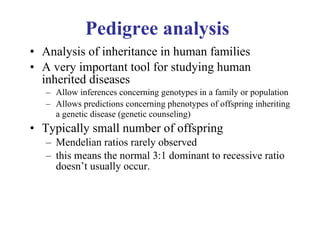
Pedigree analysis
• Analysis of inheritance in human families
• A very important tool for studying human
inherited diseases
– Allow inferences concerning genotypes in a family or population
– Allows predictions concerning phenotypes of offspring inheriting
a genetic disease (genetic counseling)
• Typically small number of offspring
– Mendelian ratios rarely observed
– this means the normal 3:1 dominant to recessive ratio
doesn’t usually occur.
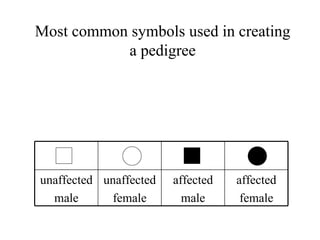
unaffected
male
unaffected
female
affected
male
affected
female
Most common symbols used in creating
a pedigree
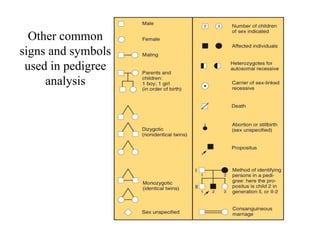
Other common
signs and symbols
used in pedigree
analysis
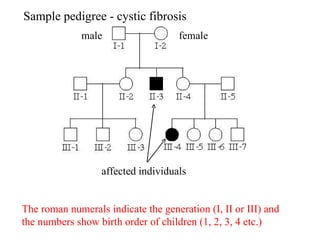
Sample pedigree - cystic fibrosis
female
male
affected individuals
The roman numerals indicate the generation (I, II or III) and
the numbers show birth order of children (1, 2, 3, 4 etc.)
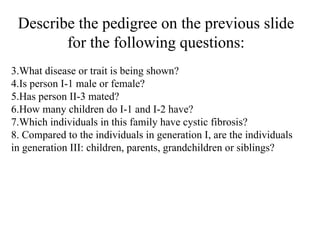
Describe the pedigree on the previous slide
for the following questions:
3.What disease or trait is being shown?
4.Is person I-1 male or female?
5.Has person II-3 mated?
6.How many children do I-1 and I-2 have?
7.Which individuals in this family have cystic fibrosis?
8. Compared to the individuals in generation I, are the individuals
in generation III: children, parents, grandchildren or siblings?
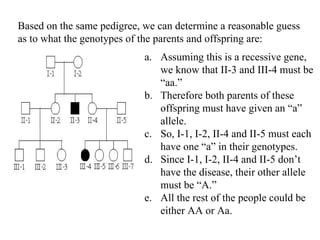
Based on the same pedigree, we can determine a reasonable guess
as to what the genotypes of the parents and offspring are:
a. Assuming this is a recessive gene,
we know that II-3 and III-4 must be
“aa.”
b. Therefore both parents of these
offspring must have given an “a”
allele.
c. So, I-1, I-2, II-4 and II-5 must each
have one “a” in their genotypes.
d. Since I-1, I-2, II-4 and II-5 don’t
have the disease, their other allele
must be “A.”
e. All the rest of the people could be
either AA or Aa.
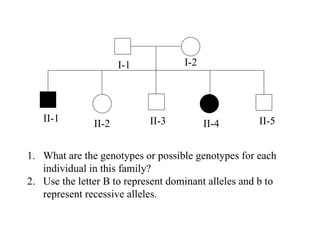
I-1 I-2
II-1
II-2 II-3 II-4 II-5
1. What are the genotypes or possible genotypes for each
individual in this family?
2. Use the letter B to represent dominant alleles and b to
represent recessive alleles.
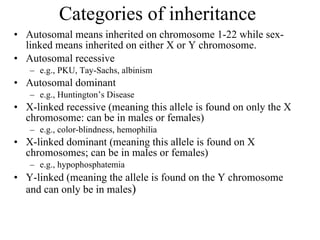
Categories of inheritance
• Autosomal means inherited on chromosome 1-22 while sex-
linked means inherited on either X or Y chromosome.
• Autosomal recessive
– e.g., PKU, Tay-Sachs, albinism
• Autosomal dominant
– e.g., Huntington’s Disease
• X-linked recessive (meaning this allele is found on only the X
chromosome: can be in males or females)
– e.g., color-blindness, hemophilia
• X-linked dominant (meaning this allele is found on X
chromosomes; can be in males or females)
– e.g., hypophosphatemia
• Y-linked (meaning the allele is found on the Y chromosome
and can only be in males)
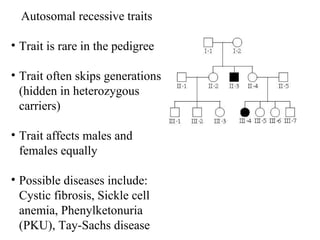
Autosomal recessive traits
• Trait is rare in the pedigree
• Trait often skips generations
(hidden in heterozygous
carriers)
• Trait affects males and
females equally
• Possible diseases include:
Cystic fibrosis, Sickle cell
anemia, Phenylketonuria
(PKU), Tay-Sachs disease
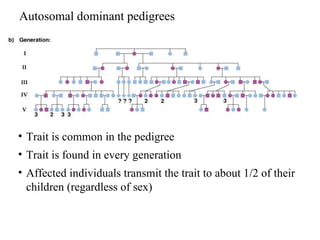
Autosomal dominant pedigrees
• Trait is common in the pedigree
• Trait is found in every generation
• Affected individuals transmit the trait to about 1/2 of their
children (regardless of sex)
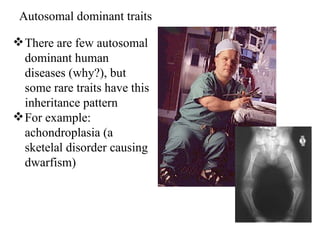
Autosomal dominant traits
There are few autosomal
dominant human
diseases (why?), but
some rare traits have this
inheritance pattern
For example:
achondroplasia (a
sketelal disorder causing
dwarfism)
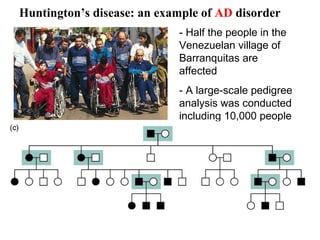
- Half the people in the
Venezuelan village of
Barranquitas are
affected
- A large-scale pedigree
analysis was conducted
including 10,000 people
- Example for one
particular family:
Huntington’s disease: an example of AD disorder
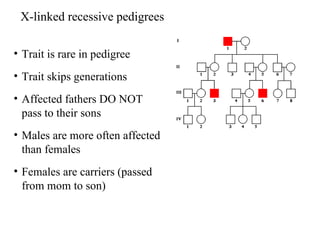
X-linked recessive pedigrees
• Trait is rare in pedigree
• Trait skips generations
• Affected fathers DO NOT
pass to their sons
• Males are more often affected
than females
• Females are carriers (passed
from mom to son)
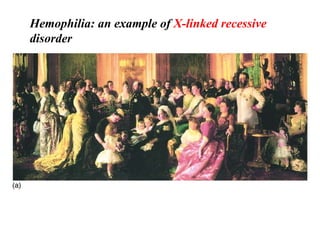
Hemophilia: an example of X-linked recessive
disorder
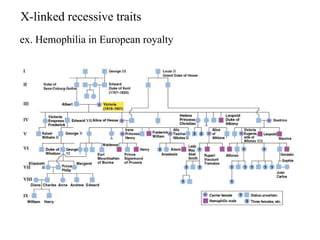
X-linked recessive traits
ex. Hemophilia in European royalty
X-linked recessive traits
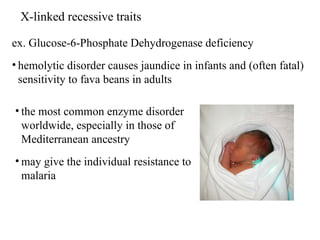
ex. Glucose-6-Phosphate Dehydrogenase deficiency
• hemolytic disorder causes jaundice in infants and (often fatal)
sensitivity to fava beans in adults
• the most common enzyme disorder
worldwide, especially in those of
Mediterranean ancestry
• may give the individual resistance to
malaria
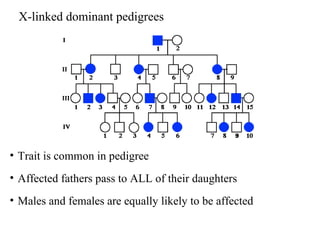
X-linked dominant pedigrees
• Trait is common in pedigree
• Affected fathers pass to ALL of their daughters
• Males and females are equally likely to be affected
X-linked dominant diseases
• X-linked dominant diseases are extremely unusual
• Often, they are lethal (before birth) in males and only seen in
females
ex. incontinentia pigmenti (skin lesions)
ex. X-linked rickets (bone lesions)
Pedigree Analysis in real life
Remember:
• dominant traits may be rare in a population
• recessive traits may be common in a population
• alleles may come into the pedigree from 2 sources
• mutation happens
• often traits are more complex
• affected by environment & other genes

pedigreeanalysis-110327104009-phpapp02.pdf

  • 1.
    The Inheritance of Single-GeneDifferences Human pedigree analysis
  • 2.
    Pedigree analysis • Analysisof inheritance in human families • A very important tool for studying human inherited diseases – Allow inferences concerning genotypes in a family or population – Allows predictions concerning phenotypes of offspring inheriting a genetic disease (genetic counseling) • Typically small number of offspring – Mendelian ratios rarely observed – this means the normal 3:1 dominant to recessive ratio doesn’t usually occur.
  • 3.
  • 4.
    Other common signs andsymbols used in pedigree analysis
  • 5.
    Sample pedigree -cystic fibrosis female male affected individuals The roman numerals indicate the generation (I, II or III) and the numbers show birth order of children (1, 2, 3, 4 etc.)
  • 6.
    Describe the pedigreeon the previous slide for the following questions: 3.What disease or trait is being shown? 4.Is person I-1 male or female? 5.Has person II-3 mated? 6.How many children do I-1 and I-2 have? 7.Which individuals in this family have cystic fibrosis? 8. Compared to the individuals in generation I, are the individuals in generation III: children, parents, grandchildren or siblings?
  • 7.
    Based on thesame pedigree, we can determine a reasonable guess as to what the genotypes of the parents and offspring are: a. Assuming this is a recessive gene, we know that II-3 and III-4 must be “aa.” b. Therefore both parents of these offspring must have given an “a” allele. c. So, I-1, I-2, II-4 and II-5 must each have one “a” in their genotypes. d. Since I-1, I-2, II-4 and II-5 don’t have the disease, their other allele must be “A.” e. All the rest of the people could be either AA or Aa.
  • 8.
    I-1 I-2 II-1 II-2 II-3II-4 II-5 1. What are the genotypes or possible genotypes for each individual in this family? 2. Use the letter B to represent dominant alleles and b to represent recessive alleles.
  • 9.
    Categories of inheritance •Autosomal means inherited on chromosome 1-22 while sex- linked means inherited on either X or Y chromosome. • Autosomal recessive – e.g., PKU, Tay-Sachs, albinism • Autosomal dominant – e.g., Huntington’s Disease • X-linked recessive (meaning this allele is found on only the X chromosome: can be in males or females) – e.g., color-blindness, hemophilia • X-linked dominant (meaning this allele is found on X chromosomes; can be in males or females) – e.g., hypophosphatemia • Y-linked (meaning the allele is found on the Y chromosome and can only be in males)
  • 10.
    Autosomal recessive traits •Trait is rare in the pedigree • Trait often skips generations (hidden in heterozygous carriers) • Trait affects males and females equally • Possible diseases include: Cystic fibrosis, Sickle cell anemia, Phenylketonuria (PKU), Tay-Sachs disease
  • 11.
    Autosomal dominant pedigrees •Trait is common in the pedigree • Trait is found in every generation • Affected individuals transmit the trait to about 1/2 of their children (regardless of sex)
  • 12.
    Autosomal dominant traits Thereare few autosomal dominant human diseases (why?), but some rare traits have this inheritance pattern For example: achondroplasia (a sketelal disorder causing dwarfism)
  • 13.
    - Half thepeople in the Venezuelan village of Barranquitas are affected - A large-scale pedigree analysis was conducted including 10,000 people - Example for one particular family: Huntington’s disease: an example of AD disorder
  • 14.
    X-linked recessive pedigrees •Trait is rare in pedigree • Trait skips generations • Affected fathers DO NOT pass to their sons • Males are more often affected than females • Females are carriers (passed from mom to son)
  • 15.
    Hemophilia: an exampleof X-linked recessive disorder
  • 16.
    X-linked recessive traits ex.Hemophilia in European royalty
  • 17.
    X-linked recessive traits ex.Glucose-6-Phosphate Dehydrogenase deficiency • hemolytic disorder causes jaundice in infants and (often fatal) sensitivity to fava beans in adults • the most common enzyme disorder worldwide, especially in those of Mediterranean ancestry • may give the individual resistance to malaria
  • 18.
    X-linked dominant pedigrees •Trait is common in pedigree • Affected fathers pass to ALL of their daughters • Males and females are equally likely to be affected
  • 19.
    X-linked dominant diseases •X-linked dominant diseases are extremely unusual • Often, they are lethal (before birth) in males and only seen in females ex. incontinentia pigmenti (skin lesions) ex. X-linked rickets (bone lesions)
  • 20.
    Pedigree Analysis inreal life Remember: • dominant traits may be rare in a population • recessive traits may be common in a population • alleles may come into the pedigree from 2 sources • mutation happens • often traits are more complex • affected by environment & other genes