Pedigree Analysis
Dr. Monisha Banerjee
Professor
Molecular & Human Genetics Lab
Department of Zoology
University of Lucknow
Lucknow
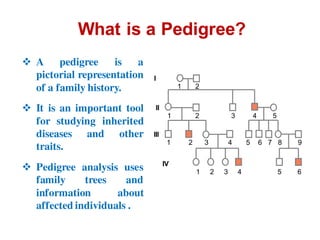
 A pedigree is a
pictorial representation
of a family history.
 It is an important tool
for studying inherited
diseases and other
traits.
 Pedigree analysis uses
family trees and
information about
affected individuals .
What is a Pedigree?
1 2 3 4 5 6
1 2 3 4 5 6 7 8 9
1 2 3 4 5
1 2
I
II
III
IV
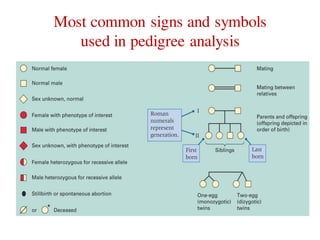
Most common signs and symbols
used in pedigree analysis
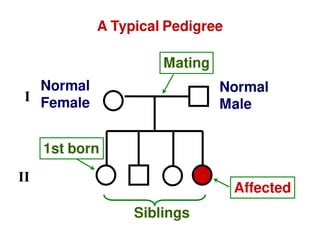
A Typical Pedigree
Normal
Female
Normal
Male
Mating
1st born
Siblings
Affected
I
II
Basic patterns of inheritance
•Autosomal, recessive
•Autosomal, dominant
•X-linked, recessive
•X-linked, dominant (very rare)
•Y-linked
Autosomal vs. sex-linked traits
Autosomal traits are caused by genes on
autosomes (chromosome #1- #22)
e.g., we speak of autosomal recessive or
autosomal dominant traits or diseases.
Sex-linked traits are caused by genes on
the sex chromosome (X or Y)
e.g., we speak of X-linked recessive or X-
linked dominant traits or diseases.
Recessive inheritance
If d is the disease allele and D is
normal, then only dd genotypes
are affected
Typically not seen in every
generation
Affected offspring can be born to
unaffected parents
Dominant inheritance
If D is the disease allele and d is
normal, then only dd genotypes are
disease free*
Dominant trait/disease found in every
generation*
Affected offspring never** born to
unaffected parents
*Assuming 100% penetrance
**Assuming no new mutation
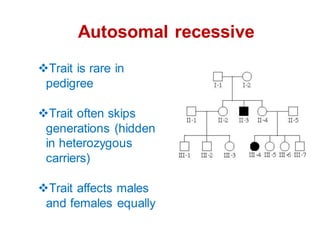
Autosomal recessive
Trait is rare in
pedigree
Trait often skips
generations (hidden
in heterozygous
carriers)
Trait affects males
and females equally
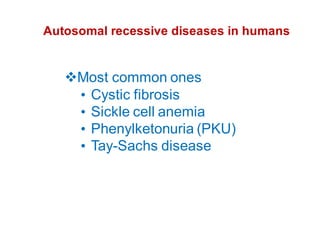
Autosomal recessive diseases in humans
Most common ones
• Cystic fibrosis
• Sickle cell anemia
• Phenylketonuria (PKU)
• Tay-Sachs disease
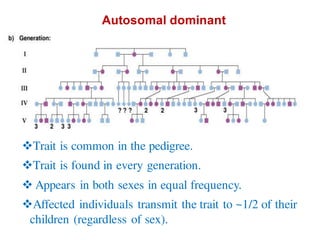
Trait is common in the pedigree.
Trait is found in every generation.
 Appears in both sexes in equal frequency.
Affected individuals transmit the trait to ~1/2 of their
children (regardless of sex).
Autosomal dominant
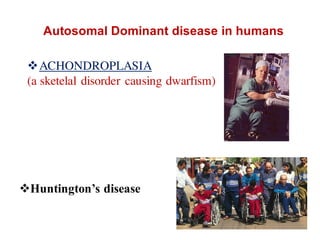
ACHONDROPLASIA
(a sketelal disorder causing dwarfism)
Autosomal Dominant disease in humans
Huntington’s disease
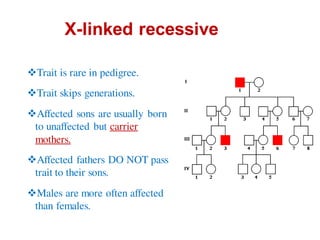
X-linked recessive
Trait is rare in pedigree.
Trait skips generations.
Affected sons are usually born
to unaffected but carrier
mothers.
Affected fathers DO NOT pass
trait to their sons.
Males are more often affected
than females.
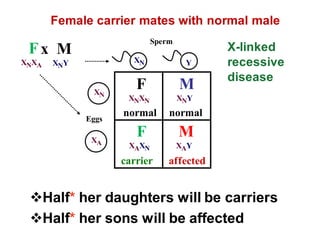
Female carrier mates with normal male
F
XNXN
Y
XN
Half* her daughters will be carriers
Half* her sons will be affected
x M
XNY
Eggs
Sperm
XN
M
XNY
normal normal
M
XAY
affected
F
XAXN
carrier
X-linked
recessive
disease
XA
F
XNXA
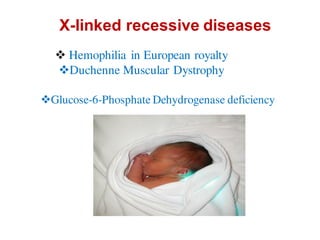
X-linked recessive diseases
Glucose-6-Phosphate Dehydrogenase deficiency
 Hemophilia in European royalty
Duchenne Muscular Dystrophy
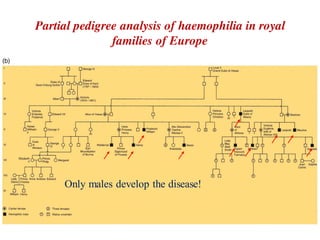
Partial pedigree analysis of haemophilia in royal
families of Europe
Only males develop the disease!
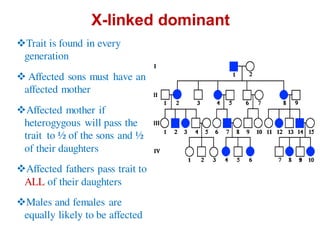
X-linked dominant
Trait is found in every
generation
 Affected sons must have an
affected mother
Affected mother if
heterogygous will pass the
trait to ½ of the sons and ½
of their daughters
Affected fathers pass trait to
ALL of their daughters
Males and females are
equally likely to be affected
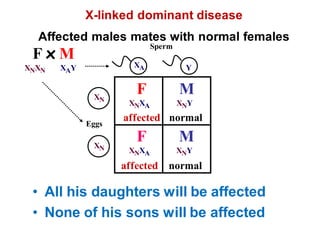
Affected males mates with normal females
Y
XN
• All his daughters will be affected
• None of his sons will be affected
F x M
XNXN XAY
Eggs
Sperm
XA
M
XNY
normal
M
XNY
normal
F
XNXA
affected
F
XNXA
affected
X-linked dominant disease
XN
X-linked dominant diseases
X-linked dominant diseases are extremely
unusual
Often, they are lethal (before birth) in males
and only seen in females
eg. Incontinentia pigmenti (skin lesions)
eg. X-linked rickets (bone lesions)
eg. Hypophosphatemia
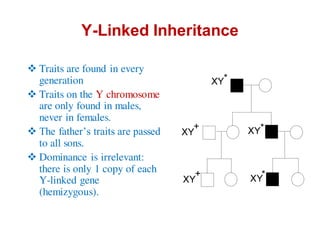
Y-Linked Inheritance
 Traits are found in every
generation
 Traits on the Y chromosome
are only found in males,
never in females.
 The father’s traits are passed
to all sons.
 Dominance is irrelevant:
there is only 1 copy of each
Y-linked gene
(hemizygous).
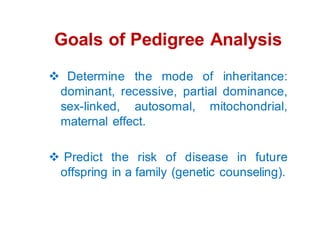
Goals of Pedigree Analysis
 Determine the mode of inheritance:
dominant, recessive, partial dominance,
sex-linked, autosomal, mitochondrial,
maternal effect.
 Predict the risk of disease in future
offspring in a family (genetic counseling).
Thank you

Pedigree_analysis.pdf

  • 1.
    Pedigree Analysis Dr. MonishaBanerjee Professor Molecular & Human Genetics Lab Department of Zoology University of Lucknow Lucknow
  • 2.
     A pedigreeis a pictorial representation of a family history.  It is an important tool for studying inherited diseases and other traits.  Pedigree analysis uses family trees and information about affected individuals . What is a Pedigree? 1 2 3 4 5 6 1 2 3 4 5 6 7 8 9 1 2 3 4 5 1 2 I II III IV
  • 3.
    Most common signsand symbols used in pedigree analysis
  • 4.
  • 5.
    Basic patterns ofinheritance •Autosomal, recessive •Autosomal, dominant •X-linked, recessive •X-linked, dominant (very rare) •Y-linked
  • 6.
    Autosomal vs. sex-linkedtraits Autosomal traits are caused by genes on autosomes (chromosome #1- #22) e.g., we speak of autosomal recessive or autosomal dominant traits or diseases. Sex-linked traits are caused by genes on the sex chromosome (X or Y) e.g., we speak of X-linked recessive or X- linked dominant traits or diseases.
  • 7.
    Recessive inheritance If dis the disease allele and D is normal, then only dd genotypes are affected Typically not seen in every generation Affected offspring can be born to unaffected parents
  • 8.
    Dominant inheritance If Dis the disease allele and d is normal, then only dd genotypes are disease free* Dominant trait/disease found in every generation* Affected offspring never** born to unaffected parents *Assuming 100% penetrance **Assuming no new mutation
  • 9.
    Autosomal recessive Trait israre in pedigree Trait often skips generations (hidden in heterozygous carriers) Trait affects males and females equally
  • 10.
    Autosomal recessive diseasesin humans Most common ones • Cystic fibrosis • Sickle cell anemia • Phenylketonuria (PKU) • Tay-Sachs disease
  • 11.
    Trait is commonin the pedigree. Trait is found in every generation.  Appears in both sexes in equal frequency. Affected individuals transmit the trait to ~1/2 of their children (regardless of sex). Autosomal dominant
  • 12.
    ACHONDROPLASIA (a sketelal disordercausing dwarfism) Autosomal Dominant disease in humans Huntington’s disease
  • 13.
    X-linked recessive Trait israre in pedigree. Trait skips generations. Affected sons are usually born to unaffected but carrier mothers. Affected fathers DO NOT pass trait to their sons. Males are more often affected than females.
  • 14.
    Female carrier mateswith normal male F XNXN Y XN Half* her daughters will be carriers Half* her sons will be affected x M XNY Eggs Sperm XN M XNY normal normal M XAY affected F XAXN carrier X-linked recessive disease XA F XNXA
  • 15.
    X-linked recessive diseases Glucose-6-PhosphateDehydrogenase deficiency  Hemophilia in European royalty Duchenne Muscular Dystrophy
  • 16.
    Partial pedigree analysisof haemophilia in royal families of Europe Only males develop the disease!
  • 17.
    X-linked dominant Trait isfound in every generation  Affected sons must have an affected mother Affected mother if heterogygous will pass the trait to ½ of the sons and ½ of their daughters Affected fathers pass trait to ALL of their daughters Males and females are equally likely to be affected
  • 18.
    Affected males mateswith normal females Y XN • All his daughters will be affected • None of his sons will be affected F x M XNXN XAY Eggs Sperm XA M XNY normal M XNY normal F XNXA affected F XNXA affected X-linked dominant disease XN
  • 19.
    X-linked dominant diseases X-linkeddominant diseases are extremely unusual Often, they are lethal (before birth) in males and only seen in females eg. Incontinentia pigmenti (skin lesions) eg. X-linked rickets (bone lesions) eg. Hypophosphatemia
  • 20.
    Y-Linked Inheritance  Traitsare found in every generation  Traits on the Y chromosome are only found in males, never in females.  The father’s traits are passed to all sons.  Dominance is irrelevant: there is only 1 copy of each Y-linked gene (hemizygous).
  • 21.
    Goals of PedigreeAnalysis  Determine the mode of inheritance: dominant, recessive, partial dominance, sex-linked, autosomal, mitochondrial, maternal effect.  Predict the risk of disease in future offspring in a family (genetic counseling).
  • 22.