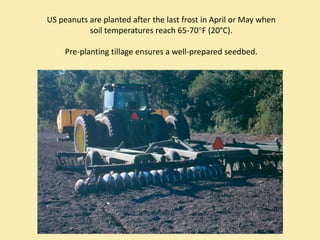
US peanuts are planted after the last frost in April or May when 
           soil temperatures reach 65‐70°F (20°C).

     Pre‐planting tillage ensures a well‐prepared seedbed.
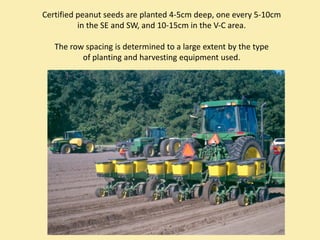
Certified peanut seeds are planted 4‐5cm deep, one every 5‐10cm 
          in the SE and SW, and 10‐15cm in the V‐C area.

   The row spacing is determined to a large extent by the type 
          of planting and harvesting equipment used.
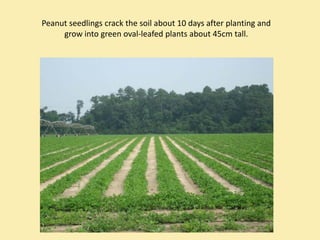
Peanut seedlings crack the soil about 10 days after planting and 
     grow into green oval‐leafed plants about 45cm tall.
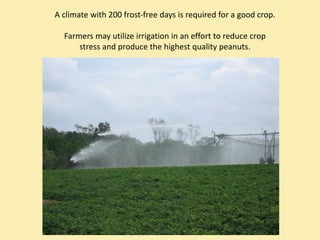
A climate with 200 frost‐free days is required for a good crop.

  Farmers may utilize irrigation in an effort to reduce crop 
      stress and produce the highest quality peanuts.
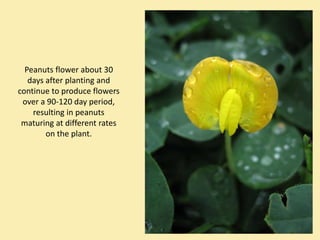
Peanuts flower about 30 
   days after planting and 
continue to produce flowers 
 over a 90‐120 day period, 
    resulting in peanuts 
 maturing at different rates 
        on the plant.
Once the flowers pollinate themselves, the petals fall 
         off as the peanut ovary begins to form.

This budding ovary, called a ‘peg’, grows away from the plant
    on a vine and penetrates the soil to become a peanut.
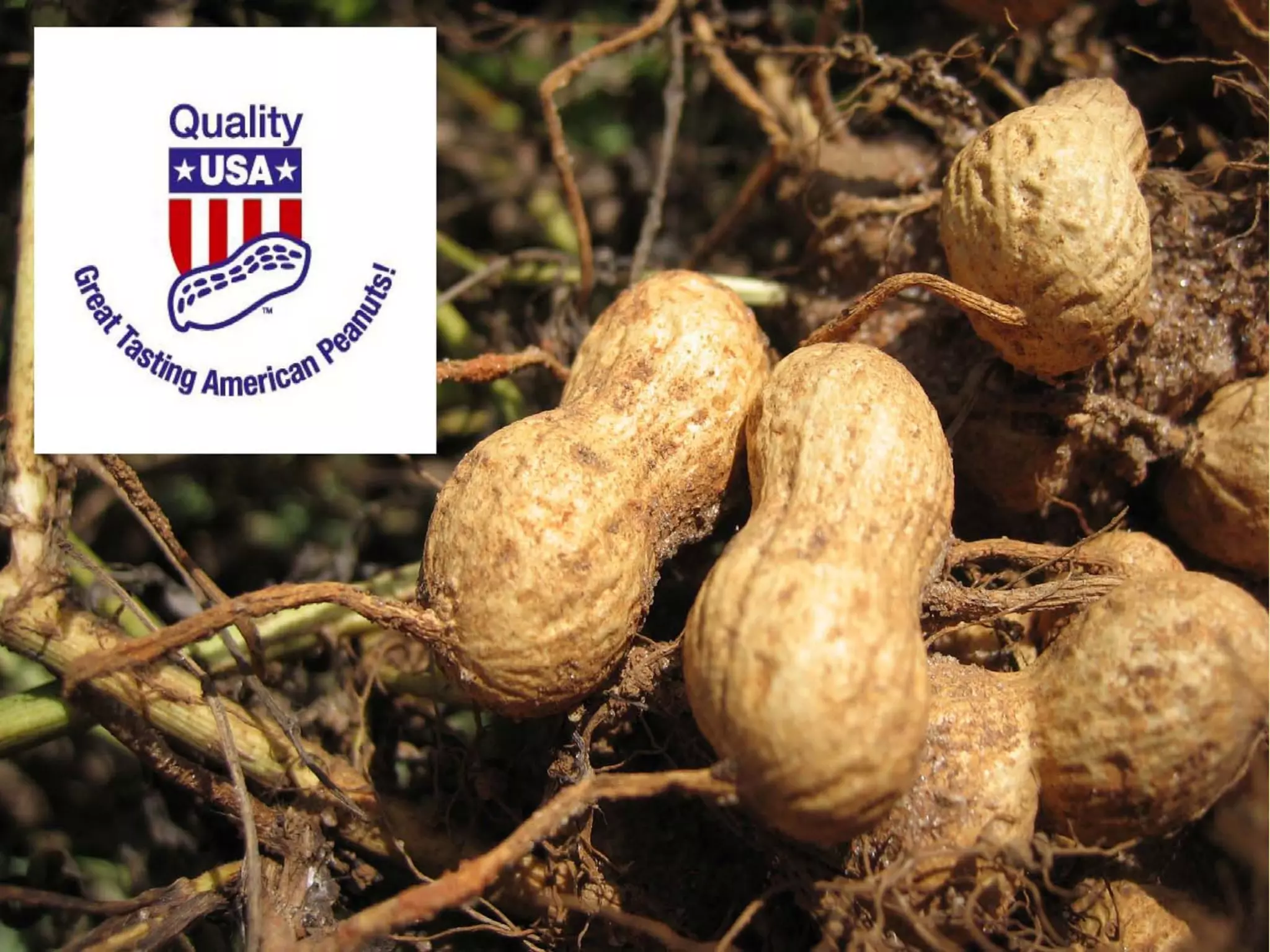
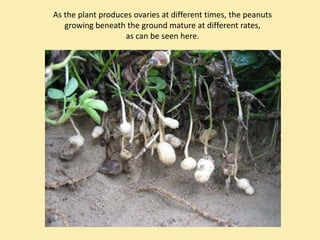
As the plant produces ovaries at different times, the peanuts 
   growing beneath the ground mature at different rates, 
                   as can be seen here.
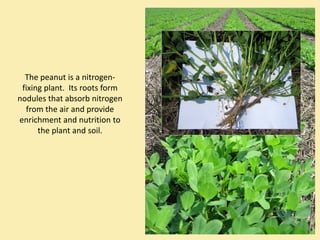
The peanut is a nitrogen‐
 fixing plant.  Its roots form 
nodules that absorb nitrogen 
  from the air and provide 
enrichment and nutrition to 
      the plant and soil.
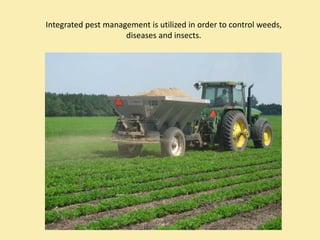
Integrated pest management is utilized in order to control weeds, 
                     diseases and insects. 
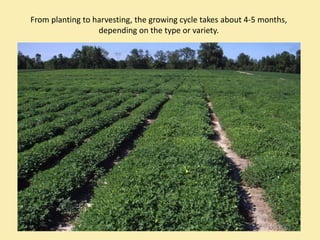
From planting to harvesting, the growing cycle takes about 4‐5 months, 
                  depending on the type or variety.
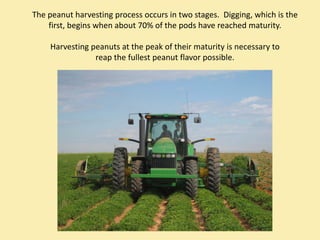
The peanut harvesting process occurs in two stages.  Digging, which is the 
    first, begins when about 70% of the pods have reached maturity.

     Harvesting peanuts at the peak of their maturity is necessary to 
                 reap the fullest peanut flavor possible. 
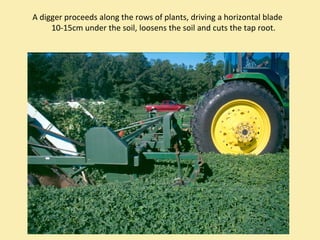
A digger proceeds along the rows of plants, driving a horizontal blade 
     10‐15cm under the soil, loosens the soil and cuts the tap root.
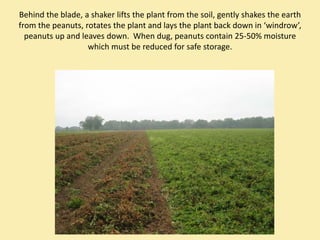
Behind the blade, a shaker lifts the plant from the soil, gently shakes the earth 
from the peanuts, rotates the plant and lays the plant back down in ‘windrow’, 
  peanuts up and leaves down.  When dug, peanuts contain 25‐50% moisture 
                   which must be reduced for safe storage.
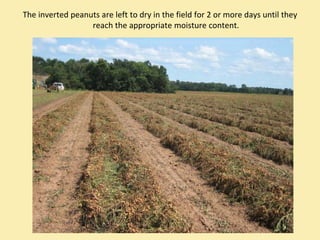
The inverted peanuts are left to dry in the field for 2 or more days until they 
                  reach the appropriate moisture content.
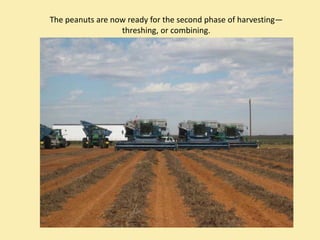
The peanuts are now ready for the second phase of harvesting—
                  threshing, or combining.
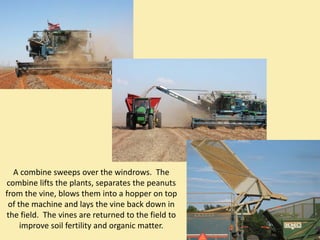
A combine sweeps over the windrows.  The 
combine lifts the plants, separates the peanuts 
from the vine, blows them into a hopper on top 
 of the machine and lays the vine back down in 
the field.  The vines are returned to the field to 
     improve soil fertility and organic matter. 
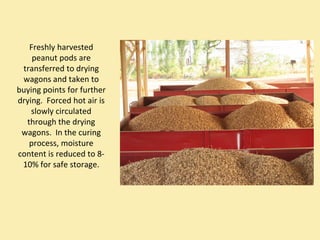
Freshly harvested 
    peanut pods are 
 transferred to drying 
 wagons and taken to 
buying points for further 
drying.  Forced hot air is 
    slowly circulated 
  through the drying 
 wagons.  In the curing 
   process, moisture 
content is reduced to 8‐
 10% for safe storage. 
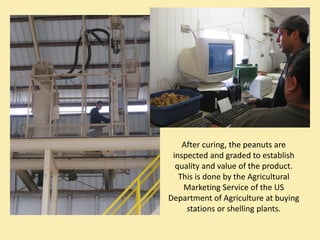
After curing, the peanuts are 
 inspected and graded to establish 
  quality and value of the product.  
   This is done by the Agricultural 
    Marketing Service of the US 
Department of Agriculture at buying 
     stations or shelling plants.
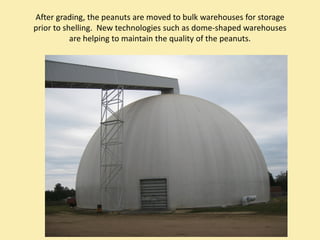
After grading, the peanuts are moved to bulk warehouses for storage 
prior to shelling.  New technologies such as dome‐shaped warehouses 
           are helping to maintain the quality of the peanuts.
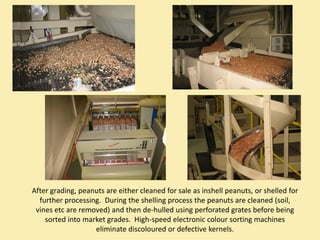
After grading, peanuts are either cleaned for sale as inshell peanuts, or shelled for 
  further processing.  During the shelling process the peanuts are cleaned (soil, 
 vines etc are removed) and then de‐hulled using perforated grates before being 
    sorted into market grades.  High‐speed electronic colour sorting machines 
                   eliminate discoloured or defective kernels.
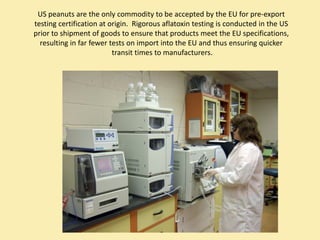
US peanuts are the only commodity to be accepted by the EU for pre‐export 
testing certification at origin.  Rigorous aflatoxin testing is conducted in the US 
prior to shipment of goods to ensure that products meet the EU specifications, 
  resulting in far fewer tests on import into the EU and thus ensuring quicker
                          transit times to manufacturers.
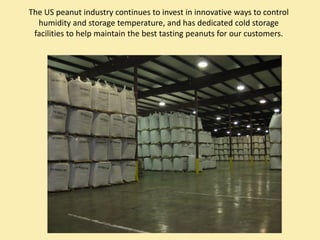
The US peanut industry continues to invest in innovative ways to control 
  humidity and storage temperature, and has dedicated cold storage 
 facilities to help maintain the best tasting peanuts for our customers. 
The US is able to offer a 
    range of peanut 
     ingredients for 
 applications including 
 bakery, confectionery, 
   ice cream and the 
   general consumer 
 market.  These include 
peanut flour, oil, extract 
 and peanut butter as 
     well as custom 
  processed peanuts.
Peanut Tour
Peanut Tour
Peanut Tour
Peanut Tour
Peanut Tour
Peanut Tour
Peanut Tour
Peanut Tour

Peanut Tour