PDU 214 METODE OBSERVASI & WAWANCARA
SEMESTER GENAP 2015/2016
FAKULTAS PSIKOLOGI UNIVERSITAS KATOLIK INDONESIA ATMA JAYA
Kuliah III - 01 Februari 2016
OBSERVATION:

Methods & Record Keeping
One Day
Objectives
Mahasiswa mampu memahami tahap
perancangan panduan observasi;1
Mahasiswa mampu menyusun panduan
observasi untuk pengumpulan data sesuai
dengan tujuan.
2
Principles of
Methods &
Record
Keeping
PDU 214 METODE OBSERVASI & WAWANCARA
FAKULTAS PSIKOLOGI UNIVERSITAS KATOLIK INDONESIA ATMA JAYA © 2016 Ardhiati
Different types of information require

the use of different recording forms.
Regardless of the purpose of the observation

and the type of record that is to be used,

several general procedures collectively make up

a method of observing.
4
(Cartwright & Cartwright, 1984: 30)
“
”
PDU 214 METODE OBSERVASI & WAWANCARA
FAKULTAS PSIKOLOGI UNIVERSITAS KATOLIK INDONESIA ATMA JAYA © 2016 Ardhiati
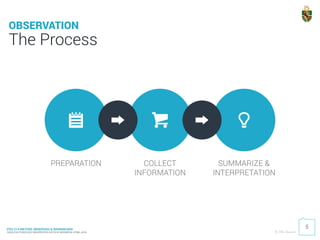
The Process
5
OBSERVATION
PREPARATION COLLECT

INFORMATION
SUMMARIZE &

INTERPRETATION
PDU 214 METODE OBSERVASI & WAWANCARA
FAKULTAS PSIKOLOGI UNIVERSITAS KATOLIK INDONESIA ATMA JAYA © 2016 Ardhiati
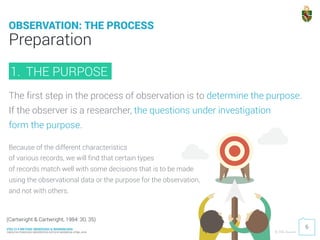
The first step in the process of observation is to determine the purpose.

If the observer is a researcher, the questions under investigation 

form the purpose.
Because of the different characteristics

of various records, we will find that certain types

of records match well with some decisions that is to be made

using the observational data or the purpose for the observation,

and not with others.
Preparation
6
OBSERVATION: THE PROCESS
(Cartwright & Cartwright, 1984: 30, 35)
1. THE PURPOSE
PDU 214 METODE OBSERVASI & WAWANCARA
FAKULTAS PSIKOLOGI UNIVERSITAS KATOLIK INDONESIA ATMA JAYA © 2016 Ardhiati
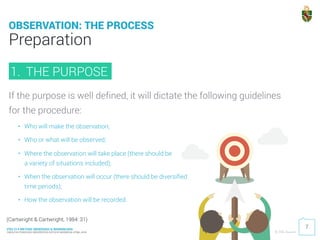
If the purpose is well defined, it will dictate the following guidelines

for the procedure:
• Who will make the observation;
• Who or what will be observed;
• Where the observation will take place (there should be

a variety of situations included);
• When the observation will occur (there should be diversified

time periods);
• How the observation will be recorded.
Preparation
7
OBSERVATION: THE PROCESS
(Cartwright & Cartwright, 1984: 31)
1. THE PURPOSE
PDU 214 METODE OBSERVASI & WAWANCARA
FAKULTAS PSIKOLOGI UNIVERSITAS KATOLIK INDONESIA ATMA JAYA © 2016 Ardhiati
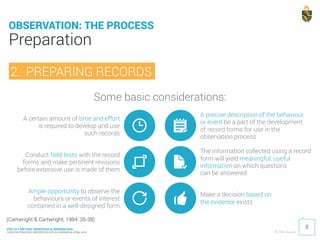
Some basic considerations:
Preparation
8
OBSERVATION: THE PROCESS
(Cartwright & Cartwright, 1984: 35-38)
2. PREPARING RECORDS
A certain amount of time and effort

is required to develop and use

such records
A precise description of the behaviour

or event be a part of the development

of record forms for use in the
observation process
Conduct field tests with the record
forms and make pertinent revisions
before extensive use is made of them
Ample opportunity to observe the
behaviours or events of interest
contained in a well-designed form
The information collected using a record
form will yield meaningful, useful
information on which questions

can be answered
Make a decision based on

the evidence exists
PDU 214 METODE OBSERVASI & WAWANCARA
FAKULTAS PSIKOLOGI UNIVERSITAS KATOLIK INDONESIA ATMA JAYA © 2016 Ardhiati
Preparation
9
OBSERVATION: THE PROCESS
(Cartwright & Cartwright, 1984: 36)
2. PREPARING RECORDS
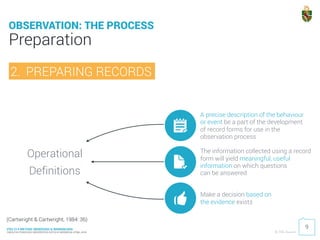
A precise description of the behaviour

or event be a part of the development

of record forms for use in the
observation process
The information collected using a record
form will yield meaningful, useful
information on which questions

can be answered
Make a decision based on

the evidence exists
Operational
Definitions
PDU 214 METODE OBSERVASI & WAWANCARA
FAKULTAS PSIKOLOGI UNIVERSITAS KATOLIK INDONESIA ATMA JAYA © 2016 Ardhiati
Preparation
10
OBSERVATION: THE PROCESS
2. PREPARING RECORDS
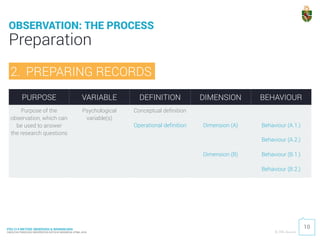
PURPOSE VARIABLE DEFINITION DIMENSION BEHAVIOUR
Purpose of the

observation, which can

be used to answer

the research questions
Psychological

variable(s)
Conceptual definition
Operational definition Dimension (A)
Dimension (B)
Behaviour (A.1.)
Behaviour (A.2.)
Behaviour (B.1.)
Behaviour (B.2.)
PDU 214 METODE OBSERVASI & WAWANCARA
FAKULTAS PSIKOLOGI UNIVERSITAS KATOLIK INDONESIA ATMA JAYA © 2016 Ardhiati
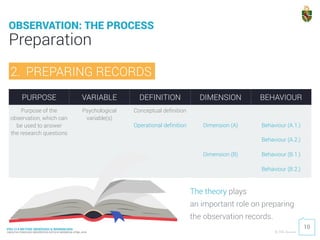
The theory plays

an important role on preparing

the observation records.
Preparation
10
OBSERVATION: THE PROCESS
2. PREPARING RECORDS
PURPOSE VARIABLE DEFINITION DIMENSION BEHAVIOUR
Purpose of the

observation, which can

be used to answer

the research questions
Psychological

variable(s)
Conceptual definition
Operational definition Dimension (A)
Dimension (B)
Behaviour (A.1.)
Behaviour (A.2.)
Behaviour (B.1.)
Behaviour (B.2.)
PDU 214 METODE OBSERVASI & WAWANCARA
FAKULTAS PSIKOLOGI UNIVERSITAS KATOLIK INDONESIA ATMA JAYA © 2016 Ardhiati
Preparation
11
OBSERVATION: THE PROCESS
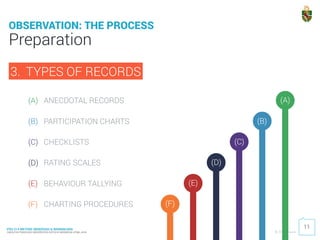
3. TYPES OF RECORDS
(A)
(B)
(C)
(D)
(E)
(F)
(A) ANECDOTAL RECORDS
(B) PARTICIPATION CHARTS
(C) CHECKLISTS
(D) RATING SCALES
(E) BEHAVIOUR TALLYING
(F) CHARTING PROCEDURES
PDU 214 METODE OBSERVASI & WAWANCARA
FAKULTAS PSIKOLOGI UNIVERSITAS KATOLIK INDONESIA ATMA JAYA © 2016 Ardhiati
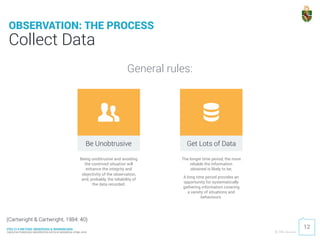
General rules:
Collect Data
12
OBSERVATION: THE PROCESS
(Cartwright & Cartwright, 1984: 40)
Being unobtrusive and avoiding
the contrived situation will
enhance the integrity and
objectivity of the observation,
and, probably, the reliability of
the data recorded.
The longer time period, the more
reliable the information
obtained is likely to be;
A long time period provides an
opportunity for systematically
gathering information covering
a variety of situations and
behaviours.
Be Unobtrusive Get Lots of Data
PDU 214 METODE OBSERVASI & WAWANCARA
FAKULTAS PSIKOLOGI UNIVERSITAS KATOLIK INDONESIA ATMA JAYA © 2016 Ardhiati
Any records, even excellent ones, are of no value

unless the information is interpreted.
Information is not gathered as an end in itself;

the information is a means to an end and that end

is the making of appropriate decisions to meet

the purposes of the observation.
Information on which interpretations will be based should be

gathered over an adequate period of time and in a variety

of situations to ensure that a reliable sampling of behaviour

is available before drawing any conclusions.
Summarize & Interpretation
13
OBSERVATION: THE PROCESS
(Cartwright & Cartwright, 1984: 41-43)
PDU 214 METODE OBSERVASI & WAWANCARA
FAKULTAS PSIKOLOGI UNIVERSITAS KATOLIK INDONESIA ATMA JAYA © 2016 Ardhiati
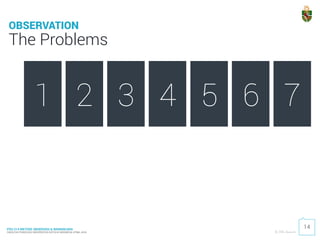
The Problems
14
OBSERVATION
7654321
PDU 214 METODE OBSERVASI & WAWANCARA
FAKULTAS PSIKOLOGI UNIVERSITAS KATOLIK INDONESIA ATMA JAYA © 2016 Ardhiati
The Problems
14
OBSERVATION
7654321
Inaccuracy Inefficiency
Observer’s
Biases
Subjectivity
Other Errors
(Generosity,
Severity, Central
Tendency, &
Logical)
Observer’s
Recent
Condition
Observer’s
Individual
Characte-
ristics
Making records
precisely and
immediately
Using a variety
of aids (index
cards,
notebooks, etc)
Making some
value judgments
Involving several
independent
observers
Taking
precautions,
using other
methods
Controling the
observer’s
condition to be
neutral
Controling the
observer’s
condition to be
neutral
PROBLEMSSOLUTIONS
(Cartwright & Cartwright, 1984: 39-52)
PDU 214 METODE OBSERVASI & WAWANCARA
FAKULTAS PSIKOLOGI UNIVERSITAS KATOLIK INDONESIA ATMA JAYA © 2016 Ardhiati
Want to Know More?
Cartwright, C.A. & Cartwright, G.P. (1984). Developing observation skills (2nd
ed.).
New York, NY: McGraw-Hill, Inc.
All illustrations designed by freepik.
19

PDU 214 Methods of Observation & Interviewing: Observation - Methods & Record Keeping

  • 1.
    PDU 214 METODEOBSERVASI & WAWANCARA SEMESTER GENAP 2015/2016 FAKULTAS PSIKOLOGI UNIVERSITAS KATOLIK INDONESIA ATMA JAYA Kuliah III - 01 Februari 2016 OBSERVATION:
 Methods & Record Keeping
  • 2.
    One Day Objectives Mahasiswa mampumemahami tahap perancangan panduan observasi;1 Mahasiswa mampu menyusun panduan observasi untuk pengumpulan data sesuai dengan tujuan. 2
  • 3.
  • 4.
    PDU 214 METODEOBSERVASI & WAWANCARA FAKULTAS PSIKOLOGI UNIVERSITAS KATOLIK INDONESIA ATMA JAYA © 2016 Ardhiati Different types of information require
 the use of different recording forms. Regardless of the purpose of the observation
 and the type of record that is to be used,
 several general procedures collectively make up
 a method of observing. 4 (Cartwright & Cartwright, 1984: 30) “ ”
  • 5.
    PDU 214 METODEOBSERVASI & WAWANCARA FAKULTAS PSIKOLOGI UNIVERSITAS KATOLIK INDONESIA ATMA JAYA © 2016 Ardhiati The Process 5 OBSERVATION PREPARATION COLLECT
 INFORMATION SUMMARIZE &
 INTERPRETATION
  • 6.
    PDU 214 METODEOBSERVASI & WAWANCARA FAKULTAS PSIKOLOGI UNIVERSITAS KATOLIK INDONESIA ATMA JAYA © 2016 Ardhiati The first step in the process of observation is to determine the purpose.
 If the observer is a researcher, the questions under investigation 
 form the purpose. Because of the different characteristics
 of various records, we will find that certain types
 of records match well with some decisions that is to be made
 using the observational data or the purpose for the observation,
 and not with others. Preparation 6 OBSERVATION: THE PROCESS (Cartwright & Cartwright, 1984: 30, 35) 1. THE PURPOSE
  • 7.
    PDU 214 METODEOBSERVASI & WAWANCARA FAKULTAS PSIKOLOGI UNIVERSITAS KATOLIK INDONESIA ATMA JAYA © 2016 Ardhiati If the purpose is well defined, it will dictate the following guidelines
 for the procedure: • Who will make the observation; • Who or what will be observed; • Where the observation will take place (there should be
 a variety of situations included); • When the observation will occur (there should be diversified
 time periods); • How the observation will be recorded. Preparation 7 OBSERVATION: THE PROCESS (Cartwright & Cartwright, 1984: 31) 1. THE PURPOSE
  • 8.
    PDU 214 METODEOBSERVASI & WAWANCARA FAKULTAS PSIKOLOGI UNIVERSITAS KATOLIK INDONESIA ATMA JAYA © 2016 Ardhiati Some basic considerations: Preparation 8 OBSERVATION: THE PROCESS (Cartwright & Cartwright, 1984: 35-38) 2. PREPARING RECORDS A certain amount of time and effort
 is required to develop and use
 such records A precise description of the behaviour
 or event be a part of the development
 of record forms for use in the observation process Conduct field tests with the record forms and make pertinent revisions before extensive use is made of them Ample opportunity to observe the behaviours or events of interest contained in a well-designed form The information collected using a record form will yield meaningful, useful information on which questions
 can be answered Make a decision based on
 the evidence exists
  • 9.
    PDU 214 METODEOBSERVASI & WAWANCARA FAKULTAS PSIKOLOGI UNIVERSITAS KATOLIK INDONESIA ATMA JAYA © 2016 Ardhiati Preparation 9 OBSERVATION: THE PROCESS (Cartwright & Cartwright, 1984: 36) 2. PREPARING RECORDS A precise description of the behaviour
 or event be a part of the development
 of record forms for use in the observation process The information collected using a record form will yield meaningful, useful information on which questions
 can be answered Make a decision based on
 the evidence exists Operational Definitions
  • 10.
    PDU 214 METODEOBSERVASI & WAWANCARA FAKULTAS PSIKOLOGI UNIVERSITAS KATOLIK INDONESIA ATMA JAYA © 2016 Ardhiati Preparation 10 OBSERVATION: THE PROCESS 2. PREPARING RECORDS PURPOSE VARIABLE DEFINITION DIMENSION BEHAVIOUR Purpose of the
 observation, which can
 be used to answer
 the research questions Psychological
 variable(s) Conceptual definition Operational definition Dimension (A) Dimension (B) Behaviour (A.1.) Behaviour (A.2.) Behaviour (B.1.) Behaviour (B.2.)
  • 11.
    PDU 214 METODEOBSERVASI & WAWANCARA FAKULTAS PSIKOLOGI UNIVERSITAS KATOLIK INDONESIA ATMA JAYA © 2016 Ardhiati The theory plays
 an important role on preparing
 the observation records. Preparation 10 OBSERVATION: THE PROCESS 2. PREPARING RECORDS PURPOSE VARIABLE DEFINITION DIMENSION BEHAVIOUR Purpose of the
 observation, which can
 be used to answer
 the research questions Psychological
 variable(s) Conceptual definition Operational definition Dimension (A) Dimension (B) Behaviour (A.1.) Behaviour (A.2.) Behaviour (B.1.) Behaviour (B.2.)
  • 12.
    PDU 214 METODEOBSERVASI & WAWANCARA FAKULTAS PSIKOLOGI UNIVERSITAS KATOLIK INDONESIA ATMA JAYA © 2016 Ardhiati Preparation 11 OBSERVATION: THE PROCESS 3. TYPES OF RECORDS (A) (B) (C) (D) (E) (F) (A) ANECDOTAL RECORDS (B) PARTICIPATION CHARTS (C) CHECKLISTS (D) RATING SCALES (E) BEHAVIOUR TALLYING (F) CHARTING PROCEDURES
  • 13.
    PDU 214 METODEOBSERVASI & WAWANCARA FAKULTAS PSIKOLOGI UNIVERSITAS KATOLIK INDONESIA ATMA JAYA © 2016 Ardhiati General rules: Collect Data 12 OBSERVATION: THE PROCESS (Cartwright & Cartwright, 1984: 40) Being unobtrusive and avoiding the contrived situation will enhance the integrity and objectivity of the observation, and, probably, the reliability of the data recorded. The longer time period, the more reliable the information obtained is likely to be; A long time period provides an opportunity for systematically gathering information covering a variety of situations and behaviours. Be Unobtrusive Get Lots of Data
  • 14.
    PDU 214 METODEOBSERVASI & WAWANCARA FAKULTAS PSIKOLOGI UNIVERSITAS KATOLIK INDONESIA ATMA JAYA © 2016 Ardhiati Any records, even excellent ones, are of no value
 unless the information is interpreted. Information is not gathered as an end in itself;
 the information is a means to an end and that end
 is the making of appropriate decisions to meet
 the purposes of the observation. Information on which interpretations will be based should be
 gathered over an adequate period of time and in a variety
 of situations to ensure that a reliable sampling of behaviour
 is available before drawing any conclusions. Summarize & Interpretation 13 OBSERVATION: THE PROCESS (Cartwright & Cartwright, 1984: 41-43)
  • 15.
    PDU 214 METODEOBSERVASI & WAWANCARA FAKULTAS PSIKOLOGI UNIVERSITAS KATOLIK INDONESIA ATMA JAYA © 2016 Ardhiati The Problems 14 OBSERVATION 7654321
  • 16.
    PDU 214 METODEOBSERVASI & WAWANCARA FAKULTAS PSIKOLOGI UNIVERSITAS KATOLIK INDONESIA ATMA JAYA © 2016 Ardhiati The Problems 14 OBSERVATION 7654321 Inaccuracy Inefficiency Observer’s Biases Subjectivity Other Errors (Generosity, Severity, Central Tendency, & Logical) Observer’s Recent Condition Observer’s Individual Characte- ristics Making records precisely and immediately Using a variety of aids (index cards, notebooks, etc) Making some value judgments Involving several independent observers Taking precautions, using other methods Controling the observer’s condition to be neutral Controling the observer’s condition to be neutral PROBLEMSSOLUTIONS (Cartwright & Cartwright, 1984: 39-52)
  • 17.
    PDU 214 METODEOBSERVASI & WAWANCARA FAKULTAS PSIKOLOGI UNIVERSITAS KATOLIK INDONESIA ATMA JAYA © 2016 Ardhiati Want to Know More? Cartwright, C.A. & Cartwright, G.P. (1984). Developing observation skills (2nd ed.). New York, NY: McGraw-Hill, Inc. All illustrations designed by freepik. 19