INTERVIEWING

SKILLS & TECHNIQUES
PDU 214 METODE OBSERVASI & WAWANCARA
SEMESTER GENAP 2014/2015
Fakultas Psikologi Universitas Katolik Indonesia Atma Jaya
KULIAH IV - 09 FEBRUARI 2015
THE

DEFINITION
ICON CREDIT: Book by P.J. Onori from the Noun Project
Ardhiati © 2015PDU 214 METODE OBSERVASI & WAWANCARA
Fakultas Psikologi Universitas Katolik Indonesia Atma Jaya
“ ”
Research data
AND ITS RELEVANCE TO INTERVIEWING
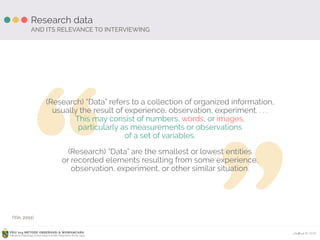
(Research) “Data” refers to a collection of organized information,
usually the result of experience, observation, experiment. . . .

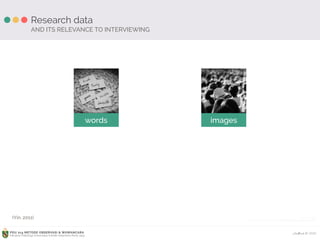
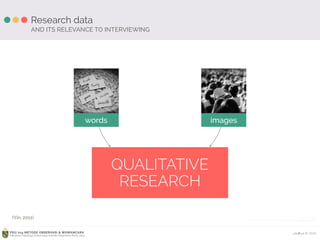
This may consist of numbers, words, or images,

particularly as measurements or observations

of a set of variables.
(Research) “Data” are the smallest or lowest entities

or recorded elements resulting from some experience,

observation, experiment, or other similar situation.
(Yin, 2011)
Ardhiati © 2015PDU 214 METODE OBSERVASI & WAWANCARA
Fakultas Psikologi Universitas Katolik Indonesia Atma Jaya
Research data
AND ITS RELEVANCE TO INTERVIEWING
words images
(Yin, 2011) IMAGE CREDIT:

A Bowl of Random Words on abowlofrandomwords.wordpress.com
Ardhiati © 2015PDU 214 METODE OBSERVASI & WAWANCARA
Fakultas Psikologi Universitas Katolik Indonesia Atma Jaya
Research data
AND ITS RELEVANCE TO INTERVIEWING
QUALITATIVE

RESEARCH
words images
(Yin, 2011) IMAGE CREDIT:

A Bowl of Random Words on abowlofrandomwords.wordpress.com
Ardhiati © 2015PDU 214 METODE OBSERVASI & WAWANCARA
Fakultas Psikologi Universitas Katolik Indonesia Atma Jaya
The definition
in·ter·view
ˈin(t)ərˌvyo͞o/
noun
1. a meeting of people face to face, especially for
consultation.
1.1. a conversation between a journalist or radio or
televesion presenter and a person of public
interest, used as the basis of a broadcast or
publication
“a half-hour interview with the prime minister.”
1.2. an oral examination of an applicant for a job
college place, etc.
“I am pleased to advise you that you have been selected
for interview.”
1.3. a session of formal questioning of a person by
the police
“It regards a course of official questioning by a police officer
as an interview.”
verb
1. [WITH OBJECT] hold an interview with (someone).
“She was interviewed by a reporter from the Daily News.”
“Police are keen to interview two men seen nearby.”
1.1. [NO OBJECT] perform (well or badly) at an interview
“He had the grades and the references from his school,
and according to his teachers he would interview well.”
(Oxford Dictionary)
Ardhiati © 2015PDU 214 METODE OBSERVASI & WAWANCARA
Fakultas Psikologi Universitas Katolik Indonesia Atma Jaya
“
”
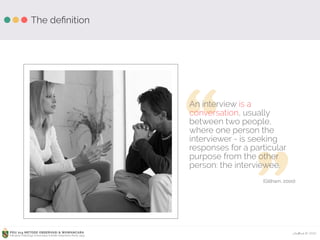
An interview is a
conversation, usually
between two people,
where one person the
interviewer - is seeking
responses for a particular
purpose from the other
person: the interviewee.
(Gillham, 2000)
The definition
Ardhiati © 2015PDU 214 METODE OBSERVASI & WAWANCARA
Fakultas Psikologi Universitas Katolik Indonesia Atma Jaya
The main features
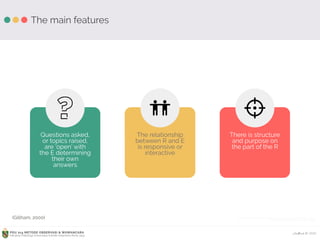
The relationship
between R and E
is responsive or
interactive
Questions asked,

or topics raised,

are ‘open’ with

the E determining
their own
answers
There is structure
and purpose on
the part of the R
(Gillham, 2000) ICON CREDITS: Question by Stefano Vetere, Friends by Javier Sánchez - javyliu,

Target by Laurent Patain, from the Noun Project
THE

ELEMENTS
ICON CREDIT: Rice by OCHA Visual Information Unit from the Noun Project
Ardhiati © 2015PDU 214 METODE OBSERVASI & WAWANCARA
Fakultas Psikologi Universitas Katolik Indonesia Atma Jaya
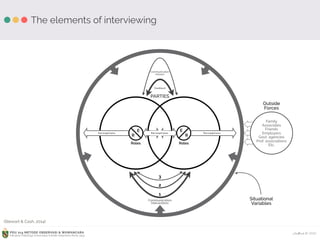
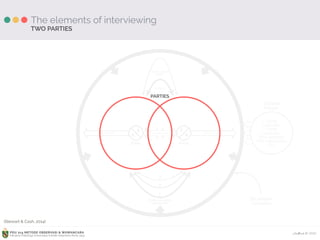
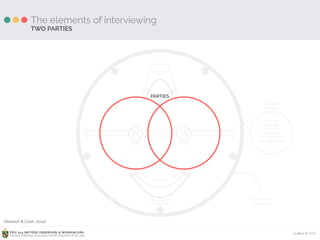
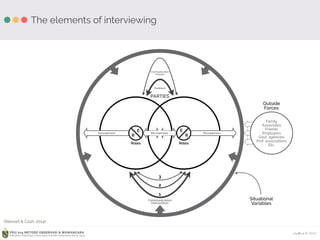
The elements of interviewing
P e r c e p t i o n s
E
R
Roles
E
R
Roles
P e r c e p t i o n sP e r c e p t i o n s
PARTIES
Feedback
Communication
Initiator
1
2
3
Communication
Interactions
Situational
Variables
Outside
Forces
Family
Associates
Friends
Employers
Govt. agencies
Prof. associations
Etc.
(Stewart & Cash, 2014)
Ardhiati © 2015PDU 214 METODE OBSERVASI & WAWANCARA
Fakultas Psikologi Universitas Katolik Indonesia Atma Jaya
P e r c e p t i o n s P e r c e p t i o n sP e r c e p t i o n s
The elements of interviewing
E
R
Roles
E
R
Roles
PARTIES
Feedback
Communication
Initiator
1
2
3
Communication
Interactions
Situational
Variables
Outside
Forces
Family
Associates
Friends
Employers
Govt. agencies
Prof. associations
Etc.
TWO PARTIES
(Stewart & Cash, 2014)
Ardhiati © 2015PDU 214 METODE OBSERVASI & WAWANCARA
Fakultas Psikologi Universitas Katolik Indonesia Atma Jaya
The elements of interviewing
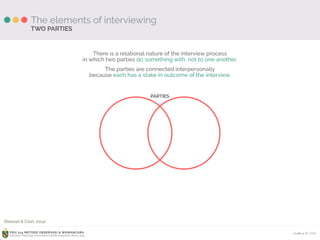
There is a relational nature of the interview process

in which two parties do something with, not to one another.
The parties are connected interpersonally

because each has a stake in outcome of the interview.
PARTIES
TWO PARTIES
(Stewart & Cash, 2014)
Ardhiati © 2015PDU 214 METODE OBSERVASI & WAWANCARA
Fakultas Psikologi Universitas Katolik Indonesia Atma Jaya
The elements of interviewing
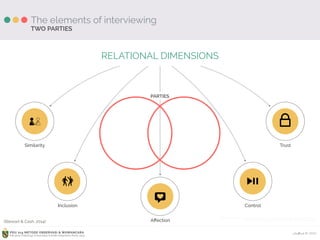
RELATIONAL DIMENSIONS
Similarity
Inclusion
Affection
Control
Trust
TWO PARTIES
ICON CREDITS: Agreement by gira Park, Dance by Thomas Le Bas, Heart by Joris Hoogendoorn,

Play by Björn Andersson, Lock by Thomas Le Bas, from the Noun Project
PARTIES
(Stewart & Cash, 2014)
Ardhiati © 2015PDU 214 METODE OBSERVASI & WAWANCARA
Fakultas Psikologi Universitas Katolik Indonesia Atma Jaya
P e r c e p t i o n s P e r c e p t i o n sP e r c e p t i o n s
The elements of interviewing
E
R
Roles
E
R
Roles
PARTIES
Feedback
Communication
Initiator
1
2
3
Communication
Interactions
Situational
Variables
Outside
Forces
Family
Associates
Friends
Employers
Govt. agencies
Prof. associations
Etc.
TWO PARTIES
(Stewart & Cash, 2014)
Ardhiati © 2015PDU 214 METODE OBSERVASI & WAWANCARA
Fakultas Psikologi Universitas Katolik Indonesia Atma Jaya
P e r c e p t i o n s P e r c e p t i o n sP e r c e p t i o n s
The elements of interviewing
E
R
Roles
E
R
Roles
PARTIES
Feedback
Communication
Initiator
1
2
3
Communication
Interactions
Situational
Variables
Outside
Forces
Family
Associates
Friends
Employers
Govt. agencies
Prof. associations
Etc.
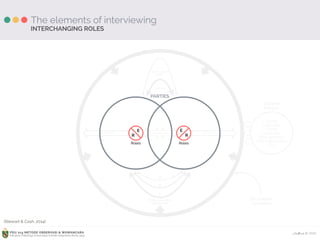
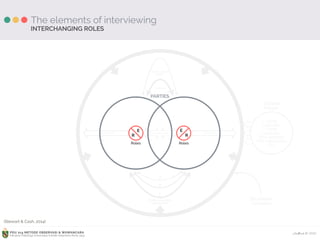
INTERCHANGING ROLES
(Stewart & Cash, 2014)
Ardhiati © 2015PDU 214 METODE OBSERVASI & WAWANCARA
Fakultas Psikologi Universitas Katolik Indonesia Atma Jaya
The elements of interviewing
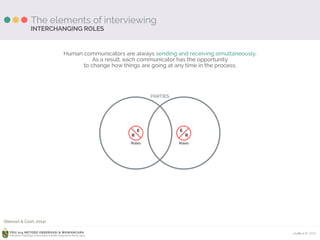
Human communicators are always sending and receiving simultaneously.

As a result, each communicator has the opportunity

to change how things are going at any time in the process.
INTERCHANGING ROLES
E
R
Roles
E
R
Roles
PARTIES
(Stewart & Cash, 2014)
Ardhiati © 2015PDU 214 METODE OBSERVASI & WAWANCARA
Fakultas Psikologi Universitas Katolik Indonesia Atma Jaya
The elements of interviewing
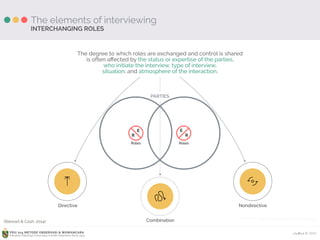
The degree to which roles are exchanged and control is shared

is often affected by the status or expertise of the parties,

who initiate the interview, type of interview,

situation, and atmosphere of the interaction.
INTERCHANGING ROLES
Directive
Combination
Nondirective
ICON CREDITS: Go-Top by iconsmind.com, Arrow-Squiggly by iconsmind.com,

Arrow-Refresh by iconsmind.com from the Noun Project
E
R
Roles
E
R
Roles
PARTIES
(Stewart & Cash, 2014)
Ardhiati © 2015PDU 214 METODE OBSERVASI & WAWANCARA
Fakultas Psikologi Universitas Katolik Indonesia Atma Jaya
P e r c e p t i o n s P e r c e p t i o n sP e r c e p t i o n s
The elements of interviewing
E
R
Roles
E
R
Roles
PARTIES
Feedback
Communication
Initiator
1
2
3
Communication
Interactions
Situational
Variables
Outside
Forces
Family
Associates
Friends
Employers
Govt. agencies
Prof. associations
Etc.
INTERCHANGING ROLES
(Stewart & Cash, 2014)
Ardhiati © 2015PDU 214 METODE OBSERVASI & WAWANCARA
Fakultas Psikologi Universitas Katolik Indonesia Atma Jaya
P e r c e p t i o n sP e r c e p t i o n s
The elements of interviewing
P e r c e p t i o n s
E
R
Roles
E
R
Roles
PARTIES
Feedback
Communication
Initiator
1
2
3
Communication
Interactions
Situational
Variables
Outside
Forces
Family
Associates
Friends
Employers
Govt. agencies
Prof. associations
Etc.
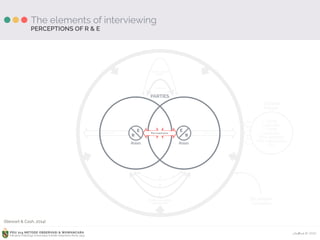
PERCEPTIONS OF R & E
(Stewart & Cash, 2014)
Ardhiati © 2015PDU 214 METODE OBSERVASI & WAWANCARA
Fakultas Psikologi Universitas Katolik Indonesia Atma Jaya
The elements of interviewing
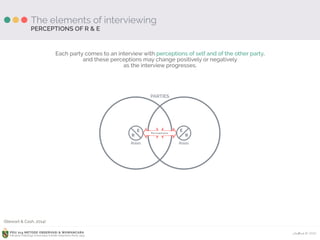
Each party comes to an interview with perceptions of self and of the other party,

and these perceptions may change positively or negatively

as the interview progresses.
PERCEPTIONS OF R & E
P e r c e p t i o n s
E
R
Roles
E
R
Roles
PARTIES
(Stewart & Cash, 2014)
Ardhiati © 2015PDU 214 METODE OBSERVASI & WAWANCARA
Fakultas Psikologi Universitas Katolik Indonesia Atma Jaya
P e r c e p t i o n sP e r c e p t i o n s
The elements of interviewing
P e r c e p t i o n s
E
R
Roles
E
R
Roles
PARTIES
Feedback
Communication
Initiator
1
2
3
Communication
Interactions
Situational
Variables
Outside
Forces
Family
Associates
Friends
Employers
Govt. agencies
Prof. associations
Etc.
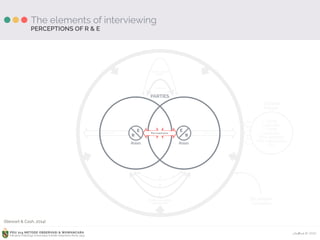
PERCEPTIONS OF R & E
(Stewart & Cash, 2014)
Ardhiati © 2015PDU 214 METODE OBSERVASI & WAWANCARA
Fakultas Psikologi Universitas Katolik Indonesia Atma Jaya
P e r c e p t i o n sP e r c e p t i o n s
The elements of interviewing
P e r c e p t i o n s
E
R
Roles
E
R
Roles
PARTIES
Feedback
Communication
Initiator
1
2
3
Communication
Interactions
Situational
Variables
Outside
Forces
Family
Associates
Friends
Employers
Govt. agencies
Prof. associations
Etc.
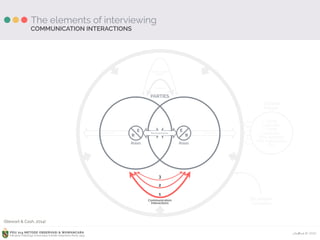
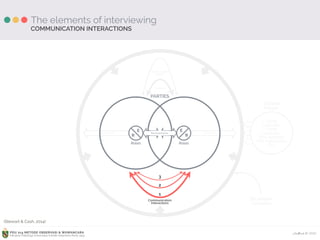
COMMUNICATION INTERACTIONS
(Stewart & Cash, 2014)
Ardhiati © 2015PDU 214 METODE OBSERVASI & WAWANCARA
Fakultas Psikologi Universitas Katolik Indonesia Atma Jaya
The elements of interviewing
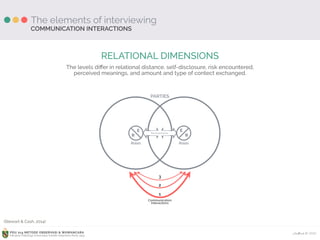
RELATIONAL DIMENSIONS
The levels differ in relational distance, self-disclosure, risk encountered,

perceived meanings, and amount and type of contect exchanged.
COMMUNICATION INTERACTIONS
P e r c e p t i o n s
E
R
Roles
E
R
Roles
PARTIES
1
2
3
Communication
Interactions
(Stewart & Cash, 2014)
Ardhiati © 2015PDU 214 METODE OBSERVASI & WAWANCARA
Fakultas Psikologi Universitas Katolik Indonesia Atma Jaya
The elements of interviewing
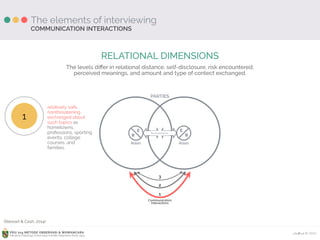
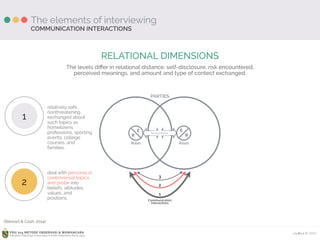
RELATIONAL DIMENSIONS
The levels differ in relational distance, self-disclosure, risk encountered,

perceived meanings, and amount and type of contect exchanged.
COMMUNICATION INTERACTIONS
P e r c e p t i o n s
E
R
Roles
E
R
Roles
PARTIES
1
2
3
Communication
Interactions
1
relatively safe,
nonthreatening
exchanged about
such topics as
hometowns,
professions, sporting
events, college
courses, and
families.
(Stewart & Cash, 2014)
Ardhiati © 2015PDU 214 METODE OBSERVASI & WAWANCARA
Fakultas Psikologi Universitas Katolik Indonesia Atma Jaya
The elements of interviewing
RELATIONAL DIMENSIONS
The levels differ in relational distance, self-disclosure, risk encountered,

perceived meanings, and amount and type of contect exchanged.
COMMUNICATION INTERACTIONS
P e r c e p t i o n s
E
R
Roles
E
R
Roles
PARTIES
1
2
3
Communication
Interactions
1
relatively safe,
nonthreatening
exchanged about
such topics as
hometowns,
professions, sporting
events, college
courses, and
families.
2
deal with personal or
controversial topics
and probe into
beliefs, attitudes,
values, and
positions.
(Stewart & Cash, 2014)
Ardhiati © 2015PDU 214 METODE OBSERVASI & WAWANCARA
Fakultas Psikologi Universitas Katolik Indonesia Atma Jaya
The elements of interviewing
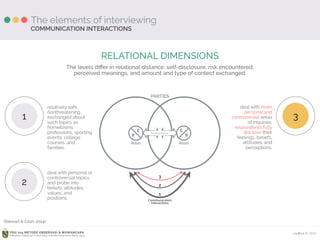
RELATIONAL DIMENSIONS
The levels differ in relational distance, self-disclosure, risk encountered,

perceived meanings, and amount and type of contect exchanged.
COMMUNICATION INTERACTIONS
P e r c e p t i o n s
E
R
Roles
E
R
Roles
PARTIES
1
2
3
Communication
Interactions
1
relatively safe,
nonthreatening
exchanged about
such topics as
hometowns,
professions, sporting
events, college
courses, and
families.
2
deal with personal or
controversial topics
and probe into
beliefs, attitudes,
values, and
positions.
3
deal with more
personal and
controversial areas
of inquiries;
respondents fully
disclose their
feelings, beliefs,
attitudes, and
perceptions.
(Stewart & Cash, 2014)
Ardhiati © 2015PDU 214 METODE OBSERVASI & WAWANCARA
Fakultas Psikologi Universitas Katolik Indonesia Atma Jaya
P e r c e p t i o n sP e r c e p t i o n s
The elements of interviewing
P e r c e p t i o n s
E
R
Roles
E
R
Roles
PARTIES
Feedback
Communication
Initiator
1
2
3
Communication
Interactions
Situational
Variables
Outside
Forces
Family
Associates
Friends
Employers
Govt. agencies
Prof. associations
Etc.
COMMUNICATION INTERACTIONS
(Stewart & Cash, 2014)
Ardhiati © 2015PDU 214 METODE OBSERVASI & WAWANCARA
Fakultas Psikologi Universitas Katolik Indonesia Atma Jaya
P e r c e p t i o n sP e r c e p t i o n s
The elements of interviewing
P e r c e p t i o n s
E
R
Roles
E
R
Roles
PARTIES
Feedback
Communication
Initiator
1
2
3
Communication
Interactions
Situational
Variables
Outside
Forces
Family
Associates
Friends
Employers
Govt. agencies
Prof. associations
Etc.
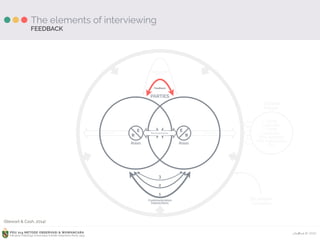
FEEDBACK
(Stewart & Cash, 2014)
Ardhiati © 2015PDU 214 METODE OBSERVASI & WAWANCARA
Fakultas Psikologi Universitas Katolik Indonesia Atma Jaya
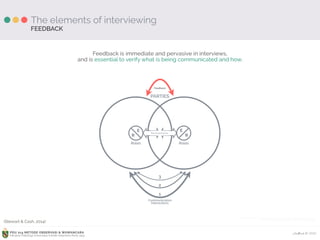
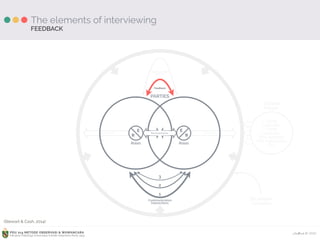
The elements of interviewing
Feedback is immediate and pervasive in interviews,

and is essential to verify what is being communicated and how.
FEEDBACK
ICON CREDITS: Go-Top by iconsmind.com, Arrow-Squiggly by iconsmind.com,

Arrow-Refresh by iconsmind.com from the Noun Project
P e r c e p t i o n s
E
R
Roles
E
R
Roles
PARTIES
Feedback
1
2
3
Communication
Interactions
(Stewart & Cash, 2014)
Ardhiati © 2015PDU 214 METODE OBSERVASI & WAWANCARA
Fakultas Psikologi Universitas Katolik Indonesia Atma Jaya
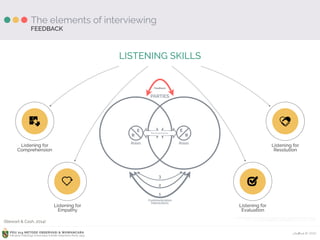
The elements of interviewing
LISTENING SKILLS
FEEDBACK
ICON CREDITS: Go-Top by iconsmind.com, Arrow-Squiggly by iconsmind.com,

Arrow-Refresh by iconsmind.com from the Noun Project
P e r c e p t i o n s
E
R
Roles
E
R
Roles
PARTIES
Feedback
1
2
3
Communication
Interactions
Listening for

Comprehension
Listening for

Empathy
Listening for

Evaluation
Listening for

Resolution
ICON CREDITS: Puzzle by Agarunov Oktay-Abraham, Heart by TrentoFuckingCity,

Check-Mark by NAS, Solidarity by Michele Pinna, from the Noun Project
(Stewart & Cash, 2014)
Ardhiati © 2015PDU 214 METODE OBSERVASI & WAWANCARA
Fakultas Psikologi Universitas Katolik Indonesia Atma Jaya
P e r c e p t i o n sP e r c e p t i o n s
The elements of interviewing
P e r c e p t i o n s
E
R
Roles
E
R
Roles
PARTIES
Feedback
Communication
Initiator
1
2
3
Communication
Interactions
Situational
Variables
Outside
Forces
Family
Associates
Friends
Employers
Govt. agencies
Prof. associations
Etc.
FEEDBACK
(Stewart & Cash, 2014)
Ardhiati © 2015PDU 214 METODE OBSERVASI & WAWANCARA
Fakultas Psikologi Universitas Katolik Indonesia Atma Jaya
The elements of interviewing
P e r c e p t i o n s
E
R
Roles
E
R
Roles
P e r c e p t i o n sP e r c e p t i o n s
PARTIES
Feedback
Communication
Initiator
1
2
3
Communication
Interactions
Situational
Variables
Outside
Forces
Family
Associates
Friends
Employers
Govt. agencies
Prof. associations
Etc.
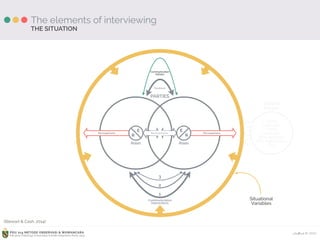
THE SITUATION
(Stewart & Cash, 2014)
Ardhiati © 2015PDU 214 METODE OBSERVASI & WAWANCARA
Fakultas Psikologi Universitas Katolik Indonesia Atma Jaya
The elements of interviewing
P e r c e p t i o n s
E
R
Roles
E
R
Roles
P e r c e p t i o n sP e r c e p t i o n s
PARTIES
Feedback
Communication
Initiator
1
2
3
Communication
Interactions
Situational
Variables
Outside
Forces
Family
Associates
Friends
Employers
Govt. agencies
Prof. associations
Etc.
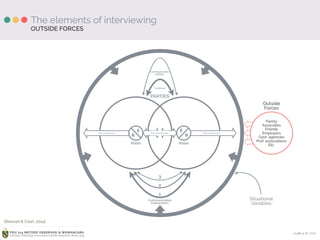
OUTSIDE FORCES
(Stewart & Cash, 2014)
Ardhiati © 2015PDU 214 METODE OBSERVASI & WAWANCARA
Fakultas Psikologi Universitas Katolik Indonesia Atma Jaya
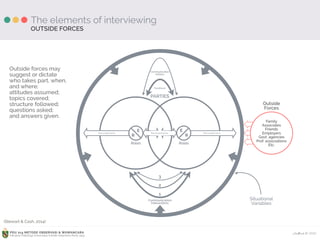
The elements of interviewing
Outside forces may
suggest or dictate
who takes part, when,
and where;

attitudes assumed;
topics covered;
structure followed;
questions asked;

and answers given.
P e r c e p t i o n s
E
R
Roles
E
R
Roles
P e r c e p t i o n sP e r c e p t i o n s
PARTIES
Feedback
Communication
Initiator
1
2
3
Communication
Interactions
Situational
Variables
Outside
Forces
Family
Associates
Friends
Employers
Govt. agencies
Prof. associations
Etc.
OUTSIDE FORCES
(Stewart & Cash, 2014)
Ardhiati © 2015PDU 214 METODE OBSERVASI & WAWANCARA
Fakultas Psikologi Universitas Katolik Indonesia Atma Jaya
The elements of interviewing
P e r c e p t i o n s
E
R
Roles
E
R
Roles
P e r c e p t i o n sP e r c e p t i o n s
PARTIES
Feedback
Communication
Initiator
1
2
3
Communication
Interactions
Situational
Variables
Outside
Forces
Family
Associates
Friends
Employers
Govt. agencies
Prof. associations
Etc.
(Stewart & Cash, 2014)
STRUCTURING
THE INTERVIEW
ICON CREDIT: Blueprint by Dimitry Sunseifer from the Noun Project
Ardhiati © 2015PDU 214 METODE OBSERVASI & WAWANCARA
Fakultas Psikologi Universitas Katolik Indonesia Atma Jaya
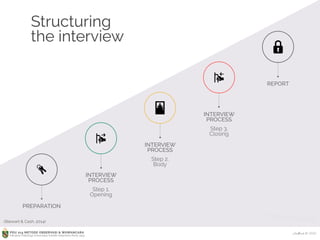
PREPARATION
INTERVIEW
PROCESS
Step 1.

Opening
INTERVIEW
PROCESS
Step 2.

Body
INTERVIEW
PROCESS
Step 3.

Closing
REPORT
Structuring
the interview
ICON CREDITS: Key by Leia Graf, Pull by Luis Prado,

Stalker by Luis Prado, Push by Luis Prado,

Lock by Lea Verou, from the Noun Project
(Stewart & Cash, 2014)
Ardhiati © 2015PDU 214 METODE OBSERVASI & WAWANCARA
Fakultas Psikologi Universitas Katolik Indonesia Atma Jaya
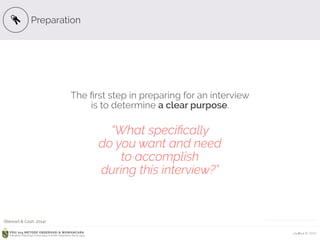
Preparation
The first step in preparing for an interview

is to determine a clear purpose.
“What specifically

do you want and need

to accomplish

during this interview?”
ICON CREDIT: Key by Leia Graf from the Noun Project
(Stewart & Cash, 2014)
Ardhiati © 2015PDU 214 METODE OBSERVASI & WAWANCARA
Fakultas Psikologi Universitas Katolik Indonesia Atma Jaya
Preparation
The form and style of an interview

is determined by its purpose.
(Gillham, 2000) ICON CREDIT: Key by Leia Graf from the Noun Project
Ardhiati © 2015PDU 214 METODE OBSERVASI & WAWANCARA
Fakultas Psikologi Universitas Katolik Indonesia Atma Jaya
Preparation
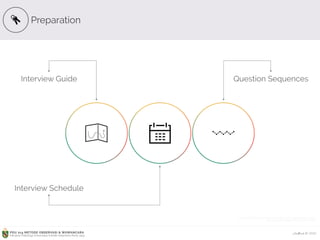
Interview Guide
Interview Schedule
Question Sequences
ICON CREDITS: Key by Leia Graf, Map by DEADTYPE, Calendar by Icon Jungle,

Process by Joel McKinney, from the Noun Project
Ardhiati © 2015PDU 214 METODE OBSERVASI & WAWANCARA
Fakultas Psikologi Universitas Katolik Indonesia Atma Jaya
Preparation
Interview Guide
ICON CREDITS: Key by Leia Graf, Map by DEADTYPE, from the Noun Project
(Stewart & Cash, 2014)
Ardhiati © 2015PDU 214 METODE OBSERVASI & WAWANCARA
Fakultas Psikologi Universitas Katolik Indonesia Atma Jaya
Preparation
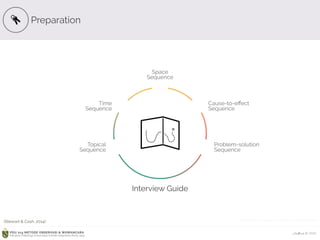
Interview Guide
ICON CREDITS: Key by Leia Graf, Map by DEADTYPE, from the Noun Project
Space

Sequence
Cause-to-effect

Sequence
Problem-solution

Sequence
Time

Sequence
Topical

Sequence
(Stewart & Cash, 2014)
Ardhiati © 2015PDU 214 METODE OBSERVASI & WAWANCARA
Fakultas Psikologi Universitas Katolik Indonesia Atma Jaya
Preparation
Interview Schedule
ICON CREDITS: Key by Leia Graf,

Process by Joel McKinney, from the Noun Project
(Stewart & Cash, 2014)
Ardhiati © 2015PDU 214 METODE OBSERVASI & WAWANCARA
Fakultas Psikologi Universitas Katolik Indonesia Atma Jaya
Preparation
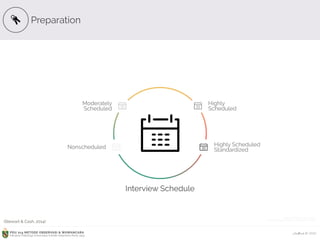
Interview Schedule
Highly

Scheduled
Highly Scheduled
Standardized
Moderately
Scheduled
Nonscheduled
ICON CREDITS: Key by Leia Graf,

Process by Joel McKinney, from the Noun Project
(Stewart & Cash, 2014)
Ardhiati © 2015PDU 214 METODE OBSERVASI & WAWANCARA
Fakultas Psikologi Universitas Katolik Indonesia Atma Jaya
Preparation
Question Sequences
ICON CREDITS: Key by Leia Graf from the Noun Project
(Stewart & Cash, 2014)
Ardhiati © 2015PDU 214 METODE OBSERVASI & WAWANCARA
Fakultas Psikologi Universitas Katolik Indonesia Atma Jaya
Preparation
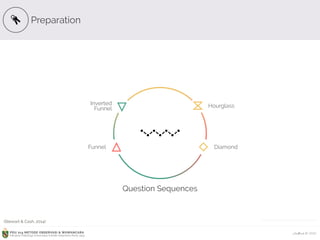
Question Sequences
ICON CREDITS: Key by Leia Graf from the Noun Project
Hourglass
Diamond
Inverted

Funnel
Funnel
(Stewart & Cash, 2014)
Ardhiati © 2015PDU 214 METODE OBSERVASI & WAWANCARA
Fakultas Psikologi Universitas Katolik Indonesia Atma Jaya
Want to know more?
Gillham, B. (2000). The research interview.

London: Continuum International Publishing Group.
Stewart, C.J. & Cash, W.B. (2014). Interviewing: Principles and
practices (14th ed.). New York, NY: McGraw-Hill Education.
Yin, R.K. (2011). Qualitative research from start to finish.

New York, NY: The Guilford Press.

PDU 214 Methods of Observation & Interviewing: Interviewing Skills & Techniques

  • 1.
    INTERVIEWING
 SKILLS & TECHNIQUES PDU214 METODE OBSERVASI & WAWANCARA SEMESTER GENAP 2014/2015 Fakultas Psikologi Universitas Katolik Indonesia Atma Jaya KULIAH IV - 09 FEBRUARI 2015
  • 2.
    THE
 DEFINITION ICON CREDIT: Bookby P.J. Onori from the Noun Project
  • 3.
    Ardhiati © 2015PDU214 METODE OBSERVASI & WAWANCARA Fakultas Psikologi Universitas Katolik Indonesia Atma Jaya “ ” Research data AND ITS RELEVANCE TO INTERVIEWING (Research) “Data” refers to a collection of organized information,
 usually the result of experience, observation, experiment. . . .
 This may consist of numbers, words, or images,
 particularly as measurements or observations
 of a set of variables. (Research) “Data” are the smallest or lowest entities
 or recorded elements resulting from some experience,
 observation, experiment, or other similar situation. (Yin, 2011)
  • 4.
    Ardhiati © 2015PDU214 METODE OBSERVASI & WAWANCARA Fakultas Psikologi Universitas Katolik Indonesia Atma Jaya Research data AND ITS RELEVANCE TO INTERVIEWING words images (Yin, 2011) IMAGE CREDIT:
 A Bowl of Random Words on abowlofrandomwords.wordpress.com
  • 5.
    Ardhiati © 2015PDU214 METODE OBSERVASI & WAWANCARA Fakultas Psikologi Universitas Katolik Indonesia Atma Jaya Research data AND ITS RELEVANCE TO INTERVIEWING QUALITATIVE
 RESEARCH words images (Yin, 2011) IMAGE CREDIT:
 A Bowl of Random Words on abowlofrandomwords.wordpress.com
  • 6.
    Ardhiati © 2015PDU214 METODE OBSERVASI & WAWANCARA Fakultas Psikologi Universitas Katolik Indonesia Atma Jaya The definition in·ter·view ˈin(t)ərˌvyo͞o/ noun 1. a meeting of people face to face, especially for consultation. 1.1. a conversation between a journalist or radio or televesion presenter and a person of public interest, used as the basis of a broadcast or publication “a half-hour interview with the prime minister.” 1.2. an oral examination of an applicant for a job college place, etc. “I am pleased to advise you that you have been selected for interview.” 1.3. a session of formal questioning of a person by the police “It regards a course of official questioning by a police officer as an interview.” verb 1. [WITH OBJECT] hold an interview with (someone). “She was interviewed by a reporter from the Daily News.” “Police are keen to interview two men seen nearby.” 1.1. [NO OBJECT] perform (well or badly) at an interview “He had the grades and the references from his school, and according to his teachers he would interview well.” (Oxford Dictionary)
  • 7.
    Ardhiati © 2015PDU214 METODE OBSERVASI & WAWANCARA Fakultas Psikologi Universitas Katolik Indonesia Atma Jaya “ ” An interview is a conversation, usually between two people, where one person the interviewer - is seeking responses for a particular purpose from the other person: the interviewee. (Gillham, 2000) The definition
  • 8.
    Ardhiati © 2015PDU214 METODE OBSERVASI & WAWANCARA Fakultas Psikologi Universitas Katolik Indonesia Atma Jaya The main features The relationship between R and E is responsive or interactive Questions asked,
 or topics raised,
 are ‘open’ with
 the E determining their own answers There is structure and purpose on the part of the R (Gillham, 2000) ICON CREDITS: Question by Stefano Vetere, Friends by Javier Sánchez - javyliu,
 Target by Laurent Patain, from the Noun Project
  • 9.
    THE
 ELEMENTS ICON CREDIT: Riceby OCHA Visual Information Unit from the Noun Project
  • 10.
    Ardhiati © 2015PDU214 METODE OBSERVASI & WAWANCARA Fakultas Psikologi Universitas Katolik Indonesia Atma Jaya The elements of interviewing P e r c e p t i o n s E R Roles E R Roles P e r c e p t i o n sP e r c e p t i o n s PARTIES Feedback Communication Initiator 1 2 3 Communication Interactions Situational Variables Outside Forces Family Associates Friends Employers Govt. agencies Prof. associations Etc. (Stewart & Cash, 2014)
  • 11.
    Ardhiati © 2015PDU214 METODE OBSERVASI & WAWANCARA Fakultas Psikologi Universitas Katolik Indonesia Atma Jaya P e r c e p t i o n s P e r c e p t i o n sP e r c e p t i o n s The elements of interviewing E R Roles E R Roles PARTIES Feedback Communication Initiator 1 2 3 Communication Interactions Situational Variables Outside Forces Family Associates Friends Employers Govt. agencies Prof. associations Etc. TWO PARTIES (Stewart & Cash, 2014)
  • 12.
    Ardhiati © 2015PDU214 METODE OBSERVASI & WAWANCARA Fakultas Psikologi Universitas Katolik Indonesia Atma Jaya The elements of interviewing There is a relational nature of the interview process
 in which two parties do something with, not to one another. The parties are connected interpersonally
 because each has a stake in outcome of the interview. PARTIES TWO PARTIES (Stewart & Cash, 2014)
  • 13.
    Ardhiati © 2015PDU214 METODE OBSERVASI & WAWANCARA Fakultas Psikologi Universitas Katolik Indonesia Atma Jaya The elements of interviewing RELATIONAL DIMENSIONS Similarity Inclusion Affection Control Trust TWO PARTIES ICON CREDITS: Agreement by gira Park, Dance by Thomas Le Bas, Heart by Joris Hoogendoorn,
 Play by Björn Andersson, Lock by Thomas Le Bas, from the Noun Project PARTIES (Stewart & Cash, 2014)
  • 14.
    Ardhiati © 2015PDU214 METODE OBSERVASI & WAWANCARA Fakultas Psikologi Universitas Katolik Indonesia Atma Jaya P e r c e p t i o n s P e r c e p t i o n sP e r c e p t i o n s The elements of interviewing E R Roles E R Roles PARTIES Feedback Communication Initiator 1 2 3 Communication Interactions Situational Variables Outside Forces Family Associates Friends Employers Govt. agencies Prof. associations Etc. TWO PARTIES (Stewart & Cash, 2014)
  • 15.
    Ardhiati © 2015PDU214 METODE OBSERVASI & WAWANCARA Fakultas Psikologi Universitas Katolik Indonesia Atma Jaya P e r c e p t i o n s P e r c e p t i o n sP e r c e p t i o n s The elements of interviewing E R Roles E R Roles PARTIES Feedback Communication Initiator 1 2 3 Communication Interactions Situational Variables Outside Forces Family Associates Friends Employers Govt. agencies Prof. associations Etc. INTERCHANGING ROLES (Stewart & Cash, 2014)
  • 16.
    Ardhiati © 2015PDU214 METODE OBSERVASI & WAWANCARA Fakultas Psikologi Universitas Katolik Indonesia Atma Jaya The elements of interviewing Human communicators are always sending and receiving simultaneously.
 As a result, each communicator has the opportunity
 to change how things are going at any time in the process. INTERCHANGING ROLES E R Roles E R Roles PARTIES (Stewart & Cash, 2014)
  • 17.
    Ardhiati © 2015PDU214 METODE OBSERVASI & WAWANCARA Fakultas Psikologi Universitas Katolik Indonesia Atma Jaya The elements of interviewing The degree to which roles are exchanged and control is shared
 is often affected by the status or expertise of the parties,
 who initiate the interview, type of interview,
 situation, and atmosphere of the interaction. INTERCHANGING ROLES Directive Combination Nondirective ICON CREDITS: Go-Top by iconsmind.com, Arrow-Squiggly by iconsmind.com,
 Arrow-Refresh by iconsmind.com from the Noun Project E R Roles E R Roles PARTIES (Stewart & Cash, 2014)
  • 18.
    Ardhiati © 2015PDU214 METODE OBSERVASI & WAWANCARA Fakultas Psikologi Universitas Katolik Indonesia Atma Jaya P e r c e p t i o n s P e r c e p t i o n sP e r c e p t i o n s The elements of interviewing E R Roles E R Roles PARTIES Feedback Communication Initiator 1 2 3 Communication Interactions Situational Variables Outside Forces Family Associates Friends Employers Govt. agencies Prof. associations Etc. INTERCHANGING ROLES (Stewart & Cash, 2014)
  • 19.
    Ardhiati © 2015PDU214 METODE OBSERVASI & WAWANCARA Fakultas Psikologi Universitas Katolik Indonesia Atma Jaya P e r c e p t i o n sP e r c e p t i o n s The elements of interviewing P e r c e p t i o n s E R Roles E R Roles PARTIES Feedback Communication Initiator 1 2 3 Communication Interactions Situational Variables Outside Forces Family Associates Friends Employers Govt. agencies Prof. associations Etc. PERCEPTIONS OF R & E (Stewart & Cash, 2014)
  • 20.
    Ardhiati © 2015PDU214 METODE OBSERVASI & WAWANCARA Fakultas Psikologi Universitas Katolik Indonesia Atma Jaya The elements of interviewing Each party comes to an interview with perceptions of self and of the other party,
 and these perceptions may change positively or negatively
 as the interview progresses. PERCEPTIONS OF R & E P e r c e p t i o n s E R Roles E R Roles PARTIES (Stewart & Cash, 2014)
  • 21.
    Ardhiati © 2015PDU214 METODE OBSERVASI & WAWANCARA Fakultas Psikologi Universitas Katolik Indonesia Atma Jaya P e r c e p t i o n sP e r c e p t i o n s The elements of interviewing P e r c e p t i o n s E R Roles E R Roles PARTIES Feedback Communication Initiator 1 2 3 Communication Interactions Situational Variables Outside Forces Family Associates Friends Employers Govt. agencies Prof. associations Etc. PERCEPTIONS OF R & E (Stewart & Cash, 2014)
  • 22.
    Ardhiati © 2015PDU214 METODE OBSERVASI & WAWANCARA Fakultas Psikologi Universitas Katolik Indonesia Atma Jaya P e r c e p t i o n sP e r c e p t i o n s The elements of interviewing P e r c e p t i o n s E R Roles E R Roles PARTIES Feedback Communication Initiator 1 2 3 Communication Interactions Situational Variables Outside Forces Family Associates Friends Employers Govt. agencies Prof. associations Etc. COMMUNICATION INTERACTIONS (Stewart & Cash, 2014)
  • 23.
    Ardhiati © 2015PDU214 METODE OBSERVASI & WAWANCARA Fakultas Psikologi Universitas Katolik Indonesia Atma Jaya The elements of interviewing RELATIONAL DIMENSIONS The levels differ in relational distance, self-disclosure, risk encountered,
 perceived meanings, and amount and type of contect exchanged. COMMUNICATION INTERACTIONS P e r c e p t i o n s E R Roles E R Roles PARTIES 1 2 3 Communication Interactions (Stewart & Cash, 2014)
  • 24.
    Ardhiati © 2015PDU214 METODE OBSERVASI & WAWANCARA Fakultas Psikologi Universitas Katolik Indonesia Atma Jaya The elements of interviewing RELATIONAL DIMENSIONS The levels differ in relational distance, self-disclosure, risk encountered,
 perceived meanings, and amount and type of contect exchanged. COMMUNICATION INTERACTIONS P e r c e p t i o n s E R Roles E R Roles PARTIES 1 2 3 Communication Interactions 1 relatively safe, nonthreatening exchanged about such topics as hometowns, professions, sporting events, college courses, and families. (Stewart & Cash, 2014)
  • 25.
    Ardhiati © 2015PDU214 METODE OBSERVASI & WAWANCARA Fakultas Psikologi Universitas Katolik Indonesia Atma Jaya The elements of interviewing RELATIONAL DIMENSIONS The levels differ in relational distance, self-disclosure, risk encountered,
 perceived meanings, and amount and type of contect exchanged. COMMUNICATION INTERACTIONS P e r c e p t i o n s E R Roles E R Roles PARTIES 1 2 3 Communication Interactions 1 relatively safe, nonthreatening exchanged about such topics as hometowns, professions, sporting events, college courses, and families. 2 deal with personal or controversial topics and probe into beliefs, attitudes, values, and positions. (Stewart & Cash, 2014)
  • 26.
    Ardhiati © 2015PDU214 METODE OBSERVASI & WAWANCARA Fakultas Psikologi Universitas Katolik Indonesia Atma Jaya The elements of interviewing RELATIONAL DIMENSIONS The levels differ in relational distance, self-disclosure, risk encountered,
 perceived meanings, and amount and type of contect exchanged. COMMUNICATION INTERACTIONS P e r c e p t i o n s E R Roles E R Roles PARTIES 1 2 3 Communication Interactions 1 relatively safe, nonthreatening exchanged about such topics as hometowns, professions, sporting events, college courses, and families. 2 deal with personal or controversial topics and probe into beliefs, attitudes, values, and positions. 3 deal with more personal and controversial areas of inquiries; respondents fully disclose their feelings, beliefs, attitudes, and perceptions. (Stewart & Cash, 2014)
  • 27.
    Ardhiati © 2015PDU214 METODE OBSERVASI & WAWANCARA Fakultas Psikologi Universitas Katolik Indonesia Atma Jaya P e r c e p t i o n sP e r c e p t i o n s The elements of interviewing P e r c e p t i o n s E R Roles E R Roles PARTIES Feedback Communication Initiator 1 2 3 Communication Interactions Situational Variables Outside Forces Family Associates Friends Employers Govt. agencies Prof. associations Etc. COMMUNICATION INTERACTIONS (Stewart & Cash, 2014)
  • 28.
    Ardhiati © 2015PDU214 METODE OBSERVASI & WAWANCARA Fakultas Psikologi Universitas Katolik Indonesia Atma Jaya P e r c e p t i o n sP e r c e p t i o n s The elements of interviewing P e r c e p t i o n s E R Roles E R Roles PARTIES Feedback Communication Initiator 1 2 3 Communication Interactions Situational Variables Outside Forces Family Associates Friends Employers Govt. agencies Prof. associations Etc. FEEDBACK (Stewart & Cash, 2014)
  • 29.
    Ardhiati © 2015PDU214 METODE OBSERVASI & WAWANCARA Fakultas Psikologi Universitas Katolik Indonesia Atma Jaya The elements of interviewing Feedback is immediate and pervasive in interviews,
 and is essential to verify what is being communicated and how. FEEDBACK ICON CREDITS: Go-Top by iconsmind.com, Arrow-Squiggly by iconsmind.com,
 Arrow-Refresh by iconsmind.com from the Noun Project P e r c e p t i o n s E R Roles E R Roles PARTIES Feedback 1 2 3 Communication Interactions (Stewart & Cash, 2014)
  • 30.
    Ardhiati © 2015PDU214 METODE OBSERVASI & WAWANCARA Fakultas Psikologi Universitas Katolik Indonesia Atma Jaya The elements of interviewing LISTENING SKILLS FEEDBACK ICON CREDITS: Go-Top by iconsmind.com, Arrow-Squiggly by iconsmind.com,
 Arrow-Refresh by iconsmind.com from the Noun Project P e r c e p t i o n s E R Roles E R Roles PARTIES Feedback 1 2 3 Communication Interactions Listening for
 Comprehension Listening for
 Empathy Listening for
 Evaluation Listening for
 Resolution ICON CREDITS: Puzzle by Agarunov Oktay-Abraham, Heart by TrentoFuckingCity,
 Check-Mark by NAS, Solidarity by Michele Pinna, from the Noun Project (Stewart & Cash, 2014)
  • 31.
    Ardhiati © 2015PDU214 METODE OBSERVASI & WAWANCARA Fakultas Psikologi Universitas Katolik Indonesia Atma Jaya P e r c e p t i o n sP e r c e p t i o n s The elements of interviewing P e r c e p t i o n s E R Roles E R Roles PARTIES Feedback Communication Initiator 1 2 3 Communication Interactions Situational Variables Outside Forces Family Associates Friends Employers Govt. agencies Prof. associations Etc. FEEDBACK (Stewart & Cash, 2014)
  • 32.
    Ardhiati © 2015PDU214 METODE OBSERVASI & WAWANCARA Fakultas Psikologi Universitas Katolik Indonesia Atma Jaya The elements of interviewing P e r c e p t i o n s E R Roles E R Roles P e r c e p t i o n sP e r c e p t i o n s PARTIES Feedback Communication Initiator 1 2 3 Communication Interactions Situational Variables Outside Forces Family Associates Friends Employers Govt. agencies Prof. associations Etc. THE SITUATION (Stewart & Cash, 2014)
  • 33.
    Ardhiati © 2015PDU214 METODE OBSERVASI & WAWANCARA Fakultas Psikologi Universitas Katolik Indonesia Atma Jaya The elements of interviewing P e r c e p t i o n s E R Roles E R Roles P e r c e p t i o n sP e r c e p t i o n s PARTIES Feedback Communication Initiator 1 2 3 Communication Interactions Situational Variables Outside Forces Family Associates Friends Employers Govt. agencies Prof. associations Etc. OUTSIDE FORCES (Stewart & Cash, 2014)
  • 34.
    Ardhiati © 2015PDU214 METODE OBSERVASI & WAWANCARA Fakultas Psikologi Universitas Katolik Indonesia Atma Jaya The elements of interviewing Outside forces may suggest or dictate who takes part, when, and where;
 attitudes assumed; topics covered; structure followed; questions asked;
 and answers given. P e r c e p t i o n s E R Roles E R Roles P e r c e p t i o n sP e r c e p t i o n s PARTIES Feedback Communication Initiator 1 2 3 Communication Interactions Situational Variables Outside Forces Family Associates Friends Employers Govt. agencies Prof. associations Etc. OUTSIDE FORCES (Stewart & Cash, 2014)
  • 35.
    Ardhiati © 2015PDU214 METODE OBSERVASI & WAWANCARA Fakultas Psikologi Universitas Katolik Indonesia Atma Jaya The elements of interviewing P e r c e p t i o n s E R Roles E R Roles P e r c e p t i o n sP e r c e p t i o n s PARTIES Feedback Communication Initiator 1 2 3 Communication Interactions Situational Variables Outside Forces Family Associates Friends Employers Govt. agencies Prof. associations Etc. (Stewart & Cash, 2014)
  • 36.
    STRUCTURING THE INTERVIEW ICON CREDIT:Blueprint by Dimitry Sunseifer from the Noun Project
  • 37.
    Ardhiati © 2015PDU214 METODE OBSERVASI & WAWANCARA Fakultas Psikologi Universitas Katolik Indonesia Atma Jaya PREPARATION INTERVIEW PROCESS Step 1.
 Opening INTERVIEW PROCESS Step 2.
 Body INTERVIEW PROCESS Step 3.
 Closing REPORT Structuring the interview ICON CREDITS: Key by Leia Graf, Pull by Luis Prado,
 Stalker by Luis Prado, Push by Luis Prado,
 Lock by Lea Verou, from the Noun Project (Stewart & Cash, 2014)
  • 38.
    Ardhiati © 2015PDU214 METODE OBSERVASI & WAWANCARA Fakultas Psikologi Universitas Katolik Indonesia Atma Jaya Preparation The first step in preparing for an interview
 is to determine a clear purpose. “What specifically
 do you want and need
 to accomplish
 during this interview?” ICON CREDIT: Key by Leia Graf from the Noun Project (Stewart & Cash, 2014)
  • 39.
    Ardhiati © 2015PDU214 METODE OBSERVASI & WAWANCARA Fakultas Psikologi Universitas Katolik Indonesia Atma Jaya Preparation The form and style of an interview
 is determined by its purpose. (Gillham, 2000) ICON CREDIT: Key by Leia Graf from the Noun Project
  • 40.
    Ardhiati © 2015PDU214 METODE OBSERVASI & WAWANCARA Fakultas Psikologi Universitas Katolik Indonesia Atma Jaya Preparation Interview Guide Interview Schedule Question Sequences ICON CREDITS: Key by Leia Graf, Map by DEADTYPE, Calendar by Icon Jungle,
 Process by Joel McKinney, from the Noun Project
  • 41.
    Ardhiati © 2015PDU214 METODE OBSERVASI & WAWANCARA Fakultas Psikologi Universitas Katolik Indonesia Atma Jaya Preparation Interview Guide ICON CREDITS: Key by Leia Graf, Map by DEADTYPE, from the Noun Project (Stewart & Cash, 2014)
  • 42.
    Ardhiati © 2015PDU214 METODE OBSERVASI & WAWANCARA Fakultas Psikologi Universitas Katolik Indonesia Atma Jaya Preparation Interview Guide ICON CREDITS: Key by Leia Graf, Map by DEADTYPE, from the Noun Project Space
 Sequence Cause-to-effect
 Sequence Problem-solution
 Sequence Time
 Sequence Topical
 Sequence (Stewart & Cash, 2014)
  • 43.
    Ardhiati © 2015PDU214 METODE OBSERVASI & WAWANCARA Fakultas Psikologi Universitas Katolik Indonesia Atma Jaya Preparation Interview Schedule ICON CREDITS: Key by Leia Graf,
 Process by Joel McKinney, from the Noun Project (Stewart & Cash, 2014)
  • 44.
    Ardhiati © 2015PDU214 METODE OBSERVASI & WAWANCARA Fakultas Psikologi Universitas Katolik Indonesia Atma Jaya Preparation Interview Schedule Highly
 Scheduled Highly Scheduled Standardized Moderately Scheduled Nonscheduled ICON CREDITS: Key by Leia Graf,
 Process by Joel McKinney, from the Noun Project (Stewart & Cash, 2014)
  • 45.
    Ardhiati © 2015PDU214 METODE OBSERVASI & WAWANCARA Fakultas Psikologi Universitas Katolik Indonesia Atma Jaya Preparation Question Sequences ICON CREDITS: Key by Leia Graf from the Noun Project (Stewart & Cash, 2014)
  • 46.
    Ardhiati © 2015PDU214 METODE OBSERVASI & WAWANCARA Fakultas Psikologi Universitas Katolik Indonesia Atma Jaya Preparation Question Sequences ICON CREDITS: Key by Leia Graf from the Noun Project Hourglass Diamond Inverted
 Funnel Funnel (Stewart & Cash, 2014)
  • 47.
    Ardhiati © 2015PDU214 METODE OBSERVASI & WAWANCARA Fakultas Psikologi Universitas Katolik Indonesia Atma Jaya Want to know more? Gillham, B. (2000). The research interview.
 London: Continuum International Publishing Group. Stewart, C.J. & Cash, W.B. (2014). Interviewing: Principles and practices (14th ed.). New York, NY: McGraw-Hill Education. Yin, R.K. (2011). Qualitative research from start to finish.
 New York, NY: The Guilford Press.