Running Head: BE ACTIVE AND EAT WELL 1
Be Active and Eat Well
Kids At Heart
Molly Carroll, Lauren Prenni, and Sammie Zimmerman
Evaluation Plan and Logic Model
“I have not given, received, or used any unauthorized assistance”
________________________________________________
________________________________________________
________________________________________________
BE ACTIVE AND EAT WELL 2
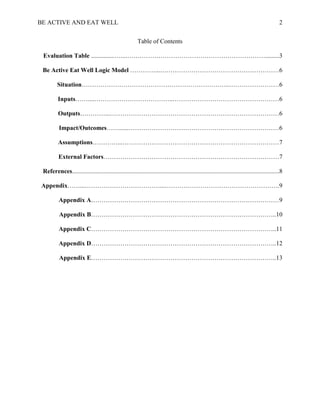
Table of Contents
Evaluation Table ...............…....………………………………………………………….........3
Be Active Eat Well Logic Model …………...…………………………………………………6
Situation……………………………………………………………..……………………6
Inputs……....………………………………..……………………………………………6
Outputs…………...………………………………………………………………………6
Impact/Outcomes……......………………………………………………………………6
Assumptions…………...…………………………………………………………………7
External Factors…………………………………………………………………………7
References....................................................................................................................................8
Appendix……...………………………………...……………………………………………….9
Appendix A………………………………………………………………………………9
Appendix B……………………………………………………………………………..10
Appendix C……………………………………………………………………………..11
Appendix D……………………………………………………………………………..12
Appendix E……………………………………………………………………………..13
BE ACTIVE AND EAT WELL 3
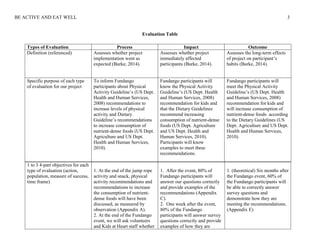
Evaluation Table
Types of Evaluation Process Impact Outcome
Definition (referenced) Assesses whether project
implementation went as
expected (Burke, 2014).
Assesses whether project
immediately affected
participants (Burke, 2014).
Assesses the long-term effects
of project on participant’s
habits (Burke, 2014).
Specific purpose of each type
of evaluation for our project
To inform Fundango
participants about Physical
Activity Guideline’s (US Dept.
Health and Human Services,
2008) recommendations to
increase levels of physical
activity and Dietary
Guideline’s recommendations
to increase consumption of
nutrient-dense foods (US Dept.
Agriculture and US Dept.
Health and Human Services,
2010).
Fundango participants will
know the Physical Activity
Guideline’s (US Dept. Health
and Human Services, 2008)
recommendation for kids and
that the Dietary Guidelines
recommend increasing
consumption of nutrient-dense
foods (US Dept. Agriculture
and US Dept. Health and
Human Services, 2010).
Participants will know
examples to meet these
recommendations.
Fundango participants will
meet the Physical Activity
Guideline’s (US Dept. Health
and Human Services, 2008)
recommendation for kids and
will increase consumption of
nutrient-dense foods according
to the Dietary Guidelines (US
Dept. Agriculture and US Dept.
Health and Human Services,
2010).
1 to 3 4-part objectives for each
type of evaluation (action,
population, measure of success,
time frame)
1. At the end of the jump rope
activity and snack, physical
activity recommendations and
recommendations to increase
the consumption of nutrient-
dense foods will have been
discussed, as measured by
observation (Appendix A).
2. At the end of the Fundango
event, we will ask volunteers
and Kids at Heart staff whether
1. After the event, 80% of
Fundango participants will
answer our questions correctly
and provide examples of the
recommendations (Appendix
C).
2. One week after the event,
80% of the Fundango
participants will answer survey
questions correctly and provide
examples of how they are
1. (theoretical) Six months after
the Fundango event, 60% of
the Fundango participants will
be able to correctly answer
survey questions and
demonstrate how they are
meeting the recommendations.
(Appendix E)
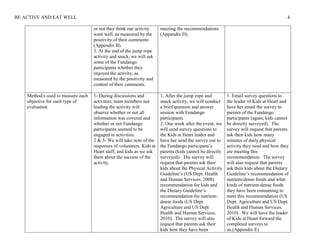
BE ACTIVE AND EAT WELL 4
or not they think our activity
went well, as measured by the
positivity of their comments
(Appendix B).
3. At the end of the jump rope
activity and snack, we will ask
some of the Fundango
participants whether they
enjoyed the activity, as
measured by the positivity and
content of their comments.
meeting the recommendations
(Appendix D).
Method/s used to measure each
objective for each type of
evaluation
1- During discussions and
activities, team members not
leading the activity will
observe whether or not all
information was covered and
whether or not Fundango
participants seemed to be
engaged in activities.
2 & 3- We will take note of the
responses of volunteers, Kids at
Heart staff, and kids as we ask
them about the success of the
activity.
1. After the jump rope and
snack activity, we will conduct
a brief question and answer
session with Fundango
participants.
2. One week after the event, we
will send survey questions to
the Kids at Heart leader and
have her send the survey out to
the Fundango participant’s
parents (kids cannot be directly
surveyed). The survey will
request that parents ask their
kids about the Physical Activity
Guideline’s (US Dept. Health
and Human Services, 2008)
recommendation for kids and
the Dietary Guideline’s
recommendation for nutrient-
dense foods (US Dept.
Agriculture and US Dept.
Health and Human Services,
2010). The survey will also
request that parents ask their
kids how they have been
1. Email survey questions to
the leader of Kids at Heart and
have her email the survey to
parents of the Fundango
participants (again, kids cannot
be directly surveyed). The
survey will request that parents
ask their kids how many
minutes of daily physical
activity they need and how they
are meeting this
recommendation. The survey
will also request that parents
ask their kids about the Dietary
Guideline’s recommendation of
nutrient-dense foods and what
kinds of nutrient-dense foods
they have been consuming to
meet this recommendation (US
Dept. Agriculture and US Dept.
Health and Human Services,
2010). We will have the leader
of Kids at Heart forward the
completed surveys to
us.(Appendix E)
BE ACTIVE AND EAT WELL 5
meeting these
recommendations She will
forward the completed surveys
to us. (Appendix D)
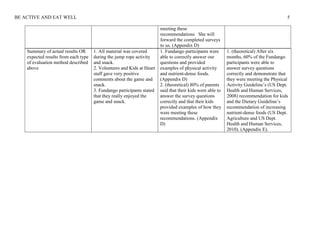
Summary of actual results OR
expected results from each type
of evaluation method described
above
1. All material was covered
during the jump rope activity
and snack.
2. Volunteers and Kids at Heart
staff gave very positive
comments about the game and
snack.
3. Fundango participants stated
that they really enjoyed the
game and snack.
1. Fundango participants were
able to correctly answer our
questions and provided
examples of physical activity
and nutrient-dense foods.
(Appendix D)
2. (theoretical) 80% of parents
said that their kids were able to
answer the survey questions
correctly and that their kids
provided examples of how they
were meeting these
recommendations. (Appendix
D)
1. (theoretical) After six
months, 60% of the Fundango
participants were able to
answer survey questions
correctly and demonstrate that
they were meeting the Physical
Activity Guideline’s (US Dept.
Health and Human Services,
2008) recommendation for kids
and the Dietary Guideline’s
recommendation of increasing
nutrient-dense foods (US Dept.
Agriculture and US Dept.
Health and Human Services,
2010). (Appendix E).
BE ACTIVE AND EAT WELL 6
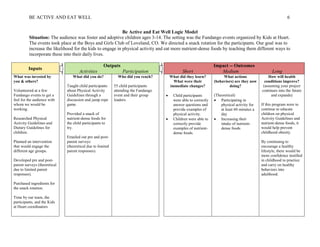
Be Active and Eat Well Logic Model
Situation: The audience was foster and adoptive children ages 3-14. The setting was the Fundango events organized by Kids at Heart.
The events took place at the Boys and Girls Club of Loveland, CO. We directed a snack rotation for the participants. Our goal was to
increase the likelihood for the kids to engage in physical activity and eat more nutrient-dense foods by teaching them different ways to
incorporate these into their daily lives.
Inputs
Outputs Impact -- Outcomes
Activities Participation Short Medium Long
What was invested by
you & others?
Volunteered at a few
Fundango events to get a
feel for the audience with
whom we would be
working.
Researched Physical
Activity Guidelines and
Dietary Guidelines for
children.
Planned an intervention
that would engage the
different age groups.
Developed pre and post-
parent surveys (theoretical
due to limited parent
responses).
Purchased ingredients for
the snack rotation.
Time by our team, the
participants, and the Kids
at Heart coordinators
What did you do?
Taught child participants
about Physical Activity
Guidelines through a
discussion and jump rope
game.
Provided a snack of
nutrient-dense foods for
the child participants to
try.
Emailed out pre and post-
parent surveys
(theoretical due to limited
parent responses).
Who did you reach?
55 child participants
attending the Fundango
event and their group
leaders.
What did they learn?
What were their
immediate changes?
 Child participants
were able to correctly
answer questions and
provide examples of
physical activity.
 Children were able to
correctly provide
examples of nutrient-
dense foods.
What actions
(behaviors) are they now
doing?
(Theoretical)
 Participating in
physical activity for
at least 60 minutes a
day
 Increasing their
intake of nutrient-
dense foods
How will health
conditions improve?
(assuming your project
continues into the future
and expands)
If this program were to
continue to educate
children on physical
Activity Guidelines and
nutrient-dense foods, it
would help prevent
childhood obesity.
By continuing to
encourage a healthy
lifestyle, there would be
more confidence instilled
in childhood to practice
and carry on healthy
behaviors into
adulthood.
BE ACTIVE AND EAT WELL 7
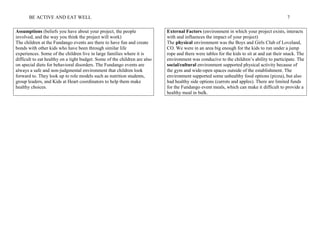
Assumptions (beliefs you have about your project, the people
involved, and the way you think the project will work)
External Factors (environment in which your project exists, interacts
with and influences the impact of your project)
The children at the Fundango events are there to have fun and create
bonds with other kids who have been through similar life
experiences. Some of the children live in large families where it is
difficult to eat healthy on a tight budget. Some of the children are also
on special diets for behavioral disorders. The Fundango events are
always a safe and non-judgmental environment that children look
forward to. They look up to role models such as nutrition students,
group leaders, and Kids at Heart coordinators to help them make
healthy choices.
The physical environment was the Boys and Girls Club of Loveland,
CO. We were in an area big enough for the kids to run under a jump
rope and there were tables for the kids to sit at and eat their snack. The
environment was conducive to the children’s ability to participate. The
social/cultural environment supported physical activity because of
the gym and wide-open spaces outside of the establishment. The
environment supported some unhealthy food options (pizza), but also
had healthy side options (carrots and apples). There are limited funds
for the Fundango event meals, which can make it difficult to provide a
healthy meal in bulk.
BE ACTIVE AND EAT WELL 8
References
US Department of Agriculture and US Department of Health and Human Services. (2010).
Chapter 1: Introduction, Chapter 4: Foods and nutrients to increase. Dietary guidelines
for Americans (7th
ed). Washington DC: US Government Printing Office.
US Department of Health and Human Services. (2008). Chapter 3: Active children and
adolescents. Physical activity guidelines for Americans. Washington DC: Federal
Government.
Burke, C. (2014). Lecture 4: Program Planning for Success[PowerPoint slides]. Retrieved from
Colorado State University Community Nutrition Blackboard: https://ramct.colostate.edu.
BE ACTIVE AND EAT WELL 9
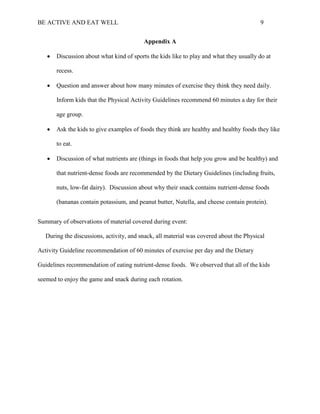
Appendix A
 Discussion about what kind of sports the kids like to play and what they usually do at
recess.
 Question and answer about how many minutes of exercise they think they need daily.
Inform kids that the Physical Activity Guidelines recommend 60 minutes a day for their
age group.
 Ask the kids to give examples of foods they think are healthy and healthy foods they like
to eat.
 Discussion of what nutrients are (things in foods that help you grow and be healthy) and
that nutrient-dense foods are recommended by the Dietary Guidelines (including fruits,
nuts, low-fat dairy). Discussion about why their snack contains nutrient-dense foods
(bananas contain potassium, and peanut butter, Nutella, and cheese contain protein).
Summary of observations of material covered during event:
During the discussions, activity, and snack, all material was covered about the Physical
Activity Guideline recommendation of 60 minutes of exercise per day and the Dietary
Guidelines recommendation of eating nutrient-dense foods. We observed that all of the kids
seemed to enjoy the game and snack during each rotation.
BE ACTIVE AND EAT WELL 10
Appendix B
Summary of volunteer, staff, and kid’s comments:
At our end of the evening meeting, volunteers and Kids at Heart staff commented on how
much all of the kids loved the jump rope game and snack. After each rotation of kids, the kids
commented on how much fun they enjoyed the activity and snack. At the end of the evening
when kids were leaving, we had different kids come up to us to thank us and say how much they
loved the game and snack.
BE ACTIVE AND EAT WELL 11
Appendix C
 Post-activity and post-snack review of how many minutes of activity is recommended
daily and examples of nutrient-dense foods.
 Ask kids what activities they will do to get 60 minutes a day of physical activity and
provide feedback on whether or not these are good ways to get physical activity. Ask
kids what kinds of foods they would like to eat to increase consumption of nutrient-dense
foods and provide feedback on whether or not these are good examples of nutrient-dense
foods.
BE ACTIVE AND EAT WELL 12
Appendix D
Impact evaluation survey questions
How many minutes of physical activity do you need each day? What did the Physical Activity
Guidelines say?
1. What kinds of activity have you been doing to get 60 minutes of physical activity a day?
2. What kinds of food did you talk about at the Fundango last week? What kinds of foods
did the Dietary Guidelines say to eat/what is a nutrient and what are nutrient-dense
foods? What kinds of nutrient-dense food do you like to eat?
3. What kinds of foods have you been eating that are nutrient-dense? How have you been
trying to eat more nutrient-dense foods?
BE ACTIVE AND EAT WELL 13
Appendix E
Outcome evaluation survey questions
1. How many minutes of physical activity do you need each day?
2. What kinds of activity have you been doing to get 60 minutes of physical activity a day?
Do you think you are getting this much activity?
3. What kinds of food are nutrient-dense? What does this mean?
4. What kinds of nutrient-dense food have you been eating? Do you think you eat a lot of
nutrient-dense foods?

Nutrition Implementation Project in Community

  • 1.
    Running Head: BEACTIVE AND EAT WELL 1 Be Active and Eat Well Kids At Heart Molly Carroll, Lauren Prenni, and Sammie Zimmerman Evaluation Plan and Logic Model “I have not given, received, or used any unauthorized assistance” ________________________________________________ ________________________________________________ ________________________________________________
  • 2.
    BE ACTIVE ANDEAT WELL 2 Table of Contents Evaluation Table ...............…....………………………………………………………….........3 Be Active Eat Well Logic Model …………...…………………………………………………6 Situation……………………………………………………………..……………………6 Inputs……....………………………………..……………………………………………6 Outputs…………...………………………………………………………………………6 Impact/Outcomes……......………………………………………………………………6 Assumptions…………...…………………………………………………………………7 External Factors…………………………………………………………………………7 References....................................................................................................................................8 Appendix……...………………………………...……………………………………………….9 Appendix A………………………………………………………………………………9 Appendix B……………………………………………………………………………..10 Appendix C……………………………………………………………………………..11 Appendix D……………………………………………………………………………..12 Appendix E……………………………………………………………………………..13
  • 3.
    BE ACTIVE ANDEAT WELL 3 Evaluation Table Types of Evaluation Process Impact Outcome Definition (referenced) Assesses whether project implementation went as expected (Burke, 2014). Assesses whether project immediately affected participants (Burke, 2014). Assesses the long-term effects of project on participant’s habits (Burke, 2014). Specific purpose of each type of evaluation for our project To inform Fundango participants about Physical Activity Guideline’s (US Dept. Health and Human Services, 2008) recommendations to increase levels of physical activity and Dietary Guideline’s recommendations to increase consumption of nutrient-dense foods (US Dept. Agriculture and US Dept. Health and Human Services, 2010). Fundango participants will know the Physical Activity Guideline’s (US Dept. Health and Human Services, 2008) recommendation for kids and that the Dietary Guidelines recommend increasing consumption of nutrient-dense foods (US Dept. Agriculture and US Dept. Health and Human Services, 2010). Participants will know examples to meet these recommendations. Fundango participants will meet the Physical Activity Guideline’s (US Dept. Health and Human Services, 2008) recommendation for kids and will increase consumption of nutrient-dense foods according to the Dietary Guidelines (US Dept. Agriculture and US Dept. Health and Human Services, 2010). 1 to 3 4-part objectives for each type of evaluation (action, population, measure of success, time frame) 1. At the end of the jump rope activity and snack, physical activity recommendations and recommendations to increase the consumption of nutrient- dense foods will have been discussed, as measured by observation (Appendix A). 2. At the end of the Fundango event, we will ask volunteers and Kids at Heart staff whether 1. After the event, 80% of Fundango participants will answer our questions correctly and provide examples of the recommendations (Appendix C). 2. One week after the event, 80% of the Fundango participants will answer survey questions correctly and provide examples of how they are 1. (theoretical) Six months after the Fundango event, 60% of the Fundango participants will be able to correctly answer survey questions and demonstrate how they are meeting the recommendations. (Appendix E)
  • 4.
    BE ACTIVE ANDEAT WELL 4 or not they think our activity went well, as measured by the positivity of their comments (Appendix B). 3. At the end of the jump rope activity and snack, we will ask some of the Fundango participants whether they enjoyed the activity, as measured by the positivity and content of their comments. meeting the recommendations (Appendix D). Method/s used to measure each objective for each type of evaluation 1- During discussions and activities, team members not leading the activity will observe whether or not all information was covered and whether or not Fundango participants seemed to be engaged in activities. 2 & 3- We will take note of the responses of volunteers, Kids at Heart staff, and kids as we ask them about the success of the activity. 1. After the jump rope and snack activity, we will conduct a brief question and answer session with Fundango participants. 2. One week after the event, we will send survey questions to the Kids at Heart leader and have her send the survey out to the Fundango participant’s parents (kids cannot be directly surveyed). The survey will request that parents ask their kids about the Physical Activity Guideline’s (US Dept. Health and Human Services, 2008) recommendation for kids and the Dietary Guideline’s recommendation for nutrient- dense foods (US Dept. Agriculture and US Dept. Health and Human Services, 2010). The survey will also request that parents ask their kids how they have been 1. Email survey questions to the leader of Kids at Heart and have her email the survey to parents of the Fundango participants (again, kids cannot be directly surveyed). The survey will request that parents ask their kids how many minutes of daily physical activity they need and how they are meeting this recommendation. The survey will also request that parents ask their kids about the Dietary Guideline’s recommendation of nutrient-dense foods and what kinds of nutrient-dense foods they have been consuming to meet this recommendation (US Dept. Agriculture and US Dept. Health and Human Services, 2010). We will have the leader of Kids at Heart forward the completed surveys to us.(Appendix E)
  • 5.
    BE ACTIVE ANDEAT WELL 5 meeting these recommendations She will forward the completed surveys to us. (Appendix D) Summary of actual results OR expected results from each type of evaluation method described above 1. All material was covered during the jump rope activity and snack. 2. Volunteers and Kids at Heart staff gave very positive comments about the game and snack. 3. Fundango participants stated that they really enjoyed the game and snack. 1. Fundango participants were able to correctly answer our questions and provided examples of physical activity and nutrient-dense foods. (Appendix D) 2. (theoretical) 80% of parents said that their kids were able to answer the survey questions correctly and that their kids provided examples of how they were meeting these recommendations. (Appendix D) 1. (theoretical) After six months, 60% of the Fundango participants were able to answer survey questions correctly and demonstrate that they were meeting the Physical Activity Guideline’s (US Dept. Health and Human Services, 2008) recommendation for kids and the Dietary Guideline’s recommendation of increasing nutrient-dense foods (US Dept. Agriculture and US Dept. Health and Human Services, 2010). (Appendix E).
  • 6.
    BE ACTIVE ANDEAT WELL 6 Be Active and Eat Well Logic Model Situation: The audience was foster and adoptive children ages 3-14. The setting was the Fundango events organized by Kids at Heart. The events took place at the Boys and Girls Club of Loveland, CO. We directed a snack rotation for the participants. Our goal was to increase the likelihood for the kids to engage in physical activity and eat more nutrient-dense foods by teaching them different ways to incorporate these into their daily lives. Inputs Outputs Impact -- Outcomes Activities Participation Short Medium Long What was invested by you & others? Volunteered at a few Fundango events to get a feel for the audience with whom we would be working. Researched Physical Activity Guidelines and Dietary Guidelines for children. Planned an intervention that would engage the different age groups. Developed pre and post- parent surveys (theoretical due to limited parent responses). Purchased ingredients for the snack rotation. Time by our team, the participants, and the Kids at Heart coordinators What did you do? Taught child participants about Physical Activity Guidelines through a discussion and jump rope game. Provided a snack of nutrient-dense foods for the child participants to try. Emailed out pre and post- parent surveys (theoretical due to limited parent responses). Who did you reach? 55 child participants attending the Fundango event and their group leaders. What did they learn? What were their immediate changes?  Child participants were able to correctly answer questions and provide examples of physical activity.  Children were able to correctly provide examples of nutrient- dense foods. What actions (behaviors) are they now doing? (Theoretical)  Participating in physical activity for at least 60 minutes a day  Increasing their intake of nutrient- dense foods How will health conditions improve? (assuming your project continues into the future and expands) If this program were to continue to educate children on physical Activity Guidelines and nutrient-dense foods, it would help prevent childhood obesity. By continuing to encourage a healthy lifestyle, there would be more confidence instilled in childhood to practice and carry on healthy behaviors into adulthood.
  • 7.
    BE ACTIVE ANDEAT WELL 7 Assumptions (beliefs you have about your project, the people involved, and the way you think the project will work) External Factors (environment in which your project exists, interacts with and influences the impact of your project) The children at the Fundango events are there to have fun and create bonds with other kids who have been through similar life experiences. Some of the children live in large families where it is difficult to eat healthy on a tight budget. Some of the children are also on special diets for behavioral disorders. The Fundango events are always a safe and non-judgmental environment that children look forward to. They look up to role models such as nutrition students, group leaders, and Kids at Heart coordinators to help them make healthy choices. The physical environment was the Boys and Girls Club of Loveland, CO. We were in an area big enough for the kids to run under a jump rope and there were tables for the kids to sit at and eat their snack. The environment was conducive to the children’s ability to participate. The social/cultural environment supported physical activity because of the gym and wide-open spaces outside of the establishment. The environment supported some unhealthy food options (pizza), but also had healthy side options (carrots and apples). There are limited funds for the Fundango event meals, which can make it difficult to provide a healthy meal in bulk.
  • 8.
    BE ACTIVE ANDEAT WELL 8 References US Department of Agriculture and US Department of Health and Human Services. (2010). Chapter 1: Introduction, Chapter 4: Foods and nutrients to increase. Dietary guidelines for Americans (7th ed). Washington DC: US Government Printing Office. US Department of Health and Human Services. (2008). Chapter 3: Active children and adolescents. Physical activity guidelines for Americans. Washington DC: Federal Government. Burke, C. (2014). Lecture 4: Program Planning for Success[PowerPoint slides]. Retrieved from Colorado State University Community Nutrition Blackboard: https://ramct.colostate.edu.
  • 9.
    BE ACTIVE ANDEAT WELL 9 Appendix A  Discussion about what kind of sports the kids like to play and what they usually do at recess.  Question and answer about how many minutes of exercise they think they need daily. Inform kids that the Physical Activity Guidelines recommend 60 minutes a day for their age group.  Ask the kids to give examples of foods they think are healthy and healthy foods they like to eat.  Discussion of what nutrients are (things in foods that help you grow and be healthy) and that nutrient-dense foods are recommended by the Dietary Guidelines (including fruits, nuts, low-fat dairy). Discussion about why their snack contains nutrient-dense foods (bananas contain potassium, and peanut butter, Nutella, and cheese contain protein). Summary of observations of material covered during event: During the discussions, activity, and snack, all material was covered about the Physical Activity Guideline recommendation of 60 minutes of exercise per day and the Dietary Guidelines recommendation of eating nutrient-dense foods. We observed that all of the kids seemed to enjoy the game and snack during each rotation.
  • 10.
    BE ACTIVE ANDEAT WELL 10 Appendix B Summary of volunteer, staff, and kid’s comments: At our end of the evening meeting, volunteers and Kids at Heart staff commented on how much all of the kids loved the jump rope game and snack. After each rotation of kids, the kids commented on how much fun they enjoyed the activity and snack. At the end of the evening when kids were leaving, we had different kids come up to us to thank us and say how much they loved the game and snack.
  • 11.
    BE ACTIVE ANDEAT WELL 11 Appendix C  Post-activity and post-snack review of how many minutes of activity is recommended daily and examples of nutrient-dense foods.  Ask kids what activities they will do to get 60 minutes a day of physical activity and provide feedback on whether or not these are good ways to get physical activity. Ask kids what kinds of foods they would like to eat to increase consumption of nutrient-dense foods and provide feedback on whether or not these are good examples of nutrient-dense foods.
  • 12.
    BE ACTIVE ANDEAT WELL 12 Appendix D Impact evaluation survey questions How many minutes of physical activity do you need each day? What did the Physical Activity Guidelines say? 1. What kinds of activity have you been doing to get 60 minutes of physical activity a day? 2. What kinds of food did you talk about at the Fundango last week? What kinds of foods did the Dietary Guidelines say to eat/what is a nutrient and what are nutrient-dense foods? What kinds of nutrient-dense food do you like to eat? 3. What kinds of foods have you been eating that are nutrient-dense? How have you been trying to eat more nutrient-dense foods?
  • 13.
    BE ACTIVE ANDEAT WELL 13 Appendix E Outcome evaluation survey questions 1. How many minutes of physical activity do you need each day? 2. What kinds of activity have you been doing to get 60 minutes of physical activity a day? Do you think you are getting this much activity? 3. What kinds of food are nutrient-dense? What does this mean? 4. What kinds of nutrient-dense food have you been eating? Do you think you eat a lot of nutrient-dense foods?