NUTRITIONAL INTERVENTIONS
Meseret Moroda (MPH in Nutrition)
Salale University
October ,2023
Course contents
 Introduction of nutritional intervention
 Type of nutritional interventions
 Nutrition specific interventions
 Essential nutrition action ( ENA)
 Nutrition sensitive interventions
 Direct and indirect interventions to address nutritional problems in Ethiopia
 Planning, implementing and evaluation of nutrition interventions
 Nutrition education and counselling
 Community Based Nutrition (CBN)
 Food and nutrient supplementation
 Management of acute severe malnutrition
Presentation outlines
At the end of the session you will be expected to:
– Describe of nutritional intervention
– Discuss type of nutritional interventions
– List nutrition specific interventions
– Discuss essential nutrition action(ENA)
– List nutrition sensitive interventions
– Discuss direct and indirect interventions to address nutritional
problems in Ethiopia
Brain storming
• What are the causes of malnutrition???
• What are the possible intervention??
Cont…
Nutritional intervention
 Purposely-planned actions designed with the intent of changing
nutritional related problem
 There are two complementary approaches (action on both is urgent) to
reducing under nutrition
– Direct nutrition /specific interventions
– Indirect/ Broader multi-sectoral approach (nutrition sensitive
interventions
Framework for cause and intervention of malnutrition
Shorter routes/Direct/Specific:-
DIRECT NUTRITION INTERVENTIONS
• Target the immediate causes of under nutrition
• inadequate dietary intake
• ill health
– Can improve child nutrition fast - in two to five years
The top Identified Nutrition specific interventions
– Maternal dietary supplementation
– Micronutrient supplementation or fortification
– Breastfeeding and complementary feeding
– Dietary supplementation for children
– Adolescent health
– Dietary diversification
– Treatment of severe acute malnutrition
Cont…
 The maximum effect on reduction of mortality is noted with:
 Management of acute malnutrition
 infant and young child nutrition package
o Promotion of breastfeeding
o Promotion of complementary feeding
o Micronutrient supplementation
KEY PROVEN PRACTICES, SERVICES AND POLICY INTERVENTIONS
THROUGHOUT THE LIFE CYCLE, Lancet 2021
Essential Nutrition Actions (ENA)
ENA is an approach to:
• Expand the coverage of seven affordable and evidence-based
actions to improve the nutritional status of
 Women and Children, especially those under two years of age
Cont…
The seven ENAs Action Areas
1. Exclusive breastfeeding for children 0-6 months
2. Adequate complementary feeding for children 6-23 months with continued
breastfeeding for at least 24 months
3. Adequate nutritional care of the sick and severely malnourished child
4. Adequate nutrition for women
5. Prevention of vitamin A deficiency for women and children
6. Prevention of anemia for women and children
7. Prevention of iodine deficiency for all members of the household
3/30/2015 Molla M 12
1. Promotion of breastfeeding
– Exclusive BF for the first 6 months of life
– Key messages
• Early Initiation of BF
• Exclusive BF until 6 months
• BF day and night at least10-12 times
• Correct positioning & attachment
• Empty one breast and switch to the other
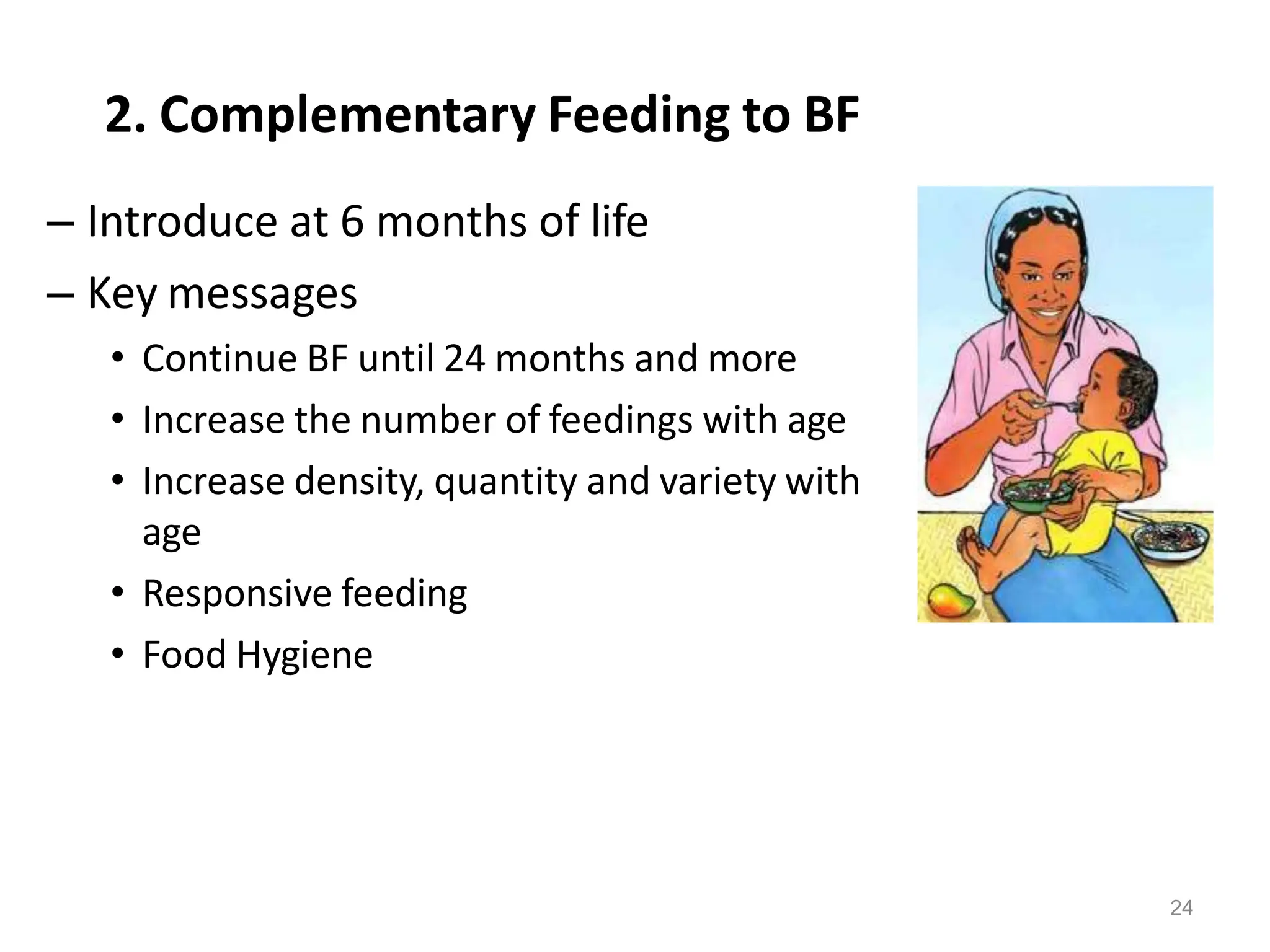
2. Complementary Feeding to BF
– Introduce at 6 months of life
– Key messages
• Continue BF until 24 months and more
• Increase the number of feedings with age
• Increase density, quantity and variety with
age
• Responsive feeding
• Food Hygiene
24
3. Feeding of the sick child
• Key messages
• Increase breast feeding and complementary feeding during
and after illness integrated management of neonatal and
Childhood Illness (IMNCI)
• Appropriate Therapeutic Feeding
4. Women’s Nutrition
– Key messages
• During pregnancy and lactation
– Increase feeding
– Iron/Folic Acid Supplementation
– Treatment & prevention of Malaria
• Deworming during pregnancy
• Vitamin A Capsule after delivery
This improves maternal vitamin A status, increases breast milk
vitamin A concentration, and contributes to improved vitamin
A status of the breastfed infant
• Reduce workload
5. Control of Vitamin A Deficiency
– Key messages
• Breastfeeding: source of Vitamin A
• Vitamin A rich foods
• Maternal supplementation
• Child supplementation
• Food fortification
6. Control of Anemia
– Key messages
• Supplementation for women and children (IMCI)
• Deworming for pregnant women and children
(twice/year)
• Malaria control
• Iron-rich foods
• Fortification
7. Control of Iodine Deficiency Disorders
– Key messages
• Access & consumption by all families of iodized salt
• ENA Where to Integrate?
7 Proven Behaviors
6 Critical Contact Points
ENA Where to Integrate?
• 7 Proven Behaviors
• 6 Critical Contact Points
• ENA takes advantage of key contact points at critical stages in the
lifecycle to deliver these interventions so that the nutritional status
of women and children improve.
• These contact points are:
– Pregnancy
– Delivery and early neonatal consultations
– Postnatal and family planning (FP) contacts
– Immunization contact
– Well child visits, including growth monitoring and
promotion
– Sick child visits, especially during and just after illness
ENA key Program Components
1. Integrate ENA actions into existing health contacts at all health
services;
2. Community level: work with community-based organizations &
networks from all sectors; and
3. Behavior change: re-enforce ENA actions through behavior change
communication at all levels, including inter-personal communication,
mass media and community mobilization.
Indirect Nutrition Interventions
(Nutrition-Sensitive)
• Key features that make programs in these sectors potentially
nutrition-sensitive are:
 They address crucial underlying determinants of nutrition;
 They are often implemented at large scale and can be effective at
reaching poor populations who have high malnutrition rates
 They can be leveraged to serve as delivery platforms for nutrition-
specific interventions.
Nut-Specific VS Nut-Sensitive
Working only on nutrition-
specific interventions is like
scratching the tip of the ‘ice
burg”
Nutrition-Sensitive
 Nutrition-sensitive approach is as an approach that tackles the
determinants of undernutrition by promoting:
 Agriculture and food security
 Access to and consumption of nutritious foods
 Improving social protection and care practices
 Ensuring access to health care
Nutrition sensitive interventions- Examples
 Homestead food production to increase dietary diversity
 Improved water sources, sanitation practices (e.g. appropriate
hand washing) to reduce disease
 Livelihoods diversification to increase resilience
 Conditional cash transfer programs to increase income, other
income generation schemes
Cont…
 Rearing livestock
 Food fortification and biofortification
 Gender-based programs-women empowerment
 Food-for-work programs-social safety net
 School feeding programs
 Nutrition education in schools
Cont…
1.Household Responses:
– Breast feeding/Complementary feeding
– Home-based fortification
– Improving household food security (quantity, quality
distribution)
– Improving household hygiene
– Food and non-food budgeting Responses to Nutritional
Stress….
Cont…
2. Community Responses:
– Growth monitoring & promotion
– Supplementary feeding
– Nutrition education activities Responses to Nutritional
Stress….
Cont…
3. National and International Responses:
– Nutritional surveillance and program monitoring
– Food aid
– Conflict resolution
– National food & nutrition policies
– Multilateral and bilateral assistance programs
Sector wide actions to address the
determinants of malnutrition
41
Sector Best Examples of nutrition interventions
Health Child and reproductive health services can
improve
Agriculture Production of more nutrient-dense foods;, and BCC for
improved consumption
Social Protection cash transfers can have conditionalities for
vaccinations and growth monitoring
Education efforts to keep girls in school can be strengthened,
and Nutrition education
Water/Sanitation improved water provision can prioritize the most
nutritionally vulnerable areas or populations
• Criteria's for Successful Nutritional
Interventions???
1. Relevance to problem at hand
• To what extent does the intervention address the specific
problem?
• An intervention is said to be relevant when it is potentially able
to correct the existing problem.
• One or more different interventions may be relevant for the
same problem, but we can choose the one most appropriate
and more direct.
2. Feasibility
• Feasibility indicates the extent to which an intervention may
be implemented with success.
• It is determined on the basis of presence or absence of those
requirements essential for implementation, e.g. infrastructure,
financial and educational, etc
3. Integrability
• The extent to which the proposed intervention may be administered
conjointly with other health, social and agricultural services.
4. Effectiveness
• The extent to which results correspond to stated
objectives:
– Nutritional impact, that is impact on the problem
– Reduction of inequalities if it is the main cause of the
problem
– Stimulation of participation and increased self- reliance,
essential for long-term alleviation of the problem.
– Strengthening of other developmental efforts.
5. Ease in targeting
• How easy is it to identify the primary target group prior or during
implementation of the programme?
• Most of the time the needy are not focused even if they are targeted.
6. Cost effectiveness
• At what cost is the desired effect achieved?
• It consists of the total costs of the intervention including personnel,
equipment, material costs, cost per actual beneficiary, cost per
person cured or protected
7. Long-term continuation (sustainability)
• If the intervention is desirable and favorable in solving the existing
problem, what are the chances for this activity to become a
long- term (permanent) programme?
• For example, the programme is food for work and if it is found to
be favorable in correcting the existing problem, is there a
chance of making the programme permanent?
 Key global Nutrition Movements :
 The Lancet Series 2008, 2013,2021
 The SUN Movement , Framework for Action, 2010
 The UN Zero Hunger Draft
 The post 2015 Development Agenda
Cont…
In January 2008 The Lancet:
• Issued a special five-part series on nutrition
o This series filled a longstanding gap by marshalling systematic
evidence of the impact of under nutrition on infant and
child mortality and its largely irreversible long term effects on
health and on cognitive and physical development
Cont…
 It also demonstrated the availability of proven interventions that
could address these problems and save millions of lives
 The Lancet set of interventions focused on the “window of
opportunity” from minus 9 to 24 months (i.e. from pregnancy to
two years old or the first 1000 days) for high impact in
reducing death and disease and avoiding irreversible harm
Scaling Up Nutrition (SUN)
 Nutrition has been seriously underemphasized by both donors
and developing countries
 A global effort called “SUN” is being mobilized by the international
development partners to “Scale Up Nutrition”.
 Growing partnership for collective action among key stakeholders
 UN, multi-lateral and bi-lateral development agencies,
foundations, developing countries, NGOs and other civil
society organisations, researchers, and the private sector.
Policy, program and strategies to address
nutrition problem
• National Level policy and program documents:
– Food and Nutrition Policy of Ethiopia, 2018
– National Food and Nutrition Strategy,
– Food and Nutrition Council and Agency establishment
Proclamation,
– Seqota declaration road map and innovative phase plan,
2015
Cont…
Guidelines and Training manuals:
• Adolescent, Maternal, Infant and Young Child Nutrition Guideline, 2016
• Guidelines for The Prevention and Control of Micronutrient Deficiencies in
Ethiopia, 2016
• National Guideline for the Management of Acute Malnutrition in Ethiopia, 2019
• National Nutrition Program Multi-sectoral Implementation Guide, 2016
• Blended Integrated Nutrition Learning Module (BINLM)
• IYCF/NSA materials (job aids, training materials, ADA/HAD materials for SBCC
• Pastoralist and Agro-pastorlaist CINS guidelines and packages, 2020
• Nutrition leadership facilitators guide and participants manual
• Acute malnutrition management training manuals, 2019
Direct and indirect interventions to address
nutritional problems in Ethiopia
Individual assignment
• Planning, implementing and evaluation of
nutrition interventions
• What are the major challenges and lessons
learned from efforts to reduced malnutrition
intervention in Ethiopia?
Thank You!

Nutritional itervention public health .pptx

  • 1.
    NUTRITIONAL INTERVENTIONS Meseret Moroda(MPH in Nutrition) Salale University October ,2023
  • 2.
    Course contents  Introductionof nutritional intervention  Type of nutritional interventions  Nutrition specific interventions  Essential nutrition action ( ENA)  Nutrition sensitive interventions  Direct and indirect interventions to address nutritional problems in Ethiopia  Planning, implementing and evaluation of nutrition interventions  Nutrition education and counselling  Community Based Nutrition (CBN)  Food and nutrient supplementation  Management of acute severe malnutrition
  • 3.
    Presentation outlines At theend of the session you will be expected to: – Describe of nutritional intervention – Discuss type of nutritional interventions – List nutrition specific interventions – Discuss essential nutrition action(ENA) – List nutrition sensitive interventions – Discuss direct and indirect interventions to address nutritional problems in Ethiopia
  • 4.
    Brain storming • Whatare the causes of malnutrition??? • What are the possible intervention??
  • 5.
    Cont… Nutritional intervention  Purposely-plannedactions designed with the intent of changing nutritional related problem  There are two complementary approaches (action on both is urgent) to reducing under nutrition – Direct nutrition /specific interventions – Indirect/ Broader multi-sectoral approach (nutrition sensitive interventions
  • 6.
    Framework for causeand intervention of malnutrition
  • 7.
    Shorter routes/Direct/Specific:- DIRECT NUTRITIONINTERVENTIONS • Target the immediate causes of under nutrition • inadequate dietary intake • ill health – Can improve child nutrition fast - in two to five years The top Identified Nutrition specific interventions – Maternal dietary supplementation – Micronutrient supplementation or fortification – Breastfeeding and complementary feeding – Dietary supplementation for children – Adolescent health – Dietary diversification – Treatment of severe acute malnutrition
  • 8.
    Cont…  The maximumeffect on reduction of mortality is noted with:  Management of acute malnutrition  infant and young child nutrition package o Promotion of breastfeeding o Promotion of complementary feeding o Micronutrient supplementation
  • 9.
    KEY PROVEN PRACTICES,SERVICES AND POLICY INTERVENTIONS THROUGHOUT THE LIFE CYCLE, Lancet 2021
  • 10.
    Essential Nutrition Actions(ENA) ENA is an approach to: • Expand the coverage of seven affordable and evidence-based actions to improve the nutritional status of  Women and Children, especially those under two years of age
  • 11.
    Cont… The seven ENAsAction Areas 1. Exclusive breastfeeding for children 0-6 months 2. Adequate complementary feeding for children 6-23 months with continued breastfeeding for at least 24 months 3. Adequate nutritional care of the sick and severely malnourished child 4. Adequate nutrition for women 5. Prevention of vitamin A deficiency for women and children 6. Prevention of anemia for women and children 7. Prevention of iodine deficiency for all members of the household
  • 12.
  • 13.
    1. Promotion ofbreastfeeding – Exclusive BF for the first 6 months of life – Key messages • Early Initiation of BF • Exclusive BF until 6 months • BF day and night at least10-12 times • Correct positioning & attachment • Empty one breast and switch to the other
  • 14.
    2. Complementary Feedingto BF – Introduce at 6 months of life – Key messages • Continue BF until 24 months and more • Increase the number of feedings with age • Increase density, quantity and variety with age • Responsive feeding • Food Hygiene 24
  • 15.
    3. Feeding ofthe sick child • Key messages • Increase breast feeding and complementary feeding during and after illness integrated management of neonatal and Childhood Illness (IMNCI) • Appropriate Therapeutic Feeding
  • 16.
    4. Women’s Nutrition –Key messages • During pregnancy and lactation – Increase feeding – Iron/Folic Acid Supplementation – Treatment & prevention of Malaria • Deworming during pregnancy • Vitamin A Capsule after delivery This improves maternal vitamin A status, increases breast milk vitamin A concentration, and contributes to improved vitamin A status of the breastfed infant • Reduce workload
  • 17.
    5. Control ofVitamin A Deficiency – Key messages • Breastfeeding: source of Vitamin A • Vitamin A rich foods • Maternal supplementation • Child supplementation • Food fortification
  • 18.
    6. Control ofAnemia – Key messages • Supplementation for women and children (IMCI) • Deworming for pregnant women and children (twice/year) • Malaria control • Iron-rich foods • Fortification
  • 19.
    7. Control ofIodine Deficiency Disorders – Key messages • Access & consumption by all families of iodized salt
  • 20.
    • ENA Whereto Integrate? 7 Proven Behaviors 6 Critical Contact Points
  • 21.
    ENA Where toIntegrate? • 7 Proven Behaviors • 6 Critical Contact Points • ENA takes advantage of key contact points at critical stages in the lifecycle to deliver these interventions so that the nutritional status of women and children improve.
  • 22.
    • These contactpoints are: – Pregnancy – Delivery and early neonatal consultations – Postnatal and family planning (FP) contacts – Immunization contact – Well child visits, including growth monitoring and promotion – Sick child visits, especially during and just after illness
  • 24.
    ENA key ProgramComponents 1. Integrate ENA actions into existing health contacts at all health services; 2. Community level: work with community-based organizations & networks from all sectors; and 3. Behavior change: re-enforce ENA actions through behavior change communication at all levels, including inter-personal communication, mass media and community mobilization.
  • 25.
    Indirect Nutrition Interventions (Nutrition-Sensitive) •Key features that make programs in these sectors potentially nutrition-sensitive are:  They address crucial underlying determinants of nutrition;  They are often implemented at large scale and can be effective at reaching poor populations who have high malnutrition rates  They can be leveraged to serve as delivery platforms for nutrition- specific interventions.
  • 26.
    Nut-Specific VS Nut-Sensitive Workingonly on nutrition- specific interventions is like scratching the tip of the ‘ice burg”
  • 27.
    Nutrition-Sensitive  Nutrition-sensitive approachis as an approach that tackles the determinants of undernutrition by promoting:  Agriculture and food security  Access to and consumption of nutritious foods  Improving social protection and care practices  Ensuring access to health care
  • 28.
    Nutrition sensitive interventions-Examples  Homestead food production to increase dietary diversity  Improved water sources, sanitation practices (e.g. appropriate hand washing) to reduce disease  Livelihoods diversification to increase resilience  Conditional cash transfer programs to increase income, other income generation schemes
  • 29.
    Cont…  Rearing livestock Food fortification and biofortification  Gender-based programs-women empowerment  Food-for-work programs-social safety net  School feeding programs  Nutrition education in schools
  • 30.
    Cont… 1.Household Responses: – Breastfeeding/Complementary feeding – Home-based fortification – Improving household food security (quantity, quality distribution) – Improving household hygiene – Food and non-food budgeting Responses to Nutritional Stress….
  • 31.
    Cont… 2. Community Responses: –Growth monitoring & promotion – Supplementary feeding – Nutrition education activities Responses to Nutritional Stress….
  • 32.
    Cont… 3. National andInternational Responses: – Nutritional surveillance and program monitoring – Food aid – Conflict resolution – National food & nutrition policies – Multilateral and bilateral assistance programs
  • 33.
    Sector wide actionsto address the determinants of malnutrition 41 Sector Best Examples of nutrition interventions Health Child and reproductive health services can improve Agriculture Production of more nutrient-dense foods;, and BCC for improved consumption Social Protection cash transfers can have conditionalities for vaccinations and growth monitoring Education efforts to keep girls in school can be strengthened, and Nutrition education Water/Sanitation improved water provision can prioritize the most nutritionally vulnerable areas or populations
  • 34.
    • Criteria's forSuccessful Nutritional Interventions???
  • 35.
    1. Relevance toproblem at hand • To what extent does the intervention address the specific problem? • An intervention is said to be relevant when it is potentially able to correct the existing problem. • One or more different interventions may be relevant for the same problem, but we can choose the one most appropriate and more direct.
  • 36.
    2. Feasibility • Feasibilityindicates the extent to which an intervention may be implemented with success. • It is determined on the basis of presence or absence of those requirements essential for implementation, e.g. infrastructure, financial and educational, etc 3. Integrability • The extent to which the proposed intervention may be administered conjointly with other health, social and agricultural services.
  • 37.
    4. Effectiveness • Theextent to which results correspond to stated objectives: – Nutritional impact, that is impact on the problem – Reduction of inequalities if it is the main cause of the problem – Stimulation of participation and increased self- reliance, essential for long-term alleviation of the problem. – Strengthening of other developmental efforts.
  • 38.
    5. Ease intargeting • How easy is it to identify the primary target group prior or during implementation of the programme? • Most of the time the needy are not focused even if they are targeted. 6. Cost effectiveness • At what cost is the desired effect achieved? • It consists of the total costs of the intervention including personnel, equipment, material costs, cost per actual beneficiary, cost per person cured or protected
  • 39.
    7. Long-term continuation(sustainability) • If the intervention is desirable and favorable in solving the existing problem, what are the chances for this activity to become a long- term (permanent) programme? • For example, the programme is food for work and if it is found to be favorable in correcting the existing problem, is there a chance of making the programme permanent?
  • 40.
     Key globalNutrition Movements :  The Lancet Series 2008, 2013,2021  The SUN Movement , Framework for Action, 2010  The UN Zero Hunger Draft  The post 2015 Development Agenda
  • 41.
    Cont… In January 2008The Lancet: • Issued a special five-part series on nutrition o This series filled a longstanding gap by marshalling systematic evidence of the impact of under nutrition on infant and child mortality and its largely irreversible long term effects on health and on cognitive and physical development
  • 42.
    Cont…  It alsodemonstrated the availability of proven interventions that could address these problems and save millions of lives  The Lancet set of interventions focused on the “window of opportunity” from minus 9 to 24 months (i.e. from pregnancy to two years old or the first 1000 days) for high impact in reducing death and disease and avoiding irreversible harm
  • 43.
    Scaling Up Nutrition(SUN)  Nutrition has been seriously underemphasized by both donors and developing countries  A global effort called “SUN” is being mobilized by the international development partners to “Scale Up Nutrition”.  Growing partnership for collective action among key stakeholders  UN, multi-lateral and bi-lateral development agencies, foundations, developing countries, NGOs and other civil society organisations, researchers, and the private sector.
  • 44.
    Policy, program andstrategies to address nutrition problem • National Level policy and program documents: – Food and Nutrition Policy of Ethiopia, 2018 – National Food and Nutrition Strategy, – Food and Nutrition Council and Agency establishment Proclamation, – Seqota declaration road map and innovative phase plan, 2015
  • 45.
    Cont… Guidelines and Trainingmanuals: • Adolescent, Maternal, Infant and Young Child Nutrition Guideline, 2016 • Guidelines for The Prevention and Control of Micronutrient Deficiencies in Ethiopia, 2016 • National Guideline for the Management of Acute Malnutrition in Ethiopia, 2019 • National Nutrition Program Multi-sectoral Implementation Guide, 2016 • Blended Integrated Nutrition Learning Module (BINLM) • IYCF/NSA materials (job aids, training materials, ADA/HAD materials for SBCC • Pastoralist and Agro-pastorlaist CINS guidelines and packages, 2020 • Nutrition leadership facilitators guide and participants manual • Acute malnutrition management training manuals, 2019
  • 46.
    Direct and indirectinterventions to address nutritional problems in Ethiopia
  • 47.
    Individual assignment • Planning,implementing and evaluation of nutrition interventions • What are the major challenges and lessons learned from efforts to reduced malnutrition intervention in Ethiopia?
  • 48.

Editor's Notes

  • #6  NI corrective measures under taken to change the occurance of malnu or specific nutrient in ethiopia under nutrition a nutrition-related behavior, risk factor, environmental condition, or aspect of health status for an individual, a target group, or population at large.”
  • #11 Essential Nutrition Action Is an action oriented approach to nutrition... The approach provides a simple & clear framework that guides “specific” actions to improve nutrition at “specific” points in time If we use ENA approach to nutrition, estimated decrease of child mortality is 25% from the existing rate
  • #12 The ENA approach is based on an integrated nutrition package that: Promotes behavior change at all levels; Promotes feasible (“do-able”) actions families Delivers age-appropriate services and messages through key contact points in the health system and in the community
  • #21 Essential Nutrition Actions Where can we focus Our efforts? What?  When?  Where