Citizen Voice and Action:
Helping Communities Realize the Power Within
WV Bangladesh
September 2013
٠ 2 ٠ CP V1
History
CBPM (Community Based Performance
Monitoring) was first piloted by CARE Malawi and
then developed further by the World Bank in the
Gambia.
World Vision initiated pilot programs in 2005.
The name of the methodology was changed from
Community Based Performance Monitoring
(CBPM) to Citizen Voice and Action in 2008.
٠ 3 ٠ CP V1
What is Citizen Voice and Action?
Citizen Voice and Action
is a social accountability approach
designed to improve the
relationship
between communities and
government
in order to improve services,
like health care and education,
that impact the daily lives
of children and their families.
٠ 4 ٠ CP V1
What is Accountability?
obligation of power holders to account for, or to take
responsibility for, their actions.
establishes a relationship between power holders and those
who hold them to account for their actions. It describes
responsibility, reciprocity and relationships among different
stakeholders.
focuses on governance issues around how decisions are made
and who controls resources.
focuses on how resources and actions are monitored,
accounted for and judged to be effective or not.
٠ 5 ٠ CP V1
What is Social Accountability?
Social accountability describes the engagement of citizens or
civil society organizations to hold power holders to account for
the social benefit of all.
Social Accountability mechanisms refer to a broad range of
actions (beyond voting) that citizens, communities and civil
society organizations can use to hold government officials and
civil servants accountable. These include citizen participation
in public policy making, participatory budgeting, public
expenditure tracking, citizen monitoring of public service
delivery, citizen advisory boards, lobbying and advocacy
campaigns.
٠ 6 ٠ CP V1
The benefits of social accountability:
1. Good governance: The social accountability of public officials
is the basis of good government and essential for effective
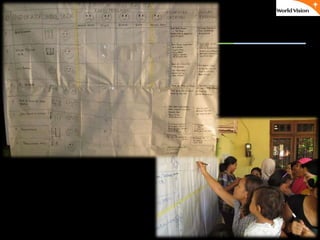
democracy.
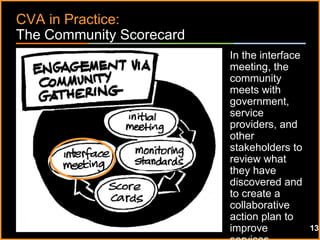
2. Development effectiveness: Social accountability contributes
to increased development effectiveness through improved
service delivery and more informed policy design, as a result of
direct participation by citizens.
3. Empowerment: Social accountability initiatives can lead to the
empowerment of citizens, particularly the poor, as they start to
engage with power holders.
Source: Parmesh Shah (2007) Social Accountability in
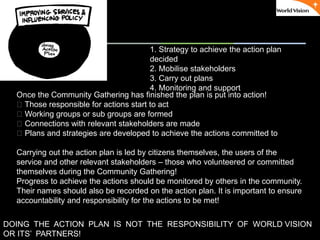
Practice: From Tools to Outcomes, South Asia Sustainable
Development Department
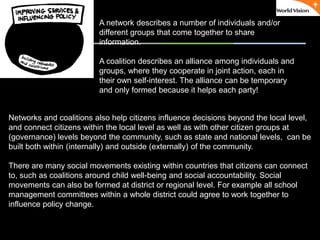
٠ 7 ٠ CP V1
Effective social accountability:
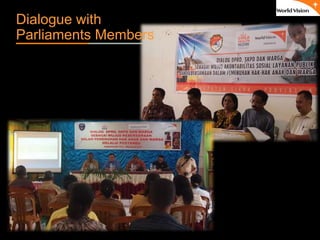
Creates direct accountability relationships between citizens
and power holders
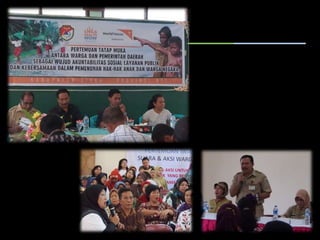
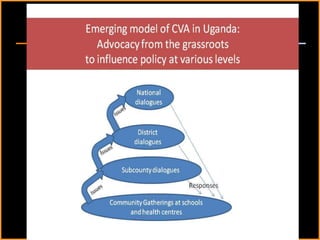
Involves a broad range of actions and mechanisms beyond
voting that citizens can use to hold power holders to account
Involves actions on the part of government, media, and other
society organisations (civil society) that promote or facilitate
accountability efforts.
٠ 8 ٠ CP V1
Citizen Voice and Action and Model of Ministry (3
C):
 􀂃 It focuses on child well-being – aiming to improve the delivery of
basic services such as health and education that are essential for
children.
 􀂃 It is community based - directly focusing public services at the
local level. Often the lowest level of government structures is used
as a basis to facilitate activities.
 􀂃 It is Christian - drawing on the biblical context of working with the
poor. Justice is central to the Bible, Jesus’ ministry and God’s
reign. Seeking justice is a central element of WVs mission. Indeed
one of the main reasons why WV exists is to seek justice for the
poor. Citizen Voice and Action seeks justice for the communities
with which we work.
٠ 9 ٠ CP V1
CVA and Principle Level Choices
 􀂃 tackling the root causes of poverty - working with and aiming
to improve existing systems and structures that provide basic
services.
 􀂃 empowering citizens - to take action themselves and to take
responsibility and ownership for improved service delivery.
 􀂃 integrating advocacy - within local level programming by
increasing community engagement in “monitoring policies,
accessing justice, and holding local government accountable.”
٠ 10 ٠ CP V1
CVA focuses on government policies
(NOT World Vision inputs):
CVA encourages local staff and communities to first consider
what government should be doing before World Vision
contributes any programmatic inputs at all in a community.
Government (public) policies and strategies that define basic
service delivery provide the framework for Citizen Voice and
Action.
Activities are planned and focused on ensuring there are
effective policies in place, and that quality services are
provided to communities.
CORE PRINCIPLES
٠ 11 ٠ CP V1
CVA focuses on social accountability
(NOT World Vision inputs)
Citizen Voice and Action seeks to strengthen existing systems
and structures to address poverty and ensure child well-being.
Strengthening citizens’ engagement in policies and practices of
government aims to improve service delivery.
Unlike projects that provide inputs for a brief period of time,
CVA strengthens systems, structures and relationships that
promote long-term, sustainable change.
CORE PRINCIPLES
٠ 12 ٠ CP V1
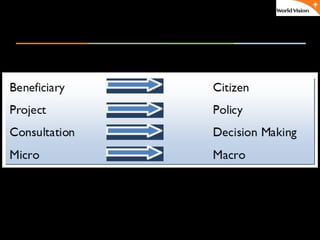
CVA focuses on citizens (NOT beneficiaries)
CVA practice treats ordinary individuals, often described as
‘the community’, as citizens of nation states.
Citizens have a primary relationship to their governments.
They have a right to access quality services. Basic services
are not welfare, nor a handout, but a right.
Active citizenship and engagement with government,
encourages governments to work effectively and to provide
quality services.
CORE PRINCIPLES
٠ 13 ٠ CP V1
CVA focuses on facilitation
(NOT implementation)
In the CVA process, World Visions’ role and that of our
partners is one of facilitation. Citizen Voice and Action
describes a process of facilitation in which educated, mobilised
and empowered citizens take action themselves, together with
other stakeholders in the community including service
providers and government staff.
CORE PRINCIPLES
٠ 14 ٠ CP V1
CVA focuses on citizen-led advocacy (NOT
advocacy directed or designed by others)
Citizens themselves decide what action they want, and need to
take, based on their own experiences, information and hopes
for the future. Advocacy responses are not directed by
external organisations or ‘experts’.
CORE PRINCIPLES
٠ 15 ٠ CP V1
CVA empowers communities to own the information
(information gathering is NOT extractive)
In the CVA process, citizens generate the evidence base for
advocacy themselves. Together with partners, they analyze
this information and use it to improve the delivery of
government services. They maintain primary ownership of the
information.
CVA encourages us to minimize the role that the NGO plays,
while maximizing the role that community and government play
in the development of the areas where we work.
CORE PRINCIPLES
٠ 16 ٠ CP V1
٠ 17 ٠ CP V1
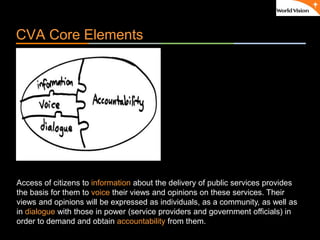
CVA Core Elements
Access of citizens to information about the delivery of public services provides
the basis for them to voice their views and opinions on these services. Their
views and opinions will be expressed as individuals, as a community, as well as
in dialogue with those in power (service providers and government officials) in
order to demand and obtain accountability from them.
٠ 18 ٠ CP V1
Citizen Voice and Action:
How Does it Work?
٠ 19 ٠ CP V1
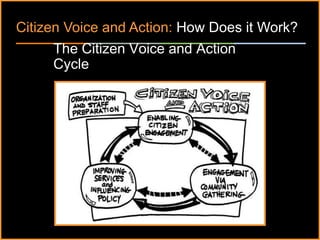
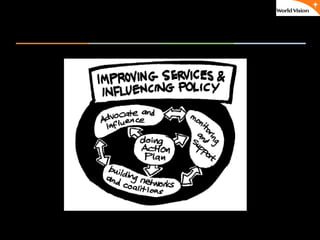
The Citizen Voice and Action
Cycle
Citizen Voice and Action: How Does it Work?
٠ 20 ٠ CP V1
First, we recommend that National Offices conduct a number of
reviews, assessments and analysis looking both at the internal
World Vision perspective, and at the external situation
regarding governance and citizenship.
This analysis focuses on three areas:
1. National Office Strategy Review
2. Staff Capacity Assessment
3. Country Context Assessment
٠ 21 ٠ CP V1
Country strategy review:
 To what extent does the strategy include:
 a) Plans for local level advocacy? If so, describe the approach and priorities
for advocacy.
 b) Plans for national level advocacy? If so describe the approach, and
issues/sectors targeted?
 c) Partnerships and alliances for advocacy work and influencing policies? If
so, describe these.
 d) Engagement with civil society and the strengthening of civil society for
advocacy?
 e) Integration of advocacy within current programming strategies?
 f) An appreciation and use of the core principles and themes of Citizen Voice
and Action? If so, describe how.
٠ 22 ٠ CP V1
Advocacy strategy
 Repeat the questions asked above of Country strategy together with those below.
 How, or in what ways, does the strategy include:
 a) Plans for citizen education?
 b) Plans for citizen mobilisation?
 c) Plans for monitoring the implementation of government policy?
 d) Plans for influencing policy?
 e) Plans for monitoring the response from advocacy work for government basic
services
 f) Plans for increasing the accountability of government in relation to their delivery
of basic services?
 g) Plans for strengthening citizen voice, dialogue and relations between
community and government.
٠ 23 ٠ CP V1
Staff experience, skills and capacity
Assess the current experience, skills and capacity of staff in:
a) community focused facilitation
b) citizen education
c) citizen mobilisation
d) local, regional and national level advocacy
e) policy analysis, policy influence and monitoring the
implementation of policies
f ) networking, partnering and coalition building for advocacy.
٠ 24 ٠ CP V1
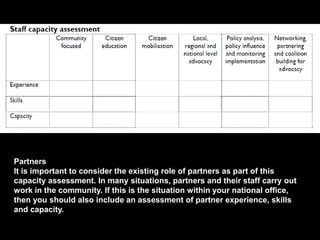
Partners
It is important to consider the existing role of partners as part of this
capacity assessment. In many situations, partners and their staff carry out
work in the community. If this is the situation within your national office,
then you should also include an assessment of partner experience, skills
and capacity.
٠ 25 ٠ CP V1
Governance and Politics
• Give an overview of the structure of government and politics
from national to local level.
• Discuss and assess the implications of decentralisation
(government funding, administrative, democratic), particularly in
relation to local service delivery
• How significant is this decentralisation for child well-being?
• Assess the strengths and weaknesses, potential opportunities
and obstacles of the governance structure, concentrating on
relevant parts such as the health or education sector and relevant
policy-making areas.
COUNTRY CONTEXT ASSESSMENT
٠ 26 ٠ CP V1
Policy development, implementation
and budgeting
• Describe government processes and systems in relation to policy development and
budgeting for basic services. Who makes the policy decisions and who influences them?
 - briefly describe any relevant decentralisation policies
 - focus on health and education initially.
 • Describe the key levels of government responsible for basic service delivery and why?
What are the implications for WV’s structure and strategy?
 • Which are the key relevant government departments and other organisations for
communities to influence? Are these at national, state or lower level?
 • Describe the priorities and processes for engaging in and monitoring Poverty Reduction
Strategy Plans (PRSP) and briefly comment on WV or civil society’s role in this.
 • Refer to any independent assessments of the PRSP processes.
COUNTRY CONTEXT ASSESSMENT
٠ 27 ٠ CP V1
Citizen participation
• Describe opportunities for citizen engagement.
• Include participatory governance structures such as
committees or participatory budgeting meetings or any other
ways in which citizens can engage in public decision making.
COUNTRY CONTEXT ASSESSMENT
٠ 28 ٠ CP V1
Public and Social accountability
• List the most common existing local accountability
mechanisms that are relevant to the chosen sectors (such as
school management committees or health management
committees).
• Briefly assess how well they function and their potential for
social accountability.
• List any social accountability initiatives already in use (or
planned) such as participatory planning, Public Expenditure
Tracking Systems (PETS) or participatory budgeting.
Describe any government accountability and monitoring
mechanisms relevant to the chosen sectors, such as school or
health inspectors. Mention any which act as public champions
urging greater government accountability.
COUNTRY CONTEXT ASSESSMENT
٠ 29 ٠ CP V1
Sector analysis
Select one or more sectors, such as health and education, to
use in responding to these questions
 􀂃 Identify relevant policies, strategies and planning
documentation in relation to the chosen sector
 􀂃 Identify government standards or entitlements in relation to
local service delivery for the chosen sector
 􀂃 Focus on child well-being, such as health and education.
 􀂃 Align the chosen sector with key priorities within country
strategies.
COUNTRY CONTEXT ASSESSMENT
٠ 30 ٠ CP V1
Civil society (1)
 􀂃 How much does the government regulate NGOs? Does this
affect their ability to criticise and carry out advocacy work relating
to government policy?
 􀂃 Does civil society or the media raise issues of good governance
and ensure accountability of government to its citizens?
 􀂃 What are the main coalitions or social movements working in
the area of social accountability, and supporting local level
advocacy work?
 􀂃 Identify any other agencies, organisations, think tanks or
academic institutions that have expertise in social accountability,
demand led governance and local level advocacy work.
COUNTRY CONTEXT ASSESSMENT
٠ 31 ٠ CP V1
Civil Society (2)
 􀂃 Identify the approaches they use, their strengths and
weaknesses. What links or partnerships does WV have with any of
these organisations? What opportunities are there for partnership in
the future?
 􀂃 Identify opportunities and capacity of the community to engage in
local level advocacy.
 􀂃 Assess the experience of communities in leading local level
advocacy efforts.
 􀂃 Assess the willingness and interest of communities to engage in
local level advocacy.
 􀂃 Identify regions or areas with the greatest potential to engage
with Citizen Voice and Action.
COUNTRY CONTEXT ASSESSMENT
٠ 32 ٠ CP V1
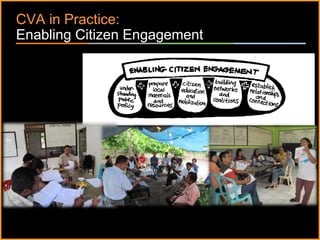
CVA in Practice:
Enabling Citizen Engagement
٠ 33 ٠ CP V1
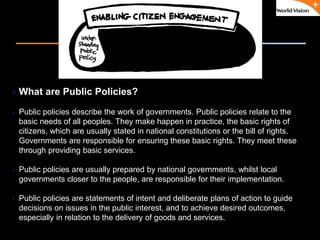
What are Public Policies?
 Public policies describe the work of governments. Public policies relate to the
basic needs of all peoples. They make happen in practice, the basic rights of
citizens, which are usually stated in national constitutions or the bill of rights.
Governments are responsible for ensuring these basic rights. They meet these
through providing basic services.
 Public policies are usually prepared by national governments, whilst local
governments closer to the people, are responsible for their implementation.
 Public policies are statements of intent and deliberate plans of action to guide
decisions on issues in the public interest, and to achieve desired outcomes,
especially in relation to the delivery of goods and services.
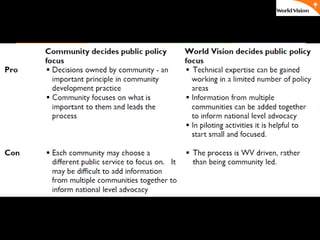
٠ 34 ٠ CP V1
٠ 35 ٠ CP V1
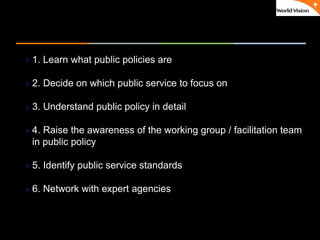
1. Learn what public policies are
2. Decide on which public service to focus on
3. Understand public policy in detail
4. Raise the awareness of the working group / facilitation team
in public policy
5. Identify public service standards
6. Network with expert agencies and institutions
٠ 36 ٠ CP V1
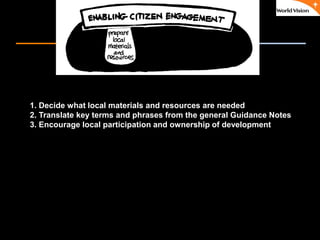
1. Decide what local materials and resources are needed
2. Translate key terms and phrases from the general Guidance Notes
3. Encourage local participation and ownership of development
٠ 37 ٠ CP V1
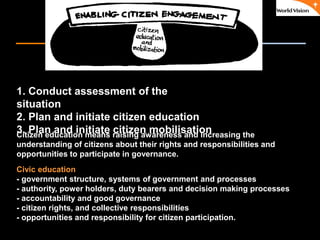
1. Conduct assessment of the
situation
2. Plan and initiate citizen education
3. Plan and initiate citizen mobilisationCitizen education means raising awareness and increasing the
understanding of citizens about their rights and responsibilities and
opportunities to participate in governance.
Civic education
- government structure, systems of government and processes
- authority, power holders, duty bearers and decision making processes
- accountability and good governance
- citizen rights, and collective responsibilities
- opportunities and responsibility for citizen participation.
٠ 38 ٠ CP V1
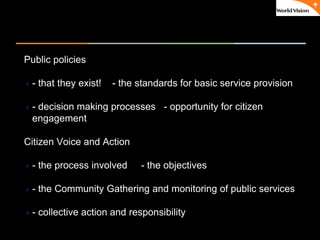
Public policies
- that they exist! - the standards for basic service provision
- decision making processes - opportunity for citizen
engagement
Citizen Voice and Action
- the process involved - the objectives
- the Community Gathering and monitoring of public services
- collective action and responsibility
٠ 39 ٠ CP V1
Citizen education can be done through workshops, meetings,
forums or informal processes. It should not be seen as one
activity, but rather as a long-term process. Though citizen
education begins at this time, it continues throughout the whole
of the Citizens Voice and Action process.
Citizen education is seen as a first step in engaging citizens as
part of the Citizen Voice and Action process. However, it is
also an important outcome in itself.
Consider the process of citizen education with various political
and administrative staff including councillors, local politicians,
as well as government staff. They also may need help to fully
understand government and citizen rights and responsibilities.
٠ 40 ٠ CP V1
When planning education and mobilisation activities, it is very
important to make sure that marginalised and vulnerable
groups have every opportunity to participate. Recognise that
there will be barriers and constraints to their participation and
make special efforts to reduce these.
Women, ethnic groups and people living with disability should
all be included
Appropriate strategies to encourage different age groups to
participate should be used. Messages should be tailored to
different audience groups.
Provide appropriate resources to support child participation
٠ 41 ٠ CP V1
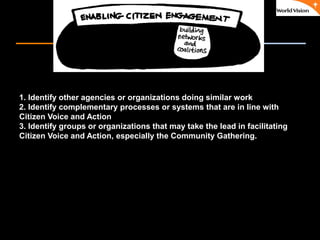
1. Identify other agencies or organizations doing similar work
2. Identify complementary processes or systems that are in line with
Citizen Voice and Action
3. Identify groups or organizations that may take the lead in facilitating
Citizen Voice and Action, especially the Community Gathering.
٠ 42 ٠ CP V1
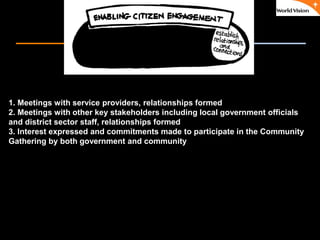
1. Meetings with service providers, relationships formed
2. Meetings with other key stakeholders including local government officials
and district sector staff, relationships formed
3. Interest expressed and commitments made to participate in the Community
Gathering by both government and community
٠ 43 ٠ CP V1
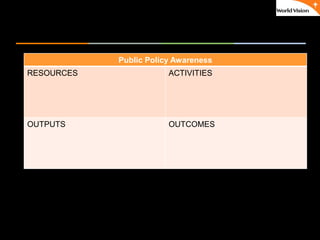
Public Policy Awareness
RESOURCES ACTIVITIES
OUTPUTS OUTCOMES
٠ 44 ٠ CP V1
CVA in Practice:
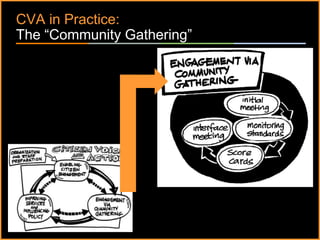
The “Community Gathering”
٠ 45 ٠ CP V1
CVA in Practice:
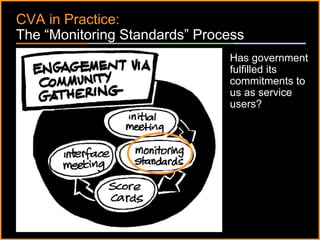
The “Monitoring Standards” Process
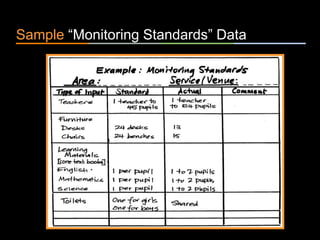
Has government
fulfilled its
commitments to
us as service
users?
٠ 46 ٠ CP V1
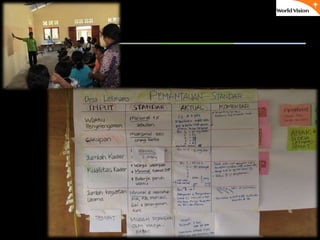
Sample “Monitoring Standards” Data
٠ 47 ٠ CP V1
٠ 48 ٠ CP V1
CVA in Practice:
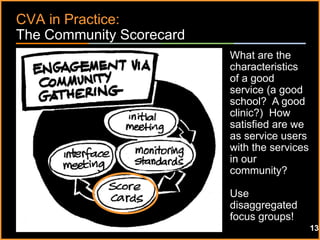
The Community Scorecard
What are the
characteristics
of a good
service (a good
school? A good
clinic?) How
satisfied are we
as service users
with the services
in our
community?
Use
disaggregated
focus groups!
13
٠ 49 ٠ CP V1
Definition and purpose
The main objective of the Score Card sessions is to enable
both users and providers of a public service to assess how
well the service is provided and to provide proposals to
improve the quality of service. The session is based on
focus group discussions.
Users of the public service are divided into separate user
groups. The service providers are asked to conduct their
own ‘self evaluation’ of their service delivery using the
Score Card process.
The Score Cards resulting from these focus group
discussions are shared during the Interface Meeting,
together with proposals suggested from each group.
٠ 50 ٠ CP V1
A series of flip charts need to be prepared before the Score Card
focus group discussions.
1. Overview of the Community Gathering process
2. Smiley scale
3. Practice Voting Sheet
4. Building group performance measures
5. Score Card
6. Voting Sheet
7. Comments and Proposals Sheet
٠ 51 ٠ CP V1
The Score Card focus group discussions sessions can take
place all on the same day, as part of one big Community
Gathering exercise. This is a massive undertaking and you will
need a lot of facilitators! This is not recommended.
It is easier to conduct the Score Card sessions over a number
of days, as the meetings often take a number of hours and you
need to ensure that participants have enough energy to
actively participate in the Interface Meeting.
٠ 52 ٠ CP V1
 In education, the groups could be formed around the following
categories:
 a. Pupils
 b. Parents
 c. Teachers
 d. School Management Committee or Parents and Teachers
Association
 e. Members of the Teachers’ CommitteeYou can also categorize focus groups based on gender or age (womens’ and mens’ groups, and children
and youth groups).
More than one focus group can be formed for any ‘user group type’.
One separate Score Card focus group must include service providers.
A second service provider focus group can be formed if required.
٠ 53 ٠ CP V1
The Score Card focus groups should take between 1½ - 3
hours.
The session should be led by a minimum of three people to
facilitate:
• one to lead the session with the participants
• one to record information on the flip chart
• one to record the information on a record sheet.
٠ 54 ٠ CP V1
٠ 55 ٠ CP V1
The characteristics provided by the group should be qualitative
in nature.
The participants should be encouraged to produce proposals
that can be carried out by the community itself, rather than
expecting others to do everything.
It is important that proposals are written as clearly and specific
as possible, so that they will be understood at the Interface
Meeting.
٠ 56 ٠ CP V1
CVA in Practice:
The Community Scorecard
In the interface
meeting, the
community
meets with
government,
service
providers, and
other
stakeholders to
review what
they have
discovered and
to create a
collaborative
action plan to
improve 13
٠ 57 ٠ CP V1
Definition and purpose
The participants who have attended the Monitoring Standards
and Score Cards sessions are then brought together in one
large meeting to present the outcomes of these sessions, and
to discuss and build together an action plan to improve the
delivery of the public service.
The main objective of this meeting is the sharing of information
(monitoring standards, users and providers assessments) and
the preparation of an action plan, which includes
responsibilities and time lines.
٠ 58 ٠ CP V1
The interface meeting is the most critical session of the
Community Gathering process. It is critical that you allow
enough time for the Interface Meeting. Between 2- 5 hours is
recommended.
The best part of the day to meet is usually mid morning to early
afternoon.
٠ 59 ٠ CP V1
 1. Prepare materials and resources
 2. Prepare flip charts (Flip charts from the Monitoring Standards session and flip charts from
each Score Card Process must also be available for use during the Interface Meeting)
 3. Organize venue
 4. Mobilise facilitation team
 5. Determine participants
 6. Facilitation of the Interface Meeting:
 Step 1: introductions, purpose and process
 Step 2: Monitoring Standards presentations
 Step 3: Score Card presentations
 Step 4: Action planning
 Step 5: Closing and celebration
٠ 60 ٠ CP V1
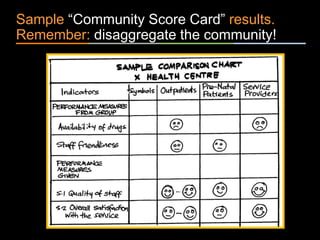
Sample “Community Score Card” results.
Remember: disaggregate the community!
٠ 61 ٠ CP V1
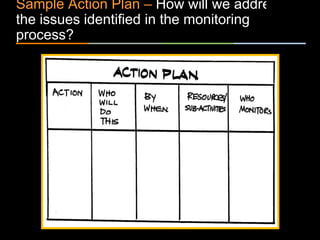
Sample Action Plan – How will we address
the issues identified in the monitoring
process?
٠ 62 ٠ CP V1
٠ 63 ٠ CP V1
٠ 64 ٠ CP V1
Once the Community Gathering has finished the plan is put into action!
􀂃 Those responsible for actions start to act
􀂃 Working groups or sub groups are formed
􀂃 Connections with relevant stakeholders are made
􀂃 Plans and strategies are developed to achieve the actions committed to
Carrying out the action plan is led by citizens themselves, the users of the
service and other relevant stakeholders – those who volunteered or committed
themselves during the Community Gathering!
Progress to achieve the actions should be monitored by others in the community.
Their names should also be recorded on the action plan. It is important to ensure
accountability and responsibility for the actions to be met!
DOING THE ACTION PLAN IS NOT THE RESPONSIBILITY OF WORLD VISION
OR ITS’ PARTNERS!
1. Strategy to achieve the action plan
decided
2. Mobilise stakeholders
3. Carry out plans
4. Monitoring and support
٠ 65 ٠ CP V1
Though individuals may be recorded on the action plan as
taking responsibility for the achievement of specific actions, it is
suggested that sub committees or groups are formed to
support their delivery. A group will make working towards the
goal easier and it will stimulate others to become involved in
achieving the action plan.
Different types of stakeholders can take responsibility to carry
out the action plan, such as:
 Citizens (users of the public service), Service providers, Community and
service providers together; Government officials, either political and
administrative; External stakeholders, such as CBOs or NGOs.
Normally different stakeholders will work together to achieve
the plans.
٠ 66 ٠ CP V1
Networks and coalitions also help citizens influence decisions beyond the local level,
and connect citizens within the local level as well as with other citizen groups at
(governance) levels beyond the community, such as state and national levels, can be
built both within (internally) and outside (externally) of the community.
There are many social movements existing within countries that citizens can connect
to, such as coalitions around child well-being and social accountability. Social
movements can also be formed at district or regional level. For example all school
management committees within a whole district could agree to work together to
influence policy change.
A network describes a number of individuals and/or
different groups that come together to share
information.
A coalition describes an alliance among individuals and
groups, where they cooperate in joint action, each in
their own self-interest. The alliance can be temporary
and only formed because it helps each party!
٠ 67 ٠ CP V1
It is important to identify the right people to target as part of your actions. It may be
useful to conduct exercises to understand power, in order to identify the right
targets for advocacy and influence.
Recognize that you may not need to target the most powerful; sometimes it is
easier to advocate first to another power holder, changing their views, so they can
then advocate on your behalf. This is why mapping power holders and influence
makers around the change that you want to happen, can be so important
٠ 68 ٠ CP V1
Dialogue with
Parliaments Members
٠ 69 ٠ CP V1
Monitoring and support serves a number of
purposes:
􀂃 to motivate those carrying out the actions
􀂃 to see that planned actions are happening
􀂃 to see that the strategies used are effective and
helping to achieve the planned action
􀂃 to enable problem solving if obstacles prevent the
actions from being achieved
􀂃 to report back progress to the community and
users of the service.
Perseverance to achieve long term, sustainable change is often difficult to
maintain. Starting with ‘quick wins’ – changes that happen easily to improve the
services, is a good way to encourage initial citizen action and to build momentum
for longer-term action.
Documenting actions taken and progress made are very important to the
monitoring and
support process. Those responsible for carrying out the actions, should be
encouraged to keep a record of what they are doing and the responses and results
of their action.
٠ 70 ٠ CP V1
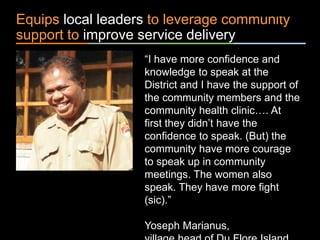
Equips local leaders to leverage community
support to improve service delivery
“I have more confidence and
knowledge to speak at the
District and I have the support of
the community members and the
community health clinic…. At
first they didn’t have the
confidence to speak. (But) the
community have more courage
to speak up in community
meetings. The women also
speak. They have more fight
(sic).”
Yoseph Marianus,
٠ 71 ٠ CP V1
٠ 72 ٠ CP V1
Some Changes
The health center ambulance is available
24 hours per day (particularly after the
replacement of Head of Puskesmas).
There is no cost to the community, said
the Head of Puskesmas Oeolo –
Thomas Laka.
After the Interface Meeting last August
2012, all health workers have stayed in
the villages. Communities have spoken
to Sub-District Community Health Center
to find the solution to ensure that midwife
stays in the village.
All Posyandu in Maubesi and Letmafo
village (including Benkoko) have obtained
Healthy Card from Health Center in
Maubesi through Nice Project. PNPM
GSC has provided 24 chairs and 2 tables
for 5 posyandu in December 2012. Health
center in Maubesi has replaced the
broken weighing scale in Benkoko
Posyandu.
The budget has been allocated and
disbursed in four posyandu in Kolidetung
village by village government for
supplementary feeding Rp.1,300,000 /
year increased to Rp.2,000,000 / year.
Increasing PMT fund is not in Kolidetung
only, but also in other villages which are
Hepang, Du, Korowuwu and Ladogahar.
In Cilincing, each Posyandu has a
midwife in monthly event. It can be
done after community approached
health cadres association, community
health center, and village government to
midwives of private practices.
In Cilincing, Nutrition education has been
conducted by cadres for mothers who
have below 2 years baby in RW 04, 05, 08
and 10. There were 7 (seven) cadres
from the community who have been
trained as breastfeeding counselor.
٠ 73 ٠ CP V1
Citizen Voice and Action:
Impact on Health Outcomes at the local level
Researchers from J-PAL studied the impact of an approach
similar to CVA in 50 communities in Uganda.
• 25 communities implemented a CVA-like intervention
• 25 communities served as a control group
After one year, researchers measured the differences. They
found that the treatment communities exhibited a:
• 33% drop in under-five mortality
• 20% increase in the utilization of outpatient services;
• 58% increase in the number of deliveries by skilled birth
attendant deliveries;
• 19% increase in the number of patients seeking
antenatal care;
• 9% decrease in waiting time.
Bjorkman, M and Svensson, J, 2009. Power to the People: Evidence from a
Randomised Field Experiment on Community Based Monitoring in Uganda.
٠ 74 ٠ CP V1
Citizen Voice and Action:
Impact on Education Outcomes at the local
level
Oxford University researchers used Randomized Control Trials
to study the impact of the CVA Score Card in100 Ugandan
schools.
• 30 schools used the CVA Score Card.
• 40 schools served as a control group.
One year later, researchers measured the differences. In the
schools using the CVA score card, they found:
• Test scores increased by .19 standard deviations (enough
to move the average student from the 50th to the 58th
percentile)
• Pupil attendance increased by 8-10%.
• Teacher absenteeism dropped by13%.
Andrew Zeitlin, Management and Motivation in Ugandan
Primary Schools: Impact Evaluation Final Report (2011).
٠ 75 ٠ CP V1
• Encourage a collaborative approach that
equips local leaders to leverage community
support to improve service delivery;
• Ensure participation remains at the heart of the
process. Participation means that all
stakeholders participate in the solution of the
problem.
• Link demand-led social accountability with
supply-side initiatives.
Citizen Voice and Action:
Three Lessons
٠ 76 ٠ CP V1
Now is your chance to
earn big returns
٠ 77 ٠ CP V1
٠ 78 ٠ CP V1
Recommendations
1. Ensure that supply-side capacity building and
good governance work (especially in
decentralization) is intentionally linked with
demand-side social accountability.
2. Examine ways to systematically scale social
accountability work in order to encourage
collective action for systemic reform beyond the
local level.
Contact:
jeff_hall@wvi.org
bill_walker@wvi.org
asteria_taruliasi_aritonang@wvi.org
christiana_widimulyani@wvi.org

Cva wv bangladesh presentation

  • 1.
    Citizen Voice andAction: Helping Communities Realize the Power Within WV Bangladesh September 2013
  • 2.
    ٠ 2 ٠CP V1 History CBPM (Community Based Performance Monitoring) was first piloted by CARE Malawi and then developed further by the World Bank in the Gambia. World Vision initiated pilot programs in 2005. The name of the methodology was changed from Community Based Performance Monitoring (CBPM) to Citizen Voice and Action in 2008.
  • 3.
    ٠ 3 ٠CP V1 What is Citizen Voice and Action? Citizen Voice and Action is a social accountability approach designed to improve the relationship between communities and government in order to improve services, like health care and education, that impact the daily lives of children and their families.
  • 4.
    ٠ 4 ٠CP V1 What is Accountability? obligation of power holders to account for, or to take responsibility for, their actions. establishes a relationship between power holders and those who hold them to account for their actions. It describes responsibility, reciprocity and relationships among different stakeholders. focuses on governance issues around how decisions are made and who controls resources. focuses on how resources and actions are monitored, accounted for and judged to be effective or not.
  • 5.
    ٠ 5 ٠CP V1 What is Social Accountability? Social accountability describes the engagement of citizens or civil society organizations to hold power holders to account for the social benefit of all. Social Accountability mechanisms refer to a broad range of actions (beyond voting) that citizens, communities and civil society organizations can use to hold government officials and civil servants accountable. These include citizen participation in public policy making, participatory budgeting, public expenditure tracking, citizen monitoring of public service delivery, citizen advisory boards, lobbying and advocacy campaigns.
  • 6.
    ٠ 6 ٠CP V1 The benefits of social accountability: 1. Good governance: The social accountability of public officials is the basis of good government and essential for effective democracy. 2. Development effectiveness: Social accountability contributes to increased development effectiveness through improved service delivery and more informed policy design, as a result of direct participation by citizens. 3. Empowerment: Social accountability initiatives can lead to the empowerment of citizens, particularly the poor, as they start to engage with power holders. Source: Parmesh Shah (2007) Social Accountability in Practice: From Tools to Outcomes, South Asia Sustainable Development Department
  • 7.
    ٠ 7 ٠CP V1 Effective social accountability: Creates direct accountability relationships between citizens and power holders Involves a broad range of actions and mechanisms beyond voting that citizens can use to hold power holders to account Involves actions on the part of government, media, and other society organisations (civil society) that promote or facilitate accountability efforts.
  • 8.
    ٠ 8 ٠CP V1 Citizen Voice and Action and Model of Ministry (3 C):  􀂃 It focuses on child well-being – aiming to improve the delivery of basic services such as health and education that are essential for children.  􀂃 It is community based - directly focusing public services at the local level. Often the lowest level of government structures is used as a basis to facilitate activities.  􀂃 It is Christian - drawing on the biblical context of working with the poor. Justice is central to the Bible, Jesus’ ministry and God’s reign. Seeking justice is a central element of WVs mission. Indeed one of the main reasons why WV exists is to seek justice for the poor. Citizen Voice and Action seeks justice for the communities with which we work.
  • 9.
    ٠ 9 ٠CP V1 CVA and Principle Level Choices  􀂃 tackling the root causes of poverty - working with and aiming to improve existing systems and structures that provide basic services.  􀂃 empowering citizens - to take action themselves and to take responsibility and ownership for improved service delivery.  􀂃 integrating advocacy - within local level programming by increasing community engagement in “monitoring policies, accessing justice, and holding local government accountable.”
  • 10.
    ٠ 10 ٠CP V1 CVA focuses on government policies (NOT World Vision inputs): CVA encourages local staff and communities to first consider what government should be doing before World Vision contributes any programmatic inputs at all in a community. Government (public) policies and strategies that define basic service delivery provide the framework for Citizen Voice and Action. Activities are planned and focused on ensuring there are effective policies in place, and that quality services are provided to communities. CORE PRINCIPLES
  • 11.
    ٠ 11 ٠CP V1 CVA focuses on social accountability (NOT World Vision inputs) Citizen Voice and Action seeks to strengthen existing systems and structures to address poverty and ensure child well-being. Strengthening citizens’ engagement in policies and practices of government aims to improve service delivery. Unlike projects that provide inputs for a brief period of time, CVA strengthens systems, structures and relationships that promote long-term, sustainable change. CORE PRINCIPLES
  • 12.
    ٠ 12 ٠CP V1 CVA focuses on citizens (NOT beneficiaries) CVA practice treats ordinary individuals, often described as ‘the community’, as citizens of nation states. Citizens have a primary relationship to their governments. They have a right to access quality services. Basic services are not welfare, nor a handout, but a right. Active citizenship and engagement with government, encourages governments to work effectively and to provide quality services. CORE PRINCIPLES
  • 13.
    ٠ 13 ٠CP V1 CVA focuses on facilitation (NOT implementation) In the CVA process, World Visions’ role and that of our partners is one of facilitation. Citizen Voice and Action describes a process of facilitation in which educated, mobilised and empowered citizens take action themselves, together with other stakeholders in the community including service providers and government staff. CORE PRINCIPLES
  • 14.
    ٠ 14 ٠CP V1 CVA focuses on citizen-led advocacy (NOT advocacy directed or designed by others) Citizens themselves decide what action they want, and need to take, based on their own experiences, information and hopes for the future. Advocacy responses are not directed by external organisations or ‘experts’. CORE PRINCIPLES
  • 15.
    ٠ 15 ٠CP V1 CVA empowers communities to own the information (information gathering is NOT extractive) In the CVA process, citizens generate the evidence base for advocacy themselves. Together with partners, they analyze this information and use it to improve the delivery of government services. They maintain primary ownership of the information. CVA encourages us to minimize the role that the NGO plays, while maximizing the role that community and government play in the development of the areas where we work. CORE PRINCIPLES
  • 16.
    ٠ 16 ٠CP V1
  • 17.
    ٠ 17 ٠CP V1 CVA Core Elements Access of citizens to information about the delivery of public services provides the basis for them to voice their views and opinions on these services. Their views and opinions will be expressed as individuals, as a community, as well as in dialogue with those in power (service providers and government officials) in order to demand and obtain accountability from them.
  • 18.
    ٠ 18 ٠CP V1 Citizen Voice and Action: How Does it Work?
  • 19.
    ٠ 19 ٠CP V1 The Citizen Voice and Action Cycle Citizen Voice and Action: How Does it Work?
  • 20.
    ٠ 20 ٠CP V1 First, we recommend that National Offices conduct a number of reviews, assessments and analysis looking both at the internal World Vision perspective, and at the external situation regarding governance and citizenship. This analysis focuses on three areas: 1. National Office Strategy Review 2. Staff Capacity Assessment 3. Country Context Assessment
  • 21.
    ٠ 21 ٠CP V1 Country strategy review:  To what extent does the strategy include:  a) Plans for local level advocacy? If so, describe the approach and priorities for advocacy.  b) Plans for national level advocacy? If so describe the approach, and issues/sectors targeted?  c) Partnerships and alliances for advocacy work and influencing policies? If so, describe these.  d) Engagement with civil society and the strengthening of civil society for advocacy?  e) Integration of advocacy within current programming strategies?  f) An appreciation and use of the core principles and themes of Citizen Voice and Action? If so, describe how.
  • 22.
    ٠ 22 ٠CP V1 Advocacy strategy  Repeat the questions asked above of Country strategy together with those below.  How, or in what ways, does the strategy include:  a) Plans for citizen education?  b) Plans for citizen mobilisation?  c) Plans for monitoring the implementation of government policy?  d) Plans for influencing policy?  e) Plans for monitoring the response from advocacy work for government basic services  f) Plans for increasing the accountability of government in relation to their delivery of basic services?  g) Plans for strengthening citizen voice, dialogue and relations between community and government.
  • 23.
    ٠ 23 ٠CP V1 Staff experience, skills and capacity Assess the current experience, skills and capacity of staff in: a) community focused facilitation b) citizen education c) citizen mobilisation d) local, regional and national level advocacy e) policy analysis, policy influence and monitoring the implementation of policies f ) networking, partnering and coalition building for advocacy.
  • 24.
    ٠ 24 ٠CP V1 Partners It is important to consider the existing role of partners as part of this capacity assessment. In many situations, partners and their staff carry out work in the community. If this is the situation within your national office, then you should also include an assessment of partner experience, skills and capacity.
  • 25.
    ٠ 25 ٠CP V1 Governance and Politics • Give an overview of the structure of government and politics from national to local level. • Discuss and assess the implications of decentralisation (government funding, administrative, democratic), particularly in relation to local service delivery • How significant is this decentralisation for child well-being? • Assess the strengths and weaknesses, potential opportunities and obstacles of the governance structure, concentrating on relevant parts such as the health or education sector and relevant policy-making areas. COUNTRY CONTEXT ASSESSMENT
  • 26.
    ٠ 26 ٠CP V1 Policy development, implementation and budgeting • Describe government processes and systems in relation to policy development and budgeting for basic services. Who makes the policy decisions and who influences them?  - briefly describe any relevant decentralisation policies  - focus on health and education initially.  • Describe the key levels of government responsible for basic service delivery and why? What are the implications for WV’s structure and strategy?  • Which are the key relevant government departments and other organisations for communities to influence? Are these at national, state or lower level?  • Describe the priorities and processes for engaging in and monitoring Poverty Reduction Strategy Plans (PRSP) and briefly comment on WV or civil society’s role in this.  • Refer to any independent assessments of the PRSP processes. COUNTRY CONTEXT ASSESSMENT
  • 27.
    ٠ 27 ٠CP V1 Citizen participation • Describe opportunities for citizen engagement. • Include participatory governance structures such as committees or participatory budgeting meetings or any other ways in which citizens can engage in public decision making. COUNTRY CONTEXT ASSESSMENT
  • 28.
    ٠ 28 ٠CP V1 Public and Social accountability • List the most common existing local accountability mechanisms that are relevant to the chosen sectors (such as school management committees or health management committees). • Briefly assess how well they function and their potential for social accountability. • List any social accountability initiatives already in use (or planned) such as participatory planning, Public Expenditure Tracking Systems (PETS) or participatory budgeting. Describe any government accountability and monitoring mechanisms relevant to the chosen sectors, such as school or health inspectors. Mention any which act as public champions urging greater government accountability. COUNTRY CONTEXT ASSESSMENT
  • 29.
    ٠ 29 ٠CP V1 Sector analysis Select one or more sectors, such as health and education, to use in responding to these questions  􀂃 Identify relevant policies, strategies and planning documentation in relation to the chosen sector  􀂃 Identify government standards or entitlements in relation to local service delivery for the chosen sector  􀂃 Focus on child well-being, such as health and education.  􀂃 Align the chosen sector with key priorities within country strategies. COUNTRY CONTEXT ASSESSMENT
  • 30.
    ٠ 30 ٠CP V1 Civil society (1)  􀂃 How much does the government regulate NGOs? Does this affect their ability to criticise and carry out advocacy work relating to government policy?  􀂃 Does civil society or the media raise issues of good governance and ensure accountability of government to its citizens?  􀂃 What are the main coalitions or social movements working in the area of social accountability, and supporting local level advocacy work?  􀂃 Identify any other agencies, organisations, think tanks or academic institutions that have expertise in social accountability, demand led governance and local level advocacy work. COUNTRY CONTEXT ASSESSMENT
  • 31.
    ٠ 31 ٠CP V1 Civil Society (2)  􀂃 Identify the approaches they use, their strengths and weaknesses. What links or partnerships does WV have with any of these organisations? What opportunities are there for partnership in the future?  􀂃 Identify opportunities and capacity of the community to engage in local level advocacy.  􀂃 Assess the experience of communities in leading local level advocacy efforts.  􀂃 Assess the willingness and interest of communities to engage in local level advocacy.  􀂃 Identify regions or areas with the greatest potential to engage with Citizen Voice and Action. COUNTRY CONTEXT ASSESSMENT
  • 32.
    ٠ 32 ٠CP V1 CVA in Practice: Enabling Citizen Engagement
  • 33.
    ٠ 33 ٠CP V1 What are Public Policies?  Public policies describe the work of governments. Public policies relate to the basic needs of all peoples. They make happen in practice, the basic rights of citizens, which are usually stated in national constitutions or the bill of rights. Governments are responsible for ensuring these basic rights. They meet these through providing basic services.  Public policies are usually prepared by national governments, whilst local governments closer to the people, are responsible for their implementation.  Public policies are statements of intent and deliberate plans of action to guide decisions on issues in the public interest, and to achieve desired outcomes, especially in relation to the delivery of goods and services.
  • 34.
    ٠ 34 ٠CP V1
  • 35.
    ٠ 35 ٠CP V1 1. Learn what public policies are 2. Decide on which public service to focus on 3. Understand public policy in detail 4. Raise the awareness of the working group / facilitation team in public policy 5. Identify public service standards 6. Network with expert agencies and institutions
  • 36.
    ٠ 36 ٠CP V1 1. Decide what local materials and resources are needed 2. Translate key terms and phrases from the general Guidance Notes 3. Encourage local participation and ownership of development
  • 37.
    ٠ 37 ٠CP V1 1. Conduct assessment of the situation 2. Plan and initiate citizen education 3. Plan and initiate citizen mobilisationCitizen education means raising awareness and increasing the understanding of citizens about their rights and responsibilities and opportunities to participate in governance. Civic education - government structure, systems of government and processes - authority, power holders, duty bearers and decision making processes - accountability and good governance - citizen rights, and collective responsibilities - opportunities and responsibility for citizen participation.
  • 38.
    ٠ 38 ٠CP V1 Public policies - that they exist! - the standards for basic service provision - decision making processes - opportunity for citizen engagement Citizen Voice and Action - the process involved - the objectives - the Community Gathering and monitoring of public services - collective action and responsibility
  • 39.
    ٠ 39 ٠CP V1 Citizen education can be done through workshops, meetings, forums or informal processes. It should not be seen as one activity, but rather as a long-term process. Though citizen education begins at this time, it continues throughout the whole of the Citizens Voice and Action process. Citizen education is seen as a first step in engaging citizens as part of the Citizen Voice and Action process. However, it is also an important outcome in itself. Consider the process of citizen education with various political and administrative staff including councillors, local politicians, as well as government staff. They also may need help to fully understand government and citizen rights and responsibilities.
  • 40.
    ٠ 40 ٠CP V1 When planning education and mobilisation activities, it is very important to make sure that marginalised and vulnerable groups have every opportunity to participate. Recognise that there will be barriers and constraints to their participation and make special efforts to reduce these. Women, ethnic groups and people living with disability should all be included Appropriate strategies to encourage different age groups to participate should be used. Messages should be tailored to different audience groups. Provide appropriate resources to support child participation
  • 41.
    ٠ 41 ٠CP V1 1. Identify other agencies or organizations doing similar work 2. Identify complementary processes or systems that are in line with Citizen Voice and Action 3. Identify groups or organizations that may take the lead in facilitating Citizen Voice and Action, especially the Community Gathering.
  • 42.
    ٠ 42 ٠CP V1 1. Meetings with service providers, relationships formed 2. Meetings with other key stakeholders including local government officials and district sector staff, relationships formed 3. Interest expressed and commitments made to participate in the Community Gathering by both government and community
  • 43.
    ٠ 43 ٠CP V1 Public Policy Awareness RESOURCES ACTIVITIES OUTPUTS OUTCOMES
  • 44.
    ٠ 44 ٠CP V1 CVA in Practice: The “Community Gathering”
  • 45.
    ٠ 45 ٠CP V1 CVA in Practice: The “Monitoring Standards” Process Has government fulfilled its commitments to us as service users?
  • 46.
    ٠ 46 ٠CP V1 Sample “Monitoring Standards” Data
  • 47.
    ٠ 47 ٠CP V1
  • 48.
    ٠ 48 ٠CP V1 CVA in Practice: The Community Scorecard What are the characteristics of a good service (a good school? A good clinic?) How satisfied are we as service users with the services in our community? Use disaggregated focus groups! 13
  • 49.
    ٠ 49 ٠CP V1 Definition and purpose The main objective of the Score Card sessions is to enable both users and providers of a public service to assess how well the service is provided and to provide proposals to improve the quality of service. The session is based on focus group discussions. Users of the public service are divided into separate user groups. The service providers are asked to conduct their own ‘self evaluation’ of their service delivery using the Score Card process. The Score Cards resulting from these focus group discussions are shared during the Interface Meeting, together with proposals suggested from each group.
  • 50.
    ٠ 50 ٠CP V1 A series of flip charts need to be prepared before the Score Card focus group discussions. 1. Overview of the Community Gathering process 2. Smiley scale 3. Practice Voting Sheet 4. Building group performance measures 5. Score Card 6. Voting Sheet 7. Comments and Proposals Sheet
  • 51.
    ٠ 51 ٠CP V1 The Score Card focus group discussions sessions can take place all on the same day, as part of one big Community Gathering exercise. This is a massive undertaking and you will need a lot of facilitators! This is not recommended. It is easier to conduct the Score Card sessions over a number of days, as the meetings often take a number of hours and you need to ensure that participants have enough energy to actively participate in the Interface Meeting.
  • 52.
    ٠ 52 ٠CP V1  In education, the groups could be formed around the following categories:  a. Pupils  b. Parents  c. Teachers  d. School Management Committee or Parents and Teachers Association  e. Members of the Teachers’ CommitteeYou can also categorize focus groups based on gender or age (womens’ and mens’ groups, and children and youth groups). More than one focus group can be formed for any ‘user group type’. One separate Score Card focus group must include service providers. A second service provider focus group can be formed if required.
  • 53.
    ٠ 53 ٠CP V1 The Score Card focus groups should take between 1½ - 3 hours. The session should be led by a minimum of three people to facilitate: • one to lead the session with the participants • one to record information on the flip chart • one to record the information on a record sheet.
  • 54.
    ٠ 54 ٠CP V1
  • 55.
    ٠ 55 ٠CP V1 The characteristics provided by the group should be qualitative in nature. The participants should be encouraged to produce proposals that can be carried out by the community itself, rather than expecting others to do everything. It is important that proposals are written as clearly and specific as possible, so that they will be understood at the Interface Meeting.
  • 56.
    ٠ 56 ٠CP V1 CVA in Practice: The Community Scorecard In the interface meeting, the community meets with government, service providers, and other stakeholders to review what they have discovered and to create a collaborative action plan to improve 13
  • 57.
    ٠ 57 ٠CP V1 Definition and purpose The participants who have attended the Monitoring Standards and Score Cards sessions are then brought together in one large meeting to present the outcomes of these sessions, and to discuss and build together an action plan to improve the delivery of the public service. The main objective of this meeting is the sharing of information (monitoring standards, users and providers assessments) and the preparation of an action plan, which includes responsibilities and time lines.
  • 58.
    ٠ 58 ٠CP V1 The interface meeting is the most critical session of the Community Gathering process. It is critical that you allow enough time for the Interface Meeting. Between 2- 5 hours is recommended. The best part of the day to meet is usually mid morning to early afternoon.
  • 59.
    ٠ 59 ٠CP V1  1. Prepare materials and resources  2. Prepare flip charts (Flip charts from the Monitoring Standards session and flip charts from each Score Card Process must also be available for use during the Interface Meeting)  3. Organize venue  4. Mobilise facilitation team  5. Determine participants  6. Facilitation of the Interface Meeting:  Step 1: introductions, purpose and process  Step 2: Monitoring Standards presentations  Step 3: Score Card presentations  Step 4: Action planning  Step 5: Closing and celebration
  • 60.
    ٠ 60 ٠CP V1 Sample “Community Score Card” results. Remember: disaggregate the community!
  • 61.
    ٠ 61 ٠CP V1 Sample Action Plan – How will we address the issues identified in the monitoring process?
  • 62.
    ٠ 62 ٠CP V1
  • 63.
    ٠ 63 ٠CP V1
  • 64.
    ٠ 64 ٠CP V1 Once the Community Gathering has finished the plan is put into action! 􀂃 Those responsible for actions start to act 􀂃 Working groups or sub groups are formed 􀂃 Connections with relevant stakeholders are made 􀂃 Plans and strategies are developed to achieve the actions committed to Carrying out the action plan is led by citizens themselves, the users of the service and other relevant stakeholders – those who volunteered or committed themselves during the Community Gathering! Progress to achieve the actions should be monitored by others in the community. Their names should also be recorded on the action plan. It is important to ensure accountability and responsibility for the actions to be met! DOING THE ACTION PLAN IS NOT THE RESPONSIBILITY OF WORLD VISION OR ITS’ PARTNERS! 1. Strategy to achieve the action plan decided 2. Mobilise stakeholders 3. Carry out plans 4. Monitoring and support
  • 65.
    ٠ 65 ٠CP V1 Though individuals may be recorded on the action plan as taking responsibility for the achievement of specific actions, it is suggested that sub committees or groups are formed to support their delivery. A group will make working towards the goal easier and it will stimulate others to become involved in achieving the action plan. Different types of stakeholders can take responsibility to carry out the action plan, such as:  Citizens (users of the public service), Service providers, Community and service providers together; Government officials, either political and administrative; External stakeholders, such as CBOs or NGOs. Normally different stakeholders will work together to achieve the plans.
  • 66.
    ٠ 66 ٠CP V1 Networks and coalitions also help citizens influence decisions beyond the local level, and connect citizens within the local level as well as with other citizen groups at (governance) levels beyond the community, such as state and national levels, can be built both within (internally) and outside (externally) of the community. There are many social movements existing within countries that citizens can connect to, such as coalitions around child well-being and social accountability. Social movements can also be formed at district or regional level. For example all school management committees within a whole district could agree to work together to influence policy change. A network describes a number of individuals and/or different groups that come together to share information. A coalition describes an alliance among individuals and groups, where they cooperate in joint action, each in their own self-interest. The alliance can be temporary and only formed because it helps each party!
  • 67.
    ٠ 67 ٠CP V1 It is important to identify the right people to target as part of your actions. It may be useful to conduct exercises to understand power, in order to identify the right targets for advocacy and influence. Recognize that you may not need to target the most powerful; sometimes it is easier to advocate first to another power holder, changing their views, so they can then advocate on your behalf. This is why mapping power holders and influence makers around the change that you want to happen, can be so important
  • 68.
    ٠ 68 ٠CP V1 Dialogue with Parliaments Members
  • 69.
    ٠ 69 ٠CP V1 Monitoring and support serves a number of purposes: 􀂃 to motivate those carrying out the actions 􀂃 to see that planned actions are happening 􀂃 to see that the strategies used are effective and helping to achieve the planned action 􀂃 to enable problem solving if obstacles prevent the actions from being achieved 􀂃 to report back progress to the community and users of the service. Perseverance to achieve long term, sustainable change is often difficult to maintain. Starting with ‘quick wins’ – changes that happen easily to improve the services, is a good way to encourage initial citizen action and to build momentum for longer-term action. Documenting actions taken and progress made are very important to the monitoring and support process. Those responsible for carrying out the actions, should be encouraged to keep a record of what they are doing and the responses and results of their action.
  • 70.
    ٠ 70 ٠CP V1 Equips local leaders to leverage community support to improve service delivery “I have more confidence and knowledge to speak at the District and I have the support of the community members and the community health clinic…. At first they didn’t have the confidence to speak. (But) the community have more courage to speak up in community meetings. The women also speak. They have more fight (sic).” Yoseph Marianus,
  • 71.
    ٠ 71 ٠CP V1
  • 72.
    ٠ 72 ٠CP V1 Some Changes The health center ambulance is available 24 hours per day (particularly after the replacement of Head of Puskesmas). There is no cost to the community, said the Head of Puskesmas Oeolo – Thomas Laka. After the Interface Meeting last August 2012, all health workers have stayed in the villages. Communities have spoken to Sub-District Community Health Center to find the solution to ensure that midwife stays in the village. All Posyandu in Maubesi and Letmafo village (including Benkoko) have obtained Healthy Card from Health Center in Maubesi through Nice Project. PNPM GSC has provided 24 chairs and 2 tables for 5 posyandu in December 2012. Health center in Maubesi has replaced the broken weighing scale in Benkoko Posyandu. The budget has been allocated and disbursed in four posyandu in Kolidetung village by village government for supplementary feeding Rp.1,300,000 / year increased to Rp.2,000,000 / year. Increasing PMT fund is not in Kolidetung only, but also in other villages which are Hepang, Du, Korowuwu and Ladogahar. In Cilincing, each Posyandu has a midwife in monthly event. It can be done after community approached health cadres association, community health center, and village government to midwives of private practices. In Cilincing, Nutrition education has been conducted by cadres for mothers who have below 2 years baby in RW 04, 05, 08 and 10. There were 7 (seven) cadres from the community who have been trained as breastfeeding counselor.
  • 73.
    ٠ 73 ٠CP V1 Citizen Voice and Action: Impact on Health Outcomes at the local level Researchers from J-PAL studied the impact of an approach similar to CVA in 50 communities in Uganda. • 25 communities implemented a CVA-like intervention • 25 communities served as a control group After one year, researchers measured the differences. They found that the treatment communities exhibited a: • 33% drop in under-five mortality • 20% increase in the utilization of outpatient services; • 58% increase in the number of deliveries by skilled birth attendant deliveries; • 19% increase in the number of patients seeking antenatal care; • 9% decrease in waiting time. Bjorkman, M and Svensson, J, 2009. Power to the People: Evidence from a Randomised Field Experiment on Community Based Monitoring in Uganda.
  • 74.
    ٠ 74 ٠CP V1 Citizen Voice and Action: Impact on Education Outcomes at the local level Oxford University researchers used Randomized Control Trials to study the impact of the CVA Score Card in100 Ugandan schools. • 30 schools used the CVA Score Card. • 40 schools served as a control group. One year later, researchers measured the differences. In the schools using the CVA score card, they found: • Test scores increased by .19 standard deviations (enough to move the average student from the 50th to the 58th percentile) • Pupil attendance increased by 8-10%. • Teacher absenteeism dropped by13%. Andrew Zeitlin, Management and Motivation in Ugandan Primary Schools: Impact Evaluation Final Report (2011).
  • 75.
    ٠ 75 ٠CP V1 • Encourage a collaborative approach that equips local leaders to leverage community support to improve service delivery; • Ensure participation remains at the heart of the process. Participation means that all stakeholders participate in the solution of the problem. • Link demand-led social accountability with supply-side initiatives. Citizen Voice and Action: Three Lessons
  • 76.
    ٠ 76 ٠CP V1 Now is your chance to earn big returns
  • 77.
    ٠ 77 ٠CP V1
  • 78.
    ٠ 78 ٠CP V1 Recommendations 1. Ensure that supply-side capacity building and good governance work (especially in decentralization) is intentionally linked with demand-side social accountability. 2. Examine ways to systematically scale social accountability work in order to encourage collective action for systemic reform beyond the local level. Contact: jeff_hall@wvi.org bill_walker@wvi.org asteria_taruliasi_aritonang@wvi.org christiana_widimulyani@wvi.org