
Synopsis
Formulae
Logic
Logic and Simple Rules
Permutations and Combinations
Practice Problems
Strategy
Bibliography
SYNOPSIS
The goal of this lesson is to get you accustomed to and comfortable with combinatorics
problems on the GMAT. We have incorporated the hardest problems from GMAT that we
could find, so this collection should make your experience on the final GMAT less stressful
because the real problems are not as difficult. Another goal is to provide you with
techniques to solve all combinations problems in time you have – 2-3 minutes.
Just to start, combinatorics problems are believed to be some of the hardest ones on the
GMAT - the elite division of questions that yields only to probability. Yet, even combinatorics
questions have several levels of difficulty, making them available through the test:
Easy – one action problems with no complications or limits imposed
Medium – two action problems or one simple limit
Hard – either include extensive calculations or several limits or even both
Still, the hardest thing with problems is to identify the solution method. The test writers, on
their part, will make sure to include several almost right, but still wrong answers in order to
make sure you pick a wrong answer should you mess up even a bit. Here is the bottom line:
the point is to figure out how to solve, the rest is arithmetic. Below you will find several
scenarios to approach combinatorics problems that, hopefully, will help you easily identify
the right solution for each given problem that you meet on your test day, and at the end we
have listed an approximation of a systematic approach to combinatorics problems.
One word on guessing: personally, we don’t like guessing. It is just as hard to guess right
as to solve right, so we usually choose solving.
Before we move on, it is recommended that you know by heart two problems from the
Kaplan Gmat Guide with CD 2003 or 2002 edition. They are located at the end of the book
in the math review section. You have to know them and understand them before continuing.
FORMULAE
There are several rules and formulae to find the number of combinations:
1. Multiplication rule – when the number of available spaces for combinations
matches the number of elements (e.g. we have 5 people for 5 positions – the result will
equal to 5x4x3x2x1 or 5!, which is 120.) or when we have several groups within one
set; we will need to multiply the results for groups to find the total. (see example 1, 2, and
3).
2. Addition rule – applies in the more complex situations, primarily when we have a
variable number of positions for combinations, and thus have to calculate several different
number of combinations for each given number of positions (e.g. we have $1, $5, $10, $20,
$50 bills what is the number of sums we can come up with?). (see example 7).
3. Permutations formula: P(n, k) = – unique members (example 7, 8).
4. Combinations formula: C(n, k) = – non unique members (example 9, 10,
11).
LOGIC
The first kind of the problems that we will consider is not what we usually imply under
standard combinatorics problems, but still very interesting. Consider the following example
from GMAT Plus:
EXAMPLE 1. Of the science books in a certain supply room, 50 are on botany, 65 are on
zoology, 90 are on physics. 50 are on geology, and 110 are on chemistry. If science books
are removed randomly from the supply room, how many must be removed to ensure that
80 of the books removed are on the same science?
(A) 81
(B) 159
(C) 166
(D) 285
(E) 324
Such problems invite us to provide a foolproof solution that would work in 100% of the
cases. Thus, this means we will need to find a solution for the worst case. In our example,
we can say that there is a devil kin sitting in the certain supply room and she hands us the
books so that each time we get a new book. So after about 250, we will have removed all of
the botany and geology books as well as 50 on zoology, 50 on physics, and 50 on
chemistry, but we still don’t have 80 of the same kind. We have 15 zoology, 40 physics, and
60 chemistry books left. So, after another 45 books, we will have removed all zoology
books, 15 physics, and 15 chemistry books. Still not enough. We have at most 65 books of
one kind. Let’s remove 14 of each kind of the books we have left. So, after removing 14 of
physics and chemistry books we will have a total of 323 books removed and we have 5
stacks that are at most 79 books. Now, however, we need to remove only one book because
we will know that we have only two kinds of books left (either chemistry or physics) and any
of them will give us a set of 50. Of course in reality it would not be that bad, but we have to
take the worst situation.
It would be easier, however, if we just took a look at the number of the books that could be
left in the room. We know that we need 80 of one kind, so we for sure know that those
would not be botany, zoology, or geology books because there too little of them. If we need
to guarantee that 80 are removed, we would have 10 physics and 30 chemistry left.
However, since we need only 80 of one kind, we can say that either 11 physics and 30
chemistry or 10 physics and 31 chemistry. The trick is to spot see that we need only one
stack to be 80, not all. Then, we could subtract 31 from the total number of books (365-
41=324).
There are not that many of these remove/remained problems, but they are fun.
Let me know if you come across any, I will include them into the practice section.
LOGIC AND SIMPLE RULES
Usually, on the GMAT you can solve and find the number of combinations or permutations
without using any formula or even writing out the combinations, but just by applying your
logic. For practice, consider the following example from the Princeton Review:
EXAMPLE 2. Katie must place five stuffed animals--a duck, a goose, a panda, a turtle and a
swan in a row in the display window of a toy store. How many different displays can she
make if the duck and the goose must be either first or last?
A. 120
B. 60
C. 24
D. 12
E. 6
Here is the explanation by the same company. It works but it is not optimal.
Let’s simplify things. We know either the duck or goose is first or last. Ignore those for the
moment. How many ways can we arrange the panda, turtle, and swan in the positions 2, 3
and 4? Be systematic, and list them out: PTS, PST, TPS, TSP, SPT, STP. 6 ways. So if the
duck is first and goose is last, there are 6 ways the whole arrangement can work; if the
goose is first and the duck is last, that makes 6 more for a total of 12. The answer is (D).
This is an average difficulty problem – we have 5 spots and 5 animals to fill them, so we will
just need to run the factorial, but even without knowing that, we can solve the problem.
Let’s use the brain for a second. I don’t think you need to write out all the combinations as
Princeton Review suggests because it is a pain (yet sometimes it helps when you are not
sure about a solution).
Anyway, just think logically: there are 3 spots available for swapping: 2, 3, and 4 (the first
and the fifth one are occupied by the duck and goose). So, for the first of the three spots,
we have 3 animals; for the second – 2, and for the third only one. This means that for every
of the three animals in the spot #1, we have 2 animals in spot #2, and one in spot #3.
Therefore, to get the total number of combinations we need to multiply 3x2x1. This falls
under the multiplication rule of combinatorics. Since the duck and goose provide us with two
options, again, according to the multiplication rule, we need to multiply our final result by 2
to get 12.
Try solving this problem on your own.
EXAMPLE 3. The president of a country and 4 other dignitaries are scheduled to sit in a row
on the 5 chairs represented above. If the president must sit in the center chair, how many
different seating arrangements are possible for the 5 people?
(A) 4
(B) 5
(C) 20
(D) 24
(E) 120
Let’s consider another example, this time from the official guide:
EXAMPLE 4. In how many arrangements can a teacher seat 3 girls and 3 boys in a row of 6
if the boys are to have the first, third, and fifth seats?
A. 6
B. 9
C. 12
D. 36
E. 720
I don’t know what approach took ETC in this problem, but the most optimal again would be
just to straighten things out and then apply logic. This is clearly a unique spots/members
situation because otherwise we would have only one combination (girls 2, 4, 6 and boys 1,
3, 5), but it is not in the answers and truly would be stupid to ask.
So let’s devise a plan.
Think for a bit so that you would not waste time doing useless and incorrect calculations.
First of all, we have a limitation on our group that defines the number of combinations for
odd and even positions. Usually for problems like this, there are two methods of solution:
find the total number of combinations and then subtract the ones that fall under a limitation
or count all the possible combinations that respect the limitation and then multiply them
(usually the preferable approach). In our case, however, the limitation is fairly large and it
will be useless counting the total number of combinations and then subtract a very
complicated condition.
So, let’s count the possible number of combinations under our limitation. We know that
there are 3 seats for 3 boys, so similarly to the previous example, we get 3! or 3x2=6. The
number of girls is the same, which gives us two groups within one set; to find the total
number of combinations, we need to multiply the two results for two groups 6x6=36.
(because for each combination of girls there are 6 arrangements of boys and vice versa).
If you were entirely at a loss with this question, you could have guessed. First of all, 720
seems just a way too much; actually it would be the correct answer if we did not have
limitation, but with the limitation it looks too much, so we are down to 36, 12, and 9. 6 is
too little; you could have figured that out too. None of the answers is the product of a
factorial. Actually, it is very useful to know the factorial products: 2!=2, 3!=6, 4!=24,
5!=120, 6!=720. Anyway, it would be hard to guess cause we would have 12 (6+6) or 36
(6x6).
Personally I don’t like guessing. I think it is much harder to guess than to solve, so why not
do the easiest thing and just solve?
Perhaps a pure multiplication rule will be the following that came from an unknown source:
EXAMPLE 5. If a customer makes exactly 1 selection from each of the 5 categories listed
below, what is the greatest number of different ice cream sundaes that a customer can
create?
12 ice cream flavors
10 kinds of candy
8 liquid toppings
5 kinds of nuts
With or without whip cream.
(A)9600
(B)4800
(C)2400
(D)800
(E)400
According to the problem, the customer must make 1 selection out of each and it can be
only one (if it were different it would much more complex). Basically, we have 5 different
ingredients, so after picking one of 12 ice cream flavors, the person has 10 choices of
candy, and then for each of 10 choices of candy, he/she has 8 options for toppings, and for
each of those 8 toppings – 5 kinds of nuts. Moreover, the person will get either with or
without whipped cream. Obviously, this is a multiplication case by all means: the number of
positions to fill with combinations equals the number of different ingredients – 5, (in such
cases, we can’t use a permutation or combination formulae). Here is what we get after
multiplying: 12x10x8x5x2 = 9,600 (don’t forget the whipped cream). This is a one-action
problem.
Sometimes, the math may not be very easy. Consider the following example from the
Schaum’s Intro to Statistics:
EXAMPLE 6. From a class consisting of 12 computer science majors, 10 mathematics
majors, and 9 statistics majors, a committee of 4 computer science majors, 4 mathematics
majors, and 3 statistics majors is to be formed. How many distinct committees are there?
To solve the problem, we will need to find the 3 constituting elements – 4 computer majors, 4 math majors, and 3
statistics majors and then, since they are elements of one set – multiply them. Jumping a little ahead, we will use the
combinations formula and will get the following results for each group: 495, 210, and 84. Now, since for each
computer science major there are a good number of math and stats majors, we multiply. The result we will get is
495x210x84= 8,731,800.
PERMUTATIONS AND COMBINATIONS
Besides the two problems explained in Kaplan, that you should know by heart, about the 3
out of 5 runners and 3 out of 8 committee members, there are few variations.
For example, let’s take a Permutation problem from high school textbook:
EXAMPLE 7. Given a selected committee of 8, in how many ways, can the members of the
committee divide the responsibilities of a president, vice president, and secretary?
The solution comes both from the permutations formula and from logic. (Permutations, not
combinations formula is used because the order matters since the positions are unique).
Scenario 1 – Formula:
P(8,3)=8!/5!=8x7x6=336
Scenario 2 – Logic:
For the President’s position we have 8 people and for the VP’s – 7, and 6 left for the
Secretarial position. Therefore, the total number of permutations equals to 8x7x6=336.
Since the position of a person matters (P - Alex, VP- Jen, and S -Sindy is different from Jen,
Sindy, Alex), we do not need to divide by anything.
Consider the following more advanced problem from the same textbook (it has a trick to it):
EXAMPLE 8. How many four-digit numbers can you form using ten numbers
(0, 1, 2, 3, 4, 5, 6, 7, 8, 9) if the numbers can be used only once?
It seems to be easy, we take 10x9x8x7 since we have 4 positions, and get 5040, but there
is a trick to this problem because 5040 will include numbers that start with a 0, and in
reality we don’t have those. So, we need to subtract the number of the fake 4-digit
numbers. There are two ways to arrive to that: either subtract 1/10 out of 5040 since all 10
digits are equally represented (5040-10% = 4536) or use a Permutation formula: P(9,3) =
9x8x7 = 504.
5040-504 = 4536.
However, the problems get more complex by requiring a test taker to make more than one
action, so, often, we will need to use addition or multiplication rule along with
combination/permutation. Let’s consider an interesting problem:
EXMAPLE 9. A person has the following bills: $1, $5, $10, $20, $50. How many unique
sums can one form using any number of these bills only once?
First of all, let’s reason (reasoning is always good!). There are 5 different bills, and we have
to make unique sums of money out of them. Basically, as we figure out from the text, we
can use either 1 or all 5 bills for our amounts. Good news is that none of the possible
combinations seems to overlap, meaning that there is no way to come up with $30, except
by taking a $10 and $20 bills. The bad news is that we will need to calculate the possible
sums when taking 1, 2, 3, 4, and 5 bills. Again, relying on logic and common sense, taking
one bill at a time, we will get 5 unique sums that will equal to the nominal value of each bill.
Taking 5 bills altogether, we will get one amount - the max, that equals to $86. Now we
need to find the number of sums when taking 2, 3, and 4 bills. Using the combination
formula, we will get C(5, 2)=5!/2!3! = 10, for C(5, 3) = 5!/3!2!=10, and for C(5,
4)=5!/4!=5
Total will be: 5+10+10+5+1=31 possible sums.
(You can check by writing all of them out).
Moving towards hard problems, let’s consider a little more complex situation offered again
by Princeton:
EXAMPLE 10 A three-person committee must be chosen from a group of 7 professors and 10 graduate students. If
at least one of the people on the committee must be a professor, how many different groups of people could be
chosen for the committee?
A. 70
B. 560
C. 630
D. 1,260
E. 1,980
This is a hard combinatorics problem that again requires several actions. At first it may be
confusing because it has a weird condition that at least one professor needs to be on the
committee. One way to solve would be to find a total without a limit and then subtract the
number of situations when there are no professors on the team. The other option will be to
calculate the number of combinations with 1 professor and 2 students, 2 professors and 1
student and 3 professors.
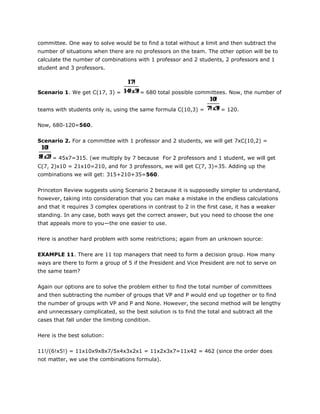
Scenario 1. We get C(17, 3) = = 680 total possible committees. Now, the number of
teams with students only is, using the same formula C(10,3) = = 120.
Now, 680-120=560.
Scenario 2. For a committee with 1 professor and 2 students, we will get 7xC(10,2) =
= 45x7=315. (we multiply by 7 because For 2 professors and 1 student, we will get
C(7, 2)x10 = 21x10=210, and for 3 professors, we will get C(7, 3)=35. Adding up the
combinations we will get: 315+210+35=560.
Princeton Review suggests using Scenario 2 because it is supposedly simpler to understand,
however, taking into consideration that you can make a mistake in the endless calculations
and that it requires 3 complex operations in contrast to 2 in the first case, it has a weaker
standing. In any case, both ways get the correct answer, but you need to choose the one
that appeals more to you—the one easier to use.
Here is another hard problem with some restrictions; again from an unknown source:
EXAMPLE 11. There are 11 top managers that need to form a decision group. How many
ways are there to form a group of 5 if the President and Vice President are not to serve on
the same team?
Again our options are to solve the problem either to find the total number of committees
and then subtracting the number of groups that VP and P would end up together or to find
the number of groups with VP and P and None. However, the second method will be lengthy
and unnecessary complicated, so the best solution is to find the total and subtract all the
cases that fall under the limiting condition.
Here is the best solution:
11!/(6!x5!) = 11x10x9x8x7/5x4x3x2x1 = 11x2x3x7=11x42 = 462 (since the order does
not matter, we use the combinations formula).
This means that the total possible number of teams of 5 out of the pool of 11 people is 462,
but we have a limiting condition imposed that says that two members of the 11 cannot be
on the same team. Therefore, we need to subtract the number of teams where the Vice
President and the President serve together. The number of the teams that VP and P would
serve together on is perhaps the hardest thing in this problem. Anyway, the trick is to count
on how many teams VP and P will be. To do this, we need to imagine the team, and the five
chairs: let’s assume that P is chair #1 (since the order does not really matter), VP is #2,
and the three other spots are available to the rest (9 total), so for the 3rd
chair, we will have
9 managers, for the 4th –
8, and the 5th
place will be offered only to the remaining 7.
Therefore, the total teams that VP and P would meet is C(9,3)= 9x8x7/3x2=84. (again we
divide because the order of the people showing up on the team does not matter).
Final step: 462-84=378
PRACTICE PROBLEMS
1. There are 9 books on a shelf, 7 hard cover and 2 soft cover. How many different combinations exist in which
you choose 4 books from the 9 and have at least one of them be a soft cover book? (Ans. 91 )
2. There are 5 married couples and a group of three is to be formed out of them; how
many arrangements are there if a husband and wife may not be in the same group?
(Ans. 80)
3. How many different signals can be transmitted by hoisting 3 red, 4 yellow and 2 blue
flags on a pole, assuming that in transmitting a signal all nine flags are to be used? (Ans.
1260)
4. From a group of 8 secretaries, select 3 persons for promotion. How many distinct selections are there? (Ans.
56)
5. In a certain game, a large container is filled with red, yellow, green, and blue beads worth, respectively, 7, 5, 3,
and 2 points each. A number of beads are then removed from the container. If the product of the point values of the
removed beads is 147,000, how many red beads were removed? (Ans.…)
(A) 5 (B) 4 (C) 3 (D) 2 (E) 0
6. There are between 100 and 110 cards in a collection of cards. If they are counted out 3
at a time, there are 2 left over, but if they are counted out 4 at a time, there is 1 left over.
How many cards are in the collection? (Ans.…)
(A) 101 (B) 103 (C) 106 (D) 107 (E) 109
7. The probability that it will rain in NYC on any given day in July is 30%. what is the
probability that it will rain on exactly 3 days from July 5 to July 10 ?
8. There are 4 Fashion magazines and 4 Car magazines. Four magazines are drawn at
random, what is the probability that all fashion magazines will be drawn?
a. 1 b. ? c. d. e.
STRATEGY
1. Read the problem carefully, trying to see both general and specific details, but do not
let the numbers confuse you; try to see the whole picture first.
2. Choose the best approach for solving the problem: either take a logical approach by
drawing the number of members, seats, etc or apply a formula.
3. If you can’t find a way to solve the problem: it seems to be too complex, try to
associate it with one of the problems we did. (It is recommended that you memorize
at least two problems that are given in the Kaplan math review section so that you
would be able to reproduce their solution on paper in a hard moment of panic). Even
the most difficult combinatorics GMAT problems are solved using the simple
formulae, so look for a way to apply them. There should be one.
4. If you are completely at a loss, there is a good way to estimate/guess take the most
and then estimate how much less the answer should be. Usually, you will get down
to two answer choices and then you can try to “podognat’” your solution to the
answers and see which solution makes more sense.
5. After you have solved the problem, go back to the question and make sure you
answered it and make sure you followed all the conditions.
6. It is also recommended to do a fast check on the questions of such difficulty; try to
use the other approach if applicable (formula if you used logic or logic if you used a
formula) or just make sure your solution is reasonable. (e.g. you may come up with
an answer that there are 150 combinations to sit 5 people into 3 seats, but, in fact, it
does not make sense because it is too much since even as much as 5! equals only to
120.)
7. Do not spend too much time on any of the problems; you can’t afford more than 3
mins on any of them.
Bibliography

Permutation and Combinations

  • 1.
    Synopsis Formulae Logic Logic and SimpleRules Permutations and Combinations Practice Problems Strategy Bibliography SYNOPSIS The goal of this lesson is to get you accustomed to and comfortable with combinatorics problems on the GMAT. We have incorporated the hardest problems from GMAT that we could find, so this collection should make your experience on the final GMAT less stressful because the real problems are not as difficult. Another goal is to provide you with techniques to solve all combinations problems in time you have – 2-3 minutes. Just to start, combinatorics problems are believed to be some of the hardest ones on the GMAT - the elite division of questions that yields only to probability. Yet, even combinatorics questions have several levels of difficulty, making them available through the test: Easy – one action problems with no complications or limits imposed Medium – two action problems or one simple limit Hard – either include extensive calculations or several limits or even both Still, the hardest thing with problems is to identify the solution method. The test writers, on their part, will make sure to include several almost right, but still wrong answers in order to make sure you pick a wrong answer should you mess up even a bit. Here is the bottom line: the point is to figure out how to solve, the rest is arithmetic. Below you will find several scenarios to approach combinatorics problems that, hopefully, will help you easily identify the right solution for each given problem that you meet on your test day, and at the end we have listed an approximation of a systematic approach to combinatorics problems. One word on guessing: personally, we don’t like guessing. It is just as hard to guess right as to solve right, so we usually choose solving. Before we move on, it is recommended that you know by heart two problems from the Kaplan Gmat Guide with CD 2003 or 2002 edition. They are located at the end of the book in the math review section. You have to know them and understand them before continuing.
  • 2.
    FORMULAE There are severalrules and formulae to find the number of combinations: 1. Multiplication rule – when the number of available spaces for combinations matches the number of elements (e.g. we have 5 people for 5 positions – the result will equal to 5x4x3x2x1 or 5!, which is 120.) or when we have several groups within one set; we will need to multiply the results for groups to find the total. (see example 1, 2, and 3). 2. Addition rule – applies in the more complex situations, primarily when we have a variable number of positions for combinations, and thus have to calculate several different number of combinations for each given number of positions (e.g. we have $1, $5, $10, $20, $50 bills what is the number of sums we can come up with?). (see example 7). 3. Permutations formula: P(n, k) = – unique members (example 7, 8). 4. Combinations formula: C(n, k) = – non unique members (example 9, 10, 11).
  • 3.
    LOGIC The first kindof the problems that we will consider is not what we usually imply under standard combinatorics problems, but still very interesting. Consider the following example from GMAT Plus: EXAMPLE 1. Of the science books in a certain supply room, 50 are on botany, 65 are on zoology, 90 are on physics. 50 are on geology, and 110 are on chemistry. If science books are removed randomly from the supply room, how many must be removed to ensure that 80 of the books removed are on the same science? (A) 81 (B) 159 (C) 166 (D) 285 (E) 324 Such problems invite us to provide a foolproof solution that would work in 100% of the cases. Thus, this means we will need to find a solution for the worst case. In our example, we can say that there is a devil kin sitting in the certain supply room and she hands us the books so that each time we get a new book. So after about 250, we will have removed all of the botany and geology books as well as 50 on zoology, 50 on physics, and 50 on chemistry, but we still don’t have 80 of the same kind. We have 15 zoology, 40 physics, and 60 chemistry books left. So, after another 45 books, we will have removed all zoology books, 15 physics, and 15 chemistry books. Still not enough. We have at most 65 books of one kind. Let’s remove 14 of each kind of the books we have left. So, after removing 14 of physics and chemistry books we will have a total of 323 books removed and we have 5 stacks that are at most 79 books. Now, however, we need to remove only one book because we will know that we have only two kinds of books left (either chemistry or physics) and any of them will give us a set of 50. Of course in reality it would not be that bad, but we have to take the worst situation. It would be easier, however, if we just took a look at the number of the books that could be left in the room. We know that we need 80 of one kind, so we for sure know that those would not be botany, zoology, or geology books because there too little of them. If we need to guarantee that 80 are removed, we would have 10 physics and 30 chemistry left. However, since we need only 80 of one kind, we can say that either 11 physics and 30
  • 4.
    chemistry or 10physics and 31 chemistry. The trick is to spot see that we need only one stack to be 80, not all. Then, we could subtract 31 from the total number of books (365- 41=324). There are not that many of these remove/remained problems, but they are fun. Let me know if you come across any, I will include them into the practice section. LOGIC AND SIMPLE RULES Usually, on the GMAT you can solve and find the number of combinations or permutations without using any formula or even writing out the combinations, but just by applying your logic. For practice, consider the following example from the Princeton Review: EXAMPLE 2. Katie must place five stuffed animals--a duck, a goose, a panda, a turtle and a swan in a row in the display window of a toy store. How many different displays can she make if the duck and the goose must be either first or last? A. 120 B. 60 C. 24 D. 12 E. 6 Here is the explanation by the same company. It works but it is not optimal. Let’s simplify things. We know either the duck or goose is first or last. Ignore those for the moment. How many ways can we arrange the panda, turtle, and swan in the positions 2, 3 and 4? Be systematic, and list them out: PTS, PST, TPS, TSP, SPT, STP. 6 ways. So if the duck is first and goose is last, there are 6 ways the whole arrangement can work; if the goose is first and the duck is last, that makes 6 more for a total of 12. The answer is (D). This is an average difficulty problem – we have 5 spots and 5 animals to fill them, so we will just need to run the factorial, but even without knowing that, we can solve the problem. Let’s use the brain for a second. I don’t think you need to write out all the combinations as Princeton Review suggests because it is a pain (yet sometimes it helps when you are not sure about a solution).
  • 5.
    Anyway, just thinklogically: there are 3 spots available for swapping: 2, 3, and 4 (the first and the fifth one are occupied by the duck and goose). So, for the first of the three spots, we have 3 animals; for the second – 2, and for the third only one. This means that for every of the three animals in the spot #1, we have 2 animals in spot #2, and one in spot #3. Therefore, to get the total number of combinations we need to multiply 3x2x1. This falls under the multiplication rule of combinatorics. Since the duck and goose provide us with two options, again, according to the multiplication rule, we need to multiply our final result by 2 to get 12. Try solving this problem on your own. EXAMPLE 3. The president of a country and 4 other dignitaries are scheduled to sit in a row on the 5 chairs represented above. If the president must sit in the center chair, how many different seating arrangements are possible for the 5 people? (A) 4 (B) 5 (C) 20 (D) 24 (E) 120 Let’s consider another example, this time from the official guide: EXAMPLE 4. In how many arrangements can a teacher seat 3 girls and 3 boys in a row of 6 if the boys are to have the first, third, and fifth seats? A. 6 B. 9 C. 12 D. 36
  • 6.
    E. 720 I don’tknow what approach took ETC in this problem, but the most optimal again would be just to straighten things out and then apply logic. This is clearly a unique spots/members situation because otherwise we would have only one combination (girls 2, 4, 6 and boys 1, 3, 5), but it is not in the answers and truly would be stupid to ask. So let’s devise a plan. Think for a bit so that you would not waste time doing useless and incorrect calculations. First of all, we have a limitation on our group that defines the number of combinations for odd and even positions. Usually for problems like this, there are two methods of solution: find the total number of combinations and then subtract the ones that fall under a limitation or count all the possible combinations that respect the limitation and then multiply them (usually the preferable approach). In our case, however, the limitation is fairly large and it will be useless counting the total number of combinations and then subtract a very complicated condition. So, let’s count the possible number of combinations under our limitation. We know that there are 3 seats for 3 boys, so similarly to the previous example, we get 3! or 3x2=6. The number of girls is the same, which gives us two groups within one set; to find the total number of combinations, we need to multiply the two results for two groups 6x6=36. (because for each combination of girls there are 6 arrangements of boys and vice versa). If you were entirely at a loss with this question, you could have guessed. First of all, 720 seems just a way too much; actually it would be the correct answer if we did not have limitation, but with the limitation it looks too much, so we are down to 36, 12, and 9. 6 is too little; you could have figured that out too. None of the answers is the product of a factorial. Actually, it is very useful to know the factorial products: 2!=2, 3!=6, 4!=24, 5!=120, 6!=720. Anyway, it would be hard to guess cause we would have 12 (6+6) or 36 (6x6). Personally I don’t like guessing. I think it is much harder to guess than to solve, so why not do the easiest thing and just solve? Perhaps a pure multiplication rule will be the following that came from an unknown source: EXAMPLE 5. If a customer makes exactly 1 selection from each of the 5 categories listed below, what is the greatest number of different ice cream sundaes that a customer can create?
  • 7.
    12 ice creamflavors 10 kinds of candy 8 liquid toppings 5 kinds of nuts With or without whip cream. (A)9600 (B)4800 (C)2400 (D)800 (E)400 According to the problem, the customer must make 1 selection out of each and it can be only one (if it were different it would much more complex). Basically, we have 5 different ingredients, so after picking one of 12 ice cream flavors, the person has 10 choices of candy, and then for each of 10 choices of candy, he/she has 8 options for toppings, and for each of those 8 toppings – 5 kinds of nuts. Moreover, the person will get either with or without whipped cream. Obviously, this is a multiplication case by all means: the number of positions to fill with combinations equals the number of different ingredients – 5, (in such cases, we can’t use a permutation or combination formulae). Here is what we get after multiplying: 12x10x8x5x2 = 9,600 (don’t forget the whipped cream). This is a one-action problem. Sometimes, the math may not be very easy. Consider the following example from the Schaum’s Intro to Statistics: EXAMPLE 6. From a class consisting of 12 computer science majors, 10 mathematics majors, and 9 statistics majors, a committee of 4 computer science majors, 4 mathematics majors, and 3 statistics majors is to be formed. How many distinct committees are there? To solve the problem, we will need to find the 3 constituting elements – 4 computer majors, 4 math majors, and 3 statistics majors and then, since they are elements of one set – multiply them. Jumping a little ahead, we will use the combinations formula and will get the following results for each group: 495, 210, and 84. Now, since for each
  • 8.
    computer science majorthere are a good number of math and stats majors, we multiply. The result we will get is 495x210x84= 8,731,800. PERMUTATIONS AND COMBINATIONS Besides the two problems explained in Kaplan, that you should know by heart, about the 3 out of 5 runners and 3 out of 8 committee members, there are few variations. For example, let’s take a Permutation problem from high school textbook: EXAMPLE 7. Given a selected committee of 8, in how many ways, can the members of the committee divide the responsibilities of a president, vice president, and secretary? The solution comes both from the permutations formula and from logic. (Permutations, not combinations formula is used because the order matters since the positions are unique). Scenario 1 – Formula: P(8,3)=8!/5!=8x7x6=336 Scenario 2 – Logic: For the President’s position we have 8 people and for the VP’s – 7, and 6 left for the Secretarial position. Therefore, the total number of permutations equals to 8x7x6=336. Since the position of a person matters (P - Alex, VP- Jen, and S -Sindy is different from Jen, Sindy, Alex), we do not need to divide by anything. Consider the following more advanced problem from the same textbook (it has a trick to it): EXAMPLE 8. How many four-digit numbers can you form using ten numbers (0, 1, 2, 3, 4, 5, 6, 7, 8, 9) if the numbers can be used only once? It seems to be easy, we take 10x9x8x7 since we have 4 positions, and get 5040, but there is a trick to this problem because 5040 will include numbers that start with a 0, and in reality we don’t have those. So, we need to subtract the number of the fake 4-digit numbers. There are two ways to arrive to that: either subtract 1/10 out of 5040 since all 10 digits are equally represented (5040-10% = 4536) or use a Permutation formula: P(9,3) = 9x8x7 = 504. 5040-504 = 4536.
  • 9.
    However, the problemsget more complex by requiring a test taker to make more than one action, so, often, we will need to use addition or multiplication rule along with combination/permutation. Let’s consider an interesting problem: EXMAPLE 9. A person has the following bills: $1, $5, $10, $20, $50. How many unique sums can one form using any number of these bills only once? First of all, let’s reason (reasoning is always good!). There are 5 different bills, and we have to make unique sums of money out of them. Basically, as we figure out from the text, we can use either 1 or all 5 bills for our amounts. Good news is that none of the possible combinations seems to overlap, meaning that there is no way to come up with $30, except by taking a $10 and $20 bills. The bad news is that we will need to calculate the possible sums when taking 1, 2, 3, 4, and 5 bills. Again, relying on logic and common sense, taking one bill at a time, we will get 5 unique sums that will equal to the nominal value of each bill. Taking 5 bills altogether, we will get one amount - the max, that equals to $86. Now we need to find the number of sums when taking 2, 3, and 4 bills. Using the combination formula, we will get C(5, 2)=5!/2!3! = 10, for C(5, 3) = 5!/3!2!=10, and for C(5, 4)=5!/4!=5 Total will be: 5+10+10+5+1=31 possible sums. (You can check by writing all of them out). Moving towards hard problems, let’s consider a little more complex situation offered again by Princeton: EXAMPLE 10 A three-person committee must be chosen from a group of 7 professors and 10 graduate students. If at least one of the people on the committee must be a professor, how many different groups of people could be chosen for the committee? A. 70 B. 560 C. 630 D. 1,260 E. 1,980 This is a hard combinatorics problem that again requires several actions. At first it may be confusing because it has a weird condition that at least one professor needs to be on the
  • 10.
    committee. One wayto solve would be to find a total without a limit and then subtract the number of situations when there are no professors on the team. The other option will be to calculate the number of combinations with 1 professor and 2 students, 2 professors and 1 student and 3 professors. Scenario 1. We get C(17, 3) = = 680 total possible committees. Now, the number of teams with students only is, using the same formula C(10,3) = = 120. Now, 680-120=560. Scenario 2. For a committee with 1 professor and 2 students, we will get 7xC(10,2) = = 45x7=315. (we multiply by 7 because For 2 professors and 1 student, we will get C(7, 2)x10 = 21x10=210, and for 3 professors, we will get C(7, 3)=35. Adding up the combinations we will get: 315+210+35=560. Princeton Review suggests using Scenario 2 because it is supposedly simpler to understand, however, taking into consideration that you can make a mistake in the endless calculations and that it requires 3 complex operations in contrast to 2 in the first case, it has a weaker standing. In any case, both ways get the correct answer, but you need to choose the one that appeals more to you—the one easier to use. Here is another hard problem with some restrictions; again from an unknown source: EXAMPLE 11. There are 11 top managers that need to form a decision group. How many ways are there to form a group of 5 if the President and Vice President are not to serve on the same team? Again our options are to solve the problem either to find the total number of committees and then subtracting the number of groups that VP and P would end up together or to find the number of groups with VP and P and None. However, the second method will be lengthy and unnecessary complicated, so the best solution is to find the total and subtract all the cases that fall under the limiting condition. Here is the best solution: 11!/(6!x5!) = 11x10x9x8x7/5x4x3x2x1 = 11x2x3x7=11x42 = 462 (since the order does not matter, we use the combinations formula).
  • 11.
    This means thatthe total possible number of teams of 5 out of the pool of 11 people is 462, but we have a limiting condition imposed that says that two members of the 11 cannot be on the same team. Therefore, we need to subtract the number of teams where the Vice President and the President serve together. The number of the teams that VP and P would serve together on is perhaps the hardest thing in this problem. Anyway, the trick is to count on how many teams VP and P will be. To do this, we need to imagine the team, and the five chairs: let’s assume that P is chair #1 (since the order does not really matter), VP is #2, and the three other spots are available to the rest (9 total), so for the 3rd chair, we will have 9 managers, for the 4th – 8, and the 5th place will be offered only to the remaining 7. Therefore, the total teams that VP and P would meet is C(9,3)= 9x8x7/3x2=84. (again we divide because the order of the people showing up on the team does not matter). Final step: 462-84=378 PRACTICE PROBLEMS 1. There are 9 books on a shelf, 7 hard cover and 2 soft cover. How many different combinations exist in which you choose 4 books from the 9 and have at least one of them be a soft cover book? (Ans. 91 ) 2. There are 5 married couples and a group of three is to be formed out of them; how many arrangements are there if a husband and wife may not be in the same group? (Ans. 80) 3. How many different signals can be transmitted by hoisting 3 red, 4 yellow and 2 blue flags on a pole, assuming that in transmitting a signal all nine flags are to be used? (Ans. 1260) 4. From a group of 8 secretaries, select 3 persons for promotion. How many distinct selections are there? (Ans. 56) 5. In a certain game, a large container is filled with red, yellow, green, and blue beads worth, respectively, 7, 5, 3, and 2 points each. A number of beads are then removed from the container. If the product of the point values of the removed beads is 147,000, how many red beads were removed? (Ans.…) (A) 5 (B) 4 (C) 3 (D) 2 (E) 0 6. There are between 100 and 110 cards in a collection of cards. If they are counted out 3 at a time, there are 2 left over, but if they are counted out 4 at a time, there is 1 left over. How many cards are in the collection? (Ans.…) (A) 101 (B) 103 (C) 106 (D) 107 (E) 109 7. The probability that it will rain in NYC on any given day in July is 30%. what is the probability that it will rain on exactly 3 days from July 5 to July 10 ? 8. There are 4 Fashion magazines and 4 Car magazines. Four magazines are drawn at random, what is the probability that all fashion magazines will be drawn?
  • 12.
    a. 1 b.? c. d. e.
  • 13.
    STRATEGY 1. Read theproblem carefully, trying to see both general and specific details, but do not let the numbers confuse you; try to see the whole picture first. 2. Choose the best approach for solving the problem: either take a logical approach by drawing the number of members, seats, etc or apply a formula. 3. If you can’t find a way to solve the problem: it seems to be too complex, try to associate it with one of the problems we did. (It is recommended that you memorize at least two problems that are given in the Kaplan math review section so that you would be able to reproduce their solution on paper in a hard moment of panic). Even the most difficult combinatorics GMAT problems are solved using the simple formulae, so look for a way to apply them. There should be one. 4. If you are completely at a loss, there is a good way to estimate/guess take the most and then estimate how much less the answer should be. Usually, you will get down to two answer choices and then you can try to “podognat’” your solution to the answers and see which solution makes more sense. 5. After you have solved the problem, go back to the question and make sure you answered it and make sure you followed all the conditions. 6. It is also recommended to do a fast check on the questions of such difficulty; try to use the other approach if applicable (formula if you used logic or logic if you used a formula) or just make sure your solution is reasonable. (e.g. you may come up with an answer that there are 150 combinations to sit 5 people into 3 seats, but, in fact, it does not make sense because it is too much since even as much as 5! equals only to 120.) 7. Do not spend too much time on any of the problems; you can’t afford more than 3 mins on any of them. Bibliography