NUMERICAL APERTURE OF
OPTICAL FIBRE
INTRODUCTION
 Optical fiber (fiber optic) refers to the medium and
the technology associated with the transmission of
information as light pulses along a glass or plastic
strand or fiber. Optical fiber carries much more
information than conventional copper wire and is in
general not subject to electromagnetic interference
and the need to retransmit signals.
ACCEPTANCE ANGLE
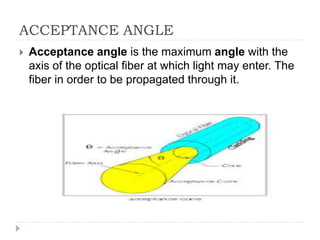
 Acceptance angle is the maximum angle with the
axis of the optical fiber at which light may enter. The
fiber in order to be propagated through it.
NUMERICAL APERTURE
DEFINATION
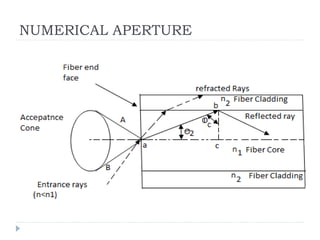
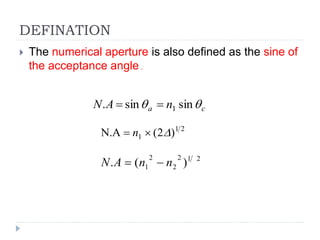
 The numerical aperture is also defined as the sine of
the acceptance angle .
ca nAN  sinsin. 1
21
1 )2(N.A  n
212
2
2
1 )(. nnAN 
SIGNIFICANCE OF NA
 The significance of NA is that light entering in the
cone of semi vertical angle a only propagate through
the fibre. The higher the value of a or NA more is the
light collected for propagation in the fibre. Numerical
aperture is thus considered as a light gathering
capacity of an optical fibre.
STRATEGY
&
PREPARATION
OF PBL
MATERIALS USED
 Optical fiber
 Wooden Plank
 Laser
 Nails
 Saw
 Arduino
 Hammer
DAY 1
ASSISTANCE FROM WORKSHOP
 Under the guidance of Prof. B.S. Rathod we did all
the wood work related to carpentry . We were
assisted by Mr. V. M Phakatkar who were designated
for carpentry , the wood was cut and shaped
according to our requirements with the help of saw .
The holes were made on the wooden planks with the
help of drill and the holes being drilled according to
the approximate value from the model.
DAY 2
SET-UP
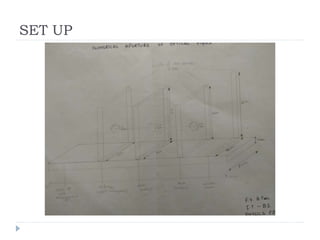
 The whole project was organized with the help of 4
wooden planks with one plank being the base of the
project and the rest three planks placed erect
according to the measurements of the model
separated by approx. distance . The optical fiber was
laid between the planks and the project was tested
with the help of laser being emitted from one end .
SET UP
RESULT
LM358
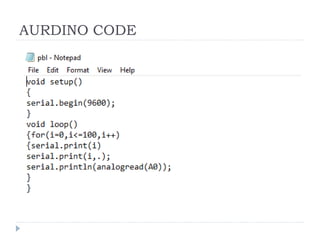
AURDINO CODE
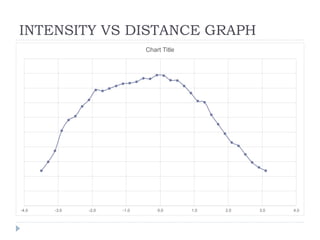
INTENSITY VS DISTANCE GRAPH
-4.0 -3.0 -2.0 -1.0 0.0 1.0 2.0 3.0 4.0
Chart Title
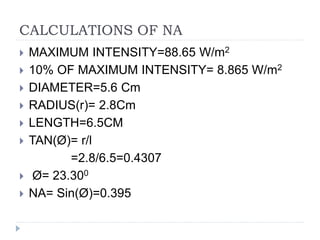
CALCULATIONS OF NA
 MAXIMUM INTENSITY=88.65 W/m2
 10% OF MAXIMUM INTENSITY= 8.865 W/m2
 DIAMETER=5.6 Cm
 RADIUS(r)= 2.8Cm
 LENGTH=6.5CM
 TAN(Ø)= r/l
=2.8/6.5=0.4307
 Ø= 23.300
 NA= Sin(Ø)=0.395
INFERENCE
 WORK INCREASED PRODUCTIVITY – working in
groups can achieve much more than individuals
working on their own. Planning for a project on
individual basis is much lengthy process, which can
be tackled by working in groups. Discussing and
designing the optical stand was done in a group
which gave a successful outcome.
 SKILLS DEVELOPMENT - being part of a group
helped develop interpersonal skills such as speaking
and listening as well as team work skills such as
leadership an working with and motivating others.
Being a part of workshop and working together was
exciting and fun. We also learnt many things working
together.
 KNOWING MORE ABOUT YOURSELF –
collaborating with others helped us identify our
strengths and weaknesses. We came to know much
about our areas of interests. Some people took
interest in designing the model while some were
active in workshop, some were busy understanding
theory and some were preparing for the result by
paying major attention to the details of the project.
TECHNICAL ASPECTS
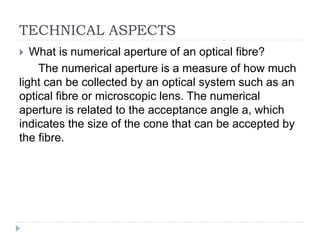
 What is numerical aperture of an optical fibre?
The numerical aperture is a measure of how much
light can be collected by an optical system such as an
optical fibre or microscopic lens. The numerical
aperture is related to the acceptance angle a, which
indicates the size of the cone that can be accepted by
the fibre.
 On what factors does NA depend?
The numerical aperture depends upon the half angle
of the maximum cone of light that can enter or exit the
lens and also depends upon the index of refraction.
 What is the maximum value of numerical aperture?
Sine of the angle is known as numerical aperture,
hence has the maximum value 1, which is theoretically
maximum. Practically its value depends upon the type
of the optical fibre and its refractive indices.
 What is physical significance of numerical aperture?
The significance of NA is that light entering in the cone
of semi vertical angle only propagate through the fibre.
Higher the value of NA more is the light collected for
propagation of the fibre. It is thus considered as light
gathering capacity of an optical fibre.
DRAWBACKS
1. Precision:
 Stands.
 Insufficient experience in workshop.
 Material.
2. Design:
 Size.
 Aesthetic Appeal.
3. Failure of Theoretical logic in
measuring the diameter.
4. User-Friendliness.
IMPROVEMENTS
1. Precision
 BPW34 Sensor
2. Size
3. Material
HOW TO MAKE THE SETUP MORE
COMPACT
Also the estimated cost of our project.
THANK YOU

Pbl itb1 phy

  • 1.
  • 2.
    INTRODUCTION  Optical fiber(fiber optic) refers to the medium and the technology associated with the transmission of information as light pulses along a glass or plastic strand or fiber. Optical fiber carries much more information than conventional copper wire and is in general not subject to electromagnetic interference and the need to retransmit signals.
  • 3.
    ACCEPTANCE ANGLE  Acceptanceangle is the maximum angle with the axis of the optical fiber at which light may enter. The fiber in order to be propagated through it.
  • 4.
  • 5.
    DEFINATION  The numericalaperture is also defined as the sine of the acceptance angle . ca nAN  sinsin. 1 21 1 )2(N.A  n 212 2 2 1 )(. nnAN 
  • 6.
    SIGNIFICANCE OF NA The significance of NA is that light entering in the cone of semi vertical angle a only propagate through the fibre. The higher the value of a or NA more is the light collected for propagation in the fibre. Numerical aperture is thus considered as a light gathering capacity of an optical fibre.
  • 7.
  • 8.
    MATERIALS USED  Opticalfiber  Wooden Plank  Laser  Nails  Saw  Arduino  Hammer
  • 9.
    DAY 1 ASSISTANCE FROMWORKSHOP  Under the guidance of Prof. B.S. Rathod we did all the wood work related to carpentry . We were assisted by Mr. V. M Phakatkar who were designated for carpentry , the wood was cut and shaped according to our requirements with the help of saw . The holes were made on the wooden planks with the help of drill and the holes being drilled according to the approximate value from the model.
  • 10.
    DAY 2 SET-UP  Thewhole project was organized with the help of 4 wooden planks with one plank being the base of the project and the rest three planks placed erect according to the measurements of the model separated by approx. distance . The optical fiber was laid between the planks and the project was tested with the help of laser being emitted from one end .
  • 11.
  • 12.
  • 13.
  • 14.
  • 15.
    INTENSITY VS DISTANCEGRAPH -4.0 -3.0 -2.0 -1.0 0.0 1.0 2.0 3.0 4.0 Chart Title
  • 16.
    CALCULATIONS OF NA MAXIMUM INTENSITY=88.65 W/m2  10% OF MAXIMUM INTENSITY= 8.865 W/m2  DIAMETER=5.6 Cm  RADIUS(r)= 2.8Cm  LENGTH=6.5CM  TAN(Ø)= r/l =2.8/6.5=0.4307  Ø= 23.300  NA= Sin(Ø)=0.395
  • 17.
    INFERENCE  WORK INCREASEDPRODUCTIVITY – working in groups can achieve much more than individuals working on their own. Planning for a project on individual basis is much lengthy process, which can be tackled by working in groups. Discussing and designing the optical stand was done in a group which gave a successful outcome.  SKILLS DEVELOPMENT - being part of a group helped develop interpersonal skills such as speaking and listening as well as team work skills such as leadership an working with and motivating others. Being a part of workshop and working together was exciting and fun. We also learnt many things working together.
  • 18.
     KNOWING MOREABOUT YOURSELF – collaborating with others helped us identify our strengths and weaknesses. We came to know much about our areas of interests. Some people took interest in designing the model while some were active in workshop, some were busy understanding theory and some were preparing for the result by paying major attention to the details of the project.
  • 19.
    TECHNICAL ASPECTS  Whatis numerical aperture of an optical fibre? The numerical aperture is a measure of how much light can be collected by an optical system such as an optical fibre or microscopic lens. The numerical aperture is related to the acceptance angle a, which indicates the size of the cone that can be accepted by the fibre.
  • 20.
     On whatfactors does NA depend? The numerical aperture depends upon the half angle of the maximum cone of light that can enter or exit the lens and also depends upon the index of refraction.  What is the maximum value of numerical aperture? Sine of the angle is known as numerical aperture, hence has the maximum value 1, which is theoretically maximum. Practically its value depends upon the type of the optical fibre and its refractive indices.
  • 21.
     What isphysical significance of numerical aperture? The significance of NA is that light entering in the cone of semi vertical angle only propagate through the fibre. Higher the value of NA more is the light collected for propagation of the fibre. It is thus considered as light gathering capacity of an optical fibre.
  • 22.
    DRAWBACKS 1. Precision:  Stands. Insufficient experience in workshop.  Material. 2. Design:  Size.  Aesthetic Appeal.
  • 23.
    3. Failure ofTheoretical logic in measuring the diameter. 4. User-Friendliness.
  • 24.
    IMPROVEMENTS 1. Precision  BPW34Sensor 2. Size 3. Material
  • 25.
    HOW TO MAKETHE SETUP MORE COMPACT Also the estimated cost of our project.
  • 26.