What is anOptical Fibre?
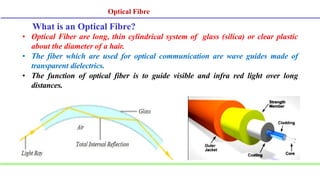
• Optical Fiber are long, thin cylindrical system of glass (silica) or clear plastic
about the diameter of a hair.
• The fiber which are used for optical communication are wave guides made of
transparent dielectrics.
• The function of optical fiber is to guide visible and infra red light over long
distances.
Optical Fibre
3.
Components of OpticalFibre
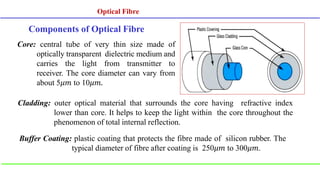
Core: central tube of very thin size made of
optically transparent dielectric medium and
carries the light from transmitter to
receiver. The core diameter can vary from
about 5𝜇𝑚 to 10𝜇𝑚.
Optical Fibre
Cladding: outer optical material that surrounds the core having refractive index
lower than core. It helps to keep the light within the core throughout the
phenomenon of total internal reflection.
Buffer Coating: plastic coating that protects the fibre made of silicon rubber. The
typical diameter of fibre after coating is 250𝜇𝑚 to 300𝜇𝑚.
4.
Working Principal ofOptical Fibre
Total Internal reflection
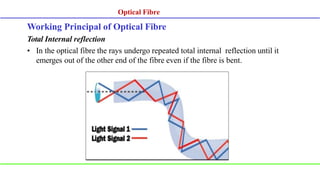
• In the optical fibre the rays undergo repeated total internal reflection until it
emerges out of the other end of the fibre even if the fibre is bent.
Optical Fibre
5.
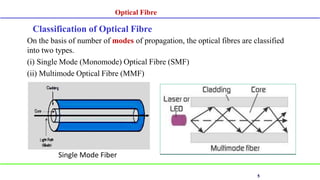
Classification of OpticalFibre
On the basis of number of modes of propagation, the optical fibres are classified
into two types.
(i) Single Mode (Monomode) Optical Fibre (SMF)
(ii) Multimode Optical Fibre (MMF)
Optical Fibre
5
Single Mode Fiber
6.
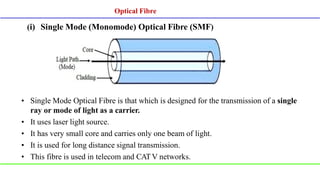
(i) Single Mode(Monomode) Optical Fibre (SMF)
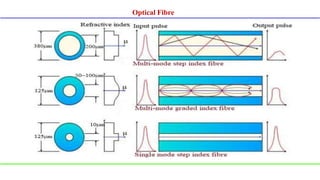
• Single Mode Optical Fibre is that which is designed for the transmission of a single
ray or mode of light as a carrier.
• It uses laser light source.
• It has very small core and carries only one beam of light.
• It is used for long distance signal transmission.
• This fibre is used in telecom and CATV networks.
Optical Fibre
7.
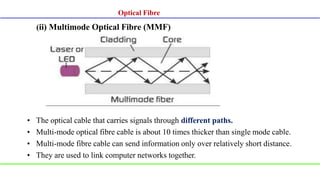
(ii) Multimode OpticalFibre (MMF)
• The optical cable that carries signals through different paths.
• Multi-mode optical fibre cable is about 10 times thicker than single mode cable.
• Multi-mode fibre cable can send information only over relatively short distance.
• They are used to link computer networks together.
Optical Fibre
8.
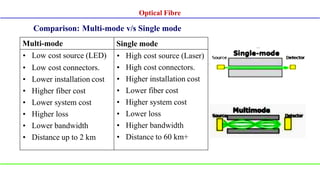
Comparison: Multi-mode v/sSingle mode
Optical Fibre
Multi-mode Single mode
• Low cost source (LED)
• Low cost connectors.
• Lower installation cost
• Higher fiber cost
• Lower system cost
• Higher loss
• Lower bandwidth
• Distance up to 2 km
• High cost source (Laser)
• High cost connectors.
• Higher installation cost
• Lower fiber cost
• Higher system cost
• Lower loss
• Higher bandwidth
• Distance to 60 km+
9.
On the basisof refractive index, there are two types of optical fibres
(i) Step index and (ii) Graded index
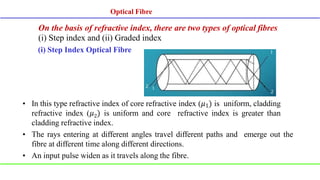
(i) Step Index Optical Fibre
• In this type refractive index of core refractive index (𝜇1) is uniform, cladding
refractive index (𝜇2) is uniform and core refractive index is greater than
cladding refractive index.
• The rays entering at different angles travel different paths and emerge out the
fibre at different time along different directions.
• An input pulse widen as it travels along the fibre.
Optical Fibre
10.
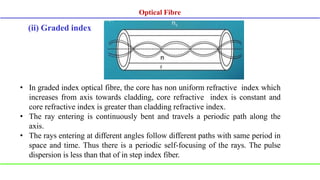
(ii) Graded index
•In graded index optical fibre, the core has non uniform refractive index which
increases from axis towards cladding, core refractive index is constant and
core refractive index is greater than cladding refractive index.
• The ray entering is continuously bent and travels a periodic path along the
axis.
• The rays entering at different angles follow different paths with same period in
space and time. Thus there is a periodic self-focusing of the rays. The pulse
dispersion is less than that of in step index fiber.
Optical Fibre
11.
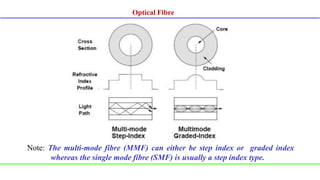
Note: The multi-modefibre (MMF) can either be step index or graded index
whereas the single mode fibre (SMF) is usually a step index type.
Optical Fibre
Acceptance Angle
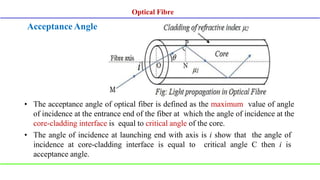
• Theacceptance angle of optical fiber is defined as the maximum value of angle
of incidence at the entrance end of the fiber at which the angle of incidence at the
core-cladding interface is equal to critical angle of the core.
• The angle of incidence at launching end with axis is i show that the angle of
incidence at core-cladding interface is equal to critical angle C then i is
acceptance angle.
Optical Fibre
14.
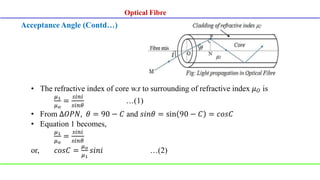
• The refractiveindex of core w.r to surrounding of refractive index 𝜇𝑂 is
𝜇1
𝜇𝑜
=
𝑠𝑖𝑛𝑖
𝑠𝑖𝑛𝜃
…(1)
• From ∆𝑂𝑃𝑁, 𝜃 = 90 − 𝐶 and 𝑠𝑖𝑛𝜃 = sin 90 − 𝐶 = 𝑐𝑜𝑠𝐶
• Equation 1 becomes,
𝜇1
𝜇𝑜
=
𝑠𝑖𝑛𝑖
𝑠𝑖𝑛𝜃
or, 𝑐𝑜𝑠𝐶 =
𝜇𝑜
𝜇1
𝑠𝑖𝑛𝑖 …(2)
Optical Fibre
AcceptanceAngle (Contd…)
15.
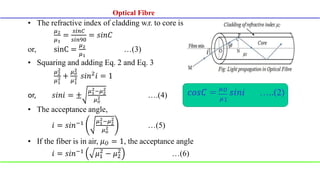
• The refractiveindex of cladding w.r. to core is
𝜇2
𝜇1
=
𝑠𝑖𝑛𝐶
𝑠𝑖𝑛90
= 𝑠𝑖𝑛𝐶
or, sinC =
𝜇2
𝜇1
…(3)
• Squaring and adding Eq. 2 and Eq. 3
𝜇2
2
𝜇1
2 +
𝜇𝑜
2
𝜇1
2 𝑠𝑖𝑛2
𝑖 = 1
or, 𝑠𝑖𝑛𝑖 = ±
𝜇1
2−𝜇2
2
𝜇𝑜
2 ….(4)
• The acceptance angle,
𝑖 = 𝑠𝑖𝑛−1 𝜇1
2−𝜇2
2
𝜇𝑜
2 …(5)
• If the fiber is in air, 𝜇𝑂 = 1, the acceptance angle
𝑖 = 𝑠𝑖𝑛−1 𝜇1
2
− 𝜇2
2
…(6)
Optical Fibre
16.
Numerical Aperture (NA)
•Numerical Aperture is a figure of merit that is used to describe the light
gathering or light collecting capacity of an optical fibre.
• The larger the magnitude of NA, the greater the amount of light accepted by the
fibre from external source.
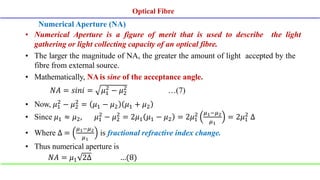
• Mathematically, NAis sine of the acceptance angle.
𝑁𝐴 = 𝑠𝑖𝑛𝑖 = 𝜇1
2
− 𝜇2
2
…(7)
• Now, 𝜇1
2
− 𝜇2
2
= 𝜇1 − 𝜇2 𝜇1 + 𝜇2
• Since 𝜇1 ≈ 𝜇2, 𝜇1
2
− 𝜇2
2
= 2𝜇1 𝜇1 − 𝜇2 = 2𝜇1
2 𝜇1−𝜇2
𝜇1
= 2𝜇1
2
∆
• Where ∆ =
𝜇1−𝜇2
𝜇1
is fractional refractive index change.
• Thus numerical aperture is
𝑁𝐴 = 𝜇1 2∆ …(8)
Optical Fibre
17.
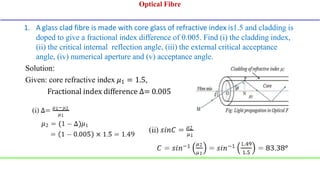
1. A glassclad fibre is made with core glass of refractive index is1.5 and cladding is
doped to give a fractional index difference of 0.005. Find (i) the cladding index,
(ii) the critical internal reflection angle, (iii) the external critical acceptance
angle, (iv) numerical aperture and (v) acceptance angle.
Solution:
Given: core refractive index 𝜇1 = 1.5,
Fractional index difference ∆= 0.005
Optical Fibre
18.
Optical Fibre
Optical Fibre
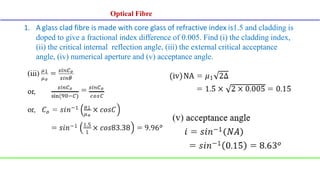
1.A glass clad fibre is made with core glass of refractive index is1.5 and cladding is
doped to give a fractional index difference of 0.005. Find (i) the cladding index,
(ii) the critical internal reflection angle, (iii) the external critical acceptance
angle, (iv) numerical aperture and (v) acceptance angle.
19.
Optical Fibre
Optical Fibre
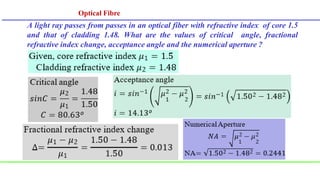
Alight ray passes from passes in an optical fiber with refractive index of core 1.5
and that of cladding 1.48. What are the values of critical angle, fractional
refractive index change, acceptance angle and the numerical aperture ?
20.
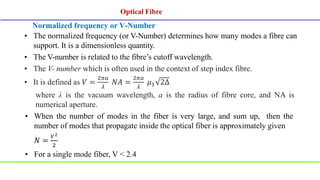
Normalized frequency orV-Number
• The normalized frequency (or V-Number) determines how many modes a fibre can
support. It is a dimensionless quantity.
• The V-number is related to the fibre’s cutoff wavelength.
• The V- number which is often used in the context of step index fibre.
• It is defined as 𝑉 =
2𝜋𝑎
𝜆
𝑁𝐴 =
2𝜋𝑎
𝜆
𝜇1 2Δ
where λ is the vacuum wavelength, a is the radius of fibre core, and NA is
numerical aperture.
• When the number of modes in the fiber is very large, and sum up, then the
number of modes that propagate inside the optical fiber is approximately given
𝑁 =
𝑉2
2
• For a single mode fiber, V < 2.4
Optical Fibre
Optical Fibre
21.
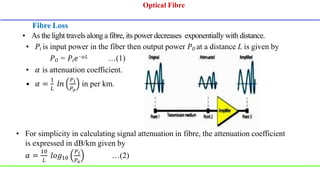
Fibre Loss
• 𝑃𝑖is input power in the fiber then output power 𝑃𝑂 at a distance L is given by
𝑃𝑂 = 𝑃𝑖𝑒−𝛼𝐿 …(1)
• 𝛼 is attenuation coefficient.
• 𝛼 =
1
𝐿
𝑙𝑛
𝑃𝑖
𝑃𝑜
in per km.
• For simplicity in calculating signal attenuation in fibre, the attenuation coefficient
is expressed in dB/km given by
𝛼 =
10
𝐿
𝑙𝑜𝑔10
𝑃𝑖
𝑃𝑜
…(2)
Optical Fibre
Optical Fibre
• As the light travels along a fibre, its power decreases exponentially with distance.
22.
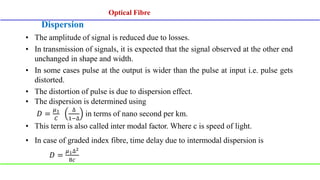
Dispersion
• The amplitudeof signal is reduced due to losses.
• In transmission of signals, it is expected that the signal observed at the other end
unchanged in shape and width.
• In some cases pulse at the output is wider than the pulse at input i.e. pulse gets
distorted.
• The distortion of pulse is due to dispersion effect.
• The dispersion is determined using
𝐷 =
𝜇1
𝐶
∆
1−∆
in terms of nano second per km.
• This term is also called inter modal factor. Where c is speed of light.
• In case of graded index fibre, time delay due to intermodal dispersion is
𝐷 =
𝜇1∆2
8𝑐
Optical Fibre
Optical Fibre
23.
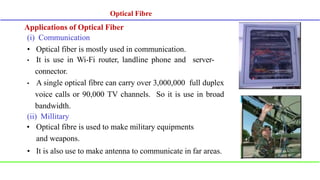
Applications of OpticalFiber
(i) Communication
• Optical fiber is mostly used in communication.
• It is use in Wi-Fi router, landline phone and server-
connector.
• A single optical fibre can carry over 3,000,000 full duplex
voice calls or 90,000 TV channels. So it is use in broad
bandwidth.
(ii) Millitary
• Optical fibre is used to make military equipments
and weapons.
• It is also use to make antenna to communicate in far areas.
Optical Fibre
24.
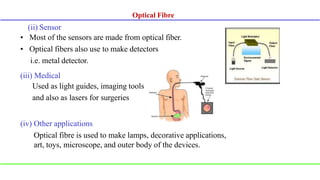
(ii) Sensor
• Mostof the sensors are made from optical fiber.
• Optical fibers also use to make detectors
i.e. metal detector.
(iii) Medical
Used as light guides, imaging tools
and also as lasers for surgeries
(iv) Other applications
Optical fibre is used to make lamps, decorative applications,
art, toys, microscope, and outer body of the devices.
Optical Fibre
Optical Fibre
25.
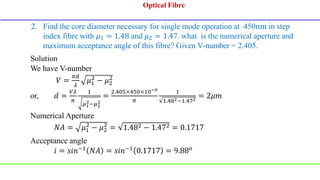
2. Find thecore diameter necessary for single mode operation at 450nm in step
index fibre with 𝜇1 = 1.48 and 𝜇2 = 1.47. what is the numerical aperture and
maximum acceptance angle of this fibre? Given V-number = 2.405.
Solution
We have V-number
𝑉 =
𝜋𝑑
𝜆
𝜇1
2
− 𝜇2
2
or, 𝑑 =
𝑉𝜆
𝜋
1
𝜇1
2−𝜇2
2
=
2.405×450×10−9
𝜋
1
1.482−1.472
= 2𝜇𝑚
Numerical Aperture
𝑁𝐴 = 𝜇1
2
− 𝜇2
2
= 1.482 − 1.472 = 0.1717
Acceptance angle
𝑖 = 𝑠𝑖𝑛−1
𝑁𝐴 = 𝑠𝑖𝑛−1
0.1717 = 9.88𝑜
Optical Fibre
Optical Fibre
26.
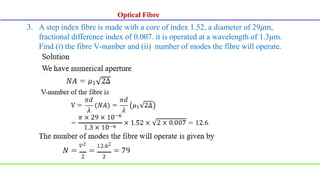
3. A stepindex fibre is made with a core of index 1.52, a diameter of 29𝜇m,
fractional difference index of 0.007. it is operated at a wavelength of 1.3𝜇m.
Find (i) the fibre V-number and (ii) number of modes the fibre will operate.
Optical Fibre
27.
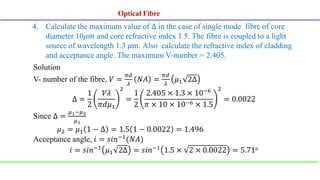
4. Calculate themaximum value of ∆ in the case of single mode fibre of core
diameter 10𝜇𝑚 and core refractive index 1.5. The fibre is coupled to a light
source of wavelength 1.3 𝜇m. Also calculate the refractive index of cladding
and acceptance angle. The maximum V-number = 2.405.
Solution
V- number of the fibre, 𝑉 =
𝜋𝑑
𝜆
𝑁𝐴 =
𝜋𝑑
𝜆
𝜇1 2Δ
Δ =
1
2
𝑉𝜆
𝜋𝑑𝜇1
2
=
1
2
2.405 × 1.3 × 10−6
𝜋 × 10 × 10−6 × 1.5
2
= 0.0022
Since Δ =
𝜇1−𝜇2
𝜇1
𝜇2 = 𝜇1 1 − ∆ = 1.5 1 − 0.0022 = 1.496
Acceptance angle, 𝑖 = 𝑠𝑖𝑛−1(𝑁𝐴)
𝑖 = 𝑠𝑖𝑛−1 𝜇1 2Δ = 𝑠𝑖𝑛−1 1.5 × 2 × 0.0022 = 5.71𝑜
Optical Fibre
Optical Fibre
28.
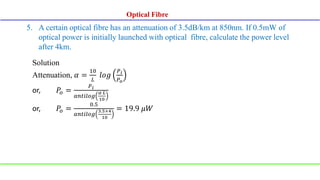
5. A certainoptical fibre has an attenuation of 3.5dB/km at 850nm. If 0.5mW of
optical power is initially launched with optical fibre, calculate the power level
after 4km.
Solution
Attenuation, 𝛼 =
10
𝐿
𝑙𝑜𝑔
𝑃𝑖
𝑃𝑜
or, 𝑃𝑜 =
𝑃𝑖
𝑎𝑛𝑡𝑖𝑙𝑜𝑔
𝛼 𝐿
10
or, 𝑃𝑜 =
0.5
𝑎𝑛𝑡𝑖𝑙𝑜𝑔
3.5×4
10
= 19.9 𝜇𝑊
Optical Fibre
Optical Fibre
29.
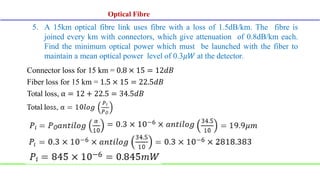
5. A 15kmoptical fibre link uses fibre with a loss of 1.5dB/km. The fibre is
joined every km with connectors, which give attenuation of 0.8dB/km each.
Find the minimum optical power which must be launched with the fiber to
maintain a mean optical power level of 0.3𝜇𝑊 at the detector.
Connector loss for 15 km = 0.8 × 15 = 12𝑑𝐵
Fiber loss for 15 km = 1.5 × 15 = 22.5𝑑𝐵
Total loss, α = 12 + 22.5 = 34.5𝑑𝐵
Optical Fibre
30.
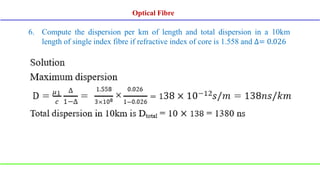
6. Compute thedispersion per km of length and total dispersion in a 10km
length of single index fibre if refractive index of core is 1.558 and ∆= 0.026
Optical Fibre
Optical Fibre
31.
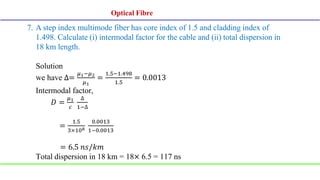
7. A stepindex multimode fiber has core index of 1.5 and cladding index of
1.498. Calculate (i) intermodal factor for the cable and (ii) total dispersion in
18 km length.
Solution
we have ∆=
𝜇1−𝜇2
𝜇1
=
1.5−1.498
1.5
= 0.0013
Intermodal factor,
𝐷 =
𝜇1
𝑐
∆
1−∆
=
1.5
3×10⁸
0.0013
1−0.0013
= 6.5 𝑛𝑠/𝑘𝑚
Total dispersion in 18 km = 18× 6.5 = 117 ns
Optical Fibre
Optical Fibre