Engineering Physics Experiments, Prof. Praveen N. Vaidya, SDMCET Dharwad.
STUDY OF OPTICAL FIBER
Aim: To determine the Angle of acceptance hence the Numerical aperture of the given optical fiber.
Apparatus: Optical fiber, Laser (10mW) source, converging lens and stands.
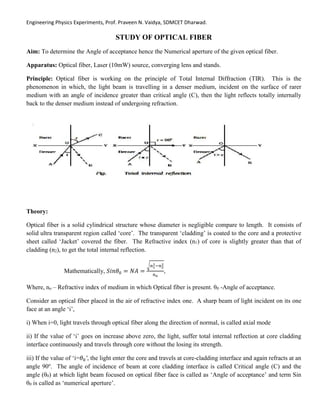
Principle: Optical fiber is working on the principle of Total Internal Diffraction (TIR). This is the
phenomenon in which, the light beam is travelling in a denser medium, incident on the surface of rarer
medium with an angle of incidence greater than critical angle (C), then the light reflects totally internally
back to the denser medium instead of undergoing refraction.
Theory:
Optical fiber is a solid cylindrical structure whose diameter is negligible compare to length. It consists of
solid ultra transparent region called ‘core’. The transparent ‘cladding’ is coated to the core and a protective
sheet called ‘Jacket’ covered the fiber. The Refractive index (n1) of core is slightly greater than that of
cladding (n2), to get the total internal reflection.
Mathematically, 𝑆𝑖𝑛𝜃0 = 𝑁𝐴 =
√𝑛1
2−𝑛2
2
𝑛𝑜
,
Where, no – Refractive index of medium in which Optical fiber is present. θ0 -Angle of acceptance.
Consider an optical fiber placed in the air of refractive index one. A sharp beam of light incident on its one
face at an angle ‘i’,
i) When i=0, light travels through optical fiber along the direction of normal, is called axial mode
ii) If the value of ‘i’ goes on increase above zero, the light, suffer total internal reflection at core cladding
interface continuously and travels through core without the losing its strength.
iii) If the value of ‘i=𝜃0′, the light enter the core and travels at core-cladding interface and again refracts at an
angle 90o
. The angle of incidence of beam at core cladding interface is called Critical angle (C) and the
angle (θ0) at which light beam focused on optical fiber face is called as ‘Angle of acceptance’ and term Sin
θ0 is called as ‘numerical aperture’.
Engineering Physics Experiments, Prof. Praveen N. Vaidya, SDMCET Dharwad.
iv) If the value of i>𝜃0, then light beam entered into the core will completely refracts into the cladding.
For all the angle incidence, which equal to or less than critical angle light ray gives total internal reflection
through core, come out from the other face of optical fiber and falls on the screen placed on opposite side at
distance ‘l’ in circular shape of diameter ‘d’, now the critical angle θc is given by,
𝑡𝑎𝑛𝜃𝑐 =
𝑑/2
𝑙
𝑜𝑟 𝑡𝑎𝑛𝜃𝑐 =
𝑑
2𝑙
𝑜𝑟 𝐴𝑛𝑔𝑙𝑒 𝑜𝑓 𝑎𝑐𝑐𝑒𝑝𝑡𝑎𝑛𝑐𝑒, 𝜃𝑐 = 𝑡𝑎𝑛−1 𝑑
2𝑙
,
∴ 𝑁𝑢𝑚𝑒𝑟𝑖𝑐𝑎𝑙 𝐴𝑝𝑒𝑟𝑡𝑢𝑟𝑒, 𝑁. 𝐴 = 𝑆𝑖𝑛 [𝑡𝑎𝑛−1
𝑑
2𝑙
]
Procedure:
Set up the apparatus of optical fiber experiment as shown in the diagram.
The laser beam is to be converted into a sharp beam by the use of condensing lens.
The beam emerged of the lens is focused on the one face of optical fiber at right direction.
The screen with a white drawing paper fitted is kept opposite to other face of optical fiber, so that the beam
appeared on the screen.
The intensity of image of laser beam appeared on the screen is adjusted to be high.
Mark the circumference of image using pencil and hence measure its diameter (d). The length between
screen and optical fiber face also measured (l ).
Determine value of angle of acceptance, using formula 𝜃𝑐 = 𝑡𝑎𝑛−1 𝑑
2𝑙
and NA using formula
𝑁. 𝐴 = 𝑆𝑖𝑛 [𝑡𝑎𝑛−1
𝑑
2𝑙
]
Repeat the experiment for different values of ‘l’ and‘d’ and tabulate the readings.
Determine the average value of N.A. and note down the result.
θ0 O
C O θ0
l
d
Engineering Physics Experiments, Prof. Praveen N. Vaidya, SDMCET Dharwad.
Diagram:
Formula used for calculation of Angle of acceptance.
𝜃0 = 𝑡𝑎𝑛−1
𝑑
2𝑙
Formula used for calculation of Numerical Aperture.
𝑁. 𝐴 = 𝑆𝑖𝑛 [𝑡𝑎𝑛−1
𝑑
2𝑙
]
Average value of Acceptance angle ____________o
,
Average value of Numerical aperture, N.A._______
Result: Acceptance angle of optical fiber ________________ o
.
Numerical aperture of the optical fiber ____________.
******
Trial
No.
Distance between
output end of the
optical fiber and
screen. ‘l’ cm
Diameter of the
image of the laser
beam on the screen
‘d’ cm
𝑑
2𝑙
Angle of
acceptance
𝜃0 = 𝑡𝑎𝑛−1
𝑑
2𝑙
Numerical
Aperture
𝑁. 𝐴 = 𝑆𝑖𝑛𝜃0
1
2
3
4
5
6
7
8

Optical fiber Experiment.docx

  • 1.
    Engineering Physics Experiments,Prof. Praveen N. Vaidya, SDMCET Dharwad. STUDY OF OPTICAL FIBER Aim: To determine the Angle of acceptance hence the Numerical aperture of the given optical fiber. Apparatus: Optical fiber, Laser (10mW) source, converging lens and stands. Principle: Optical fiber is working on the principle of Total Internal Diffraction (TIR). This is the phenomenon in which, the light beam is travelling in a denser medium, incident on the surface of rarer medium with an angle of incidence greater than critical angle (C), then the light reflects totally internally back to the denser medium instead of undergoing refraction. Theory: Optical fiber is a solid cylindrical structure whose diameter is negligible compare to length. It consists of solid ultra transparent region called ‘core’. The transparent ‘cladding’ is coated to the core and a protective sheet called ‘Jacket’ covered the fiber. The Refractive index (n1) of core is slightly greater than that of cladding (n2), to get the total internal reflection. Mathematically, 𝑆𝑖𝑛𝜃0 = 𝑁𝐴 = √𝑛1 2−𝑛2 2 𝑛𝑜 , Where, no – Refractive index of medium in which Optical fiber is present. θ0 -Angle of acceptance. Consider an optical fiber placed in the air of refractive index one. A sharp beam of light incident on its one face at an angle ‘i’, i) When i=0, light travels through optical fiber along the direction of normal, is called axial mode ii) If the value of ‘i’ goes on increase above zero, the light, suffer total internal reflection at core cladding interface continuously and travels through core without the losing its strength. iii) If the value of ‘i=𝜃0′, the light enter the core and travels at core-cladding interface and again refracts at an angle 90o . The angle of incidence of beam at core cladding interface is called Critical angle (C) and the angle (θ0) at which light beam focused on optical fiber face is called as ‘Angle of acceptance’ and term Sin θ0 is called as ‘numerical aperture’.
  • 2.
    Engineering Physics Experiments,Prof. Praveen N. Vaidya, SDMCET Dharwad. iv) If the value of i>𝜃0, then light beam entered into the core will completely refracts into the cladding. For all the angle incidence, which equal to or less than critical angle light ray gives total internal reflection through core, come out from the other face of optical fiber and falls on the screen placed on opposite side at distance ‘l’ in circular shape of diameter ‘d’, now the critical angle θc is given by, 𝑡𝑎𝑛𝜃𝑐 = 𝑑/2 𝑙 𝑜𝑟 𝑡𝑎𝑛𝜃𝑐 = 𝑑 2𝑙 𝑜𝑟 𝐴𝑛𝑔𝑙𝑒 𝑜𝑓 𝑎𝑐𝑐𝑒𝑝𝑡𝑎𝑛𝑐𝑒, 𝜃𝑐 = 𝑡𝑎𝑛−1 𝑑 2𝑙 , ∴ 𝑁𝑢𝑚𝑒𝑟𝑖𝑐𝑎𝑙 𝐴𝑝𝑒𝑟𝑡𝑢𝑟𝑒, 𝑁. 𝐴 = 𝑆𝑖𝑛 [𝑡𝑎𝑛−1 𝑑 2𝑙 ] Procedure: Set up the apparatus of optical fiber experiment as shown in the diagram. The laser beam is to be converted into a sharp beam by the use of condensing lens. The beam emerged of the lens is focused on the one face of optical fiber at right direction. The screen with a white drawing paper fitted is kept opposite to other face of optical fiber, so that the beam appeared on the screen. The intensity of image of laser beam appeared on the screen is adjusted to be high. Mark the circumference of image using pencil and hence measure its diameter (d). The length between screen and optical fiber face also measured (l ). Determine value of angle of acceptance, using formula 𝜃𝑐 = 𝑡𝑎𝑛−1 𝑑 2𝑙 and NA using formula 𝑁. 𝐴 = 𝑆𝑖𝑛 [𝑡𝑎𝑛−1 𝑑 2𝑙 ] Repeat the experiment for different values of ‘l’ and‘d’ and tabulate the readings. Determine the average value of N.A. and note down the result. θ0 O C O θ0 l d
  • 3.
    Engineering Physics Experiments,Prof. Praveen N. Vaidya, SDMCET Dharwad. Diagram: Formula used for calculation of Angle of acceptance. 𝜃0 = 𝑡𝑎𝑛−1 𝑑 2𝑙 Formula used for calculation of Numerical Aperture. 𝑁. 𝐴 = 𝑆𝑖𝑛 [𝑡𝑎𝑛−1 𝑑 2𝑙 ] Average value of Acceptance angle ____________o , Average value of Numerical aperture, N.A._______ Result: Acceptance angle of optical fiber ________________ o . Numerical aperture of the optical fiber ____________. ****** Trial No. Distance between output end of the optical fiber and screen. ‘l’ cm Diameter of the image of the laser beam on the screen ‘d’ cm 𝑑 2𝑙 Angle of acceptance 𝜃0 = 𝑡𝑎𝑛−1 𝑑 2𝑙 Numerical Aperture 𝑁. 𝐴 = 𝑆𝑖𝑛𝜃0 1 2 3 4 5 6 7 8