MUSIC, BRAINWAVES AND
FREQUENCY
How does particular music of suitable frequency affects
brainwaves thereby using it to perform the desired activity at
desired extent.
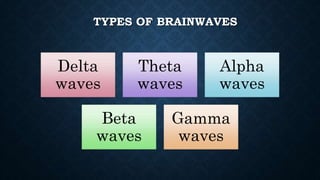
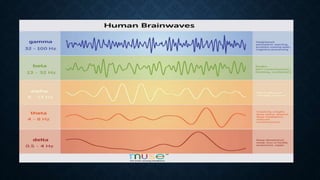
TYPES OF BRAINWAVES
Delta
waves
Theta
waves
Alpha
waves
Beta
waves
Gamma
waves
DELTA WAVES ( < 4 HZ )
• Delta waves are associated with deep levels of relaxation and restorative sleep.
• They are slowest recorded brain waves in humans and higher levels are more found in
young children. Lower delta waves are produced during aging.
• Delta waves are attributed to many unconscious bodily functions such as regulating the
cardiovascular and digestive system.
• Delta waves are responsible for restful sleep, wake up refreshed.
• High levels leads to brain injuries, learning problems and inability to think.
• Low levels affects adversely on the process of body rejuvenation, brain revitalization and
poor sleep.
THETA WAVES ( 4-7 HZ )
• Theta waves are known as ‘suggestible waves’ because of their prevalence in hypnotic state.
• Theta waves are commonly found when one daydreams or is asleep which exhibits more relaxed
mindset.
• Theta waves are also linked to us experiencing and feeling deep and raw emotions, and to much of
its activity may also lead to depression.
• They help improve our creativity, wholeness and intuition, making us feel more natural.
• It is also involved in restorative sleep and as long as theta isn’t produced in excess during working
hours it is a very helpful brainwave range.
• High levels may lead to depressive stress impulsive activity or inattentiveness.
• Low levels shows anxiety symptoms, poor emotional awareness, higher stress levels.
ALPHA WAVES ( 7-13 HZ )
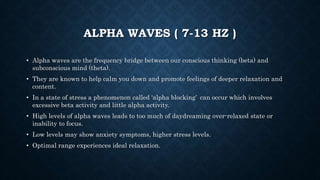
• Alpha waves are the frequency bridge between our conscious thinking (beta) and
subconscious mind (theta).
• They are known to help calm you down and promote feelings of deeper relaxation and
content.
• In a state of stress a phenomenon called ‘alpha blocking’ can occur which involves
excessive beta activity and little alpha activity.
• High levels of alpha waves leads to too much of daydreaming over-relaxed state or
inability to focus.
• Low levels may show anxiety symptoms, higher stress levels.
• Optimal range experiences ideal relaxation.
BETA WAVES ( 13-39 HZ )
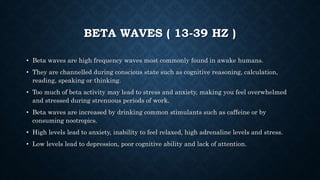
• Beta waves are high frequency waves most commonly found in awake humans.
• They are channelled during conscious state such as cognitive reasoning, calculation,
reading, speaking or thinking.
• Too much of beta activity may lead to stress and anxiety, making you feel overwhelmed
and stressed during strenuous periods of work.
• Beta waves are increased by drinking common stimulants such as caffeine or by
consuming nootropics.
• High levels lead to anxiety, inability to feel relaxed, high adrenaline levels and stress.
• Low levels lead to depression, poor cognitive ability and lack of attention.
BETA WAVES
GAMMA WAVES ( > 40 HZ )
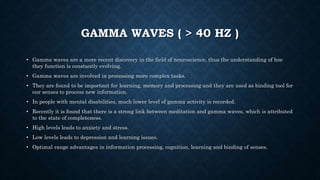
• Gamma waves are a more recent discovery in the field of neuroscience, thus the understanding of hoe
they function is constantly evolving.
• Gamma waves are involved in processing more complex tasks.
• They are found to be important for learning, memory and processing and they are used as binding tool for
our senses to process new information.
• In people with mental disabilities, much lower level of gamma activity is recorded.
• Recently it is found that there is a strong link between meditation and gamma waves, which is attributed
to the state of completeness.
• High levels leads to anxiety and stress.
• Low levels leads to depression and learning issues.
• Optimal range advantages in information processing, cognition, learning and binding of senses.
SNOWBALL RESPONDING TO BEATS
RESPONSE TOWARDS MUSIC OF
PARKINSON’S PATIENT
MUSIC AND BRAIN
Listening to music engages oneself in many activities. While playing music equals to
the the work out.
Being associated with music strengthens brain function that can be applied to other
activities.
Playing music engages various areas of brain they are visual, auditory and motor,
thereby keeping all the senses active.
Music is something that is capable of driving to desired state of mind, and is also
capable of not only keeping a person mentally but also physically active.

Music

  • 1.
    MUSIC, BRAINWAVES AND FREQUENCY Howdoes particular music of suitable frequency affects brainwaves thereby using it to perform the desired activity at desired extent.
  • 2.
  • 3.
    DELTA WAVES (< 4 HZ ) • Delta waves are associated with deep levels of relaxation and restorative sleep. • They are slowest recorded brain waves in humans and higher levels are more found in young children. Lower delta waves are produced during aging. • Delta waves are attributed to many unconscious bodily functions such as regulating the cardiovascular and digestive system. • Delta waves are responsible for restful sleep, wake up refreshed. • High levels leads to brain injuries, learning problems and inability to think. • Low levels affects adversely on the process of body rejuvenation, brain revitalization and poor sleep.
  • 4.
    THETA WAVES (4-7 HZ ) • Theta waves are known as ‘suggestible waves’ because of their prevalence in hypnotic state. • Theta waves are commonly found when one daydreams or is asleep which exhibits more relaxed mindset. • Theta waves are also linked to us experiencing and feeling deep and raw emotions, and to much of its activity may also lead to depression. • They help improve our creativity, wholeness and intuition, making us feel more natural. • It is also involved in restorative sleep and as long as theta isn’t produced in excess during working hours it is a very helpful brainwave range. • High levels may lead to depressive stress impulsive activity or inattentiveness. • Low levels shows anxiety symptoms, poor emotional awareness, higher stress levels.
  • 5.
    ALPHA WAVES (7-13 HZ ) • Alpha waves are the frequency bridge between our conscious thinking (beta) and subconscious mind (theta). • They are known to help calm you down and promote feelings of deeper relaxation and content. • In a state of stress a phenomenon called ‘alpha blocking’ can occur which involves excessive beta activity and little alpha activity. • High levels of alpha waves leads to too much of daydreaming over-relaxed state or inability to focus. • Low levels may show anxiety symptoms, higher stress levels. • Optimal range experiences ideal relaxation.
  • 6.
    BETA WAVES (13-39 HZ ) • Beta waves are high frequency waves most commonly found in awake humans. • They are channelled during conscious state such as cognitive reasoning, calculation, reading, speaking or thinking. • Too much of beta activity may lead to stress and anxiety, making you feel overwhelmed and stressed during strenuous periods of work. • Beta waves are increased by drinking common stimulants such as caffeine or by consuming nootropics. • High levels lead to anxiety, inability to feel relaxed, high adrenaline levels and stress. • Low levels lead to depression, poor cognitive ability and lack of attention.
  • 7.
  • 8.
    GAMMA WAVES (> 40 HZ ) • Gamma waves are a more recent discovery in the field of neuroscience, thus the understanding of hoe they function is constantly evolving. • Gamma waves are involved in processing more complex tasks. • They are found to be important for learning, memory and processing and they are used as binding tool for our senses to process new information. • In people with mental disabilities, much lower level of gamma activity is recorded. • Recently it is found that there is a strong link between meditation and gamma waves, which is attributed to the state of completeness. • High levels leads to anxiety and stress. • Low levels leads to depression and learning issues. • Optimal range advantages in information processing, cognition, learning and binding of senses.
  • 10.
  • 11.
    RESPONSE TOWARDS MUSICOF PARKINSON’S PATIENT
  • 12.
    MUSIC AND BRAIN Listeningto music engages oneself in many activities. While playing music equals to the the work out. Being associated with music strengthens brain function that can be applied to other activities. Playing music engages various areas of brain they are visual, auditory and motor, thereby keeping all the senses active. Music is something that is capable of driving to desired state of mind, and is also capable of not only keeping a person mentally but also physically active.