Graduation Portfolio Modules
2
Modules
Module 1 What is GPS?
Module 2 What are Performance Outcomes?
Module 3 How are Performance Outcomes Connected to
Our Standards?
Module 4 What kind of Instruction Supports our
Work?
Module 5 How do I Design Performance Tasks?
Module 6 How do we Design Units that Support this
Work?
Module 7 What makes a High Quality Unit?
Module 8 How do we give Meaningful Feedback to
Students?
Module 9 How do we connect this GPS work to our work
across the network?
Module 10 How do Students Manage the Process?
Instructional Model
Module 4
Objectives
Participants will be able to answer:
• What kind of instruction supports this work?
4
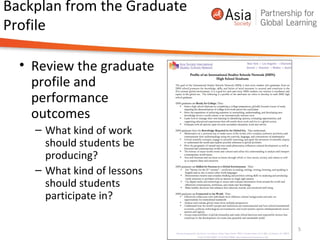
Backplan from the Graduate
Profile
• Review the graduate
profile and
performance
outcomes
– What kind of work
should students be
producing?
– What kind of lessons
should students
participate in?
5
What kind of instruction
supports implementation?
Balancing direct instruction with opportunities to
explore and investigate open-ended questions
• Simulations
• Community engagement activities
• Projects and investigations
• Service-learning
• Open ended questions for investigation
A focus on relevance and taking action
6
Examples of
Essential Questions
• What does it mean to be a citizen?
• What is art?
• What makes a system?
• How do numbers represent the world?
• When is something alive?
• What makes something true?
7
Simulations and Immersions
What are some examples of immersions and
simulations?
• Model United Nations
• Language Immersions
• Cultural Exchanges
• Role Play
• Real-time Problem Solving
8
Project-Based
Learning
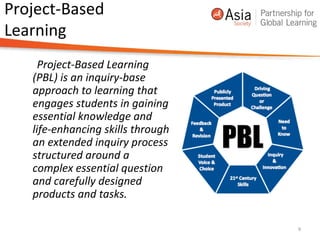
Project-Based Learning
(PBL) is an inquiry-base
approach to learning that
engages students in gaining
essential knowledge and
life-enhancing skills through
an extended inquiry process
structured around a
complex essential question
and carefully designed
products and tasks.
9
Basic Elements of a PBL
A Project-Based Learning includes these basic
elements:
(1) an extended time frame
(2) collaboration
(3) inquiry, investigation, and research
(4) the construction of an artifact or
performance of a consequential task.
10
Why use this model?
Allows students to explore real-world
problems and challenges through working
and cooperating with students in small
groups.
Majority of time is spent on active and
engaged learning, which studies show helps
students retain a deeper knowledge of
subjects studied.
Helps students develop organizational skills,
build collaborative skills, and become
better communicators.
11
Essentials of PBL
What is the Essential Question?
What 21st
C. Skills / Global Competencies
will be developed?
What are the student expectations?
How will the project be assessed?
What resources are needed?
What are knowledge and skills that
students need to be successful?
12
Classroom Practices
• What would it look like on a regular basis?
• What would an observer be able to observe in
the classroom?
• What support do you need to maximize
student engagement during an instructional
block?
13
Classroom Follow-up
• How will we communicate these ideas to the
student?
– Advisory?
– Content area courses?
– Schoolwide?
14
Resources
Buck Institute for Education / Project Based Learning
Videos, Tools, Research to help teachers implement PBL
http://www.bie.org/
Edutopia
Core Concept – Project Based Learning
http://www.edutopia.org/project-based-learning
PBL – Online
Resources to design and manage high quality projects for
middle and secondary school students.
http://pbl-online.org/
15

Gps mod 4 v2.1

  • 2.
    Graduation Portfolio Modules 2 Modules Module1 What is GPS? Module 2 What are Performance Outcomes? Module 3 How are Performance Outcomes Connected to Our Standards? Module 4 What kind of Instruction Supports our Work? Module 5 How do I Design Performance Tasks? Module 6 How do we Design Units that Support this Work? Module 7 What makes a High Quality Unit? Module 8 How do we give Meaningful Feedback to Students? Module 9 How do we connect this GPS work to our work across the network? Module 10 How do Students Manage the Process?
  • 3.
  • 4.
    Objectives Participants will beable to answer: • What kind of instruction supports this work? 4
  • 5.
    Backplan from theGraduate Profile • Review the graduate profile and performance outcomes – What kind of work should students be producing? – What kind of lessons should students participate in? 5
  • 6.
    What kind ofinstruction supports implementation? Balancing direct instruction with opportunities to explore and investigate open-ended questions • Simulations • Community engagement activities • Projects and investigations • Service-learning • Open ended questions for investigation A focus on relevance and taking action 6
  • 7.
    Examples of Essential Questions •What does it mean to be a citizen? • What is art? • What makes a system? • How do numbers represent the world? • When is something alive? • What makes something true? 7
  • 8.
    Simulations and Immersions Whatare some examples of immersions and simulations? • Model United Nations • Language Immersions • Cultural Exchanges • Role Play • Real-time Problem Solving 8
  • 9.
    Project-Based Learning Project-Based Learning (PBL) isan inquiry-base approach to learning that engages students in gaining essential knowledge and life-enhancing skills through an extended inquiry process structured around a complex essential question and carefully designed products and tasks. 9
  • 10.
    Basic Elements ofa PBL A Project-Based Learning includes these basic elements: (1) an extended time frame (2) collaboration (3) inquiry, investigation, and research (4) the construction of an artifact or performance of a consequential task. 10
  • 11.
    Why use thismodel? Allows students to explore real-world problems and challenges through working and cooperating with students in small groups. Majority of time is spent on active and engaged learning, which studies show helps students retain a deeper knowledge of subjects studied. Helps students develop organizational skills, build collaborative skills, and become better communicators. 11
  • 12.
    Essentials of PBL Whatis the Essential Question? What 21st C. Skills / Global Competencies will be developed? What are the student expectations? How will the project be assessed? What resources are needed? What are knowledge and skills that students need to be successful? 12
  • 13.
    Classroom Practices • Whatwould it look like on a regular basis? • What would an observer be able to observe in the classroom? • What support do you need to maximize student engagement during an instructional block? 13
  • 14.
    Classroom Follow-up • Howwill we communicate these ideas to the student? – Advisory? – Content area courses? – Schoolwide? 14
  • 15.
    Resources Buck Institute forEducation / Project Based Learning Videos, Tools, Research to help teachers implement PBL http://www.bie.org/ Edutopia Core Concept – Project Based Learning http://www.edutopia.org/project-based-learning PBL – Online Resources to design and manage high quality projects for middle and secondary school students. http://pbl-online.org/ 15

Editor's Notes

  • #4 NOTES  TO  THE  TRAINER:   For  more  details,  see  the  Field  Guide   Welcome  participants.     Provide  a  brief  overview  of  the  module.   Description:  Presentation  of  the  design  and  components  of  the  GPS  Learning  System   provides  participants  the  basic  understanding  of  the  importance  of  high-quality,   college  ready  work  and  how  to  incorporate  expectations  for  global  competencies.  
  • #5 The focus of the Graduate Portfolio System is on students showcasing their global competency and college readiness. There performance outcomes and graduate profile help clarify the expectations and type of work the students should produce. This module will focus on the type of instruction that supports students as they develop their competencies.
  • #6 We reviewed the Graduate Profile in previous modules for connections to standard, performance outcomes, or curriculum. Have participants discuss what kind of instruction and experiences help students meet the expectations in the graduate profile.
  • #7 A variety of instructional techniques and tools are required throughout students’ experiences in order for them to develop the skills needed to be successful.
  • #8 Essential questions can drive the curriculum and lead to more authentic assessments and performances. What essential questions are we currently using? How is our curriculum design to help students address these questions?
  • #9 Discuss how simulations and immersions are used currently and in what contexts Are there certain content areas currently using simulations? What’s happening outside of the classroom? What examples can we think of, big and small, in which students apply their learning in a real or simulated context?
  • #13 Pair Share – “teach” your partner – what is Project Based Learning? Why use this model?