

PATTERNS OF
DEVELOPMENT
PATTERNS OF DEVELOPMENT
 Structures writers use to organize their
ideas.
 Use to connect your ideas and provide
enough details in your writing.
 Use to arrange ideas to achieve the writers
purpose in writing the text.
PATTERNS OF DEVELOPMENT
ACROSS DISCIPLINES
a) Narration
b) Description
c) Definition
d) Exemplification/
Classification
e) Comparison and
Contrast
f) Cause and Effect
g) Problem – Solution
h) Persuasion
NARRATION
It is used to tell a story or focus
on a set of events.
NARRATIVE TEXT
Any type of writing that relates a
series of events and includes
both fiction and nonfiction
PURPOSE OF NARRATIVE
TEXT
To entertain
To gain a reader’s interest
To hold a reader’s interest
ELEMENTS OF
NARRATIVE TEXT
1. Setting –time and location
2. Characters –significant part of the story
3. Plot –planned, logical series of events
PARTS OF PLOT
a)Exposition-characters and settings are revealed
b)Rising Action-events of the story become complicated
and the conflict is exposed
c)Climax-highest point of interest and the turning point
of the story
d)Falling Action-events and complications begins to
resolve
e)Point of View-perspective of the writer(1st, 2nd & 3rd)
DESCRIPTION
It states the details of what
something looks like and its
characteristics
KINDS OF DESCRIPTION
1) Objective Description
-it describes something without
conveying the writer’s own
emotions
-it is used in technical or scientific
writing
KINDS OF DESCRIPTION
2) Subjective Description
-it conveys feelings and emotions
about a person, place, or thing.
-it is conveying impressions and
contains specific details
DEFINITION
It explains what a term means.
You use this when you want
your readers to know exactly
how you are using a certain term
or an unfamiliar concept
TYPES OF DEFINITION
1) Formal Definition
-the definitions provided in dictionaries
-it as three (3) general elements:
a. term - the word being defined
b. class – refers to the group to which the term
belongs
c. differentiating features – the word or phrase that
makes it different with the others from the same
FORMAL DEFINITION
a) Scientific Writing -form of writing
based on actual and relevant studies
b) Science -the field of study which
attempts to describe and understand the
nature of the universe
TYPES OF DEFINITION
2) Informal Definition
a. Operational Definitions
b. Synonyms
c. Denotation
d. Connotation
TYPES OF INFORMAL
DEFINITION
a) Operational Definitions –give
the meaning of an abstract word
for one particular time and place.
TYPES OF INFORMAL
DEFINITION
b) Synonyms – words that mean
the same as another word
TYPES OF INFORMAL
DEFINITION
c) Denotation – exact meaning of
the word or thing
TYPES OF INFORMAL
DEFINITION
d) Connotation – an idea or
meaning suggested by or
associated with a word or thing
TYPES OF DEFINITION
3) Definition Paragraph
–is a definition sentence that is extended into a
paragraph by adding meanings, descriptions,
narrations
-starts with a definition sentence which is used
as a topic sentence then, a supporting and
concluding statement
CLASSIFICATION
- divide a topic into its
component parts
- categorize a group of related
items or events
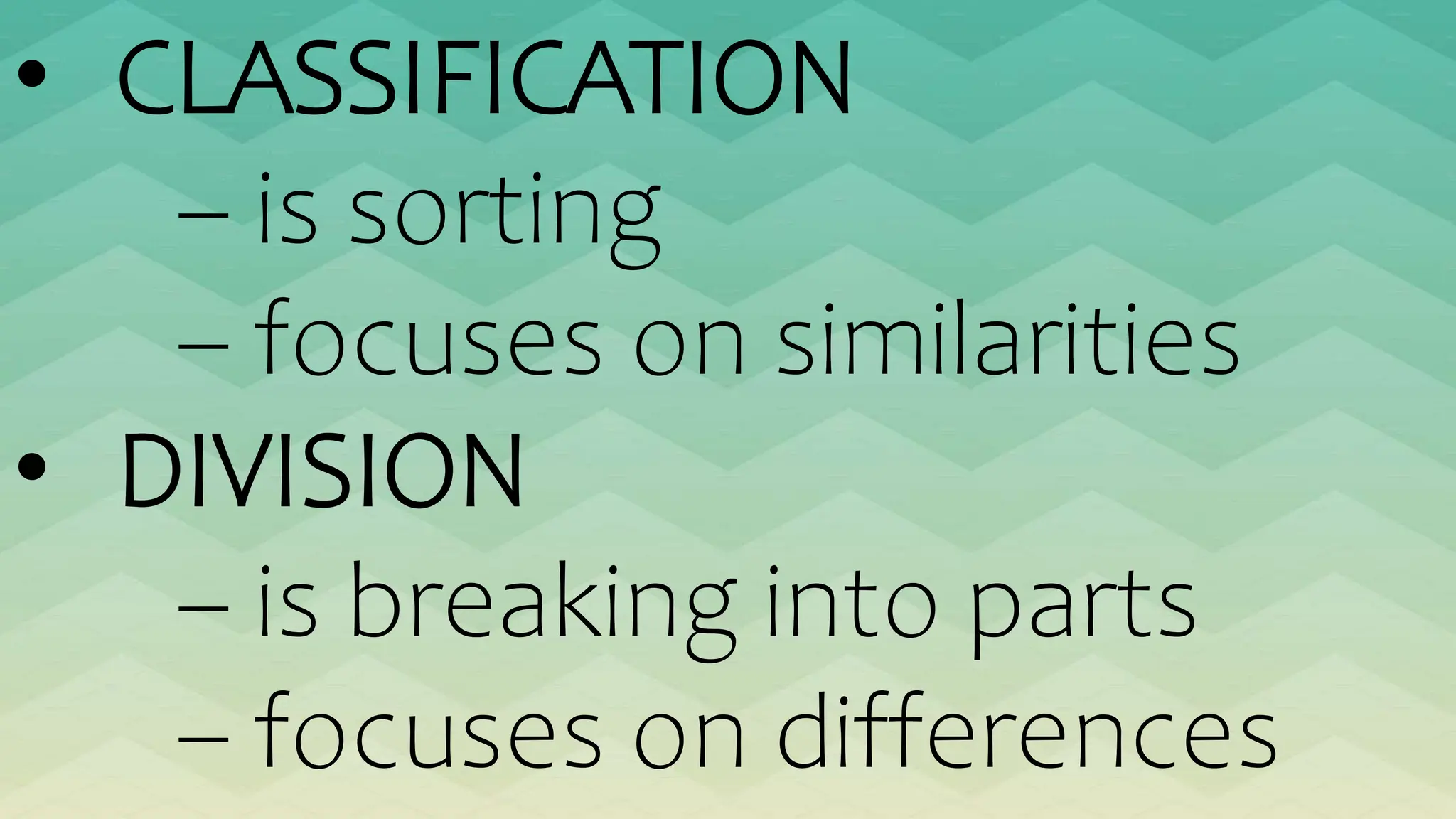
• CLASSIFICATION
– is sorting
– focuses on similarities
• DIVISION
– is breaking into parts
– focuses on differences
COMPARISON &
CONTRAST
COMPARE – similar
CONTRAST – difference
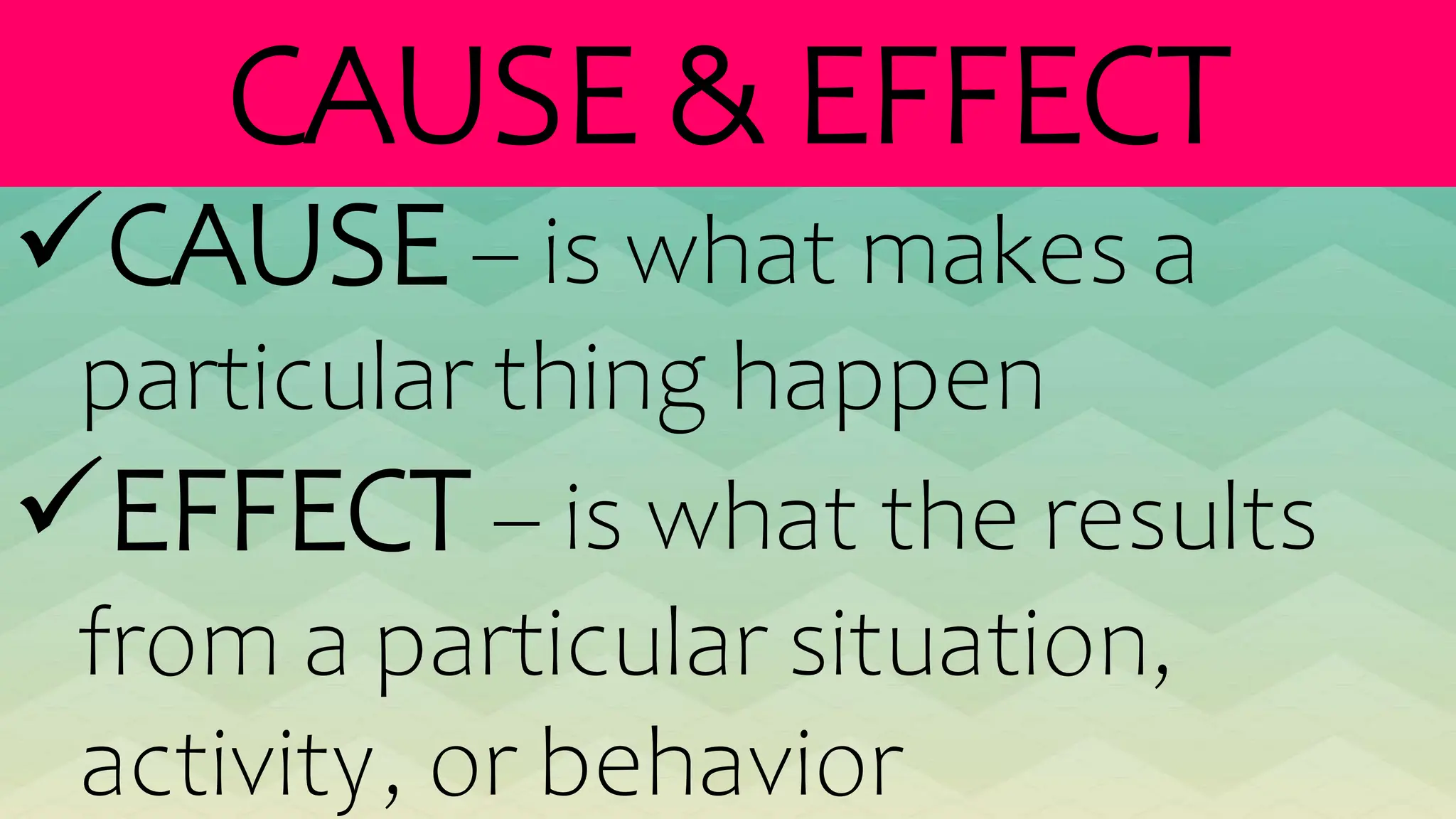
CAUSE & EFFECT
CAUSE – is what makes a
particular thing happen
EFFECT – is what the results
from a particular situation,
activity, or behavior
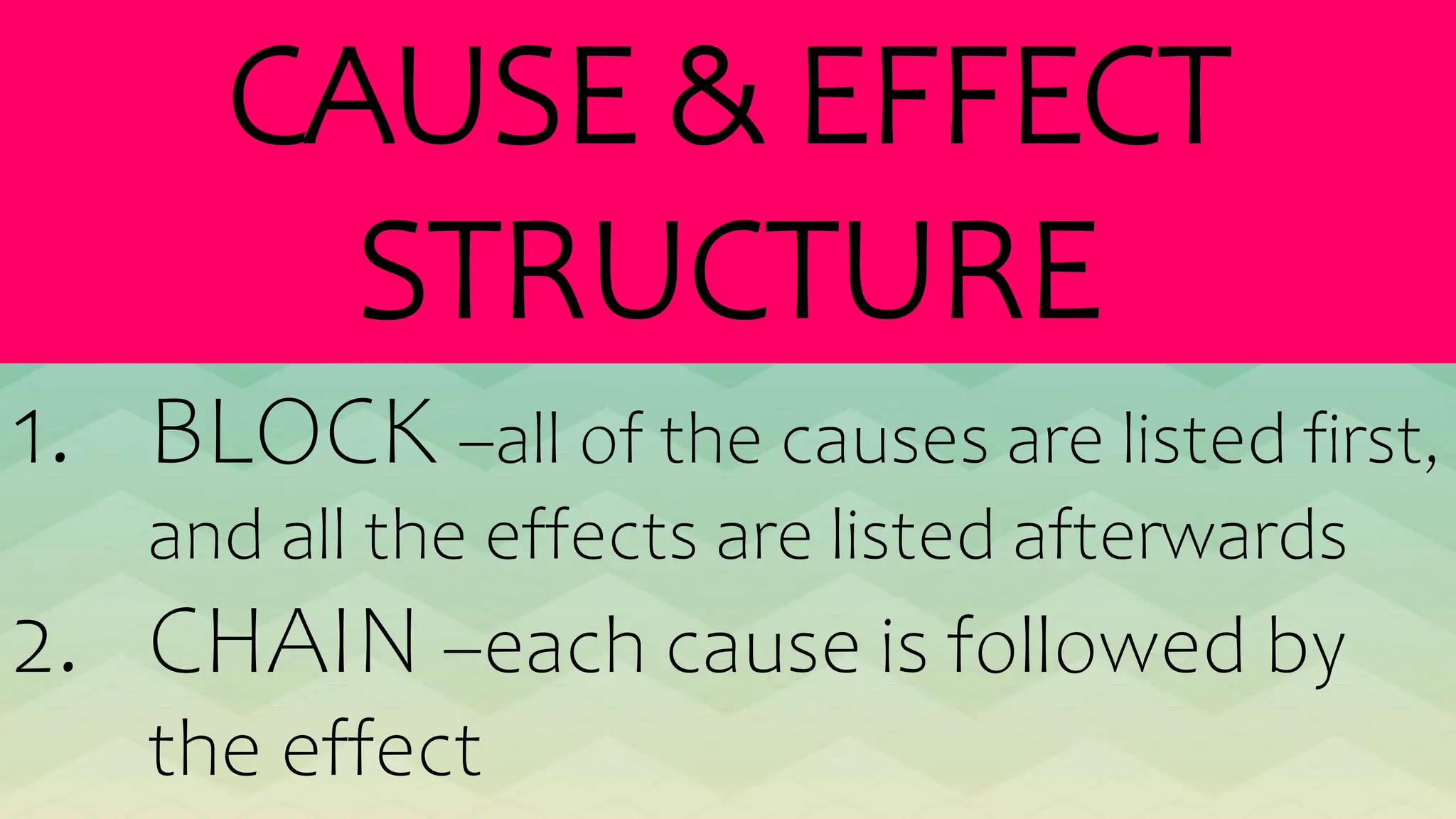
CAUSE & EFFECT
STRUCTURE
1. BLOCK –all of the causes are listed first,
and all the effects are listed afterwards
2. CHAIN –each cause is followed by
the effect
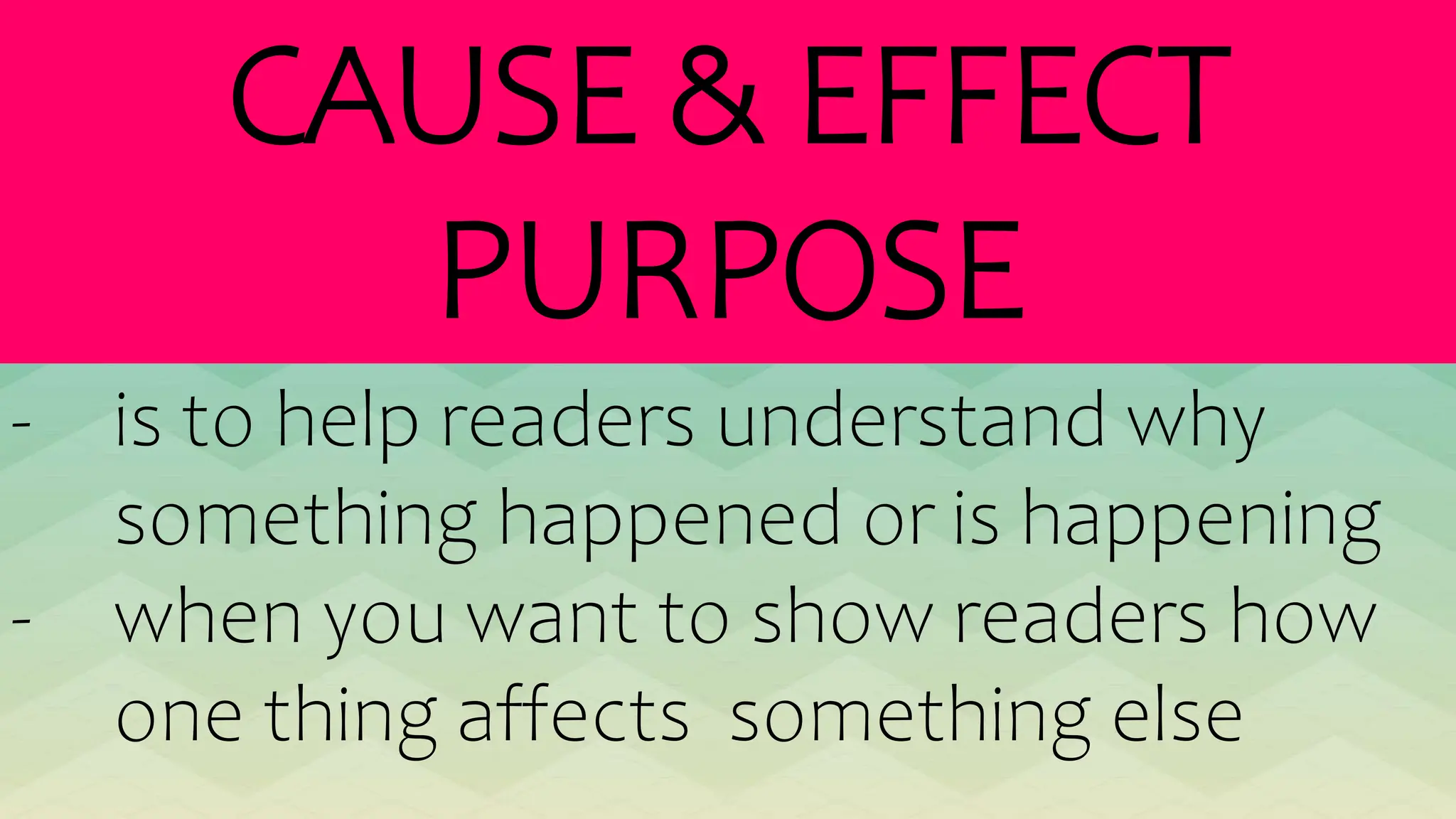
CAUSE & EFFECT
PURPOSE
- is to help readers understand why
something happened or is happening
- when you want to show readers how
one thing affects something else
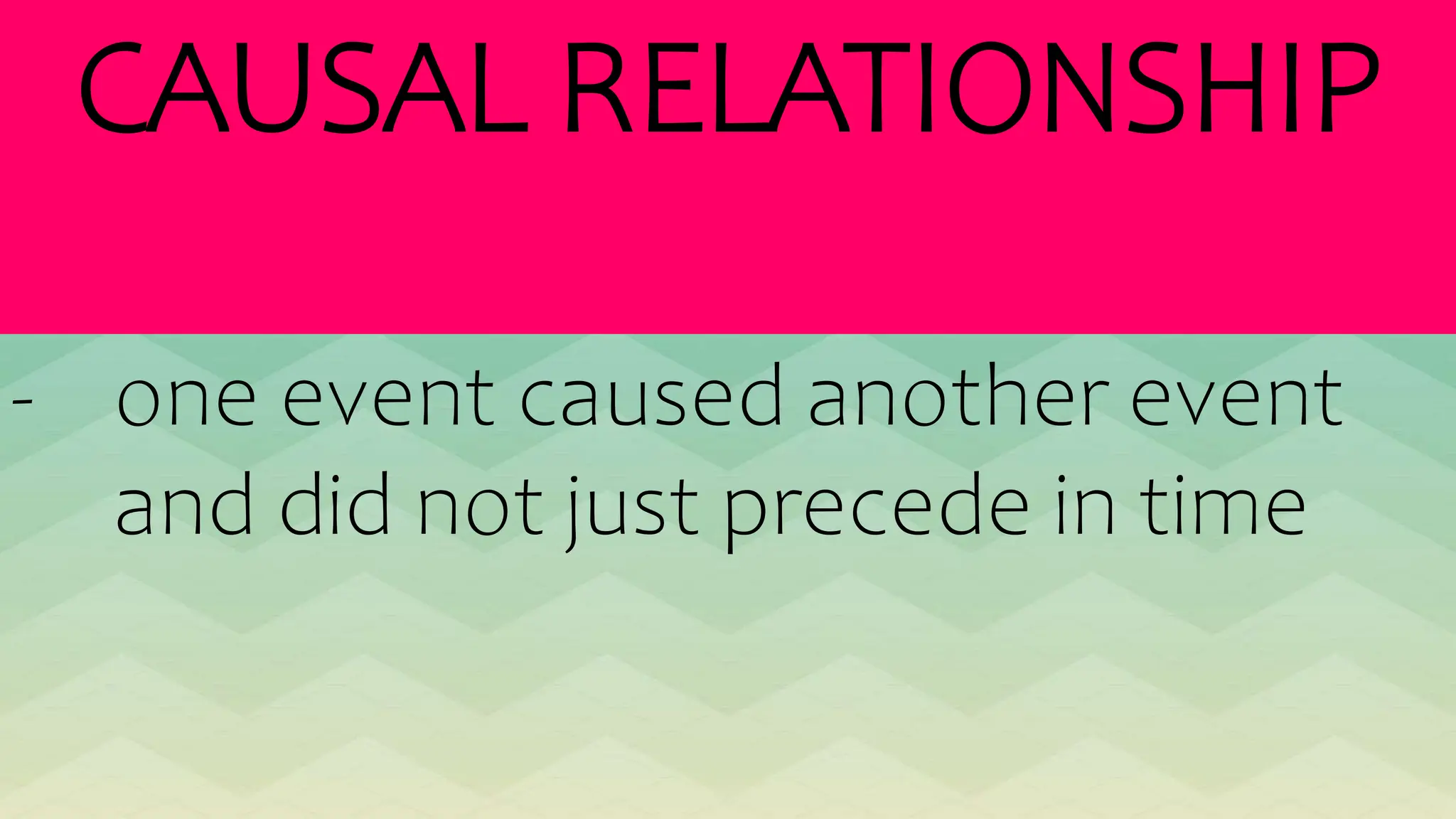
CAUSAL RELATIONSHIP
- one event caused another event
and did not just precede in time
CAUSE & EFFECT
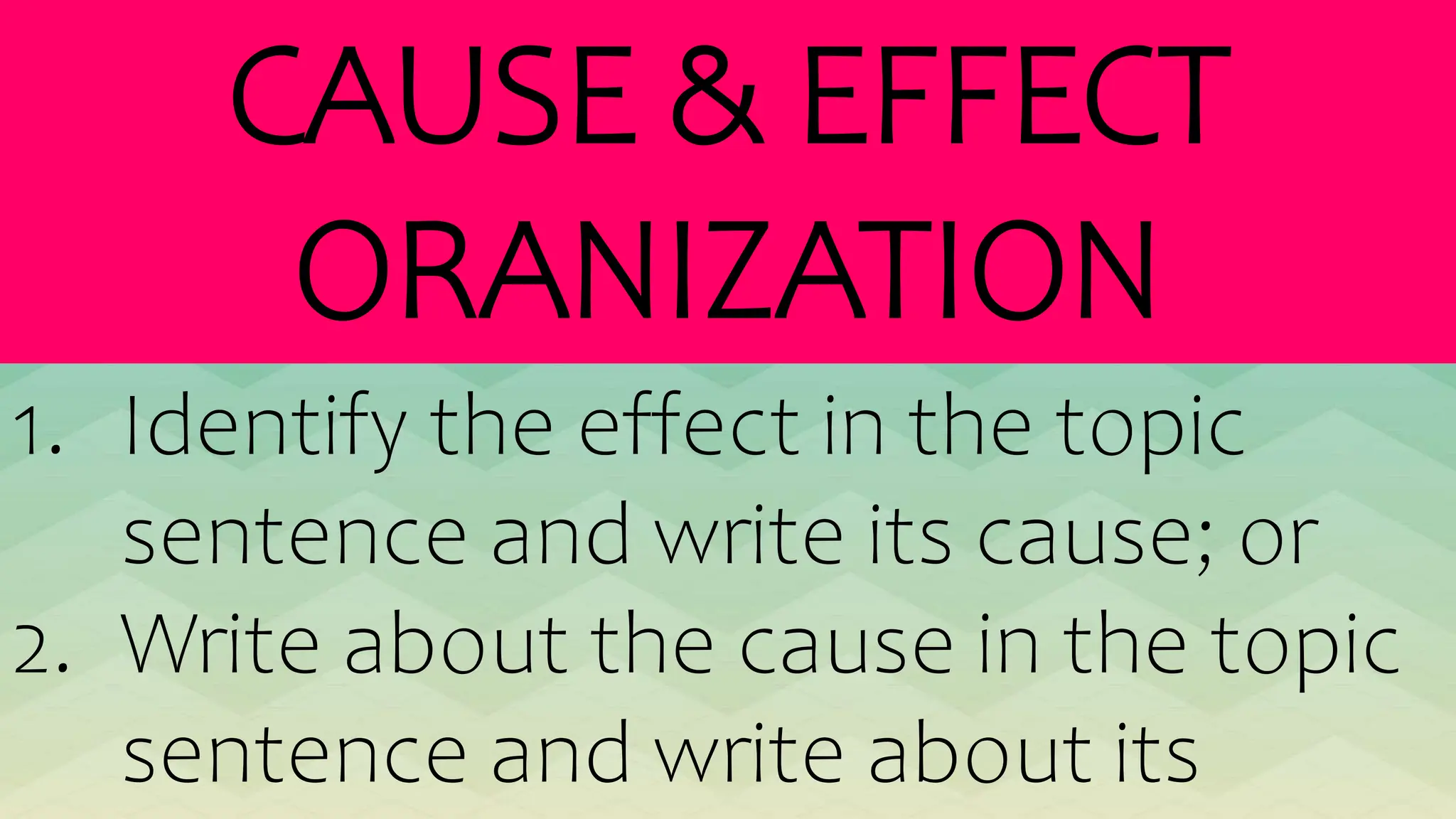
ORANIZATION
1. Identify the effect in the topic
sentence and write its cause; or
2. Write about the cause in the topic
sentence and write about its
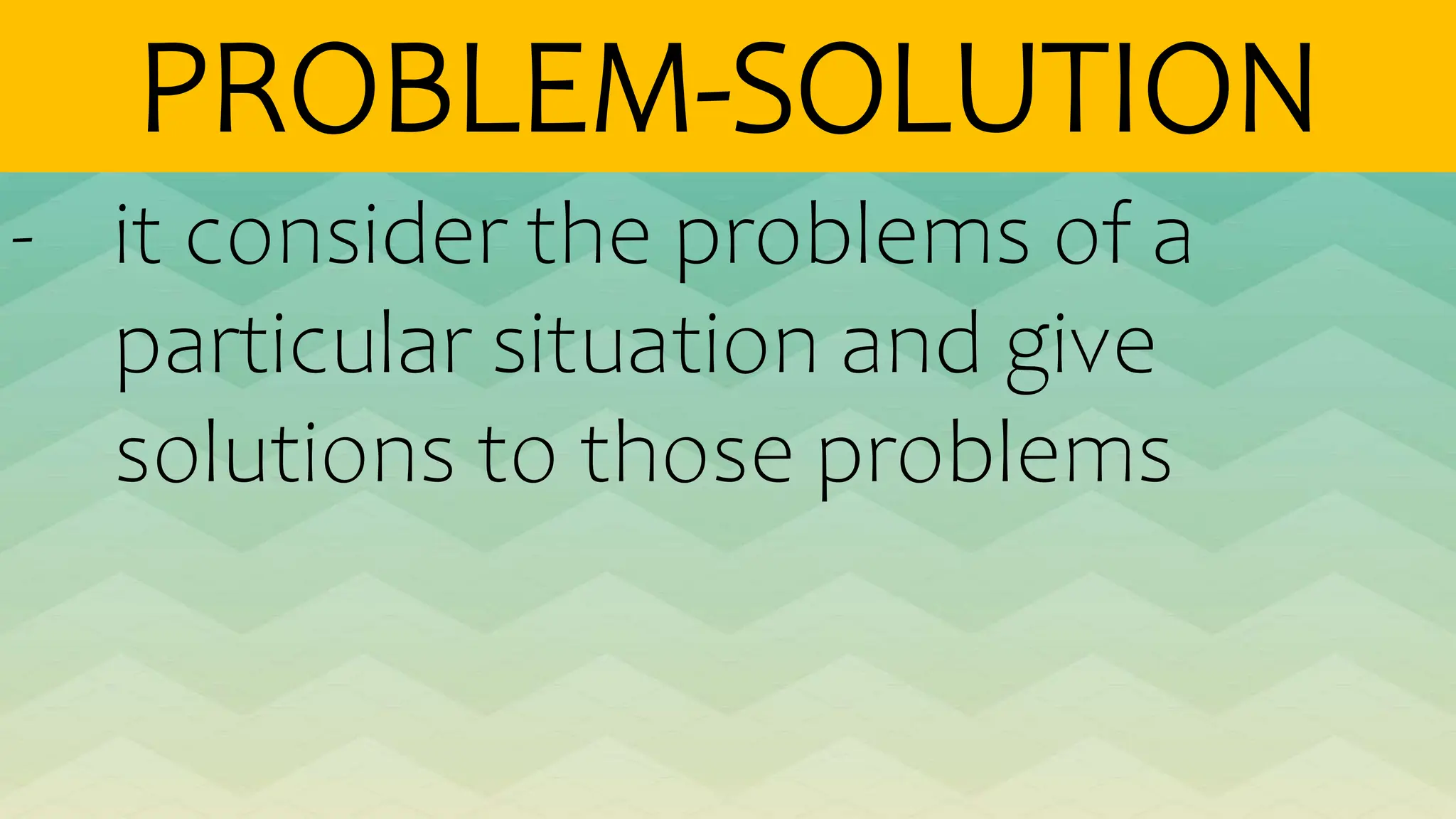
PROBLEM-SOLUTION
- it consider the problems of a
particular situation and give
solutions to those problems
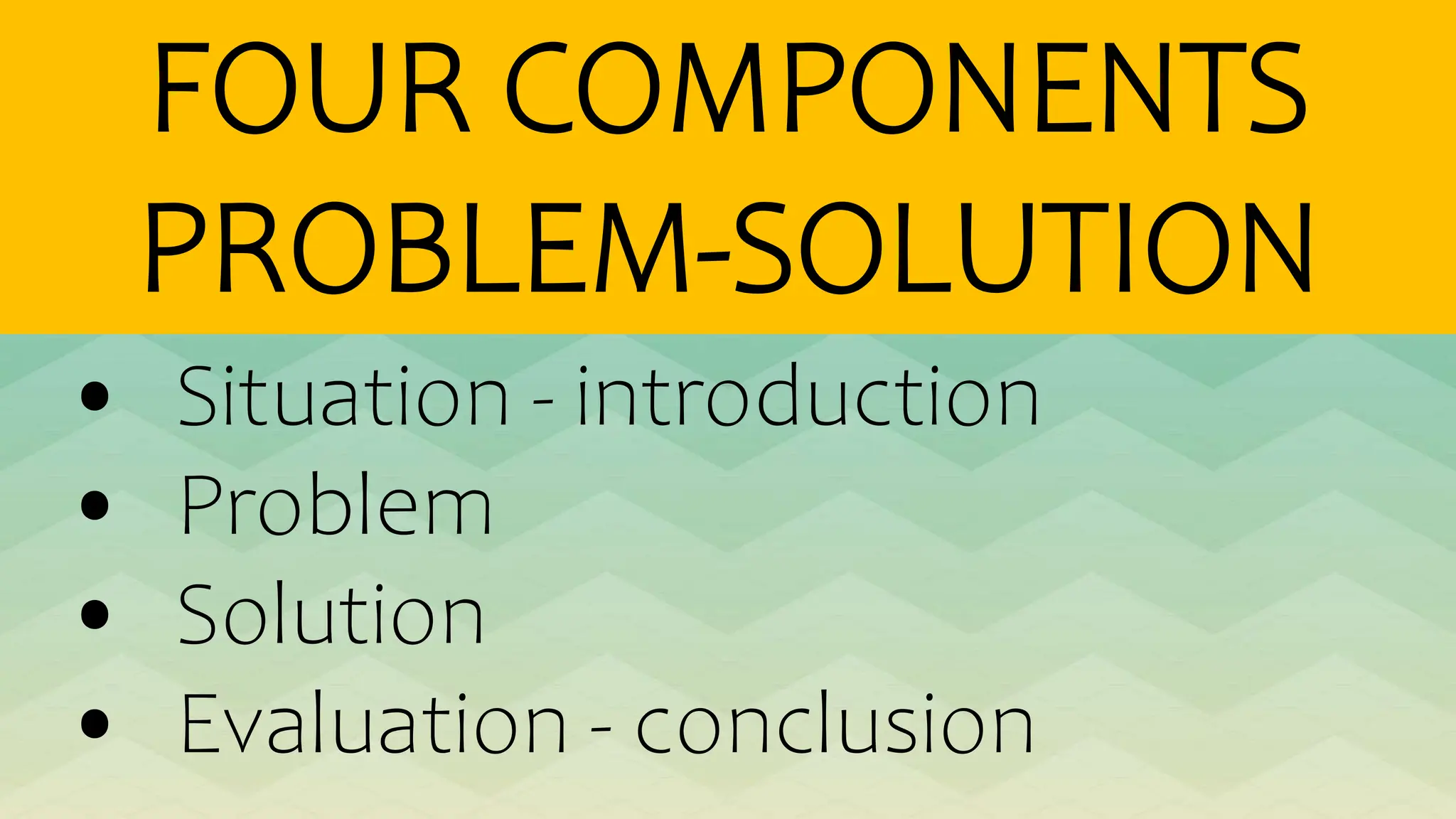
FOUR COMPONENTS
PROBLEM-SOLUTION
• Situation - introduction
• Problem
• Solution
• Evaluation - conclusion
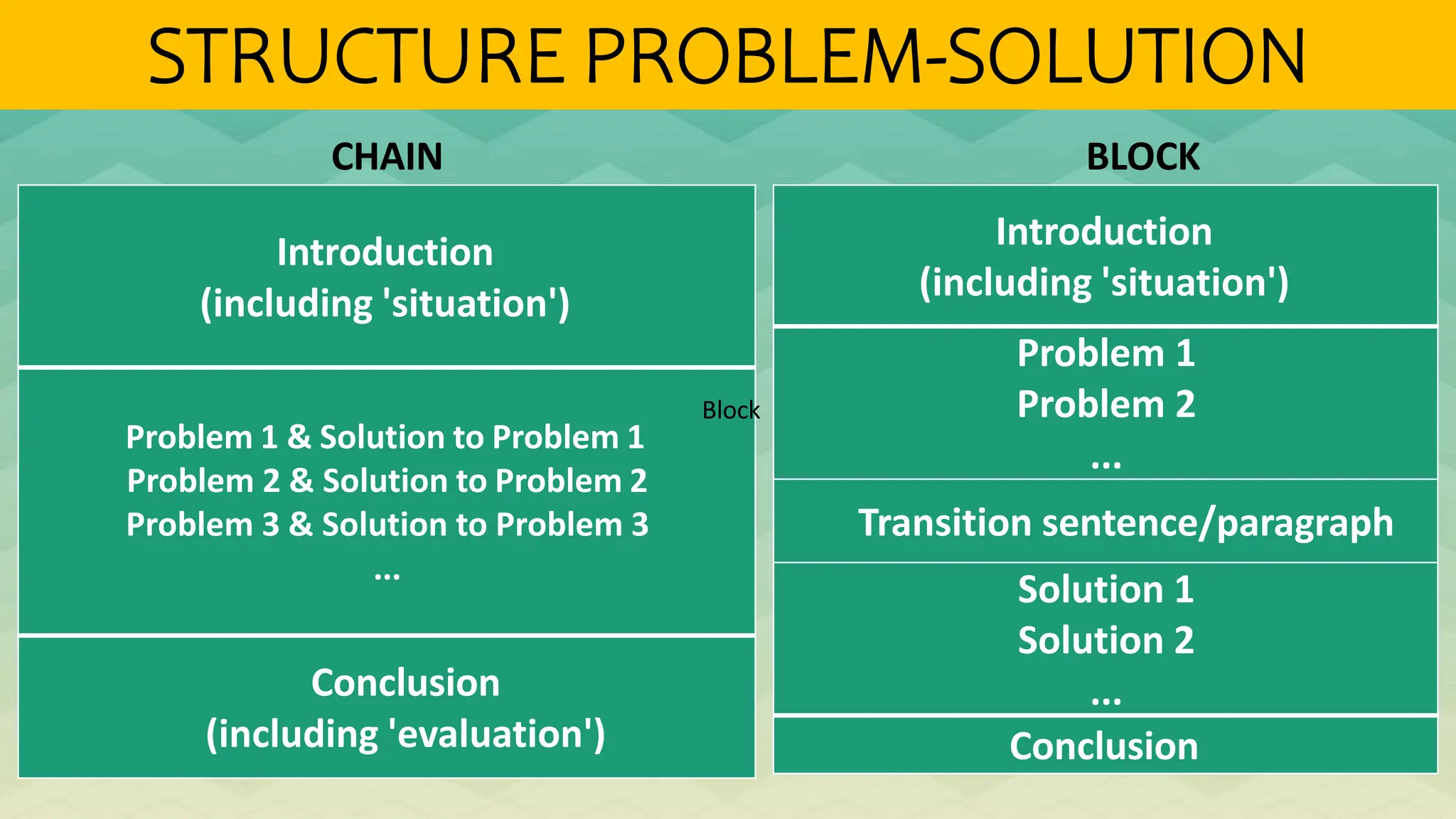
Introduction
(including 'situation')
Problem 1 & Solution to Problem 1
Problem 2 & Solution to Problem 2
Problem 3 & Solution to Problem 3
...
Conclusion
(including 'evaluation')
STRUCTURE PROBLEM-SOLUTION
Introduction
(including 'situation')
Problem 1
Problem 2
...
Transition sentence/paragraph
Solution 1
Solution 2
...
Conclusion
CHAIN
Block
BLOCK
PERSUASION
- means to convince someone that
your opinion on a subject is the
right one
Methods of Persuasion
• FACTS - A statement of what is.
• REFERRING TO AUTHORITY - An
expert who can be relied on to give
unbiased facts and information.
Methods of Persuasion
• EXAMPLES - An example should
clearly relate to the argument and
should be typical enough to support
it.
Methods of Persuasion
• PREDICTING THE CONSEQUENCE -
Helps the reader visualize what will
occur if something does or does not
happen.
Methods of Persuasion
• ANSWERING THE OPPOSITION-
Answering possible critics shows you
are aware of the opposing opinion
and are able to respond to it.

Patterns of Written Texts Across Disciplines.pptx

  • 1.
  • 3.
    PATTERNS OF DEVELOPMENT Structures writers use to organize their ideas.  Use to connect your ideas and provide enough details in your writing.  Use to arrange ideas to achieve the writers purpose in writing the text.
  • 4.
    PATTERNS OF DEVELOPMENT ACROSSDISCIPLINES a) Narration b) Description c) Definition d) Exemplification/ Classification e) Comparison and Contrast f) Cause and Effect g) Problem – Solution h) Persuasion
  • 5.
    NARRATION It is usedto tell a story or focus on a set of events.
  • 6.
    NARRATIVE TEXT Any typeof writing that relates a series of events and includes both fiction and nonfiction
  • 7.
    PURPOSE OF NARRATIVE TEXT Toentertain To gain a reader’s interest To hold a reader’s interest
  • 8.
    ELEMENTS OF NARRATIVE TEXT 1.Setting –time and location 2. Characters –significant part of the story 3. Plot –planned, logical series of events
  • 9.
    PARTS OF PLOT a)Exposition-charactersand settings are revealed b)Rising Action-events of the story become complicated and the conflict is exposed c)Climax-highest point of interest and the turning point of the story d)Falling Action-events and complications begins to resolve e)Point of View-perspective of the writer(1st, 2nd & 3rd)
  • 10.
    DESCRIPTION It states thedetails of what something looks like and its characteristics
  • 11.
    KINDS OF DESCRIPTION 1)Objective Description -it describes something without conveying the writer’s own emotions -it is used in technical or scientific writing
  • 12.
    KINDS OF DESCRIPTION 2)Subjective Description -it conveys feelings and emotions about a person, place, or thing. -it is conveying impressions and contains specific details
  • 13.
    DEFINITION It explains whata term means. You use this when you want your readers to know exactly how you are using a certain term or an unfamiliar concept
  • 14.
    TYPES OF DEFINITION 1)Formal Definition -the definitions provided in dictionaries -it as three (3) general elements: a. term - the word being defined b. class – refers to the group to which the term belongs c. differentiating features – the word or phrase that makes it different with the others from the same
  • 15.
    FORMAL DEFINITION a) ScientificWriting -form of writing based on actual and relevant studies b) Science -the field of study which attempts to describe and understand the nature of the universe
  • 16.
    TYPES OF DEFINITION 2)Informal Definition a. Operational Definitions b. Synonyms c. Denotation d. Connotation
  • 17.
    TYPES OF INFORMAL DEFINITION a)Operational Definitions –give the meaning of an abstract word for one particular time and place.
  • 18.
    TYPES OF INFORMAL DEFINITION b)Synonyms – words that mean the same as another word
  • 19.
    TYPES OF INFORMAL DEFINITION c)Denotation – exact meaning of the word or thing
  • 20.
    TYPES OF INFORMAL DEFINITION d)Connotation – an idea or meaning suggested by or associated with a word or thing
  • 21.
    TYPES OF DEFINITION 3)Definition Paragraph –is a definition sentence that is extended into a paragraph by adding meanings, descriptions, narrations -starts with a definition sentence which is used as a topic sentence then, a supporting and concluding statement
  • 22.
    CLASSIFICATION - divide atopic into its component parts - categorize a group of related items or events
  • 23.
    • CLASSIFICATION – issorting – focuses on similarities • DIVISION – is breaking into parts – focuses on differences
  • 24.
    COMPARISON & CONTRAST COMPARE –similar CONTRAST – difference
  • 27.
    CAUSE & EFFECT CAUSE– is what makes a particular thing happen EFFECT – is what the results from a particular situation, activity, or behavior
  • 28.
    CAUSE & EFFECT STRUCTURE 1.BLOCK –all of the causes are listed first, and all the effects are listed afterwards 2. CHAIN –each cause is followed by the effect
  • 29.
    CAUSE & EFFECT PURPOSE -is to help readers understand why something happened or is happening - when you want to show readers how one thing affects something else
  • 30.
    CAUSAL RELATIONSHIP - oneevent caused another event and did not just precede in time
  • 31.
    CAUSE & EFFECT ORANIZATION 1.Identify the effect in the topic sentence and write its cause; or 2. Write about the cause in the topic sentence and write about its
  • 32.
    PROBLEM-SOLUTION - it considerthe problems of a particular situation and give solutions to those problems
  • 33.
    FOUR COMPONENTS PROBLEM-SOLUTION • Situation- introduction • Problem • Solution • Evaluation - conclusion
  • 34.
    Introduction (including 'situation') Problem 1& Solution to Problem 1 Problem 2 & Solution to Problem 2 Problem 3 & Solution to Problem 3 ... Conclusion (including 'evaluation') STRUCTURE PROBLEM-SOLUTION Introduction (including 'situation') Problem 1 Problem 2 ... Transition sentence/paragraph Solution 1 Solution 2 ... Conclusion CHAIN Block BLOCK
  • 35.
    PERSUASION - means toconvince someone that your opinion on a subject is the right one
  • 36.
    Methods of Persuasion •FACTS - A statement of what is. • REFERRING TO AUTHORITY - An expert who can be relied on to give unbiased facts and information.
  • 37.
    Methods of Persuasion •EXAMPLES - An example should clearly relate to the argument and should be typical enough to support it.
  • 38.
    Methods of Persuasion •PREDICTING THE CONSEQUENCE - Helps the reader visualize what will occur if something does or does not happen.
  • 39.
    Methods of Persuasion •ANSWERING THE OPPOSITION- Answering possible critics shows you are aware of the opposing opinion and are able to respond to it.