

HAIKU
POETRY
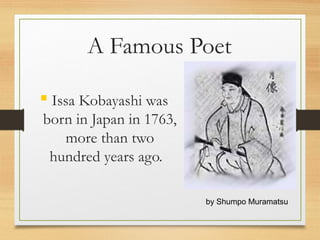
A Famous Poet
 Issa Kobayashi was
born in Japan in 1763,
more than two
hundred years ago.
by Shumpo Muramatsu
• Issa had a poet’s eyes. He noticed
things many people would not. He
took the time to look, to listen, and to
enjoy the movements of the many
small creatures who shared his world,
like sparrows, crickets, and frogs.
• Issa had a compassionate feeling for
all creatures, including fleas and flies.
He felt even common houseflies have
a right to live, and would not swat
them.
In many ways, Issa’s life was a sad one.
His mother died before he was two, and
his own four sons and a daughter all
died before they were a year old, a great
sorrow to a man who loved children as
much as Issa did.
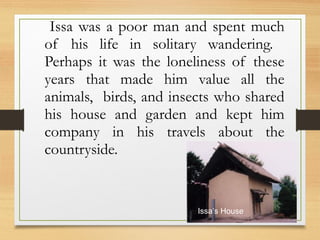
Issa was a poor man and spent much
of his life in solitary wandering.
Perhaps it was the loneliness of these
years that made him value all the
animals, birds, and insects who shared
his house and garden and kept him
company in his travels about the
countryside.
Issa’s House
At the age of 25, Issa began to write
haiku poems. Many of his poems are
about the humble creatures he loved.
Here is one of Issa’s haiku poems.
A few flies and I
Keep house together
In this humble home.
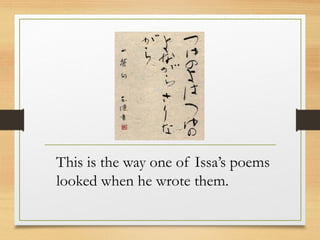
This is the way one of Issa’s poems
looked when he wrote them.
Style in Writing Poetry
 Some poems contain a beautiful
image.
 Some are funny.
 Some make you think.
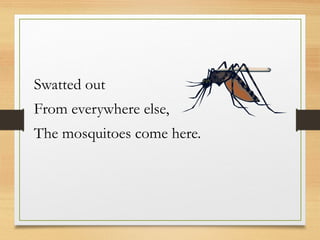
Swatted out
From everywhere else,
The mosquitoes come here.
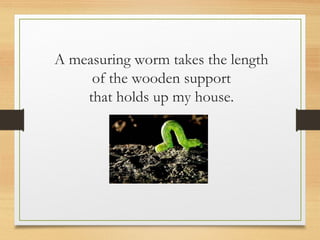
A measuring worm takes the length
of the wooden support
that holds up my house.
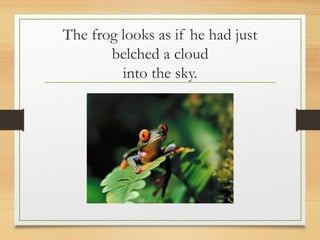
The frog looks as if he had just
belched a cloud
into the sky.
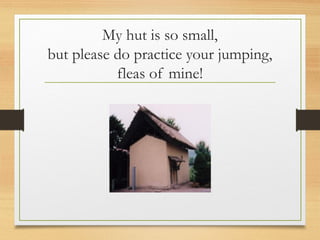
My hut is so small,
but please do practice your jumping,
fleas of mine!
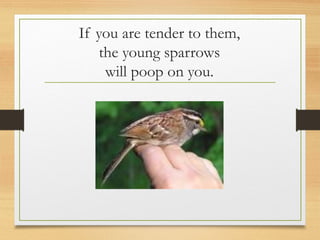
If you are tender to them,
the young sparrows
will poop on you.
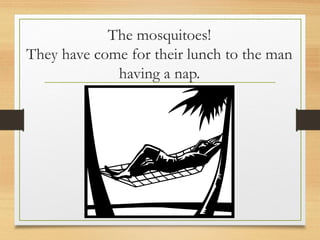
The mosquitoes!
They have come for their lunch to the man
having a nap.
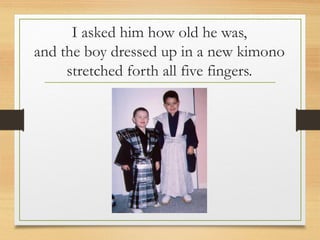
I asked him how old he was,
and the boy dressed up in a new kimono
stretched forth all five fingers.
HAIKU
• It was created centuries ago.
• It was treasured for its pure form and
exquisite content.
• Western culture has grown to love and
respect this special type of poetry.
Writing your own haiku is easy.
Follow these seven easy steps.
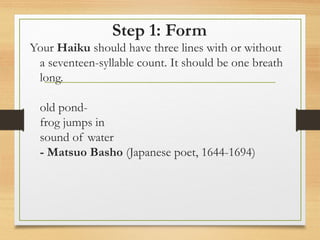
Step 1: Form
Your Haiku should have three lines with or without
a seventeen-syllable count. It should be one breath
long.
old pond-
frog jumps in
sound of water
- Matsuo Basho (Japanese poet, 1644-1694)
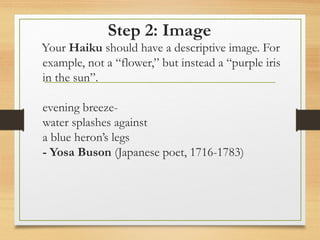
Step 2: Image
Your Haiku should have a descriptive image. For
example, not a “flower,” but instead a “purple iris
in the sun”.
evening breeze-
water splashes against
a blue heron’s legs
- Yosa Buson (Japanese poet, 1716-1783)
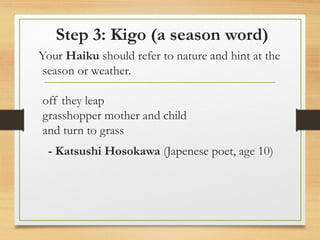
Step 3: Kigo (a season word)
Your Haiku should refer to nature and hint at the
season or weather.
off they leap
grasshopper mother and child
and turn to grass
- Katsushi Hosokawa (Japenese poet, age 10)
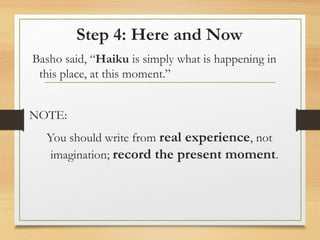
Step 4: Here and Now
Basho said, “Haiku is simply what is happening in
this place, at this moment.”
NOTE:
You should write from real experience, not
imagination; record the present moment.
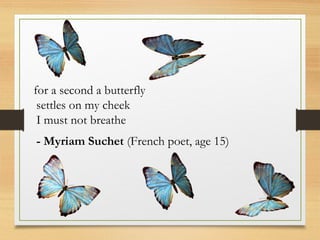
for a second a butterfly
settles on my cheek
I must not breathe
- Myriam Suchet (French poet, age 15)
Step 5: Feeling
Your Haiku should not explain or tell, but instead
show the feeling through your image.
along with spring leaves
my child’s teeth
are coming in
- Nakamura Kusatao (Japanese poet, 1901-1983)
Step 6: Surprise!
Your Haiku should have an “ah!” moment that
wakes us up.
in a mouse’s nest
someone’s love letter
was found
- Unknown Japanese Poet
Step 7: Compassion
Your Haiku should express openheartedness
toward nature.
Don’t hit the fly-
He prays with his hands
And his feet
- Kobayashi Issa (Japanese poet, 1763-1827)
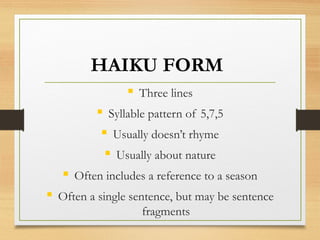
HAIKU FORM
 Three lines
 Syllable pattern of 5,7,5
 Usually doesn’t rhyme
 Usually about nature
 Often includes a reference to a season
 Often a single sentence, but may be sentence
fragments
Now try writing your own!


Haiku Poetry

  • 1.
  • 2.
    A Famous Poet Issa Kobayashi was born in Japan in 1763, more than two hundred years ago. by Shumpo Muramatsu
  • 3.
    • Issa hada poet’s eyes. He noticed things many people would not. He took the time to look, to listen, and to enjoy the movements of the many small creatures who shared his world, like sparrows, crickets, and frogs. • Issa had a compassionate feeling for all creatures, including fleas and flies. He felt even common houseflies have a right to live, and would not swat them.
  • 4.
    In many ways,Issa’s life was a sad one. His mother died before he was two, and his own four sons and a daughter all died before they were a year old, a great sorrow to a man who loved children as much as Issa did.
  • 5.
    Issa was apoor man and spent much of his life in solitary wandering. Perhaps it was the loneliness of these years that made him value all the animals, birds, and insects who shared his house and garden and kept him company in his travels about the countryside. Issa’s House
  • 6.
    At the ageof 25, Issa began to write haiku poems. Many of his poems are about the humble creatures he loved.
  • 7.
    Here is oneof Issa’s haiku poems. A few flies and I Keep house together In this humble home.
  • 8.
    This is theway one of Issa’s poems looked when he wrote them.
  • 9.
    Style in WritingPoetry  Some poems contain a beautiful image.  Some are funny.  Some make you think.
  • 10.
    Swatted out From everywhereelse, The mosquitoes come here.
  • 11.
    A measuring wormtakes the length of the wooden support that holds up my house.
  • 12.
    The frog looksas if he had just belched a cloud into the sky.
  • 13.
    My hut isso small, but please do practice your jumping, fleas of mine!
  • 14.
    If you aretender to them, the young sparrows will poop on you.
  • 15.
    The mosquitoes! They havecome for their lunch to the man having a nap.
  • 16.
    I asked himhow old he was, and the boy dressed up in a new kimono stretched forth all five fingers.
  • 17.
    HAIKU • It wascreated centuries ago. • It was treasured for its pure form and exquisite content. • Western culture has grown to love and respect this special type of poetry.
  • 18.
    Writing your ownhaiku is easy. Follow these seven easy steps.
  • 19.
    Step 1: Form YourHaiku should have three lines with or without a seventeen-syllable count. It should be one breath long. old pond- frog jumps in sound of water - Matsuo Basho (Japanese poet, 1644-1694)
  • 20.
    Step 2: Image YourHaiku should have a descriptive image. For example, not a “flower,” but instead a “purple iris in the sun”. evening breeze- water splashes against a blue heron’s legs - Yosa Buson (Japanese poet, 1716-1783)
  • 21.
    Step 3: Kigo(a season word) Your Haiku should refer to nature and hint at the season or weather. off they leap grasshopper mother and child and turn to grass - Katsushi Hosokawa (Japenese poet, age 10)
  • 22.
    Step 4: Hereand Now Basho said, “Haiku is simply what is happening in this place, at this moment.” NOTE: You should write from real experience, not imagination; record the present moment.
  • 23.
    for a seconda butterfly settles on my cheek I must not breathe - Myriam Suchet (French poet, age 15)
  • 24.
    Step 5: Feeling YourHaiku should not explain or tell, but instead show the feeling through your image. along with spring leaves my child’s teeth are coming in - Nakamura Kusatao (Japanese poet, 1901-1983)
  • 25.
    Step 6: Surprise! YourHaiku should have an “ah!” moment that wakes us up. in a mouse’s nest someone’s love letter was found - Unknown Japanese Poet
  • 26.
    Step 7: Compassion YourHaiku should express openheartedness toward nature. Don’t hit the fly- He prays with his hands And his feet - Kobayashi Issa (Japanese poet, 1763-1827)
  • 27.
    HAIKU FORM  Threelines  Syllable pattern of 5,7,5  Usually doesn’t rhyme  Usually about nature  Often includes a reference to a season  Often a single sentence, but may be sentence fragments
  • 28.
    Now try writingyour own! 