Improving quality, safety 
and lives -The Patient 
Safety Collaborative 
Programme 2014-2019 
NHS Improving Quality 
Chief Nursing 
Officer for England’s 
Summit 2014 
Barbara Zutshi 
26 November 2014Network
Responding to Francis and 
Berwick 
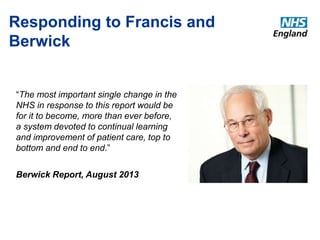
“The most important single change in the 
NHS in response to this report would be 
for it to become, more than ever before, 
a system devoted to continual learning 
and improvement of patient care, top to 
bottom and end to end.” 
Berwick Report, August 2013
For NHS staff and clinicians 
• Participate actively in the improvement of systems of 
care. 
• Acquire the skills to do so. 
• Speak up when things go wrong. 
• Involve patients as active partners and co-producers 
in their own care.
For patients and carers 
• As far as you are able, become active partners in 
your healthcare and always expect to be treated as 
such by those providing your healthcare. 
• Speak up about what you see – right and wrong. 
You have extraordinarily valuable information on the 
basis of which to make the NHS better.
Responding to Francis and 
Berwick 
“Following Don Berwick’s recommendation, NHS 
England will establish a new Patient Safety 
Collaborative Programme across England to 
spread best practice, build skills and capabilities in 
patient safety and improvement science, and to 
focus on actions that can make the biggest 
difference to patients in every part of the country. 
They will be supported to systematically tackle the 
leading causes of harm to patients. The 
programme will start in April 2014.” 
The government’s response to Francis 
and Berwick, November 2013
Patient safety collaboratives 
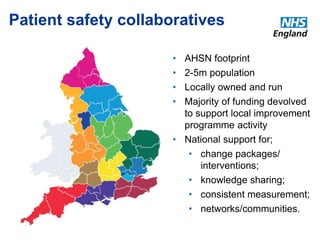
• AHSN footprint 
• 2-5m population 
• Locally owned and run 
• Majority of funding devolved 
to support local improvement 
programme activity 
• National support for; 
• change packages/ 
interventions; 
• knowledge sharing; 
• consistent measurement; 
• networks/communities.
A different kind of collaborative 
• Locally driven and led 
• Designed in partnership 
• Provide support, co-ordination & rapid spread and 
adoption 
• Developing capacity & capability for QI & Safety 
• Variation on traditional breakthrough model 
• Far reaching, all levels, whole system
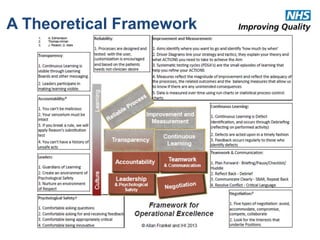
A Theoretical Framework
NHS IQ Role 
• A small national supporting / coordinating function 
• Developing joint approaches with partners to: 
o Measurement - expert group, baseline metric 
development and national aggregation 
o Leadership and Culture 
o Capability building 
o Programme evaluation and ROI 
o Partner with patients and carers 
• Provide QI and change expertise nationally 
• Develop programme support materials 
• Do what adds value nationally - help align work, connect 
and join up the dots
Collaboratives progress to date (1) 
• 15 patient safety collaboratives established in each AHSN 
across England and confirmed in July 2014 
• Event held on 14th Oct 2014 to formally launch patient safety 
collaboratives, supported by SoS and National Medical 
Director 
• Patient Safety Collaborative Programme Board established– 
Chaired by Norman Williams with membership from DH, 
NHS England, NHS IQ, AHSNs, NHS Leadership Academy, 
‘Sign up to Safety’ campaign 
• Leadership and Measurement groups being established and 
developing strategies with AHSNs 
• Funding devolved to AHSNs as contract uplift – recruiting 
posts etc
Collaboratives progress to date (2) 
• Local engagement with member organisations and 
establishment of patient safety priorities ongoing 
• AHSN’s connecting with organisations that have ‘signed up to 
safety’ to ensure alignment 
• Developed first stage improvement work plans for 2014/15 
that have been shared across all collaboratives. 
• Developing patient and carer engagement plans as a 
foundation of the work 
• Developing a central system that enables shared learning 
and practical implementation of good practice
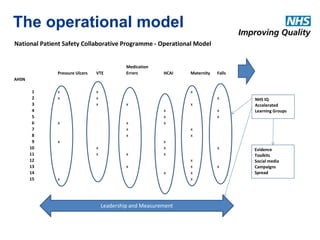
The operational model 
National Patient Safety Collaborative Programme - Operational Model 
Pressure Ulcers VTE 
Medication 
Errors HCAI Maternity Falls 
AHSN 
1 x x x 
2 x x x 
3 x x x 
4 x x 
5 x x 
6 x x x 
7 x x 
8 x x 
9 x x 
10 x x x 
11 x x x 
12 x 
13 x x x 
14 x x 
15 x x 
Leadership and Measurement 
NHS IQ 
Accelerated 
Learning Groups 
Evidence 
Toolkits 
Social media 
Campaigns 
Spread
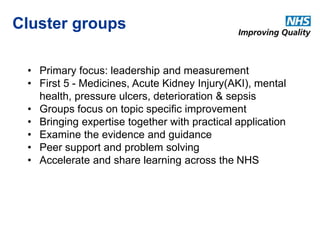
Cluster groups 
• Primary focus: leadership and measurement 
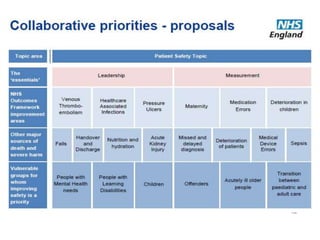
• First 5 - Medicines, Acute Kidney Injury(AKI), mental 
health, pressure ulcers, deterioration & sepsis 
• Groups focus on topic specific improvement 
• Bringing expertise together with practical application 
• Examine the evidence and guidance 
• Peer support and problem solving 
• Accelerate and share learning across the NHS
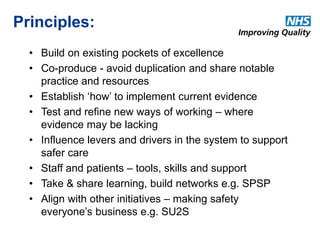
Principles: 
• Build on existing pockets of excellence 
• Co-produce - avoid duplication and share notable 
practice and resources 
• Establish ‘how’ to implement current evidence 
• Test and refine new ways of working – where 
evidence may be lacking 
• Influence levers and drivers in the system to support 
safer care 
• Staff and patients – tools, skills and support 
• Take & share learning, build networks e.g. SPSP 
• Align with other initiatives – making safety 
everyone’s business e.g. SU2S
16
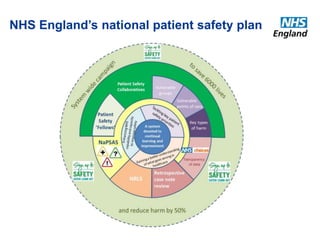
NHS England’s national patient safety plan
THANK YOU 
Barbara.zutshi@nhsiq.nhs.uk 
#saferNHS 
Improving health outcomes across England 
by providing improvement and change expertise.
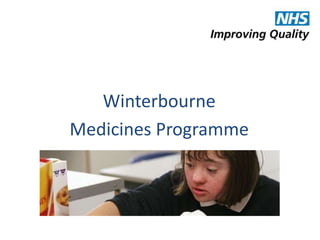
Winterbourne 
Medicines Programme 
Carol Marley - Improvement Manager 
@NHSIQ #winterbourne_meds 
@ZoeLord1 @CarolMarley3 
Improving health outcomes across England by providing improvement and change expertise
A national response to Winterbourne View Hospital 
“7.31 We have heard deep concerns about over-use of 
antipsychotic and antidepressant medicines. 
Health professionals caring for people with learning 
disabilities should assess and keep under review the 
medicines requirements for each individual patient to 
determine the best course of action for that patient, taking 
into account the views of the person if possible and their 
family and/or carer. Services should have systems and 
policies in place to ensure that this is done safely and in a 
timely manner and should carry out regular audits of 
medication prescribing and management, involving 
pharmacists, doctors and nurses.”
Case For Change 
• It has been estimated that over 1 million people in England 
(2% of the population) have a learning disability. 
• The numbers known to learning disability services are much 
smaller: an estimated 236,235 people. 
• Between 20% and 66% of people with learning disabilities are 
given psychotropic medication. 
• Psychotropic medication is used to treat mental health 
disorders; however the majority of people with a learning 
disability who demonstrate challenging behaviour do not 
have a mental health diagnosis.
Case For Change… 
• It is often used as a form of chemical constraint for 
behaviour management rather than to treat mental health 
problems. Its effectiveness in addressing challenging 
behaviour is questionable and there are strong arguments 
for stopping (Winterbourne View – A serious Case Review) 
• Studies note that the concurrent prescription of more than 
one antipsychotic was associated with reduced survival.
Winterbourne 
Medicines Programme
Programme Board and Reference Group 
• Chaired by Dr Keith Ridge 
• Family / Carers 
• Department of Health 
• NHS England 
• NHS Improving Quality 
• Royal Colleges across professions 
• Care Quality Commission 
• Independent sector 
• Charities
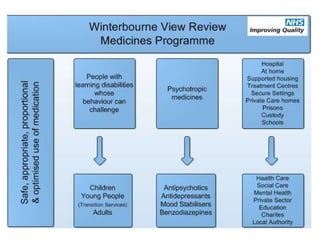
Aim of the Winterbourne Medicines 
Programme 
Safe, appropriate and optimised use of medication 
for people with learning disabilities whose behaviour 
can challenge
Programme Objectives: 
1. Ensure the service user is central to the work. 
2. To review and develop a deep understanding of issues 
around current medication processes. 
3. To identify and share notable practice. 
4. To identify a method of measuring change and 
improvement. 
5. Test new ways of working to improve process where 
appropriate. 
6. To improve awareness of the issues around medication.
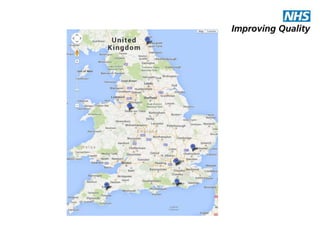
Working in partnership with: 
• Northumberland Tyne and Wear NHS Foundation Trust 
• Cheshire and Wirral Partnership NHS Foundation Trust 
• South West London and St Georges Mental Health Trust 
• Sussex Partnership NHS Foundation Trust 
• Hertfordshire Partnership Foundation Trust 
• Devon Partnership NHS Trust
Community of Practice… 
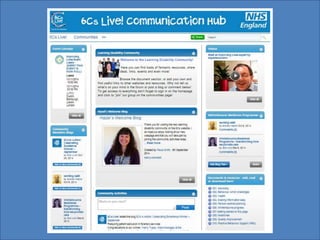
• 6C’s Website - www.6cs.england.nhs.uk 
• Blogs 
• Research Papers 
• Documents & Publications 
• News Articles 
• Links and websites 
• Forums 
• Hot topics via webex! 
• Quality Improvement Training
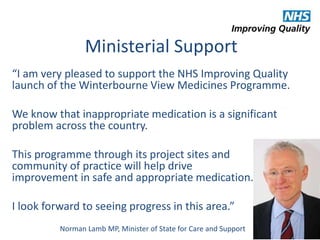
Ministerial Support 
“I am very pleased to support the NHS Improving Quality 
launch of the Winterbourne View Medicines Programme. 
We know that inappropriate medication is a significant 
problem across the country. 
This programme through its project sites and 
community of practice will help drive 
improvement in safe and appropriate medication. 
I look forward to seeing progress in this area.” 
Norman Lamb MP, Minister of State for Care and Support
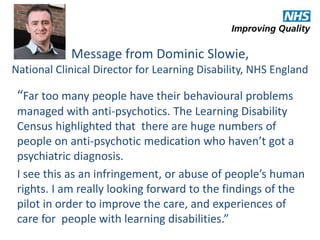
Message from Dominic Slowie, 
National Clinical Director for Learning Disability, NHS England 
“Far too many people have their behavioural problems 
managed with anti-psychotics. The Learning Disability 
Census highlighted that there are huge numbers of 
people on anti-psychotic medication who haven’t got a 
psychiatric diagnosis. 
I see this as an infringement, or abuse of people’s human 
rights. I am really looking forward to the findings of the 
pilot in order to improve the care, and experiences of 
care for people with learning disabilities.”
Winterbourne 
Medicines Programme

Patient safety collaboratives

  • 1.
    Improving quality, safety and lives -The Patient Safety Collaborative Programme 2014-2019 NHS Improving Quality Chief Nursing Officer for England’s Summit 2014 Barbara Zutshi 26 November 2014Network
  • 2.
    Responding to Francisand Berwick “The most important single change in the NHS in response to this report would be for it to become, more than ever before, a system devoted to continual learning and improvement of patient care, top to bottom and end to end.” Berwick Report, August 2013
  • 3.
    For NHS staffand clinicians • Participate actively in the improvement of systems of care. • Acquire the skills to do so. • Speak up when things go wrong. • Involve patients as active partners and co-producers in their own care.
  • 4.
    For patients andcarers • As far as you are able, become active partners in your healthcare and always expect to be treated as such by those providing your healthcare. • Speak up about what you see – right and wrong. You have extraordinarily valuable information on the basis of which to make the NHS better.
  • 5.
    Responding to Francisand Berwick “Following Don Berwick’s recommendation, NHS England will establish a new Patient Safety Collaborative Programme across England to spread best practice, build skills and capabilities in patient safety and improvement science, and to focus on actions that can make the biggest difference to patients in every part of the country. They will be supported to systematically tackle the leading causes of harm to patients. The programme will start in April 2014.” The government’s response to Francis and Berwick, November 2013
  • 6.
    Patient safety collaboratives • AHSN footprint • 2-5m population • Locally owned and run • Majority of funding devolved to support local improvement programme activity • National support for; • change packages/ interventions; • knowledge sharing; • consistent measurement; • networks/communities.
  • 7.
    A different kindof collaborative • Locally driven and led • Designed in partnership • Provide support, co-ordination & rapid spread and adoption • Developing capacity & capability for QI & Safety • Variation on traditional breakthrough model • Far reaching, all levels, whole system
  • 9.
  • 10.
    NHS IQ Role • A small national supporting / coordinating function • Developing joint approaches with partners to: o Measurement - expert group, baseline metric development and national aggregation o Leadership and Culture o Capability building o Programme evaluation and ROI o Partner with patients and carers • Provide QI and change expertise nationally • Develop programme support materials • Do what adds value nationally - help align work, connect and join up the dots
  • 11.
    Collaboratives progress todate (1) • 15 patient safety collaboratives established in each AHSN across England and confirmed in July 2014 • Event held on 14th Oct 2014 to formally launch patient safety collaboratives, supported by SoS and National Medical Director • Patient Safety Collaborative Programme Board established– Chaired by Norman Williams with membership from DH, NHS England, NHS IQ, AHSNs, NHS Leadership Academy, ‘Sign up to Safety’ campaign • Leadership and Measurement groups being established and developing strategies with AHSNs • Funding devolved to AHSNs as contract uplift – recruiting posts etc
  • 12.
    Collaboratives progress todate (2) • Local engagement with member organisations and establishment of patient safety priorities ongoing • AHSN’s connecting with organisations that have ‘signed up to safety’ to ensure alignment • Developed first stage improvement work plans for 2014/15 that have been shared across all collaboratives. • Developing patient and carer engagement plans as a foundation of the work • Developing a central system that enables shared learning and practical implementation of good practice
  • 13.
    The operational model National Patient Safety Collaborative Programme - Operational Model Pressure Ulcers VTE Medication Errors HCAI Maternity Falls AHSN 1 x x x 2 x x x 3 x x x 4 x x 5 x x 6 x x x 7 x x 8 x x 9 x x 10 x x x 11 x x x 12 x 13 x x x 14 x x 15 x x Leadership and Measurement NHS IQ Accelerated Learning Groups Evidence Toolkits Social media Campaigns Spread
  • 14.
    Cluster groups •Primary focus: leadership and measurement • First 5 - Medicines, Acute Kidney Injury(AKI), mental health, pressure ulcers, deterioration & sepsis • Groups focus on topic specific improvement • Bringing expertise together with practical application • Examine the evidence and guidance • Peer support and problem solving • Accelerate and share learning across the NHS
  • 15.
    Principles: • Buildon existing pockets of excellence • Co-produce - avoid duplication and share notable practice and resources • Establish ‘how’ to implement current evidence • Test and refine new ways of working – where evidence may be lacking • Influence levers and drivers in the system to support safer care • Staff and patients – tools, skills and support • Take & share learning, build networks e.g. SPSP • Align with other initiatives – making safety everyone’s business e.g. SU2S
  • 16.
  • 17.
    NHS England’s nationalpatient safety plan
  • 18.
    THANK YOU Barbara.zutshi@nhsiq.nhs.uk #saferNHS Improving health outcomes across England by providing improvement and change expertise.
  • 19.
    Winterbourne Medicines Programme Carol Marley - Improvement Manager @NHSIQ #winterbourne_meds @ZoeLord1 @CarolMarley3 Improving health outcomes across England by providing improvement and change expertise
  • 20.
    A national responseto Winterbourne View Hospital “7.31 We have heard deep concerns about over-use of antipsychotic and antidepressant medicines. Health professionals caring for people with learning disabilities should assess and keep under review the medicines requirements for each individual patient to determine the best course of action for that patient, taking into account the views of the person if possible and their family and/or carer. Services should have systems and policies in place to ensure that this is done safely and in a timely manner and should carry out regular audits of medication prescribing and management, involving pharmacists, doctors and nurses.”
  • 21.
    Case For Change • It has been estimated that over 1 million people in England (2% of the population) have a learning disability. • The numbers known to learning disability services are much smaller: an estimated 236,235 people. • Between 20% and 66% of people with learning disabilities are given psychotropic medication. • Psychotropic medication is used to treat mental health disorders; however the majority of people with a learning disability who demonstrate challenging behaviour do not have a mental health diagnosis.
  • 22.
    Case For Change… • It is often used as a form of chemical constraint for behaviour management rather than to treat mental health problems. Its effectiveness in addressing challenging behaviour is questionable and there are strong arguments for stopping (Winterbourne View – A serious Case Review) • Studies note that the concurrent prescription of more than one antipsychotic was associated with reduced survival.
  • 23.
  • 24.
    Programme Board andReference Group • Chaired by Dr Keith Ridge • Family / Carers • Department of Health • NHS England • NHS Improving Quality • Royal Colleges across professions • Care Quality Commission • Independent sector • Charities
  • 25.
    Aim of theWinterbourne Medicines Programme Safe, appropriate and optimised use of medication for people with learning disabilities whose behaviour can challenge
  • 27.
    Programme Objectives: 1.Ensure the service user is central to the work. 2. To review and develop a deep understanding of issues around current medication processes. 3. To identify and share notable practice. 4. To identify a method of measuring change and improvement. 5. Test new ways of working to improve process where appropriate. 6. To improve awareness of the issues around medication.
  • 28.
    Working in partnershipwith: • Northumberland Tyne and Wear NHS Foundation Trust • Cheshire and Wirral Partnership NHS Foundation Trust • South West London and St Georges Mental Health Trust • Sussex Partnership NHS Foundation Trust • Hertfordshire Partnership Foundation Trust • Devon Partnership NHS Trust
  • 30.
    Community of Practice… • 6C’s Website - www.6cs.england.nhs.uk • Blogs • Research Papers • Documents & Publications • News Articles • Links and websites • Forums • Hot topics via webex! • Quality Improvement Training
  • 32.
    Ministerial Support “Iam very pleased to support the NHS Improving Quality launch of the Winterbourne View Medicines Programme. We know that inappropriate medication is a significant problem across the country. This programme through its project sites and community of practice will help drive improvement in safe and appropriate medication. I look forward to seeing progress in this area.” Norman Lamb MP, Minister of State for Care and Support
  • 33.
    Message from DominicSlowie, National Clinical Director for Learning Disability, NHS England “Far too many people have their behavioural problems managed with anti-psychotics. The Learning Disability Census highlighted that there are huge numbers of people on anti-psychotic medication who haven’t got a psychiatric diagnosis. I see this as an infringement, or abuse of people’s human rights. I am really looking forward to the findings of the pilot in order to improve the care, and experiences of care for people with learning disabilities.”
  • 34.

Editor's Notes

  • #14 In practical terms…
  • #22 It has been estimated that 1,043,449 people in England (2% of the population) have a learning disability. The numbers known to learning disability services are much smaller: an estimated 236,235 people. Figures taken from The Improving Health and Lives Learning Disabilities Observatory (IHAL), 2013.