Launch of Primary Care
Collaborative Cohort 2
24 May 2017
Bath
Academic Health Science Networks
We are one of 15 AHSNs
across England,
established by NHS
England in 2013 to
spread innovation at
pace and scale.
West of England Academic Health Science
Network
A promise to learn – a commitment to act
“The most important single
change in the NHS in response to
this report would be for it to
become, more than ever before, a
system devoted to continual
learning and improvement of care,
top to bottom and end to end.”
Don Berwick, August 2013
WE BELIEVE: A MANIFESTO FOR PATIENT SAFETY IN PRIMARY CARE
FROM SMALL STEPS BIG CHANGE CAN OCCUR
PRIMARY CARE IS THE HE OF THE NHS
WORKING TOGETHER WE CAN MAKE CHANGE HAPPEN FASTER AND BETTER
SAFETY IN NUMBERSBETTER SAFETY CULTURE = BETTER, SAFER CARE FOR PATIENTS
WE CAN’T CHANGE THE HUMAN CONDITIONS, BUT WE CAN CHANGE THE CONDITIONS HUMANS WORK IN
HEAR THE VOICE OF THE PATIENT  BE PART OF THE CIRCLE OF CARE
NEVER STOP LEARNING & EXPERIMENTING
REPORTING AND LEARNING FROM INCIDENTS WILL CREATE THE CONDITIONS FOR SAFER PATIENT CARE
CELEBRATE SUCCESS  SHARE AND LEARN BEST PRACTICE
WEST OF ENGLAND ACADEMIC HEALTH SCIENCE NETWORK PRIMARY CARE COLLABORATIVE
Primary Care Collaborative
Develop a safety
culture that
engages with
patients and staff
to support the
delivery of safe
and reliable care
in primary care
teams.
Collaboration: everyone’s a
winner
Dr Hein Le Roux
Patient
Safety
Quality
Improvement
the ill patient’s journey
What? Patient Safety and Quality Improvement
What does better look like?
Pathological
• Who cares if we
are not caught?
Reactive
• Safety is
important we do
lots of it after
every accident
Calculative
• We have
systems in place
to manage all
hazards
Proactive
• We work on
problems that
we still find
Generative
• Safety is built
into the way we
work and think
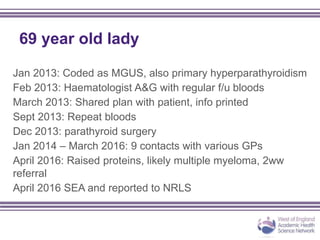
69 year old lady
Jan 2013: Coded as MGUS, also primary hyperparathyroidism
Feb 2013: Haematologist A&G with regular f/u bloods
March 2013: Shared plan with patient, info printed
Sept 2013: Repeat bloods
Dec 2013: parathyroid surgery
Jan 2014 – March 2016: 9 contacts with various GPs
April 2016: Raised proteins, likely multiple myeloma, 2ww
referral
April 2016 SEA and reported to NRLS
From Vincent et al
A systems approach
From Vincent et al
A systems approach
From Vincent et al
A systems approach
From Vincent et al
A systems approach
From Vincent et al
A systems approach
From Vincent et al
A systems approach
In our fox holes .....
Ego & defensiveness
“Doctors differ and their patients die”
Isaac Cruikshank, 1794
“Change is not
necessary,
Survival is not
mandatory”
W. Edwards Deming
Share your cards …….
Values
Person-centred view
Perfection Myth. If I try harder, I won’t make a mistake.
The Punishment Myth. If we punish a person who makes
an error, they won’t make the error again.
Systems view
Perfection Myth. If I try harder, I won’t make a mistake.
The Punishment Myth. If we punish a person who makes
an error, they won’t make the error again.
Johnson’s Substitution Test. Could some equally
motivated, comparably qualified staff member have made
the same error under similar circumstances?
Culture: the heart of quality
improvement
Anna Burhouse
Building reliable systems
• Design needs to be woven into working practices, with
repeated cycles of adaptation, small steps.
• Find what works, adapt or abandon what does not.
• When you know what works on a small scale, look to
implement more widely.
• Ask the people who are on the receiving end of care
whether the new methods result in good care.
• Open culture, flat hierarchies, challenge is not a threat
but a source of new ideas and improvement
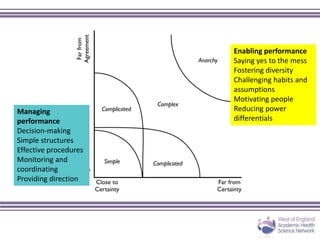
Enabling performance
Saying yes to the mess
Fostering diversity
Challenging habits and
assumptions
Motivating people
Reducing power
differentials
Managing
performance
Decision-making
Simple structures
Effective procedures
Monitoring and
coordinating
Providing direction
The PDSA Cycle for Learning and Improvement
Plan
• Objective
• Questions &
predictions
• Plan to carry out:
Who?When?
How? Where?
Do
• Carry out plan
• Document
problems
• Begin data
analysis
Act
• Ready to
implement?
• Try something
else?
• Next cycle
Study
• Complete data
analysis
• Compare to
predictions
• Summarize
What will happen
if we try
something
different?
Let’s try it!Did it
work?
What’s
next?
Repeated Use of the PDSA Cycle for Testing
Hunches
Theories
Ideas
Changes That Result in
Improvement
Very Small
Scale Test
Follow-up
Tests
Wide-Scale Tests of Change
Implementation of Change
What are we trying to
accomplish?
How will we know that a
change is an improvement?
What change can we make that
will result in improvement?
Model for Improvement
Sequential building of
knowledge under a wide range
of conditions
Spreading
AP
DS
A
P
D
S
AP
D S
A
P
D
S
AP
DS
A
P
D
S
A P
DS
Sustaining the gains
Example PDSA Testing Ramps
advanced care planning
A P
S D
A P
S D
Cycle 1A: 11/02/14 Identification patients by respiratory FY1 by
putting a Q beside their name on ward board and handover sheets
Cycle 1B: 3/03/14 Teaching the other side of the ward- gastro
FY1’s
Cycle 1D: 24/04/14 “re-inform &
support” with Hannah & thank you
cookies
Cycle 1C: 14/04/14 disseminate the Q project-
targeted 5 medical wards
a) sign sheet b) Cert to do one
c) Cert to teach one
Cycle 1E: 7/05/14 Consultant lead
to boost confidence in identifying
Q patients
59
“What is the variation in one system over time?” Walter
A. Shewhart - early 1920’s, Bell Laboratories
time
UCL
Every process displays variation:
• Controlled variation
stable, consistent pattern of variation
“chance”, constant causes
• Special cause variation
“assignable”
pattern changes over time
LCL
Static View
StaticView
Dynamic View
Probability of a “trend”
Why do we need 5 data points for a trend?
What is the probability of a coin landing heads or tails?
One head or tail .5
.5 x .5 = .25
.5 x .5 x .5 = .125
.5 x .5 x .5 x .5 = .0625
.5 x .5 x .5 x .5 x .5 = .03125
.5 x .5 x .5 x .5 x .5 x .5 = .015625
https://vimeo.com/146294950
Improvement Habits
https://www.google.co.uk/url?sa=t&rct=j&q=&esrc=s&source=web&cd=3&cad=
rja&uact=8&ved=0ahUKEwi57_3B1eTTAhXqJMAKHUjQCYkQFggwMAI&url=http
%3A%2F%2Fwww.health.org.uk%2Fpublication%2Fhabits-
improver&usg=AFQjCNESNjFSjruDOkJI7cBEV50w1iiypw&sig2=hDyZDnPAFmhfV
mB3PS65sw
Education Pathway
Improvement Coaches Network
Learning and development events
The Improvement Journey – quality improvement
tools and resources
Why do things go wrong and
how can we make them right?
Nathalie Delaney
Swiss cheese
Although many
layers of defence
lie between
hazards and
accidents, there
are flaws in each
layer that, if
aligned, can allow
the adverse event
to occur.
“For a long time, people were saying
that most accidents were due to human
error. And this is true in a sense, but it’s
not very helpful. It’s a bit like saying
that falls are due to gravity”
Prof. Trevor Kletz
What makes your working day easier
or more difficult?
Good/ poor communication
Good/ poor leadership
Good/ poor teamwork
Good/ poor organisation
Good/ poor attitude
Positivity/ Negativity
Challenges
Too much/ not enough
information
No thanks/ praise/ feedback
• Conflict
• Morale
• Evolving plans
• Repetition
• Changes
• Stress
• Breaks
“Workplaces and
organizations are
easier to manage
than the minds of
individuals workers.
You cannot change
the human condition,
but you can change
the conditions
under which people
work”
James Reason
Individual
Hungry
Tired
Stress
Cognitive
Anxious
Late
Environment
Design
ErgonomicsIT
Equipment
Task
Skills
Confidence
Systems
Communication
Circle of Care
https://vimeo.com/166819236
Safety Culture survey
Online, anonymous survey
Opportunity to tailor to meet your needs
Debrief with core team
Optional facilitated debrief with wider team
Repeat survey after 12 months
Stress enhancers
Hungry
Angry
Late
Tired
Suzette Woodward’s top tips…
1. Learn to listen
2. Resist the pressure for a simple explanation
3. Don’t be judgemental
Abraham Wald
Resources available
http://weahsn.net/wepcc1
Wessex Patient Safety Collaborative
Connecting and sharing across Wessex to improve patient safety
Wessex Patient Safety Collaborative
Connecting and sharing across Wessex to improve patient safety
Safe Practice Framework
for
General Practice
Lesley Mackenzie, Patient Safety Programme Manager
Wessex Patient Safety Collaborative
Primary Care Collaborative Cohort 2 Launch
24th May 2017
Wessex Patient Safety Collaborative
Connecting and sharing across Wessex to improve patient safety
To develop a safe practice framework which will
support staff in the delivery of safe care in General
Practice.
To raise staff awareness of
patient safety.
To support staff to determine why
and where improvement is
required in patient safety.
Our vision
Wessex Patient Safety Collaborative
Connecting and sharing across Wessex to improve patient safety
• The safe practice framework was developed by a number of GPs and
Primary Care Commissioners and agreed by Wessex Patient Safety
Collaborative [WPSC] Primary Care Forum.
• Test specification and measurement strategy was developed to measure
the impact of any change.
• The framework was tested by GP
practices.
• Framework was reviewed following feedback
and amended.
How?
Wessex Patient Safety Collaborative
Connecting and sharing across Wessex to improve patient safety
• A voluntary self assessment tool which aims to assess the maturity and
robustness of the patient safety systems.
• It is presented in 2 levels; good practice and outstanding practice.
• Resources about patient safety are available via links to support staff
development and understanding of patient safety.
• When completed the framework identifies
process & systems that are working well
and those which may need improvement.
The framework
Wessex Patient Safety Collaborative
Connecting and sharing across Wessex to improve patient safety
• Feedback itself is crucial to ensure the framework is useful for you.
• The feedback we received;
• Most useful when completed as a team.
• Each team member had ownership of the good
practice that was identified and wanted to take
responsibility for what needed to change.
• Local Medical Council [LMC] Chief Executive
saw value in the framework.
• Rewritten to reflect Key Lines of Enquiry and as a 2 stage approach.
• Not an assurance tool.
Feedback!
Wessex Patient Safety Collaborative
Connecting and sharing across Wessex to improve patient safety
• Concerns about duplication dispelled.
• Offered a planned approach to the quality work in the practice.
• The process of completing the framework as a team;
• generated healthy discussion
• raised awareness about patient safety
• started conversations
• provided an opportunity to celebrate what
was working well
• offered a shared understanding of what was still required
• encouraged the team to take ownership
The outcome
Wessex Patient Safety Collaborative
Connecting and sharing across Wessex to improve patient safety
• West of England is using the framework for your collaborative.
• Wessex keen to extend the testing phase.
• We are assessing;
• Ease of using the framework
• Content
• Impact of using the framework
• We will be seeking brief feedback
on these 3 areas to influence and
improve the design of the
framework.
Working in partnership
Looking forward to the future
Dr Hein Le Roux
Thinking and Linking
What has worked from today’s session?
What tools can you take away from today to
improve your practice?
What barriers are there to you taking this forward
into your practice?
Looking after yourself
Recognise the emotional
impact of caring
Acknowledge that self care is
important
What are the ways you care
for and support yourself and
each other in your team?
As a result of today I will…
@weahsn
Connect with us

Primary Care Collaborative 2

  • 1.
    Launch of PrimaryCare Collaborative Cohort 2 24 May 2017 Bath
  • 2.
    Academic Health ScienceNetworks We are one of 15 AHSNs across England, established by NHS England in 2013 to spread innovation at pace and scale.
  • 3.
    West of EnglandAcademic Health Science Network
  • 4.
    A promise tolearn – a commitment to act “The most important single change in the NHS in response to this report would be for it to become, more than ever before, a system devoted to continual learning and improvement of care, top to bottom and end to end.” Don Berwick, August 2013
  • 6.
    WE BELIEVE: AMANIFESTO FOR PATIENT SAFETY IN PRIMARY CARE FROM SMALL STEPS BIG CHANGE CAN OCCUR PRIMARY CARE IS THE HE OF THE NHS WORKING TOGETHER WE CAN MAKE CHANGE HAPPEN FASTER AND BETTER SAFETY IN NUMBERSBETTER SAFETY CULTURE = BETTER, SAFER CARE FOR PATIENTS WE CAN’T CHANGE THE HUMAN CONDITIONS, BUT WE CAN CHANGE THE CONDITIONS HUMANS WORK IN HEAR THE VOICE OF THE PATIENT  BE PART OF THE CIRCLE OF CARE NEVER STOP LEARNING & EXPERIMENTING REPORTING AND LEARNING FROM INCIDENTS WILL CREATE THE CONDITIONS FOR SAFER PATIENT CARE CELEBRATE SUCCESS  SHARE AND LEARN BEST PRACTICE WEST OF ENGLAND ACADEMIC HEALTH SCIENCE NETWORK PRIMARY CARE COLLABORATIVE
  • 7.
    Primary Care Collaborative Developa safety culture that engages with patients and staff to support the delivery of safe and reliable care in primary care teams.
  • 9.
  • 10.
    Patient Safety Quality Improvement the ill patient’sjourney What? Patient Safety and Quality Improvement
  • 11.
    What does betterlook like? Pathological • Who cares if we are not caught? Reactive • Safety is important we do lots of it after every accident Calculative • We have systems in place to manage all hazards Proactive • We work on problems that we still find Generative • Safety is built into the way we work and think
  • 12.
    69 year oldlady Jan 2013: Coded as MGUS, also primary hyperparathyroidism Feb 2013: Haematologist A&G with regular f/u bloods March 2013: Shared plan with patient, info printed Sept 2013: Repeat bloods Dec 2013: parathyroid surgery Jan 2014 – March 2016: 9 contacts with various GPs April 2016: Raised proteins, likely multiple myeloma, 2ww referral April 2016 SEA and reported to NRLS
  • 13.
    From Vincent etal A systems approach
  • 14.
    From Vincent etal A systems approach
  • 15.
    From Vincent etal A systems approach
  • 16.
    From Vincent etal A systems approach
  • 17.
    From Vincent etal A systems approach
  • 18.
    From Vincent etal A systems approach
  • 23.
    In our foxholes .....
  • 24.
    Ego & defensiveness “Doctorsdiffer and their patients die” Isaac Cruikshank, 1794
  • 26.
    “Change is not necessary, Survivalis not mandatory” W. Edwards Deming
  • 27.
  • 28.
  • 31.
    Person-centred view Perfection Myth.If I try harder, I won’t make a mistake. The Punishment Myth. If we punish a person who makes an error, they won’t make the error again.
  • 32.
    Systems view Perfection Myth.If I try harder, I won’t make a mistake. The Punishment Myth. If we punish a person who makes an error, they won’t make the error again. Johnson’s Substitution Test. Could some equally motivated, comparably qualified staff member have made the same error under similar circumstances?
  • 34.
    Culture: the heartof quality improvement Anna Burhouse
  • 39.
    Building reliable systems •Design needs to be woven into working practices, with repeated cycles of adaptation, small steps. • Find what works, adapt or abandon what does not. • When you know what works on a small scale, look to implement more widely. • Ask the people who are on the receiving end of care whether the new methods result in good care. • Open culture, flat hierarchies, challenge is not a threat but a source of new ideas and improvement
  • 42.
    Enabling performance Saying yesto the mess Fostering diversity Challenging habits and assumptions Motivating people Reducing power differentials Managing performance Decision-making Simple structures Effective procedures Monitoring and coordinating Providing direction
  • 50.
    The PDSA Cyclefor Learning and Improvement Plan • Objective • Questions & predictions • Plan to carry out: Who?When? How? Where? Do • Carry out plan • Document problems • Begin data analysis Act • Ready to implement? • Try something else? • Next cycle Study • Complete data analysis • Compare to predictions • Summarize What will happen if we try something different? Let’s try it!Did it work? What’s next?
  • 54.
    Repeated Use ofthe PDSA Cycle for Testing Hunches Theories Ideas Changes That Result in Improvement Very Small Scale Test Follow-up Tests Wide-Scale Tests of Change Implementation of Change What are we trying to accomplish? How will we know that a change is an improvement? What change can we make that will result in improvement? Model for Improvement Sequential building of knowledge under a wide range of conditions Spreading AP DS A P D S AP D S A P D S AP DS A P D S A P DS Sustaining the gains
  • 55.
    Example PDSA TestingRamps advanced care planning A P S D A P S D Cycle 1A: 11/02/14 Identification patients by respiratory FY1 by putting a Q beside their name on ward board and handover sheets Cycle 1B: 3/03/14 Teaching the other side of the ward- gastro FY1’s Cycle 1D: 24/04/14 “re-inform & support” with Hannah & thank you cookies Cycle 1C: 14/04/14 disseminate the Q project- targeted 5 medical wards a) sign sheet b) Cert to do one c) Cert to teach one Cycle 1E: 7/05/14 Consultant lead to boost confidence in identifying Q patients
  • 59.
    59 “What is thevariation in one system over time?” Walter A. Shewhart - early 1920’s, Bell Laboratories time UCL Every process displays variation: • Controlled variation stable, consistent pattern of variation “chance”, constant causes • Special cause variation “assignable” pattern changes over time LCL Static View StaticView Dynamic View
  • 62.
    Probability of a“trend” Why do we need 5 data points for a trend? What is the probability of a coin landing heads or tails? One head or tail .5 .5 x .5 = .25 .5 x .5 x .5 = .125 .5 x .5 x .5 x .5 = .0625 .5 x .5 x .5 x .5 x .5 = .03125 .5 x .5 x .5 x .5 x .5 x .5 = .015625
  • 65.
  • 68.
  • 71.
    Education Pathway Improvement CoachesNetwork Learning and development events The Improvement Journey – quality improvement tools and resources
  • 73.
    Why do thingsgo wrong and how can we make them right? Nathalie Delaney
  • 74.
    Swiss cheese Although many layersof defence lie between hazards and accidents, there are flaws in each layer that, if aligned, can allow the adverse event to occur.
  • 75.
    “For a longtime, people were saying that most accidents were due to human error. And this is true in a sense, but it’s not very helpful. It’s a bit like saying that falls are due to gravity” Prof. Trevor Kletz
  • 76.
    What makes yourworking day easier or more difficult? Good/ poor communication Good/ poor leadership Good/ poor teamwork Good/ poor organisation Good/ poor attitude Positivity/ Negativity Challenges Too much/ not enough information No thanks/ praise/ feedback • Conflict • Morale • Evolving plans • Repetition • Changes • Stress • Breaks
  • 78.
    “Workplaces and organizations are easierto manage than the minds of individuals workers. You cannot change the human condition, but you can change the conditions under which people work” James Reason
  • 80.
  • 81.
  • 82.
  • 83.
  • 84.
  • 86.
    Safety Culture survey Online,anonymous survey Opportunity to tailor to meet your needs Debrief with core team Optional facilitated debrief with wider team Repeat survey after 12 months
  • 88.
  • 95.
    Suzette Woodward’s toptips… 1. Learn to listen 2. Resist the pressure for a simple explanation 3. Don’t be judgemental
  • 96.
  • 98.
  • 99.
    Wessex Patient SafetyCollaborative Connecting and sharing across Wessex to improve patient safety
  • 100.
    Wessex Patient SafetyCollaborative Connecting and sharing across Wessex to improve patient safety Safe Practice Framework for General Practice Lesley Mackenzie, Patient Safety Programme Manager Wessex Patient Safety Collaborative Primary Care Collaborative Cohort 2 Launch 24th May 2017
  • 101.
    Wessex Patient SafetyCollaborative Connecting and sharing across Wessex to improve patient safety To develop a safe practice framework which will support staff in the delivery of safe care in General Practice. To raise staff awareness of patient safety. To support staff to determine why and where improvement is required in patient safety. Our vision
  • 102.
    Wessex Patient SafetyCollaborative Connecting and sharing across Wessex to improve patient safety • The safe practice framework was developed by a number of GPs and Primary Care Commissioners and agreed by Wessex Patient Safety Collaborative [WPSC] Primary Care Forum. • Test specification and measurement strategy was developed to measure the impact of any change. • The framework was tested by GP practices. • Framework was reviewed following feedback and amended. How?
  • 103.
    Wessex Patient SafetyCollaborative Connecting and sharing across Wessex to improve patient safety • A voluntary self assessment tool which aims to assess the maturity and robustness of the patient safety systems. • It is presented in 2 levels; good practice and outstanding practice. • Resources about patient safety are available via links to support staff development and understanding of patient safety. • When completed the framework identifies process & systems that are working well and those which may need improvement. The framework
  • 104.
    Wessex Patient SafetyCollaborative Connecting and sharing across Wessex to improve patient safety • Feedback itself is crucial to ensure the framework is useful for you. • The feedback we received; • Most useful when completed as a team. • Each team member had ownership of the good practice that was identified and wanted to take responsibility for what needed to change. • Local Medical Council [LMC] Chief Executive saw value in the framework. • Rewritten to reflect Key Lines of Enquiry and as a 2 stage approach. • Not an assurance tool. Feedback!
  • 105.
    Wessex Patient SafetyCollaborative Connecting and sharing across Wessex to improve patient safety • Concerns about duplication dispelled. • Offered a planned approach to the quality work in the practice. • The process of completing the framework as a team; • generated healthy discussion • raised awareness about patient safety • started conversations • provided an opportunity to celebrate what was working well • offered a shared understanding of what was still required • encouraged the team to take ownership The outcome
  • 106.
    Wessex Patient SafetyCollaborative Connecting and sharing across Wessex to improve patient safety • West of England is using the framework for your collaborative. • Wessex keen to extend the testing phase. • We are assessing; • Ease of using the framework • Content • Impact of using the framework • We will be seeking brief feedback on these 3 areas to influence and improve the design of the framework. Working in partnership
  • 107.
    Looking forward tothe future Dr Hein Le Roux
  • 108.
    Thinking and Linking Whathas worked from today’s session? What tools can you take away from today to improve your practice? What barriers are there to you taking this forward into your practice?
  • 109.
    Looking after yourself Recognisethe emotional impact of caring Acknowledge that self care is important What are the ways you care for and support yourself and each other in your team?
  • 110.
    As a resultof today I will…
  • 112.