LOGO
Dr.D.VENODEN, MEDICAL ADMINISTRATOR, MoH, Sri Lanka
CONTENTS
๏ถIntroduction to patient safety
๏ถClassification of hospital accidents
๏ถEvolution of patient safety culture
๏ถElements of safety culture
๏ถTypes of Medical errors
11/22/2017
2
WHAT IS PATIENT SAFETY?
๏ถPatient safety is defined as the prevention and
reduction of adverse outcomes (Alahmadi,2009)
11/22/2017
3
Learning from the
mistake is the key to
improve patient safety
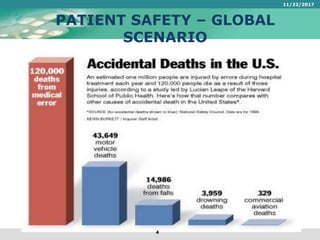
PATIENT SAFETY โ€“ GLOBAL
SCENARIO
11/22/2017
4
PATIENT SAFETY โ€“ GLOBAL
SCENARIO
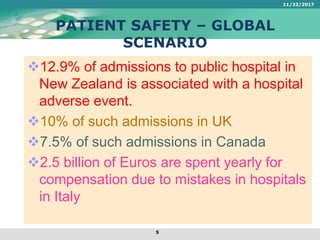
๏ถ12.9% of admissions to public hospital in
New Zealand is associated with a hospital
adverse event.
๏ถ10% of such admissions in UK
๏ถ7.5% of such admissions in Canada
๏ถ2.5 billion of Euros are spent yearly for
compensation due to mistakes in hospitals
in Italy
11/22/2017
5
11/22/2017
6
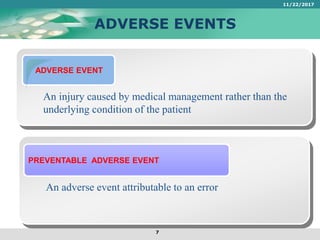
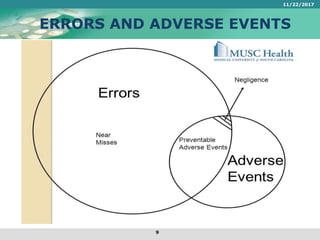
ADVERSE EVENTS
ADVERSE EVENT
PREVENTABLE ADVERSE EVENT
An injury caused by medical management rather than the
underlying condition of the patient
An adverse event attributable to an error
11/22/2017
7
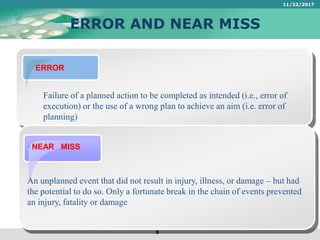
ERROR AND NEAR MISS
ERROR
NNEAR MISS
Failure of a planned action to be completed as intended (i.e., error of
execution) or the use of a wrong plan to achieve an aim (i.e. error of
planning)
An unplanned event that did not result in injury, illness, or damage โ€“ but had
the potential to do so. Only a fortunate break in the chain of events prevented
an injury, fatality or damage
11/22/2017
8
ERRORS AND ADVERSE EVENTS
11/22/2017
9
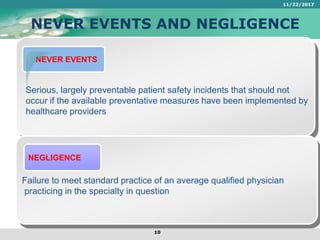
NEVER EVENTS AND NEGLIGENCE
NEVER EVENTS
Failure to meet standard practice of an average qualified physician
practicing in the specialty in question
NEGLIGENCE
Serious, largely preventable patient safety incidents that should not
occur if the available preventative measures have been implemented by
healthcare providers
11/22/2017
10
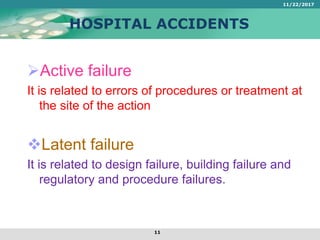
HOSPITAL ACCIDENTS
๏ƒ˜Active failure
It is related to errors of procedures or treatment at
the site of the action
๏ถLatent failure
It is related to design failure, building failure and
regulatory and procedure failures.
11/22/2017
11
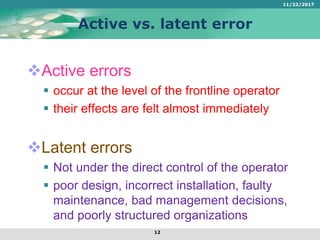
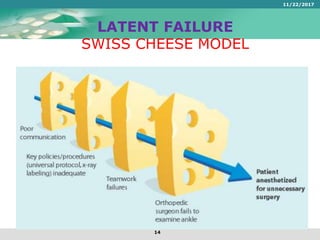
Active vs. latent error
๏ถActive errors
๏‚ง occur at the level of the frontline operator
๏‚ง their effects are felt almost immediately
๏ถLatent errors
๏‚ง Not under the direct control of the operator
๏‚ง poor design, incorrect installation, faulty
maintenance, bad management decisions,
and poorly structured organizations
11/22/2017
12
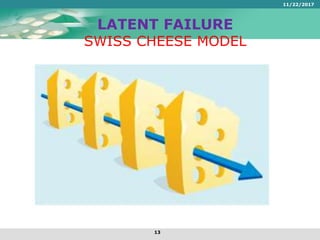
LATENT FAILURE
SWISS CHEESE MODEL
11/22/2017
13
LATENT FAILURE
SWISS CHEESE MODEL
11/22/2017
14
15
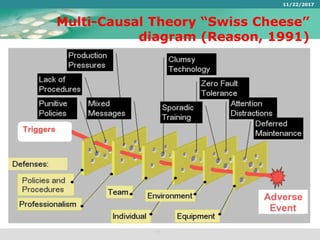
Multi-Causal Theory โ€œSwiss Cheeseโ€
diagram (Reason, 1991)
11/22/2017
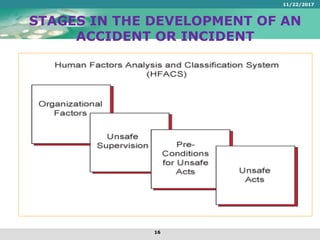
STAGES IN THE DEVELOPMENT OF AN
ACCIDENT OR INCIDENT
11/22/2017
16
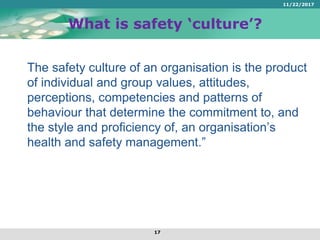
What is safety โ€˜cultureโ€™?
The safety culture of an organisation is the product
of individual and group values, attitudes,
perceptions, competencies and patterns of
behaviour that determine the commitment to, and
the style and proficiency of, an organisationโ€™s
health and safety management.โ€
11/22/2017
17
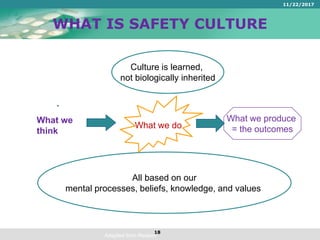
All based on our
mental processes, beliefs, knowledge, and values
What we
think
Culture is learned,
not biologically inherited
What we do
What we produce
= the outcomes
Adapted from Reason
WHAT IS SAFETY CULTURE
11/22/2017
18
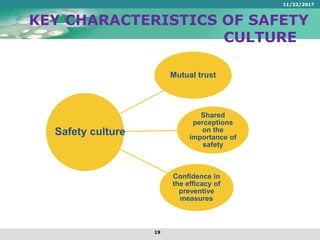
KEY CHARACTERISTICS OF SAFETY
CULTUREโ€ฆ
Mutual trust
Shared
perceptions
on the
importance of
safety
Confidence in
the efficacy of
preventive
measures
Safety culture
11/22/2017
19
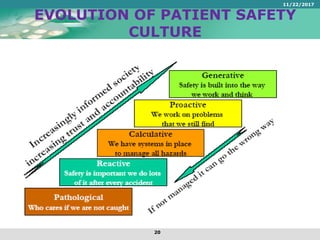
EVOLUTION OF PATIENT SAFETY
CULTURE
11/22/2017
20
@SAFE_QI
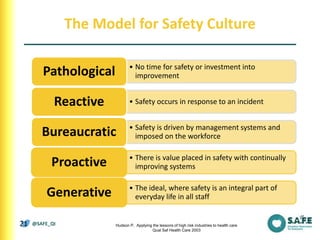
The Model for Safety Culture
โ€ข No time for safety or investment into
improvementPathological
โ€ข Safety occurs in response to an incidentReactive
โ€ข Safety is driven by management systems and
imposed on the workforceBureaucratic
โ€ข There is value placed in safety with continually
improving systemsProactive
โ€ข The ideal, where safety is an integral part of
everyday life in all staffGenerative
Hudson P. Applying the lessons of high risk industries to health care
Qual Saf Health Care 2003
21
ELEMENTS OF SAFETY CULTURE
Element of safety
culture
Characteristics
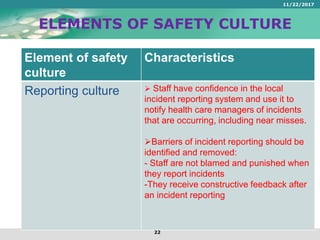
Reporting culture ๏ƒ˜ Staff have confidence in the local
incident reporting system and use it to
notify health care managers of incidents
that are occurring, including near misses.
๏ƒ˜Barriers of incident reporting should be
identified and removed:
- Staff are not blamed and punished when
they report incidents
-They receive constructive feedback after
an incident reporting
11/22/2017
22
ELEMENTS OF SAFETY CULTURE
Element of safety
culture
Characteristics
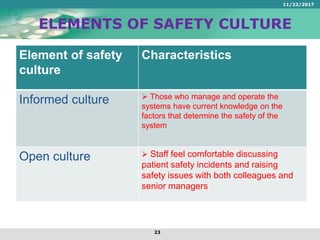
Informed culture ๏ƒ˜ Those who manage and operate the
systems have current knowledge on the
factors that determine the safety of the
system
Open culture ๏ƒ˜ Staff feel comfortable discussing
patient safety incidents and raising
safety issues with both colleagues and
senior managers
11/22/2017
23
ELEMENTS OF SAFETY CULTURE
Element of safety
culture
Characteristics
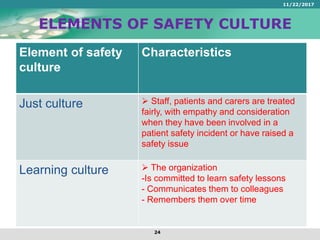
Just culture ๏ƒ˜ Staff, patients and carers are treated
fairly, with empathy and consideration
when they have been involved in a
patient safety incident or have raised a
safety issue
Learning culture ๏ƒ˜ The organization
-Is committed to learn safety lessons
- Communicates them to colleagues
- Remembers them over time
11/22/2017
24
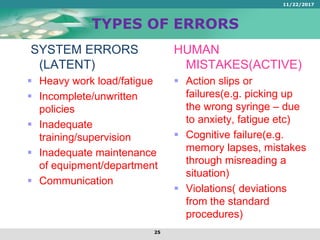
TYPES OF ERRORS
SYSTEM ERRORS
(LATENT)
๏‚ง Heavy work load/fatigue
๏‚ง Incomplete/unwritten
policies
๏‚ง Inadequate
training/supervision
๏‚ง Inadequate maintenance
of equipment/department
๏‚ง Communication
HUMAN
MISTAKES(ACTIVE)
๏‚ง Action slips or
failures(e.g. picking up
the wrong syringe โ€“ due
to anxiety, fatigue etc)
๏‚ง Cognitive failure(e.g.
memory lapses, mistakes
through misreading a
situation)
๏‚ง Violations( deviations
from the standard
procedures)
11/22/2017
25
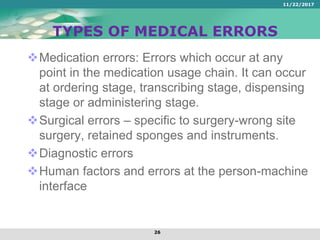
TYPES OF MEDICAL ERRORS
๏ถMedication errors: Errors which occur at any
point in the medication usage chain. It can occur
at ordering stage, transcribing stage, dispensing
stage or administering stage.
๏ถSurgical errors โ€“ specific to surgery-wrong site
surgery, retained sponges and instruments.
๏ถDiagnostic errors
๏ถHuman factors and errors at the person-machine
interface
11/22/2017
26
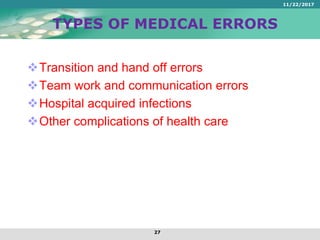
TYPES OF MEDICAL ERRORS
๏ถTransition and hand off errors
๏ถTeam work and communication errors
๏ถHospital acquired infections
๏ถOther complications of health care
11/22/2017
27
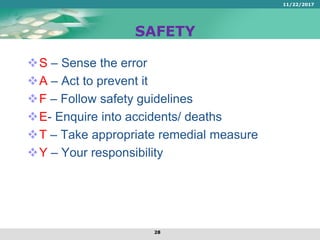
SAFETY
๏ถS โ€“ Sense the error
๏ถA โ€“ Act to prevent it
๏ถF โ€“ Follow safety guidelines
๏ถE- Enquire into accidents/ deaths
๏ถT โ€“ Take appropriate remedial measure
๏ถY โ€“ Your responsibility
11/22/2017
28
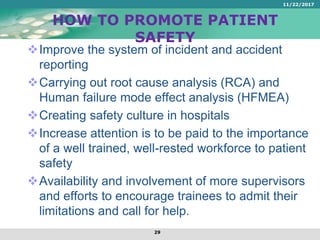
HOW TO PROMOTE PATIENT
SAFETY
๏ถImprove the system of incident and accident
reporting
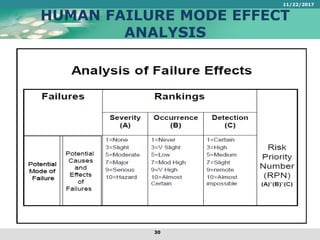
๏ถCarrying out root cause analysis (RCA) and
Human failure mode effect analysis (HFMEA)
๏ถCreating safety culture in hospitals
๏ถIncrease attention is to be paid to the importance
of a well trained, well-rested workforce to patient
safety
๏ถAvailability and involvement of more supervisors
and efforts to encourage trainees to admit their
limitations and call for help.
11/22/2017
29
HUMAN FAILURE MODE EFFECT
ANALYSIS
30
11/22/2017
HOW TO PROMOTE PATIENT
SAFETY
Regulations and Accreditations are powerful
tools to promote patient safety
11/22/2017
31
LOGO

Patient safety in Healthcare; Developing Patient Safety Culture by reporting adverse events and near misses and learning from the mistakes

  • 1.
  • 2.
    CONTENTS ๏ถIntroduction to patientsafety ๏ถClassification of hospital accidents ๏ถEvolution of patient safety culture ๏ถElements of safety culture ๏ถTypes of Medical errors 11/22/2017 2
  • 3.
    WHAT IS PATIENTSAFETY? ๏ถPatient safety is defined as the prevention and reduction of adverse outcomes (Alahmadi,2009) 11/22/2017 3 Learning from the mistake is the key to improve patient safety
  • 4.
    PATIENT SAFETY โ€“GLOBAL SCENARIO 11/22/2017 4
  • 5.
    PATIENT SAFETY โ€“GLOBAL SCENARIO ๏ถ12.9% of admissions to public hospital in New Zealand is associated with a hospital adverse event. ๏ถ10% of such admissions in UK ๏ถ7.5% of such admissions in Canada ๏ถ2.5 billion of Euros are spent yearly for compensation due to mistakes in hospitals in Italy 11/22/2017 5
  • 6.
  • 7.
    ADVERSE EVENTS ADVERSE EVENT PREVENTABLEADVERSE EVENT An injury caused by medical management rather than the underlying condition of the patient An adverse event attributable to an error 11/22/2017 7
  • 8.
    ERROR AND NEARMISS ERROR NNEAR MISS Failure of a planned action to be completed as intended (i.e., error of execution) or the use of a wrong plan to achieve an aim (i.e. error of planning) An unplanned event that did not result in injury, illness, or damage โ€“ but had the potential to do so. Only a fortunate break in the chain of events prevented an injury, fatality or damage 11/22/2017 8
  • 9.
    ERRORS AND ADVERSEEVENTS 11/22/2017 9
  • 10.
    NEVER EVENTS ANDNEGLIGENCE NEVER EVENTS Failure to meet standard practice of an average qualified physician practicing in the specialty in question NEGLIGENCE Serious, largely preventable patient safety incidents that should not occur if the available preventative measures have been implemented by healthcare providers 11/22/2017 10
  • 11.
    HOSPITAL ACCIDENTS ๏ƒ˜Active failure Itis related to errors of procedures or treatment at the site of the action ๏ถLatent failure It is related to design failure, building failure and regulatory and procedure failures. 11/22/2017 11
  • 12.
    Active vs. latenterror ๏ถActive errors ๏‚ง occur at the level of the frontline operator ๏‚ง their effects are felt almost immediately ๏ถLatent errors ๏‚ง Not under the direct control of the operator ๏‚ง poor design, incorrect installation, faulty maintenance, bad management decisions, and poorly structured organizations 11/22/2017 12
  • 13.
    LATENT FAILURE SWISS CHEESEMODEL 11/22/2017 13
  • 14.
    LATENT FAILURE SWISS CHEESEMODEL 11/22/2017 14
  • 15.
    15 Multi-Causal Theory โ€œSwissCheeseโ€ diagram (Reason, 1991) 11/22/2017
  • 16.
    STAGES IN THEDEVELOPMENT OF AN ACCIDENT OR INCIDENT 11/22/2017 16
  • 17.
    What is safetyโ€˜cultureโ€™? The safety culture of an organisation is the product of individual and group values, attitudes, perceptions, competencies and patterns of behaviour that determine the commitment to, and the style and proficiency of, an organisationโ€™s health and safety management.โ€ 11/22/2017 17
  • 18.
    All based onour mental processes, beliefs, knowledge, and values What we think Culture is learned, not biologically inherited What we do What we produce = the outcomes Adapted from Reason WHAT IS SAFETY CULTURE 11/22/2017 18
  • 19.
    KEY CHARACTERISTICS OFSAFETY CULTUREโ€ฆ Mutual trust Shared perceptions on the importance of safety Confidence in the efficacy of preventive measures Safety culture 11/22/2017 19
  • 20.
    EVOLUTION OF PATIENTSAFETY CULTURE 11/22/2017 20
  • 21.
    @SAFE_QI The Model forSafety Culture โ€ข No time for safety or investment into improvementPathological โ€ข Safety occurs in response to an incidentReactive โ€ข Safety is driven by management systems and imposed on the workforceBureaucratic โ€ข There is value placed in safety with continually improving systemsProactive โ€ข The ideal, where safety is an integral part of everyday life in all staffGenerative Hudson P. Applying the lessons of high risk industries to health care Qual Saf Health Care 2003 21
  • 22.
    ELEMENTS OF SAFETYCULTURE Element of safety culture Characteristics Reporting culture ๏ƒ˜ Staff have confidence in the local incident reporting system and use it to notify health care managers of incidents that are occurring, including near misses. ๏ƒ˜Barriers of incident reporting should be identified and removed: - Staff are not blamed and punished when they report incidents -They receive constructive feedback after an incident reporting 11/22/2017 22
  • 23.
    ELEMENTS OF SAFETYCULTURE Element of safety culture Characteristics Informed culture ๏ƒ˜ Those who manage and operate the systems have current knowledge on the factors that determine the safety of the system Open culture ๏ƒ˜ Staff feel comfortable discussing patient safety incidents and raising safety issues with both colleagues and senior managers 11/22/2017 23
  • 24.
    ELEMENTS OF SAFETYCULTURE Element of safety culture Characteristics Just culture ๏ƒ˜ Staff, patients and carers are treated fairly, with empathy and consideration when they have been involved in a patient safety incident or have raised a safety issue Learning culture ๏ƒ˜ The organization -Is committed to learn safety lessons - Communicates them to colleagues - Remembers them over time 11/22/2017 24
  • 25.
    TYPES OF ERRORS SYSTEMERRORS (LATENT) ๏‚ง Heavy work load/fatigue ๏‚ง Incomplete/unwritten policies ๏‚ง Inadequate training/supervision ๏‚ง Inadequate maintenance of equipment/department ๏‚ง Communication HUMAN MISTAKES(ACTIVE) ๏‚ง Action slips or failures(e.g. picking up the wrong syringe โ€“ due to anxiety, fatigue etc) ๏‚ง Cognitive failure(e.g. memory lapses, mistakes through misreading a situation) ๏‚ง Violations( deviations from the standard procedures) 11/22/2017 25
  • 26.
    TYPES OF MEDICALERRORS ๏ถMedication errors: Errors which occur at any point in the medication usage chain. It can occur at ordering stage, transcribing stage, dispensing stage or administering stage. ๏ถSurgical errors โ€“ specific to surgery-wrong site surgery, retained sponges and instruments. ๏ถDiagnostic errors ๏ถHuman factors and errors at the person-machine interface 11/22/2017 26
  • 27.
    TYPES OF MEDICALERRORS ๏ถTransition and hand off errors ๏ถTeam work and communication errors ๏ถHospital acquired infections ๏ถOther complications of health care 11/22/2017 27
  • 28.
    SAFETY ๏ถS โ€“ Sensethe error ๏ถA โ€“ Act to prevent it ๏ถF โ€“ Follow safety guidelines ๏ถE- Enquire into accidents/ deaths ๏ถT โ€“ Take appropriate remedial measure ๏ถY โ€“ Your responsibility 11/22/2017 28
  • 29.
    HOW TO PROMOTEPATIENT SAFETY ๏ถImprove the system of incident and accident reporting ๏ถCarrying out root cause analysis (RCA) and Human failure mode effect analysis (HFMEA) ๏ถCreating safety culture in hospitals ๏ถIncrease attention is to be paid to the importance of a well trained, well-rested workforce to patient safety ๏ถAvailability and involvement of more supervisors and efforts to encourage trainees to admit their limitations and call for help. 11/22/2017 29
  • 30.
    HUMAN FAILURE MODEEFFECT ANALYSIS 30 11/22/2017
  • 31.
    HOW TO PROMOTEPATIENT SAFETY Regulations and Accreditations are powerful tools to promote patient safety 11/22/2017 31
  • 32.