The Safe 
Use of 
Patient 
Restraints 
Mandatory Annual Review Course
Safe Safe UUssee ooff PPaattiieenntt RReessttrraaiinntt 
Definitions 
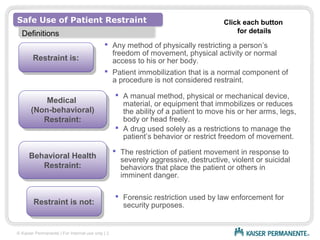
RReesstrtraainint ti sis:: 
Medical 
Medical 
(Non-behavioral) 
(Non-behavioral) 
Restraint: 
Restraint: 
Click each button 
for details 
 Any method of physically restricting a person’s 
freedom of movement, physical activity or normal 
access to his or her body. 
 Patient immobilization that is a normal component of 
a procedure is not considered restraint. 
Behavioral Health 
Restraint: 
© Kaiser Permanente | For Internal use only | 2 
 A manual method, physical or mechanical device, 
material, or equipment that immobilizes or reduces 
the ability of a patient to move his or her arms, legs, 
body or head freely. 
 A drug used solely as a restrictions to manage the 
patient’s behavior or restrict freedom of movement. 
Behavioral Health 
Restraint: 
 The restriction of patient movement in response to 
severely aggressive, destructive, violent or suicidal 
behaviors that place the patient or others in 
imminent danger. 
RReesstrtraainint ti sis n noot: Forensic restriction used by law enforcement for 
t: security purposes.
Safe Safe UUssee ooff PPaattiieenntt RReessttrraaiinntt 
Side Rails – Restraint or Not? 
Click the answer 
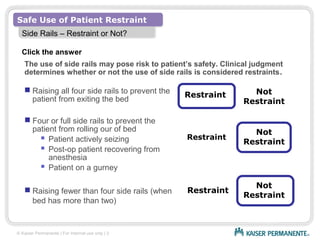
The use of side rails may pose risk to patient’s safety. Clinical judgment 
determines whether or not the use of side rails is considered restraints. 
 Raising all four side rails to prevent the 
patient from exiting the bed 
© Kaiser Permanente | For Internal use only | 3 
Restraint Not 
Restraint 
 Four or full side rails to prevent the 
patient from rolling our of bed 
 Patient actively seizing 
 Post-op patient recovering from 
anesthesia 
 Patient on a gurney 
Restraint 
Not 
Restraint 
 Raising fewer than four side rails (when 
bed has more than two) 
Restraint 
Not 
Restraint
Safe Safe UUssee ooff PPaattiieenntt RReessttrraaiinntt 
Alternatives to Restraints 
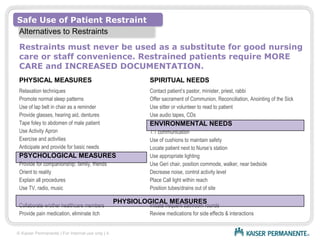
Restraints must never be used as a substitute for good nursing 
care or staff convenience. Restrained patients require MORE 
CARE and INCREASED DOCUMENTATION. 
PHYSICAL MEASURES SPIRITUAL NEEDS 
Relaxation techniques 
Promote normal sleep patterns 
Use of lap belt in chair as a reminder 
Provide glasses, hearing aid, dentures 
Tape foley to abdomen of male patient 
Use Activity Apron 
Exercise and activities 
Anticipate and provide for basic needs 
PSYCHOLOGICAL MEASURES 
Provide for companionship: family, friends 
Orient to reality 
Explain all procedures 
Use TV, radio, music 
Collaborate w/other healthcare members 
Provide pain medication, eliminate itch 
© Kaiser Permanente | For Internal use only | 4 
Contact patient’s pastor, minister, priest, rabbi 
Offer sacrament of Communion, Reconciliation, Anointing of the Sick 
Use sitter or volunteer to read to patient 
Use audio tapes, CDs 
ENVIRONMENTAL NEEDS 
1:1 communication 
Use of cushions to maintain safety 
Locate patient next to Nurse’s station 
Use appropriate lighting 
Use Geri chair, position commode, walker, near bedside 
Decrease noise, control activity level 
Place Call light within reach 
Position tubes/drains out of site 
PHYSIOLOGICAL MEASURES 
Initiate frequent bathroom rounds 
Review medications for side effects & interactions
Safe Safe UUssee ooff PPaattiieenntt RReessttrraaiinntt 
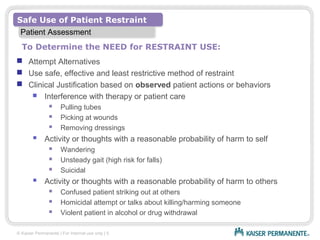
Patient Assessment 
To Determine the NEED for RESTRAINT USE: 
 Attempt Alternatives 
 Use safe, effective and least restrictive method of restraint 
 Clinical Justification based on observed patient actions or behaviors 
 Interference with therapy or patient care 
 Pulling tubes 
 Picking at wounds 
 Removing dressings 
 Activity or thoughts with a reasonable probability of harm to self 
 Wandering 
 Unsteady gait (high risk for falls) 
 Suicidal 
 Activity or thoughts with a reasonable probability of harm to others 
 Confused patient striking out at others 
 Homicidal attempt or talks about killing/harming someone 
 Violent patient in alcohol or drug withdrawal 
© Kaiser Permanente | For Internal use only | 5
Safe Safe UUssee ooff PPaattiieenntt RReessttrraaiinntt 
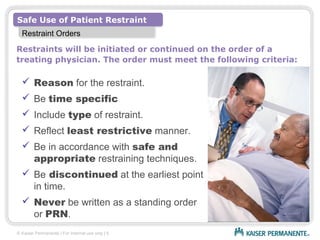
Restraint Orders 
Restraints will be initiated or continued on the order of a 
treating physician. The order must meet the following criteria: 
 Reason for the restraint. 
 Be time specific 
 Include type of restraint. 
 Reflect least restrictive manner. 
 Be in accordance with safe and 
appropriate restraining techniques. 
 Be discontinued at the earliest point 
in time. 
 Never be written as a standing order 
or PRN. 
© Kaiser Permanente | For Internal use only | 6
Safe Safe UUssee ooff PPaattiieenntt RReessttrraaiinntt 
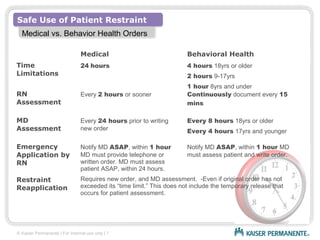
Medical vs. Behavior Health Orders 
Medical Behavioral Health 
Time 
Limitations 
24 hours 4 hours 18yrs or older 
© Kaiser Permanente | For Internal use only | 7 
2 hours 9-17yrs 
1 hour 8yrs and under 
RN 
Assessment 
Every 2 hours or sooner Continuously document every 15 
mins 
MD 
Assessment 
Every 24 hours prior to writing 
new order 
Every 8 hours 18yrs or older 
Every 4 hours 17yrs and younger 
Emergency 
Application by 
RN 
Notify MD ASAP, within 1 hour 
MD must provide telephone or 
written order. MD must assess 
patient ASAP, within 24 hours. 
Notify MD ASAP, within 1 hour MD 
must assess patient and write order. 
Restraint 
Reapplication 
Requires new order, and MD assessment. -Even if original order has not 
exceeded its “time limit.” This does not include the temporary release that 
occurs for patient assessment.
Safe Safe UUssee ooff PPaattiieenntt RReessttrraaiinntt 
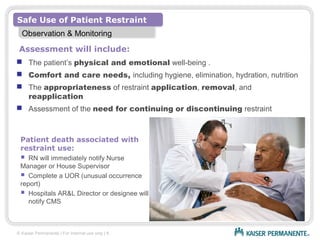
Observation & Monitoring 
Assessment will include: 
 The patient’s physical and emotional well-being . 
 Comfort and care needs, including hygiene, elimination, hydration, nutrition 
 The appropriateness of restraint application, removal, and 
reapplication 
 Assessment of the need for continuing or discontinuing restraint 
Patient death associated with 
restraint use: 
 RN will immediately notify Nurse 
Manager or House Supervisor 
 Complete a UOR (unusual occurrence 
report) 
 Hospitals AR&L Director or designee will 
notify CMS 
© Kaiser Permanente | For Internal use only | 8
Safe Safe UUssee ooff PPaattiieenntt RReessttrraaiinntt 
Application of Restraint 
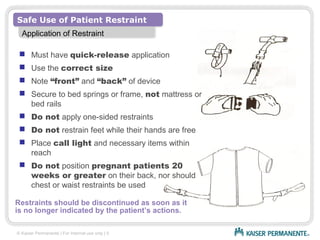
 Must have quick-release application 
 Use the correct size 
 Note “front” and “back” of device 
 Secure to bed springs or frame, not mattress or 
bed rails 
 Do not apply one-sided restraints 
 Do not restrain feet while their hands are free 
 Place call light and necessary items within 
reach 
 Do not position pregnant patients 20 
weeks or greater on their back, nor should 
chest or waist restraints be used 
Restraints should be discontinued as soon as it 
is no longer indicated by the patient’s actions. 
© Kaiser Permanente | For Internal use only | 9
Safe Safe UUssee ooff PPaattiieenntt RReessttrraaiinntt 
Documentation 
Patient basic needs must be attended to, 
including: 
 Hygiene 
 Elimination 
 Hydration 
Document the following in Patient’s record in KP 
Health Connect: 
 Physician’s order 
 Initial assessment by the RN and 1 hour in-person evaluation by MD 
 Patient’s actions or condition that indicated the initial and continued use of 
restraint 
 Less restrictive alternatives considered 
 Patient monitoring and response to interventions used 
 Significant changes in the patient’s condition 
 Reassessment/observations, discontinuation of restraints 
 Education and information about restraints provided to the patient and family 
© Kaiser Permanente | For Internal use only | 10 
 Nutrition 
 Circulation 
 Range of motion
Safe Safe UUssee ooff PPaattiieenntt RReessttrraaiinntt 
POST TEST 
© Kaiser Permanente | For Internal use only | 11
Safe Safe UUssee ooff PPaattiieenntt RReessttrraaiinntt 
Quiz 
Answer True or False 
1. Application of restraints should be the initial nursing intervention 
when caring for the confused or disoriented patient. 
True False 
2. Restraints are utilized to prevent disruption of treatment or significant harm 
to persons. 
True False 
3. The care of a patient in restraints requires more nursing time. 
True False 
4. Once restraints are applied, they are not to be removed by anyone without 
a physician’s order. 
True False 
© Kaiser Permanente | For Internal use only | 12
Safe Safe UUssee ooff PPaattiieenntt RReessttrraaiinntt 
Quiz 
Answer True or False 
5. Bed rails can either be restraints or a protective device, depending on 
the intent of use. 
True False 
6. Use of restraints can be harmful to patients and can result in such outcomes 
as impaired skin integrity, incontinence, increased falls, etc. 
True False 
7. When appropriate, the use of alternatives is attempted in an effort to use 
restraints as a last resort. 
True False 
8. Reassessment is ongoing and occurs at a minimum of q 4 hours for patients 
in medical restraints in an effort to discontinue the restraints early whenever 
possible. 
True False 
© Kaiser Permanente | For Internal use only | 13
Safe Safe UUssee ooff PPaattiieenntt RReessttrraaiinntt 
Quiz 
Answer True or False 
9. Four-point soft restraints for an actively suicidal patient requires the 
same 15-minute observation checks as leather or hard restraints. 
True False 
10. A physician’s order for a behavioral health restraint must be time specific 
with a maximum limit of 4 hours for the adult, 2 hours for children ages 9- 
17, and 1 hour for children 8 and under. 
True False 
11. RNs may discontinue restraints before the ordered time frame, but must 
obtain a new order if the patient again meets indications that justify 
restraint. 
True False 
12. RNs can apply a restraint without a physician order, but must obtain a 
verbal phone order within 1 hour of the initiation of the medical restraint. 
True False 
© Kaiser Permanente | For Internal use only | 14
Safe Safe UUssee ooff PPaattiieenntt RReessttrraaiinntt 
Quiz 
Answer True or False 
13. Bed rails should be used on all patient at all times to keep them 
from falling or getting out of bed. 
True False 
Select the Correct Answer 
14. Which of the following observations intervals is incorrect? 
A. Every 30 minutes for a patient in four-point restraints to prevent 
combative behavior. 
B. Every 15 minutes for a patient in leather restraints for violent behavior 
to prevent injury. 
C. Every 2 hours for a patient with soft wrist ties to prevent dislodgment of 
NG tube. 
D. Every 2 hours for bed rails up on a patient to prevent them from 
continued wandering. 
© Kaiser Permanente | For Internal use only | 15
Safe Safe UUssee ooff PPaattiieenntt RReessttrraaiinntt 
Quiz 
Select the Correct Answer 
15. Which of the following are types of protective devices and not considered 
restraints? 
A. Portable table top chair to prevent the patient from slipping out of the 
chair. 
B. Safety belt on a gurney. 
C. Knee immobilizer. 
D. All of the above. 
16. The nurse should assess and address which of the following at least every 
two hours for patients who are restrained: 
A. Hydration and nutrition 
B. Hygiene and elimination 
C. Continuance or termination of restraint 
D. Circulation and ROM 
E. All of the above. 
© Kaiser Permanente | For Internal use only | 16
Safe Safe UUssee ooff PPaattiieenntt RReessttrraaiinntt 
Quiz 
Select the Correct Answer 
17.Which of the following is not a clinically justified use of restraints? 
A. Patient continues to pull at the NG tube after reorientation and 
explanation. 
B. Combative patient in DTs. 
C. Patient is 75 years old and is weak and confused. 
D. Patient removes abdominal dressing despite use of abdominal binder. 
18.Which of the following is not an example of an alternative to restraint use? 
A. Medicate patient to induce sleeping. 
B. Tape foley to abdomen of male patient. 
C. Provide adequate pain medication. 
D. Use TV, radio, or music as diversion. 
© Kaiser Permanente | For Internal use only | 17
Safe Safe UUssee ooff PPaattiieenntt RReessttrraaiinntt 
Quiz 
19. A 9-year-old requires transport via gurney to radiology for a MRI. The 
gurney rails are placed in the up position. This is not considered restraint 
because: 
A. Children are allowed to sit up in gurneys. 
B. The child can see through side rails. 
C. Side rails are to be up during patient transports of all types regardless of 
age and are a protective/safety device. 
D. The child will be transferred to an exam table upon arrival so it doesn’t 
matter. 
© Kaiser Permanente | For Internal use only | 18 
Select the Correct Answer 
20. Which of the following employees would need documented competency for 
restraints? 
A. A transportation aide that unties and reties wrist restraints for transport 
to radiology. 
B. A physical therapist that releases and reties a patient restraint in order to 
exercise a patient. 
C. A RN that monitors the patient in restraints. 
D. An unlicensed assistant that removes and reapplies restraints to bathe a 
patient. 
E. All of the above.

Safe useofpatientrestraintscompetency

  • 1.
    The Safe Useof Patient Restraints Mandatory Annual Review Course
  • 2.
    Safe Safe UUsseeooff PPaattiieenntt RReessttrraaiinntt Definitions RReesstrtraainint ti sis:: Medical Medical (Non-behavioral) (Non-behavioral) Restraint: Restraint: Click each button for details  Any method of physically restricting a person’s freedom of movement, physical activity or normal access to his or her body.  Patient immobilization that is a normal component of a procedure is not considered restraint. Behavioral Health Restraint: © Kaiser Permanente | For Internal use only | 2  A manual method, physical or mechanical device, material, or equipment that immobilizes or reduces the ability of a patient to move his or her arms, legs, body or head freely.  A drug used solely as a restrictions to manage the patient’s behavior or restrict freedom of movement. Behavioral Health Restraint:  The restriction of patient movement in response to severely aggressive, destructive, violent or suicidal behaviors that place the patient or others in imminent danger. RReesstrtraainint ti sis n noot: Forensic restriction used by law enforcement for t: security purposes.
  • 3.
    Safe Safe UUsseeooff PPaattiieenntt RReessttrraaiinntt Side Rails – Restraint or Not? Click the answer The use of side rails may pose risk to patient’s safety. Clinical judgment determines whether or not the use of side rails is considered restraints.  Raising all four side rails to prevent the patient from exiting the bed © Kaiser Permanente | For Internal use only | 3 Restraint Not Restraint  Four or full side rails to prevent the patient from rolling our of bed  Patient actively seizing  Post-op patient recovering from anesthesia  Patient on a gurney Restraint Not Restraint  Raising fewer than four side rails (when bed has more than two) Restraint Not Restraint
  • 4.
    Safe Safe UUsseeooff PPaattiieenntt RReessttrraaiinntt Alternatives to Restraints Restraints must never be used as a substitute for good nursing care or staff convenience. Restrained patients require MORE CARE and INCREASED DOCUMENTATION. PHYSICAL MEASURES SPIRITUAL NEEDS Relaxation techniques Promote normal sleep patterns Use of lap belt in chair as a reminder Provide glasses, hearing aid, dentures Tape foley to abdomen of male patient Use Activity Apron Exercise and activities Anticipate and provide for basic needs PSYCHOLOGICAL MEASURES Provide for companionship: family, friends Orient to reality Explain all procedures Use TV, radio, music Collaborate w/other healthcare members Provide pain medication, eliminate itch © Kaiser Permanente | For Internal use only | 4 Contact patient’s pastor, minister, priest, rabbi Offer sacrament of Communion, Reconciliation, Anointing of the Sick Use sitter or volunteer to read to patient Use audio tapes, CDs ENVIRONMENTAL NEEDS 1:1 communication Use of cushions to maintain safety Locate patient next to Nurse’s station Use appropriate lighting Use Geri chair, position commode, walker, near bedside Decrease noise, control activity level Place Call light within reach Position tubes/drains out of site PHYSIOLOGICAL MEASURES Initiate frequent bathroom rounds Review medications for side effects & interactions
  • 5.
    Safe Safe UUsseeooff PPaattiieenntt RReessttrraaiinntt Patient Assessment To Determine the NEED for RESTRAINT USE:  Attempt Alternatives  Use safe, effective and least restrictive method of restraint  Clinical Justification based on observed patient actions or behaviors  Interference with therapy or patient care  Pulling tubes  Picking at wounds  Removing dressings  Activity or thoughts with a reasonable probability of harm to self  Wandering  Unsteady gait (high risk for falls)  Suicidal  Activity or thoughts with a reasonable probability of harm to others  Confused patient striking out at others  Homicidal attempt or talks about killing/harming someone  Violent patient in alcohol or drug withdrawal © Kaiser Permanente | For Internal use only | 5
  • 6.
    Safe Safe UUsseeooff PPaattiieenntt RReessttrraaiinntt Restraint Orders Restraints will be initiated or continued on the order of a treating physician. The order must meet the following criteria:  Reason for the restraint.  Be time specific  Include type of restraint.  Reflect least restrictive manner.  Be in accordance with safe and appropriate restraining techniques.  Be discontinued at the earliest point in time.  Never be written as a standing order or PRN. © Kaiser Permanente | For Internal use only | 6
  • 7.
    Safe Safe UUsseeooff PPaattiieenntt RReessttrraaiinntt Medical vs. Behavior Health Orders Medical Behavioral Health Time Limitations 24 hours 4 hours 18yrs or older © Kaiser Permanente | For Internal use only | 7 2 hours 9-17yrs 1 hour 8yrs and under RN Assessment Every 2 hours or sooner Continuously document every 15 mins MD Assessment Every 24 hours prior to writing new order Every 8 hours 18yrs or older Every 4 hours 17yrs and younger Emergency Application by RN Notify MD ASAP, within 1 hour MD must provide telephone or written order. MD must assess patient ASAP, within 24 hours. Notify MD ASAP, within 1 hour MD must assess patient and write order. Restraint Reapplication Requires new order, and MD assessment. -Even if original order has not exceeded its “time limit.” This does not include the temporary release that occurs for patient assessment.
  • 8.
    Safe Safe UUsseeooff PPaattiieenntt RReessttrraaiinntt Observation & Monitoring Assessment will include:  The patient’s physical and emotional well-being .  Comfort and care needs, including hygiene, elimination, hydration, nutrition  The appropriateness of restraint application, removal, and reapplication  Assessment of the need for continuing or discontinuing restraint Patient death associated with restraint use:  RN will immediately notify Nurse Manager or House Supervisor  Complete a UOR (unusual occurrence report)  Hospitals AR&L Director or designee will notify CMS © Kaiser Permanente | For Internal use only | 8
  • 9.
    Safe Safe UUsseeooff PPaattiieenntt RReessttrraaiinntt Application of Restraint  Must have quick-release application  Use the correct size  Note “front” and “back” of device  Secure to bed springs or frame, not mattress or bed rails  Do not apply one-sided restraints  Do not restrain feet while their hands are free  Place call light and necessary items within reach  Do not position pregnant patients 20 weeks or greater on their back, nor should chest or waist restraints be used Restraints should be discontinued as soon as it is no longer indicated by the patient’s actions. © Kaiser Permanente | For Internal use only | 9
  • 10.
    Safe Safe UUsseeooff PPaattiieenntt RReessttrraaiinntt Documentation Patient basic needs must be attended to, including:  Hygiene  Elimination  Hydration Document the following in Patient’s record in KP Health Connect:  Physician’s order  Initial assessment by the RN and 1 hour in-person evaluation by MD  Patient’s actions or condition that indicated the initial and continued use of restraint  Less restrictive alternatives considered  Patient monitoring and response to interventions used  Significant changes in the patient’s condition  Reassessment/observations, discontinuation of restraints  Education and information about restraints provided to the patient and family © Kaiser Permanente | For Internal use only | 10  Nutrition  Circulation  Range of motion
  • 11.
    Safe Safe UUsseeooff PPaattiieenntt RReessttrraaiinntt POST TEST © Kaiser Permanente | For Internal use only | 11
  • 12.
    Safe Safe UUsseeooff PPaattiieenntt RReessttrraaiinntt Quiz Answer True or False 1. Application of restraints should be the initial nursing intervention when caring for the confused or disoriented patient. True False 2. Restraints are utilized to prevent disruption of treatment or significant harm to persons. True False 3. The care of a patient in restraints requires more nursing time. True False 4. Once restraints are applied, they are not to be removed by anyone without a physician’s order. True False © Kaiser Permanente | For Internal use only | 12
  • 13.
    Safe Safe UUsseeooff PPaattiieenntt RReessttrraaiinntt Quiz Answer True or False 5. Bed rails can either be restraints or a protective device, depending on the intent of use. True False 6. Use of restraints can be harmful to patients and can result in such outcomes as impaired skin integrity, incontinence, increased falls, etc. True False 7. When appropriate, the use of alternatives is attempted in an effort to use restraints as a last resort. True False 8. Reassessment is ongoing and occurs at a minimum of q 4 hours for patients in medical restraints in an effort to discontinue the restraints early whenever possible. True False © Kaiser Permanente | For Internal use only | 13
  • 14.
    Safe Safe UUsseeooff PPaattiieenntt RReessttrraaiinntt Quiz Answer True or False 9. Four-point soft restraints for an actively suicidal patient requires the same 15-minute observation checks as leather or hard restraints. True False 10. A physician’s order for a behavioral health restraint must be time specific with a maximum limit of 4 hours for the adult, 2 hours for children ages 9- 17, and 1 hour for children 8 and under. True False 11. RNs may discontinue restraints before the ordered time frame, but must obtain a new order if the patient again meets indications that justify restraint. True False 12. RNs can apply a restraint without a physician order, but must obtain a verbal phone order within 1 hour of the initiation of the medical restraint. True False © Kaiser Permanente | For Internal use only | 14
  • 15.
    Safe Safe UUsseeooff PPaattiieenntt RReessttrraaiinntt Quiz Answer True or False 13. Bed rails should be used on all patient at all times to keep them from falling or getting out of bed. True False Select the Correct Answer 14. Which of the following observations intervals is incorrect? A. Every 30 minutes for a patient in four-point restraints to prevent combative behavior. B. Every 15 minutes for a patient in leather restraints for violent behavior to prevent injury. C. Every 2 hours for a patient with soft wrist ties to prevent dislodgment of NG tube. D. Every 2 hours for bed rails up on a patient to prevent them from continued wandering. © Kaiser Permanente | For Internal use only | 15
  • 16.
    Safe Safe UUsseeooff PPaattiieenntt RReessttrraaiinntt Quiz Select the Correct Answer 15. Which of the following are types of protective devices and not considered restraints? A. Portable table top chair to prevent the patient from slipping out of the chair. B. Safety belt on a gurney. C. Knee immobilizer. D. All of the above. 16. The nurse should assess and address which of the following at least every two hours for patients who are restrained: A. Hydration and nutrition B. Hygiene and elimination C. Continuance or termination of restraint D. Circulation and ROM E. All of the above. © Kaiser Permanente | For Internal use only | 16
  • 17.
    Safe Safe UUsseeooff PPaattiieenntt RReessttrraaiinntt Quiz Select the Correct Answer 17.Which of the following is not a clinically justified use of restraints? A. Patient continues to pull at the NG tube after reorientation and explanation. B. Combative patient in DTs. C. Patient is 75 years old and is weak and confused. D. Patient removes abdominal dressing despite use of abdominal binder. 18.Which of the following is not an example of an alternative to restraint use? A. Medicate patient to induce sleeping. B. Tape foley to abdomen of male patient. C. Provide adequate pain medication. D. Use TV, radio, or music as diversion. © Kaiser Permanente | For Internal use only | 17
  • 18.
    Safe Safe UUsseeooff PPaattiieenntt RReessttrraaiinntt Quiz 19. A 9-year-old requires transport via gurney to radiology for a MRI. The gurney rails are placed in the up position. This is not considered restraint because: A. Children are allowed to sit up in gurneys. B. The child can see through side rails. C. Side rails are to be up during patient transports of all types regardless of age and are a protective/safety device. D. The child will be transferred to an exam table upon arrival so it doesn’t matter. © Kaiser Permanente | For Internal use only | 18 Select the Correct Answer 20. Which of the following employees would need documented competency for restraints? A. A transportation aide that unties and reties wrist restraints for transport to radiology. B. A physical therapist that releases and reties a patient restraint in order to exercise a patient. C. A RN that monitors the patient in restraints. D. An unlicensed assistant that removes and reapplies restraints to bathe a patient. E. All of the above.

Editor's Notes

  • #3 Click each button for further details
  • #4 Click the photo for examples