Patient Centered
interviewing
Aswin Ravi
Roll no: 21
• A user-friendly step-by-step method for the beginning of the medical interview
• It is followed by clinician centred interview
• Benefits:
a)improved patient satisfaction,
b)decreased risk of malpractice law suits,
c)improved health outcomes.
d)after this investment, you will find the rest of the interview to be fairly easy and
routine,
e)the data you generate will be easily understood and usually describe the primary
symptoms and their personal context.
f)the mind–body connection will be established
g)the patient will feel listened-to, understood, and cared-for.
Steps
• Setting the stage for the interview
• Obtaining agenda
• Opening the pt. centered HOPI
• Continuing the pt. centered HOPI
• Transition to middle part of the interview
Step 1: SETTING THE STAGE FOR THE INTERVIEW
“ Mr. George Brown? Hello, I am Mark Burn. I am the medical student on the team that will be looking after
you. How do you prefer to be called”
- eye contact, smiling, attentive& calm, friendly, respectful demeanour
is time convenient for the interview?, Patient circumstances,
pressing needs that might delay interview
draw full attention & show your caring & concern
‘is that a comfortable chair for you?’, ‘is that light bothering your eyes’
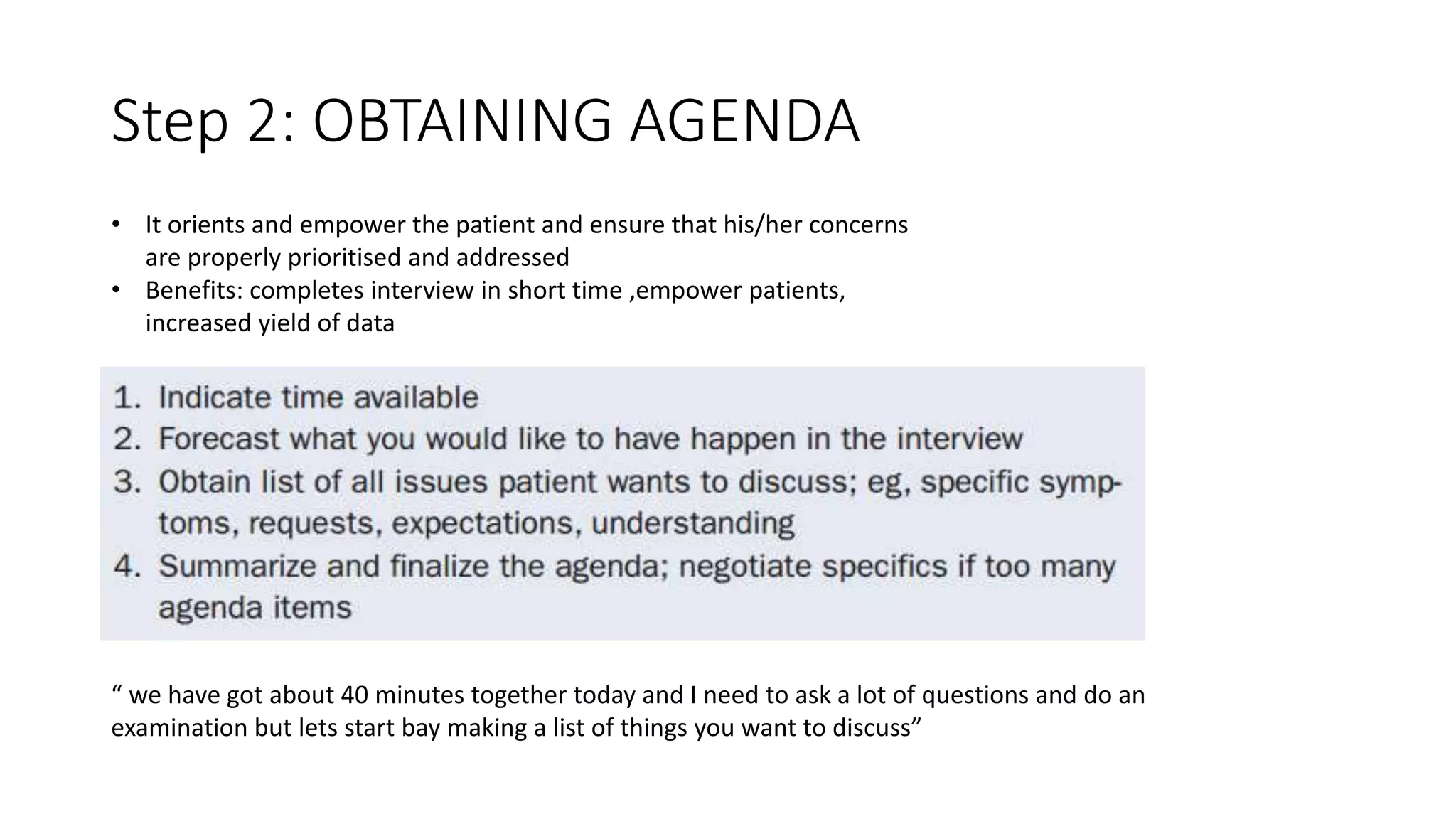
Step 2: OBTAINING AGENDA
• It orients and empower the patient and ensure that his/her concerns
are properly prioritised and addressed
• Benefits: completes interview in short time ,empower patients,
increased yield of data
“ we have got about 40 minutes together today and I need to ask a lot of questions and do an
examination but lets start bay making a list of things you want to discuss”
Step 3: OPENING THE HOPI
• HOPI most important component of interview
• Encourage continuous flow of information ( knowing pt. symptom story)
• If pt. not talking, focussing open ende skills are used( echoing, requesting,
summary)
• Mentally active: think what the information means
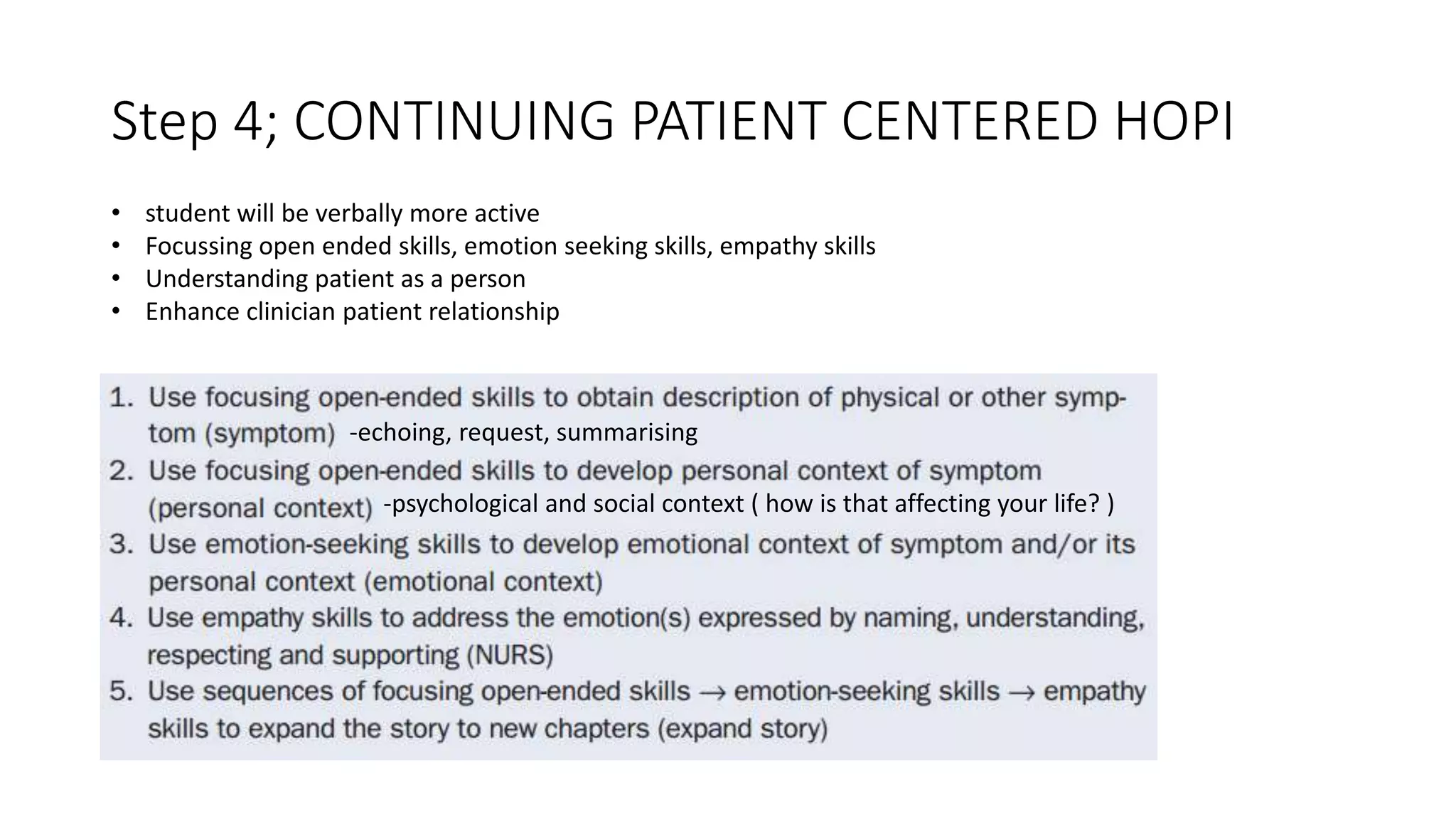
Step 4; CONTINUING PATIENT CENTERED HOPI
• student will be verbally more active
• Focussing open ended skills, emotion seeking skills, empathy skills
• Understanding patient as a person
• Enhance clinician patient relationship
-echoing, request, summarising
-psychological and social context ( how is that affecting your life? )
Step 4
• Emotional context; Emotional focus (emotion seeking skills) : direct or indirect
• Empathy skills; To address emotion & feeling, convey the patient that you have recognized it by
naming it, you understand it and you are available in any anyway possible
• Empathy skills may make patient introduce new personal information- you can work on that
• Do this until you are satisfied with depth of the story
Step 5: TRANSITION TO MIDDLE PART OF INTERVIEW
SUMMARY
• The beginning of the medical interview consists of two preparatory steps during
which we set the stage (Step 1) and the agenda (Step 2) followed by an open-
ended beginning of the HPI (step 3), continuation of the HPI (Step 4), and
transition to the middle of the interview (Step 5).
• The transition (Step 5) prepares the patient for the more direct clinician-centered
style of the middle of the interview.
• In Steps 3 and 4, you use the following patient-centered skills to “build the
patient’s history”: non focusing and focusing open-ended inquiry, occasional
closed-ended questions, emotion-seeking and empathy skills, and hypothesis
testing.
• The cyclic, integrated use of these patient centered skills occupies all of the
longest and most important Step 4.
• These are the tools that will allow you to begin to understand the richness and
complexity of the human condition
THANK YOU

Patient Centered Interview

  • 1.
  • 2.
    • A user-friendlystep-by-step method for the beginning of the medical interview • It is followed by clinician centred interview • Benefits: a)improved patient satisfaction, b)decreased risk of malpractice law suits, c)improved health outcomes. d)after this investment, you will find the rest of the interview to be fairly easy and routine, e)the data you generate will be easily understood and usually describe the primary symptoms and their personal context. f)the mind–body connection will be established g)the patient will feel listened-to, understood, and cared-for.
  • 4.
    Steps • Setting thestage for the interview • Obtaining agenda • Opening the pt. centered HOPI • Continuing the pt. centered HOPI • Transition to middle part of the interview
  • 5.
    Step 1: SETTINGTHE STAGE FOR THE INTERVIEW “ Mr. George Brown? Hello, I am Mark Burn. I am the medical student on the team that will be looking after you. How do you prefer to be called” - eye contact, smiling, attentive& calm, friendly, respectful demeanour is time convenient for the interview?, Patient circumstances, pressing needs that might delay interview draw full attention & show your caring & concern ‘is that a comfortable chair for you?’, ‘is that light bothering your eyes’
  • 6.
    Step 2: OBTAININGAGENDA • It orients and empower the patient and ensure that his/her concerns are properly prioritised and addressed • Benefits: completes interview in short time ,empower patients, increased yield of data “ we have got about 40 minutes together today and I need to ask a lot of questions and do an examination but lets start bay making a list of things you want to discuss”
  • 7.
    Step 3: OPENINGTHE HOPI • HOPI most important component of interview • Encourage continuous flow of information ( knowing pt. symptom story) • If pt. not talking, focussing open ende skills are used( echoing, requesting, summary) • Mentally active: think what the information means
  • 8.
    Step 4; CONTINUINGPATIENT CENTERED HOPI • student will be verbally more active • Focussing open ended skills, emotion seeking skills, empathy skills • Understanding patient as a person • Enhance clinician patient relationship -echoing, request, summarising -psychological and social context ( how is that affecting your life? )
  • 9.
    Step 4 • Emotionalcontext; Emotional focus (emotion seeking skills) : direct or indirect • Empathy skills; To address emotion & feeling, convey the patient that you have recognized it by naming it, you understand it and you are available in any anyway possible • Empathy skills may make patient introduce new personal information- you can work on that • Do this until you are satisfied with depth of the story
  • 10.
    Step 5: TRANSITIONTO MIDDLE PART OF INTERVIEW
  • 11.
    SUMMARY • The beginningof the medical interview consists of two preparatory steps during which we set the stage (Step 1) and the agenda (Step 2) followed by an open- ended beginning of the HPI (step 3), continuation of the HPI (Step 4), and transition to the middle of the interview (Step 5). • The transition (Step 5) prepares the patient for the more direct clinician-centered style of the middle of the interview. • In Steps 3 and 4, you use the following patient-centered skills to “build the patient’s history”: non focusing and focusing open-ended inquiry, occasional closed-ended questions, emotion-seeking and empathy skills, and hypothesis testing. • The cyclic, integrated use of these patient centered skills occupies all of the longest and most important Step 4. • These are the tools that will allow you to begin to understand the richness and complexity of the human condition
  • 12.