Guided by : DR .Anusuya
Presented by : DR. Deepti Dewan
ETIOLOGY
 ATOPY AND ALLERGY: 75-85% of pts. With asthma have positive immediate
skin reactions to common inhalant allergens
 Most people with asthma are atopic and can be measured by skin tests or with
measurements of specific IgE, house dust mite allergens appear to be the most
common one ass. with asthma
 Allergens increases the severity of the disease
 Occupational asthma occurs due to allergens and sensitizers , some healthy
people exposed to these agents sensitization occurs and episodic wheeze is
present
 Intrinsic asthma people have higher levels of circulating IgE than non-asthmatic
population
 House mites, grass pollens, animal and moulds, Alternia alternate (fungus
causing leaf spot) ,climates ,surroundings.
 Predominant offending allergen :
 Delhi: Amaranthus , Cassia siamea,Ricinus, Brassica,
Imperata, Prosopis, Cenchrus, Cassia Occidentalis.
 Prosopis : Bikaner, Lucknow ,Varanasi
 Brassica : Bhopal, Kanpur
 Parthenium in Kohlapur
 Pollen allergy : particles greater than 10micron in diameter do not
penetrate the LRT. Ragweed and grass pollination. It is mainly season related
 Mould : mould spores smaller than pollen grains
 House dustmite: arachnoids related to ticks and spiders. ubiquitous living
in house dust and scales of skin shed by human. Commonest mite is
Dermatophagoides pteronssinus. High levels found in
mattresses,pillows,carpets, bed covers, clothes soft toys.
 Animal allergens: cat allergen is more likely to cause sensitisation than that
of dogs. Major cat allergen Fel d 1, which is a protein secreted by cat’s
salivary,sabeceous and lacrimal glands, this protein is stable and does not
lose its antigenic property for a month. A no. of epidemiological study
suggest close contact with a cat or dog in very early infancy reduces the
prevalence
 Cockroach allergen: imp. Species Blatella germanica and periplaneta
American
 Infection
PROVOCATEURS OF ASTHMA
The principal infection provacateurs of asthma in childhood during the
first 2years of life are rep. synctial virus (RSV), parainfluenza virus,
and rhinovirus. Exacerbate Mycoplasma pneumoniae, clamydia
pneumoniae
In recent years it is observed that some infections are protective of
bronchial asthma. viral infections can undoubtedly cause
deterioration of established asthma,viral or bacterial infections
during the first three years of life may serve a protective function
against the development of allergic diseases. Possibly they evoke a
Th-1- like protective response with the generation of IFN-gamma
and IL-2.
This high conc. Of Th1 cytokines could inhibit the release of Th2
cytokines thus tuning the mucosal immune response away from
allergen sensitisation
Drugs
 About 5-20% of adults with asthma will experience severe
and even fatal exacerbations of bronchoconstriction after
ingestion of aspirin or certain non-steroidal anti-
inflammatory drugs(NSAIDS)
 Apirin , Ibuprofen ,Indomethacin, Piroxicam, Sulindac,
Tolmetin, Naproxen, Fenoprefen, Meclofanamate,
Mefenamic acid, Diclofenac sodium.
 In these individuals ,ingestion of asspirin is followed
within 1-2 hours by the onset of bronchospasm
accompanied by urticaria and rhinitis
Exercise induced asthma
 EIA asthma of persons in whom exercise is predominant or even the
only trigger to airflow obstruction. EI bronchoconstriction is one
manifestation of asthmatic diathesis
 All people with asthma have airway hyperirritability that leads to
exercise-induced asthma if provocative stimulus-eucapnic voluntary
hyperventilation- is appropriately intensified
 It is the airway narrowing develops within2-3 minutes after cessation
of exercise. It reaches its peak about 5-10mins, after cessation of
activity and usually resolves spontnaeously in next 30-90 mins or
with few mins after administration of an inhaled beta adrenergic
bronchodilator.
 A rapid change to warm, moist air post-exercise tends to worsen the
development of airflow obstruction.
 Some pts. Who engage in continuous, repetitive exercise periods ,
EIA diminishes during a refractory period usually lasts 2hrs after an
exercise challenge.
EIA
 It is mainly due to smooth muscle contraction, thus its known as airflow-
induced bronchoconstriction (AIB) or exercise-induced bronchospasm(EIB)
 EIA is due to loss of heat or water or both, from the lung during exercise
resulting from hyperventilaion of air that is cooler and dryer than the
bronchial tree
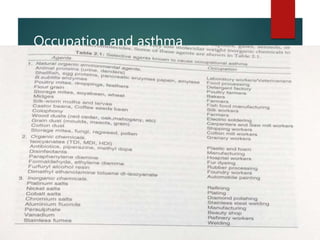
Occupation and asthma
 It accounts for 10% adult onset asthma
Tartrazine and sulphite sensitivity
 It is a yellow dye commonly employed in food and
medications.
 Sulphiting agents is used to preserve foods and
beverages since ancient times, maintaining crisp and
fresh appearance of foods, prevents browning and
control microbial growth and spoilage
 Rhinitis and sinusitis
 GER: reflex vagal bronchoconstriction occurs secondary to
stimulation of sensory nerve fibres in lower oesophagus
 Psychological factors
 Pollution: passive smoking , diesel fumes ass. With
increased allergic responses. Tokyo Yokohama asthma.
Asthmatic smokers have higher soutum total cell and
neutrophil numbers and IL-8 concentrations compared to
asthmatic non smokers, sputum eosinophils and
eosinophil-cation-protein levels are higher in non smoking
sugesting a normalising effect of smoking on Th1/Th2
balance
 Endocrinal factors
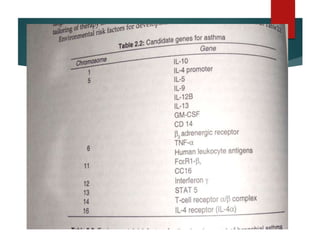
 Genetics: molecular genetic linkage studies indicate
“atopy” genes locus is on chromosome 11
PATHOPHYSIOLOGY
 Three factors narrow airway caliber to limit the flow:
 Airway smooth muscle contraction
 Gland and epithelial secretions and exudation into the
airway lumen
 Inflammatory oedema and vasodilatation (hyperemia)
EARLY ASTHMATIC REACTION
 This early reaction is IgE dependent and is the result of IgE
binding to mast cells by its Fc portion and to specific
antigens by its F(ab) portion.
 When IgE-sensitized mast cells are exposed to antigen
against which the IgE molecule is directed, preformed and
newly generated mediators are released.
 These can be detected in the blood as they overflow into the
circulation, in bronchoalveolar lavage (BAL) fluid and as
metabolites in the urine and include histamine,
prostaglandin D2 , and leukotriene C4 from airway mast cells
,this early response is due to histamine.
LATE ASTHMATIC REACTION (LAR)
AND BRONCHIAL HYPERREACTIVITY
(BHR)
 The LAR is characterised by release of inflammatory
mediators into same fluids.
 The BHR is exaggerated bronchoconstriction of smooth
muscles and airway narrowing on exposure to small
quantity of non-allergic stimulant that usually does not
provoke such a reaction in normal subjects
Pathogenesis
 T-lymphocyte play a key role in asthmatic airway inflammation and
sensitisation.
 Two types of T-lymphocyte helper (Th)cells.
 Th 1 controls synthesis of Igs such as IgA and IgM whereas Th 2 controls
IgE production. There is balance between Th1/T2 switch.
 Exposure to an inducing factor sensitises T cells of a person wiith genetic
susceptibility with bronchial asthma, and it shifts th Th1/Th2 switch in
favour Th2 dominance.
 Once sensitised these Th2 cells get into airway mucosa and governs IgE
mediated responses of allergic reaction.
 Normal individual when a noxious allergic substance enters airway, IgA
released. However in a sensitised person IgE is released

PATHOLOGY
 Crystalline material consisting largely of major basic
protein derived from eosinophils granules (Charcot-
Leyden crystals) maybe present.
 Oedema,dense eosinophilic infiltration and epithelial
denudation in bronchial wall
 Airway samples obtained at open lung biopsy show
goblet cell hyperplasia, peribronchial smooth muscle
hypertrophy and apparent basement membrane
thickening
 Strips of epithalial cells Curschmann’s spirals, clumps of
cells (Creola bodies) or isolate metaplastic cells are
common
Clinical Presentation
 Wheezing,cough, white or clear sputum,chest tightness
 Flexural eczema
 In children evidence of hyperinflation of lungs with use
of accessory muscles , appearance of hunched shoulders
and “pigeon chest”
 Intensity of breath sounds in symptomatic asthma will be
reduced and expiratory phase is prolonged.
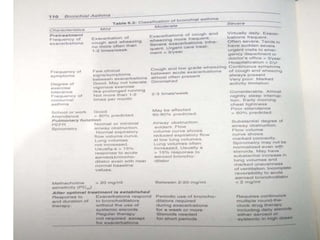
CLASSIFICATION
 Intrinsic and extrinsic asthma
 Late onset asthma
 Occupational asthma: and work aggravated asthma
 Nocturnal asthma
 Chronic asthma:
 Brittle asthma: intractable and persistent asthma resistant to
all conventional therapy
 Morning dippers: worsen symptoms during early hours of
night. In children attack is worse around 2am and in adults it
is variabe increasing slowly and rapidly from midnight
diagnosis
 Blood examination: patients have eosinophil count in the range of 5-
15%
 Sputum induction: no. of eosinophils are increased in induced
sputum
 Airway hyperresponsiveness: Methacholine or histamine challenge
test
 Chest Radiograph: hyperinflation in patient with ashma
 Skin prick test: sensitivity to a particular antigen can be identified by
injecting a small amount of allergens into the skin. Wheal and flare
appear at the site of injection of a sensitised allergen. Allergerns can
be identified by estimation of specific IgE im blood through
radioallergosorbent test (RAST)
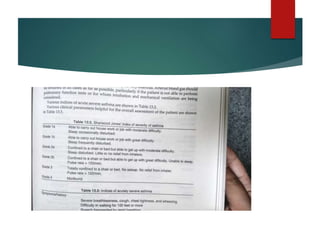
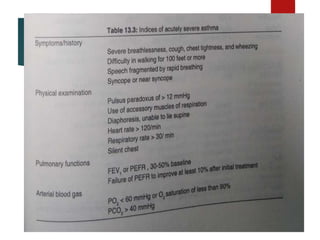
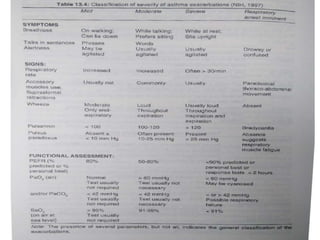
ASSESMENT OF SEVERITY
 PEAK EXPIRATORY FLOW RATE (PEFR):
It represents maximal expiratory effort
performed after full inhalation. Its measured
using a peak flow meter. Personal best value is
highest recorded PEFR value of a person taken
over a few days during asymptomatic period.
The magnitude of variation between mornning and evening
PEFR values is called PEFR variability and is proportional to
the severity of asthma.
Another useful index is PEFR reversibility.
Salbutamol or terbutaline administered
 SPIROMETRY:
A ratio of FEV1 and forced vital capacity (FVC) less than 0.7 is
diagnostic of airway obstruction.
 LUNG VOLUMES AND DIFFUSING CAPACITY:
Lung vols. Such as residual volume and total lung capacity are
increased in a patient with asthma. Carbon Monoxide diffusing capacity
(DLCO) is either normal or increased in asthma patients but its increased
in COPD.
 OXIMETRY:
O2 saturation should be more than 90%
 ARTERIAL BLOOD GAS ANALYSIS
PaO2 decreases but PaCO2 normal, when latter increased
for assisted ventilation
Indices determining control of
asthma
 Day time symptoms less than twice per week.
 Short acting beta agonist (SABA) inhaler use less than twice per
week.
 Without an night symptoms
 Without limitation of activity
 Normal PEFR and FEV1
 controlled if indices fulfilled and no exacerbation in last one year.
 PARTLY CONTROLLED: if any of the indices are fulfilled and patient
did not have an exacerbation during last one yr.
 POORLY CONTROLLED: more than 3indices are more severe and pt.
had exacerbation in last one week
Management of asthma
 Patient education
 Identify and reduce exposure to risk factors
 THERAPEUTICS
Thank you.

Bronchial asthma

  • 1.
    Guided by :DR .Anusuya Presented by : DR. Deepti Dewan
  • 3.
    ETIOLOGY  ATOPY ANDALLERGY: 75-85% of pts. With asthma have positive immediate skin reactions to common inhalant allergens  Most people with asthma are atopic and can be measured by skin tests or with measurements of specific IgE, house dust mite allergens appear to be the most common one ass. with asthma  Allergens increases the severity of the disease  Occupational asthma occurs due to allergens and sensitizers , some healthy people exposed to these agents sensitization occurs and episodic wheeze is present  Intrinsic asthma people have higher levels of circulating IgE than non-asthmatic population  House mites, grass pollens, animal and moulds, Alternia alternate (fungus causing leaf spot) ,climates ,surroundings.
  • 4.
     Predominant offendingallergen :  Delhi: Amaranthus , Cassia siamea,Ricinus, Brassica, Imperata, Prosopis, Cenchrus, Cassia Occidentalis.  Prosopis : Bikaner, Lucknow ,Varanasi  Brassica : Bhopal, Kanpur  Parthenium in Kohlapur
  • 5.
     Pollen allergy: particles greater than 10micron in diameter do not penetrate the LRT. Ragweed and grass pollination. It is mainly season related  Mould : mould spores smaller than pollen grains  House dustmite: arachnoids related to ticks and spiders. ubiquitous living in house dust and scales of skin shed by human. Commonest mite is Dermatophagoides pteronssinus. High levels found in mattresses,pillows,carpets, bed covers, clothes soft toys.  Animal allergens: cat allergen is more likely to cause sensitisation than that of dogs. Major cat allergen Fel d 1, which is a protein secreted by cat’s salivary,sabeceous and lacrimal glands, this protein is stable and does not lose its antigenic property for a month. A no. of epidemiological study suggest close contact with a cat or dog in very early infancy reduces the prevalence  Cockroach allergen: imp. Species Blatella germanica and periplaneta American  Infection
  • 6.
    PROVOCATEURS OF ASTHMA Theprincipal infection provacateurs of asthma in childhood during the first 2years of life are rep. synctial virus (RSV), parainfluenza virus, and rhinovirus. Exacerbate Mycoplasma pneumoniae, clamydia pneumoniae In recent years it is observed that some infections are protective of bronchial asthma. viral infections can undoubtedly cause deterioration of established asthma,viral or bacterial infections during the first three years of life may serve a protective function against the development of allergic diseases. Possibly they evoke a Th-1- like protective response with the generation of IFN-gamma and IL-2. This high conc. Of Th1 cytokines could inhibit the release of Th2 cytokines thus tuning the mucosal immune response away from allergen sensitisation
  • 7.
    Drugs  About 5-20%of adults with asthma will experience severe and even fatal exacerbations of bronchoconstriction after ingestion of aspirin or certain non-steroidal anti- inflammatory drugs(NSAIDS)  Apirin , Ibuprofen ,Indomethacin, Piroxicam, Sulindac, Tolmetin, Naproxen, Fenoprefen, Meclofanamate, Mefenamic acid, Diclofenac sodium.  In these individuals ,ingestion of asspirin is followed within 1-2 hours by the onset of bronchospasm accompanied by urticaria and rhinitis
  • 8.
    Exercise induced asthma EIA asthma of persons in whom exercise is predominant or even the only trigger to airflow obstruction. EI bronchoconstriction is one manifestation of asthmatic diathesis  All people with asthma have airway hyperirritability that leads to exercise-induced asthma if provocative stimulus-eucapnic voluntary hyperventilation- is appropriately intensified  It is the airway narrowing develops within2-3 minutes after cessation of exercise. It reaches its peak about 5-10mins, after cessation of activity and usually resolves spontnaeously in next 30-90 mins or with few mins after administration of an inhaled beta adrenergic bronchodilator.  A rapid change to warm, moist air post-exercise tends to worsen the development of airflow obstruction.  Some pts. Who engage in continuous, repetitive exercise periods , EIA diminishes during a refractory period usually lasts 2hrs after an exercise challenge.
  • 9.
    EIA  It ismainly due to smooth muscle contraction, thus its known as airflow- induced bronchoconstriction (AIB) or exercise-induced bronchospasm(EIB)  EIA is due to loss of heat or water or both, from the lung during exercise resulting from hyperventilaion of air that is cooler and dryer than the bronchial tree
  • 10.
    Occupation and asthma It accounts for 10% adult onset asthma
  • 11.
    Tartrazine and sulphitesensitivity  It is a yellow dye commonly employed in food and medications.  Sulphiting agents is used to preserve foods and beverages since ancient times, maintaining crisp and fresh appearance of foods, prevents browning and control microbial growth and spoilage
  • 12.
     Rhinitis andsinusitis  GER: reflex vagal bronchoconstriction occurs secondary to stimulation of sensory nerve fibres in lower oesophagus  Psychological factors  Pollution: passive smoking , diesel fumes ass. With increased allergic responses. Tokyo Yokohama asthma. Asthmatic smokers have higher soutum total cell and neutrophil numbers and IL-8 concentrations compared to asthmatic non smokers, sputum eosinophils and eosinophil-cation-protein levels are higher in non smoking sugesting a normalising effect of smoking on Th1/Th2 balance
  • 13.
     Endocrinal factors Genetics: molecular genetic linkage studies indicate “atopy” genes locus is on chromosome 11
  • 15.
    PATHOPHYSIOLOGY  Three factorsnarrow airway caliber to limit the flow:  Airway smooth muscle contraction  Gland and epithelial secretions and exudation into the airway lumen  Inflammatory oedema and vasodilatation (hyperemia)
  • 16.
    EARLY ASTHMATIC REACTION This early reaction is IgE dependent and is the result of IgE binding to mast cells by its Fc portion and to specific antigens by its F(ab) portion.  When IgE-sensitized mast cells are exposed to antigen against which the IgE molecule is directed, preformed and newly generated mediators are released.  These can be detected in the blood as they overflow into the circulation, in bronchoalveolar lavage (BAL) fluid and as metabolites in the urine and include histamine, prostaglandin D2 , and leukotriene C4 from airway mast cells ,this early response is due to histamine.
  • 17.
    LATE ASTHMATIC REACTION(LAR) AND BRONCHIAL HYPERREACTIVITY (BHR)  The LAR is characterised by release of inflammatory mediators into same fluids.  The BHR is exaggerated bronchoconstriction of smooth muscles and airway narrowing on exposure to small quantity of non-allergic stimulant that usually does not provoke such a reaction in normal subjects
  • 18.
    Pathogenesis  T-lymphocyte playa key role in asthmatic airway inflammation and sensitisation.  Two types of T-lymphocyte helper (Th)cells.  Th 1 controls synthesis of Igs such as IgA and IgM whereas Th 2 controls IgE production. There is balance between Th1/T2 switch.  Exposure to an inducing factor sensitises T cells of a person wiith genetic susceptibility with bronchial asthma, and it shifts th Th1/Th2 switch in favour Th2 dominance.  Once sensitised these Th2 cells get into airway mucosa and governs IgE mediated responses of allergic reaction.  Normal individual when a noxious allergic substance enters airway, IgA released. However in a sensitised person IgE is released 
  • 19.
    PATHOLOGY  Crystalline materialconsisting largely of major basic protein derived from eosinophils granules (Charcot- Leyden crystals) maybe present.  Oedema,dense eosinophilic infiltration and epithelial denudation in bronchial wall  Airway samples obtained at open lung biopsy show goblet cell hyperplasia, peribronchial smooth muscle hypertrophy and apparent basement membrane thickening  Strips of epithalial cells Curschmann’s spirals, clumps of cells (Creola bodies) or isolate metaplastic cells are common
  • 20.
    Clinical Presentation  Wheezing,cough,white or clear sputum,chest tightness  Flexural eczema  In children evidence of hyperinflation of lungs with use of accessory muscles , appearance of hunched shoulders and “pigeon chest”  Intensity of breath sounds in symptomatic asthma will be reduced and expiratory phase is prolonged.
  • 24.
    CLASSIFICATION  Intrinsic andextrinsic asthma  Late onset asthma  Occupational asthma: and work aggravated asthma  Nocturnal asthma  Chronic asthma:  Brittle asthma: intractable and persistent asthma resistant to all conventional therapy  Morning dippers: worsen symptoms during early hours of night. In children attack is worse around 2am and in adults it is variabe increasing slowly and rapidly from midnight
  • 26.
    diagnosis  Blood examination:patients have eosinophil count in the range of 5- 15%  Sputum induction: no. of eosinophils are increased in induced sputum  Airway hyperresponsiveness: Methacholine or histamine challenge test  Chest Radiograph: hyperinflation in patient with ashma  Skin prick test: sensitivity to a particular antigen can be identified by injecting a small amount of allergens into the skin. Wheal and flare appear at the site of injection of a sensitised allergen. Allergerns can be identified by estimation of specific IgE im blood through radioallergosorbent test (RAST)
  • 27.
    ASSESMENT OF SEVERITY PEAK EXPIRATORY FLOW RATE (PEFR): It represents maximal expiratory effort performed after full inhalation. Its measured using a peak flow meter. Personal best value is highest recorded PEFR value of a person taken over a few days during asymptomatic period. The magnitude of variation between mornning and evening PEFR values is called PEFR variability and is proportional to the severity of asthma. Another useful index is PEFR reversibility. Salbutamol or terbutaline administered
  • 28.
     SPIROMETRY: A ratioof FEV1 and forced vital capacity (FVC) less than 0.7 is diagnostic of airway obstruction.  LUNG VOLUMES AND DIFFUSING CAPACITY: Lung vols. Such as residual volume and total lung capacity are increased in a patient with asthma. Carbon Monoxide diffusing capacity (DLCO) is either normal or increased in asthma patients but its increased in COPD.  OXIMETRY: O2 saturation should be more than 90%  ARTERIAL BLOOD GAS ANALYSIS PaO2 decreases but PaCO2 normal, when latter increased for assisted ventilation
  • 29.
    Indices determining controlof asthma  Day time symptoms less than twice per week.  Short acting beta agonist (SABA) inhaler use less than twice per week.  Without an night symptoms  Without limitation of activity  Normal PEFR and FEV1  controlled if indices fulfilled and no exacerbation in last one year.  PARTLY CONTROLLED: if any of the indices are fulfilled and patient did not have an exacerbation during last one yr.  POORLY CONTROLLED: more than 3indices are more severe and pt. had exacerbation in last one week
  • 30.
    Management of asthma Patient education  Identify and reduce exposure to risk factors  THERAPEUTICS
  • 33.