Pathology of Cerebrovascular Disease By Prof. J.T. Anim Department of Pathology
Cerebrovascular Disease Affected blood vessels Intracranial vessels Middle cerebral artery Anterior cerebral artery Basilar artery (posterior cerebral arteries) Extracranial vessels Carotid artery Common carotid artery Internal carotid artery (external carotid artery) Vertebral artery others
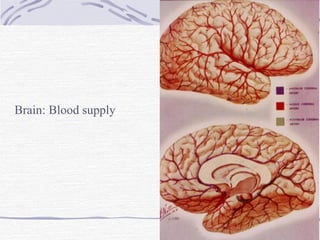
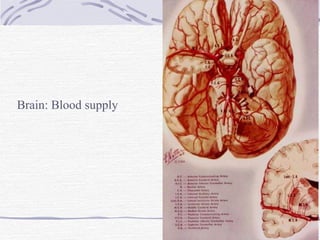
Brain: Blood supply
Brain: Blood supply
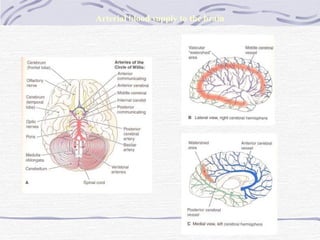
Arterial blood supply to the brain
Brain: Blood supply
Cerebrovascular Disease Transient ischaemic attack (TIA) A fully  reversible  neurological deficit often lasting for no more than  a few minutes , but occasionally up to 24 hours. No structural brain damage has occurred
Cerebrovascular Disease Factors predisposing to TIA Atherosclerosis Superimposed hypotension Spasm of diseased vessel Disorders in the neck (spondylosis) Other extracranial vascular diseases eg. embolism
Cerebrovascular Disease Stroke Rapid onset of a  focal  disturbance of cerebral function of presumed vascular origin and of  more than 24 hours  duration. Permanent brain damage has occured
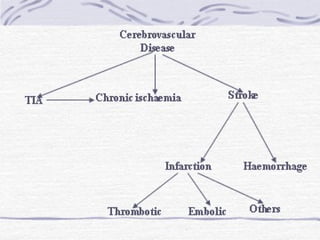
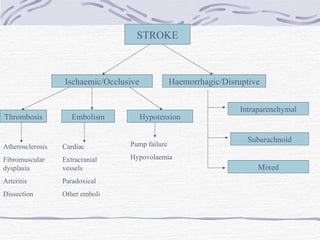
STROKE Ischaemic/Occlusive Haemorrhagic/Disruptive Intraparenchymal Subarachnoid Mixed Thrombosis Embolism Hypotension Atherosclerosis Fibromuscular dysplasia Arteritis Dissection Cardiac Extracranial vessels Paradoxical Other emboli Pump failure Hypovolaemia
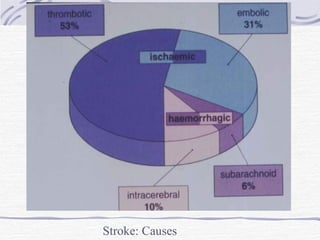
Stroke: Causes
Ischaemic Stroke Atherosclerosis Carotid artery Common carotid Internal carotid (external carotid) Vertebro-basilar system Posterior cerebral With normal BP, >90% cross sectional area reduction is necessary to impair blood flow
Ischaemic Stroke Factors affecting tissue survival Adequacy of collateral circulation State of systemic circulation Reduced blood flow, cardiac pump failure, hypovolaemia, hyperviscosity Serological factors Low blood sugar, high blood sugar, hypoxia, elevated serum calcium, high blood alcohol
Ischaemic Stroke Factors affecting tissue survival  contd . Changes within obstructing vascular lesion Fragmentation and advancing of embolus Reactive vasoconstriction (spasm) Reperfusion – stunned cells may recover Propagation of thrombus – collateral occlusion Embolisation from previous thrombus
Ischaemic Stroke Factors affecting tissue survival  contd . Resistance within microcirculatory bed Hypertension Diabetes mellitus – thickened vessel walls Hyperviscosity Diffuse thromboses (low microcirculatory flow) Oedema and raised ICP Increased resistance to blood flow
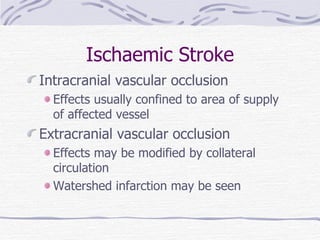
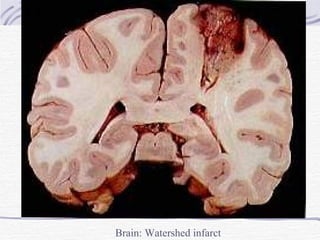
Ischaemic Stroke Intracranial vascular occlusion Effects usually confined to area of supply of affected vessel  Extracranial vascular occlusion Effects may be modified by collateral circulation Watershed infarction may be seen
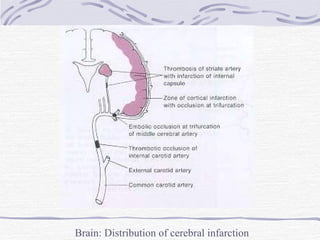
Brain: Distribution of cerebral infarction
CNS Ischaemia Selective vulnerability of CNS cells Neurons – most sensitive Oligodendroglia Astrocytes Microglia Blood vessels In descending order of sensitivity
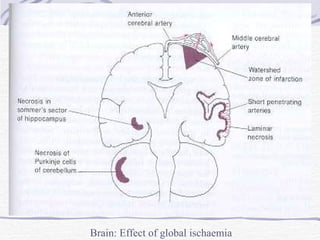
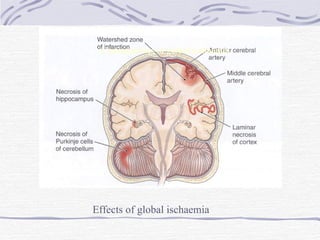
Brain: Effect of global ischaemia
Consequences of global ischaemia Effects of global ischaemia
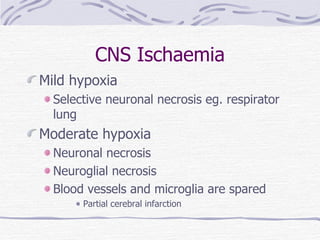
CNS Ischaemia Mild hypoxia Selective neuronal necrosis eg. respirator lung Moderate hypoxia Neuronal necrosis Neuroglial necrosis Blood vessels and microglia are spared Partial cerebral infarction
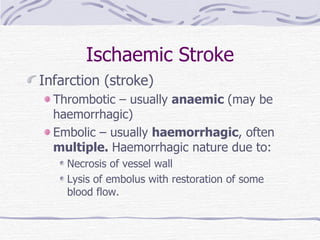
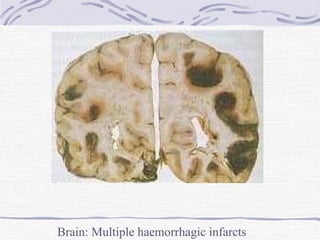
Ischaemic Stroke Infarction (stroke) Thrombotic – usually  anaemic  (may be haemorrhagic) Embolic – usually  haemorrhagic , often  multiple.  Haemorrhagic nature due to: Necrosis of vessel wall Lysis of embolus with restoration of some blood flow.
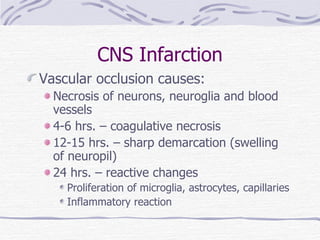
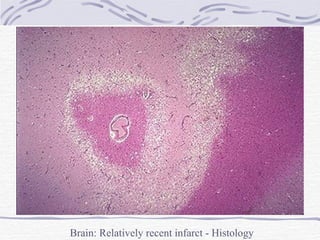
CNS Infarction Vascular occlusion causes: Necrosis of neurons, neuroglia and blood vessels 4-6 hrs. – coagulative necrosis 12-15 hrs. – sharp demarcation (swelling of neuropil) 24 hrs. – reactive changes Proliferation of microglia, astrocytes, capillaries Inflammatory reaction
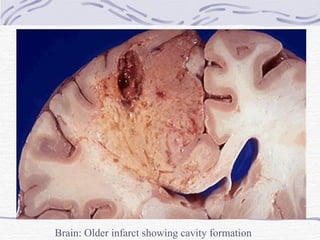
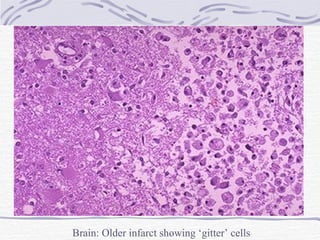
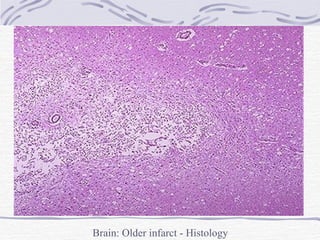
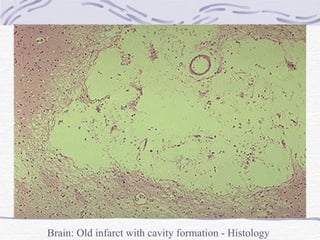
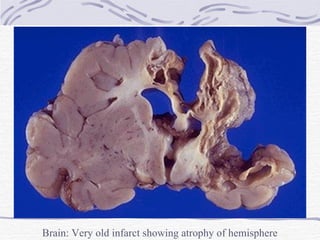
CNS Infarction Infarction contd. 1-2 weeks – Swelling resolves Softening Shrunken granular grey matter Accumulation of lipid-laden phagocytes (gitter cells) in infarcted area Several months – shrunken cystic lesion traversed by glial fibrils and small blood vessels
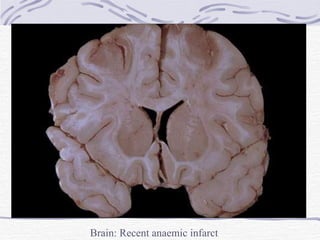
Brain: Recent anaemic infarct
Brain: Older infarct showing cavity formation
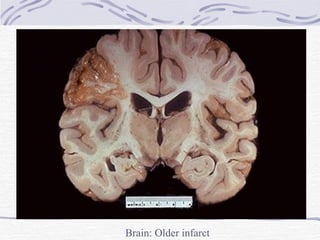
Brain: Older infarct
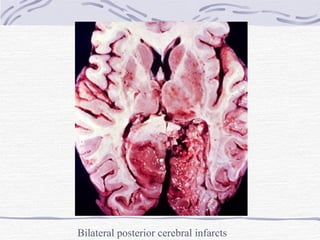
Bilateral posterior cerebral infarcts
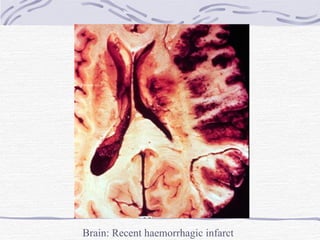
Brain: Recent haemorrhagic infarct
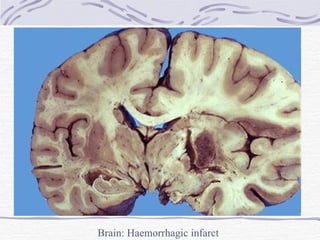
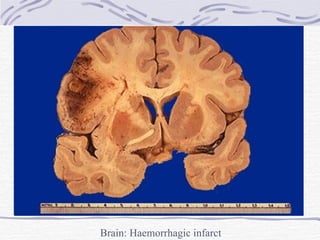
Brain: Haemorrhagic infarct
Brain: Multiple haemorrhagic infarcts
Brain: Relatively recent infarct - Histology
Brain: Older infarct showing ‘gitter’ cells
Brain: Older infarct - Histology
Brain: Old infarct with cavity formation - Histology
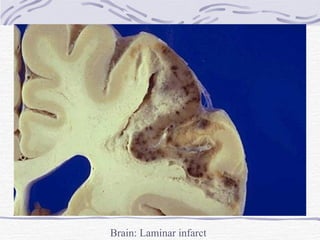
Brain: Laminar infarct
Brain: Watershed infarct
Brain: Very old infarct showing atrophy of hemisphere
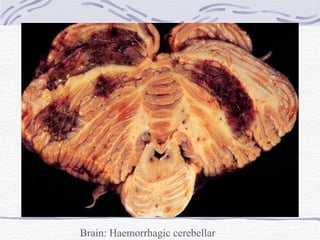
CNS Infarction Vertebro-basilar occlusion Infarction of brainstem Infarction of cerebellum Infarction of posterior cerebral arterial territory
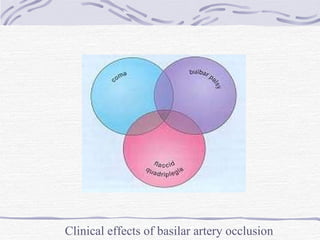
Clinical effects of basilar artery occlusion
Brain: Haemorrhagic cerebellar infarcts
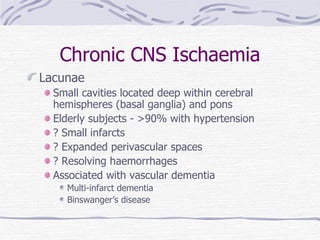
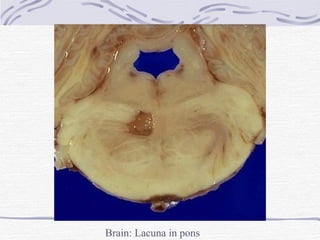
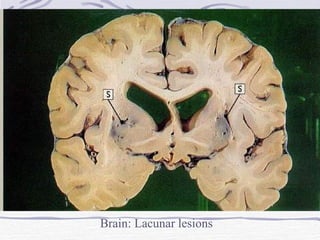
Chronic CNS Ischaemia Lacunae Small cavities located deep within cerebral hemispheres (basal ganglia) and pons Elderly subjects - >90% with hypertension ? Small infarcts ? Expanded perivascular spaces ? Resolving haemorrhages Associated with vascular dementia Multi-infarct dementia Binswanger’s disease
Brain: Lacuna in pons
Brain: Lacunar lesions
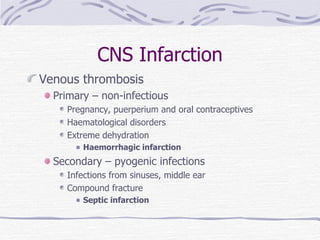
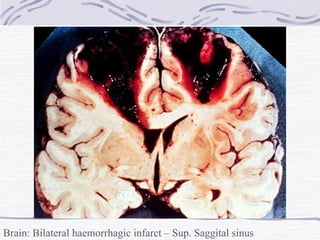
CNS Infarction Venous thrombosis Primary – non-infectious Pregnancy, puerperium and oral contraceptives Haematological disorders Extreme dehydration Haemorrhagic infarction Secondary – pyogenic infections Infections from sinuses, middle ear Compound fracture Septic infarction
Brain: Bilateral haemorrhagic infarct – Sup. Saggital sinus thrombosis
Haemorrhagic Stroke Brain and spinal cord substance (intraparenchymal) Subarachnoid Mixed
Haemorrhagic Stroke Major predisposing factors Hypertension Congenital anomalies Vascular malformations Minor predisposing factors Vasculitis Bleeding diatheses
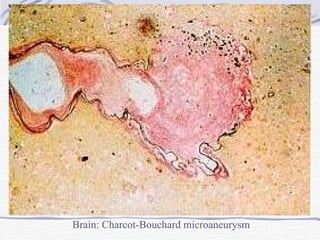
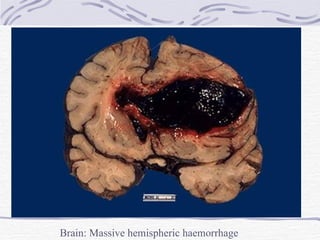
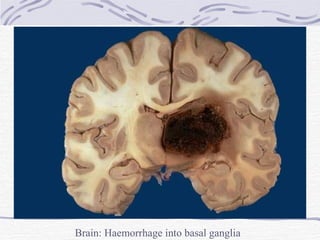
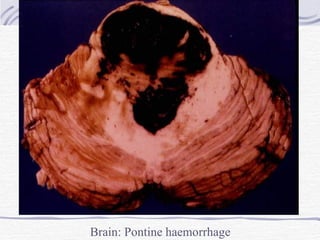
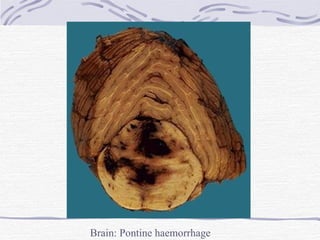
Haemorrhagic Stroke Primary intraparenchmal haemorrhage Predisposing vascular changes include: Fibrinoid necrosis Hyaline arteriolosclerosis (lipohyalinosis) Microaneurysms (Charcôt-Bouchard) Sizes of haemorrhage Massive - >3cm diam. Cerebral hemisphere > 1.5cm diam. brainstem
Brain: Charcot-Bouchard microaneurysm
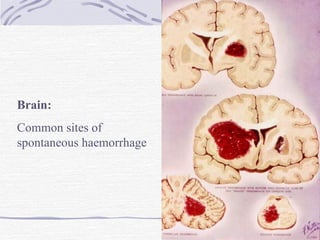
Brain: Common sites of spontaneous haemorrhage
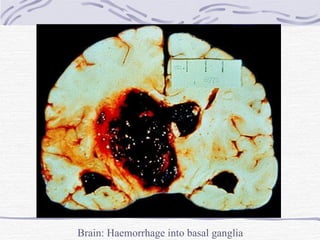
Brain: Haemorrhage into basal ganglia
Brain: Massive hemispheric haemorrhage
Brain: Haemorrhage into basal ganglia
Brain: Pontine haemorrhage
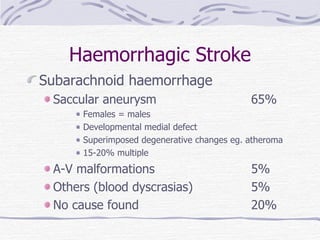
Haemorrhagic Stroke Subarachnoid haemorrhage Saccular aneurysm  65% Females = males Developmental medial defect Superimposed degenerative changes eg. atheroma 15-20% multiple A-V malformations 5% Others (blood dyscrasias) 5% No cause found 20%
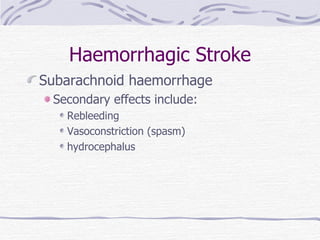
Haemorrhagic Stroke Subarachnoid haemorrhage Secondary effects include: Rebleeding Vasoconstriction (spasm) hydrocephalus
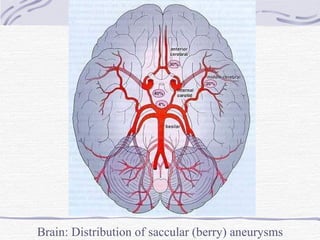
Brain: Distribution of saccular (berry) aneurysms
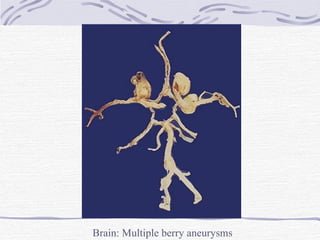
Brain: Multiple berry aneurysms
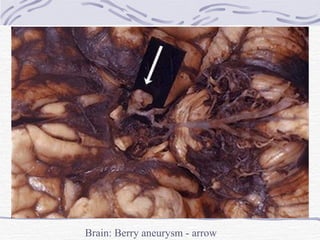
Brain: Berry aneurysm - arrow
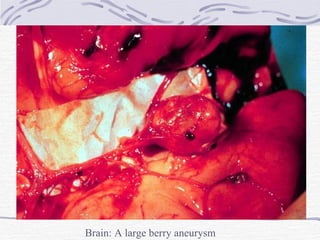
Brain: A large berry aneurysm
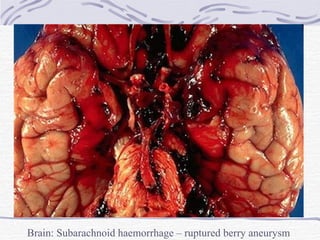
Brain: Subarachnoid haemorrhage – ruptured berry aneurysm
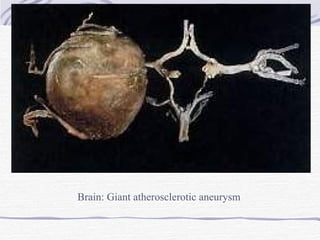
Brain: Giant atherosclerotic aneurysm
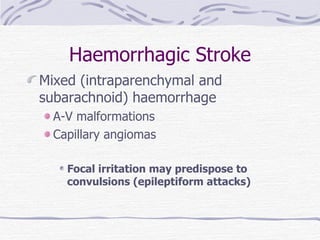
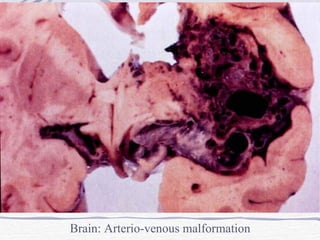
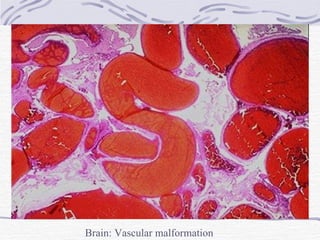
Haemorrhagic Stroke Mixed (intraparenchymal and subarachnoid) haemorrhage A-V malformations Capillary angiomas Focal irritation may predispose to convulsions (epileptiform attacks)
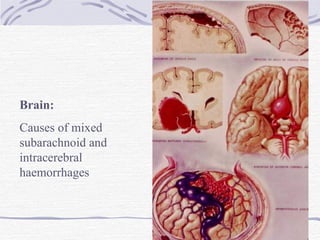
Brain: Causes of mixed subarachnoid and intracerebral haemorrhages
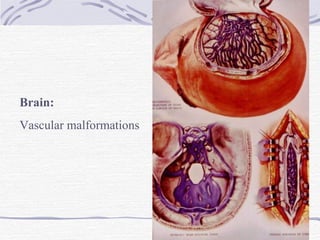
Brain: Vascular malformations
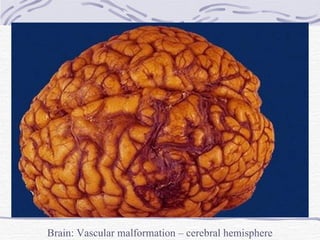
Brain: Vascular malformation – cerebral hemisphere
Brain: Arterio-venous malformation
Brain: Vascular malformation

Pathology+of+cerebrovascular+disease+dr+anim