GRADING AND STAGING OF
TUMORS & PARANEOPLASTIC
SYNDROME
Shiksha Choytoo
Roll No. 12
22 September 2014
Introduction
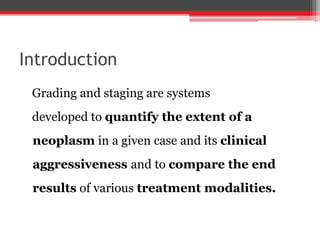
Grading and staging are systems
developed to quantify the extent of a
neoplasm in a given case and its clinical
aggressiveness and to compare the end
results of various treatment modalities.
GRADING
Grading
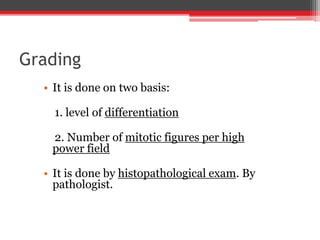
• It is done on two basis:
1. level of differentiation
2. Number of mitotic figures per high
power field
• It is done by histopathological exam. By
pathologist.
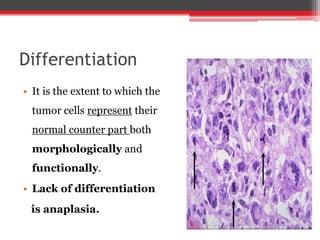
Differentiation
• It is the extent to which the
tumor cells represent their
normal counter part both
morphologically and
functionally.
• Lack of differentiation
is anaplasia.
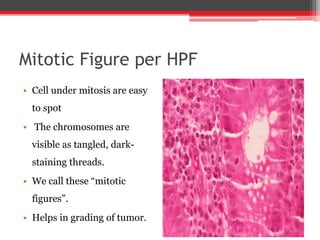
Mitotic Figure per HPF
• Cell under mitosis are easy
to spot
• The chromosomes are
visible as tangled, dark-
staining threads.
• We call these “mitotic
figures”.
• Helps in grading of tumor.
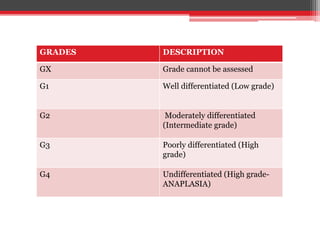
• The malignancy of tumor can be graded
into 4 categories.
• Recommended by the American Joint
commission on Cancers and other
bodies
GRADES DESCRIPTION
GX Grade cannot be assessed
G1 Well differentiated (Low grade)
G2 Moderately differentiated
(Intermediate grade)
G3 Poorly differentiated (High
grade)
G4 Undifferentiated (High grade-
ANAPLASIA)
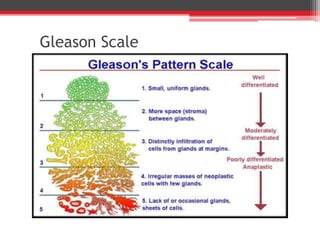
Gleason Scale
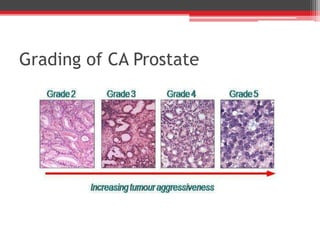
Grading of CA Prostate
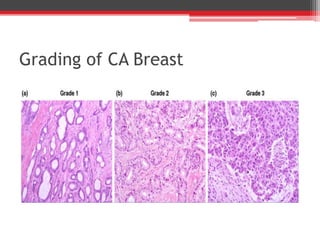
Grading of CA Breast
STAGING
• It is based on
1. Tumor size and/or extent reached
2. Lymph node status
3. presence or absence of metastasis
• It is done by detailed clinical examination,
usually along with radiological exam. (x-
ray, CT scan, MRI, Ultrasonography)
• Sometimes surgical exploration may be
required.
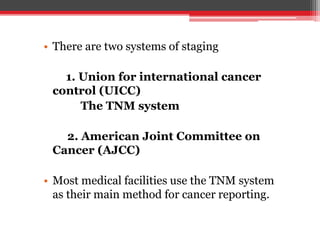
• There are two systems of staging
1. Union for international cancer
control (UICC)
The TNM system
2. American Joint Committee on
Cancer (AJCC)
• Most medical facilities use the TNM system
as their main method for cancer reporting.
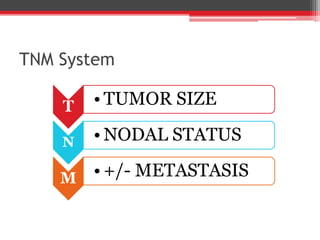
TNM System
T • TUMOR SIZE
N • NODAL STATUS
M • +/- METASTASIS
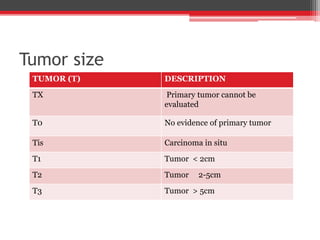
Tumor size
TUMOR (T) DESCRIPTION
TX Primary tumor cannot be
evaluated
T0 No evidence of primary tumor
Tis Carcinoma in situ
T1 Tumor < 2cm
T2 Tumor 2-5cm
T3 Tumor > 5cm
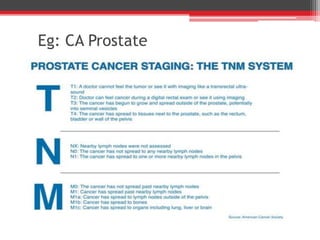
Eg: CA Prostate
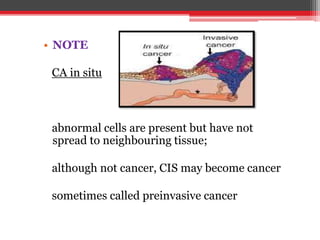
• NOTE
CA in situ
abnormal cells are present but have not
spread to neighbouring tissue;
although not cancer, CIS may become cancer
sometimes called preinvasive cancer

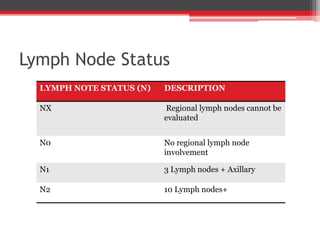
Lymph Node Status
LYMPH NOTE STATUS (N) DESCRIPTION
NX Regional lymph nodes cannot be
evaluated
N0 No regional lymph node
involvement
N1 3 Lymph nodes + Axillary
N2 10 Lymph nodes+
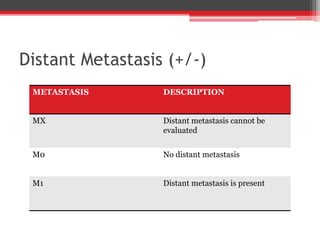
Distant Metastasis (+/-)
METASTASIS DESCRIPTION
MX Distant metastasis cannot be
evaluated
M0 No distant metastasis
M1 Distant metastasis is present
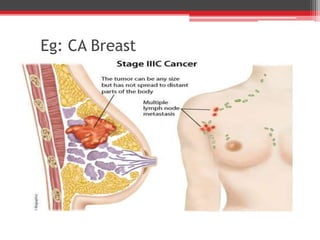
Eg: CA Breast
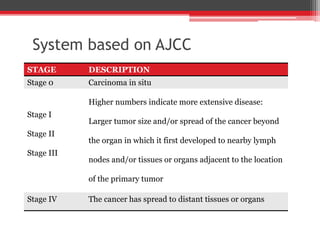
System based on AJCC
STAGE DESCRIPTION
Stage 0 Carcinoma in situ
Stage I
Stage II
Stage III
Higher numbers indicate more extensive disease:
Larger tumor size and/or spread of the cancer beyond
the organ in which it first developed to nearby lymph
nodes and/or tissues or organs adjacent to the location
of the primary tumor
Stage IV The cancer has spread to distant tissues or organs
Importance of grading and
staging
• Helps the doctor plan the appropriate treatment
• Estimates patients’ prognosis trials and comparing the
results of different trials.
• Helps health care providers and researchers exchange
information about patients.
• It also gives them a common terminology for
evaluating the results various treatments
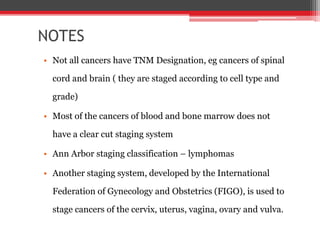
NOTES
• Not all cancers have TNM Designation, eg cancers of spinal
cord and brain ( they are staged according to cell type and
grade)
• Most of the cancers of blood and bone marrow does not
have a clear cut staging system
• Ann Arbor staging classification – lymphomas
• Another staging system, developed by the International
Federation of Gynecology and Obstetrics (FIGO), is used to
stage cancers of the cervix, uterus, vagina, ovary and vulva.
PARANEOPLASTIC
SYNDROME
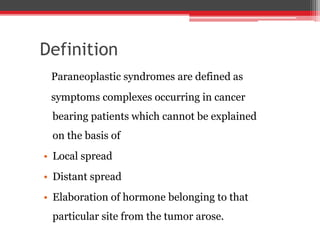
Definition
Paraneoplastic syndromes are defined as
symptoms complexes occurring in cancer
bearing patients which cannot be explained
on the basis of
• Local spread
• Distant spread
• Elaboration of hormone belonging to that
particular site from the tumor arose.
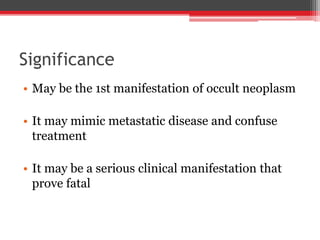
Significance
• May be the 1st manifestation of occult neoplasm
• It may mimic metastatic disease and confuse
treatment
• It may be a serious clinical manifestation that
prove fatal
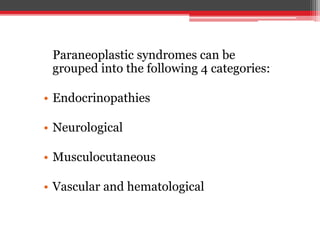
Paraneoplastic syndromes can be
grouped into the following 4 categories:
• Endocrinopathies
• Neurological
• Musculocutaneous
• Vascular and hematological
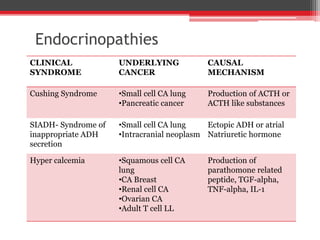
Endocrinopathies
CLINICAL
SYNDROME
UNDERLYING
CANCER
CAUSAL
MECHANISM
Cushing Syndrome •Small cell CA lung
•Pancreatic cancer
Production of ACTH or
ACTH like substances
SIADH- Syndrome of
inappropriate ADH
secretion
•Small cell CA lung
•Intracranial neoplasm
Ectopic ADH or atrial
Natriuretic hormone
Hyper calcemia •Squamous cell CA
lung
•CA Breast
•Renal cell CA
•Ovarian CA
•Adult T cell LL
Production of
parathomone related
peptide, TGF-alpha,
TNF-alpha, IL-1
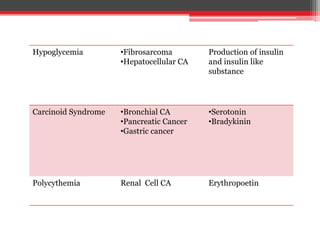
Hypoglycemia •Fibrosarcoma
•Hepatocellular CA
Production of insulin
and insulin like
substance
Carcinoid Syndrome •Bronchial CA
•Pancreatic Cancer
•Gastric cancer
•Serotonin
•Bradykinin
Polycythemia Renal Cell CA Erythropoetin
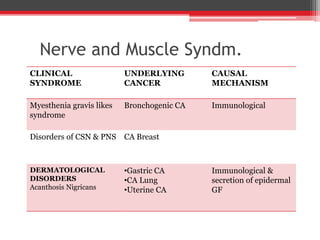
Nerve and Muscle Syndm.
CLINICAL
SYNDROME
UNDERLYING
CANCER
CAUSAL
MECHANISM
Myesthenia gravis likes
syndrome
Bronchogenic CA Immunological
Disorders of CSN & PNS CA Breast
DERMATOLOGICAL
DISORDERS
Acanthosis Nigricans
•Gastric CA
•CA Lung
•Uterine CA
Immunological &
secretion of epidermal
GF
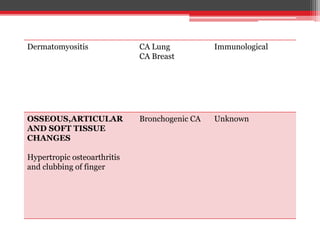
Dermatomyositis CA Lung
CA Breast
Immunological
OSSEOUS,ARTICULAR
AND SOFT TISSUE
CHANGES
Hypertropic osteoarthritis
and clubbing of finger
Bronchogenic CA Unknown
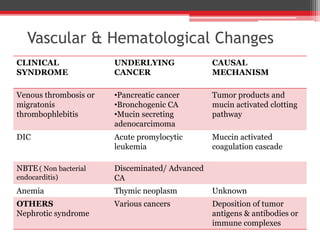
Vascular & Hematological Changes
CLINICAL
SYNDROME
UNDERLYING
CANCER
CAUSAL
MECHANISM
Venous thrombosis or
migratonis
thrombophlebitis
•Pancreatic cancer
•Bronchogenic CA
•Mucin secreting
adenocarcimoma
Tumor products and
mucin activated clotting
pathway
DIC Acute promylocytic
leukemia
Muccin activated
coagulation cascade
NBTE( Non bacterial
endocarditis)
Disceminated/ Advanced
CA
Anemia Thymic neoplasm Unknown
OTHERS
Nephrotic syndrome
Various cancers Deposition of tumor
antigens & antibodies or
immune complexes
References
• Class Notes
• Robbins and Cotran- pathology textbook
• Internet
• Wikipedia
Thank you

Grading and staging of tumors and paraneoplastic syndrome

  • 1.
    GRADING AND STAGINGOF TUMORS & PARANEOPLASTIC SYNDROME Shiksha Choytoo Roll No. 12 22 September 2014
  • 2.
    Introduction Grading and stagingare systems developed to quantify the extent of a neoplasm in a given case and its clinical aggressiveness and to compare the end results of various treatment modalities.
  • 3.
  • 4.
    Grading • It isdone on two basis: 1. level of differentiation 2. Number of mitotic figures per high power field • It is done by histopathological exam. By pathologist.
  • 5.
    Differentiation • It isthe extent to which the tumor cells represent their normal counter part both morphologically and functionally. • Lack of differentiation is anaplasia.
  • 6.
    Mitotic Figure perHPF • Cell under mitosis are easy to spot • The chromosomes are visible as tangled, dark- staining threads. • We call these “mitotic figures”. • Helps in grading of tumor.
  • 7.
    • The malignancyof tumor can be graded into 4 categories. • Recommended by the American Joint commission on Cancers and other bodies
  • 8.
    GRADES DESCRIPTION GX Gradecannot be assessed G1 Well differentiated (Low grade) G2 Moderately differentiated (Intermediate grade) G3 Poorly differentiated (High grade) G4 Undifferentiated (High grade- ANAPLASIA)
  • 9.
  • 10.
    Grading of CAProstate
  • 11.
  • 12.
  • 13.
    • It isbased on 1. Tumor size and/or extent reached 2. Lymph node status 3. presence or absence of metastasis • It is done by detailed clinical examination, usually along with radiological exam. (x- ray, CT scan, MRI, Ultrasonography) • Sometimes surgical exploration may be required.
  • 14.
    • There aretwo systems of staging 1. Union for international cancer control (UICC) The TNM system 2. American Joint Committee on Cancer (AJCC) • Most medical facilities use the TNM system as their main method for cancer reporting.
  • 15.
    TNM System T •TUMOR SIZE N • NODAL STATUS M • +/- METASTASIS
  • 16.
    Tumor size TUMOR (T)DESCRIPTION TX Primary tumor cannot be evaluated T0 No evidence of primary tumor Tis Carcinoma in situ T1 Tumor < 2cm T2 Tumor 2-5cm T3 Tumor > 5cm
  • 17.
  • 18.
    • NOTE CA insitu abnormal cells are present but have not spread to neighbouring tissue; although not cancer, CIS may become cancer sometimes called preinvasive cancer
  • 19.
    Lymph Node Status LYMPHNOTE STATUS (N) DESCRIPTION NX Regional lymph nodes cannot be evaluated N0 No regional lymph node involvement N1 3 Lymph nodes + Axillary N2 10 Lymph nodes+
  • 20.
    Distant Metastasis (+/-) METASTASISDESCRIPTION MX Distant metastasis cannot be evaluated M0 No distant metastasis M1 Distant metastasis is present
  • 21.
  • 22.
    System based onAJCC STAGE DESCRIPTION Stage 0 Carcinoma in situ Stage I Stage II Stage III Higher numbers indicate more extensive disease: Larger tumor size and/or spread of the cancer beyond the organ in which it first developed to nearby lymph nodes and/or tissues or organs adjacent to the location of the primary tumor Stage IV The cancer has spread to distant tissues or organs
  • 23.
    Importance of gradingand staging • Helps the doctor plan the appropriate treatment • Estimates patients’ prognosis trials and comparing the results of different trials. • Helps health care providers and researchers exchange information about patients. • It also gives them a common terminology for evaluating the results various treatments
  • 24.
    NOTES • Not allcancers have TNM Designation, eg cancers of spinal cord and brain ( they are staged according to cell type and grade) • Most of the cancers of blood and bone marrow does not have a clear cut staging system • Ann Arbor staging classification – lymphomas • Another staging system, developed by the International Federation of Gynecology and Obstetrics (FIGO), is used to stage cancers of the cervix, uterus, vagina, ovary and vulva.
  • 25.
  • 26.
    Definition Paraneoplastic syndromes aredefined as symptoms complexes occurring in cancer bearing patients which cannot be explained on the basis of • Local spread • Distant spread • Elaboration of hormone belonging to that particular site from the tumor arose.
  • 27.
    Significance • May bethe 1st manifestation of occult neoplasm • It may mimic metastatic disease and confuse treatment • It may be a serious clinical manifestation that prove fatal
  • 28.
    Paraneoplastic syndromes canbe grouped into the following 4 categories: • Endocrinopathies • Neurological • Musculocutaneous • Vascular and hematological
  • 29.
    Endocrinopathies CLINICAL SYNDROME UNDERLYING CANCER CAUSAL MECHANISM Cushing Syndrome •Smallcell CA lung •Pancreatic cancer Production of ACTH or ACTH like substances SIADH- Syndrome of inappropriate ADH secretion •Small cell CA lung •Intracranial neoplasm Ectopic ADH or atrial Natriuretic hormone Hyper calcemia •Squamous cell CA lung •CA Breast •Renal cell CA •Ovarian CA •Adult T cell LL Production of parathomone related peptide, TGF-alpha, TNF-alpha, IL-1
  • 30.
    Hypoglycemia •Fibrosarcoma •Hepatocellular CA Productionof insulin and insulin like substance Carcinoid Syndrome •Bronchial CA •Pancreatic Cancer •Gastric cancer •Serotonin •Bradykinin Polycythemia Renal Cell CA Erythropoetin
  • 31.
    Nerve and MuscleSyndm. CLINICAL SYNDROME UNDERLYING CANCER CAUSAL MECHANISM Myesthenia gravis likes syndrome Bronchogenic CA Immunological Disorders of CSN & PNS CA Breast DERMATOLOGICAL DISORDERS Acanthosis Nigricans •Gastric CA •CA Lung •Uterine CA Immunological & secretion of epidermal GF
  • 32.
    Dermatomyositis CA Lung CABreast Immunological OSSEOUS,ARTICULAR AND SOFT TISSUE CHANGES Hypertropic osteoarthritis and clubbing of finger Bronchogenic CA Unknown
  • 33.
    Vascular & HematologicalChanges CLINICAL SYNDROME UNDERLYING CANCER CAUSAL MECHANISM Venous thrombosis or migratonis thrombophlebitis •Pancreatic cancer •Bronchogenic CA •Mucin secreting adenocarcimoma Tumor products and mucin activated clotting pathway DIC Acute promylocytic leukemia Muccin activated coagulation cascade NBTE( Non bacterial endocarditis) Disceminated/ Advanced CA Anemia Thymic neoplasm Unknown OTHERS Nephrotic syndrome Various cancers Deposition of tumor antigens & antibodies or immune complexes
  • 34.
    References • Class Notes •Robbins and Cotran- pathology textbook • Internet • Wikipedia
  • 35.