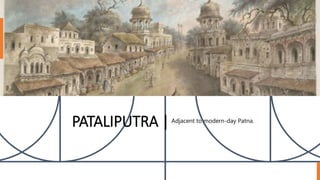
PATALIPUTRA |Adjacent to modern-day Patna.
LOCATION
• Its central location in north eastern India led rulers of successive dynasties to base their
administrative capital here, from the Nandas, Mauryans, Shungas and the Guptas.
• The city is situated at the confluence of the Ganges, Gandhaka and Son rivers, Pataliputra formed a
"water fort, or jaldurga".
• Its position helped it dominate the riverine trade of the Indo-Gangetic plains during Magadha's early
imperial period. It was a great centre of trade and commerce.
LOCATION
• Its central location in north eastern
india led rulers of successive dynasties to
base their administrative capital here,
from
the nandas, mauryans, shungas and
the guptas.
• The city is situated at the confluence of
the ganges, gandhaka and son rivers,
pataliputra formed a "water fort,
or jaldurga".
• Its position helped it dominate the
riverine trade of the indo-gangetic
plains during magadha's early imperial
period. It was a great centre of trade and
commerce.
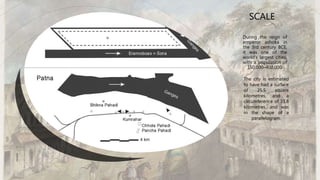
During the reign of
emperor ashoka in
the 3rd century BCE,
it was one of the
world's largest cities,
with a population of
150,000–400,000.
SCALE
The city is estimated
to have had a surface
of 25.5 square
kilometres, and a
circumference of 33.8
kilometres, and was
in the shape of a
parallelogram.
FORTIFICATION
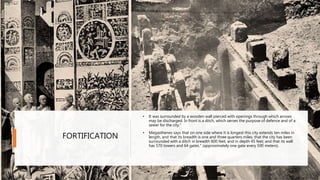
• It was surrounded by a wooden wall pierced with openings through which arrows
may be discharged. In front is a ditch, which serves the purpose of defence and of a
sewer for the city.“
• Megasthenes says that on one side where it is longest this city extends ten miles in
length, and that its breadth is one and three quarters miles; that the city has been
surrounded with a ditch in breadth 600 feet, and in depth 45 feet; and that its wall
has 570 towers and 64 gates." (approximately one gate every 500 meters).
• FORTIFICATION
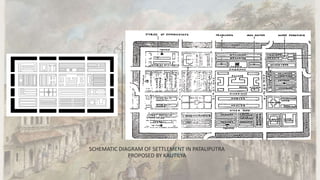
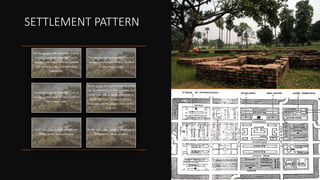
SCHEMATIC DIAGRAM OF SETTLEMENT IN PATALIPUTRA
PROPOSED BY KAUTILYA
SETTLEMENT PATTERN
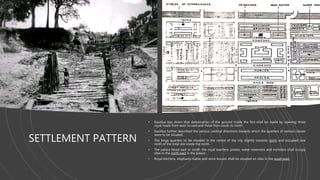
• Kautilya lays down that demarcation of the ground inside the fort shall be made by opening three
royal roads from west to east and three from south to north.
• Kautilya further described the various cardinal directions towards which the quarters of various classes
were to be situated.
• The kings quarters to be situated in the centre of the city slightly towards north and occupied one
ninth of the total site inside the north.
• The palace faced east or north .the royal teachers, priests, water reservoirs and ministers shall occupy
sites in the north east in the palace.
• Royal kitchens, elephants stable and store houses shall be situated on sites in the south east.
SETTLEMENT PATTERN
On the eastern side, merchants trading
in scents, garlands, grain and liquids,
together with expert artist and people
with kshatriya class shall have their
habitations.
The treasury and accountant office and
various manufactories shall be situated
on sites in south east.
The store houses of the forest produce
and the arsenal shall be constructed on
site in south west .
To the south, the superintendents of the
city, of commerce, of manufactories, and
of army as well as those who trade in
liquor and flesh, besides prostitutes,
musicians and the people of the vaishya
caste live.
To the south west shall be stable for
asses, camels and workshops.
To the north west stable of conveyances
and chariots will be situated.
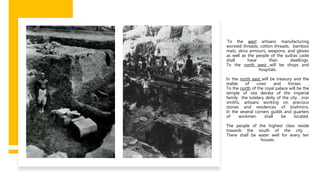
To the west artisans manufacturing
worsted threads, cotton threads, bamboo
mats, skins armours, weapons, and gloves
as well as the people of the sudras caste
shall have their dwellings.
To the north west will be shops and
hospitals.
In the north east will be treasury and the
stable of cows and horses .
To the north of the royal palace will be the
temple of ista devata of the imperial
family the tutelary deity of the city , iron
smiths, artisans working on precious
stones and residences of brahmins.
In the several corners guilds and quarters
of workmen shall be located.
The people of the highest class reside
towards the south of the city .
There shall be water well for every ten
houses.
Pataliputra

Pataliputra

  • 1.
    PATALIPUTRA |Adjacent tomodern-day Patna.
  • 2.
    LOCATION • Its centrallocation in north eastern India led rulers of successive dynasties to base their administrative capital here, from the Nandas, Mauryans, Shungas and the Guptas. • The city is situated at the confluence of the Ganges, Gandhaka and Son rivers, Pataliputra formed a "water fort, or jaldurga". • Its position helped it dominate the riverine trade of the Indo-Gangetic plains during Magadha's early imperial period. It was a great centre of trade and commerce.
  • 3.
    LOCATION • Its centrallocation in north eastern india led rulers of successive dynasties to base their administrative capital here, from the nandas, mauryans, shungas and the guptas. • The city is situated at the confluence of the ganges, gandhaka and son rivers, pataliputra formed a "water fort, or jaldurga". • Its position helped it dominate the riverine trade of the indo-gangetic plains during magadha's early imperial period. It was a great centre of trade and commerce.
  • 4.
    During the reignof emperor ashoka in the 3rd century BCE, it was one of the world's largest cities, with a population of 150,000–400,000. SCALE The city is estimated to have had a surface of 25.5 square kilometres, and a circumference of 33.8 kilometres, and was in the shape of a parallelogram.
  • 5.
    FORTIFICATION • It wassurrounded by a wooden wall pierced with openings through which arrows may be discharged. In front is a ditch, which serves the purpose of defence and of a sewer for the city.“ • Megasthenes says that on one side where it is longest this city extends ten miles in length, and that its breadth is one and three quarters miles; that the city has been surrounded with a ditch in breadth 600 feet, and in depth 45 feet; and that its wall has 570 towers and 64 gates." (approximately one gate every 500 meters). • FORTIFICATION
  • 6.
    SCHEMATIC DIAGRAM OFSETTLEMENT IN PATALIPUTRA PROPOSED BY KAUTILYA
  • 7.
    SETTLEMENT PATTERN • Kautilyalays down that demarcation of the ground inside the fort shall be made by opening three royal roads from west to east and three from south to north. • Kautilya further described the various cardinal directions towards which the quarters of various classes were to be situated. • The kings quarters to be situated in the centre of the city slightly towards north and occupied one ninth of the total site inside the north. • The palace faced east or north .the royal teachers, priests, water reservoirs and ministers shall occupy sites in the north east in the palace. • Royal kitchens, elephants stable and store houses shall be situated on sites in the south east.
  • 8.
    SETTLEMENT PATTERN On theeastern side, merchants trading in scents, garlands, grain and liquids, together with expert artist and people with kshatriya class shall have their habitations. The treasury and accountant office and various manufactories shall be situated on sites in south east. The store houses of the forest produce and the arsenal shall be constructed on site in south west . To the south, the superintendents of the city, of commerce, of manufactories, and of army as well as those who trade in liquor and flesh, besides prostitutes, musicians and the people of the vaishya caste live. To the south west shall be stable for asses, camels and workshops. To the north west stable of conveyances and chariots will be situated.
  • 9.
    To the westartisans manufacturing worsted threads, cotton threads, bamboo mats, skins armours, weapons, and gloves as well as the people of the sudras caste shall have their dwellings. To the north west will be shops and hospitals. In the north east will be treasury and the stable of cows and horses . To the north of the royal palace will be the temple of ista devata of the imperial family the tutelary deity of the city , iron smiths, artisans working on precious stones and residences of brahmins. In the several corners guilds and quarters of workmen shall be located. The people of the highest class reside towards the south of the city . There shall be water well for every ten houses.