PASSIVE VOICE
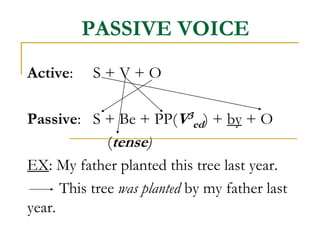
Active: S + V + O
Passive: S + Be + PP(V3
ed) + by + O
(tense)
EX: My father planted this tree last year.
This tree was planted by my father last
year.
TABLE OF ENGLISH TENSES
IN PASSIVE VOICE
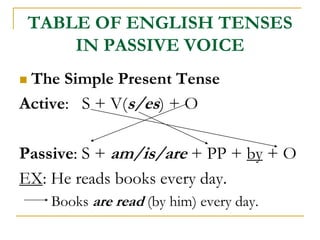
 The Simple Present Tense
Active: S + V(s/es) + O
Passive: S + am/is/are + PP + by + O
EX: He reads books every day.
Books are read (by him) every day.
TABLE OF ENGLISH TENSES
IN PASSIVE VOICE
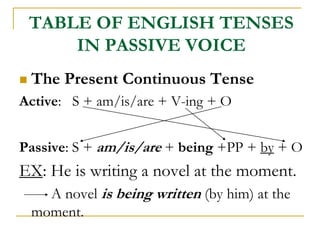
 The Present Continuous Tense
Active: S + am/is/are + V-ing + O
Passive: S + am/is/are + being +PP + by + O
EX: He is writing a novel at the moment.
A novel is being written (by him) at the
moment.
TABLE OF ENGLISH TENSES
IN PASSIVE VOICE
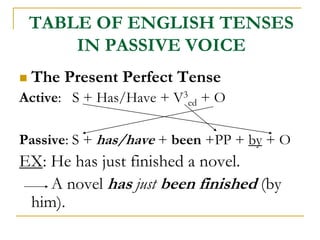
 The Present Perfect Tense
Active: S + Has/Have + V3
ed + O
Passive: S + has/have + been +PP + by + O
EX: He has just finished a novel.
A novel has just been finished (by
him).
TABLE OF ENGLISH TENSES
IN PASSIVE VOICE
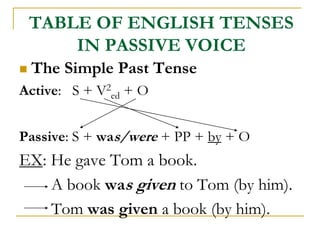
 The Simple Past Tense
Active: S + V2
ed + O
Passive: S + was/were + PP + by + O
EX: He gave Tom a book.
A book was given to Tom (by him).
Tom was given a book (by him).
TABLE OF ENGLISH TENSES
IN PASSIVE VOICE
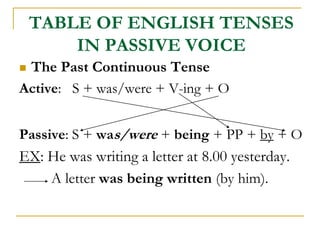
 The Past Continuous Tense
Active: S + was/were + V-ing + O
Passive: S + was/were + being + PP + by + O
EX: He was writing a letter at 8.00 yesterday.
A letter was being written (by him).
TABLE OF ENGLISH TENSES
IN PASSIVE VOICE
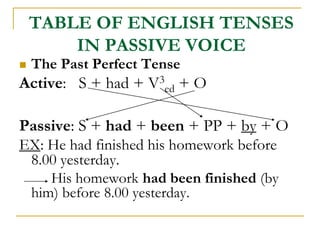
 The Past Perfect Tense
Active: S + had + V3
ed + O
Passive: S + had + been + PP + by + O
EX: He had finished his homework before
8.00 yesterday.
His homework had been finished (by
him) before 8.00 yesterday.
TABLE OF ENGLISH TENSES
IN PASSIVE VOICE
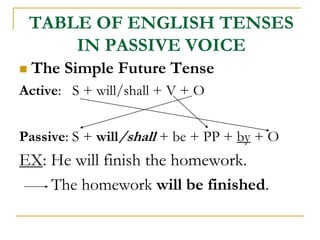
 The Simple Future Tense
Active: S + will/shall + V + O
Passive: S + will/shall + be + PP + by + O
EX: He will finish the homework.
The homework will be finished.
TABLE OF ENGLISH TENSES
IN PASSIVE VOICE
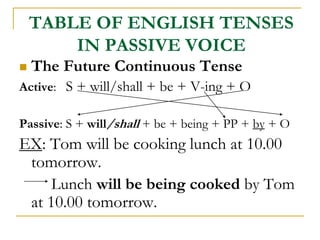
 The Future Continuous Tense
Active: S + will/shall + be + V-ing + O
Passive: S + will/shall + be + being + PP + by + O
EX: Tom will be cooking lunch at 10.00
tomorrow.
Lunch will be being cooked by Tom
at 10.00 tomorrow.
TABLE OF ENGLISH TENSES
IN PASSIVE VOICE
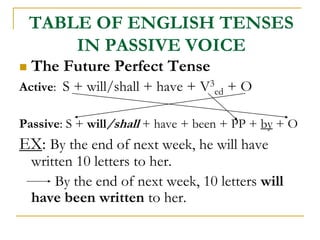
 The Future Perfect Tense
Active: S + will/shall + have + V3
ed + O
Passive: S + will/shall + have + been + PP + by + O
EX: By the end of next week, he will have
written 10 letters to her.
By the end of next week, 10 letters will
have been written to her.
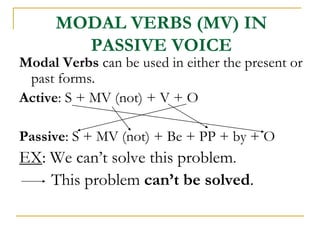
MODAL VERBS (MV) IN
PASSIVE VOICE
Modal Verbs can be used in either the present or
past forms.
Active: S + MV (not) + V + O
Passive: S + MV (not) + Be + PP + by + O
EX: We can’t solve this problem.
This problem can’t be solved.
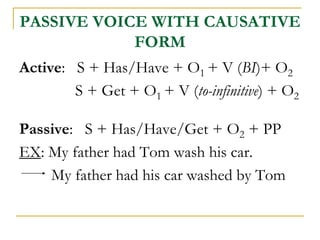
PASSIVE VOICE WITH CAUSATIVE
FORM
Active: S + Has/Have + O1 + V (BI)+ O2
S + Get + O1 + V (to-infinitive) + O2
Passive: S + Has/Have/Get + O2 + PP
EX: My father had Tom wash his car.
My father had his car washed by Tom
OTHER INFINITIVE
COMBINATIONS IN PASSIVE
VOICE
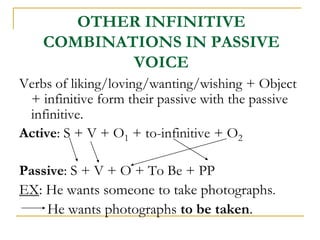
Verbs of liking/loving/wanting/wishing + Object
+ infinitive form their passive with the passive
infinitive.
Active: S + V + O1 + to-infinitive + O2
Passive: S + V + O + To Be + PP
EX: He wants someone to take photographs.
He wants photographs to be taken.
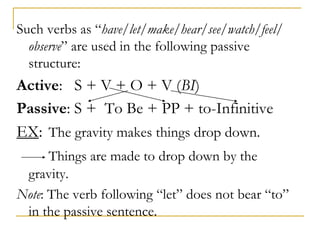
Such verbs as “have/let/make/hear/see/watch/feel/
observe” are used in the following passive
structure:
Active: S + V + O + V (BI)
Passive: S + To Be + PP + to-Infinitive
EX: The gravity makes things drop down.
Things are made to drop down by the
gravity.
Note: The verb following “let” does not bear “to”
in the passive sentence.
OTHER INFINITIVE
COMBINATIONS IN PASSIVE
VOICE
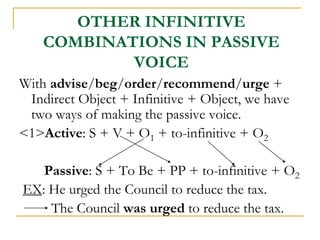
With advise/beg/order/recommend/urge +
Indirect Object + Infinitive + Object, we have
two ways of making the passive voice.
<1>Active: S + V + O1 + to-infinitive + O2
Passive: S + To Be + PP + to-infinitive + O2
EX: He urged the Council to reduce the tax.
The Council was urged to reduce the tax.
OTHER INFINITIVE
COMBINATIONS IN PASSIVE
VOICE
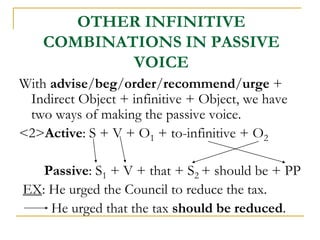
With advise/beg/order/recommend/urge +
Indirect Object + infinitive + Object, we have
two ways of making the passive voice.
<2>Active: S + V + O1 + to-infinitive + O2
Passive: S1 + V + that + S2 + should be + PP
EX: He urged the Council to reduce the tax.
He urged that the tax should be reduced.
OTHER INFINITIVE
COMBINATIONS AFTER THE
PASSIVE VERB
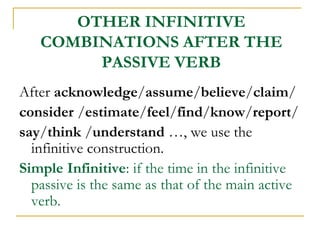
After acknowledge/assume/believe/claim/
consider /estimate/feel/find/know/report/
say/think /understand …, we use the
infinitive construction.
Simple Infinitive: if the time in the infinitive
passive is the same as that of the main active
verb.
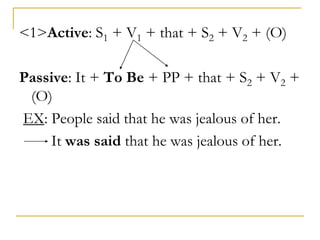
<1>Active: S1 + V1 + that + S2 + V2 + (O)
Passive: It + To Be + PP + that + S2 + V2 +
(O)
EX: People said that he was jealous of her.
It was said that he was jealous of her.
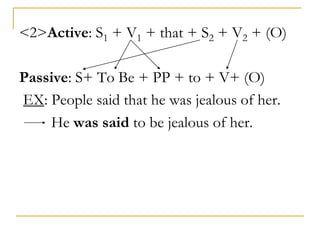
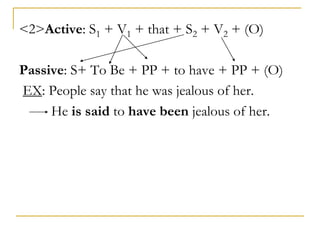
<2>Active: S1 + V1 + that + S2 + V2 + (O)
Passive: S+ To Be + PP + to + V+ (O)
EX: People said that he was jealous of her.
He was said to be jealous of her.
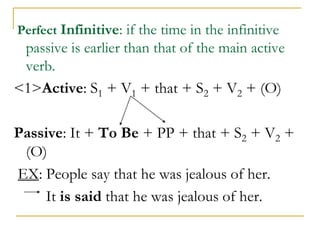
Perfect Infinitive: if the time in the infinitive
passive is earlier than that of the main active
verb.
<1>Active: S1 + V1 + that + S2 + V2 + (O)
Passive: It + To Be + PP + that + S2 + V2 +
(O)
EX: People say that he was jealous of her.
It is said that he was jealous of her.
<2>Active: S1 + V1 + that + S2 + V2 + (O)
Passive: S+ To Be + PP + to have + PP + (O)
EX: People say that he was jealous of her.
He is said to have been jealous of her.
OTHER GERUND
COMBINATIONS IN PASSIVE
VOICE
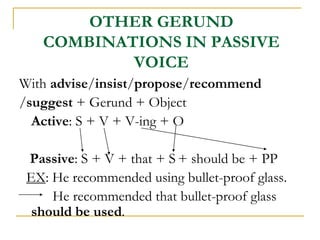
With advise/insist/propose/recommend
/suggest + Gerund + Object
Active: S + V + V-ing + O
Passive: S + V + that + S + should be + PP
EX: He recommended using bullet-proof glass.
He recommended that bullet-proof glass
should be used.
OTHER GERUND
COMBINATIONS IN PASSIVE
VOICE
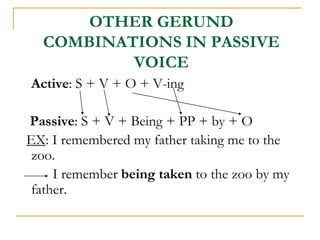
Active: S + V + O + V-ing
Passive: S + V + Being + PP + by + O
EX: I remembered my father taking me to the
zoo.
I remember being taken to the zoo by my
father.
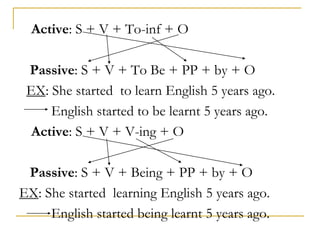
Active: S + V + To-inf + O
Passive: S + V + To Be + PP + by + O
EX: She started to learn English 5 years ago.
English started to be learnt 5 years ago.
Active: S + V + V-ing + O
Passive: S + V + Being + PP + by + O
EX: She started learning English 5 years ago.
English started being learnt 5 years ago.

Passive Voice

  • 1.
    PASSIVE VOICE Active: S+ V + O Passive: S + Be + PP(V3 ed) + by + O (tense) EX: My father planted this tree last year. This tree was planted by my father last year.
  • 2.
    TABLE OF ENGLISHTENSES IN PASSIVE VOICE  The Simple Present Tense Active: S + V(s/es) + O Passive: S + am/is/are + PP + by + O EX: He reads books every day. Books are read (by him) every day.
  • 3.
    TABLE OF ENGLISHTENSES IN PASSIVE VOICE  The Present Continuous Tense Active: S + am/is/are + V-ing + O Passive: S + am/is/are + being +PP + by + O EX: He is writing a novel at the moment. A novel is being written (by him) at the moment.
  • 4.
    TABLE OF ENGLISHTENSES IN PASSIVE VOICE  The Present Perfect Tense Active: S + Has/Have + V3 ed + O Passive: S + has/have + been +PP + by + O EX: He has just finished a novel. A novel has just been finished (by him).
  • 5.
    TABLE OF ENGLISHTENSES IN PASSIVE VOICE  The Simple Past Tense Active: S + V2 ed + O Passive: S + was/were + PP + by + O EX: He gave Tom a book. A book was given to Tom (by him). Tom was given a book (by him).
  • 6.
    TABLE OF ENGLISHTENSES IN PASSIVE VOICE  The Past Continuous Tense Active: S + was/were + V-ing + O Passive: S + was/were + being + PP + by + O EX: He was writing a letter at 8.00 yesterday. A letter was being written (by him).
  • 7.
    TABLE OF ENGLISHTENSES IN PASSIVE VOICE  The Past Perfect Tense Active: S + had + V3 ed + O Passive: S + had + been + PP + by + O EX: He had finished his homework before 8.00 yesterday. His homework had been finished (by him) before 8.00 yesterday.
  • 8.
    TABLE OF ENGLISHTENSES IN PASSIVE VOICE  The Simple Future Tense Active: S + will/shall + V + O Passive: S + will/shall + be + PP + by + O EX: He will finish the homework. The homework will be finished.
  • 9.
    TABLE OF ENGLISHTENSES IN PASSIVE VOICE  The Future Continuous Tense Active: S + will/shall + be + V-ing + O Passive: S + will/shall + be + being + PP + by + O EX: Tom will be cooking lunch at 10.00 tomorrow. Lunch will be being cooked by Tom at 10.00 tomorrow.
  • 10.
    TABLE OF ENGLISHTENSES IN PASSIVE VOICE  The Future Perfect Tense Active: S + will/shall + have + V3 ed + O Passive: S + will/shall + have + been + PP + by + O EX: By the end of next week, he will have written 10 letters to her. By the end of next week, 10 letters will have been written to her.
  • 11.
    MODAL VERBS (MV)IN PASSIVE VOICE Modal Verbs can be used in either the present or past forms. Active: S + MV (not) + V + O Passive: S + MV (not) + Be + PP + by + O EX: We can’t solve this problem. This problem can’t be solved.
  • 12.
    PASSIVE VOICE WITHCAUSATIVE FORM Active: S + Has/Have + O1 + V (BI)+ O2 S + Get + O1 + V (to-infinitive) + O2 Passive: S + Has/Have/Get + O2 + PP EX: My father had Tom wash his car. My father had his car washed by Tom
  • 13.
    OTHER INFINITIVE COMBINATIONS INPASSIVE VOICE Verbs of liking/loving/wanting/wishing + Object + infinitive form their passive with the passive infinitive. Active: S + V + O1 + to-infinitive + O2 Passive: S + V + O + To Be + PP EX: He wants someone to take photographs. He wants photographs to be taken.
  • 14.
    Such verbs as“have/let/make/hear/see/watch/feel/ observe” are used in the following passive structure: Active: S + V + O + V (BI) Passive: S + To Be + PP + to-Infinitive EX: The gravity makes things drop down. Things are made to drop down by the gravity. Note: The verb following “let” does not bear “to” in the passive sentence.
  • 15.
    OTHER INFINITIVE COMBINATIONS INPASSIVE VOICE With advise/beg/order/recommend/urge + Indirect Object + Infinitive + Object, we have two ways of making the passive voice. <1>Active: S + V + O1 + to-infinitive + O2 Passive: S + To Be + PP + to-infinitive + O2 EX: He urged the Council to reduce the tax. The Council was urged to reduce the tax.
  • 16.
    OTHER INFINITIVE COMBINATIONS INPASSIVE VOICE With advise/beg/order/recommend/urge + Indirect Object + infinitive + Object, we have two ways of making the passive voice. <2>Active: S + V + O1 + to-infinitive + O2 Passive: S1 + V + that + S2 + should be + PP EX: He urged the Council to reduce the tax. He urged that the tax should be reduced.
  • 17.
    OTHER INFINITIVE COMBINATIONS AFTERTHE PASSIVE VERB After acknowledge/assume/believe/claim/ consider /estimate/feel/find/know/report/ say/think /understand …, we use the infinitive construction. Simple Infinitive: if the time in the infinitive passive is the same as that of the main active verb.
  • 18.
    <1>Active: S1 +V1 + that + S2 + V2 + (O) Passive: It + To Be + PP + that + S2 + V2 + (O) EX: People said that he was jealous of her. It was said that he was jealous of her.
  • 19.
    <2>Active: S1 +V1 + that + S2 + V2 + (O) Passive: S+ To Be + PP + to + V+ (O) EX: People said that he was jealous of her. He was said to be jealous of her.
  • 20.
    Perfect Infinitive: ifthe time in the infinitive passive is earlier than that of the main active verb. <1>Active: S1 + V1 + that + S2 + V2 + (O) Passive: It + To Be + PP + that + S2 + V2 + (O) EX: People say that he was jealous of her. It is said that he was jealous of her.
  • 21.
    <2>Active: S1 +V1 + that + S2 + V2 + (O) Passive: S+ To Be + PP + to have + PP + (O) EX: People say that he was jealous of her. He is said to have been jealous of her.
  • 22.
    OTHER GERUND COMBINATIONS INPASSIVE VOICE With advise/insist/propose/recommend /suggest + Gerund + Object Active: S + V + V-ing + O Passive: S + V + that + S + should be + PP EX: He recommended using bullet-proof glass. He recommended that bullet-proof glass should be used.
  • 23.
    OTHER GERUND COMBINATIONS INPASSIVE VOICE Active: S + V + O + V-ing Passive: S + V + Being + PP + by + O EX: I remembered my father taking me to the zoo. I remember being taken to the zoo by my father.
  • 24.
    Active: S +V + To-inf + O Passive: S + V + To Be + PP + by + O EX: She started to learn English 5 years ago. English started to be learnt 5 years ago. Active: S + V + V-ing + O Passive: S + V + Being + PP + by + O EX: She started learning English 5 years ago. English started being learnt 5 years ago.