K c college of engineering & management studies
& Research ,Kopri, Thane (E)
Password Based Encryption
Decryption in Android
Jainil sharma
Aakanksha singh
Madhavi soni
Sachin tripathi
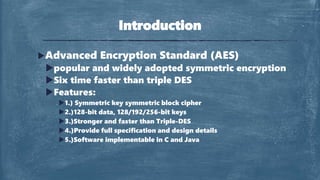
Advanced Encryption Standard (AES)
popular and widely adopted symmetric encryption
Six time faster than triple DES
Features:
1.) Symmetric key symmetric block cipher
2.)128-bit data, 128/192/256-bit keys
3.)Stronger and faster than Triple-DES
4.)Provide full specification and design details
5.)Software implementable in C and Java
Introduction
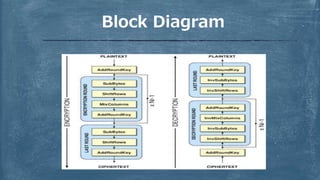
Encryption & Decryption
 Encryption Process
 Byte Substitution
 Shift rows
 Mix columns
 Add Round key
 Decryption Process
 Add round key
 Mix columns
 Shift rows
 Byte substitution
AES Operations
 An iterative rather than
Feistel cipher.
 Based on ‘substitution–
permutation network’.
 AES uses 10 rounds for 128-
bit keys, 12 rounds for 192-
bit keys and 14 rounds for
256-bit keys.
 series of linked operations:
 replacing inputs by specific
outputs (substitutions).
 involve shuffling bits around
(permutations).
Proposed System Algorithm's :
Initiate a Connection
The Key Generation Process
The XoR Encryption Process
Index Generator Table Shifting
The Index Generation Process
The Key Insertion Process
Sending Packets
The Key Extracting Process
The Decryption Process
Proposed System
Block Diagram
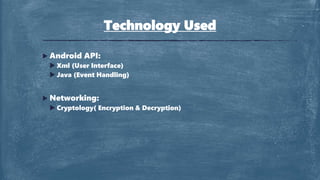
 Android API:
 Xml (User Interface)
 Java (Event Handling)
 Networking:
 Cryptology( Encryption & Decryption)
Technology Used
User Interface
 Voice Communications
 Network Appliances
 Virtual Private Network (VPN)
 Secure Socket Layer (SSL)
Application
 Nowadays, the networks have gone global and information
has taken the digital form of bits and bytes. Critical
information now gets stored, processed and transmitted in
digital form on computer systems and open communication
channels.
 Since information plays such a vital role, adversaries are
targeting the computer systems and open communication
channels to either steal the sensitive information or to disrupt
the critical information system.
 Modern cryptography provides a robust set of techniques to
ensure that the malevolent intentions of the adversary are
thwarted while ensuring the legitimate users get access to
information. Here in this chapter, we will discuss the benefits
that we draw from cryptography, its limitations, as well as the
future of cryptography.
Conclusion

Password based encryption

  • 1.
    K c collegeof engineering & management studies & Research ,Kopri, Thane (E) Password Based Encryption Decryption in Android Jainil sharma Aakanksha singh Madhavi soni Sachin tripathi
  • 2.
    Advanced Encryption Standard(AES) popular and widely adopted symmetric encryption Six time faster than triple DES Features: 1.) Symmetric key symmetric block cipher 2.)128-bit data, 128/192/256-bit keys 3.)Stronger and faster than Triple-DES 4.)Provide full specification and design details 5.)Software implementable in C and Java Introduction
  • 3.
    Encryption & Decryption Encryption Process  Byte Substitution  Shift rows  Mix columns  Add Round key  Decryption Process  Add round key  Mix columns  Shift rows  Byte substitution
  • 4.
    AES Operations  Aniterative rather than Feistel cipher.  Based on ‘substitution– permutation network’.  AES uses 10 rounds for 128- bit keys, 12 rounds for 192- bit keys and 14 rounds for 256-bit keys.  series of linked operations:  replacing inputs by specific outputs (substitutions).  involve shuffling bits around (permutations).
  • 5.
    Proposed System Algorithm's: Initiate a Connection The Key Generation Process The XoR Encryption Process Index Generator Table Shifting The Index Generation Process The Key Insertion Process Sending Packets The Key Extracting Process The Decryption Process Proposed System
  • 6.
  • 7.
     Android API: Xml (User Interface)  Java (Event Handling)  Networking:  Cryptology( Encryption & Decryption) Technology Used
  • 8.
  • 9.
     Voice Communications Network Appliances  Virtual Private Network (VPN)  Secure Socket Layer (SSL) Application
  • 10.
     Nowadays, thenetworks have gone global and information has taken the digital form of bits and bytes. Critical information now gets stored, processed and transmitted in digital form on computer systems and open communication channels.  Since information plays such a vital role, adversaries are targeting the computer systems and open communication channels to either steal the sensitive information or to disrupt the critical information system.  Modern cryptography provides a robust set of techniques to ensure that the malevolent intentions of the adversary are thwarted while ensuring the legitimate users get access to information. Here in this chapter, we will discuss the benefits that we draw from cryptography, its limitations, as well as the future of cryptography. Conclusion